



Hydraulic Intensifiers Market
Hydraulic Intensifiers Market Size, Share, Insights, Competitive Landscape, and Forecast 2026 to 2033
Hydraulic Intensifiers Market Size and Trend Analysis
How Fast Will the Hydraulic Intensifiers Market Grow?
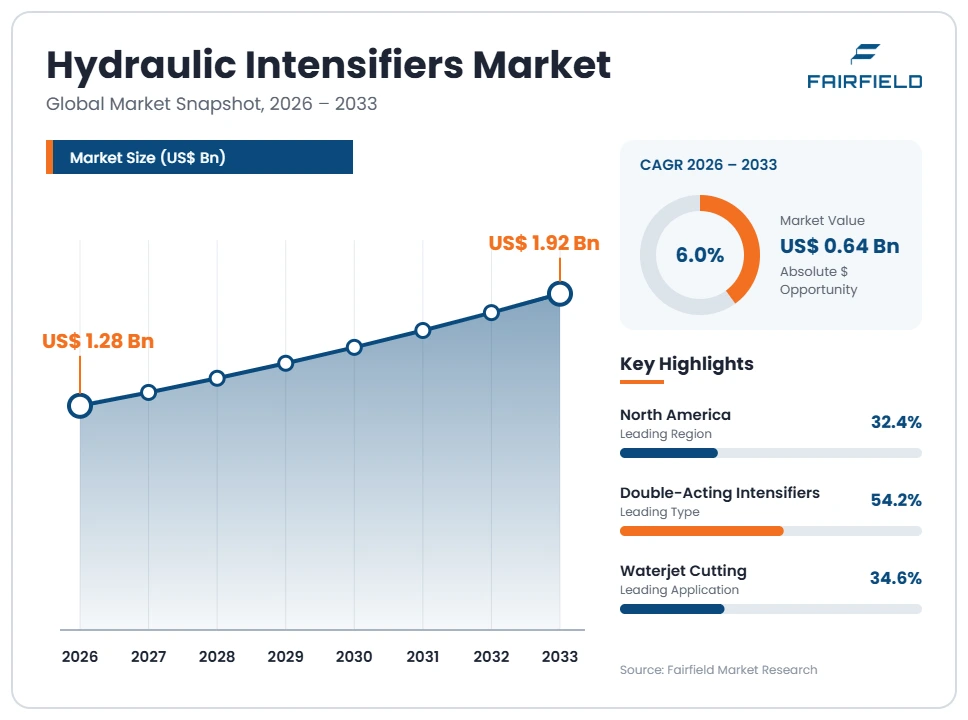
The global Hydraulic Intensifiers market size is expected to be valued at US$ 1.28 billion in 2026 and projected to reach US$ 1.92 billion by 2033, growing at a CAGR of 6.0% between 2026 and 2033. Growth rests on rising ultra-high-pressure waterjet cutting capacity, wider hydraulic clamping use in machine tools, and steady demand for pressure testing rigs. Buyers increasingly replace large pumps with compact intensifiers that raise localized pressure while cutting installed power. Energy efficiency rules, lighter vehicle structures and hydrogen component testing add further pull, keeping absolute dollar opportunity at US$ 640 million across the 2026 to 2033 forecast window.
Key Report Takeaways
- By Type: Double-acting intensifiers led with 54.2% share in 2026, while multi-stage intensifiers are projected to expand at a 7.4% CAGR through 2033, driven by continuous-duty ultra-high-pressure cutting heads needing steady flow.
- By Pressure Rating: 1,000–4,000 bar units led with 46.8% share in 2026, while the above 4,000 bar class is projected to expand at a 7.8% CAGR through 2033, driven by abrasive waterjet trimming of composite aerostructures.
- By Application: Waterjet cutting led with 34.6% share in 2026, while pressure testing and calibration is projected to expand at a 7.6% CAGR through 2033, driven by hydrogen storage qualification programmes demanding repeatable burst testing.
- By End-Use Industry: Metal fabrication and machinery led with 32.8% share in 2026, while aerospace and defence is projected to expand at a 7.9% CAGR through 2033, driven by rising titanium and composite machining work in airframe supply chains.
- By Region: North America led with 32.4% share in 2026 ahead of Europe, Asia Pacific, Latin America and Middle East & Africa, while Asia Pacific is projected to expand at a 7.6% CAGR through 2033, driven by new fabrication capacity.
Global Hydraulic Intensifiers Market Trends and Insights
Market Growth Drivers
Waterjet Cutting Capacity Keeps Pulling Intensifier Demand Higher
Abrasive waterjet cutting remains the single largest pull on hydraulic intensifier demand. Every ultra-high-pressure waterjet pump relies on a reciprocating intensifier to lift hydraulic pressure to the level a cutting orifice needs. As job shops add waterjet tables to cut titanium, glass and composite panels without heat damage, intensifier shipments climb. Spare seals, plungers and check valves create a durable aftermarket that outlives the machine sale.
Behind that demand sits a wider shift in metal fabrication toward flexible, low-heat cutting. Waterjet avoids the heat-affected zone that plasma and laser leave, which matters for aerospace alloys and hardened tool steels. Machine builders have responded with compact tables, five-axis cutting heads and quieter pump enclosures suited to small workshops. Simpler nesting software and better abrasive handling have widened the buyer base to regional fabricators.
Compact Intensifiers Cut Installed Power and System Cost
Hydraulic intensifiers let designers run a whole circuit at modest pressure and raise pressure only where it is needed. That removes the case for oversizing a central pump, reservoir and cooler for one clamping station. Smaller power units follow, which lowers installed motor power, fluid volume and heat rejection across the machine. For builders facing energy rules and tight floors, localized boosting is the cheapest route to higher force.
The trend tracks the move toward decentralized, electrified fluid power in industrial machinery. Compact screw-in and cartridge intensifiers now fit directly into manifolds, so retrofits need no new piping or control cabinet. Machine tool builders use them for workholding and press makers for final-stage tonnage. Suppliers have widened catalogues of standard ratios and leak-free designs, making specification a parts-list decision rather than an engineering project.
Market Restraints
Seal Wear and Maintenance Intensity Limit Uptake
Maintenance intensity is the clearest brake on hydraulic intensifier adoption. Reciprocating units work against very high differential pressure, so seals, plungers and check valves wear far faster than components in ordinary circuits. Plants running continuous shifts must schedule seal kits, hold spares and train technicians, which raises ownership cost well above the purchase price. Smaller fabricators with thin margins often defer a purchase or accept slower methods.
The underlying issue is fluid cleanliness and duty cycle, not design quality. Contamination that passes in a standard circuit can shorten intensifier seal life sharply, so filtration must be upgraded alongside the pump. Water quality matters just as much in waterjet work, where dissolved solids attack sealing surfaces. Suppliers have improved materials and service intervals, but the discipline required still deters buyers with limited maintenance staff.
Direct-Drive and Servo-Electric Alternatives Take Share
Competing pressure-generation methods cap how far intensifiers can spread. In waterjet cutting, direct-drive crankshaft pumps reach useful pressures with fewer wear parts, and many shops accept their lower ceiling for easier upkeep. In presses and clamping, servo-electric actuators and electro-hydrostatic units now deliver controlled force without a hydraulic power unit at all. Each displacement is small alone, yet together they trim the addressable base.
This pressure comes from steady gains in motor, drive and controls technology. Permanent-magnet servo motors and high-resolution feedback allow precise force and position control that hydraulics once provided alone. Factories chasing energy reporting targets also favour electric drives that draw power only during motion. Intensifier suppliers respond by stressing force density, shock tolerance and the ability to hold load without current draw, qualities electric actuators struggle to match.
Market Opportunities
Hydrogen and High-Pressure Testing Opens a New Revenue Pool
High-pressure testing is opening a revenue pool outside traditional cutting and pressing duties. Hydrogen storage vessels, valves, fittings and fuel lines must pass burst, cycle and leak qualification at pressures ordinary pumps cannot reach. Air-driven and hydraulically driven intensifiers suit these rigs because they hold pressure steadily and need no electrical supply in classified areas. That creates demand for test benches, boosters and the calibration services around them.
The pull comes from energy transition programmes and tightening equipment qualification rules. Vehicle makers, tank fabricators and component suppliers need accredited test capability before product approval, and third-party laboratories are expanding. Subsea and well-service equipment testing follows similar protocols, so one bench often covers several industries. Suppliers that package intensifiers with controls, data logging and traceable certification move from component sales toward higher-value systems and recurring service revenue.
Condition Monitoring Converts Wear Parts Into Service Revenue
The wear that restrains adoption also creates the sector’s most attractive aftermarket opportunity. Intensifiers consume seals and plungers predictably, so suppliers that instrument the pump can forecast replacement and sell planned service. Pressure, temperature and stroke-count sensors feed simple models that flag seal degradation before a cutting head loses quality. For fabricators, that converts unplanned downtime into scheduled work and protects delivery promises.
Enabling technology is now cheap enough to fit as standard. Low-cost sensors, edge controllers and industrial connectivity let a pump report its own status to a plant system or a supplier portal. Equipment makers across fluid power have built similar monitoring into power units, so customers expect the capability. For intensifier specialists, subscription monitoring and consumable supply agreements smooth revenue and defend the installed base against cheaper replacement parts.
Segment Analysis
- Double-Acting Designs Hold the Core of Installed Capacity
Double-acting intensifiers led the market with 54.2% share in 2026, because they deliver pressure on both strokes and keep flow close to continuous. That matters in waterjet cutting and continuous pressing, where a pressure dip shows up as a poor edge. Single-acting units held 31.4% share in 2026 and remain the economical choice for intermittent clamping and short-stroke tooling. Multi-stage intensifiers, at 14.4% share in 2026, are the fastest growing type at a 7.4% CAGR between 2026 and 2033, as testing rigs and specialist cutting heads push beyond a single stage’s efficient range. Suppliers now offer modular ratios and leak-free cartridge formats that change stage count without redesigning the manifold. For the wider market, volume stays with double-acting platforms while margin shifts toward multi-stage variants.
- Mid-Band Pressure Classes Carry the Largest Revenue Pool
Units rated 1,000–4,000 bar led with 46.8% share in 2026, because that band covers most production waterjet cutting, press tooling and hydraulic testing duty. Below it, the up to 1,000 bar class held 33.5% share in 2026 and serves clamping, bolt tensioning and machine functions where cost outweighs pressure. The above 4,000 bar class held 19.7% share in 2026 and is the fastest growing at a 7.8% CAGR between 2026 and 2033, pulled by composite and titanium trimming, hydrogen component qualification and fine-nozzle cutting. Reaching those levels demands better seal materials, hardened plungers and tighter fluid cleanliness, so each sale carries higher service value. The implication is a two-speed market: mid-band products sustain volume, while the highest pressure classes set technical reputation.
- Which Application Uses the Most Hydraulic Intensifiers?
Waterjet cutting uses the most hydraulic intensifiers, taking 34.6% share in 2026. Every ultra-high-pressure waterjet pump needs an intensifier stage, and cutting tables run long shifts, so both new-build and spare-part demand concentrate here. Press and forming tools followed with 24.1% share in 2026, using intensifiers for final-stage tonnage without oversizing the main cylinder. Pressure testing and calibration held 17.3% share in 2026 and is the fastest growing application at a 7.6% CAGR between 2026 and 2033, as hydrogen storage, valve and subsea component programmes expand accredited test capacity. Hydraulic clamping and tooling held 14.8% share in 2026, with remaining applications at 9.2%. The mix argues for defending the waterjet aftermarket while building test-bench packages that bundle controls, data logging and certification.
- Metal Fabrication Anchors Demand While Aerospace Sets the Pace
Metal fabrication and machinery led end-use demand with 32.8% share in 2026, reflecting the dense installed base of waterjet tables, presses and workholding systems in job shops. Automotive and transportation followed at 23.4% share in 2026, where intensifiers support trim cutting, squeeze-pin die casting and assembly clamping. Oil and gas accounted for 17.6% share in 2026 through well-service, valve testing and subsea equipment duties. Aerospace and defence, at 13.9% share in 2026, is the fastest growing end use at a 7.9% CAGR between 2026 and 2033, driven by rising build rates for composite and titanium structures favouring cold cutting. Remaining industries, including construction, mining and marine, made up 12.3%. Suppliers should defend fabrication volume through distribution and spares while qualifying for aerospace process approvals.
Geography Analysis
- Which Region Is Leading the Hydraulic Intensifiers Market?
North America leads the Hydraulic Intensifiers market with 32.4% share in 2026 and is set to grow at a 5.3% CAGR through 2033. The United States contributes most, with Canada and Mexico adding fabrication and automotive demand. Leadership rests on the region’s deep waterjet cutting base: ultra-high-pressure pump development and cutting-head engineering sit here, supported by job shops serving aerospace, defence and energy customers. Oil and gas service work along the Gulf coast sustains testing and well-service intensifier demand. Incentives for new semiconductor, battery and aerospace plants have added machining capacity, while distributor and service coverage keeps replacement part sales close to the installed base.
- Europe Holds a Strong Engineering and Export Position
Europe held 28.6% share in 2026 and is projected to grow at a 5.2% CAGR through 2033. Germany, Italy, Sweden, Denmark and the United Kingdom anchor the region, home to specialist intensifier and high-pressure pump builders. Demand comes from precision machine tools, automotive tier-one plants, shipbuilding and a large industrial testing sector. Energy efficiency rules and factory decarbonisation plans encourage designs that cut installed motor power, which favours localized pressure boosting over oversized central hydraulics. Hydrogen mobility and storage programmes across Germany and the Nordic countries are expanding qualification testing work. Mature replacement cycles and service networks keep aftermarket revenue stable when new machine orders soften.
- Which Region Is Growing Fastest in the Hydraulic Intensifiers Market?
Asia Pacific is growing fastest in the Hydraulic Intensifiers market, at a 7.6% CAGR between 2026 and 2033, from 27.9% share in 2026. China, India, Japan and South Korea drive the gain. New metal fabrication, electronics and battery plants are adding waterjet tables and presses faster than any other region, and local builders now offer competitively priced ultra-high-pressure pumps. India’s engineering goods and defence push is widening the buyer base beyond export-focused plants. Japanese and South Korean suppliers contribute advanced sealing and precision machining for high-pressure components. Rising labour costs and tighter quality requirements are pulling shops toward automated cold cutting, which lifts intensifier content per machine.
- Latin America Builds Demand Around Mining and Automotive Work
Latin America held 6.3% share in 2026 and is projected to grow at a 5.6% CAGR through 2033. Brazil and Mexico account for most activity, supported by Argentina and Chile. Mexican demand follows automotive and aerospace supplier plants serving North American programmes, where clamping and trim cutting use intensifiers heavily. Brazilian demand centres on offshore oil equipment, valve testing and agricultural machinery production. Mining operations in Chile and Peru use high-pressure hydraulics for maintenance, bolt tensioning and component testing. Growth is tempered by limited local service capability and import dependence for spare parts, so suppliers that build distributor and repair coverage gain a clear advantage.
- Middle East & Africa Growth Follows Energy and Industrial Diversification
Middle East & Africa held 4.8% share in 2026 and is projected to grow at a 6.1% CAGR through 2033. Saudi Arabia, the United Arab Emirates, Qatar and South Africa lead activity. Oil and gas remains the primary pull, with intensifiers used in well-service pressure equipment, valve and wellhead testing, and pipeline maintenance. Industrial diversification programmes are funding new fabrication, petrochemical and defence manufacturing capacity, which brings waterjet cutting and press tooling into local plants for the first time. South African mining and metals work adds steady replacement demand. Limited regional service depth keeps buyers reliant on imported units, so training and local stock are decisive for suppliers.
Competitive Landscape
The Hydraulic Intensifiers market is moderately fragmented. A small group of diversified fluid power groups, including Parker Hannifin Corporation, Bosch Rexroth AG and HYDAC International GmbH, supply intensifier components inside wider hydraulic portfolios. Alongside them sit focused specialists such as Minibooster Hydraulics A/S, SCANWILL Fluid Power ApS and Maximator GmbH, whose whole business is pressure boosting. Waterjet system builders including Flow International Corporation, KMT Waterjet Systems, OMAX Corporation and Jet Edge, Inc. form a third group that sells intensifier pumps as part of complete cutting systems. That mix keeps entry barriers moderate and leaves room for niche specialists.
Competition turns on sealing life, pressure stability and serviceability rather than headline pressure alone. Buyers compare seal change intervals, plunger materials, noise and the ease of swapping a cartridge without draining a system. Compact screw-in formats, leak-free designs and standard ratio ranges have become common ground, so suppliers separate themselves through fluid cleanliness tolerance, control integration and documented test data.
Strategic activity follows three themes. Diversified groups extend reach through distribution and by folding intensifiers into packaged power units. Specialists invest in materials and precision machining to lengthen service life, which protects aftermarket revenue. Waterjet builders expand service networks and consumable supply so that spare parts, not machines, carry the customer relationship. Engineering investment increasingly targets testing applications, where certification requirements raise switching costs.
Direction of travel favours suppliers that combine component engineering with monitoring, training and local service. Energy efficiency expectations, hydrogen qualification work and factory digitalisation are reshaping specification criteria, and vendors able to prove performance with data are winning longer-term positions.
Industry Leaders
- Parker Hannifin Corporation
- Bosch Rexroth AG
- HYDAC International GmbH
- Flow International Corporation
- KMT Waterjet Systems
- Maximator GmbH
- Haskel International, Inc.
- Enerpac Tool Group Corp.
Companies Covered in the Report
- Parker Hannifin Corporation
- Bosch Rexroth AG
- HYDAC International GmbH
- Eaton Corporation plc
- Enerpac Tool Group Corp.
- Haskel International, Inc.
- Maximator GmbH
- Hammelmann GmbH
- Minibooster Hydraulics A/S
- SCANWILL Fluid Power ApS
- Hydratron Limited
- Resato International B.V.
- Flow International Corporation
- KMT Waterjet Systems
- OMAX Corporation
- Jet Edge, Inc.
- Techni Waterjet
- Interpump Group S.p.A.
Hydraulic Intensifiers Market Report Scope
| Metric | Value |
| Study Period | 2020–2033 |
| Market Size 2026 | US$ 1.28 Billion |
| Market Size 2033 | US$ 1.92 Billion |
| CAGR 2026–2033 | 6.0% |
| Absolute Dollar Opportunity | US$ 0.64 Billion |
| Largest Market | North America (32.4% share in 2026) |
| Fastest-Growing Market | Asia Pacific (7.6% CAGR 2026–2033) |
| Market Concentration | Moderately Fragmented |
| Major Players | Parker Hannifin Corporation, Bosch Rexroth AG, HYDAC International GmbH, Flow International Corporation, KMT Waterjet Systems |
Hydraulic Intensifiers Market Segmentation
- Executive Summary
- Global Hydraulic Intensifiers Market Snapshot
- Future Projections, 2026–2033
- Key Industry Highlights
- Regional Snapshot
- Market Overview
- Market Definition and Report Scope
- Market Dynamics
- Drivers
- Restraints
- Market Opportunities
- Global Hydraulic Intensifiers Market Outlook, 2026–2033
- Global Hydraulic Intensifiers Market Outlook, by Type, Value (US$ Billion), 2026–2033
- Single-Acting Intensifiers
- Double-Acting Intensifiers
- Multi-Stage Intensifiers
- Global Hydraulic Intensifiers Market Outlook, by Pressure Rating, Value (US$ Billion), 2026–2033
- Up to 1,000 bar
- 1,000–4,000 bar
- Above 4,000 bar
- Global Hydraulic Intensifiers Market Outlook, by Application, Value (US$ Billion), 2026–2033
- Waterjet Cutting
- Press and Forming Tools
- Pressure Testing and Calibration
- Hydraulic Clamping and Tooling
- Others
- Global Hydraulic Intensifiers Market Outlook, by End-Use Industry, Value (US$ Billion), 2026–2033
- Metal Fabrication and Machinery
- Automotive and Transportation
- Oil and Gas
- Aerospace and Defence
- Others
- Global Hydraulic Intensifiers Market Outlook, by Region, Value (US$ Billion), 2026–2033
- North America
- Europe
- Asia Pacific
- Latin America
- Middle East & Africa
- Global Hydraulic Intensifiers Market Outlook, by Type, Value (US$ Billion), 2026–2033
- North America Hydraulic Intensifiers Market Outlook, 2026–2033
- North America Hydraulic Intensifiers Market Outlook, by Type, Value (US$ Billion), 2026–2033
- Single-Acting Intensifiers
- Double-Acting Intensifiers
- Multi-Stage Intensifiers
- North America Hydraulic Intensifiers Market Outlook, by Pressure Rating, Value (US$ Billion), 2026–2033
- Up to 1,000 bar
- 1,000–4,000 bar
- Above 4,000 bar
- North America Hydraulic Intensifiers Market Outlook, by Application, Value (US$ Billion), 2026–2033
- Waterjet Cutting
- Press and Forming Tools
- Pressure Testing and Calibration
- Hydraulic Clamping and Tooling
- Others
- North America Hydraulic Intensifiers Market Outlook, by End-Use Industry, Value (US$ Billion), 2026–2033
- Metal Fabrication and Machinery
- Automotive and Transportation
- Oil and Gas
- Aerospace and Defence
- Others
- North America Hydraulic Intensifiers Market Outlook, by Country, Value (US$ Billion), 2026–2033
- United States Hydraulic Intensifiers Market Outlook, by Type, 2026–2033
- United States Hydraulic Intensifiers Market Outlook, by Pressure Rating, 2026–2033
- United States Hydraulic Intensifiers Market Outlook, by Application, 2026–2033
- United States Hydraulic Intensifiers Market Outlook, by End-Use Industry, 2026–2033
- Canada Hydraulic Intensifiers Market Outlook, by Type, 2026–2033
- Canada Hydraulic Intensifiers Market Outlook, by Pressure Rating, 2026–2033
- Canada Hydraulic Intensifiers Market Outlook, by Application, 2026–2033
- Canada Hydraulic Intensifiers Market Outlook, by End-Use Industry, 2026–2033
- Mexico Hydraulic Intensifiers Market Outlook, by Type, 2026–2033
- Mexico Hydraulic Intensifiers Market Outlook, by Pressure Rating, 2026–2033
- Mexico Hydraulic Intensifiers Market Outlook, by Application, 2026–2033
- Mexico Hydraulic Intensifiers Market Outlook, by End-Use Industry, 2026–2033
- North America Hydraulic Intensifiers Market Outlook, by Type, Value (US$ Billion), 2026–2033
- Europe Hydraulic Intensifiers Market Outlook, 2026–2033
- Europe Hydraulic Intensifiers Market Outlook, by Type, Value (US$ Billion), 2026–2033
- Single-Acting Intensifiers
- Double-Acting Intensifiers
- Multi-Stage Intensifiers
- Europe Hydraulic Intensifiers Market Outlook, by Pressure Rating, Value (US$ Billion), 2026–2033
- Up to 1,000 bar
- 1,000–4,000 bar
- Above 4,000 bar
- Europe Hydraulic Intensifiers Market Outlook, by Application, Value (US$ Billion), 2026–2033
- Waterjet Cutting
- Press and Forming Tools
- Pressure Testing and Calibration
- Hydraulic Clamping and Tooling
- Others
- Europe Hydraulic Intensifiers Market Outlook, by End-Use Industry, Value (US$ Billion), 2026–2033
- Metal Fabrication and Machinery
- Automotive and Transportation
- Oil and Gas
- Aerospace and Defence
- Others
- Europe Hydraulic Intensifiers Market Outlook, by Country and Subregion, Value (US$ Billion), 2026–2033
- Germany Hydraulic Intensifiers Market Outlook, by Type, 2026–2033
- Germany Hydraulic Intensifiers Market Outlook, by Pressure Rating, 2026–2033
- Germany Hydraulic Intensifiers Market Outlook, by Application, 2026–2033
- Germany Hydraulic Intensifiers Market Outlook, by End-Use Industry, 2026–2033
- Italy Hydraulic Intensifiers Market Outlook, by Type, 2026–2033
- Italy Hydraulic Intensifiers Market Outlook, by Pressure Rating, 2026–2033
- Italy Hydraulic Intensifiers Market Outlook, by Application, 2026–2033
- Italy Hydraulic Intensifiers Market Outlook, by End-Use Industry, 2026–2033
- Sweden Hydraulic Intensifiers Market Outlook, by Type, 2026–2033
- Sweden Hydraulic Intensifiers Market Outlook, by Pressure Rating, 2026–2033
- Sweden Hydraulic Intensifiers Market Outlook, by Application, 2026–2033
- Sweden Hydraulic Intensifiers Market Outlook, by End-Use Industry, 2026–2033
- Denmark Hydraulic Intensifiers Market Outlook, by Type, 2026–2033
- Denmark Hydraulic Intensifiers Market Outlook, by Pressure Rating, 2026–2033
- Denmark Hydraulic Intensifiers Market Outlook, by Application, 2026–2033
- Denmark Hydraulic Intensifiers Market Outlook, by End-Use Industry, 2026–2033
- United Kingdom Hydraulic Intensifiers Market Outlook, by Type, 2026–2033
- United Kingdom Hydraulic Intensifiers Market Outlook, by Pressure Rating, 2026–2033
- United Kingdom Hydraulic Intensifiers Market Outlook, by Application, 2026–2033
- United Kingdom Hydraulic Intensifiers Market Outlook, by End-Use Industry, 2026–2033
- Nordic countries Hydraulic Intensifiers Market Outlook, by Type, 2026–2033
- Nordic countries Hydraulic Intensifiers Market Outlook, by Pressure Rating, 2026–2033
- Nordic countries Hydraulic Intensifiers Market Outlook, by Application, 2026–2033
- Nordic countries Hydraulic Intensifiers Market Outlook, by End-Use Industry, 2026–2033
- Europe Hydraulic Intensifiers Market Outlook, by Type, Value (US$ Billion), 2026–2033
- Asia Pacific Hydraulic Intensifiers Market Outlook, 2026–2033
- Asia Pacific Hydraulic Intensifiers Market Outlook, by Type, Value (US$ Billion), 2026–2033
- Single-Acting Intensifiers
- Double-Acting Intensifiers
- Multi-Stage Intensifiers
- Asia Pacific Hydraulic Intensifiers Market Outlook, by Pressure Rating, Value (US$ Billion), 2026–2033
- Up to 1,000 bar
- 1,000–4,000 bar
- Above 4,000 bar
- Asia Pacific Hydraulic Intensifiers Market Outlook, by Application, Value (US$ Billion), 2026–2033
- Waterjet Cutting
- Press and Forming Tools
- Pressure Testing and Calibration
- Hydraulic Clamping and Tooling
- Others
- Asia Pacific Hydraulic Intensifiers Market Outlook, by End-Use Industry, Value (US$ Billion), 2026–2033
- Metal Fabrication and Machinery
- Automotive and Transportation
- Oil and Gas
- Aerospace and Defence
- Others
- Asia Pacific Hydraulic Intensifiers Market Outlook, by Country, Value (US$ Billion), 2026–2033
- China Hydraulic Intensifiers Market Outlook, by Type, 2026–2033
- China Hydraulic Intensifiers Market Outlook, by Pressure Rating, 2026–2033
- China Hydraulic Intensifiers Market Outlook, by Application, 2026–2033
- China Hydraulic Intensifiers Market Outlook, by End-Use Industry, 2026–2033
- India Hydraulic Intensifiers Market Outlook, by Type, 2026–2033
- India Hydraulic Intensifiers Market Outlook, by Pressure Rating, 2026–2033
- India Hydraulic Intensifiers Market Outlook, by Application, 2026–2033
- India Hydraulic Intensifiers Market Outlook, by End-Use Industry, 2026–2033
- Japan Hydraulic Intensifiers Market Outlook, by Type, 2026–2033
- Japan Hydraulic Intensifiers Market Outlook, by Pressure Rating, 2026–2033
- Japan Hydraulic Intensifiers Market Outlook, by Application, 2026–2033
- Japan Hydraulic Intensifiers Market Outlook, by End-Use Industry, 2026–2033
- South Korea Hydraulic Intensifiers Market Outlook, by Type, 2026–2033
- South Korea Hydraulic Intensifiers Market Outlook, by Pressure Rating, 2026–2033
- South Korea Hydraulic Intensifiers Market Outlook, by Application, 2026–2033
- South Korea Hydraulic Intensifiers Market Outlook, by End-Use Industry, 2026–2033
- Asia Pacific Hydraulic Intensifiers Market Outlook, by Type, Value (US$ Billion), 2026–2033
- Latin America Hydraulic Intensifiers Market Outlook, 2026–2033
- Latin America Hydraulic Intensifiers Market Outlook, by Type, Value (US$ Billion), 2026–2033
- Single-Acting Intensifiers
- Double-Acting Intensifiers
- Multi-Stage Intensifiers
- Latin America Hydraulic Intensifiers Market Outlook, by Pressure Rating, Value (US$ Billion), 2026–2033
- Up to 1,000 bar
- 1,000–4,000 bar
- Above 4,000 bar
- Latin America Hydraulic Intensifiers Market Outlook, by Application, Value (US$ Billion), 2026–2033
- Waterjet Cutting
- Press and Forming Tools
- Pressure Testing and Calibration
- Hydraulic Clamping and Tooling
- Others
- Latin America Hydraulic Intensifiers Market Outlook, by End-Use Industry, Value (US$ Billion), 2026–2033
- Metal Fabrication and Machinery
- Automotive and Transportation
- Oil and Gas
- Aerospace and Defence
- Others
- Latin America Hydraulic Intensifiers Market Outlook, by Country, Value (US$ Billion), 2026–2033
- Brazil Hydraulic Intensifiers Market Outlook, by Type, 2026–2033
- Brazil Hydraulic Intensifiers Market Outlook, by Pressure Rating, 2026–2033
- Brazil Hydraulic Intensifiers Market Outlook, by Application, 2026–2033
- Brazil Hydraulic Intensifiers Market Outlook, by End-Use Industry, 2026–2033
- Mexico Hydraulic Intensifiers Market Outlook, by Type, 2026–2033
- Mexico Hydraulic Intensifiers Market Outlook, by Pressure Rating, 2026–2033
- Mexico Hydraulic Intensifiers Market Outlook, by Application, 2026–2033
- Mexico Hydraulic Intensifiers Market Outlook, by End-Use Industry, 2026–2033
- Argentina Hydraulic Intensifiers Market Outlook, by Type, 2026–2033
- Argentina Hydraulic Intensifiers Market Outlook, by Pressure Rating, 2026–2033
- Argentina Hydraulic Intensifiers Market Outlook, by Application, 2026–2033
- Argentina Hydraulic Intensifiers Market Outlook, by End-Use Industry, 2026–2033
- Chile Hydraulic Intensifiers Market Outlook, by Type, 2026–2033
- Chile Hydraulic Intensifiers Market Outlook, by Pressure Rating, 2026–2033
- Chile Hydraulic Intensifiers Market Outlook, by Application, 2026–2033
- Chile Hydraulic Intensifiers Market Outlook, by End-Use Industry, 2026–2033
- Peru Hydraulic Intensifiers Market Outlook, by Type, 2026–2033
- Peru Hydraulic Intensifiers Market Outlook, by Pressure Rating, 2026–2033
- Peru Hydraulic Intensifiers Market Outlook, by Application, 2026–2033
- Peru Hydraulic Intensifiers Market Outlook, by End-Use Industry, 2026–2033
- Latin America Hydraulic Intensifiers Market Outlook, by Type, Value (US$ Billion), 2026–2033
- Middle East & Africa Hydraulic Intensifiers Market Outlook, 2026–2033
- Middle East & Africa Hydraulic Intensifiers Market Outlook, by Type, Value (US$ Billion), 2026–2033
- Single-Acting Intensifiers
- Double-Acting Intensifiers
- Multi-Stage Intensifiers
- Middle East & Africa Hydraulic Intensifiers Market Outlook, by Pressure Rating, Value (US$ Billion), 2026–2033
- Up to 1,000 bar
- 1,000–4,000 bar
- Above 4,000 bar
- Middle East & Africa Hydraulic Intensifiers Market Outlook, by Application, Value (US$ Billion), 2026–2033
- Waterjet Cutting
- Press and Forming Tools
- Pressure Testing and Calibration
- Hydraulic Clamping and Tooling
- Others
- Middle East & Africa Hydraulic Intensifiers Market Outlook, by End-Use Industry, Value (US$ Billion), 2026–2033
- Metal Fabrication and Machinery
- Automotive and Transportation
- Oil and Gas
- Aerospace and Defence
- Others
- Middle East & Africa Hydraulic Intensifiers Market Outlook, by Country, Value (US$ Billion), 2026–2033
- Saudi Arabia Hydraulic Intensifiers Market Outlook, by Type, 2026–2033
- Saudi Arabia Hydraulic Intensifiers Market Outlook, by Pressure Rating, 2026–2033
- Saudi Arabia Hydraulic Intensifiers Market Outlook, by Application, 2026–2033
- Saudi Arabia Hydraulic Intensifiers Market Outlook, by End-Use Industry, 2026–2033
- United Arab Emirates Hydraulic Intensifiers Market Outlook, by Type, 2026–2033
- United Arab Emirates Hydraulic Intensifiers Market Outlook, by Pressure Rating, 2026–2033
- United Arab Emirates Hydraulic Intensifiers Market Outlook, by Application, 2026–2033
- United Arab Emirates Hydraulic Intensifiers Market Outlook, by End-Use Industry, 2026–2033
- Qatar Hydraulic Intensifiers Market Outlook, by Type, 2026–2033
- Qatar Hydraulic Intensifiers Market Outlook, by Pressure Rating, 2026–2033
- Qatar Hydraulic Intensifiers Market Outlook, by Application, 2026–2033
- Qatar Hydraulic Intensifiers Market Outlook, by End-Use Industry, 2026–2033
- South Africa Hydraulic Intensifiers Market Outlook, by Type, 2026–2033
- South Africa Hydraulic Intensifiers Market Outlook, by Pressure Rating, 2026–2033
- South Africa Hydraulic Intensifiers Market Outlook, by Application, 2026–2033
- South Africa Hydraulic Intensifiers Market Outlook, by End-Use Industry, 2026–2033
- Middle East & Africa Hydraulic Intensifiers Market Outlook, by Type, Value (US$ Billion), 2026–2033
- Competitive Landscape
- Industry Leaders
- Company Profiles
- Parker Hannifin Corporation
- Bosch Rexroth AG
- HYDAC International GmbH
- Eaton Corporation plc
- Enerpac Tool Group Corp.
- Haskel International, Inc.
- Maximator GmbH
- Hammelmann GmbH
- Minibooster Hydraulics A/S
- SCANWILL Fluid Power ApS
- Hydratron Limited
- Resato International B.V.
- Flow International Corporation
- KMT Waterjet Systems
- OMAX Corporation
- Jet Edge, Inc.
- Techni Waterjet
- Interpump Group S.p.A.
- Appendix
- Research Methodology
- Report Assumptions
- Acronyms and Abbreviations
Type
- Single-Acting Intensifiers
- Double-Acting Intensifiers
- Multi-Stage Intensifiers
Pressure Rating
- Up to 1,000 bar
- 1,000–4,000 bar
- Above 4,000 bar
Application
- Waterjet Cutting
- Press and Forming Tools
- Pressure Testing and Calibration
- Hydraulic Clamping and Tooling
- Others
End-Use Industry
- Metal Fabrication and Machinery
- Automotive and Transportation
- Oil and Gas
- Aerospace and Defence
- Others
Region
- North America
- Europe
- Asia Pacific
- Latin America
- Middle East & Africa
Our Research Methodology
Considering the volatility of business today, traditional approaches to strategizing a game plan can be unfruitful if not detrimental. True ambiguity is no way to determine a forecast. A myriad of predetermined factors must be accounted for such as the degree of risk involved, the magnitude of circumstances, as well as conditions or consequences that are not known or unpredictable. To circumvent binary views that cast uncertainty, the application of market research intelligence to strategically posture, move, and enable actionable outcomes is necessary.
View Methodology
Quality Assured
Rigorous Validation Process

Confidentiality Assured
End-to-end Data Security

Custom Research Services
Tailored To Your Objectives
FAQs
The global Hydraulic Intensifiers market is valued at US$ 1.28 billion in 2026 and is projected to reach US$ 1.92 billion by 2033.
The market is expected to grow at a 6.0% CAGR between 2026 and 2033, creating an absolute dollar opportunity of US$ 640 million.
Waterjet cutting leads with 34.6% share in 2026, while pressure testing and calibration grows fastest at a 7.6% CAGR through 2033.
North America leads with 32.4% share in 2026, while Asia Pacific grows fastest at a 7.6% CAGR between 2026 and 2033.
Key companies include Parker Hannifin Corporation, Bosch Rexroth AG, HYDAC International GmbH and Flow International Corporation, within a moderately fragmented competitive field.
Related Reports
Machine Automation Controller Market Size, Share, Insights, Competitive Landscape, and Forecast 2026 to 2033
The global machine automation controller market is valued at US$2.4 billion in 2026, reaching US$4.5 billion by 2033, growing at a 9.4% CAGR
Lined Valve Market Size, Share, Insights, Competitive Landscape, and Forecast 2026 to 2033
The global lined valve market is valued at US$2.8 billion in 2026, reaching US$4.1 billion by 2033, growing at a 5.6% CAGR
Dual Chamber Syringe Filling Machine Market Size, Share, Insights, Competitive Landscape, and Forecast 2026 to 2033
The dual chamber syringe filling machine market is projected to grow from US$430 million in 2026 to US$771 million by 2033 at an 8.7% CAGR.
CVD and CVI Vacuum Furnaces Market Size, Share, Insights, Competitive Landscape, and Forecast 2026 to 2033
The CVD and CVI vacuum furnaces market is projected to grow from US$1.24 billion in 2026 to US$2.04 billion by 2033 at a 7.4% CAGR.
Construction Bolts Market Size, Share, Insights, Competitive Landscape, and Forecast 2026 to 2033
The construction bolts market is projected to grow from US$9.6 billion in 2026 to US$13.9 billion by 2033 at a 5.4% CAGR.
Capping Machine Market Size, Share, Insights, Competitive Landscape, and Forecast 2026 to 2033
The capping machine market is projected to grow from US$3.4 billion in 2026 to US$4.9 billion by 2033 at a 5.4% CAGR.