



Lined Valve Market
Lined Valve Market Size, Share, Insights, Competitive Landscape, and Forecast 2026 to 2033
Lined Valve Market Size and Trend Analysis
How Fast Is the Lined Valve Market Expected to Grow?
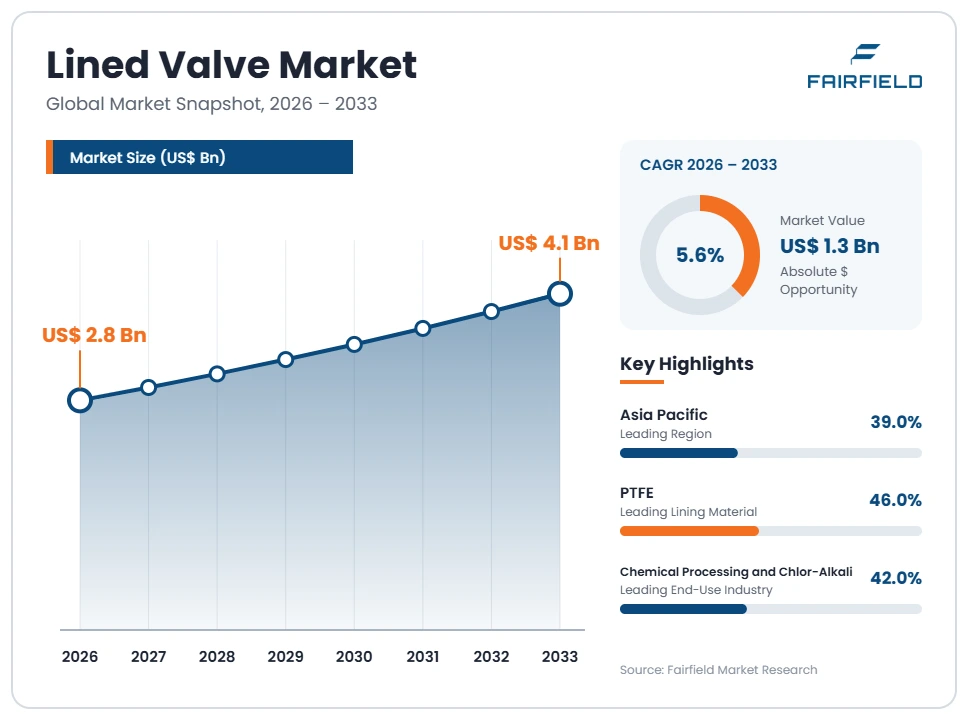
The global lined valve market size is expected to be valued at US$ 2.8 billion in 2026 and projected to reach US$ 4.1 billion by 2033, growing at a CAGR of 5.6% between 2026 and 2033.
Between 2020 and 2025 the market advanced at roughly 3.9% a year, held back by postponed chemical plant projects and a slow recovery in process industry capital spending. Three factors now improve the outlook. Exotic alloy prices keep the cost gap between a lined valve and a solid nickel, titanium or zirconium valve very wide, so substitution continues. New chlor-alkali, battery chemical and hydrometallurgical plants handle exactly the acids and halides that lined equipment exists for. Ageing lined assets installed decades ago are reaching the end of their liner life. Growth is therefore steady rather than cyclical in character, with replacement demand cushioning the lumpiness of new chemical plant construction.
Key Report Takeaways
- By Valve Type: Lined butterfly valves held 31% share in 2026, while lined control valves are projected to expand at a 7.3% CAGR through 2033, driven by automation of acid dosing and batch chemistry in fine chemical plants.
- By Lining Material: PTFE held 46% share in 2026, while PFA is projected to grow at a 7.1% CAGR through 2033, because its melt-processability gives a seamless, pinhole-free liner for high-purity and permeation-sensitive duty.
- By End-Use Industry: Chemical processing and chlor-alkali held 42% share in 2026, while semiconductor and electronics chemical handling is projected to expand at an 8.2% CAGR through 2033, as new fabrication plants add ultra-pure acid distribution loops.
- By Size Range: The 2 to 6 inch band held 38% share in 2026, while valves up to 2 inches are projected to grow at a 6.9% CAGR through 2033, reflecting small-bore reagent, sampling and dosing lines in pharmaceutical and electronics plants.
- By Geography: Asia Pacific held 39% share in 2026, while Latin America is projected to expand at a 7.4% CAGR through 2033, led by lithium brine and copper hydrometallurgy projects in Chile and Argentina.
Global Lined Valve Market Trends and Insights
Drivers Impact Analysis
Two forces account for most of the forecast growth in polymer-lined valve demand.
| Driver | Impact on CAGR Forecast | Geographic Relevance | Impact Timeline |
| The price gap between a lined iron or steel body and a solid exotic alloy valve | High | Asia Pacific, Europe, North America | Short term ≤2 years |
| Product purity requirements that rule out metal contact in pharmaceutical and electronic chemistry | High | Asia Pacific, North America, Europe | Medium term 2–4 years |
Exotic Alloy Prices Keep the Substitution Case for Lined Valves Intact
A lined valve is bought instead of an alloy valve, and the entire market rests on that price gap. For hydrochloric, hydrofluoric and sulphuric acid service, wet chlorine, bromine and caustic duty, the metallurgical alternatives are nickel alloys, titanium, zirconium and tantalum. Those valves cost several times a ductile iron body fitted with a fluoropolymer liner, so engineers choose the liner whenever service conditions allow.
The mechanism is arithmetic rather than preference. Alloy valve cost scales with the mass of expensive metal in the body, which rises steeply with size, while a liner adds a largely fixed processing cost to a cheap casting. Nickel and titanium price movements therefore shift the crossover point directly. Standards give buyers confidence to substitute: ASME B16.34 and ASME B16.42 define pressure and temperature ratings, API 598 governs inspection and testing, and ASTM F1545 covers plastic-lined ferrous pipe, fittings and flanges.
Purity Requirements in Pharmaceutical and Electronic Chemistry Exclude Bare Metal Surfaces
Lined valves are increasingly specified for what they keep out of the product, not only for what they resist. In active pharmaceutical ingredient manufacture, electronic-grade chemical distribution and battery precursor production, dissolved metal at trace concentrations can fail a batch or ruin device yield. A bare alloy wetted surface releases ions into the stream, so even a corrosion-resistant metal valve may be unacceptable.
The causal chain runs from product specification back to the valve. Electronic-grade acids are controlled at parts-per-billion metal levels, and injectable drug intermediates face equally strict limits, so process designers select PTFE, PFA and PVDF wetted paths throughout. That choice brings secondary requirements with it: smooth, crevice-free bores for cleanability, fire testing to ISO 10497 and API 607 because the seats are non-metallic, and conductive liner options to satisfy ATEX electrostatic rules in solvent service.
Restraints Impact Analysis
Two constraints limit where lined valves can be used and how fast demand grows.
| Restraint | Impact on CAGR Forecast | Geographic Relevance | Impact Timeline |
| The liner’s narrow temperature, pressure and vacuum envelope and its abrupt failure mode | High | North America, Europe, Asia Pacific | Long term ≥4 years |
| Lumpy chemical capital cycles, fluoropolymer requalification uncertainty and regional price competition | Medium | Europe, Asia Pacific, Middle East & Africa | Medium term 2–4 years |
The Liner Envelope Rules Lined Valves Out of Hot and High-Pressure Service
The liner is the reason the product exists and also its principal weakness, which caps the addressable duty range. Fluoropolymer liners lose mechanical strength well below the limits of the metal body, so the valve is derated steeply with temperature and cannot approach the body rating at elevated service conditions. Full vacuum can collapse or blister a liner, thermal cycling works it loose, abrasive slurries erode it, and permeating gases accumulate behind it.
The failure mode matters as much as the limits. A corroding alloy valve thins gradually and gives warning; a failed liner exposes unprotected iron to acid and the valve can fail quickly and completely. Vent holes in the body, bonded or mechanically retained liner designs, and careful cycling procedures are mitigations rather than solutions. Specification discipline and supplier application engineering therefore matter far more than catalogue price in this market.
Capital Cycles and Fluoropolymer Requalification Uncertainty Slow Lined Valve Orders
Demand is lumpy because it follows chemical industry investment, and that creates long flat periods between surges. A lined valve population is installed when a plant is built and then replaced gradually, so order intake tracks project sanctions rather than production volumes. When European and Asian chemical producers defer expansions on weak margins or high energy costs, valve bookings fall quickly and recover slowly.
A second drag is regulatory uncertainty around fluoropolymers. Plant owners specify lined equipment for decades of service, so any prospect that a liner chemistry might become harder to obtain, or require new documentation, creates a requalification question at the design stage. Engineering contractors hesitate to lock in a material they may have to justify again later. Meanwhile regional manufacturers in Asia compete hard on price for standard rubber-lined and PTFE-lined butterfly valves, compressing margins on commodity sizes.
Market Opportunities
Battery Chemical, Lithium and Rare Earth Plants Open a New Lined Valve Revenue Pool
Battery materials and critical mineral processing create a genuinely new demand pool for polymer-lined valves. Lithium brine and spodumene conversion, nickel and cobalt hydrometallurgy, rare earth separation and cathode precursor production all run hot acid leaching, solvent extraction and chloride or sulphate chemistry. These are classic lined-valve duties, and the plants being built are large, numerous and concentrated in a short construction window.
Valve makers with chemical application engineering and local service capability can capture this work, because specifying engineers need help matching liner chemistry to leach liquor composition. Demand originates with mining and chemical companies, engineering contractors and battery material producers rather than traditional refinery buyers. Supporting the trend are government critical mineral programmes in several regions that are funding domestic processing capacity, and the steady movement of refining steps closer to mine sites.
Semiconductor Chemical Handling and Ageing Asset Replacement Create Durable Demand
Two pools reinforce each other: new semiconductor chemical distribution and the replacement of lined assets installed a generation ago. Fabrication plants run extensive ultra-pure acid, solvent and slurry loops in which every wetted surface must be fluoropolymer, and the valve count per facility is high. Separately, chemical plants built in earlier decades now hold large populations of lined valves whose liners are at the end of their service life.
Suppliers with high-purity product lines, short lead times and audited cleanliness procedures can win the fabrication work, while those with field survey, refurbishment and liner replacement services can capture the installed base. Demand comes from semiconductor manufacturers, specialty chemical producers and pulp bleaching operations. Supporting developments include new fabrication capacity backed by national semiconductor programmes and tightening plant integrity management practices.
Segment Analysis
- By Valve Type: Lined Butterfly Valves Lead While Lined Control Valves Advance Quickest
Lined butterfly valves held 31% share in 2026, the largest valve type, because they offer the cheapest route to a fully protected wetted path in the medium and large sizes that dominate chemical plant headers, tank farms and effluent lines. Lined control valves are the fastest-growing type at a 7.3% CAGR to 2033, as fine chemical and battery material plants automate acid dosing, pH correction and batch transfers that were previously set by hand. Lined ball and plug valves hold strong positions in isolation duty, with plug designs favoured where slurries would damage a seat. Lined diaphragm and check valves serve dosing, sampling and backflow protection. Design evidence runs through API 609 for butterfly valves and the fire testing required by ISO 10497. The implication is that growth increasingly follows instrumentation content rather than pipe size.
- By Lining Material: PTFE Dominates While PFA Gains on Purity and Permeation
PTFE accounted for 46% of lined valve value in 2026, the leading lining material, because it tolerates almost every industrial chemical, holds a very wide temperature range for a polymer and is the material most engineering specifications already name. PFA is the fastest-growing liner at a 7.1% CAGR through 2033, since it can be melt-processed into a seamless, pinhole-free lining with better permeation resistance, which matters for high-purity electronic chemicals and for aggressive gases. PVDF serves strong oxidisers and higher-pressure duty at lower cost, FEP suits transparent and lower-temperature applications, polypropylene covers dilute acids and water treatment, and rubber linings remain standard for abrasive slurries and mining service. For suppliers, liner selection is the core technical conversation and the main defence against commodity pricing.
- By End-Use Industry: Chemical Plants Anchor Demand as Semiconductor Handling Grows Fastest
Chemical processing and chlor-alkali represented 42% of demand in 2026, the largest end-use industry, since these plants handle hydrochloric acid, wet chlorine, caustic and halogenated intermediates that simply cannot run in unprotected metal. Semiconductor and electronics chemical handling is the fastest-growing end use at an 8.2% CAGR to 2033, driven by new fabrication capacity and by the parts-per-billion purity limits that exclude metal wetted surfaces entirely. Pharmaceuticals and fine chemicals follow with cleanability-driven demand, while pulp and paper bleaching, water and wastewater treatment, and mining and metals processing provide a broad base. Food and beverage adds a smaller specialist slice. The commercial consequence is that the fastest pool buys on cleanliness documentation and lead time, which rewards a different set of capabilities than traditional chemical plant supply.
- By Size Range: Mid-Bore Valves Hold the Base While Small-Bore Lines Expand Fastest
The 2 to 6 inch band held 38% share in 2026, the leading size range, because it matches the process headers, pump discharges and transfer lines that make up most of a chemical plant’s valve population. Valves up to 2 inches are the fastest-growing range at a 6.9% CAGR through 2033, reflecting the rise of reagent dosing, sampling, analyser and small-batch lines in pharmaceutical, fine chemical and electronics plants, where instrument counts rise even when pipe sizes do not. The 6 to 12 inch range grows with bulk acid handling and effluent treatment, while valves above 12 inches remain a specialised niche because liner forming and handling become difficult at scale. The practical implication for manufacturers is that unit volume growth sits in small bores, while engineering margin remains concentrated in large ones.
Geography Analysis
- North America Replaces an Ageing Lined Valve Population in Mature Chemical Plants
North America held 23% of the market in 2026, anchored by the United States Gulf Coast chemical complex, Canadian chlor-alkali and pulp operations, and a growing semiconductor construction programme. Much of the installed lined valve base dates from earlier decades, so replacement and liner refurbishment account for a large share of regional revenue. New demand is concentrated in semiconductor fabrication plants and battery material facilities supported by federal incentive programmes, both of which specify high-purity fluoropolymer wetted paths. Buyers apply ASME pressure ratings and ASTM F1545 for lined piping systems as standard practice. The main barriers are slow project sanctioning and shortages of specialist installation labour. The clearest opportunity is survey-based replacement programmes, in which suppliers inspect installed valves, identify liners nearing the end of their life and convert reactive failures into planned work.
- Europe Combines Specification Depth With a Constrained Chemical Investment Cycle
Europe accounted for 24% of global demand in 2026, a share built on engineering depth rather than tonnage growth. Germany, Belgium, the Netherlands, France and Italy host dense chemical clusters, and several of the leading lined valve manufacturers are based in the region, exporting engineered products worldwide. Specification practice is rigorous: pressure equipment conformity requirements govern design and documentation, fire testing for non-metallic seated valves is routinely demanded, and electrostatic requirements for non-conductive linings are applied strictly in solvent and flammable service. High energy costs have discouraged new chemical capacity, so demand leans heavily toward maintenance, upgrades and emissions-related refurbishment. The structural headwind is capital flight to lower-cost regions. The strongest opportunity lies in supplying high-specification valves and application engineering to projects built elsewhere, which keeps regional manufacturing busy without local plant construction.
- Which Region Is Leading the Lined Valve Market?
Asia Pacific leads the lined valve market with a 39% share in 2026, the result of the world’s largest concentration of chemical production and its fastest electronics build-out. China operates an enormous chlor-alkali, pesticide, dye and intermediate industry that consumes lined equipment in volume, and it also manufactures a large proportion of global supply, which keeps prices competitive. India has expanded agrochemical, pharmaceutical and specialty chemical capacity substantially, and its producers specify lined valves heavily for acid service. Japan and South Korea contribute high-purity demand from semiconductor, display and battery material plants, where liner cleanliness is audited rather than assumed. Taiwan adds further electronic chemical handling. Local manufacturing keeps average selling prices below Western levels, so the region’s unit share exceeds its value share. The decisive change is the movement of domestic producers from commodity rubber-lined valves toward engineered fluoropolymer products.
- Which Region Is Growing Fastest in the Lined Valve Market?
Latin America is the fastest-growing geography at a 7.4% CAGR between 2026 and 2033, from an 8% share in 2026. The driver is mineral processing chemistry. Chile and Argentina are expanding lithium brine extraction and conversion, which runs on acid treatment, ion exchange and chloride-rich liquors that attack unprotected metal. Peruvian and Chilean copper operations are adding hydrometallurgical leaching and solvent extraction circuits, and Brazil is investing in fertiliser, pulp bleaching and specialty chemical capacity. All of these duties sit squarely in the lined valve envelope. Barriers are significant: import dependence lengthens lead times, currency volatility complicates capital approval, and field expertise in liner selection and installation is thin outside a few industrial centres. The most practical opportunity is local stocking combined with supplier-delivered application training, which shortens delivery and reduces premature liner failures.
- Middle East & Africa Builds Lined Valve Demand on Downstream Diversification
Middle East & Africa held 6% of the market in 2026 and is expanding at a 6.3% CAGR, the smallest regional pool but one with clear direction. Gulf producers are moving beyond basic petrochemicals into chlor-alkali, specialty chemicals and fertiliser derivatives, all of which require corrosion-protected wetted paths. Desalination and water treatment add chlorine and acid handling duty, while South African and North African mining and phosphate operations use lined equipment in leaching and acid distribution. Morocco’s phosphoric acid industry is a particularly large consumer. Barriers include heavy reliance on imported valves, limited local liner repair capability and high ambient temperatures that narrow an already restricted liner envelope. The clearest opportunity is regional service and refurbishment capacity, which would let operators maintain lined assets without shipping them abroad.
Competitive Landscape
The lined valve market is moderately concentrated. A group of established Western and Japanese manufacturers supplies most engineered, documentation-heavy valves for chemical, pharmaceutical and electronics service, while a wide field of regional producers, concentrated in China and India, supplies standard rubber-lined and PTFE-lined butterfly valves at low cost. Concentration varies by product: lined control valves and high-purity PFA products are made by relatively few firms with the forming, sintering and testing capability required, whereas commodity lined butterfly valves are widely available. Consolidation has been gradual, generally involving diversified flow control groups acquiring specialist lined valve brands to gain liner technology and chemical industry references.
Competition rests on technical credibility rather than price in most of the market. The first factor is application engineering, meaning the ability to match liner chemistry, temperature, vacuum and cycling conditions to a specific process stream and to say honestly when a lined valve is the wrong choice. The second is manufacturing quality in the liner itself, since bonding, thickness uniformity and freedom from pinholes determine service life. The third is certification breadth, covering pressure ratings, fire testing for non-metallic seats, sour service requirements where applicable, and electrostatic provisions for non-conductive linings. New entrants generally start in commodity sizes and attempt to move upward.
Strategic activity concentrates on three themes. Manufacturers are extending high-purity product ranges aimed at semiconductor and battery chemical customers, adding liner refurbishment and field survey services to monetise the installed base, and broadening actuation and instrumentation content so a lined valve is sold as a controlled assembly rather than a body.
Strategic direction across the field favours specialisation: deeper liner technology, more documentation, closer engineering contact with plant designers, and a growing share of revenue from service rather than from first fit.
Lined Valve Industry Leaders
Crane Company
Flowserve Corporation
Emerson Electric Co.
SAMSON AG
Richter Chemie-Technik GmbH
Recent Industry Developments
- May 2024: The European Union critical raw materials regulation entered into force, setting capacity benchmarks for strategic materials including nickel and titanium – reinforcing the cost argument for polymer-lined iron and steel valves wherever exotic alloy supply is tight or expensive.
- 2025: The phase-out date set by the Minamata Convention on Mercury for mercury-cell chlor-alkali production took effect, obliging remaining plants to convert or close – driving membrane-cell conversions that install large populations of lined valves on chlorine, caustic and hydrochloric acid duty.
- January 2026: The definitive phase of the European Union carbon border adjustment mechanism began, applying a carbon cost to imported iron, steel and aluminium – shifting the delivered cost comparison between lined ferrous bodies and imported alloy valves and changing procurement calculations.
Companies Covered in the Report
- Crane Company
- Flowserve Corporation
- Emerson Electric Co.
- ITT Inc.
- SAMSON AG
- GEMÜ Gebr. Müller Apparatebau GmbH & Co. KG
- Richter Chemie-Technik GmbH
- KSB SE & Co. KGaA
- Bray International, Inc.
- KITZ Corporation
- EBRO ARMATUREN Gebr. Bröer GmbH
- Fluoroseal Inc.
Lined Valve Market Report Scope
| Metric | Value |
| Study Period | 2020–2033 |
| Market Size 2026 | US$ 2.8 Billion |
| Market Size 2033 | US$ 4.1 Billion |
| CAGR 2026–2033 | 5.6% |
| Absolute Dollar Opportunity | US$ 1.3 Billion |
| Largest Market | Asia Pacific (39% share in 2026) |
| Fastest-Growing Market | Latin America (7.4% CAGR) |
| Market Concentration | Medium |
| Major Players | Crane Company, Flowserve Corporation, Emerson Electric Co., GEMÜ Gebr. Müller Apparatebau GmbH & Co. KG |
Lined Valve Market Segmentation
- Executive Summary
- Global Lined Valve Market Snapshot
- Future Projections, 2026–2033
- Key Industry Highlights
- Regional Snapshot
- Market Overview
- Market Definition and Report Scope
- Historical Market Trends
- Market Dynamics
- Drivers
- Exotic Alloy Prices Keep the Substitution Case for Lined Valves Intact
- Purity Requirements in Pharmaceutical and Electronic Chemistry Exclude Bare Metal Surfaces
- Restraints
- The Liner Envelope Rules Lined Valves Out of Hot and High-Pressure Service
- Capital Cycles and Fluoropolymer Requalification Uncertainty Slow Lined Valve Orders
- Market Opportunities
- Battery Chemical, Lithium and Rare Earth Plants Open a New Lined Valve Revenue Pool
- Semiconductor Chemical Handling and Ageing Asset Replacement Create Durable Demand
- Drivers
- Global Lined Valve Market Outlook, 2020–2033
- Global Lined Valve Market Outlook, by Valve Type, Value (US$ Billion), 2020–2033
- Ball Valves
- Butterfly Valves
- Plug Valves
- Diaphragm Valves
- Check Valves
- Control Valves
- Global Lined Valve Market Outlook, by Lining Material, Value (US$ Billion), 2020–2033
- PTFE
- PFA
- FEP
- PVDF
- Polypropylene
- Rubber and Elastomer Linings
- Global Lined Valve Market Outlook, by End-Use Industry, Value (US$ Billion), 2020–2033
- Chemical Processing and Chlor-Alkali
- Pharmaceuticals and Fine Chemicals
- Pulp and Paper
- Water and Wastewater Treatment
- Mining and Metals Processing
- Semiconductor and Electronics
- Food and Beverage
- Global Lined Valve Market Outlook, by Size Range, Value (US$ Billion), 2020–2033
- Up to 2 Inches
- 2 to 6 Inches
- 6 to 12 Inches
- Above 12 Inches
- Global Lined Valve Market Outlook, by Region, Value (US$ Billion), 2020–2033
- North America
- Europe
- Asia Pacific
- Latin America
- Middle East & Africa
- Global Lined Valve Market Outlook, by Valve Type, Value (US$ Billion), 2020–2033
- North America Lined Valve Market Outlook, 2020–2033
- North America Lined Valve Market Outlook, by Valve Type, Value (US$ Billion), 2020–2033
- Ball Valves
- Butterfly Valves
- Plug Valves
- Diaphragm Valves
- Check Valves
- Control Valves
- North America Lined Valve Market Outlook, by Lining Material, Value (US$ Billion), 2020–2033
- PTFE
- PFA
- FEP
- PVDF
- Polypropylene
- Rubber and Elastomer Linings
- North America Lined Valve Market Outlook, by End-Use Industry, Value (US$ Billion), 2020–2033
- Chemical Processing and Chlor-Alkali
- Pharmaceuticals and Fine Chemicals
- Pulp and Paper
- Water and Wastewater Treatment
- Mining and Metals Processing
- Semiconductor and Electronics
- Food and Beverage
- North America Lined Valve Market Outlook, by Size Range, Value (US$ Billion), 2020–2033
- Up to 2 Inches
- 2 to 6 Inches
- 6 to 12 Inches
- Above 12 Inches
- North America Lined Valve Market Outlook, by Country, Value (US$ Billion), 2020–2033
- United States Lined Valve Market Outlook, by Valve Type, 2020–2033
- United States Lined Valve Market Outlook, by Lining Material, 2020–2033
- United States Lined Valve Market Outlook, by End-Use Industry, 2020–2033
- United States Lined Valve Market Outlook, by Size Range, 2020–2033
- North America Lined Valve Market Outlook, by Valve Type, Value (US$ Billion), 2020–2033
- Europe Lined Valve Market Outlook, 2020–2033
- Europe Lined Valve Market Outlook, by Valve Type, Value (US$ Billion), 2020–2033
- Ball Valves
- Butterfly Valves
- Plug Valves
- Diaphragm Valves
- Check Valves
- Control Valves
- Europe Lined Valve Market Outlook, by Lining Material, Value (US$ Billion), 2020–2033
- PTFE
- PFA
- FEP
- PVDF
- Polypropylene
- Rubber and Elastomer Linings
- Europe Lined Valve Market Outlook, by End-Use Industry, Value (US$ Billion), 2020–2033
- Chemical Processing and Chlor-Alkali
- Pharmaceuticals and Fine Chemicals
- Pulp and Paper
- Water and Wastewater Treatment
- Mining and Metals Processing
- Semiconductor and Electronics
- Food and Beverage
- Europe Lined Valve Market Outlook, by Size Range, Value (US$ Billion), 2020–2033
- Up to 2 Inches
- 2 to 6 Inches
- 6 to 12 Inches
- Above 12 Inches
- Europe Lined Valve Market Outlook, by Country, Value (US$ Billion), 2020–2033
- Germany Lined Valve Market Outlook, by Valve Type, 2020–2033
- Germany Lined Valve Market Outlook, by Lining Material, 2020–2033
- Germany Lined Valve Market Outlook, by End-Use Industry, 2020–2033
- Germany Lined Valve Market Outlook, by Size Range, 2020–2033
- Belgium Lined Valve Market Outlook, by Valve Type, 2020–2033
- Belgium Lined Valve Market Outlook, by Lining Material, 2020–2033
- Belgium Lined Valve Market Outlook, by End-Use Industry, 2020–2033
- Belgium Lined Valve Market Outlook, by Size Range, 2020–2033
- Netherlands Lined Valve Market Outlook, by Valve Type, 2020–2033
- Netherlands Lined Valve Market Outlook, by Lining Material, 2020–2033
- Netherlands Lined Valve Market Outlook, by End-Use Industry, 2020–2033
- Netherlands Lined Valve Market Outlook, by Size Range, 2020–2033
- France Lined Valve Market Outlook, by Valve Type, 2020–2033
- France Lined Valve Market Outlook, by Lining Material, 2020–2033
- France Lined Valve Market Outlook, by End-Use Industry, 2020–2033
- France Lined Valve Market Outlook, by Size Range, 2020–2033
- Italy Lined Valve Market Outlook, by Valve Type, 2020–2033
- Italy Lined Valve Market Outlook, by Lining Material, 2020–2033
- Italy Lined Valve Market Outlook, by End-Use Industry, 2020–2033
- Italy Lined Valve Market Outlook, by Size Range, 2020–2033
- Europe Lined Valve Market Outlook, by Valve Type, Value (US$ Billion), 2020–2033
- Asia Pacific Lined Valve Market Outlook, 2020–2033
- Asia Pacific Lined Valve Market Outlook, by Valve Type, Value (US$ Billion), 2020–2033
- Ball Valves
- Butterfly Valves
- Plug Valves
- Diaphragm Valves
- Check Valves
- Control Valves
- Asia Pacific Lined Valve Market Outlook, by Lining Material, Value (US$ Billion), 2020–2033
- PTFE
- PFA
- FEP
- PVDF
- Polypropylene
- Rubber and Elastomer Linings
- Asia Pacific Lined Valve Market Outlook, by End-Use Industry, Value (US$ Billion), 2020–2033
- Chemical Processing and Chlor-Alkali
- Pharmaceuticals and Fine Chemicals
- Pulp and Paper
- Water and Wastewater Treatment
- Mining and Metals Processing
- Semiconductor and Electronics
- Food and Beverage
- Asia Pacific Lined Valve Market Outlook, by Size Range, Value (US$ Billion), 2020–2033
- Up to 2 Inches
- 2 to 6 Inches
- 6 to 12 Inches
- Above 12 Inches
- Asia Pacific Lined Valve Market Outlook, by Country, Value (US$ Billion), 2020–2033
- China Lined Valve Market Outlook, by Valve Type, 2020–2033
- China Lined Valve Market Outlook, by Lining Material, 2020–2033
- China Lined Valve Market Outlook, by End-Use Industry, 2020–2033
- China Lined Valve Market Outlook, by Size Range, 2020–2033
- India Lined Valve Market Outlook, by Valve Type, 2020–2033
- India Lined Valve Market Outlook, by Lining Material, 2020–2033
- India Lined Valve Market Outlook, by End-Use Industry, 2020–2033
- India Lined Valve Market Outlook, by Size Range, 2020–2033
- Japan Lined Valve Market Outlook, by Valve Type, 2020–2033
- Japan Lined Valve Market Outlook, by Lining Material, 2020–2033
- Japan Lined Valve Market Outlook, by End-Use Industry, 2020–2033
- Japan Lined Valve Market Outlook, by Size Range, 2020–2033
- South Korea Lined Valve Market Outlook, by Valve Type, 2020–2033
- South Korea Lined Valve Market Outlook, by Lining Material, 2020–2033
- South Korea Lined Valve Market Outlook, by End-Use Industry, 2020–2033
- South Korea Lined Valve Market Outlook, by Size Range, 2020–2033
- Taiwan Lined Valve Market Outlook, by Valve Type, 2020–2033
- Taiwan Lined Valve Market Outlook, by Lining Material, 2020–2033
- Taiwan Lined Valve Market Outlook, by End-Use Industry, 2020–2033
- Taiwan Lined Valve Market Outlook, by Size Range, 2020–2033
- Asia Pacific Lined Valve Market Outlook, by Valve Type, Value (US$ Billion), 2020–2033
- Latin America Lined Valve Market Outlook, 2020–2033
- Latin America Lined Valve Market Outlook, by Valve Type, Value (US$ Billion), 2020–2033
- Ball Valves
- Butterfly Valves
- Plug Valves
- Diaphragm Valves
- Check Valves
- Control Valves
- Latin America Lined Valve Market Outlook, by Lining Material, Value (US$ Billion), 2020–2033
- PTFE
- PFA
- FEP
- PVDF
- Polypropylene
- Rubber and Elastomer Linings
- Latin America Lined Valve Market Outlook, by End-Use Industry, Value (US$ Billion), 2020–2033
- Chemical Processing and Chlor-Alkali
- Pharmaceuticals and Fine Chemicals
- Pulp and Paper
- Water and Wastewater Treatment
- Mining and Metals Processing
- Semiconductor and Electronics
- Food and Beverage
- Latin America Lined Valve Market Outlook, by Size Range, Value (US$ Billion), 2020–2033
- Up to 2 Inches
- 2 to 6 Inches
- 6 to 12 Inches
- Above 12 Inches
- Latin America Lined Valve Market Outlook, by Country, Value (US$ Billion), 2020–2033
- Chile Lined Valve Market Outlook, by Valve Type, 2020–2033
- Chile Lined Valve Market Outlook, by Lining Material, 2020–2033
- Chile Lined Valve Market Outlook, by End-Use Industry, 2020–2033
- Chile Lined Valve Market Outlook, by Size Range, 2020–2033
- Argentina Lined Valve Market Outlook, by Valve Type, 2020–2033
- Argentina Lined Valve Market Outlook, by Lining Material, 2020–2033
- Argentina Lined Valve Market Outlook, by End-Use Industry, 2020–2033
- Argentina Lined Valve Market Outlook, by Size Range, 2020–2033
- Brazil Lined Valve Market Outlook, by Valve Type, 2020–2033
- Brazil Lined Valve Market Outlook, by Lining Material, 2020–2033
- Brazil Lined Valve Market Outlook, by End-Use Industry, 2020–2033
- Brazil Lined Valve Market Outlook, by Size Range, 2020–2033
- Latin America Lined Valve Market Outlook, by Valve Type, Value (US$ Billion), 2020–2033
- Middle East & Africa Lined Valve Market Outlook, 2020–2033
- Middle East & Africa Lined Valve Market Outlook, by Valve Type, Value (US$ Billion), 2020–2033
- Ball Valves
- Butterfly Valves
- Plug Valves
- Diaphragm Valves
- Check Valves
- Control Valves
- Middle East & Africa Lined Valve Market Outlook, by Lining Material, Value (US$ Billion), 2020–2033
- PTFE
- PFA
- FEP
- PVDF
- Polypropylene
- Rubber and Elastomer Linings
- Middle East & Africa Lined Valve Market Outlook, by End-Use Industry, Value (US$ Billion), 2020–2033
- Chemical Processing and Chlor-Alkali
- Pharmaceuticals and Fine Chemicals
- Pulp and Paper
- Water and Wastewater Treatment
- Mining and Metals Processing
- Semiconductor and Electronics
- Food and Beverage
- Middle East & Africa Lined Valve Market Outlook, by Size Range, Value (US$ Billion), 2020–2033
- Up to 2 Inches
- 2 to 6 Inches
- 6 to 12 Inches
- Above 12 Inches
- Middle East & Africa Lined Valve Market Outlook, by Country and Subregion, Value (US$ Billion), 2020–2033
- Gulf Lined Valve Market Outlook, by Valve Type, 2020–2033
- Gulf Lined Valve Market Outlook, by Lining Material, 2020–2033
- Gulf Lined Valve Market Outlook, by End-Use Industry, 2020–2033
- Gulf Lined Valve Market Outlook, by Size Range, 2020–2033
- Morocco Lined Valve Market Outlook, by Valve Type, 2020–2033
- Morocco Lined Valve Market Outlook, by Lining Material, 2020–2033
- Morocco Lined Valve Market Outlook, by End-Use Industry, 2020–2033
- Morocco Lined Valve Market Outlook, by Size Range, 2020–2033
- Middle East & Africa Lined Valve Market Outlook, by Valve Type, Value (US$ Billion), 2020–2033
- Competitive Landscape
- Industry Leaders
- Recent Industry Developments
- Company Profiles
- Crane Company
- Flowserve Corporation
- Emerson Electric Co.
- ITT Inc.
- SAMSON AG
- GEMÜ Gebr. Müller Apparatebau GmbH & Co. KG
- Richter Chemie-Technik GmbH
- KSB SE & Co. KGaA
- Bray International, Inc.
- KITZ Corporation
- EBRO ARMATUREN Gebr. Bröer GmbH
- Fluoroseal Inc.
- Appendix
- Research Methodology
- Report Assumptions
- Acronyms and Abbreviations
Valve Type
- Ball Valves
- Butterfly Valves
- Plug Valves
- Diaphragm Valves
- Check Valves
- Control Valves
Lining Material
- PTFE
- PFA
- FEP
- PVDF
- Polypropylene
- Rubber and Elastomer Linings
End-Use Industry
- Chemical Processing and Chlor-Alkali
- Pharmaceuticals and Fine Chemicals
- Pulp and Paper
- Water and Wastewater Treatment
- Mining and Metals Processing
- Semiconductor and Electronics
- Food and Beverage
Size Range
- Up to 2 Inches
- 2 to 6 Inches
- 6 to 12 Inches
- Above 12 Inches
Regions
- North America
- Europe
- Asia Pacific
- Latin America
- Middle East & Africa
Our Research Methodology
Considering the volatility of business today, traditional approaches to strategizing a game plan can be unfruitful if not detrimental. True ambiguity is no way to determine a forecast. A myriad of predetermined factors must be accounted for such as the degree of risk involved, the magnitude of circumstances, as well as conditions or consequences that are not known or unpredictable. To circumvent binary views that cast uncertainty, the application of market research intelligence to strategically posture, move, and enable actionable outcomes is necessary.
View Methodology
Quality Assured
Rigorous Validation Process

Confidentiality Assured
End-to-end Data Security

Custom Research Services
Tailored To Your Objectives
FAQs
The polymer-lined valve market is valued at US$ 2.8 billion in 2026, covering lined ball, butterfly, plug, diaphragm, check and control valves.
The market is projected to reach US$ 4.1 billion by 2033, growing at a 5.6% CAGR and adding US$ 1.3 billion over the forecast period.
Lined butterfly valves lead with 31% share in 2026, offering the lowest-cost protected wetted path in medium and large chemical plant lines.
Latin America grows fastest at a 7.4% CAGR to 2033, driven by lithium conversion and copper hydrometallurgy projects in Chile, Argentina and Peru.
Asia Pacific holds the largest share at 39% in 2026, supported by chemical production in China and India and electronics chemical handling.
Related Reports
Machine Automation Controller Market Size, Share, Insights, Competitive Landscape, and Forecast 2026 to 2033
The global machine automation controller market is valued at US$2.4 billion in 2026, reaching US$4.5 billion by 2033, growing at a 9.4% CAGR
Hydraulic Intensifiers Market Size, Share, Insights, Competitive Landscape, and Forecast 2026 to 2033
The global hydraulic intensifiers market is valued at US$1.28 billion in 2026, reaching US$1.92 billion by 2033, growing at a 6.0% CAGR
Dual Chamber Syringe Filling Machine Market Size, Share, Insights, Competitive Landscape, and Forecast 2026 to 2033
The dual chamber syringe filling machine market is projected to grow from US$430 million in 2026 to US$771 million by 2033 at an 8.7% CAGR.
CVD and CVI Vacuum Furnaces Market Size, Share, Insights, Competitive Landscape, and Forecast 2026 to 2033
The CVD and CVI vacuum furnaces market is projected to grow from US$1.24 billion in 2026 to US$2.04 billion by 2033 at a 7.4% CAGR.
Construction Bolts Market Size, Share, Insights, Competitive Landscape, and Forecast 2026 to 2033
The construction bolts market is projected to grow from US$9.6 billion in 2026 to US$13.9 billion by 2033 at a 5.4% CAGR.
Capping Machine Market Size, Share, Insights, Competitive Landscape, and Forecast 2026 to 2033
The capping machine market is projected to grow from US$3.4 billion in 2026 to US$4.9 billion by 2033 at a 5.4% CAGR.