



CVD and CVI Vacuum Furnaces Market
CVD and CVI Vacuum Furnaces Market Size, Share, Insights, Competitive Landscape, and Forecast 2026 to 2033
Report Overview
CVD and CVI Vacuum Furnaces Market Size and Trend Analysis
How Fast Will CVD and CVI Furnace Demand Grow?
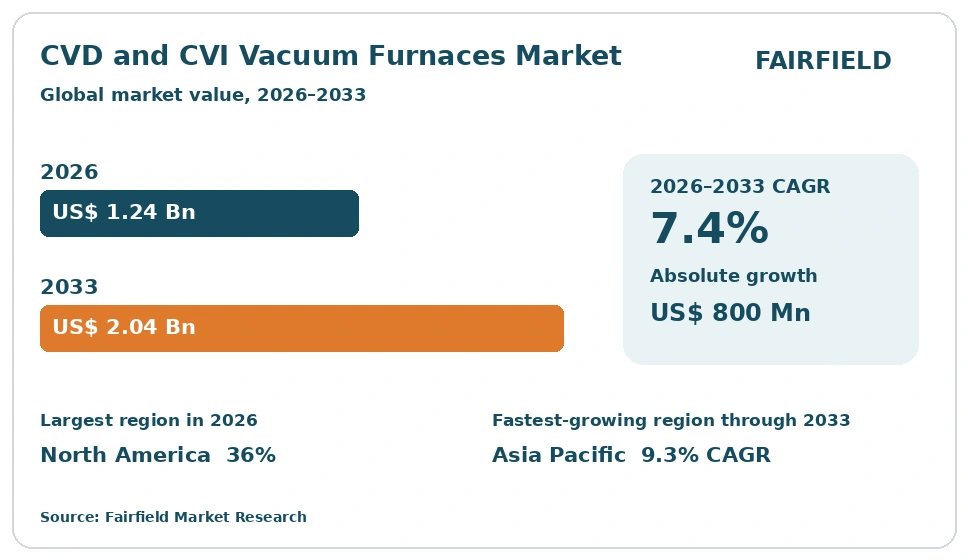
The global CVD and CVI Vacuum Furnaces market size is expected to be valued at US$ 1.24 billion in 2026 and projected to reach US$ 2.04 billion by 2033, growing at a CAGR of 7.4% between 2026 and 2033. Growth follows rising output of carbon-carbon and ceramic matrix composite parts for aircraft brakes, rocket nozzles and engine hot sections. Buyers now specify larger chambers, tighter temperature uniformity and better gas handling to cut cost per part. Historical growth was slower, at a CAGR of 5.9% between 2020 and 2025, leaving an absolute dollar opportunity of US$ 800 million over the forecast period.
Key Report Takeaways
- By Process Type: Chemical vapour infiltration led with 52% share in 2026, while hybrid CVD/CVI systems are projected to expand at a 9.1% CAGR through 2033, driven by single-chamber densification and coating of composite brake discs.
- By Hot Zone Configuration: Graphite resistance hot zones led with 58% share in 2026, while induction-heated systems are projected to expand at an 8.6% CAGR through 2033, driven by faster thermal response in smaller production cells.
- By Furnace Capacity: Mid-volume production furnaces led with 46% share in 2026, while large-volume industrial systems are projected to expand at an 8.9% CAGR through 2033, driven by brake plant consolidation into fewer, bigger densification lines.
- By End Use Industry: Aerospace and defence led with 44% share in 2026, while semiconductor and electronics is projected to expand at a 9.4% CAGR through 2033, driven by demand for coated graphite and silicon carbide consumables.
- By Region: North America led with 36% share in 2026, ahead of Asia Pacific at 28%, Europe at 27%, Middle East & Africa at 5% and Latin America at 4%, with Asia Pacific fastest at a 9.3% CAGR on new composite capacity.
Market Trends and Insights
Market Growth Drivers
Aircraft Brake Output Keeps Large CVI Furnaces Fully Booked
Carbon-carbon brake discs remain the largest single consumer of chemical vapour infiltration capacity, and steady commercial aircraft deliveries keep furnace order books full. Friction material is replaced several times over an airframe life, so demand arrives from both new build and overhaul channels. Brake suppliers therefore plan plant throughput around furnace availability rather than press or machining capacity.
Fleet growth in Asia and the Middle East has pushed wheel and brake makers to add densification lines nearer final assembly and repair hubs. Airlines also qualify second sources for friction material, which spreads work across more plants and more equipment suppliers. Furnace builders answer with taller chambers, multi-zone control and improved gas distribution that raise usable part count per batch without new buildings. That combination keeps replacement and expansion orders flowing through the forecast period.
Ceramic Matrix Composites Move Into Engine Hot Sections
Ceramic matrix composites are moving from demonstrator status into shipping turbine hardware, and each qualified part creates recurring furnace demand. Shrouds, liners and nozzles made from silicon carbide composites need infiltration and protective coating steps that only vacuum furnace lines can supply. Because engine makers hold rate commitments for decades, equipment orders follow programme ramp schedules rather than short cycles.
Weight and temperature targets explain the shift. Composite hot-section parts let engines run hotter with less cooling air, which supports the fuel burn and emissions goals now written into airline fleet plans. Tier-one suppliers have responded by building dedicated composite plants, and those plants are designed around banks of identical furnaces that deliver repeatable, auditable output. Defence propulsion and hypersonics work adds a second, less cyclical stream of orders for similar equipment.
Restraints Impact Analysis of Market
High Capital Cost and Long Payback Limit Buyer Numbers
Vacuum furnace lines for infiltration are capital-heavy, and the long processing cycles typical of densification stretch payback periods well beyond standard machine tools. A single large system carries costs for the furnace, gas supply, abatement, utilities and building reinforcement. Smaller composite fabricators therefore delay purchases or buy processing time from contract densification houses instead.
The effect is a narrow buyer base concentrated among a few large aerospace suppliers, contract processors and research institutions. Lenders treat these assets as programme-specific, so financing often waits until a long-term supply agreement has been signed. Furnace makers counter with modular designs, shared vacuum and gas infrastructure, and refurbishment of installed systems at far lower cost than replacement. Those options help, yet they also slow new unit sales because existing equipment stays in service far longer.
Precursor Handling Rules and Skilled Labour Gaps Slow Installations
Permitting and workforce constraints push out installation schedules and dampen near-term equipment revenue. Hydrocarbon and chlorosilane precursors used in these processes are flammable or corrosive, so plants need abatement, scrubbing, monitoring and emergency systems approved by local authorities. Each approval adds months between purchase order and production release.
Staffing is the second constraint. Running and maintaining vacuum furnaces at high temperature demands technicians who understand vacuum systems, gas safety, refractory maintenance and process control together. That skill set is scarce outside established aerospace clusters, and experienced staff are retiring faster than replacements qualify. Buyers in new regions often contract the original equipment maker for commissioning and extended support, which raises total project cost. Until training pipelines widen, these combined factors cap how quickly installed capacity can realistically grow in emerging manufacturing centres.
Market Opportunities
Semiconductor and Energy Buyers Open a Second Demand Base
Non-aerospace buyers now offer furnace makers a growth path that is less tied to aircraft build rates. Semiconductor fabs consume coated graphite susceptors, silicon carbide components and chamber parts that are produced on vacuum deposition equipment. Energy customers need coated and densified components for high-temperature reactors, solar silicon production and hydrogen equipment.
These applications favour smaller and mid-sized systems with fast changeover, which suits suppliers already serving research and pilot markets. Demand also sits in regions investing heavily in domestic chip and clean-energy capacity, where new plants are built from scratch and specify equipment early. Because qualification cycles in electronics are much shorter than in aviation, orders convert to revenue faster. Vendors that package deposition furnaces with process support and consumable coating services can capture recurring revenue alongside the original equipment sale.
Automation, Digital Controls and Retrofits Create Aftermarket Revenue
Service and upgrade work is becoming a durable earnings stream rather than a sideline for furnace suppliers. Installed systems often run for two decades, and owners prefer upgrading controls, pumps, hot zones and gas panels over buying replacement units. Each retrofit improves uniformity and yield while extending asset life at a fraction of new-equipment cost.
Digital tools make this more valuable. Recipe management, batch traceability and condition monitoring help aerospace customers meet audit requirements and reduce scrapped parts, which matters when a single batch holds high-value hardware. Remote diagnostics also cut downtime for plants far from the supplier’s service centres. Vendors building connected control platforms gain visibility into fleet performance, which informs product development and supports long-term service contracts. For buyers, predictable maintenance spending is easier to justify than fresh capital expenditure.
Category-wise Insights
Which Process Type Accounts for the Largest Share?
Chemical vapour infiltration leads the market with 52% share in 2026, because densification of carbon-carbon and ceramic composites consumes the largest and most numerous furnaces in service. Aircraft brake manufacture alone supports a sizeable installed base, and each line runs long, high-value batches that justify dedicated equipment. Pure deposition systems hold 36%, serving coating work for tooling, graphite consumables and semiconductor components.
Hybrid CVD/CVI systems are the growth leader, at a 9.1% CAGR through 2033. Composite parts increasingly need both an infiltrated matrix and a protective outer coating, and handling both in one chamber removes transfer steps and contamination risk. Suppliers are responding with flexible gas delivery and control architectures. The shift favours vendors with strong process engineering and blurs the line between coating houses and densification plants.
Graphite Hot Zones Hold Scale While Induction Heating Gains
Graphite resistance hot zones account for 58% share in 2026, reflecting their suitability for the large chambers and high temperatures that composite work requires. Graphite insulation and heating elements remain comparatively affordable, tolerate reactive atmospheres and can be rebuilt in service, which keeps lifetime cost competitive for production plants. Refractory metal hot zones hold 16%, concentrated in cleaner applications where carbon contamination is unacceptable.
Induction-heated systems grow fastest at an 8.6% CAGR through 2033. They heat and cool more quickly, which raises throughput for smaller batches and suits research, pilot and electronics work where part mixes change often. Improved power electronics have widened the practical size range. Capacity additions are therefore splitting between very large graphite systems for brakes and nimble induction cells for diversified customers.
Mid-Volume Production Furnaces Lead While Large Systems Scale Faster
Mid-volume production furnaces hold 46% share in 2026, as they match the batch sizes used by most composite and coating plants outside the largest brake operations. These systems balance capital cost against output and fit existing buildings and utility supplies, which shortens installation. Lab and pilot-scale equipment accounts for 21%, supported by universities, defence laboratories and materials developers qualifying new fibre and matrix combinations.
Large-volume industrial systems grow fastest at an 8.9% CAGR through 2033. Brake and composite suppliers are consolidating output into fewer, bigger plants where a single tall chamber processes many parts per cycle, lowering energy and labour per unit. Site selection then follows power availability and permitting. Unit volumes stay modest while average selling prices rise, favouring vendors able to commission very large installations.
Aerospace and Defence Anchors Demand While Semiconductors Accelerate
Aerospace and defence holds 44% share in 2026, driven by brake densification, rocket nozzles, thermal protection structures and turbine hot-section components. Long qualification cycles lock equipment choices in for years, so incumbent furnace suppliers retain work across programme life. Industrial tooling and other uses account for 18%, mainly wear and corrosion coatings on cutting tools, dies and process components.
Semiconductor and electronics is the fastest-growing end use at a 9.4% CAGR through 2033, as fab construction raises demand for coated graphite susceptors, silicon carbide parts and chamber hardware. Automotive sits at 13% and energy and power at 10%, with carbon-ceramic brakes supporting steady orders. The practical effect is a widening customer mix that reduces exposure to aerospace cycles and rewards flexible, smaller-footprint product lines.
Geography Analysis
Which Region Is Leading the CVD and CVI Vacuum Furnaces Market?
North America leads with 36% share in 2026 and is forecast to grow at a 6.8% CAGR through 2033. The region hosts the deepest concentration of carbon-carbon brake manufacturing, composite engine component plants and defence propulsion work, principally in the United States with supporting activity in Canada and Mexico. Established furnace builders and service networks sit close to those customers, which shortens commissioning and maintenance response.
Demand is reinforced by defence budgets covering hypersonics, missile structures and thermal protection materials, where composite hardware is produced in controlled domestic facilities. Export control rules also favour local equipment supply and process qualification. Reshoring of semiconductor manufacturing adds a newer buyer group for deposition systems, broadening the installed base beyond traditional aerospace accounts.
Europe Pairs Engine Programmes With Strong Equipment Engineering
Europe accounts for 27% share in 2026 and is projected to grow at a 6.4% CAGR through 2033. France, Germany, the United Kingdom and Italy combine aircraft brake and composite production with a long-standing vacuum furnace engineering base, so the region both consumes and supplies equipment. Space launch programmes and defence propulsion work add specialised demand for nozzle and thermal protection hardware.
Emissions targets and aviation decarbonisation goals are pushing engine makers toward lighter, higher-temperature composite parts, supporting qualification of new densification capacity. Energy costs, however, weigh on operating economics for long furnace cycles, prompting investment in insulation upgrades and control retrofits. European buyers therefore spend proportionately more on modernising installed systems than on greenfield lines.
Which Region Is Growing Fastest in the CVD and CVI Vacuum Furnaces Market?
Asia Pacific is growing fastest at a 9.3% CAGR through 2033, from 28% share in 2026. China, Japan, South Korea and India are building composite and advanced materials capacity at the same time as commercial fleets expand, creating simultaneous demand for new brake plants and maintenance capability. Domestic aircraft and engine programmes add further pull for qualified densification lines.
Semiconductor investment amplifies the trend, since new fabs need coated graphite and silicon carbide components produced on deposition equipment. Governments back advanced manufacturing through industrial policy, lowering the financing hurdle for capital-heavy furnace projects. Local equipment makers are also maturing, adding price competition while expanding installed capacity faster than any other region.
Latin America Builds Capability Around Aerospace Maintenance Clusters
Latin America holds 4% share in 2026 with a 6.0% CAGR through 2033, the smallest regional base. Brazil anchors activity through its aircraft manufacturing and maintenance ecosystem, with Mexico contributing aerospace component and tooling work tied to North American supply chains. Most installations are mid-sized or pilot-scale rather than very large densification lines.
Growth depends on overhaul work migrating closer to regional operators, which gradually justifies local coating and densification capacity. Industrial tooling and mining equipment coating provide baseload demand outside aviation. Constraints are practical rather than technical: financing costs, import duties and limited local service coverage lengthen project timelines. Suppliers usually enter through agents rather than permanent facilities.
Middle East & Africa Follows Aviation Hubs and Industrial Diversification
Middle East & Africa accounts for 5% share in 2026 and a 6.6% CAGR through 2033. Demand concentrates in Gulf aviation hubs, where large widebody fleets generate heavy brake overhaul volumes, and in South Africa’s industrial and tooling base. Maintenance, repair and overhaul investment is the primary route by which furnace capacity enters the region.
Economic diversification programmes support the trend, as several Gulf states fund domestic aerospace, defence and advanced materials capability rather than importing finished components. Low industrial energy costs offset the long cycles typical of densification work. A thin local skills base and dependence on foreign commissioning teams remain limiting, so suppliers bundle training with equipment sales.
Competitive Landscape
The CVD and CVI vacuum furnace market is moderately concentrated, with a small group of established thermal processing specialists holding most large-system work and a wider field of regional builders serving laboratory and mid-sized demand. Entry barriers are high because customers demand proven process results, documented uniformity and safety compliance before releasing a purchase order. Aerospace qualification further protects incumbents, since changing furnace supplier can require requalifying the part. Consolidation in the broader industrial furnace sector has grouped several brands under larger engineering owners, giving them wider service networks and combined research resources.
Competition centres on process capability rather than hardware alone. Vendors differentiate on temperature uniformity across large loads, gas distribution design, vacuum integrity, energy use per cycle and the quality of control software. Automation, data logging and traceability have become decisive for aerospace buyers managing audit requirements. Materials expertise matters too, as hot zone design, insulation life and maintenance intervals shape total ownership cost. Newer entrants from Asia compete on price and delivery time, pushing established suppliers to defend value through engineering support and guaranteed process outcomes.
Strategic activity concentrates on capacity, service and adjacency. Suppliers are expanding commissioning capability near growing customer clusters, building regional service hubs, and adding retrofit programmes that monetise ageing installed bases. Several are extending from aerospace into semiconductor and energy equipment, where chamber and coating expertise transfers directly. Research partnerships with composite producers and universities help validate new configurations without carrying full development risk. The direction favours vendors combining large-system engineering, dependable aftermarket service and software-led process control, while customers increasingly judge suppliers on lifetime cost rather than purchase price alone.
Industry Leaders
- Ipsen International GmbH
- ALD Vacuum Technologies GmbH
- SECO/WARWICK S.A.
- PVA TePla AG
- Centorr Vacuum Industries
- ULVAC, Inc.
- Tenova S.p.A.
- ECM Technologies
Companies Covered in the Report
- Ipsen International GmbH
- ALD Vacuum Technologies GmbH
- SECO/WARWICK S.A.
- PVA TePla AG
- Centorr Vacuum Industries
- ULVAC, Inc.
- Tenova S.p.A.
- ECM Technologies
- Nabertherm GmbH
- Carbolite Gero
- Thermal Technology LLC
- Harper International
- Materials Research Furnaces, LLC
- Hind High Vacuum Company Pvt. Ltd.
- Shenyang Vacuum Technology Institute
CVD and CVI Vacuum Furnaces Market Report Scope
The market is segmented by process type, hot zone configuration, furnace capacity, end use industry and region.
| By Process Type | Chemical Vapour Infiltration (CVI), Chemical Vapour Deposition (CVD), Hybrid CVD/CVI Systems |
| By Hot Zone Configuration | Graphite Resistance Hot Zone, Induction-Heated Hot Zone, Refractory Metal Hot Zone |
| By Furnace Capacity | Lab and Pilot Scale, Mid-Volume Production, Large-Volume Industrial |
| By End Use Industry | Aerospace and Defence, Automotive, Semiconductor and Electronics, Energy and Power, Industrial Tooling and Others |
| By Region | North America, Europe, Asia Pacific, Latin America, Middle East & Africa |
1. Executive Summary
1.1 Global CVD and CVI Vacuum Furnaces Market Snapshot
1.2 Future Projections, 2026–2033
1.3 Key Industry Highlights
1.4 Regional Snapshot
2. Market Overview
2.1 Market Definition and Report Scope
2.2 Historical Market Trends
2.3 Market Dynamics
2.3.1 Drivers
2.3.2 Restraints
2.3.3 Market Opportunities
3. Global CVD and CVI Vacuum Furnaces Market Outlook, 2026–2033
3.1 Global CVD and CVI Vacuum Furnaces Market Outlook, by Process Type, Value (US$ Billion), 2026–2033
3.1.1 Chemical Vapour Infiltration (CVI)
3.1.2 Chemical Vapour Deposition (CVD)
3.1.3 Hybrid CVD/CVI Systems
3.2 Global CVD and CVI Vacuum Furnaces Market Outlook, by Hot Zone Configuration, Value (US$ Billion), 2026–2033
3.2.1 Graphite Resistance Hot Zone
3.2.2 Induction-Heated Hot Zone
3.2.3 Refractory Metal Hot Zone
3.3 Global CVD and CVI Vacuum Furnaces Market Outlook, by Furnace Capacity, Value (US$ Billion), 2026–2033
3.3.1 Lab and Pilot Scale
3.3.2 Mid-Volume Production
3.3.3 Large-Volume Industrial
3.4 Global CVD and CVI Vacuum Furnaces Market Outlook, by End Use Industry, Value (US$ Billion), 2026–2033
3.4.1 Aerospace and Defence
3.4.2 Automotive
3.4.3 Semiconductor and Electronics
3.4.4 Energy and Power
3.4.5 Industrial Tooling and Others
3.5 Global CVD and CVI Vacuum Furnaces Market Outlook, by Region, Value (US$ Billion), 2026–2033
3.5.1 North America
3.5.2 Europe
3.5.3 Asia Pacific
3.5.4 Latin America
3.5.5 Middle East & Africa
4. North America CVD and CVI Vacuum Furnaces Market Outlook, 2026–2033
4.1 North America CVD and CVI Vacuum Furnaces Market Outlook, by Process Type, Value (US$ Billion), 2026–2033
4.1.1 Chemical Vapour Infiltration (CVI)
4.1.2 Chemical Vapour Deposition (CVD)
4.1.3 Hybrid CVD/CVI Systems
4.2 North America CVD and CVI Vacuum Furnaces Market Outlook, by Hot Zone Configuration, Value (US$ Billion), 2026–2033
4.2.1 Graphite Resistance Hot Zone
4.2.2 Induction-Heated Hot Zone
4.2.3 Refractory Metal Hot Zone
4.3 North America CVD and CVI Vacuum Furnaces Market Outlook, by Furnace Capacity, Value (US$ Billion), 2026–2033
4.3.1 Lab and Pilot Scale
4.3.2 Mid-Volume Production
4.3.3 Large-Volume Industrial
4.4 North America CVD and CVI Vacuum Furnaces Market Outlook, by End Use Industry, Value (US$ Billion), 2026–2033
4.4.1 Aerospace and Defence
4.4.2 Automotive
4.4.3 Semiconductor and Electronics
4.4.4 Energy and Power
4.4.5 Industrial Tooling and Others
4.5 North America CVD and CVI Vacuum Furnaces Market Outlook, by Country, Value (US$ Billion), 2026–2033
4.5.1 United States CVD and CVI Vacuum Furnaces Market Outlook, by Process Type, 2026–2033
4.5.2 United States CVD and CVI Vacuum Furnaces Market Outlook, by Hot Zone Configuration, 2026–2033
4.5.3 United States CVD and CVI Vacuum Furnaces Market Outlook, by Furnace Capacity, 2026–2033
4.5.4 United States CVD and CVI Vacuum Furnaces Market Outlook, by End Use Industry, 2026–2033
4.5.5 Canada CVD and CVI Vacuum Furnaces Market Outlook, by Process Type, 2026–2033
4.5.6 Canada CVD and CVI Vacuum Furnaces Market Outlook, by Hot Zone Configuration, 2026–2033
4.5.7 Canada CVD and CVI Vacuum Furnaces Market Outlook, by Furnace Capacity, 2026–2033
4.5.8 Canada CVD and CVI Vacuum Furnaces Market Outlook, by End Use Industry, 2026–2033
4.5.9 Mexico CVD and CVI Vacuum Furnaces Market Outlook, by Process Type, 2026–2033
4.5.10 Mexico CVD and CVI Vacuum Furnaces Market Outlook, by Hot Zone Configuration, 2026–2033
4.5.11 Mexico CVD and CVI Vacuum Furnaces Market Outlook, by Furnace Capacity, 2026–2033
4.5.12 Mexico CVD and CVI Vacuum Furnaces Market Outlook, by End Use Industry, 2026–2033
5. Europe CVD and CVI Vacuum Furnaces Market Outlook, 2026–2033
5.1 Europe CVD and CVI Vacuum Furnaces Market Outlook, by Process Type, Value (US$ Billion), 2026–2033
5.1.1 Chemical Vapour Infiltration (CVI)
5.1.2 Chemical Vapour Deposition (CVD)
5.1.3 Hybrid CVD/CVI Systems
5.2 Europe CVD and CVI Vacuum Furnaces Market Outlook, by Hot Zone Configuration, Value (US$ Billion), 2026–2033
5.2.1 Graphite Resistance Hot Zone
5.2.2 Induction-Heated Hot Zone
5.2.3 Refractory Metal Hot Zone
5.3 Europe CVD and CVI Vacuum Furnaces Market Outlook, by Furnace Capacity, Value (US$ Billion), 2026–2033
5.3.1 Lab and Pilot Scale
5.3.2 Mid-Volume Production
5.3.3 Large-Volume Industrial
5.4 Europe CVD and CVI Vacuum Furnaces Market Outlook, by End Use Industry, Value (US$ Billion), 2026–2033
5.4.1 Aerospace and Defence
5.4.2 Automotive
5.4.3 Semiconductor and Electronics
5.4.4 Energy and Power
5.4.5 Industrial Tooling and Others
5.5 Europe CVD and CVI Vacuum Furnaces Market Outlook, by Country, Value (US$ Billion), 2026–2033
5.5.1 France CVD and CVI Vacuum Furnaces Market Outlook, by Process Type, 2026–2033
5.5.2 France CVD and CVI Vacuum Furnaces Market Outlook, by Hot Zone Configuration, 2026–2033
5.5.3 France CVD and CVI Vacuum Furnaces Market Outlook, by Furnace Capacity, 2026–2033
5.5.4 France CVD and CVI Vacuum Furnaces Market Outlook, by End Use Industry, 2026–2033
5.5.5 Germany CVD and CVI Vacuum Furnaces Market Outlook, by Process Type, 2026–2033
5.5.6 Germany CVD and CVI Vacuum Furnaces Market Outlook, by Hot Zone Configuration, 2026–2033
5.5.7 Germany CVD and CVI Vacuum Furnaces Market Outlook, by Furnace Capacity, 2026–2033
5.5.8 Germany CVD and CVI Vacuum Furnaces Market Outlook, by End Use Industry, 2026–2033
5.5.9 United Kingdom CVD and CVI Vacuum Furnaces Market Outlook, by Process Type, 2026–2033
5.5.10 United Kingdom CVD and CVI Vacuum Furnaces Market Outlook, by Hot Zone Configuration, 2026–2033
5.5.11 United Kingdom CVD and CVI Vacuum Furnaces Market Outlook, by Furnace Capacity, 2026–2033
5.5.12 United Kingdom CVD and CVI Vacuum Furnaces Market Outlook, by End Use Industry, 2026–2033
5.5.13 Italy CVD and CVI Vacuum Furnaces Market Outlook, by Process Type, 2026–2033
5.5.14 Italy CVD and CVI Vacuum Furnaces Market Outlook, by Hot Zone Configuration, 2026–2033
5.5.15 Italy CVD and CVI Vacuum Furnaces Market Outlook, by Furnace Capacity, 2026–2033
5.5.16 Italy CVD and CVI Vacuum Furnaces Market Outlook, by End Use Industry, 2026–2033
6. Asia Pacific CVD and CVI Vacuum Furnaces Market Outlook, 2026–2033
6.1 Asia Pacific CVD and CVI Vacuum Furnaces Market Outlook, by Process Type, Value (US$ Billion), 2026–2033
6.1.1 Chemical Vapour Infiltration (CVI)
6.1.2 Chemical Vapour Deposition (CVD)
6.1.3 Hybrid CVD/CVI Systems
6.2 Asia Pacific CVD and CVI Vacuum Furnaces Market Outlook, by Hot Zone Configuration, Value (US$ Billion), 2026–2033
6.2.1 Graphite Resistance Hot Zone
6.2.2 Induction-Heated Hot Zone
6.2.3 Refractory Metal Hot Zone
6.3 Asia Pacific CVD and CVI Vacuum Furnaces Market Outlook, by Furnace Capacity, Value (US$ Billion), 2026–2033
6.3.1 Lab and Pilot Scale
6.3.2 Mid-Volume Production
6.3.3 Large-Volume Industrial
6.4 Asia Pacific CVD and CVI Vacuum Furnaces Market Outlook, by End Use Industry, Value (US$ Billion), 2026–2033
6.4.1 Aerospace and Defence
6.4.2 Automotive
6.4.3 Semiconductor and Electronics
6.4.4 Energy and Power
6.4.5 Industrial Tooling and Others
6.5 Asia Pacific CVD and CVI Vacuum Furnaces Market Outlook, by Country, Value (US$ Billion), 2026–2033
6.5.1 China CVD and CVI Vacuum Furnaces Market Outlook, by Process Type, 2026–2033
6.5.2 China CVD and CVI Vacuum Furnaces Market Outlook, by Hot Zone Configuration, 2026–2033
6.5.3 China CVD and CVI Vacuum Furnaces Market Outlook, by Furnace Capacity, 2026–2033
6.5.4 China CVD and CVI Vacuum Furnaces Market Outlook, by End Use Industry, 2026–2033
6.5.5 Japan CVD and CVI Vacuum Furnaces Market Outlook, by Process Type, 2026–2033
6.5.6 Japan CVD and CVI Vacuum Furnaces Market Outlook, by Hot Zone Configuration, 2026–2033
6.5.7 Japan CVD and CVI Vacuum Furnaces Market Outlook, by Furnace Capacity, 2026–2033
6.5.8 Japan CVD and CVI Vacuum Furnaces Market Outlook, by End Use Industry, 2026–2033
6.5.9 South Korea CVD and CVI Vacuum Furnaces Market Outlook, by Process Type, 2026–2033
6.5.10 South Korea CVD and CVI Vacuum Furnaces Market Outlook, by Hot Zone Configuration, 2026–2033
6.5.11 South Korea CVD and CVI Vacuum Furnaces Market Outlook, by Furnace Capacity, 2026–2033
6.5.12 South Korea CVD and CVI Vacuum Furnaces Market Outlook, by End Use Industry, 2026–2033
6.5.13 India CVD and CVI Vacuum Furnaces Market Outlook, by Process Type, 2026–2033
6.5.14 India CVD and CVI Vacuum Furnaces Market Outlook, by Hot Zone Configuration, 2026–2033
6.5.15 India CVD and CVI Vacuum Furnaces Market Outlook, by Furnace Capacity, 2026–2033
6.5.16 India CVD and CVI Vacuum Furnaces Market Outlook, by End Use Industry, 2026–2033
7. Latin America CVD and CVI Vacuum Furnaces Market Outlook, 2026–2033
7.1 Latin America CVD and CVI Vacuum Furnaces Market Outlook, by Process Type, Value (US$ Billion), 2026–2033
7.1.1 Chemical Vapour Infiltration (CVI)
7.1.2 Chemical Vapour Deposition (CVD)
7.1.3 Hybrid CVD/CVI Systems
7.2 Latin America CVD and CVI Vacuum Furnaces Market Outlook, by Hot Zone Configuration, Value (US$ Billion), 2026–2033
7.2.1 Graphite Resistance Hot Zone
7.2.2 Induction-Heated Hot Zone
7.2.3 Refractory Metal Hot Zone
7.3 Latin America CVD and CVI Vacuum Furnaces Market Outlook, by Furnace Capacity, Value (US$ Billion), 2026–2033
7.3.1 Lab and Pilot Scale
7.3.2 Mid-Volume Production
7.3.3 Large-Volume Industrial
7.4 Latin America CVD and CVI Vacuum Furnaces Market Outlook, by End Use Industry, Value (US$ Billion), 2026–2033
7.4.1 Aerospace and Defence
7.4.2 Automotive
7.4.3 Semiconductor and Electronics
7.4.4 Energy and Power
7.4.5 Industrial Tooling and Others
7.5 Latin America CVD and CVI Vacuum Furnaces Market Outlook, by Country, Value (US$ Billion), 2026–2033
7.5.1 Brazil CVD and CVI Vacuum Furnaces Market Outlook, by Process Type, 2026–2033
7.5.2 Brazil CVD and CVI Vacuum Furnaces Market Outlook, by Hot Zone Configuration, 2026–2033
7.5.3 Brazil CVD and CVI Vacuum Furnaces Market Outlook, by Furnace Capacity, 2026–2033
7.5.4 Brazil CVD and CVI Vacuum Furnaces Market Outlook, by End Use Industry, 2026–2033
7.5.5 Mexico CVD and CVI Vacuum Furnaces Market Outlook, by Process Type, 2026–2033
7.5.6 Mexico CVD and CVI Vacuum Furnaces Market Outlook, by Hot Zone Configuration, 2026–2033
7.5.7 Mexico CVD and CVI Vacuum Furnaces Market Outlook, by Furnace Capacity, 2026–2033
7.5.8 Mexico CVD and CVI Vacuum Furnaces Market Outlook, by End Use Industry, 2026–2033
8. Middle East & Africa CVD and CVI Vacuum Furnaces Market Outlook, 2026–2033
8.1 Middle East & Africa CVD and CVI Vacuum Furnaces Market Outlook, by Process Type, Value (US$ Billion), 2026–2033
8.1.1 Chemical Vapour Infiltration (CVI)
8.1.2 Chemical Vapour Deposition (CVD)
8.1.3 Hybrid CVD/CVI Systems
8.2 Middle East & Africa CVD and CVI Vacuum Furnaces Market Outlook, by Hot Zone Configuration, Value (US$ Billion), 2026–2033
8.2.1 Graphite Resistance Hot Zone
8.2.2 Induction-Heated Hot Zone
8.2.3 Refractory Metal Hot Zone
8.3 Middle East & Africa CVD and CVI Vacuum Furnaces Market Outlook, by Furnace Capacity, Value (US$ Billion), 2026–2033
8.3.1 Lab and Pilot Scale
8.3.2 Mid-Volume Production
8.3.3 Large-Volume Industrial
8.4 Middle East & Africa CVD and CVI Vacuum Furnaces Market Outlook, by End Use Industry, Value (US$ Billion), 2026–2033
8.4.1 Aerospace and Defence
8.4.2 Automotive
8.4.3 Semiconductor and Electronics
8.4.4 Energy and Power
8.4.5 Industrial Tooling and Others
8.5 Middle East & Africa CVD and CVI Vacuum Furnaces Market Outlook, by Country and Subregion, Value (US$ Billion), 2026–2033
8.5.1 South Africa CVD and CVI Vacuum Furnaces Market Outlook, by Process Type, 2026–2033
8.5.2 South Africa CVD and CVI Vacuum Furnaces Market Outlook, by Hot Zone Configuration, 2026–2033
8.5.3 South Africa CVD and CVI Vacuum Furnaces Market Outlook, by Furnace Capacity, 2026–2033
8.5.4 South Africa CVD and CVI Vacuum Furnaces Market Outlook, by End Use Industry, 2026–2033
8.5.5 Gulf states CVD and CVI Vacuum Furnaces Market Outlook, by Process Type, 2026–2033
8.5.6 Gulf states CVD and CVI Vacuum Furnaces Market Outlook, by Hot Zone Configuration, 2026–2033
8.5.7 Gulf states CVD and CVI Vacuum Furnaces Market Outlook, by Furnace Capacity, 2026–2033
8.5.8 Gulf states CVD and CVI Vacuum Furnaces Market Outlook, by End Use Industry, 2026–2033
9. Competitive Landscape
9.1 Industry Leaders
9.2 Company Profiles
9.2.1 Ipsen International GmbH
9.2.2 ALD Vacuum Technologies GmbH
9.2.3 SECO/WARWICK S.A.
9.2.4 PVA TePla AG
9.2.5 Centorr Vacuum Industries
9.2.6 ULVAC, Inc.
9.2.7 Tenova S.p.A.
9.2.8 ECM Technologies
9.2.9 Nabertherm GmbH
9.2.10 Carbolite Gero
9.2.11 Thermal Technology LLC
9.2.12 Harper International
9.2.13 Materials Research Furnaces, LLC
9.2.14 Hind High Vacuum Company Pvt. Ltd.
9.2.15 Shenyang Vacuum Technology Institute
10. Appendix
10.1 Research Methodology
10.2 Report Assumptions
10.3 Acronyms and Abbreviations
| By Process Type | Chemical Vapour Infiltration (CVI), Chemical Vapour Deposition (CVD), Hybrid CVD/CVI Systems |
| By Hot Zone Configuration | Graphite Resistance Hot Zone, Induction-Heated Hot Zone, Refractory Metal Hot Zone |
| By Furnace Capacity | Lab and Pilot Scale, Mid-Volume Production, Large-Volume Industrial |
| By End Use Industry | Aerospace and Defence, Automotive, Semiconductor and Electronics, Energy and Power, Industrial Tooling and Others |
| By Region | North America, Europe, Asia Pacific, Latin America, Middle East & Africa |
Our Research Methodology
Considering the volatility of business today, traditional approaches to strategizing a game plan can be unfruitful if not detrimental. True ambiguity is no way to determine a forecast. A myriad of predetermined factors must be accounted for such as the degree of risk involved, the magnitude of circumstances, as well as conditions or consequences that are not known or unpredictable. To circumvent binary views that cast uncertainty, the application of market research intelligence to strategically posture, move, and enable actionable outcomes is necessary.
View Methodology
Quality Assured
Rigorous Validation Process

Confidentiality Assured
End-to-end Data Security

Custom Research Services
Tailored To Your Objectives
FAQs
The market is valued at US$ 1.24 billion in 2026 and is projected to reach US$ 2.04 billion by 2033, growing at 7.4% annually.
Chemical vapour infiltration leads with 52% share in 2026, while hybrid CVD/CVI systems grow fastest at a 9.1% CAGR through 2033.
North America leads with 36% share in 2026, while Asia Pacific grows fastest at a 9.3% CAGR through 2033 on capacity additions.
Leading suppliers include Ipsen International GmbH, ALD Vacuum Technologies GmbH, SECO/WARWICK S.A., PVA TePla AG, Centorr Vacuum Industries, ULVAC, Inc. and Tenova S.p.A.
Related Reports
Machine Automation Controller Market Size, Share, Insights, Competitive Landscape, and Forecast 2026 to 2033
The global machine automation controller market is valued at US$2.4 billion in 2026, reaching US$4.5 billion by 2033, growing at a 9.4% CAGR
Lined Valve Market Size, Share, Insights, Competitive Landscape, and Forecast 2026 to 2033
The global lined valve market is valued at US$2.8 billion in 2026, reaching US$4.1 billion by 2033, growing at a 5.6% CAGR
Hydraulic Intensifiers Market Size, Share, Insights, Competitive Landscape, and Forecast 2026 to 2033
The global hydraulic intensifiers market is valued at US$1.28 billion in 2026, reaching US$1.92 billion by 2033, growing at a 6.0% CAGR
Dual Chamber Syringe Filling Machine Market Size, Share, Insights, Competitive Landscape, and Forecast 2026 to 2033
The dual chamber syringe filling machine market is projected to grow from US$430 million in 2026 to US$771 million by 2033 at an 8.7% CAGR.
Construction Bolts Market Size, Share, Insights, Competitive Landscape, and Forecast 2026 to 2033
The construction bolts market is projected to grow from US$9.6 billion in 2026 to US$13.9 billion by 2033 at a 5.4% CAGR.
Capping Machine Market Size, Share, Insights, Competitive Landscape, and Forecast 2026 to 2033
The capping machine market is projected to grow from US$3.4 billion in 2026 to US$4.9 billion by 2033 at a 5.4% CAGR.