



Digital Healthcare Supply Chain Management Market
Digital Healthcare Supply Chain Management Market
Market Overview
Digital healthcare supply chain management encompasses software platforms and services that provide end-to-end visibility, inventory optimization, and procurement automation across pharmaceutical, medical device, and clinical consumable supply networks. As healthcare providers have continued grappling with supply disruption risk and cost pressure following widely publicized shortages in recent years, digital supply chain management technology has become an increasingly essential tool supporting resilient, cost-efficient healthcare procurement and inventory operations.
Demand growth through the 2026-2033 window is closely tied to sustained healthcare provider investment in supply chain visibility and resilience technology following recent disruption experience, growing pharmaceutical and medical device manufacturer adoption of digital supply chain platforms supporting regulatory traceability requirements, and continued advanced analytics and automation technology integration improving demand forecasting and inventory optimization accuracy. Growing regulatory emphasis on pharmaceutical traceability and serialization compliance continues to support platform adoption across the healthcare supply chain ecosystem.
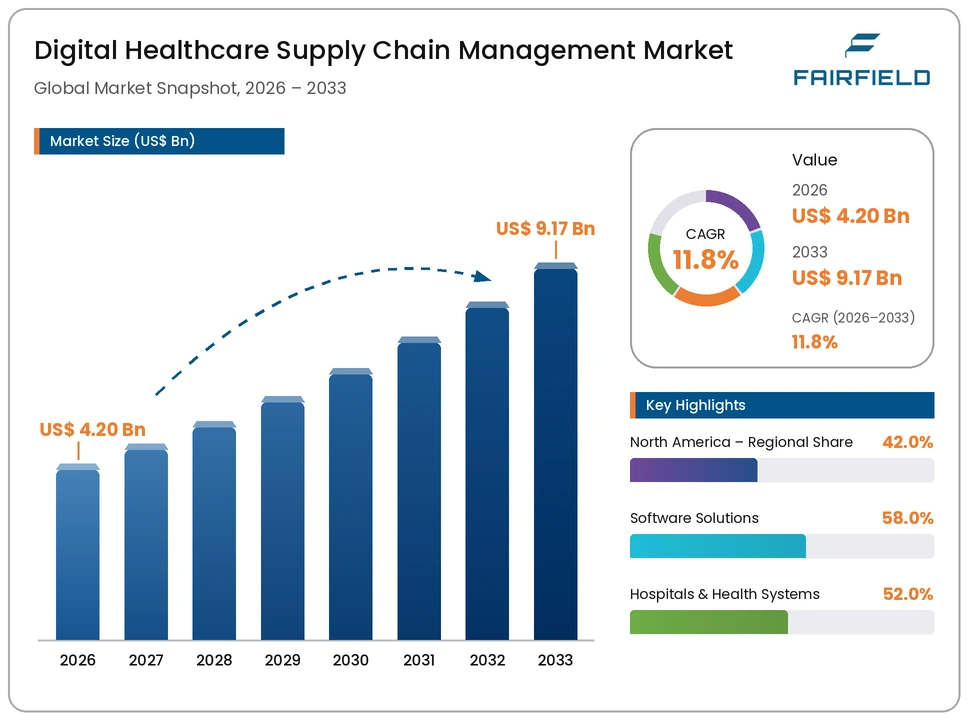
The market is valued at USD 4.20 Billion in 2026, with software providers directing investment toward improved analytics and automation capability that enhances supply chain visibility and procurement efficiency. By 2033, the market is forecast to reach USD 9.17 Billion, reflecting steady growth across established software solution deployment alongside expanding managed services adoption.
Key Highlights
- The global digital healthcare supply chain management market is valued at USD 4.20 Billion in 2026 and is projected to reach USD 9.17 Billion by 2033, expanding at a CAGR of 11.8% across the 2026-2033 forecast period.
- Software Solutions lead the component segment with a 58.0% share in 2026, equivalent to USD 2.44 Billion.
- Hospitals & Health Systems remain the dominant end-user segment, accounting for 52.0% of global demand, or USD 2.18 Billion, in 2026.
- North America commands the largest regional share at 42.0% of the global market in 2026.
- Services are emerging as the fastest-growing component category through 2033.
Market Dynamics
Key Growth Drivers
Growth in the digital healthcare supply chain management market is driven primarily by sustained healthcare provider investment in supply chain visibility and resilience technology, as recent disruption experience continues to prompt hospitals and health systems to prioritize digital supply chain infrastructure.
A second driver is growing pharmaceutical and medical device manufacturer adoption of digital supply chain platforms, as these companies increasingly require robust traceability capability supporting regulatory serialization and compliance requirements.
Key Restraints
The substantial implementation complexity associated with integrating digital supply chain platforms across legacy hospital information systems creates deployment barriers, particularly for smaller and mid-sized health systems.
Additionally, data standardization challenges across diverse healthcare supply chain participants create interoperability barriers that can limit the full realization of end-to-end visibility benefits.
Market Opportunities
The expansion of managed services offerings presents a substantial opportunity, as growing healthcare provider interest in outsourced supply chain management expertise continues to expand demand beyond software licensing alone.
A second opportunity lies in continued advanced analytics and automation technology integration that improves demand forecasting accuracy. Companies that successfully advance this analytics capability stand to capture growing demand as healthcare organizations increasingly seek predictive, automated supply chain management.
Segmentation Analysis
By Component
Software Solutions lead the component segment, accounting for 58.0% of global market value in 2026, equivalent to USD 2.44 Billion. Their leadership reflects the central role of supply chain management platforms in providing the core visibility and automation infrastructure. Services represents the fastest-growing component category through 2033, driven by growing healthcare provider interest in outsourced implementation and management expertise.
By End User
Hospitals & Health Systems form the leading end-user segment, representing 52.0% of global demand in 2026, or USD 2.18 Billion, reflecting these organizations’ substantial procurement volume and supply chain complexity. Pharmaceutical & Medical Device Manufacturers represents the fastest-growing end-user category, propelled by expanding regulatory traceability requirements.
Regional Insights
North America
North America holds the largest regional share, at 42.0% of the global market in 2026, equivalent to USD 1.76 Billion. The region’s dominance reflects substantial healthcare technology investment and well-established digital supply chain platform adoption across the United States and Canada.
Europe
Europe accounts for 26.0% of the global market in 2026, valued at USD 1.09 Billion. Demand is supported by growing regulatory traceability requirements and expanding healthcare digitalization investment across major European markets.
Asia Pacific
Asia Pacific represents 22.0% of the global market in 2026, or USD 0.92 Billion. Growth is underpinned by expanding healthcare infrastructure investment and growing supply chain digitalization across China, Japan, and India.
Latin America
Latin America contributes 6.0% of the global market in 2026, equivalent to USD 0.25 Billion. Growth is linked to expanding healthcare digitalization investment in Brazil and Mexico.
Middle East & Africa
Middle East & Africa holds 4.0% of the global market in 2026, valued at USD 0.17 Billion. Growth remains gradual, tied to expanding regional healthcare technology investment.
Competitive Landscape
The global digital healthcare supply chain management market is moderately concentrated, with a mix of large diversified enterprise software companies and specialized healthcare supply chain platform providers competing for hospital and manufacturer adoption. Competition centers on analytics and automation capability, breadth of integration with existing hospital information systems, and the strength of relationships with healthcare providers and manufacturers. Companies are increasingly differentiating through expanded managed services capability rather than competing on software licensing alone.
Key Market Players
- Oracle Corporation
- SAP SE
- Infor, Inc.
- McKesson Corporation
- Cardinal Health, Inc.
- Global Healthcare Exchange, LLC
- Tecsys Inc.
- Manhattan Associates, Inc.
- Blue Yonder Group, Inc.
- Owens & Minor, Inc.
Market Segmentation
By Component
- Software Solutions
- Services
- Others
By End User
- Hospitals & Health Systems
- Pharmaceutical & Medical Device Manufacturers
- Others
By Deployment
- Cloud-based
- On-premise
By Geography
- North America
- Europe
- Asia Pacific
- Latin America
- Middle East & Africa
1. Executive Summary
1.1 Global Digital Healthcare Supply Chain Management Market Snapshot
1.2 Future Projections
1.3 Key Highlights
1.4 Regional Snapshot by Value 2026
2. Market Overview
2.1 Market Definition and Segmentation
2.2 Market Dynamics
2.2.1 Key Growth Drivers
2.2.2 Key Restraints
2.2.3 Market Opportunities
3. Global Digital Healthcare Supply Chain Management Market Outlook 2026–2033
3.1 Global Digital Healthcare Supply Chain Management Market Outlook, by Component, Value (USD Billion), 2026–2033
3.1.1 Software Solutions
3.1.2 Services
3.1.3 Others
3.2 Global Digital Healthcare Supply Chain Management Market Outlook, by End User, Value (USD Billion), 2026–2033
3.2.1 Hospitals & Health Systems
3.2.2 Pharmaceutical & Medical Device Manufacturers
3.2.3 Others
3.3 Global Digital Healthcare Supply Chain Management Market Outlook, by Deployment, Value (USD Billion), 2026–2033
3.3.1 Cloud-based
3.3.2 On-premise
3.4 Global Digital Healthcare Supply Chain Management Market Outlook, by Region, Value (USD Billion), 2026–2033
3.4.1 North America
3.4.2 Europe
3.4.3 Asia Pacific
3.4.4 Latin America
3.4.5 Middle East & Africa
4. North America Digital Healthcare Supply Chain Management Market Outlook 2026–2033
4.1 North America Digital Healthcare Supply Chain Management Market Outlook, by Component, Value (USD Billion), 2026–2033
4.1.1 Software Solutions
4.1.2 Services
4.1.3 Others
4.2 North America Digital Healthcare Supply Chain Management Market Outlook, by End User, Value (USD Billion), 2026–2033
4.2.1 Hospitals & Health Systems
4.2.2 Pharmaceutical & Medical Device Manufacturers
4.2.3 Others
4.3 North America Digital Healthcare Supply Chain Management Market Outlook, by Deployment, Value (USD Billion), 2026–2033
4.3.1 Cloud-based
4.3.2 On-premise
4.4 North America Digital Healthcare Supply Chain Management Market Outlook, by Country and Subregion, Value (USD Billion), 2026–2033
4.4.1 United States Digital Healthcare Supply Chain Management Market Outlook, by Component, 2026–2033
4.4.2 United States Digital Healthcare Supply Chain Management Market Outlook, by End User, 2026–2033
4.4.3 United States Digital Healthcare Supply Chain Management Market Outlook, by Deployment, 2026–2033
4.4.4 Canada Digital Healthcare Supply Chain Management Market Outlook, by Component, 2026–2033
4.4.5 Canada Digital Healthcare Supply Chain Management Market Outlook, by End User, 2026–2033
4.4.6 Canada Digital Healthcare Supply Chain Management Market Outlook, by Deployment, 2026–2033
5. Europe Digital Healthcare Supply Chain Management Market Outlook 2026–2033
5.1 Europe Digital Healthcare Supply Chain Management Market Outlook, by Component, Value (USD Billion), 2026–2033
5.1.1 Software Solutions
5.1.2 Services
5.1.3 Others
5.2 Europe Digital Healthcare Supply Chain Management Market Outlook, by End User, Value (USD Billion), 2026–2033
5.2.1 Hospitals & Health Systems
5.2.2 Pharmaceutical & Medical Device Manufacturers
5.2.3 Others
5.3 Europe Digital Healthcare Supply Chain Management Market Outlook, by Deployment, Value (USD Billion), 2026–2033
5.3.1 Cloud-based
5.3.2 On-premise
6. Asia Pacific Digital Healthcare Supply Chain Management Market Outlook 2026–2033
6.1 Asia Pacific Digital Healthcare Supply Chain Management Market Outlook, by Component, Value (USD Billion), 2026–2033
6.1.1 Software Solutions
6.1.2 Services
6.1.3 Others
6.2 Asia Pacific Digital Healthcare Supply Chain Management Market Outlook, by End User, Value (USD Billion), 2026–2033
6.2.1 Hospitals & Health Systems
6.2.2 Pharmaceutical & Medical Device Manufacturers
6.2.3 Others
6.3 Asia Pacific Digital Healthcare Supply Chain Management Market Outlook, by Deployment, Value (USD Billion), 2026–2033
6.3.1 Cloud-based
6.3.2 On-premise
6.4 Asia Pacific Digital Healthcare Supply Chain Management Market Outlook, by Country and Subregion, Value (USD Billion), 2026–2033
6.4.1 China Digital Healthcare Supply Chain Management Market Outlook, by Component, 2026–2033
6.4.2 China Digital Healthcare Supply Chain Management Market Outlook, by End User, 2026–2033
6.4.3 China Digital Healthcare Supply Chain Management Market Outlook, by Deployment, 2026–2033
6.4.4 Japan Digital Healthcare Supply Chain Management Market Outlook, by Component, 2026–2033
6.4.5 Japan Digital Healthcare Supply Chain Management Market Outlook, by End User, 2026–2033
6.4.6 Japan Digital Healthcare Supply Chain Management Market Outlook, by Deployment, 2026–2033
6.4.7 India Digital Healthcare Supply Chain Management Market Outlook, by Component, 2026–2033
6.4.8 India Digital Healthcare Supply Chain Management Market Outlook, by End User, 2026–2033
6.4.9 India Digital Healthcare Supply Chain Management Market Outlook, by Deployment, 2026–2033
7. Latin America Digital Healthcare Supply Chain Management Market Outlook 2026–2033
7.1 Latin America Digital Healthcare Supply Chain Management Market Outlook, by Component, Value (USD Billion), 2026–2033
7.1.1 Software Solutions
7.1.2 Services
7.1.3 Others
7.2 Latin America Digital Healthcare Supply Chain Management Market Outlook, by End User, Value (USD Billion), 2026–2033
7.2.1 Hospitals & Health Systems
7.2.2 Pharmaceutical & Medical Device Manufacturers
7.2.3 Others
7.3 Latin America Digital Healthcare Supply Chain Management Market Outlook, by Deployment, Value (USD Billion), 2026–2033
7.3.1 Cloud-based
7.3.2 On-premise
7.4 Latin America Digital Healthcare Supply Chain Management Market Outlook, by Country and Subregion, Value (USD Billion), 2026–2033
7.4.1 Brazil Digital Healthcare Supply Chain Management Market Outlook, by Component, 2026–2033
7.4.2 Brazil Digital Healthcare Supply Chain Management Market Outlook, by End User, 2026–2033
7.4.3 Brazil Digital Healthcare Supply Chain Management Market Outlook, by Deployment, 2026–2033
7.4.4 Mexico Digital Healthcare Supply Chain Management Market Outlook, by Component, 2026–2033
7.4.5 Mexico Digital Healthcare Supply Chain Management Market Outlook, by End User, 2026–2033
7.4.6 Mexico Digital Healthcare Supply Chain Management Market Outlook, by Deployment, 2026–2033
8. Middle East & Africa Digital Healthcare Supply Chain Management Market Outlook 2026–2033
8.1 Middle East & Africa Digital Healthcare Supply Chain Management Market Outlook, by Component, Value (USD Billion), 2026–2033
8.1.1 Software Solutions
8.1.2 Services
8.1.3 Others
8.2 Middle East & Africa Digital Healthcare Supply Chain Management Market Outlook, by End User, Value (USD Billion), 2026–2033
8.2.1 Hospitals & Health Systems
8.2.2 Pharmaceutical & Medical Device Manufacturers
8.2.3 Others
8.3 Middle East & Africa Digital Healthcare Supply Chain Management Market Outlook, by Deployment, Value (USD Billion), 2026–2033
8.3.1 Cloud-based
8.3.2 On-premise
9. Competitive Landscape
9.1 Competitive Positioning and Differentiation
9.2 Company Profiles
9.2.1 Oracle Corporation
9.2.2 SAP SE
9.2.3 Infor, Inc.
9.2.4 McKesson Corporation
9.2.5 Cardinal Health, Inc.
9.2.6 Global Healthcare Exchange, LLC
9.2.7 Tecsys Inc.
9.2.8 Manhattan Associates, Inc.
9.2.9 Blue Yonder Group, Inc.
9.2.10 Owens & Minor, Inc.
10. Appendix
10.1 Research Methodology
10.2 Report Assumptions
10.3 Acronyms and Abbreviations
By Component
- Software Solutions
- Services
- Others
By End User
- Hospitals & Health Systems
- Pharmaceutical & Medical Device Manufacturers
- Others
By Deployment
- Cloud-based
- On-premise
By Geography
- North America
- Europe
- Asia Pacific
- Latin America
- Middle East & Africa
Our Research Methodology
Considering the volatility of business today, traditional approaches to strategizing a game plan can be unfruitful if not detrimental. True ambiguity is no way to determine a forecast. A myriad of predetermined factors must be accounted for such as the degree of risk involved, the magnitude of circumstances, as well as conditions or consequences that are not known or unpredictable. To circumvent binary views that cast uncertainty, the application of market research intelligence to strategically posture, move, and enable actionable outcomes is necessary.
View Methodology
Quality Assured
Rigorous Validation Process

Confidentiality Assured
End-to-end Data Security

Custom Research Services
Tailored To Your Objectives
FAQs
The global digital healthcare supply chain management market is valued at USD 4.20 Billion in 2026, reflecting sustained healthcare provider investment in supply chain resilience technology.
The market is projected to grow at a CAGR of 11.8%, reaching USD 9.17 Billion by 2033, driven by traceability requirements and analytics technology advancement.
Software Solutions lead with a 58.0% share in 2026, reflecting their central role in supply chain visibility infrastructure.
North America leads with a 42.0% share in 2026, reflecting substantial healthcare technology investment.
The largest opportunity lies in services, expanding alongside demand for outsourced implementation expertise.
Related Reports
2D Barcode Reader Market Size, Share, Insights, Competitive Landscape, and Forecast 2026 to 2033
The global 2D barcode reader market is valued at US$4.8 billion in 2026, reaching US$8.6 billion by 2033, growing at an 8.7% CAGR
Tunnel Construction Market Size, Share, Insights, Competitive Landscape, and Forecast 2026 to 2033
The global tunnel construction market is valued at US$29.52 billion in 2026, reaching US$47.09 billion by 2033, growing at a 6.9% CAGR
Sports Analytics Market Size, Share, Insights, Competitive Landscape, and Forecast 2026 to 2033
The global sports analytics market is valued at US$7.06 billion in 2026, reaching US$23.15 billion by 2033, growing at an 18.5% CAGR
Distributed Acoustic Sensing Market Size, Share, Insights, Competitive Landscape, and Forecast 2026 to 2033
The global distributed acoustic sensing market is valued at US$0.565 billion in 2026, reaching US$1.173 billion by 2033, growing at an 11.0% CAGR
Secure Flash Drive Market Size, Share, Insights, Competitive Landscape, and Forecast 2026 to 2033
The global secure flash drive market is valued at US$0.8 billion in 2026, reaching US$1.1 billion by 2033, growing at a 4.7% CAGR
Optical I/O for AI Chips Market Size, Share, Insights, Competitive Landscape, and Forecast 2026 to 2033
The global optical I/O for AI chips market is valued at US$1.6 billion in 2026, reaching US$14.5 billion by 2033, growing at a 37.01% CAGR