



eCTOL Aircraft Market
eCTOL Aircraft Market Size, Share, Insights, Competitive Landscape, and Forecast 2026 to 2033
eCTOL Aircraft Market Size, Share, Insights, Competitive Landscape, and Forecast 2026 to 2033
How Fast Is the eCTOL Aircraft Market Growing?
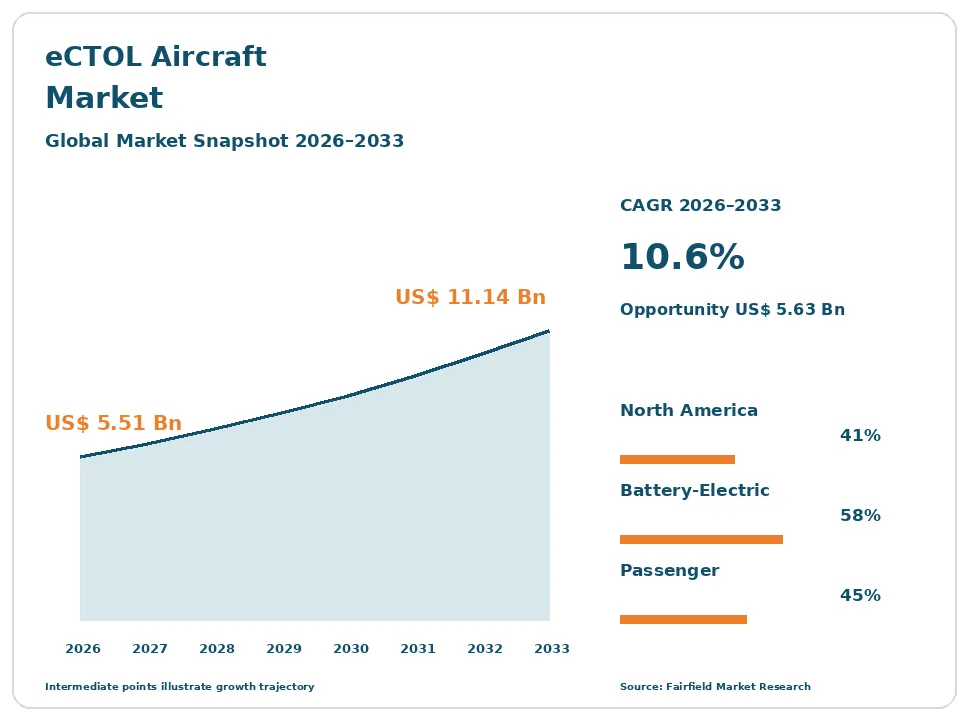
The global eCTOL aircraft market size is expected to be valued at US$ 5.51 billion in 2026 and projected to reach US$ 11.14 billion by 2033, growing at a CAGR of 10.6% between 2026 and 2033.
Between 2020 and 2025, the market grew at a CAGR of about 8.5%, rising from early prototypes and small electric trainers to larger demonstrators, airline orders, and certification programs. Electric conventional takeoff and landing aircraft use runways like normal airplanes but replace or support combustion engines with batteries, electric motors, and hybrid power systems. Because they fly on wings rather than rotors, they carry more payload over longer distances than many vertical-lift designs and can use thousands of existing small airports. Growth comes from airline decarbonization targets, rising fuel costs, demand for regional air mobility, and cargo operators seeking cheaper short routes. The market is shifting from technology demonstrations toward certified electric aircraft and hybrid-electric models. In August 2026, Heart Aerospace flew its X1 demonstrator, described as the largest battery-electric aircraft ever flown, a key step for the sector.
Key Report Takeaways
- By Propulsion: Battery-Electric held 58.0% share in 2026, while Hybrid-Electric is projected to expand at a 12.0% CAGR through 2033, driven by longer range needs, larger regional aircraft, and airline programs such as the Heart Aerospace ES-30.
- By Application: Passenger held 45.0% share in 2026, while Cargo & Logistics is projected to expand at a 12.5% CAGR through 2033, driven by express parcel operators, medical supply routes, and lower operating costs on short flights.
- By Range: 0-200 km held 55.0% share in 2026, while 200-500 km is projected to expand at a 11.8% CAGR through 2033, driven by better batteries and hybrid systems that extend practical regional air mobility routes.
- By Region: North America held 41.0% share in 2026, while Asia Pacific is projected to expand at a 12.4% CAGR through 2033, driven by island and regional connectivity needs, new air mobility programs, and manufacturing growth in China, Japan, and India.
Global eCTOL Aircraft Market Trends and Insights
Drivers Impact Analysis
| Driver | Impact on CAGR Forecast | Geographic Relevance | Impact Timeline |
| Aviation decarbonization and lower operating costs | High | Global | Long term (≥4 years) |
| Regional air mobility and cargo demand | High | North America, Europe, Asia Pacific | Medium term (2-4 years) |
Two drivers carry the strongest influence on eCTOL aircraft demand during the forecast period.
Aviation Decarbonization Is Driving the eCTOL Aircraft Market
Aviation decarbonization and lower operating costs are the strongest driver of the eCTOL aircraft market. Airlines must cut emissions while controlling costs.
The mechanism is policy pressure combined with simple economics. Airlines and governments have committed to net-zero aviation targets, and short flights produce high emissions per passenger. Electric aircraft produce no direct emissions in battery mode and far lower emissions in hybrid mode. Electricity is cheaper than jet fuel, and electric motors have fewer moving parts, cutting maintenance costs by large margins. Lower noise allows operations at more airports and at more hours. United Airlines, Air Canada, and Air New Zealand have invested in or ordered electric and hybrid regional aircraft. Government programs in the United States, Norway, and the United Kingdom fund research and early routes. These pressures push operators toward electric conventional takeoff and landing aircraft for short routes.
Regional Air Mobility Is Expanding the eCTOL Aircraft Market
Regional air mobility and cargo demand are expanding the eCTOL aircraft market. Short routes between smaller cities are ready for new aircraft.
The cause is underused airports and costly regional flying. Many small airports lost scheduled air service because conventional regional aircraft are expensive to operate. Regional air mobility plans use quiet, low-cost electric aircraft to restore service on routes of 50 to 500 km. Cargo operators see a fast path, since freight flights face fewer certification hurdles than passenger flights. BETA Technologies has worked with UPS, medical networks, and the U.S. Air Force on its CX300 aircraft. Flight schools use electric trainers such as the Pipistrel Velis Electro to cut training costs. Island and coastal routes in Norway, Scotland, and the remote islands of New Zealand are natural early markets. These uses create early demand, flight data, and revenue.
Restraints Impact Analysis
| Restraint | Impact on CAGR Forecast | Geographic Relevance | Impact Timeline |
| Battery energy density and range limits | High | Global | Long term (≥4 years) |
| Certification complexity and charging infrastructure gaps | High | Global | Medium term (2-4 years) |
Two restraints limit how quickly the eCTOL aircraft market grows.
Battery Limits Slow the eCTOL Aircraft Market
Battery energy density and range limits slow the eCTOL aircraft market. Batteries store far less energy than jet fuel.
The specific causes are weight and physics. Today’s aviation batteries store only a small fraction of the energy of the same weight of kerosene, which limits range, payload, and the number of seats. Reserve requirements for diversions and holding further reduce usable range. Batteries lose capacity over time and need replacement, adding to lifecycle cost. Cold weather lowers battery performance. Thermal runaway risk demands heavy protection systems. These constraints restrict battery-electric aircraft to small sizes and short routes, pushing many manufacturers toward hybrid designs and slowing the timeline for larger all-electric airliners. Progress in solid-state and lithium-sulfur cells may help, but most experts expect gradual rather than sudden gains during the forecast period.
Certification and Infrastructure Gaps Restrict the eCTOL Aircraft Market
Certification complexity and charging infrastructure gaps restrict the eCTOL aircraft market. New technology takes time to approve.
The underlying causes are new rules and missing equipment. Aviation regulators such as the Federal Aviation Administration and the European Union Aviation Safety Agency are still developing standards for electric propulsion, high-voltage systems, and battery safety. Certification programs can take many years and cost hundreds of millions of dollars. Several startups, including Eviation, have paused or slowed programs due to funding gaps. Airports need high-power chargers, grid upgrades, and trained staff, which few smaller airports have. Pilot training standards and maintenance rules for high-voltage systems are also still forming. Insurance providers lack long safety records to price risk. These hurdles delay commercial service, raise costs, and push back investor returns.
Market Opportunities
Hybrid-Electric Regional Aircraft Open a Large Revenue Pool
Hybrid-electric regional aircraft open a large revenue pool in the eCTOL aircraft market. Hybrids bridge today’s battery limits.
Manufacturers and airlines can capture this opportunity. Hybrid aircraft combine batteries with small turbine generators or fuel cells, allowing longer range and larger cabins while cutting fuel use sharply. Heart Aerospace targets entry into service for its 30-seat ES-30 in 2031, and Electra.aero is developing hybrid-electric short-takeoff aircraft. Airlines such as United Airlines and Air Canada have placed conditional orders. Hybrid designs can use sustainable aviation fuel to cut emissions further. Hybrid aircraft can also be upgraded with better batteries over time, extending their useful life. Leasing companies are showing interest in financing early fleets. Companies that certify reliable hybrid aircraft first can win large regional fleet orders.
Cargo, Defense, and Training Create Early-Adoption Revenue Pools
Cargo, defense, and training create early-adoption revenue pools in the eCTOL aircraft market. These users accept new aircraft sooner.
Aircraft makers and service providers can capture this opportunity. Cargo operators can fly electric aircraft at night between regional hubs with fewer passenger-safety requirements. Defense agencies test electric aircraft for logistics, low-noise surveillance, and base-to-base transport. Flight schools adopt electric trainers to cut fuel and maintenance costs and reduce noise near airports. Medical networks use small electric aircraft to move organs, blood, and urgent supplies quickly between hospitals. Surveying, aerial mapping, border patrol, and pipeline inspection add further niche uses. Companies that serve these niches can earn revenue, build safety records, and gather flight data before passenger certification is complete, strengthening their position for later airline sales.
Segment Analysis
By Propulsion: Battery-Electric Leads While Hybrid-Electric Grows Fastest
Battery-Electric held 58.0% share in 2026. Battery-electric aircraft include trainers, small utility aircraft, and short-range cargo designs such as the BETA CX300 and Pipistrel Velis Electro. They offer the lowest operating costs, zero direct emissions, and simple propulsion systems, making them ideal for short missions and flight training.
Hybrid-Electric is the fastest-growing propulsion type, expanding at a 12.0% CAGR through 2033. Hybrid systems extend range and allow larger aircraft for regional routes. Heart Aerospace, Electra.aero, and Ampaire focus on hybrid designs. Hydrogen-electric and fuel-cell aircraft, led by ZeroAvia, form an emerging category. For the market, hybrid growth extends the reach of electric aircraft to regional airline networks.
By Application: Passenger Leads While Cargo & Logistics Grows Fastest
Passenger held 45.0% share in 2026. Regional and commuter passenger flights are the main long-term target, supported by airline orders and government programs for small-airport service. Training flights also count as a major passenger-carrying use. Airlines including United Airlines, Air Canada, and Air New Zealand have signaled interest in electric regional passenger aircraft.
Cargo & Logistics is the fastest-growing application, expanding at a 12.5% CAGR through 2033. Express parcel, medical, and mail operators value low costs and quiet night operations. Cargo routes face simpler certification, and night flights benefit from low noise. BETA Technologies has tested cargo missions with UPS and medical partners. Emergency and medical services and other commercial missions are additional applications. For the market, cargo growth creates an early revenue base.
By Range: 0-200 km Leads While 200-500 km Grows Fastest
0-200 km held 55.0% share in 2026. Short routes match current battery capacity, including training flights, island hops, short cargo runs, and medical transfers. Most certified and near-certified electric aircraft operate in this range today, and charging between flights is easier on short sectors.
200-500 km is the fastest-growing range, expanding at a 11.8% CAGR through 2033. Better batteries and hybrid power open longer regional routes between secondary cities. Many regional city pairs in North America, Europe, and Asia Pacific fall in this distance band, where electric aircraft can compete with road and rail travel times. Routes above 500 km remain limited to hybrid designs. For the market, longer range expands the routes eCTOL aircraft can serve.
Geography Analysis
Which Region Is Leading the eCTOL Aircraft Market?
North America is leading the eCTOL aircraft market with a 41.0% share in 2026. The United States hosts BETA Technologies, Electra.aero, Ampaire, and Heart Aerospace’s U.S. operations, along with strong venture funding and defense support. The Federal Aviation Administration is developing rules and pilot programs for electric aircraft, and United Airlines has invested in electric regional aircraft. Canada adds demand, with Air Canada ordering hybrid aircraft and Harbour Air testing electric seaplanes. Strong defense interest, including U.S. Air Force programs, helps fund testing. Key barriers include certification timelines. One change shaping the region is cargo and defense adoption.
Europe Advances the eCTOL Aircraft Market Through Green Aviation Policy
Europe is a major eCTOL aircraft market. Sweden, Norway, the United Kingdom, France, Germany, and Slovenia are active, with Pipistrel producing the first certified electric aircraft. Norway plans to electrify short domestic flights, and European Union climate policy supports clean aviation research. Heart Aerospace, based in Sweden, has strong ties to airlines in Sweden and Norway, and Vertical Aerospace and ZeroAvia are active in the United Kingdom. Several startups develop hybrid and hydrogen-electric aircraft. Key barriers include funding gaps and slow airport infrastructure. One opportunity is short regional routes across fjord, coastal, and island networks.
Which Region Is Growing Fastest in the eCTOL Aircraft Market?
Asia Pacific is growing fastest in the eCTOL aircraft market at a 12.4% CAGR through 2033. China is investing heavily in electric aviation and battery supply chains, while Japan, South Korea, and Australia support new air mobility programs. New Zealand, through Air New Zealand, plans electric cargo and passenger flights. India and Indonesia have many islands and remote regions needing affordable air links. Chinese firms are testing electric fixed-wing aircraft and large cargo drones at scale, supported by local battery makers. Key barriers include regulatory readiness. One change shaping the region is battery manufacturing scale.
Latin America Develops the eCTOL Aircraft Market Through Regional Connectivity
Latin America is an emerging eCTOL aircraft market. Brazil, home to Embraer, is developing electric and hybrid aircraft concepts and has a large network of small airports. Mexico, Chile, and Colombia have remote communities and mountainous terrain where short regional flights save travel time. Flight schools are exploring electric trainers to cut costs. Mining and agricultural regions could use small electric aircraft for crew transport and logistics. Several regional airlines in Brazil serve small cities where lower operating costs could restore routes. Key barriers include limited funding and infrastructure. One opportunity is regional connectivity for underserved towns.
Middle East & Africa Explores the eCTOL Aircraft Market Through Innovation Programs
Middle East & Africa is an emerging eCTOL aircraft market. The United Arab Emirates and Saudi Arabia invest in advanced air mobility and clean aviation as part of diversification plans. South Africa and Kenya have interest in electric aircraft for training, medical delivery, and remote access. Desert and remote mining regions also need low-cost, reliable logistics flights between sites. Key barriers include high temperatures that stress batteries and limited charging networks. Large distances between towns and limited road networks in parts of the region create demand for affordable air links. One change shaping the region is government-backed pilot programs.
Competitive Landscape
The eCTOL aircraft market is fragmented. BETA Technologies, Heart Aerospace, Pipistrel, Electra.aero, and Ampaire are leading developers, while Eviation, Bye Aerospace, Textron Aviation, Embraer, ZeroAvia, Harbour Air, and Joby Aviation are active in electric and hybrid fixed-wing programs. Many startups are still in testing, and some programs have been delayed or cancelled due to funding shortages, which keeps the field shifting.
Companies compete on certification progress, range, payload, cost, safety, and funding. Strong orders and partnerships with airlines help secure financing. Partnerships with battery makers, motor suppliers, and established aerospace firms provide technology and manufacturing support. Public listings, such as the BETA Technologies listing on the New York Stock Exchange, and government grants also provide capital.
Strategic moves show how competition is changing. In July 2026, BETA Technologies flew its CX300 at the Farnborough airshow. In August 2026, Heart Aerospace completed the first flight of its X1 demonstrator. In September 2026, Heart Aerospace announced a new ES-36 aircraft and a 100-aircraft order from JSX. These moves show competition shifting from design studies toward flight testing, certification milestones, and firm airline orders. Developers that reach these milestones first gain credibility with airlines, lessors, and investors.
Three themes shape vendor strategy. First, companies are moving to hybrid designs to extend range and seat capacity. Second, they are targeting cargo, training, and defense missions for early revenue. Third, they are raising capital through public listings, strategic investors, and airline partners.
eCTOL Aircraft Market Industry Leaders
- BETA Technologies
- Heart Aerospace
- Pipistrel
- Electra.aero
- Ampaire
Recent Industry Developments
- September 2026: Heart Aerospace announced the ES-36 hybrid-electric aircraft with more payload and an order for 100 aircraft from JSX - strengthens commercial demand for electric aircraft.
- August 2026: Heart Aerospace completed the first flight of its X1 demonstrator at Plattsburgh, described as the largest battery-electric aircraft ever flown - advances regional air mobility testing.
- July 2026: BETA Technologies flew its all-electric Alia CX300 in the Farnborough airshow flying display - raises visibility for electric conventional takeoff and landing aircraft.
Companies Covered in the Report
- BETA Technologies
- Heart Aerospace
- Pipistrel
- Electra.aero
- Ampaire
- Eviation
- Bye Aerospace
- Textron Aviation
- Embraer
- ZeroAvia
- Harbour Air
- Joby Aviation
eCTOL Aircraft Market Report Scope
This report covers electric conventional takeoff and landing aircraft, including battery-electric and hybrid-electric fixed-wing aircraft, across passenger, cargo and logistics, emergency and medical, and other commercial applications, with ranges from below 200 km to above 500 km. The base year is 2025, and the forecast period runs from 2026 to 2033. All values are expressed in US$ Billion.
Propulsion
- Battery-Electric
- Hybrid-Electric
- Others
Application
- Passenger
- Cargo & Logistics
- Emergency & Medical
- Other Commercial
Range
- 0-200 km
- 200-500 km
- Above 500 km
Regions
- North America
- Europe
- Asia Pacific
- Latin America
- Middle East & Africa
Key Questions Answered in the Report
How big is the eCTOL aircraft market in 2026?
The eCTOL aircraft market is valued at US$ 5.51 billion in 2026, led by battery-electric aircraft and North America.
What is the eCTOL aircraft market forecast to 2033?
The market is projected to reach US$ 11.14 billion by 2033, growing at a 10.6% CAGR and adding US$ 5.63 billion.
Which application is growing fastest in the eCTOL aircraft market?
Cargo & Logistics is growing fastest at a 12.5% CAGR through 2033, driven by low-cost, quiet regional freight and medical flights.
Which region is growing fastest in the eCTOL aircraft market?
Asia Pacific is growing fastest at a 12.4% CAGR through 2033, driven by air mobility programs and battery supply chains in China.
Which region holds the largest eCTOL aircraft market share?
North America holds the largest share at 41.0% in 2026, supported by leading developers, defense support, and airline investment.
1. Executive Summary
1.1. Global eCTOL Aircraft Market Snapshot
1.2. Future Projections
1.3. Key Report Takeaways
1.4. Regional Snapshot
2. Market Overview
2.1. Market Definition and Report Scope
2.2. Historical Trends 2020–2025
2.3. Market Dynamics
2.3.1. Drivers
2.3.1.1. Aviation Decarbonization Is Driving the eCTOL Aircraft Market
2.3.1.2. Regional Air Mobility Is Expanding the eCTOL Aircraft Market
2.3.2. Restraints
2.3.2.1. Battery Limits Slow the eCTOL Aircraft Market
2.3.2.2. Certification and Infrastructure Gaps Restrict the eCTOL Aircraft Market
2.3.3. Market Opportunities
2.3.3.1. Hybrid-Electric Regional Aircraft Open a Large Revenue Pool
2.3.3.2. Cargo, Defense, and Training Create Early-Adoption Revenue Pools
3. Global eCTOL Aircraft Market Outlook, 2020-2033
3.1. Global eCTOL Aircraft Market Outlook, by Propulsion, Value (US$ Billion), 2020-2033
3.1.1. Battery-Electric
3.1.2. Hybrid-Electric
3.1.3. Others
3.2. Global eCTOL Aircraft Market Outlook, by Application, Value (US$ Billion), 2020-2033
3.2.1. Passenger
3.2.2. Cargo & Logistics
3.2.3. Emergency & Medical
3.2.4. Other Commercial
3.3. Global eCTOL Aircraft Market Outlook, by Range, Value (US$ Billion), 2020-2033
3.3.1. 0-200 km
3.3.2. 200-500 km
3.3.3. Above 500 km
3.4. Global eCTOL Aircraft Market Outlook, by Region, Value (US$ Billion), 2020-2033
3.4.1. North America
3.4.2. Europe
3.4.3. Asia Pacific
3.4.4. Latin America
3.4.5. Middle East & Africa
4. North America eCTOL Aircraft Market Outlook, 2020-2033
4.1. North America eCTOL Aircraft Market Outlook, by Propulsion, Value (US$ Billion), 2020-2033
4.1.1. Battery-Electric
4.1.2. Hybrid-Electric
4.1.3. Others
4.2. North America eCTOL Aircraft Market Outlook, by Application, Value (US$ Billion), 2020-2033
4.2.1. Passenger
4.2.2. Cargo & Logistics
4.2.3. Emergency & Medical
4.2.4. Other Commercial
4.3. North America eCTOL Aircraft Market Outlook, by Range, Value (US$ Billion), 2020-2033
4.3.1. 0-200 km
4.3.2. 200-500 km
4.3.3. Above 500 km
4.4. North America eCTOL Aircraft Market Outlook, by Country, Value (US$ Billion), 2020-2033
4.4.1. United States eCTOL Aircraft Market Outlook, by Propulsion, 2020-2033
4.4.2. United States eCTOL Aircraft Market Outlook, by Application, 2020-2033
4.4.3. United States eCTOL Aircraft Market Outlook, by Range, 2020-2033
4.4.4. Canada eCTOL Aircraft Market Outlook, by Propulsion, 2020-2033
4.4.5. Canada eCTOL Aircraft Market Outlook, by Application, 2020-2033
4.4.6. Canada eCTOL Aircraft Market Outlook, by Range, 2020-2033
5. Europe eCTOL Aircraft Market Outlook, 2020-2033
5.1. Europe eCTOL Aircraft Market Outlook, by Propulsion, Value (US$ Billion), 2020-2033
5.1.1. Battery-Electric
5.1.2. Hybrid-Electric
5.1.3. Others
5.2. Europe eCTOL Aircraft Market Outlook, by Application, Value (US$ Billion), 2020-2033
5.2.1. Passenger
5.2.2. Cargo & Logistics
5.2.3. Emergency & Medical
5.2.4. Other Commercial
5.3. Europe eCTOL Aircraft Market Outlook, by Range, Value (US$ Billion), 2020-2033
5.3.1. 0-200 km
5.3.2. 200-500 km
5.3.3. Above 500 km
5.4. Europe eCTOL Aircraft Market Outlook, by Country, Value (US$ Billion), 2020-2033
5.4.1. Sweden eCTOL Aircraft Market Outlook, by Propulsion, 2020-2033
5.4.2. Sweden eCTOL Aircraft Market Outlook, by Application, 2020-2033
5.4.3. Sweden eCTOL Aircraft Market Outlook, by Range, 2020-2033
5.4.4. Norway eCTOL Aircraft Market Outlook, by Propulsion, 2020-2033
5.4.5. Norway eCTOL Aircraft Market Outlook, by Application, 2020-2033
5.4.6. Norway eCTOL Aircraft Market Outlook, by Range, 2020-2033
5.4.7. United Kingdom eCTOL Aircraft Market Outlook, by Propulsion, 2020-2033
5.4.8. United Kingdom eCTOL Aircraft Market Outlook, by Application, 2020-2033
5.4.9. United Kingdom eCTOL Aircraft Market Outlook, by Range, 2020-2033
5.4.10. France eCTOL Aircraft Market Outlook, by Propulsion, 2020-2033
5.4.11. France eCTOL Aircraft Market Outlook, by Application, 2020-2033
5.4.12. France eCTOL Aircraft Market Outlook, by Range, 2020-2033
5.4.13. Germany eCTOL Aircraft Market Outlook, by Propulsion, 2020-2033
5.4.14. Germany eCTOL Aircraft Market Outlook, by Application, 2020-2033
5.4.15. Germany eCTOL Aircraft Market Outlook, by Range, 2020-2033
5.4.16. Slovenia eCTOL Aircraft Market Outlook, by Propulsion, 2020-2033
5.4.17. Slovenia eCTOL Aircraft Market Outlook, by Application, 2020-2033
5.4.18. Slovenia eCTOL Aircraft Market Outlook, by Range, 2020-2033
6. Asia Pacific eCTOL Aircraft Market Outlook, 2020-2033
6.1. Asia Pacific eCTOL Aircraft Market Outlook, by Propulsion, Value (US$ Billion), 2020-2033
6.1.1. Battery-Electric
6.1.2. Hybrid-Electric
6.1.3. Others
6.2. Asia Pacific eCTOL Aircraft Market Outlook, by Application, Value (US$ Billion), 2020-2033
6.2.1. Passenger
6.2.2. Cargo & Logistics
6.2.3. Emergency & Medical
6.2.4. Other Commercial
6.3. Asia Pacific eCTOL Aircraft Market Outlook, by Range, Value (US$ Billion), 2020-2033
6.3.1. 0-200 km
6.3.2. 200-500 km
6.3.3. Above 500 km
6.4. Asia Pacific eCTOL Aircraft Market Outlook, by Country, Value (US$ Billion), 2020-2033
6.4.1. China eCTOL Aircraft Market Outlook, by Propulsion, 2020-2033
6.4.2. China eCTOL Aircraft Market Outlook, by Application, 2020-2033
6.4.3. China eCTOL Aircraft Market Outlook, by Range, 2020-2033
6.4.4. Japan eCTOL Aircraft Market Outlook, by Propulsion, 2020-2033
6.4.5. Japan eCTOL Aircraft Market Outlook, by Application, 2020-2033
6.4.6. Japan eCTOL Aircraft Market Outlook, by Range, 2020-2033
6.4.7. South Korea eCTOL Aircraft Market Outlook, by Propulsion, 2020-2033
6.4.8. South Korea eCTOL Aircraft Market Outlook, by Application, 2020-2033
6.4.9. South Korea eCTOL Aircraft Market Outlook, by Range, 2020-2033
6.4.10. Australia eCTOL Aircraft Market Outlook, by Propulsion, 2020-2033
6.4.11. Australia eCTOL Aircraft Market Outlook, by Application, 2020-2033
6.4.12. Australia eCTOL Aircraft Market Outlook, by Range, 2020-2033
6.4.13. New Zealand eCTOL Aircraft Market Outlook, by Propulsion, 2020-2033
6.4.14. New Zealand eCTOL Aircraft Market Outlook, by Application, 2020-2033
6.4.15. New Zealand eCTOL Aircraft Market Outlook, by Range, 2020-2033
6.4.16. India eCTOL Aircraft Market Outlook, by Propulsion, 2020-2033
6.4.17. India eCTOL Aircraft Market Outlook, by Application, 2020-2033
6.4.18. India eCTOL Aircraft Market Outlook, by Range, 2020-2033
6.4.19. Indonesia eCTOL Aircraft Market Outlook, by Propulsion, 2020-2033
6.4.20. Indonesia eCTOL Aircraft Market Outlook, by Application, 2020-2033
6.4.21. Indonesia eCTOL Aircraft Market Outlook, by Range, 2020-2033
7. Latin America eCTOL Aircraft Market Outlook, 2020-2033
7.1. Latin America eCTOL Aircraft Market Outlook, by Propulsion, Value (US$ Billion), 2020-2033
7.1.1. Battery-Electric
7.1.2. Hybrid-Electric
7.1.3. Others
7.2. Latin America eCTOL Aircraft Market Outlook, by Application, Value (US$ Billion), 2020-2033
7.2.1. Passenger
7.2.2. Cargo & Logistics
7.2.3. Emergency & Medical
7.2.4. Other Commercial
7.3. Latin America eCTOL Aircraft Market Outlook, by Range, Value (US$ Billion), 2020-2033
7.3.1. 0-200 km
7.3.2. 200-500 km
7.3.3. Above 500 km
7.4. Latin America eCTOL Aircraft Market Outlook, by Country, Value (US$ Billion), 2020-2033
7.4.1. Brazil eCTOL Aircraft Market Outlook, by Propulsion, 2020-2033
7.4.2. Brazil eCTOL Aircraft Market Outlook, by Application, 2020-2033
7.4.3. Brazil eCTOL Aircraft Market Outlook, by Range, 2020-2033
7.4.4. Mexico eCTOL Aircraft Market Outlook, by Propulsion, 2020-2033
7.4.5. Mexico eCTOL Aircraft Market Outlook, by Application, 2020-2033
7.4.6. Mexico eCTOL Aircraft Market Outlook, by Range, 2020-2033
7.4.7. Chile eCTOL Aircraft Market Outlook, by Propulsion, 2020-2033
7.4.8. Chile eCTOL Aircraft Market Outlook, by Application, 2020-2033
7.4.9. Chile eCTOL Aircraft Market Outlook, by Range, 2020-2033
7.4.10. Colombia eCTOL Aircraft Market Outlook, by Propulsion, 2020-2033
7.4.11. Colombia eCTOL Aircraft Market Outlook, by Application, 2020-2033
7.4.12. Colombia eCTOL Aircraft Market Outlook, by Range, 2020-2033
8. Middle East & Africa eCTOL Aircraft Market Outlook, 2020-2033
8.1. Middle East & Africa eCTOL Aircraft Market Outlook, by Propulsion, Value (US$ Billion), 2020-2033
8.1.1. Battery-Electric
8.1.2. Hybrid-Electric
8.1.3. Others
8.2. Middle East & Africa eCTOL Aircraft Market Outlook, by Application, Value (US$ Billion), 2020-2033
8.2.1. Passenger
8.2.2. Cargo & Logistics
8.2.3. Emergency & Medical
8.2.4. Other Commercial
8.3. Middle East & Africa eCTOL Aircraft Market Outlook, by Range, Value (US$ Billion), 2020-2033
8.3.1. 0-200 km
8.3.2. 200-500 km
8.3.3. Above 500 km
8.4. Middle East & Africa eCTOL Aircraft Market Outlook, by Country, Value (US$ Billion), 2020-2033
8.4.1. United Arab Emirates eCTOL Aircraft Market Outlook, by Propulsion, 2020-2033
8.4.2. United Arab Emirates eCTOL Aircraft Market Outlook, by Application, 2020-2033
8.4.3. United Arab Emirates eCTOL Aircraft Market Outlook, by Range, 2020-2033
8.4.4. Saudi Arabia eCTOL Aircraft Market Outlook, by Propulsion, 2020-2033
8.4.5. Saudi Arabia eCTOL Aircraft Market Outlook, by Application, 2020-2033
8.4.6. Saudi Arabia eCTOL Aircraft Market Outlook, by Range, 2020-2033
8.4.7. South Africa eCTOL Aircraft Market Outlook, by Propulsion, 2020-2033
8.4.8. South Africa eCTOL Aircraft Market Outlook, by Application, 2020-2033
8.4.9. South Africa eCTOL Aircraft Market Outlook, by Range, 2020-2033
8.4.10. Kenya eCTOL Aircraft Market Outlook, by Propulsion, 2020-2033
8.4.11. Kenya eCTOL Aircraft Market Outlook, by Application, 2020-2033
8.4.12. Kenya eCTOL Aircraft Market Outlook, by Range, 2020-2033
9. Competitive Landscape
9.1. Market Concentration and Industry Leaders
9.2. Competitive Differentiation
9.3. Strategic Moves and Market Direction
9.4. Recent Industry Developments
9.5. Company Profiles
9.5.1. BETA Technologies
9.5.2. Heart Aerospace
9.5.3. Pipistrel
9.5.4. Electra.aero
9.5.5. Ampaire
9.5.6. Eviation
9.5.7. Bye Aerospace
9.5.8. Textron Aviation
9.5.9. Embraer
9.5.10. ZeroAvia
9.5.11. Harbour Air
9.5.12. Joby Aviation
10. Appendix
10.1. Research Methodology
10.2. Report Assumptions
10.3. Acronyms and Abbreviations
| Propulsion | Battery-Electric, Hybrid-Electric, Others |
| Application | Passenger, Cargo & Logistics, Emergency & Medical, Other Commercial |
| Range | 0-200 km, 200-500 km, Above 500 km |
| Regions | North America, Europe, Asia Pacific, Latin America, Middle East & Africa |
Our Research Methodology
Considering the volatility of business today, traditional approaches to strategizing a game plan can be unfruitful if not detrimental. True ambiguity is no way to determine a forecast. A myriad of predetermined factors must be accounted for such as the degree of risk involved, the magnitude of circumstances, as well as conditions or consequences that are not known or unpredictable. To circumvent binary views that cast uncertainty, the application of market research intelligence to strategically posture, move, and enable actionable outcomes is necessary.
View Methodology
Quality Assured
Rigorous Validation Process

Confidentiality Assured
End-to-end Data Security

Custom Research Services
Tailored To Your Objectives
FAQs
The eCTOL aircraft market is valued at US$ 5.51 billion in 2026, led by battery-electric aircraft and North America.
The market is projected to reach US$ 11.14 billion by 2033, growing at a 10.6% CAGR and adding US$ 5.63 billion.
Cargo & Logistics is growing fastest at a 12.5% CAGR through 2033, driven by low-cost, quiet regional freight and medical flights.
Asia Pacific is growing fastest at a 12.4% CAGR through 2033, driven by air mobility programs and battery supply chains in China.
North America holds the largest share at 41.0% in 2026, supported by leading developers, defense support, and airline investment.
Related Reports
Container Fleet Market Size, Share, Insights, Competitive Landscape, and Forecast 2026 to 2033
Explore the container fleet market, projected to reach US$ 26.8 billion by 2033 at a 5.4% CAGR, with container types, ownership and regional insights.
Micro-mobility Charging Infrastructure Market Size, Share, Insights, Competitive Landscape, and Forecast 2026 to 2033
The global micro-mobility charging infrastructure market is valued at US$9.06 billion in 2026, reaching US$34.02 billion by 2033, growing at a 20.8% CAGR
Smart EV Charging Networks Market Size, Share, Insights, Competitive Landscape, and Forecast 2026 to 2033
The global smart EV charging networks market is valued at US$9.43 billion in 2026, reaching US$37.07 billion by 2033, growing at a 21.6% CAGR
Ultra High Performance Tire Market Size, Share, Insights, Competitive Landscape, and Forecast 2026 to 2033
The global ultra high performance tire market is valued at US$18.65 billion in 2026, reaching US$38.97 billion by 2033, growing at an 11.1% CAGR
Small Parcels Delivery Market Size, Share, Insights, Competitive Landscape, and Forecast 2026 to 2033
Explore the small parcels delivery market, forecast to reach US$957.5 billion by 2033 at 7.3% CAGR, with service, shipment weight and regional insights.
Advanced Aerial Mobility Market Size, Share, Insights, Competitive Landscape, and Forecast 2026 to 2033
The global advanced aerial mobility market is valued at US$18.51 billion in 2026, reaching US$90.75 billion by 2033, growing at a 25.5% CAGR