



Ultra High Performance Tire Market
Ultra High Performance Tire Market Size, Share, Insights, Competitive Landscape, and Forecast 2026 to 2033
Ultra High Performance Tire Market Size and Trend Analysis
How Fast Is the Ultra High Performance Tire Market Growing?
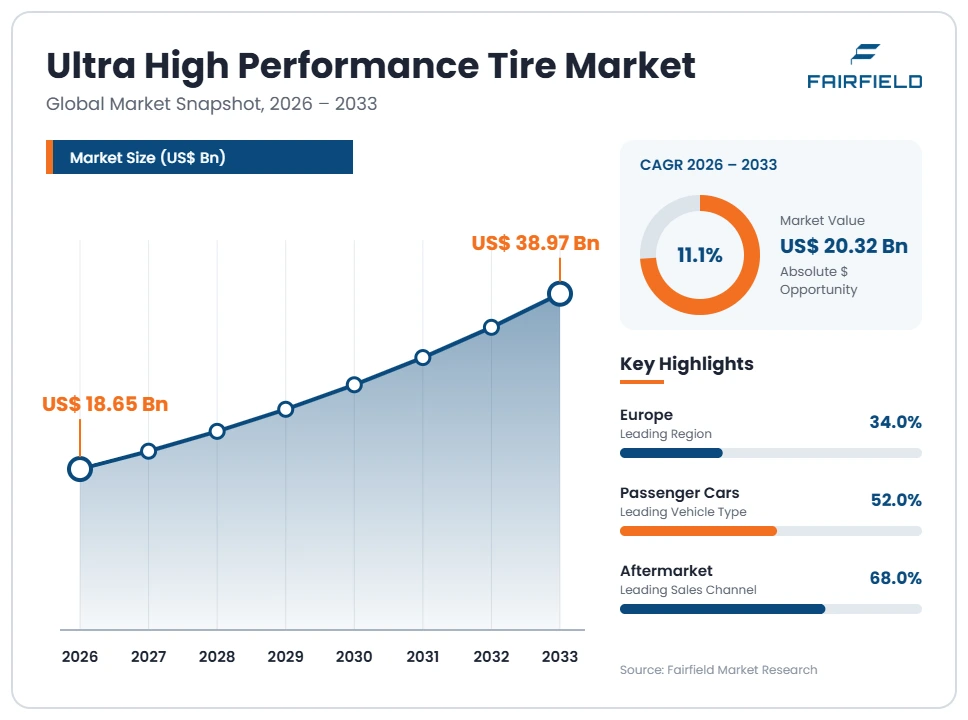
The global ultra high performance tire market size is expected to be valued at US$ 18.65 billion in 2026 and projected to reach US$ 38.97 billion by 2033, growing at a CAGR of 11.1% between 2026 and 2033.
Between 2020 and 2025, the market grew at a CAGR of about 10.4%, as car buyers shifted toward SUVs and premium models, wheel sizes kept rising, and electric vehicles with heavy batteries and instant torque needed stronger, grippier tires. UHP tires are passenger car and SUV tires, typically 18 inches and larger, with high speed ratings, low-profile sidewalls, and advanced compounds for sharp handling, short braking, and high-speed stability. Three factors now drive growth: rising sales of SUVs, luxury, and sports cars, the growth of EV tires designed for heavy, powerful electric vehicles, and consumer demand for safety and driving performance. The market is shifting toward larger rim sizes, all-season and summer tires with lower rolling resistance, run-flat tires, and sensor-equipped smart tires. In September 2026, Continental said it would add more than 650 UHP sizes by 2027, after UHP reached 62% of its core brand’s passenger car tire sales in 2025.
Key Report Takeaways
- By Tire Type: Summer held 46.0% share in 2026, while All-Season is projected to expand at a 12.0% CAGR through 2033, driven by drivers who want year-round grip without changing performance tires each season.
- By Vehicle Type: Passenger Cars held 52.0% share in 2026, while SUVs & Crossovers are projected to expand at a 12.6% CAGR through 2033, driven by larger wheels and higher torque on premium and electric SUVs.
- By Sales Channel: Aftermarket held 68.0% share in 2026, while OEM is projected to expand at an 11.8% CAGR through 2033, driven by carmakers fitting UHP sizes as standard on new EVs and SUVs.
- By Region: Europe held 34.0% share in 2026, while Asia Pacific is projected to expand at a 12.4% CAGR through 2033, driven by premium and electric vehicle sales in China, South Korea, Japan, and India.
Global Ultra High Performance Tire Market Trends and Insights
Drivers Impact Analysis
Two drivers carry the strongest influence on ultra high performance tire demand during the forecast period.
| Driver | Impact on CAGR Forecast | Geographic Relevance | Impact Timeline |
| Premium vehicle, SUV, and larger wheel trends | High | Global | Long term (≥4 years) |
| Electric vehicle growth | High | Asia Pacific, Europe, North America | Medium term (2–4 years) |
Premium Vehicles and Larger Wheels Are Driving the Ultra High Performance Tire Market
Premium vehicles, SUVs, and larger wheel sizes are the strongest driver of the ultra high performance tire market. Cars are getting bigger and more powerful.
The mechanism is the steady upsizing of vehicles and wheels. SUVs now account for a large share of new car sales in North America, Europe, and China, and carmakers fit them with 19-inch to 22-inch wheels for style and handling. Luxury brands such as BMW, Mercedes-Benz, Audi, and Porsche specify UHP tires as original equipment. Even mid-range cars increasingly come with 18-inch wheels. When these cars need replacement tires, owners must buy UHP sizes. Continental reported that UHP rose from 49% to 62% of its core brand’s passenger car tire sales between 2020 and 2025. These trends lift both volumes and average prices across the industry.
Electric Vehicles Are Expanding the Ultra High Performance Tire Market
Electric vehicle growth is expanding the ultra high performance tire market. Electric cars put special demands on tires.
The cause is the weight and torque of electric vehicles. Batteries make EVs heavier than similar gasoline cars, and electric motors deliver instant torque, which increases tire wear. EV makers want low rolling resistance to extend range and quiet tires because there is no engine noise to mask road sound. EV tires use special compounds, reinforced structures, and noise-reducing foam. Tesla, BYD, Hyundai, and Polestar fit large performance tires on many models. Michelin, Pirelli, Continental, and Goodyear have launched EV-specific UHP lines. Faster wear means more frequent replacement, adding aftermarket demand. Chinese EV makers increasingly specify premium tires from global and local brands as standard equipment.
Restraints Impact Analysis
Two restraints limit how quickly the ultra high performance tire market grows.
| Restraint | Impact on CAGR Forecast | Geographic Relevance | Impact Timeline |
| High prices and raw material costs | Medium | Global | Medium term (2–4 years) |
| Tire wear rules and competition from budget brands | Medium | Europe, Asia Pacific | Long term (≥4 years) |
High Prices Slow the Ultra High Performance Tire Market
High prices and raw material costs slow the ultra high performance tire market. UHP tires cost more than standard tires.
The specific causes are complex construction and volatile inputs. UHP tires use advanced rubber compounds, silica, aramid, and precise manufacturing, which raise production costs. Natural rubber, synthetic rubber, carbon black, and steel cord prices swing with oil prices and supply. Large sizes cost much more to replace, and soft, grippy compounds wear faster than standard all-season tires. When household budgets are tight, some drivers delay replacement and safety checks or switch to cheaper brands. Tariffs on imported tires add costs in some markets. These factors limit growth among price-sensitive buyers. Premium brands respond with longer warranties, wear-resistant compounds, and second-tier brands that offer UHP sizes at lower prices.
Wear Rules and Budget Brands Restrict the Ultra High Performance Tire Market
Tire wear rules and competition from budget brands restrict the ultra high performance tire market. Regulators and rivals are changing the market.
The underlying causes are environmental concerns and low-cost imports. The European Union Euro 7 rules will set limits on tire abrasion, which may require changes to soft, grippy compounds. Labeling rules show rolling resistance, wet grip, and noise, putting pressure on performance designs. Chinese and other Asian brands now offer UHP sizes at much lower prices, taking share in the replacement market. Anti-dumping duties on imports from some countries apply in the United States and Europe. These factors pressure margins for premium brands. Leading makers are investing in new compounds that cut abrasion while keeping grip, and testing methods for wear are being standardized across the region.
Market Opportunities
EV-Specific and Sustainable UHP Tires Open a Fast-Growth Revenue Pool
EV-specific and sustainable UHP tires open a fast-growth revenue pool in the ultra high performance tire market. Electric cars need new tire designs.
Premium tire makers can capture this opportunity. EV tires that combine low rolling resistance, quiet running, and high load capacity command higher prices. Tires made with a higher share of renewable and recycled materials, such as bio-based oils, recycled carbon black, and natural rubber from certified sources, appeal to carmakers with sustainability goals. Original equipment approvals with EV makers in China and Europe secure valuable long-term replacement demand. Companies that lead in EV fitments can grow faster than the market. Recycling programs that turn old tires into new materials also support brand image and help meet stricter rules on end-of-life tires.
Smart and Run-Flat Tires Create a Technology Revenue Pool
Smart and run-flat tires create a technology revenue pool in the ultra high performance tire market. Technology adds value and safety.
Tire makers and technology firms can capture this opportunity. Sensor-equipped tires report pressure, temperature, load, and tread wear to vehicle systems, supporting safety and fleet management. Run-flat tires let drivers continue after a puncture, removing the need for a spare and saving space in EVs. Noise-reducing foam inserts improve cabin comfort. Data from smart tires can support predictive maintenance services for drivers and fleets. Companies that combine performance with digital features can earn premium margins. Self-sealing tires that close small punctures are another growing option, especially for EVs without spare wheels. Fleet operators and ride-hailing services value smart tire data that reduces downtime and improves safety.
Segment Analysis
- By Tire Type: Summer Leads While All-Season Grows Fastest
Summer held 46.0% share in 2026. Summer tires offer the best dry and wet grip in warm conditions and are standard on sports and luxury cars, especially in Europe and warmer markets. Michelin, Pirelli, Continental, and Bridgestone lead with products such as the Pilot Sport, P Zero, SportContact, and Potenza lines.
All-Season is the fastest-growing tire type, expanding at a 12.0% CAGR through 2033. All-season UHP tires offer year-round convenience and are popular in North America, where many drivers prefer not to switch tires between seasons. Winter UHP tires serve cold climates. For the market, all-season growth broadens the customer base to drivers who previously bought standard all-season tires.
- By Vehicle Type: Passenger Cars Lead While SUVs & Crossovers Grow Fastest
Passenger Cars held 52.0% share in 2026. Sports cars, sedans, and hatchbacks with large wheels make up the largest share of overall UHP demand.
SUVs & Crossovers are the fastest-growing vehicle type, expanding at a 12.6% CAGR through 2033. Larger and heavier SUVs, including electric SUVs, need strong performance tires in big sizes. Light commercial vehicles are a small segment. For the market, SUV growth raises sizes and average prices. Sports cars and premium sedans remain the core of the high-speed segment, often fitted with tires developed with carmakers such as Porsche, Ferrari, and BMW. Light commercial vehicles, including premium vans and electric delivery vans, are starting to use larger, higher-rated tires.
- By Sales Channel: Aftermarket Leads While OEM Grows Fastest
Aftermarket held 68.0% share in 2026. Most UHP tires are sold as replacements through tire dealers, online retailers, and service centers, often with installation, balancing, and alignment services included in the price.
OEM is the fastest-growing sales channel, expanding at an 11.8% CAGR through 2033. Carmakers increasingly fit UHP sizes as standard on new EVs, SUVs, and mid-range models. For the market, OEM growth secures future replacement demand, because many owners replace tires with the same brand and model fitted at the factory. Online sales of UHP tires through e-commerce platforms and fitting networks are growing quickly. Independent dealers, brand-owned chains, and car dealerships compete for replacement business, and mobile fitting services add convenience.
Geography Analysis
- North America Builds the Ultra High Performance Tire Market Through SUVs and Trucks
North America is a major ultra high performance tire market. The United States has strong demand for SUVs, pickups, and performance cars, and all-season UHP tires are popular. Goodyear is based in the country, and Michelin, Bridgestone, and Continental have large plants. Canada adds strong winter tire demand, and provinces such as Quebec require winter tires in cold months. Pickup trucks with large wheels are adopting performance-oriented tires. Online retailers such as Tire Rack sell large volumes. Key barriers include tariffs on imported tires and high replacement costs. One opportunity is EVs, which need special UHP designs.
- Which Region Is Leading the Ultra High Performance Tire Market?
Europe is leading the ultra high performance tire market with a 34.0% share in 2026. Germany, the United Kingdom, France, and Italy have many premium carmakers and high-speed roads. Michelin in France, Continental in Germany, and Pirelli in Italy are global leaders with strong OEM relationships. Drivers often switch between summer and winter tires, which increases total tire purchases. Strict EU tire labeling helps premium brands show their better wet grip and lower noise. Key barriers include Euro 7 abrasion rules and budget imports. One opportunity is sustainable tires with renewable and recycled materials.
- Which Region Is Growing Fastest in the Ultra High Performance Tire Market?
Asia Pacific is growing fastest in the ultra high performance tire market at a 12.4% CAGR through 2033. China is the largest EV market, and Japan and South Korea host Bridgestone, Yokohama, Hankook, and Kumho. India is adding premium cars and SUVs quickly, and local makers such as Apollo Tyres and CEAT are expanding UHP ranges for domestic and export markets. Chinese tire makers such as Linglong and Sailun are expanding UHP ranges. Continental reports UHP penetration of about 70% in the region. Key barriers include price competition. One change shaping the region is EV fitments by local carmakers.
- Latin America Grows the Ultra High Performance Tire Market Through Premium Cars
Latin America is a growing ultra high performance tire market. Brazil and Mexico have growing SUV, pickup, and premium car sales. Tire makers including Pirelli, Michelin, Bridgestone, and Goodyear have plants in Brazil and Mexico, serving local carmakers and export markets. Rapidly rising sales of Chinese EVs in Brazil and Chile are increasing demand for large performance sizes. Argentina and Colombia have growing premium car segments and expanding dealer networks in major cities. Key barriers include high import costs, taxes, counterfeit products, and currency swings. One opportunity is aftermarket sales through dealer and online networks in large cities.
- Middle East & Africa Expands the Ultra High Performance Tire Market Through Luxury Vehicles
Middle East & Africa is an emerging ultra high performance tire market. The United Arab Emirates and Saudi Arabia have very high luxury car ownership. Large SUVs and sports cars are popular, and high temperatures and fast highways demand durable, heat-resistant tires. Saudi Arabia is building its first tire plants as part of plans to develop a local automotive industry. South Africa has several tire factories, a car export industry, and steady premium car demand. Key barriers include extreme heat and sand that shorten tire life and raise replacement costs. One opportunity is SUVs and large luxury vehicle fleets.
Competitive Landscape
The ultra high performance tire market is moderately concentrated. Michelin, Continental, Bridgestone, Pirelli, and Goodyear lead, while Hankook, Yokohama, Sumitomo Rubber Industries, Toyo Tires, Kumho, Nexen Tire, and Giti Tire compete strongly. Chinese brands are growing in replacement markets.
Companies compete on grip, handling, wear life, rolling resistance, noise, brand image, and OEM approvals. OEM fitments matter, because tires developed with carmakers carry special markings and build loyalty for replacement sales. Premium brands invest heavily in motorsport, testing, and marketing to support their image. Asian brands compete on value and are steadily winning more OEM approvals from global carmakers. Online sales and price comparison sites increase price transparency for consumers. Distribution networks and retail partnerships remain important.
Strategic moves show how competition is changing. In June 2025, Continental said UHP reached 52% of its group-wide passenger car tire sales. In May 2026, Continental launched the SportContact 7 Force. In September 2026, Continental announced more than 650 new UHP sizes. These moves show competition shifting toward larger rim sizes, EV-ready designs, and very high performance products for supercars, as brands compete for original equipment approvals on new premium and electric models.
Three themes shape vendor strategy. First, companies are adding larger rim sizes. Second, they are targeting EVs. Third, they are improving sustainability with renewable and recycled materials. Vendors that combine strong OEM ties, advanced compounds, and broad size ranges are best placed to win share.
Recent Industry Developments
- September 2026: Continental announced more than 650 new UHP tire sizes by the end of 2027 across its brands, after UHP reached 62% of Continental-brand passenger car tire sales in 2025 – expands UHP tires coverage.
- May 2026: Continental introduced the SportContact 7 Force, an ultra-ultra-high-performance summer tire fitted to the Brabus Bodo – strengthens its supercar portfolio.
- June 2025: Continental reported that UHP rose to 52% of its passenger car tire sales across all brands and expected the segment to grow about 9% a year through 2029 – confirms strong demand for performance tires.
Companies Covered in the Report
- Michelin
- Continental
- Bridgestone
- Pirelli
- Goodyear
- Hankook
- Yokohama
- Sumitomo Rubber Industries
- Toyo Tires
- Kumho Tire
- Nexen Tire
- Giti Tire
Ultra High Performance Tire Market Report Scope
| Metric | Value |
| Study Period | 2020–2033 |
| Market Size 2026 | US$ 18.65 Billion |
| Market Size 2033 | US$ 38.97 Billion |
| CAGR 2026–2033 | 11.1% |
| Absolute Dollar Opportunity | US$ 20.32 Billion |
| Largest Market | Europe |
| Fastest-Growing Market | Asia Pacific |
| Market Concentration | Moderately Concentrated |
| Major Players | Michelin, Continental, Bridgestone, Pirelli, Goodyear |
Ultra High Performance Tire Market Segmentation
Tire Type
- Summer
- All-Season
- Winter
Vehicle Type
- Passenger Cars
- SUVs & Crossovers
- Light Commercial Vehicles
Sales Channel
- OEM
- Aftermarket
Regions
- North America
- Europe
- Asia Pacific
- Latin America
- Middle East & Africa
- Executive Summary
- Global Ultra High Performance Tire Market Snapshot
- Future Projections
- Key Report Takeaways
- Regional Snapshot
- Market Overview
- Market Definition and Report Scope
- Historical Trends 2020–2025
- Market Dynamics
- Drivers
- Premium Vehicles and Larger Wheels Are Driving the Ultra High Performance Tire Market
- Electric Vehicles Are Expanding the Ultra High Performance Tire Market
- Restraints
- High Prices Slow the Ultra High Performance Tire Market
- Wear Rules and Budget Brands Restrict the Ultra High Performance Tire Market
- Market Opportunities
- EV-Specific and Sustainable UHP Tires Open a Fast-Growth Revenue Pool
- Smart and Run-Flat Tires Create a Technology Revenue Pool
- Drivers
- Global Ultra High Performance Tire Market Outlook, 2020-2033
- Global Ultra High Performance Tire Market Outlook, by Tire Type, Value (US$ Billion), 2020-2033
- Summer
- All-Season
- Winter
- Global Ultra High Performance Tire Market Outlook, by Vehicle Type, Value (US$ Billion), 2020-2033
- Passenger Cars
- SUVs & Crossovers
- Light Commercial Vehicles
- Global Ultra High Performance Tire Market Outlook, by Sales Channel, Value (US$ Billion), 2020-2033
- OEM
- Aftermarket
- Global Ultra High Performance Tire Market Outlook, by Region, Value (US$ Billion), 2020-2033
- North America
- Europe
- Asia Pacific
- Latin America
- Middle East & Africa
- Global Ultra High Performance Tire Market Outlook, by Tire Type, Value (US$ Billion), 2020-2033
- North America Ultra High Performance Tire Market Outlook, 2020-2033
- North America Ultra High Performance Tire Market Outlook, by Tire Type, Value (US$ Billion), 2020-2033
- Summer
- All-Season
- Winter
- North America Ultra High Performance Tire Market Outlook, by Vehicle Type, Value (US$ Billion), 2020-2033
- Passenger Cars
- SUVs & Crossovers
- Light Commercial Vehicles
- North America Ultra High Performance Tire Market Outlook, by Sales Channel, Value (US$ Billion), 2020-2033
- OEM
- Aftermarket
- North America Ultra High Performance Tire Market Outlook, by Country, Value (US$ Billion), 2020-2033
- United States Ultra High Performance Tire Market Outlook, by Tire Type, 2020-2033
- United States Ultra High Performance Tire Market Outlook, by Vehicle Type, 2020-2033
- United States Ultra High Performance Tire Market Outlook, by Sales Channel, 2020-2033
- Canada Ultra High Performance Tire Market Outlook, by Tire Type, 2020-2033
- Canada Ultra High Performance Tire Market Outlook, by Vehicle Type, 2020-2033
- Canada Ultra High Performance Tire Market Outlook, by Sales Channel, 2020-2033
- North America Ultra High Performance Tire Market Outlook, by Tire Type, Value (US$ Billion), 2020-2033
- Europe Ultra High Performance Tire Market Outlook, 2020-2033
- Europe Ultra High Performance Tire Market Outlook, by Tire Type, Value (US$ Billion), 2020-2033
- Summer
- All-Season
- Winter
- Europe Ultra High Performance Tire Market Outlook, by Vehicle Type, Value (US$ Billion), 2020-2033
- Passenger Cars
- SUVs & Crossovers
- Light Commercial Vehicles
- Europe Ultra High Performance Tire Market Outlook, by Sales Channel, Value (US$ Billion), 2020-2033
- OEM
- Aftermarket
- Europe Ultra High Performance Tire Market Outlook, by Country, Value (US$ Billion), 2020-2033
- Germany Ultra High Performance Tire Market Outlook, by Tire Type, 2020-2033
- Germany Ultra High Performance Tire Market Outlook, by Vehicle Type, 2020-2033
- Germany Ultra High Performance Tire Market Outlook, by Sales Channel, 2020-2033
- United Kingdom Ultra High Performance Tire Market Outlook, by Tire Type, 2020-2033
- United Kingdom Ultra High Performance Tire Market Outlook, by Vehicle Type, 2020-2033
- United Kingdom Ultra High Performance Tire Market Outlook, by Sales Channel, 2020-2033
- France Ultra High Performance Tire Market Outlook, by Tire Type, 2020-2033
- France Ultra High Performance Tire Market Outlook, by Vehicle Type, 2020-2033
- France Ultra High Performance Tire Market Outlook, by Sales Channel, 2020-2033
- Italy Ultra High Performance Tire Market Outlook, by Tire Type, 2020-2033
- Italy Ultra High Performance Tire Market Outlook, by Vehicle Type, 2020-2033
- Italy Ultra High Performance Tire Market Outlook, by Sales Channel, 2020-2033
- Europe Ultra High Performance Tire Market Outlook, by Tire Type, Value (US$ Billion), 2020-2033
- Asia Pacific Ultra High Performance Tire Market Outlook, 2020-2033
- Asia Pacific Ultra High Performance Tire Market Outlook, by Tire Type, Value (US$ Billion), 2020-2033
- Summer
- All-Season
- Winter
- Asia Pacific Ultra High Performance Tire Market Outlook, by Vehicle Type, Value (US$ Billion), 2020-2033
- Passenger Cars
- SUVs & Crossovers
- Light Commercial Vehicles
- Asia Pacific Ultra High Performance Tire Market Outlook, by Sales Channel, Value (US$ Billion), 2020-2033
- OEM
- Aftermarket
- Asia Pacific Ultra High Performance Tire Market Outlook, by Country, Value (US$ Billion), 2020-2033
- China Ultra High Performance Tire Market Outlook, by Tire Type, 2020-2033
- China Ultra High Performance Tire Market Outlook, by Vehicle Type, 2020-2033
- China Ultra High Performance Tire Market Outlook, by Sales Channel, 2020-2033
- Japan Ultra High Performance Tire Market Outlook, by Tire Type, 2020-2033
- Japan Ultra High Performance Tire Market Outlook, by Vehicle Type, 2020-2033
- Japan Ultra High Performance Tire Market Outlook, by Sales Channel, 2020-2033
- South Korea Ultra High Performance Tire Market Outlook, by Tire Type, 2020-2033
- South Korea Ultra High Performance Tire Market Outlook, by Vehicle Type, 2020-2033
- South Korea Ultra High Performance Tire Market Outlook, by Sales Channel, 2020-2033
- India Ultra High Performance Tire Market Outlook, by Tire Type, 2020-2033
- India Ultra High Performance Tire Market Outlook, by Vehicle Type, 2020-2033
- India Ultra High Performance Tire Market Outlook, by Sales Channel, 2020-2033
- Asia Pacific Ultra High Performance Tire Market Outlook, by Tire Type, Value (US$ Billion), 2020-2033
- Latin America Ultra High Performance Tire Market Outlook, 2020-2033
- Latin America Ultra High Performance Tire Market Outlook, by Tire Type, Value (US$ Billion), 2020-2033
- Summer
- All-Season
- Winter
- Latin America Ultra High Performance Tire Market Outlook, by Vehicle Type, Value (US$ Billion), 2020-2033
- Passenger Cars
- SUVs & Crossovers
- Light Commercial Vehicles
- Latin America Ultra High Performance Tire Market Outlook, by Sales Channel, Value (US$ Billion), 2020-2033
- OEM
- Aftermarket
- Latin America Ultra High Performance Tire Market Outlook, by Country, Value (US$ Billion), 2020-2033
- Brazil Ultra High Performance Tire Market Outlook, by Tire Type, 2020-2033
- Brazil Ultra High Performance Tire Market Outlook, by Vehicle Type, 2020-2033
- Brazil Ultra High Performance Tire Market Outlook, by Sales Channel, 2020-2033
- Mexico Ultra High Performance Tire Market Outlook, by Tire Type, 2020-2033
- Mexico Ultra High Performance Tire Market Outlook, by Vehicle Type, 2020-2033
- Mexico Ultra High Performance Tire Market Outlook, by Sales Channel, 2020-2033
- Chile Ultra High Performance Tire Market Outlook, by Tire Type, 2020-2033
- Chile Ultra High Performance Tire Market Outlook, by Vehicle Type, 2020-2033
- Chile Ultra High Performance Tire Market Outlook, by Sales Channel, 2020-2033
- Argentina Ultra High Performance Tire Market Outlook, by Tire Type, 2020-2033
- Argentina Ultra High Performance Tire Market Outlook, by Vehicle Type, 2020-2033
- Argentina Ultra High Performance Tire Market Outlook, by Sales Channel, 2020-2033
- Colombia Ultra High Performance Tire Market Outlook, by Tire Type, 2020-2033
- Colombia Ultra High Performance Tire Market Outlook, by Vehicle Type, 2020-2033
- Colombia Ultra High Performance Tire Market Outlook, by Sales Channel, 2020-2033
- Latin America Ultra High Performance Tire Market Outlook, by Tire Type, Value (US$ Billion), 2020-2033
- Middle East & Africa Ultra High Performance Tire Market Outlook, 2020-2033
- Middle East & Africa Ultra High Performance Tire Market Outlook, by Tire Type, Value (US$ Billion), 2020-2033
- Summer
- All-Season
- Winter
- Middle East & Africa Ultra High Performance Tire Market Outlook, by Vehicle Type, Value (US$ Billion), 2020-2033
- Passenger Cars
- SUVs & Crossovers
- Light Commercial Vehicles
- Middle East & Africa Ultra High Performance Tire Market Outlook, by Sales Channel, Value (US$ Billion), 2020-2033
- OEM
- Aftermarket
- Middle East & Africa Ultra High Performance Tire Market Outlook, by Country, Value (US$ Billion), 2020-2033
- United Arab Emirates Ultra High Performance Tire Market Outlook, by Tire Type, 2020-2033
- United Arab Emirates Ultra High Performance Tire Market Outlook, by Vehicle Type, 2020-2033
- United Arab Emirates Ultra High Performance Tire Market Outlook, by Sales Channel, 2020-2033
- Saudi Arabia Ultra High Performance Tire Market Outlook, by Tire Type, 2020-2033
- Saudi Arabia Ultra High Performance Tire Market Outlook, by Vehicle Type, 2020-2033
- Saudi Arabia Ultra High Performance Tire Market Outlook, by Sales Channel, 2020-2033
- South Africa Ultra High Performance Tire Market Outlook, by Tire Type, 2020-2033
- South Africa Ultra High Performance Tire Market Outlook, by Vehicle Type, 2020-2033
- South Africa Ultra High Performance Tire Market Outlook, by Sales Channel, 2020-2033
- Middle East & Africa Ultra High Performance Tire Market Outlook, by Tire Type, Value (US$ Billion), 2020-2033
- Competitive Landscape
- Market Concentration and Industry Leaders
- Competitive Differentiation
- Strategic Moves and Market Direction
- Recent Industry Developments
- Company Profiles
- Michelin
- Continental
- Bridgestone
- Pirelli
- Goodyear
- Hankook
- Yokohama
- Sumitomo Rubber Industries
- Toyo Tires
- Kumho Tire
- Nexen Tire
- Giti Tire
- Appendix
- Research Methodology
- Report Assumptions
- Acronyms and Abbreviations
Tire Type
- Summer
- All-Season
- Winter
Vehicle Type
- Passenger Cars
- SUVs & Crossovers
- Light Commercial Vehicles
Sales Channel
- OEM
- Aftermarket
Regions
- North America
- Europe
- Asia Pacific
- Latin America
- Middle East & Africa
Our Research Methodology
Considering the volatility of business today, traditional approaches to strategizing a game plan can be unfruitful if not detrimental. True ambiguity is no way to determine a forecast. A myriad of predetermined factors must be accounted for such as the degree of risk involved, the magnitude of circumstances, as well as conditions or consequences that are not known or unpredictable. To circumvent binary views that cast uncertainty, the application of market research intelligence to strategically posture, move, and enable actionable outcomes is necessary.
View Methodology
Quality Assured
Rigorous Validation Process

Confidentiality Assured
End-to-end Data Security

Custom Research Services
Tailored To Your Objectives
FAQs
The ultra high performance tire market is valued at US$ 18.65 billion in 2026, led by summer tires and Europe.
The market is projected to reach US$ 38.97 billion by 2033, growing at an 11.1% CAGR and adding US$ 20.32 billion.
SUVs and crossovers are growing fastest at a 12.6% CAGR through 2033, driven by larger wheels and heavier electric SUVs.
Asia Pacific is growing fastest at a 12.4% CAGR through 2033, driven by premium and electric vehicle sales in China and South Korea.
Europe holds the largest share at 34.0% in 2026, supported by premium carmakers, high-speed roads, and leading tire brands.
Related Reports
Micro-mobility Charging Infrastructure Market Size, Share, Insights, Competitive Landscape, and Forecast 2026 to 2033
The global micro-mobility charging infrastructure market is valued at US$9.06 billion in 2026, reaching US$34.02 billion by 2033, growing at a 20.8% CAGR
Smart EV Charging Networks Market Size, Share, Insights, Competitive Landscape, and Forecast 2026 to 2033
The global smart EV charging networks market is valued at US$9.43 billion in 2026, reaching US$37.07 billion by 2033, growing at a 21.6% CAGR
Small Parcels Delivery Market Size, Share, Insights, Competitive Landscape, and Forecast 2026 to 2033
Explore the small parcels delivery market, forecast to reach US$957.5 billion by 2033 at 7.3% CAGR, with service, shipment weight and regional insights.
Advanced Aerial Mobility Market Size, Share, Insights, Competitive Landscape, and Forecast 2026 to 2033
The global advanced aerial mobility market is valued at US$18.51 billion in 2026, reaching US$90.75 billion by 2033, growing at a 25.5% CAGR
Low Rolling Resistance Tire Market Size, Share, Insights, Competitive Landscape, and Forecast 2026 to 2033
The low rolling resistance tire market is projected to grow from US$38.6 billion in 2026 to US$62.4 billion by 2033, at a 7.1% CAGR. Explore key trends.
Active Noise and Vibration Control System Market Size, Share, Insights, Competitive Landscape, and Forecast 2026 to 2033
The global active noise and vibration control system market is valued at US$3.84 billion in 2026, reaching US$6.09 billion by 2033, growing at a 6.8% CAGR