



Small Parcels Delivery Market
Small Parcels Delivery Market Size, Share, Insights, Competitive Landscape, and Forecast 2026 to 2033
Small Parcels Delivery Market Size and Trend Analysis
How Fast Is the Small Parcels Delivery Market Growing?
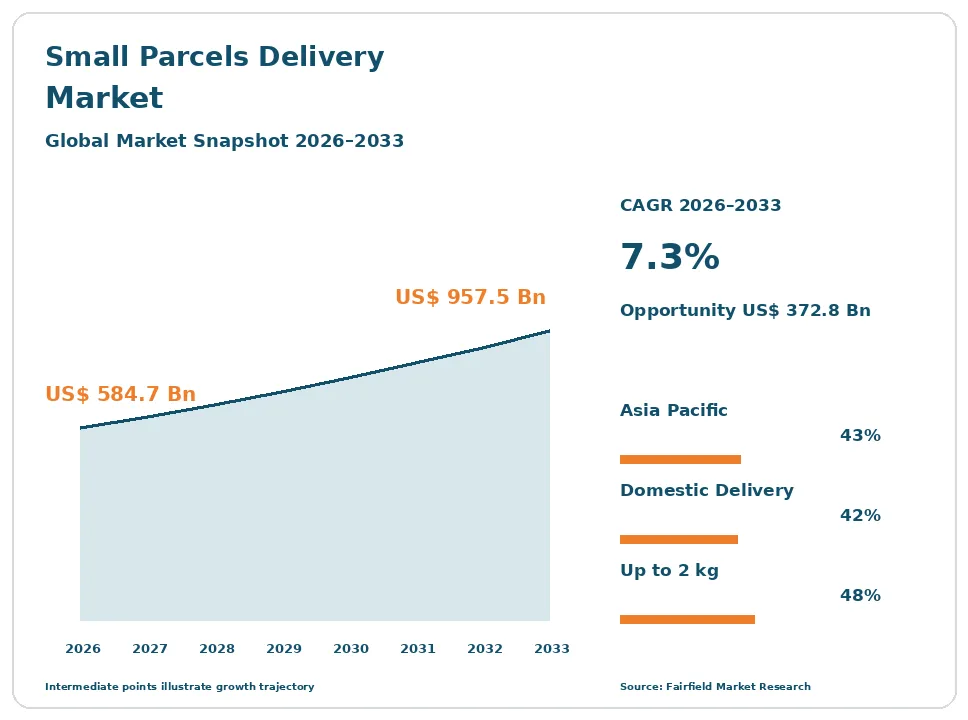
The global small parcels delivery market size is expected to be valued at US$ 584.7 billion in 2026 and projected to reach US$ 957.5 billion by 2033, growing at a CAGR of 7.3% between 2026 and 2033.
Between 2020 and 2025, the market grew at a CAGR of about 8.1%, as pandemic lockdowns pushed shoppers online, parcel volumes surged, and retailers built their own delivery networks, followed by a period of normalization and price competition. Small parcels delivery covers the pickup, sorting, transport, and last-mile delivery of packages, usually under 30 kg, for businesses and consumers. Three factors now drive growth: rising e-commerce parcels from online marketplaces, social commerce, and cross-border shopping, customer demand for faster options such as same-day delivery, and growth in healthcare and business-to-business shipments. The market is shifting toward automated sorting hubs, electric delivery vans, parcel lockers and pickup points, and data-driven route planning. In January 2026, UPS said it would cut up to 30,000 operational roles as it continued reducing Amazon volume and shifting toward higher-margin shipments, showing how carriers are reshaping networks around profitability.
Key Report Takeaways
- By Service Type: Domestic Delivery held 42.0% share in 2026, while Same-Day Delivery is projected to expand at an 11.4% CAGR through 2033, driven by quick commerce, urban micro-fulfillment centers, and retailer delivery promises.
- By Shipment Weight: Up to 2 kg held 48.0% share in 2026, while 2-5 kg is projected to expand at an 8.1% CAGR through 2033, driven by online sales of household goods, appliances, and bulky fashion and beauty bundles.
- By End User: E-commerce & Retail held 52.0% share in 2026, while Healthcare is projected to expand at a 9.2% CAGR through 2033, driven by home delivery of medicines, test kits, and temperature-controlled products.
- By Region: Asia Pacific held 43.0% share in 2026, while India is projected to expand at a 9.6% CAGR through 2033, driven by fast e-commerce growth, digital payments, and investment in logistics networks.
Global Small Parcels Delivery Market Trends and Insights
Drivers Impact Analysis
| Driver | Impact on CAGR Forecast | Geographic Relevance | Impact Timeline |
| E-commerce and cross-border shopping growth | High | Global | Long term (≥4 years) |
| Demand for faster and more flexible delivery | High | North America, Asia Pacific, Europe | Medium term (2-4 years) |
Two drivers carry the strongest influence on small parcels delivery demand during the forecast period.
E-commerce Growth Is Driving the Small Parcels Delivery Market
E-commerce and cross-border shopping growth are the strongest driver of the small parcels delivery market. Every online order creates at least one parcel.
The mechanism is the steady shift of retail spending online. Marketplaces such as Amazon, Alibaba, Flipkart, Mercado Libre, Shein, and Temu generate billions of e-commerce parcels each year, and social commerce adds more. Small and medium businesses sell directly to consumers through online stores, relying on carriers to reach customers. Cross-border e-commerce ships low-value items from China to buyers worldwide. Returns add a second flow of parcels. Subscription services for food, beauty, and pet products create recurring shipments. Rising smartphone use and digital payments in India, Indonesia, Brazil, and Nigeria bring new online shoppers. These trends keep parcel volumes rising.
Faster Delivery Demand Is Expanding the Small Parcels Delivery Market
Demand for faster and more flexible delivery is expanding the small parcels delivery market. Shoppers expect quick, convenient service.
The cause is rising customer expectations. Amazon and other retailers have trained consumers to expect next-day or same-day delivery, and quick commerce apps deliver groceries in minutes in cities such as Mumbai, Bengaluru, and Jakarta. Carriers add evening, weekend, and time-slot options. Parcel lockers and pickup points let customers collect parcels when convenient and reduce failed deliveries. Real-time tracking and notifications improve the experience. Businesses pay premiums for speed and reliability, which raises revenue per parcel. Healthcare and business shipments need time-definite service. These factors support higher-value delivery services across the market and encourage carriers to invest in dense urban networks.
Restraints Impact Analysis
| Restraint | Impact on CAGR Forecast | Geographic Relevance | Impact Timeline |
| High last-mile costs and pricing pressure | High | Global | Long term (≥4 years) |
| Labor shortages, regulation, and sustainability rules | Medium | North America, Europe | Medium term (2-4 years) |
Two restraints limit how quickly the small parcels delivery market grows.
High Last-Mile Costs Slow the Small Parcels Delivery Market
High last-mile delivery costs and pricing pressure slow the small parcels delivery market. The final step to the customer is the most expensive.
The specific causes are fragmented deliveries and price competition. Delivering single parcels to many homes requires drivers, vehicles, and fuel for each stop, and the last mile can account for about half of total delivery cost. Failed deliveries and returns add more cost. Large retailers have built their own networks and negotiate low rates, putting pressure on carrier margins. UPS decided in January 2025 to cut Amazon volume by more than half by the second half of 2026 because it was low-margin. Fuel, insurance, and wage costs have risen. Low-cost regional carriers compete on price. These factors make growth in volume harder to turn into profit.
Labor and Regulatory Pressure Restricts the Small Parcels Delivery Market
Labor shortages, regulation, and sustainability rules restrict the small parcels delivery market. Delivery depends on large workforces.
The underlying causes are tight labor markets and new rules. Carriers struggle to hire and keep drivers and warehouse staff, which raises wages and benefits. Union contracts have significantly increased labor costs at major carriers. Regulators in Europe are reviewing the employment status of gig delivery workers and platform couriers. Cities restrict delivery vehicles through congestion charges, low-emission zones, and loading limits. Carbon reduction targets require heavy investment in electric vehicles and charging infrastructure. Customs changes on low-value imports in the United States and Europe may reduce some cross-border flows. These factors raise costs and add complexity. Carriers are responding with better pay, training programs, automation, and partnerships with independent delivery contractors.
Market Opportunities
Automation and Electric Fleets Open a Fast-Growth Revenue Pool
Automation and electric delivery fleets open a fast-growth revenue pool in the small parcels delivery market. Technology can lower cost per parcel.
Carriers and technology suppliers can capture this opportunity. Automated sorting centers handle hundreds of thousands of parcels per hour with fewer workers. AI route planning cuts miles driven and fuel use. Electric vans, cargo bikes, and micro-hubs reduce emissions in cities, and DHL Group has invested heavily in electric delivery fleets. Delivery robots and drones are being tested for short trips. Parcel lockers concentrate deliveries at one point, cutting stops. Companies that combine automation with green delivery can win contracts from retailers with climate targets and improve margins over time. Shared delivery networks, where several carriers use common micro-hubs and lockers, can further reduce costs in crowded cities.
Healthcare and B2B Logistics Create a Premium Revenue Pool
Healthcare and business-to-business logistics create a premium revenue pool in the small parcels delivery market. These customers pay more for reliability.
Carriers with specialized capabilities can capture this opportunity. Hospitals, pharmacies, and laboratories ship medicines, samples, and devices that need temperature control, tracking, and time-definite delivery. Home healthcare and online pharmacies increase parcel volumes. UPS is expanding healthcare logistics as it reduces lower-margin volume. Manufacturers and distributors ship spare parts and supplies to businesses on tight schedules. Small and medium businesses value simple, digital shipping tools. Companies that offer specialized handling can earn higher margins than standard consumer delivery. Clinical trial logistics, which ships drugs and samples directly to patients’ homes, is a fast-growing niche. Carriers are also adding digital platforms that let small businesses compare rates, print labels, and manage returns easily.
Segment Analysis
By Service Type: Domestic Delivery Leads While Same-Day Delivery Grows Fastest
Domestic Delivery held 42.0% share in 2026. Most parcels travel within one country, from warehouses and stores to homes and businesses, using ground and express networks. UPS, FedEx, USPS, SF Express, and national postal operators handle large domestic volumes.
Same-Day Delivery is the fastest-growing service type, expanding at an 11.4% CAGR through 2033. Same-day delivery relies on local stores, dark stores, and micro-fulfillment centers close to customers, and quick commerce apps are expanding it in Asia Pacific. International express and economy services serve cross-border shoppers buying from overseas marketplaces and brands. For the market, same-day growth raises revenue per parcel and rewards networks located close to customers.
By Shipment Weight: Up to 2 kg Leads While 2-5 kg Grows Fastest
Up to 2 kg held 48.0% share in 2026. Small, light parcels such as clothing, cosmetics, books, phone accessories, and cross-border goods make up the largest share of e-commerce parcels.
2-5 kg is the fastest-growing weight band, expanding at an 8.1% CAGR through 2033. Online sales of household goods, small appliances, and bundled orders are increasing parcel weights. Parcels of 5-30 kg serve business and bulky retail orders. For the market, heavier parcels raise revenue per shipment. Carriers adjust pricing using dimensional weight, which charges for package size as well as weight, encouraging retailers to use smaller boxes. Light parcels under 2 kg often move through postal networks and low-cost cross-border services.
By End User: E-commerce & Retail Leads While Healthcare Grows Fastest
E-commerce & Retail held 52.0% share in 2026. Online marketplaces, brands, and retailers generate most parcels for home delivery and returns.
Healthcare is the fastest-growing end user, expanding at a 9.2% CAGR through 2033. Pharmacies, laboratories, and medical device firms need reliable, often temperature-controlled delivery. Manufacturing, financial services, and government are other end users. For the market, healthcare growth adds premium volume. Manufacturers ship spare parts, components, and samples to customers and repair centers, often on next-day schedules. Financial services firms send cards, documents, and devices. Government agencies ship passports, licenses, and official documents. Consumer-to-consumer shipments through resale platforms such as second-hand fashion marketplaces are also rising, adding new small parcel flows.
Geography Analysis
Why Is North America Important to the Small Parcels Delivery Market?
North America is a large and profitable small parcels delivery market. The United States has high online spending, and UPS, FedEx, USPS, and Amazon Logistics handle billions of parcels each year. Amazon now delivers most of its own parcels. Canada Post and regional carriers serve Canada, where long distances raise costs. FedEx is merging its Express and Ground networks to cut costs. Key barriers include high labor costs and union contracts. One change shaping the region is carriers shifting toward higher-margin parcels from small businesses and healthcare customers, while Amazon handles more of its own deliveries.
Europe Builds the Small Parcels Delivery Market Through Cross-Border Trade
Europe is a major small parcels delivery market. Germany, the United Kingdom, France, Italy, and Poland have strong e-commerce and dense locker networks. DHL Group, La Poste Group, Royal Mail, and Poste Italiane are major players. Poland and Czech Republic have some of the densest parcel locker networks in the world, led by InPost, which has expanded across the region. Cross-border shopping within the European Union is common, and low-value imports from China are a large flow. Key barriers include strict green rules and urban vehicle restrictions. One opportunity is electric delivery and cargo bikes in city centers.
Which Region Is Leading the Small Parcels Delivery Market?
Asia Pacific is leading the small parcels delivery market with a 43.0% share in 2026. China handles the world’s largest parcel volumes, served by SF Express, JD Logistics, and Cainiao Network. India is the fastest-growing country at a 9.6% CAGR through 2033. Japan hosts Yamato Holdings. Australia and South Korea have advanced delivery networks, and Indonesia and the Philippines are fast-growing e-commerce markets. Key barriers include intense price wars among couriers in China and India. One change shaping the region is quick commerce, which delivers groceries and essentials in minutes.
Latin America Grows the Small Parcels Delivery Market Through Online Shopping
Latin America is a growing small parcels delivery market. Brazil, Mexico, and Colombia have fast-growing e-commerce led by Mercado Libre. Mercado Libre has built its own logistics network with sorting centers, aircraft, and delivery fleets, and now delivers many orders within 48 hours in Brazil and Mexico. Cross-border parcels from China are a large share of volume. Chile, Argentina, and Peru are also growing. Key barriers include weak road infrastructure in rural areas, theft risk, and complex customs rules. One opportunity is local networks with pickup points and lockers in major cities.
Middle East & Africa Expands the Small Parcels Delivery Market Through Digital Retail
Middle East & Africa is an emerging small parcels delivery market. The United Arab Emirates and Saudi Arabia have high online spending, and Aramex is a regional leader. National postal operators and new couriers in Saudi Arabia are expanding under government plans to grow e-commerce. Egypt, Nigeria, Kenya, and South Africa have fast-growing online shopping and new local courier startups, often paid by mobile money, cards, or cash on delivery. Key barriers include addressing gaps, as many homes lack formal street addresses. One opportunity is lockers and pickup points that solve difficult last-mile challenges.
Competitive Landscape
The small parcels delivery market is moderately concentrated. UPS, FedEx, DHL Group, and Amazon Logistics lead globally, while SF Express, JD Logistics, Cainiao Network, and Yamato Holdings lead in Asia Pacific. USPS, Royal Mail, La Poste Group, Poste Italiane, Canada Post, Aramex, and Blue Dart Express are important national players.
Companies compete on speed, reliability, price, network coverage, tracking, and sustainability. Scale lowers cost per parcel, so large networks have an advantage. Retailers with their own delivery fleets, such as Amazon and Mercado Libre, compete directly with traditional carriers. Regional and gig-based couriers compete on price and flexibility, especially in cities. Postal operators use their universal networks to serve light parcels. Technology platforms connect shippers with many carriers and compare prices and delivery times automatically.
Strategic moves show how competition is changing. In September 2024, DHL Group announced major investment in electric delivery. In January 2025, UPS said it would cut Amazon volume by more than half. In January 2026, UPS announced up to 30,000 role reductions. These moves show competition shifting toward profitability, network efficiency, and sustainable delivery rather than chasing the lowest-priced volume from the largest online retailers.
Three themes shape vendor strategy. First, companies are automating sorting hubs. Second, they are electrifying fleets. Third, they are targeting premium parcels from healthcare and small businesses. Vendors that combine dense networks, automation, and specialized services are best placed to win share.
Small Parcels Delivery Market Industry Leaders
- UPS
- FedEx
- DHL Group
- Amazon Logistics
- SF Express
Recent Industry Developments
- January 2026: UPS said it would cut up to 30,000 operational roles as it continued its Amazon glide-down, expecting about US$ 3 billion in savings - shifts focus to higher-margin parcels.
- January 2025: UPS announced plans to reduce Amazon volume by more than half by the second half of 2026 - reshapes the largest US parcel relationship.
- September 2024: DHL Group announced a multi-billion-euro investment in sustainable logistics and electric delivery fleets in European cities - supports green last-mile delivery.
Companies Covered in the Report
- UPS
- FedEx
- DHL Group
- Amazon Logistics
- SF Express
- JD Logistics
- Cainiao Network
- Yamato Holdings
- USPS
- Royal Mail
- La Poste Group
- Aramex
Small Parcels Delivery Market Report Scope
This report covers small parcels delivery services, including domestic, international, same-day, and other services, for parcels up to 2 kg, 2-5 kg, and 5-30 kg, used by e-commerce and retail, healthcare, manufacturing, financial services, government, and other end users. The base year is 2025, and the forecast period runs from 2026 to 2033. All values are expressed in US$ Billion.
Service Type
- Domestic Delivery
- International Delivery
- Same-Day Delivery
- Others
Shipment Weight
- Up to 2 kg
- 2-5 kg
- 5-30 kg
End User
- E-commerce & Retail
- Healthcare
- Manufacturing
- Financial Services
- Government
- Others
Regions
- North America
- Europe
- Asia Pacific
- Latin America
- Middle East & Africa
Key Questions Answered in the Report
How big is the small parcels delivery market in 2026?
The small parcels delivery market is valued at US$ 584.7 billion in 2026, led by domestic delivery and Asia Pacific.
What is the small parcels delivery market forecast to 2033?
The market is projected to reach US$ 957.5 billion by 2033, growing at a 7.3% CAGR and adding US$ 372.8 billion.
Which service type is growing fastest in the small parcels delivery market?
Same-day delivery is growing fastest at an 11.4% CAGR through 2033, driven by quick commerce and urban micro-fulfillment centers.
Which country is growing fastest in the small parcels delivery market?
India is growing fastest at a 9.6% CAGR through 2033, driven by rapid e-commerce growth, digital payments, and logistics investment.
Which region holds the largest small parcels delivery market share?
Asia Pacific holds the largest share at 43.0% in 2026, supported by the world’s largest parcel volumes in China.
1. Executive Summary
1.1. Global Small Parcels Delivery Market Snapshot
1.2. Future Projections
1.3. Key Report Takeaways
1.4. Regional Snapshot
2. Market Overview
2.1. Market Definition and Report Scope
2.2. Historical Trends 2020–2025
2.3. Market Dynamics
2.3.1. Drivers
2.3.1.1. E-commerce Growth Is Driving the Small Parcels Delivery Market
2.3.1.2. Faster Delivery Demand Is Expanding the Small Parcels Delivery Market
2.3.2. Restraints
2.3.2.1. High Last-Mile Costs Slow the Small Parcels Delivery Market
2.3.2.2. Labor and Regulatory Pressure Restricts the Small Parcels Delivery Market
2.3.3. Market Opportunities
2.3.3.1. Automation and Electric Fleets Open a Fast-Growth Revenue Pool
2.3.3.2. Healthcare and B2B Logistics Create a Premium Revenue Pool
3. Global Small Parcels Delivery Market Outlook, 2020-2033
3.1. Global Small Parcels Delivery Market Outlook, by Service Type, Value (US$ Billion), 2020-2033
3.1.1. Domestic Delivery
3.1.2. International Delivery
3.1.3. Same-Day Delivery
3.1.4. Others
3.2. Global Small Parcels Delivery Market Outlook, by Shipment Weight, Value (US$ Billion), 2020-2033
3.2.1. Up to 2 kg
3.2.2. 2-5 kg
3.2.3. 5-30 kg
3.3. Global Small Parcels Delivery Market Outlook, by End User, Value (US$ Billion), 2020-2033
3.3.1. E-commerce & Retail
3.3.2. Healthcare
3.3.3. Manufacturing
3.3.4. Financial Services
3.3.5. Government
3.3.6. Others
3.4. Global Small Parcels Delivery Market Outlook, by Region, Value (US$ Billion), 2020-2033
3.4.1. North America
3.4.2. Europe
3.4.3. Asia Pacific
3.4.4. Latin America
3.4.5. Middle East & Africa
4. North America Small Parcels Delivery Market Outlook, 2020-2033
4.1. North America Small Parcels Delivery Market Outlook, by Service Type, Value (US$ Billion), 2020-2033
4.1.1. Domestic Delivery
4.1.2. International Delivery
4.1.3. Same-Day Delivery
4.1.4. Others
4.2. North America Small Parcels Delivery Market Outlook, by Shipment Weight, Value (US$ Billion), 2020-2033
4.2.1. Up to 2 kg
4.2.2. 2-5 kg
4.2.3. 5-30 kg
4.3. North America Small Parcels Delivery Market Outlook, by End User, Value (US$ Billion), 2020-2033
4.3.1. E-commerce & Retail
4.3.2. Healthcare
4.3.3. Manufacturing
4.3.4. Financial Services
4.3.5. Government
4.3.6. Others
4.4. North America Small Parcels Delivery Market Outlook, by Country, Value (US$ Billion), 2020-2033
4.4.1. United States Small Parcels Delivery Market Outlook, by Service Type, 2020-2033
4.4.2. United States Small Parcels Delivery Market Outlook, by Shipment Weight, 2020-2033
4.4.3. United States Small Parcels Delivery Market Outlook, by End User, 2020-2033
4.4.4. Canada Small Parcels Delivery Market Outlook, by Service Type, 2020-2033
4.4.5. Canada Small Parcels Delivery Market Outlook, by Shipment Weight, 2020-2033
4.4.6. Canada Small Parcels Delivery Market Outlook, by End User, 2020-2033
5. Europe Small Parcels Delivery Market Outlook, 2020-2033
5.1. Europe Small Parcels Delivery Market Outlook, by Service Type, Value (US$ Billion), 2020-2033
5.1.1. Domestic Delivery
5.1.2. International Delivery
5.1.3. Same-Day Delivery
5.1.4. Others
5.2. Europe Small Parcels Delivery Market Outlook, by Shipment Weight, Value (US$ Billion), 2020-2033
5.2.1. Up to 2 kg
5.2.2. 2-5 kg
5.2.3. 5-30 kg
5.3. Europe Small Parcels Delivery Market Outlook, by End User, Value (US$ Billion), 2020-2033
5.3.1. E-commerce & Retail
5.3.2. Healthcare
5.3.3. Manufacturing
5.3.4. Financial Services
5.3.5. Government
5.3.6. Others
5.4. Europe Small Parcels Delivery Market Outlook, by Country, Value (US$ Billion), 2020-2033
5.4.1. Germany Small Parcels Delivery Market Outlook, by Service Type, 2020-2033
5.4.2. Germany Small Parcels Delivery Market Outlook, by Shipment Weight, 2020-2033
5.4.3. Germany Small Parcels Delivery Market Outlook, by End User, 2020-2033
5.4.4. United Kingdom Small Parcels Delivery Market Outlook, by Service Type, 2020-2033
5.4.5. United Kingdom Small Parcels Delivery Market Outlook, by Shipment Weight, 2020-2033
5.4.6. United Kingdom Small Parcels Delivery Market Outlook, by End User, 2020-2033
5.4.7. France Small Parcels Delivery Market Outlook, by Service Type, 2020-2033
5.4.8. France Small Parcels Delivery Market Outlook, by Shipment Weight, 2020-2033
5.4.9. France Small Parcels Delivery Market Outlook, by End User, 2020-2033
5.4.10. Italy Small Parcels Delivery Market Outlook, by Service Type, 2020-2033
5.4.11. Italy Small Parcels Delivery Market Outlook, by Shipment Weight, 2020-2033
5.4.12. Italy Small Parcels Delivery Market Outlook, by End User, 2020-2033
5.4.13. Poland Small Parcels Delivery Market Outlook, by Service Type, 2020-2033
5.4.14. Poland Small Parcels Delivery Market Outlook, by Shipment Weight, 2020-2033
5.4.15. Poland Small Parcels Delivery Market Outlook, by End User, 2020-2033
5.4.16. Czech Republic Small Parcels Delivery Market Outlook, by Service Type, 2020-2033
5.4.17. Czech Republic Small Parcels Delivery Market Outlook, by Shipment Weight, 2020-2033
5.4.18. Czech Republic Small Parcels Delivery Market Outlook, by End User, 2020-2033
6. Asia Pacific Small Parcels Delivery Market Outlook, 2020-2033
6.1. Asia Pacific Small Parcels Delivery Market Outlook, by Service Type, Value (US$ Billion), 2020-2033
6.1.1. Domestic Delivery
6.1.2. International Delivery
6.1.3. Same-Day Delivery
6.1.4. Others
6.2. Asia Pacific Small Parcels Delivery Market Outlook, by Shipment Weight, Value (US$ Billion), 2020-2033
6.2.1. Up to 2 kg
6.2.2. 2-5 kg
6.2.3. 5-30 kg
6.3. Asia Pacific Small Parcels Delivery Market Outlook, by End User, Value (US$ Billion), 2020-2033
6.3.1. E-commerce & Retail
6.3.2. Healthcare
6.3.3. Manufacturing
6.3.4. Financial Services
6.3.5. Government
6.3.6. Others
6.4. Asia Pacific Small Parcels Delivery Market Outlook, by Country, Value (US$ Billion), 2020-2033
6.4.1. China Small Parcels Delivery Market Outlook, by Service Type, 2020-2033
6.4.2. China Small Parcels Delivery Market Outlook, by Shipment Weight, 2020-2033
6.4.3. China Small Parcels Delivery Market Outlook, by End User, 2020-2033
6.4.4. India Small Parcels Delivery Market Outlook, by Service Type, 2020-2033
6.4.5. India Small Parcels Delivery Market Outlook, by Shipment Weight, 2020-2033
6.4.6. India Small Parcels Delivery Market Outlook, by End User, 2020-2033
6.4.7. Japan Small Parcels Delivery Market Outlook, by Service Type, 2020-2033
6.4.8. Japan Small Parcels Delivery Market Outlook, by Shipment Weight, 2020-2033
6.4.9. Japan Small Parcels Delivery Market Outlook, by End User, 2020-2033
6.4.10. Australia Small Parcels Delivery Market Outlook, by Service Type, 2020-2033
6.4.11. Australia Small Parcels Delivery Market Outlook, by Shipment Weight, 2020-2033
6.4.12. Australia Small Parcels Delivery Market Outlook, by End User, 2020-2033
6.4.13. South Korea Small Parcels Delivery Market Outlook, by Service Type, 2020-2033
6.4.14. South Korea Small Parcels Delivery Market Outlook, by Shipment Weight, 2020-2033
6.4.15. South Korea Small Parcels Delivery Market Outlook, by End User, 2020-2033
6.4.16. Indonesia Small Parcels Delivery Market Outlook, by Service Type, 2020-2033
6.4.17. Indonesia Small Parcels Delivery Market Outlook, by Shipment Weight, 2020-2033
6.4.18. Indonesia Small Parcels Delivery Market Outlook, by End User, 2020-2033
6.4.19. Philippines Small Parcels Delivery Market Outlook, by Service Type, 2020-2033
6.4.20. Philippines Small Parcels Delivery Market Outlook, by Shipment Weight, 2020-2033
6.4.21. Philippines Small Parcels Delivery Market Outlook, by End User, 2020-2033
7. Latin America Small Parcels Delivery Market Outlook, 2020-2033
7.1. Latin America Small Parcels Delivery Market Outlook, by Service Type, Value (US$ Billion), 2020-2033
7.1.1. Domestic Delivery
7.1.2. International Delivery
7.1.3. Same-Day Delivery
7.1.4. Others
7.2. Latin America Small Parcels Delivery Market Outlook, by Shipment Weight, Value (US$ Billion), 2020-2033
7.2.1. Up to 2 kg
7.2.2. 2-5 kg
7.2.3. 5-30 kg
7.3. Latin America Small Parcels Delivery Market Outlook, by End User, Value (US$ Billion), 2020-2033
7.3.1. E-commerce & Retail
7.3.2. Healthcare
7.3.3. Manufacturing
7.3.4. Financial Services
7.3.5. Government
7.3.6. Others
7.4. Latin America Small Parcels Delivery Market Outlook, by Country, Value (US$ Billion), 2020-2033
7.4.1. Brazil Small Parcels Delivery Market Outlook, by Service Type, 2020-2033
7.4.2. Brazil Small Parcels Delivery Market Outlook, by Shipment Weight, 2020-2033
7.4.3. Brazil Small Parcels Delivery Market Outlook, by End User, 2020-2033
7.4.4. Mexico Small Parcels Delivery Market Outlook, by Service Type, 2020-2033
7.4.5. Mexico Small Parcels Delivery Market Outlook, by Shipment Weight, 2020-2033
7.4.6. Mexico Small Parcels Delivery Market Outlook, by End User, 2020-2033
7.4.7. Colombia Small Parcels Delivery Market Outlook, by Service Type, 2020-2033
7.4.8. Colombia Small Parcels Delivery Market Outlook, by Shipment Weight, 2020-2033
7.4.9. Colombia Small Parcels Delivery Market Outlook, by End User, 2020-2033
7.4.10. Chile Small Parcels Delivery Market Outlook, by Service Type, 2020-2033
7.4.11. Chile Small Parcels Delivery Market Outlook, by Shipment Weight, 2020-2033
7.4.12. Chile Small Parcels Delivery Market Outlook, by End User, 2020-2033
7.4.13. Argentina Small Parcels Delivery Market Outlook, by Service Type, 2020-2033
7.4.14. Argentina Small Parcels Delivery Market Outlook, by Shipment Weight, 2020-2033
7.4.15. Argentina Small Parcels Delivery Market Outlook, by End User, 2020-2033
7.4.16. Peru Small Parcels Delivery Market Outlook, by Service Type, 2020-2033
7.4.17. Peru Small Parcels Delivery Market Outlook, by Shipment Weight, 2020-2033
7.4.18. Peru Small Parcels Delivery Market Outlook, by End User, 2020-2033
8. Middle East & Africa Small Parcels Delivery Market Outlook, 2020-2033
8.1. Middle East & Africa Small Parcels Delivery Market Outlook, by Service Type, Value (US$ Billion), 2020-2033
8.1.1. Domestic Delivery
8.1.2. International Delivery
8.1.3. Same-Day Delivery
8.1.4. Others
8.2. Middle East & Africa Small Parcels Delivery Market Outlook, by Shipment Weight, Value (US$ Billion), 2020-2033
8.2.1. Up to 2 kg
8.2.2. 2-5 kg
8.2.3. 5-30 kg
8.3. Middle East & Africa Small Parcels Delivery Market Outlook, by End User, Value (US$ Billion), 2020-2033
8.3.1. E-commerce & Retail
8.3.2. Healthcare
8.3.3. Manufacturing
8.3.4. Financial Services
8.3.5. Government
8.3.6. Others
8.4. Middle East & Africa Small Parcels Delivery Market Outlook, by Country, Value (US$ Billion), 2020-2033
8.4.1. United Arab Emirates Small Parcels Delivery Market Outlook, by Service Type, 2020-2033
8.4.2. United Arab Emirates Small Parcels Delivery Market Outlook, by Shipment Weight, 2020-2033
8.4.3. United Arab Emirates Small Parcels Delivery Market Outlook, by End User, 2020-2033
8.4.4. Saudi Arabia Small Parcels Delivery Market Outlook, by Service Type, 2020-2033
8.4.5. Saudi Arabia Small Parcels Delivery Market Outlook, by Shipment Weight, 2020-2033
8.4.6. Saudi Arabia Small Parcels Delivery Market Outlook, by End User, 2020-2033
8.4.7. Egypt Small Parcels Delivery Market Outlook, by Service Type, 2020-2033
8.4.8. Egypt Small Parcels Delivery Market Outlook, by Shipment Weight, 2020-2033
8.4.9. Egypt Small Parcels Delivery Market Outlook, by End User, 2020-2033
8.4.10. Nigeria Small Parcels Delivery Market Outlook, by Service Type, 2020-2033
8.4.11. Nigeria Small Parcels Delivery Market Outlook, by Shipment Weight, 2020-2033
8.4.12. Nigeria Small Parcels Delivery Market Outlook, by End User, 2020-2033
8.4.13. Kenya Small Parcels Delivery Market Outlook, by Service Type, 2020-2033
8.4.14. Kenya Small Parcels Delivery Market Outlook, by Shipment Weight, 2020-2033
8.4.15. Kenya Small Parcels Delivery Market Outlook, by End User, 2020-2033
8.4.16. South Africa Small Parcels Delivery Market Outlook, by Service Type, 2020-2033
8.4.17. South Africa Small Parcels Delivery Market Outlook, by Shipment Weight, 2020-2033
8.4.18. South Africa Small Parcels Delivery Market Outlook, by End User, 2020-2033
9. Competitive Landscape
9.1. Market Concentration and Industry Leaders
9.2. Competitive Differentiation
9.3. Strategic Moves and Market Direction
9.4. Recent Industry Developments
9.5. Company Profiles
9.5.1. UPS
9.5.2. FedEx
9.5.3. DHL Group
9.5.4. Amazon Logistics
9.5.5. SF Express
9.5.6. JD Logistics
9.5.7. Cainiao Network
9.5.8. Yamato Holdings
9.5.9. USPS
9.5.10. Royal Mail
9.5.11. La Poste Group
9.5.12. Aramex
10. Appendix
10.1. Research Methodology
10.2. Report Assumptions
10.3. Acronyms and Abbreviations
| Service Type | Domestic Delivery, International Delivery, Same-Day Delivery, Others |
| Shipment Weight | Up to 2 kg, 2-5 kg, 5-30 kg |
| End User | E-commerce & Retail, Healthcare, Manufacturing, Financial Services, Government, Others |
| Regions | North America, Europe, Asia Pacific, Latin America, Middle East & Africa |
Our Research Methodology
Considering the volatility of business today, traditional approaches to strategizing a game plan can be unfruitful if not detrimental. True ambiguity is no way to determine a forecast. A myriad of predetermined factors must be accounted for such as the degree of risk involved, the magnitude of circumstances, as well as conditions or consequences that are not known or unpredictable. To circumvent binary views that cast uncertainty, the application of market research intelligence to strategically posture, move, and enable actionable outcomes is necessary.
View Methodology
Quality Assured
Rigorous Validation Process

Confidentiality Assured
End-to-end Data Security

Custom Research Services
Tailored To Your Objectives
FAQs
The small parcels delivery market is valued at US$ 584.7 billion in 2026, led by domestic delivery and Asia Pacific.
The market is projected to reach US$ 957.5 billion by 2033, growing at a 7.3% CAGR and adding US$ 372.8 billion.
Same-day delivery is growing fastest at an 11.4% CAGR through 2033, driven by quick commerce and urban micro-fulfillment centers.
India is growing fastest at a 9.6% CAGR through 2033, driven by rapid e-commerce growth, digital payments, and logistics investment.
Asia Pacific holds the largest share at 43.0% in 2026, supported by the world’s largest parcel volumes in China.
Related Reports
Advanced Aerial Mobility Market Size, Share, Insights, Competitive Landscape, and Forecast 2026 to 2033
The global advanced aerial mobility market is valued at US$18.51 billion in 2026, reaching US$90.75 billion by 2033, growing at a 25.5% CAGR
Low Rolling Resistance Tire Market Size, Share, Insights, Competitive Landscape, and Forecast 2026 to 2033
The low rolling resistance tire market is projected to grow from US$38.6 billion in 2026 to US$62.4 billion by 2033, at a 7.1% CAGR. Explore key trends.
Active Noise and Vibration Control System Market Size, Share, Insights, Competitive Landscape, and Forecast 2026 to 2033
The global active noise and vibration control system market is valued at US$3.84 billion in 2026, reaching US$6.09 billion by 2033, growing at a 6.8% CAGR
Autonomous Cars, Robotaxis & Sensors Market Size, Share, Insights, Competitive Landscape, and Forecast 2026 to 2033
The autonomous cars, robotaxis and sensors market is projected to grow from US$38.0 Bn in 2026 to US$118.3 Bn by 2033, at a CAGR of 17.6%.
Electric Two Wheeler Market Size, Share, Insights, Competitive Landscape, and Forecast 2026 to 2033
The electric two wheeler market is projected to grow from US$52.0 billion in 2026 to US$98.4 billion by 2033, at a CAGR of 9.5%, led by Asia Pacific demand.
Pass by Noise Testing Market Size, Share, Insights, Competitive Landscape, and Forecast 2026 to 2033
Pass-by noise testing market to grow from US$1.72 Bn in 2026 to US$2.43 Bn by 2033 at 5.0% CAGR. Explore components, test types, propulsion and regions.