



Smart EV Charging Networks Market
Smart EV Charging Networks Market Size, Share, Insights, Competitive Landscape, and Forecast 2026 to 2033
Smart EV Charging Networks Market Size and Trend Analysis
How Fast Is the Smart EV Charging Networks Market Growing?
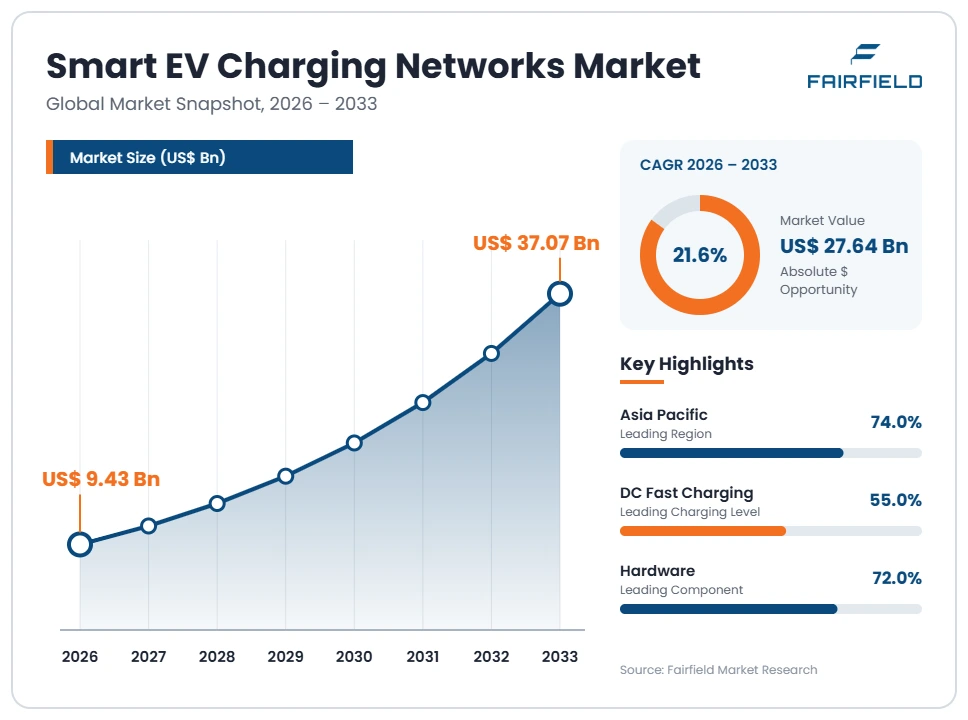
The global smart EV charging networks market size is expected to be valued at US$ 9.43 billion in 2026 and projected to reach US$ 37.07 billion by 2033, growing at a CAGR of 21.6% between 2026 and 2033.
Between 2020 and 2025, the market grew at a CAGR of about 27.0%, as electric vehicle sales surged in China, Europe, and the United States, governments funded public charging, and utilities began rewarding drivers for charging at off-peak times. Smart EV charging networks connect chargers to cloud software, so operators can monitor stations, take payments, balance power across sites, and shift charging to when electricity is cheaper or cleaner. Features such as load management, open communication protocols, and vehicle-to-grid capability turn chargers into flexible grid assets. Growth comes from rising EV adoption, grid capacity limits, fleet electrification, and policies that require smart charging functions in new chargers. The market is shifting toward high-power DC hubs, bidirectional charging, and AI-based energy management. In January 2026, Walmart announced plans to install 400 kW chargers at 78 parking lots across 19 U.S. states.
Key Report Takeaways
- By Charging Level: DC Fast Charging held 55.0% share in 2026 and is projected to expand at the fastest 22.4% CAGR through 2033, driven by highway corridors, retail hubs, and fleet depots that need rapid turnaround and high utilization.
- By Grid Interaction: Unidirectional Smart Charging held 79.0% share in 2026, while Bidirectional Charging-Enabled Networks are projected to expand at a 23.2% CAGR through 2033, driven by vehicle-to-grid pilots, school bus fleets, and utility flexibility programs.
- By Component: Hardware held 72.0% share in 2026, while Software is projected to expand at a 24.5% CAGR through 2033, driven by subscription platforms for load management, payments, roaming, and predictive maintenance across growing charger fleets.
- By Region: Asia Pacific held 74.0% share in 2026, while India is projected to expand at a 26.4% CAGR through 2033, driven by public charger expansion, government incentives, and fast-growing electric car, bus, and three-wheeler adoption.
Global Smart EV Charging Networks Market Trends and Insights
Drivers Impact Analysis
Two drivers carry the strongest influence on smart EV charging networks demand during the forecast period.
| Driver | Impact on CAGR Forecast | Geographic Relevance | Impact Timeline |
| Rising EV adoption and public charging investment | High | Global | Long term (≥4 years) |
| Grid constraints and demand for flexible charging | High | Europe, North America, Asia Pacific | Medium term (2–4 years) |
Rising EV Adoption Is Driving the Smart EV Charging Networks Market
Rising EV adoption and public charging investment are the strongest driver of the smart EV charging networks market. More electric vehicles need more connected chargers.
The mechanism is a fast-growing installed base of electric cars, vans, buses, and trucks. China sells more electric vehicles than the rest of the world combined, while Europe and the United States continue to expand their fleets. Drivers expect reliable, easy-to-find chargers with app-based payment and real-time availability. Governments fund charging through programs such as the European Union’s Alternative Fuels Infrastructure Regulation and U.S. federal and state grants, often requiring open protocols, uptime targets, and smart functions. Retailers, fuel companies, and automakers build networks to attract customers. Walmart, BP Pulse, Shell Recharge, and Tesla are expanding high-power hubs. These investments create steady demand for networked chargers and management software.
Grid Constraints Are Expanding the Smart EV Charging Networks Market
Grid constraints and demand for flexible charging are expanding the smart EV charging networks market. Power grids cannot absorb unmanaged charging.
The cause is limited grid capacity and peak demand. When many vehicles charge at the same time, they can overload local transformers and raise peak loads. Smart charging spreads demand across hours, caps site power, and responds to utility signals. Depots and apartment buildings use load management to install more chargers without costly grid upgrades. Time-of-use tariffs and demand response programs reward drivers who charge off-peak or during periods of high solar and wind output. The United Kingdom requires smart functions in new home chargers. Fleets with many vehicles at one depot rely on smart scheduling to avoid high demand charges. These needs make intelligence a core requirement, not an extra feature.
Restraints Impact Analysis
Two restraints limit how quickly the smart EV charging networks market grows.
| Restraint | Impact on CAGR Forecast | Geographic Relevance | Impact Timeline |
| High installation and grid connection costs | High | Global | Long term (≥4 years) |
| Reliability, interoperability, and cybersecurity concerns | Medium | Global | Medium term (2–4 years) |
High Costs Slow the Smart EV Charging Networks Market
High installation and grid connection costs slow the smart EV charging networks market. Fast chargers are expensive to build.
The specific causes are hardware, civil works, and power upgrades. A high-power DC charging site needs chargers, transformers, switchgear, cabling, and sometimes new substations, which can cost hundreds of thousands of dollars per site. Grid connection queues can delay projects by months or years. Utilization at many new sites remains low while EV adoption grows, making returns uncertain. Some operators, such as EVBox, have exited or restructured after losses. Shifts in government incentives and permitting rules add uncertainty for investors planning long-term networks. Rising interest rates have raised financing costs for network operators. These cost pressures slow network rollout, especially in rural areas, smaller towns, and emerging markets.
Reliability and Cybersecurity Concerns Restrict the Smart EV Charging Networks Market
Reliability, interoperability, and cybersecurity concerns restrict the smart EV charging networks market. Drivers lose trust when chargers fail.
The underlying causes are complex systems and many vendors. Broken chargers, payment errors, and poor connectivity frustrate drivers and slow EV adoption. Chargers, vehicles, and software from different makers must communicate using standards such as OCPP and ISO 15118, but implementation varies. Connected chargers are potential targets for cyberattacks that could disrupt networks or the grid. Regulators now demand uptime, transparency, and security standards for funded chargers. Operators must invest in remote monitoring, spare parts, and field technicians to meet uptime targets. Software updates and new standards can make older chargers obsolete. Data privacy rules also govern how driver and vehicle data are used. These concerns raise costs and slow deployment.
Market Opportunities
Vehicle-to-Grid Opens a Fast-Growth Revenue Pool
Vehicle-to-grid and bidirectional charging open a fast-growth revenue pool in the smart EV charging networks market. Car batteries can support the grid.
Charger makers, software firms, utilities, and fleets can capture this opportunity. Bidirectional chargers allow EVs to send power back to homes, buildings, or the grid during peak demand, earning revenue for owners. Electric school buses, which sit idle much of the day, are early users; Hubject, Heliox, Accelera, and Blue Bird launched a commercial V2G solution. Automakers are adding bidirectional capability to new models and home energy bundles. Utilities in Europe, Japan, and North America are testing tariffs that pay EV owners for grid support. Companies that build reliable V2G platforms and utility partnerships can earn recurring grid services revenue.
Fleet and Software Platforms Create a Recurring Revenue Pool
Fleet electrification and software platforms create a recurring revenue pool in the smart EV charging networks market. Fleets need managed charging.
Software providers and charge point operators can capture this opportunity. Delivery vans, buses, taxis, and trucks charge at depots where load management keeps costs low. Software schedules charging, tracks energy use, and integrates with fleet systems. Charging-as-a-service models bundle hardware, software, installation, and maintenance for a monthly fee, removing large upfront costs for fleet owners. Ride-hailing and taxi operators need reliable fast charging in cities, often through dedicated hubs. GM, EVgo, and Pilot have expanded truck stop charging. Megawatt charging systems for heavy trucks open another segment. Companies with strong software, energy management, and service capabilities can win long-term contracts with fleets.
Segment Analysis
- By Charging Level: DC Fast Charging Leads and Grows Fastest
DC Fast Charging held 55.0% share in 2026 and is the fastest-growing charging level, expanding at a 22.4% CAGR through 2033. High-power chargers rated from 50 kW to more than 400 kW serve highway corridors, retail hubs, urban fast-charging sites, and fleet depots, where vehicles need to recharge in minutes rather than hours. Each DC site carries far higher hardware, grid, and software value than an AC charger, which explains its large revenue share. Tesla, Electrify America, EVgo, BP Pulse, and ABB E-mobility lead deployment, and retailers such as Walmart are adding 400 kW hubs.
Level 2 AC charging serves homes, workplaces, hotels, and destinations where cars park for several hours. Smart Level 2 chargers are essential for load management in apartments and offices, and many governments require smart functions in new home units. For the market, DC growth raises network value, while Level 2 expands coverage.
- By Grid Interaction: Unidirectional Leads While Bidirectional Grows Fastest
Unidirectional Smart Charging held 79.0% share in 2026. These systems control when and how fast vehicles charge, responding to tariffs, site limits, and utility signals without sending power back. They are mature, widely supported by vehicles, and required by many grid operators for new installations.
Bidirectional Charging-Enabled Networks are the fastest-growing type, expanding at a 23.2% CAGR through 2033. Vehicle-to-grid, vehicle-to-home, and vehicle-to-building systems let EV batteries supply power during peaks or outages. Electric school buses, fleet vans, and new car models with bidirectional capability are driving pilots in North America, Europe, and Japan. Standards such as ISO 15118-20 support adoption. For the market, bidirectional growth adds grid services revenue.
- By Component: Hardware Leads While Software Grows Fastest
Hardware held 72.0% share in 2026. Chargers, power cabinets, transformers, cables, and payment terminals make up most spending, especially at DC fast-charging sites. ABB E-mobility, Delta Electronics, Siemens, Wallbox, and Tesla are major hardware suppliers.
Software is the fastest-growing component, expanding at a 24.5% CAGR through 2033. Platforms manage networks of chargers, handle payments and roaming, balance power, predict failures, and connect to utility programs. ChargePoint, Schneider Electric, and specialist software firms sell subscriptions per port. Services, including site design, installation, maintenance, and customer support, form the remaining component and grow as networks age and uptime rules tighten. For the market, software growth adds recurring revenue and improves charger uptime.
Geography Analysis
- Why Is North America Important to the Smart EV Charging Networks Market?
North America is important because the United States hosts many of the world’s leading charging network operators and software providers, including Tesla, ChargePoint, Electrify America, EVgo, and Blink Charging. Federal and state programs have funded fast-charging corridors, and automakers have adopted the NACS connector, giving drivers access to the Tesla Supercharger network. Retailers such as Walmart are building large hubs, while GM, EVgo, and Pilot have expanded truck stop charging. Canada adds demand through federal and provincial incentives. Key barriers include policy uncertainty and uneven utilization. One change shaping the region is the shift to a single connector standard.
- Europe Expands the Smart EV Charging Networks Market Through Regulation
Europe is a major smart EV charging networks market. Germany, France, the United Kingdom, the Netherlands, and Norway lead, supported by European Union rules that require fast chargers along main highways, open payment, and smart functions. Ionity, Fastned, Allego, BP Pulse, and Shell Recharge operate large networks. Osprey Charging and Connected Kerb raised major funding in January 2026. The United Kingdom requires smart features in home chargers. Key barriers include grid connection delays and high electricity prices. One opportunity is on-street and lamppost charging for drivers without driveways in dense cities.
- Which Region Is Leading the Smart EV Charging Networks Market?
Asia Pacific is leading the smart EV charging networks market with a 74.0% share in 2026. China dominates with millions of public chargers, strong EV sales, and operators such as TELD, Star Charge, and State Grid. India is the fastest-growing country, expanding at a 26.4% CAGR through 2033, as the government expands public chargers and supports electric buses and three-wheelers. Japan, South Korea, and Australia add demand, with Japan testing vehicle-to-home systems. Key barriers include low utilization at some sites. One change shaping the region is ultra-fast and megawatt charging for trucks.
- Latin America Grows the Smart EV Charging Networks Market Through Early Adoption
Latin America is a growing smart EV charging networks market. Brazil, Mexico, Chile, and Colombia are expanding networks as Chinese automakers bring affordable EVs to the region. Santiago and Bogotá operate some of the largest electric bus fleets outside China, which need depot charging with load management. Utilities and fuel retailers such as Enel X and national fuel retail chains are installing fast chargers along main highways and in shopping centers. Mexico benefits from proximity to U.S. supply chains. Key barriers include high costs, import duties, and limited incentives. One opportunity is electric bus and taxi fleets that need managed depot charging.
- Middle East & Africa Develops the Smart EV Charging Networks Market Through Diversification
Middle East & Africa is a developing smart EV charging networks market. The United Arab Emirates and Saudi Arabia are building national networks to meet EV adoption targets, with utilities and new joint ventures installing fast chargers in cities and along highways. Morocco, Egypt, and South Africa are adding early public charging. Solar-powered charging hubs with battery storage are attractive in sunny climates and can reduce grid dependence. Luxury hotels and malls add destination chargers. Key barriers include low EV adoption and grid limits in some countries. One change shaping the region is government targets for electric mobility.
Competitive Landscape
The smart EV charging networks market is moderately fragmented. ABB E-mobility, ChargePoint, Tesla, Electrify America, and Schneider Electric are leading players, while Siemens, EVgo, BP Pulse, Shell Recharge, Blink Charging, Wallbox, and Delta Electronics compete strongly. In China, state-owned and private operators such as State Grid, TELD, and Star Charge run very large networks. Automakers, including Tesla, BYD, Mercedes-Benz, and Hyundai, also build their own networks or joint ventures to support vehicle sales.
Companies compete on reliability, charging speed, software features, network coverage, pricing, and partnerships with automakers, retailers, and utilities. Hardware makers compete on power, efficiency, and cost, while network operators compete on location quality and uptime. Software firms compete on interoperability, energy management, and data insights. Oil majors use strong balance sheets and existing fuel station sites to expand quickly.
Strategic moves show how competition is changing. In January 2026, Walmart announced 400 kW charging at 78 sites across 19 states. In January 2026, Osprey Charging secured US$ 138 million in debt. In January 2026, Connected Kerb secured US$ 90 million. These moves show competition shifting toward high-power hubs and well-funded networks.
Three themes shape vendor strategy. First, companies are building high-power hubs at retail and highway locations. Second, they are adding software for load management, payments, and maintenance. Third, they are developing vehicle-to-grid solutions with utilities and fleets.
Recent Industry Developments
- January 2026: Walmart announced plans to install 400 kW chargers at 78 parking lots across 19 U.S. states – expands high-power smart EV charging networks at retail sites.
- January 2026: Osprey Charging reported 158% annual sales growth and secured US$ 138 million in debt financing – supports rapid charging hub growth in the United Kingdom.
- January 2026: Connected Kerb reported 82.7% sales growth and secured US$ 90 million in funding – expands on-street EV charging infrastructure for drivers without driveways.
Companies Covered in the Report
- ABB E-mobility
- ChargePoint
- Tesla
- Electrify America
- Schneider Electric
- Siemens
- EVgo
- BP Pulse
- Shell Recharge
- Blink Charging
- Wallbox
- Delta Electronics
Smart EV Charging Networks Market Report Scope
| Metric | Value |
| Study Period | 2020–2033 |
| Market Size 2026 | US$ 9.43 Billion |
| Market Size 2033 | US$ 37.07 Billion |
| CAGR 2026–2033 | 21.6% |
| Absolute Dollar Opportunity | US$ 27.64 Billion |
| Largest Market | Asia Pacific |
| Fastest-Growing Market | India |
| Market Concentration | Moderately Fragmented |
| Major Players | ABB E-mobility, ChargePoint, Tesla, Electrify America, Schneider Electric |
Smart EV Charging Networks Market Segmentation
Charging Level
- Level 2
- DC Fast Charging
Grid Interaction
- Unidirectional Smart Charging
- Bidirectional Charging-Enabled Networks
Component
- Hardware
- Software
- Services
Regions
- North America
- Europe
- Asia Pacific
- Latin America
- Middle East & Africa
- Executive Summary
- Global Smart EV Charging Networks Market Snapshot
- Future Projections
- Key Report Takeaways
- Regional Snapshot
- Market Overview
- Market Definition and Report Scope
- Historical Trends 2020–2025
- Market Dynamics
- Drivers
- Rising EV Adoption Is Driving the Smart EV Charging Networks Market
- Grid Constraints Are Expanding the Smart EV Charging Networks Market
- Restraints
- High Costs Slow the Smart EV Charging Networks Market
- Reliability and Cybersecurity Concerns Restrict the Smart EV Charging Networks Market
- Market Opportunities
- Vehicle-to-Grid Opens a Fast-Growth Revenue Pool
- Fleet and Software Platforms Create a Recurring Revenue Pool
- Drivers
- Global Smart EV Charging Networks Market Outlook, 2020-2033
- Global Smart EV Charging Networks Market Outlook, by Charging Level, Value (US$ Billion), 2020-2033
- Level 2
- DC Fast Charging
- Global Smart EV Charging Networks Market Outlook, by Grid Interaction, Value (US$ Billion), 2020-2033
- Unidirectional Smart Charging
- Bidirectional Charging-Enabled Networks
- Global Smart EV Charging Networks Market Outlook, by Component, Value (US$ Billion), 2020-2033
- Hardware
- Software
- Services
- Global Smart EV Charging Networks Market Outlook, by Region, Value (US$ Billion), 2020-2033
- North America
- Europe
- Asia Pacific
- Latin America
- Middle East & Africa
- Global Smart EV Charging Networks Market Outlook, by Charging Level, Value (US$ Billion), 2020-2033
- North America Smart EV Charging Networks Market Outlook, 2020-2033
- North America Smart EV Charging Networks Market Outlook, by Charging Level, Value (US$ Billion), 2020-2033
- Level 2
- DC Fast Charging
- North America Smart EV Charging Networks Market Outlook, by Grid Interaction, Value (US$ Billion), 2020-2033
- Unidirectional Smart Charging
- Bidirectional Charging-Enabled Networks
- North America Smart EV Charging Networks Market Outlook, by Component, Value (US$ Billion), 2020-2033
- Hardware
- Software
- Services
- North America Smart EV Charging Networks Market Outlook, by Country, Value (US$ Billion), 2020-2033
- United States Smart EV Charging Networks Market Outlook, by Charging Level, 2020-2033
- United States Smart EV Charging Networks Market Outlook, by Grid Interaction, 2020-2033
- United States Smart EV Charging Networks Market Outlook, by Component, 2020-2033
- Canada Smart EV Charging Networks Market Outlook, by Charging Level, 2020-2033
- Canada Smart EV Charging Networks Market Outlook, by Grid Interaction, 2020-2033
- Canada Smart EV Charging Networks Market Outlook, by Component, 2020-2033
- North America Smart EV Charging Networks Market Outlook, by Charging Level, Value (US$ Billion), 2020-2033
- Europe Smart EV Charging Networks Market Outlook, 2020-2033
- Europe Smart EV Charging Networks Market Outlook, by Charging Level, Value (US$ Billion), 2020-2033
- Level 2
- DC Fast Charging
- Europe Smart EV Charging Networks Market Outlook, by Grid Interaction, Value (US$ Billion), 2020-2033
- Unidirectional Smart Charging
- Bidirectional Charging-Enabled Networks
- Europe Smart EV Charging Networks Market Outlook, by Component, Value (US$ Billion), 2020-2033
- Hardware
- Software
- Services
- Europe Smart EV Charging Networks Market Outlook, by Country, Value (US$ Billion), 2020-2033
- Germany Smart EV Charging Networks Market Outlook, by Charging Level, 2020-2033
- Germany Smart EV Charging Networks Market Outlook, by Grid Interaction, 2020-2033
- Germany Smart EV Charging Networks Market Outlook, by Component, 2020-2033
- France Smart EV Charging Networks Market Outlook, by Charging Level, 2020-2033
- France Smart EV Charging Networks Market Outlook, by Grid Interaction, 2020-2033
- France Smart EV Charging Networks Market Outlook, by Component, 2020-2033
- United Kingdom Smart EV Charging Networks Market Outlook, by Charging Level, 2020-2033
- United Kingdom Smart EV Charging Networks Market Outlook, by Grid Interaction, 2020-2033
- United Kingdom Smart EV Charging Networks Market Outlook, by Component, 2020-2033
- Netherlands Smart EV Charging Networks Market Outlook, by Charging Level, 2020-2033
- Netherlands Smart EV Charging Networks Market Outlook, by Grid Interaction, 2020-2033
- Netherlands Smart EV Charging Networks Market Outlook, by Component, 2020-2033
- Norway Smart EV Charging Networks Market Outlook, by Charging Level, 2020-2033
- Norway Smart EV Charging Networks Market Outlook, by Grid Interaction, 2020-2033
- Norway Smart EV Charging Networks Market Outlook, by Component, 2020-2033
- Europe Smart EV Charging Networks Market Outlook, by Charging Level, Value (US$ Billion), 2020-2033
- Asia Pacific Smart EV Charging Networks Market Outlook, 2020-2033
- Asia Pacific Smart EV Charging Networks Market Outlook, by Charging Level, Value (US$ Billion), 2020-2033
- Level 2
- DC Fast Charging
- Asia Pacific Smart EV Charging Networks Market Outlook, by Grid Interaction, Value (US$ Billion), 2020-2033
- Unidirectional Smart Charging
- Bidirectional Charging-Enabled Networks
- Asia Pacific Smart EV Charging Networks Market Outlook, by Component, Value (US$ Billion), 2020-2033
- Hardware
- Software
- Services
- Asia Pacific Smart EV Charging Networks Market Outlook, by Country, Value (US$ Billion), 2020-2033
- China Smart EV Charging Networks Market Outlook, by Charging Level, 2020-2033
- China Smart EV Charging Networks Market Outlook, by Grid Interaction, 2020-2033
- China Smart EV Charging Networks Market Outlook, by Component, 2020-2033
- India Smart EV Charging Networks Market Outlook, by Charging Level, 2020-2033
- India Smart EV Charging Networks Market Outlook, by Grid Interaction, 2020-2033
- India Smart EV Charging Networks Market Outlook, by Component, 2020-2033
- Japan Smart EV Charging Networks Market Outlook, by Charging Level, 2020-2033
- Japan Smart EV Charging Networks Market Outlook, by Grid Interaction, 2020-2033
- Japan Smart EV Charging Networks Market Outlook, by Component, 2020-2033
- South Korea Smart EV Charging Networks Market Outlook, by Charging Level, 2020-2033
- South Korea Smart EV Charging Networks Market Outlook, by Grid Interaction, 2020-2033
- South Korea Smart EV Charging Networks Market Outlook, by Component, 2020-2033
- Australia Smart EV Charging Networks Market Outlook, by Charging Level, 2020-2033
- Australia Smart EV Charging Networks Market Outlook, by Grid Interaction, 2020-2033
- Australia Smart EV Charging Networks Market Outlook, by Component, 2020-2033
- Asia Pacific Smart EV Charging Networks Market Outlook, by Charging Level, Value (US$ Billion), 2020-2033
- Latin America Smart EV Charging Networks Market Outlook, 2020-2033
- Latin America Smart EV Charging Networks Market Outlook, by Charging Level, Value (US$ Billion), 2020-2033
- Level 2
- DC Fast Charging
- Latin America Smart EV Charging Networks Market Outlook, by Grid Interaction, Value (US$ Billion), 2020-2033
- Unidirectional Smart Charging
- Bidirectional Charging-Enabled Networks
- Latin America Smart EV Charging Networks Market Outlook, by Component, Value (US$ Billion), 2020-2033
- Hardware
- Software
- Services
- Latin America Smart EV Charging Networks Market Outlook, by Country, Value (US$ Billion), 2020-2033
- Brazil Smart EV Charging Networks Market Outlook, by Charging Level, 2020-2033
- Brazil Smart EV Charging Networks Market Outlook, by Grid Interaction, 2020-2033
- Brazil Smart EV Charging Networks Market Outlook, by Component, 2020-2033
- Mexico Smart EV Charging Networks Market Outlook, by Charging Level, 2020-2033
- Mexico Smart EV Charging Networks Market Outlook, by Grid Interaction, 2020-2033
- Mexico Smart EV Charging Networks Market Outlook, by Component, 2020-2033
- Chile Smart EV Charging Networks Market Outlook, by Charging Level, 2020-2033
- Chile Smart EV Charging Networks Market Outlook, by Grid Interaction, 2020-2033
- Chile Smart EV Charging Networks Market Outlook, by Component, 2020-2033
- Colombia Smart EV Charging Networks Market Outlook, by Charging Level, 2020-2033
- Colombia Smart EV Charging Networks Market Outlook, by Grid Interaction, 2020-2033
- Colombia Smart EV Charging Networks Market Outlook, by Component, 2020-2033
- Latin America Smart EV Charging Networks Market Outlook, by Charging Level, Value (US$ Billion), 2020-2033
- Middle East & Africa Smart EV Charging Networks Market Outlook, 2020-2033
- Middle East & Africa Smart EV Charging Networks Market Outlook, by Charging Level, Value (US$ Billion), 2020-2033
- Level 2
- DC Fast Charging
- Middle East & Africa Smart EV Charging Networks Market Outlook, by Grid Interaction, Value (US$ Billion), 2020-2033
- Unidirectional Smart Charging
- Bidirectional Charging-Enabled Networks
- Middle East & Africa Smart EV Charging Networks Market Outlook, by Component, Value (US$ Billion), 2020-2033
- Hardware
- Software
- Services
- Middle East & Africa Smart EV Charging Networks Market Outlook, by Country, Value (US$ Billion), 2020-2033
- United Arab Emirates Smart EV Charging Networks Market Outlook, by Charging Level, 2020-2033
- United Arab Emirates Smart EV Charging Networks Market Outlook, by Grid Interaction, 2020-2033
- United Arab Emirates Smart EV Charging Networks Market Outlook, by Component, 2020-2033
- Saudi Arabia Smart EV Charging Networks Market Outlook, by Charging Level, 2020-2033
- Saudi Arabia Smart EV Charging Networks Market Outlook, by Grid Interaction, 2020-2033
- Saudi Arabia Smart EV Charging Networks Market Outlook, by Component, 2020-2033
- Morocco Smart EV Charging Networks Market Outlook, by Charging Level, 2020-2033
- Morocco Smart EV Charging Networks Market Outlook, by Grid Interaction, 2020-2033
- Morocco Smart EV Charging Networks Market Outlook, by Component, 2020-2033
- Egypt Smart EV Charging Networks Market Outlook, by Charging Level, 2020-2033
- Egypt Smart EV Charging Networks Market Outlook, by Grid Interaction, 2020-2033
- Egypt Smart EV Charging Networks Market Outlook, by Component, 2020-2033
- South Africa Smart EV Charging Networks Market Outlook, by Charging Level, 2020-2033
- South Africa Smart EV Charging Networks Market Outlook, by Grid Interaction, 2020-2033
- South Africa Smart EV Charging Networks Market Outlook, by Component, 2020-2033
- Middle East & Africa Smart EV Charging Networks Market Outlook, by Charging Level, Value (US$ Billion), 2020-2033
- Competitive Landscape
- Market Concentration and Industry Leaders
- Competitive Differentiation
- Strategic Moves and Market Direction
- Recent Industry Developments
- Company Profiles
- ABB E-mobility
- ChargePoint
- Tesla
- Electrify America
- Schneider Electric
- Siemens
- EVgo
- BP Pulse
- Shell Recharge
- Blink Charging
- Wallbox
- Delta Electronics
- Appendix
- Research Methodology
- Report Assumptions
- Acronyms and Abbreviations
Charging Level
- Level 2
- DC Fast Charging
Grid Interaction
- Unidirectional Smart Charging
- Bidirectional Charging-Enabled Networks
Component
- Hardware
- Software
- Services
Regions
- North America
- Europe
- Asia Pacific
- Latin America
- Middle East & Africa
Our Research Methodology
Considering the volatility of business today, traditional approaches to strategizing a game plan can be unfruitful if not detrimental. True ambiguity is no way to determine a forecast. A myriad of predetermined factors must be accounted for such as the degree of risk involved, the magnitude of circumstances, as well as conditions or consequences that are not known or unpredictable. To circumvent binary views that cast uncertainty, the application of market research intelligence to strategically posture, move, and enable actionable outcomes is necessary.
View Methodology
Quality Assured
Rigorous Validation Process

Confidentiality Assured
End-to-end Data Security

Custom Research Services
Tailored To Your Objectives
FAQs
The smart EV charging networks market is valued at US$ 9.43 billion in 2026, led by DC fast charging and Asia Pacific.
The market is projected to reach US$ 37.07 billion by 2033, growing at a 21.6% CAGR and adding US$ 27.64 billion.
Software is growing fastest at a 24.5% CAGR through 2033, driven by platforms for load management, payments, and maintenance.
India is growing fastest at a 26.4% CAGR through 2033, driven by public charger expansion, incentives, and rising EV adoption.
Asia Pacific holds the largest share at 74.0% in 2026, supported by millions of public chargers and strong EV sales in China.
Related Reports
Micro-mobility Charging Infrastructure Market Size, Share, Insights, Competitive Landscape, and Forecast 2026 to 2033
The global micro-mobility charging infrastructure market is valued at US$9.06 billion in 2026, reaching US$34.02 billion by 2033, growing at a 20.8% CAGR
Ultra High Performance Tire Market Size, Share, Insights, Competitive Landscape, and Forecast 2026 to 2033
The global ultra high performance tire market is valued at US$18.65 billion in 2026, reaching US$38.97 billion by 2033, growing at an 11.1% CAGR
Small Parcels Delivery Market Size, Share, Insights, Competitive Landscape, and Forecast 2026 to 2033
Explore the small parcels delivery market, forecast to reach US$957.5 billion by 2033 at 7.3% CAGR, with service, shipment weight and regional insights.
Advanced Aerial Mobility Market Size, Share, Insights, Competitive Landscape, and Forecast 2026 to 2033
The global advanced aerial mobility market is valued at US$18.51 billion in 2026, reaching US$90.75 billion by 2033, growing at a 25.5% CAGR
Low Rolling Resistance Tire Market Size, Share, Insights, Competitive Landscape, and Forecast 2026 to 2033
The low rolling resistance tire market is projected to grow from US$38.6 billion in 2026 to US$62.4 billion by 2033, at a 7.1% CAGR. Explore key trends.
Active Noise and Vibration Control System Market Size, Share, Insights, Competitive Landscape, and Forecast 2026 to 2033
The global active noise and vibration control system market is valued at US$3.84 billion in 2026, reaching US$6.09 billion by 2033, growing at a 6.8% CAGR