



Electronic Circuit Protectors Market
Electronic Circuit Protectors Market Size, Share, Insights, Competitive Landscape, and Forecast 2026 to 2033
Electronic Circuit Protectors Market Size and Trend Analysis
What Shapes the Electronic Circuit Protectors Growth Outlook?
The global electronic circuit protectors market size is expected to be valued at US$3.2000 billion in 2026 and projected to reach US$5.6280 billion by 2033, growing at a CAGR of 8.4% between 2026 and 2033. The outlook applies the published benchmark growth rate to the requested forecast window. The calculated endpoint represents a constant-growth projection, rather than a separately published estimate for that year.
The 2025 benchmark is US$2.9000 billion; a consistent historical CAGR for 2020–2025 is not established. The market covers active electronic protection ICs, modules, and branch-protection devices that detect and respond to electrical faults in a defined circuit. Its direction reflects integrated protection simplifies board-level power paths and selective branch isolation supports industrial availability. Commercial selection depends on fault response, current limits, thermal loss, selective isolation, and reset behavior; the supported implementation must fit the customer’s actual operating requirements.
Key Report Takeaways
- By Product Form: Protection ICs are semiconductor devices integrated into electronics. Comparative revenue and growth leadership are not established for the requested period; commercial selection follows the function, supported operating conditions, and responsibilities described for each alternative.
- By Response Function: Current Limiting bounds a specified electrical condition. Comparative revenue and growth leadership are not established for the requested period; commercial selection follows the function, supported operating conditions, and responsibilities described for each alternative.
- By Application: Electronic Power Entry protects an incoming circuit path. Comparative revenue and growth leadership are not established for the requested period; commercial selection follows the function, supported operating conditions, and responsibilities described for each alternative.
- By Integration Responsibility: Component Design-In requires device-level circuit work. Comparative revenue and growth leadership are not established for the requested period; commercial selection follows the function, supported operating conditions, and responsibilities described for each alternative.
- By Geography: North America, Europe, Asia Pacific, Latin America, and Middle East & Africa require separate application and customer assessments. Regional shares and growth rankings are not assigned without comparable evidence; local integration and continuing support determine practical commercial fit.
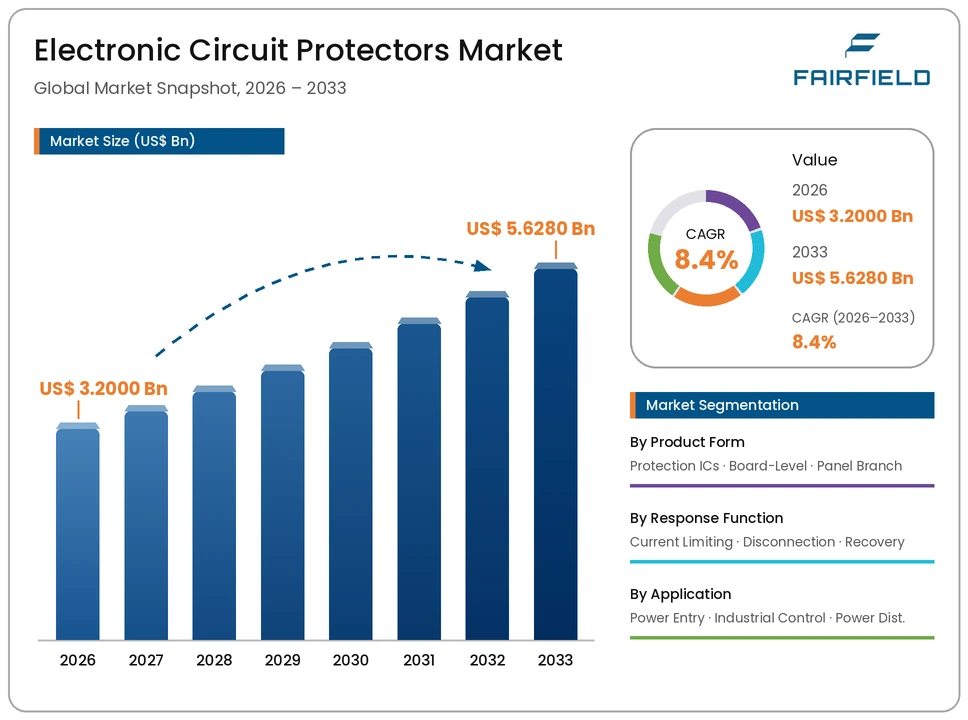
Global Electronic Circuit Protectors Market Trends and Insights
Drivers Impact Analysis
Impact ratings describe qualitative commercial relevance; they do not quantify additional CAGR contributions.
| Driver | Impact on CAGR Forecast | Geographic Relevance | Impact Timeline |
| Integrated Protection Simplifies Board-Level Power Paths | High | All regions; relevance varies by application | Medium term 2–4 years |
| Selective Branch Isolation Supports Industrial Availability | Medium | All regions; relevance varies by application | Long term ≥4 years |
- Electronic Circuit Protectors: Integrated Protection Simplifies Board-Level Power Paths
Programmable electronic fuses can combine several power-path functions within a defined device. Integration creates demand where board designers need a controlled response to faults without adding many separate components. The commercial requirement is a protector that fits the circuit’s load and operating conditions, not simply a smaller package. For a purchasing decision, the relevant benefit is the problem removed from the customer's existing workflow. A supplier should identify the required output, the conditions under which it is achieved, and the resources needed to maintain it.
Texas Instruments provides eFuses with protection against specified current, voltage, and power-entry events. The designer must select the actual component and verify its behavior in the complete circuit rather than transfer every family-level feature to one part. This mechanism creates a stronger commercial case when the customer can compare the proposed solution with an existing alternative.
- Electronic Circuit Protectors: Selective Branch Isolation Supports Industrial Availability
Selective DC branch isolation can prevent a local control-circuit problem from interrupting other loads sharing a supply. This creates demand for protection with a predictable response and clear status information. A maintenance team needs to identify the affected branch and restore service under an appropriate process. The effect on demand depends on whether the customer can incorporate the offering into an established routine. Additional capabilities are valuable when they address a real bottleneck and remain practical for the people responsible for implementation.
Phoenix Contact supplies electronic circuit breakers for industrial DC loads, including multichannel products. Its participation establishes a panel-level route distinct from semiconductor IC protection. The circuit’s supply behavior and downstream loads still determine whether the proposed breaker provides the intended selective response. Buyers should distinguish technical availability from successful deployment.
Restraints Impact Analysis
Impact ratings describe qualitative commercial relevance; they do not quantify additional CAGR contributions.
| Restraint | Impact on CAGR Forecast | Geographic Relevance | Impact Timeline |
| Continuous Current Creates Thermal and Voltage-Drop Costs | Medium | All regions; relevance varies by application | Medium term 2–4 years |
| Protection Coordination Adds Verification Work | Medium | All regions; relevance varies by application | Long term ≥4 years |
- Electronic Circuit Protectors: Continuous Current Creates Thermal and Voltage-Drop Costs
An active protector can introduce power loss while carrying normal load current. In a compact assembly, that loss can create a thermal constraint or reduce the voltage available to the protected load. Buyers must evaluate continuous operation alongside the device’s advertised fault-interruption capability. This limitation can extend the interval between first interest and a repeatable commercial relationship. Development budgets should include the work needed to resolve the problem rather than treating qualification as an incidental expense after supplier selection.
Active power-path protection requires component selection, board layout, and heat assessment. The cost sources include added copper, cooling, or a different device configuration. A low nominal on-resistance is useful context, but the actual operating current and temperature determine the implementation result. Clear acceptance criteria can reduce disagreement between the buyer and supplier.
- Electronic Circuit Protectors: Protection Coordination Adds Verification Work
A protector must work with the supply and other protection layers. A local device that responds too slowly or trips unnecessarily can undermine the circuit’s operating purpose. Integration effort can restrain adoption where a simple passive solution already meets the customer’s bounded needs at lower expense. The commercial consequence is a more selective purchasing process. Customers may defer adoption, narrow the intended use, or retain an alternative until the complete operating requirements are understood. A quotation should make those requirements visible before commitment.
STMicroelectronics describes eFuses with integrated switching and configurable fault response. Resettable circuit protection needs a defined retry or latch behavior suitable for the load. Verification expense includes startup, fault, recovery, and interactions with upstream equipment under representative conditions. A credible mitigation plan addresses the actual source of the constraint.
Market Opportunities
Impact ratings describe qualitative commercial relevance; they do not quantify additional CAGR contributions.
| Opportunity | Impact on CAGR Forecast | Geographic Relevance | Impact Timeline |
| Fault Telemetry Opens Control-Cabinet Service Value | Medium | All regions; relevance varies by application | Medium term 2–4 years |
| Reference Power Designs Support Electronics Integration Programs | Medium | All regions; relevance varies by application | Long term ≥4 years |
- Electronic Circuit Protectors: Fault Telemetry Opens Control-Cabinet Service Value
Fault-status monitoring creates an opportunity around identifying a failed branch and connecting that information with maintenance systems. Suppliers can provide integration and commissioning services alongside electronic protection hardware. The revenue pool concerns usable diagnostic information and support rather than the mere presence of another status output. The attractive customer is one with a clearly defined unmet requirement and the resources to implement the solution. Sales development should begin with that requirement, rather than assume that a broad category trend converts automatically into an order.
Phoenix Contact provides electronic branch-protection products with defined industrial functions. Integrators can connect their outputs with the customer’s controls where supported. A service proposal should describe the actual signal, reset authority, and maintenance action instead of promising autonomous troubleshooting of every machine fault. Capturing this opportunity requires a bounded offer with understandable deliverables.
- Electronic Circuit Protectors: Reference Power Designs Support Electronics Integration Programs
Reference power designs create an opportunity for suppliers that can reduce repeated implementation work around protection ICs. A bounded design package can document component selection and representative circuit behavior. It creates value for an electronics customer while leaving final equipment verification with the responsible manufacturer. This opportunity differs from general category expansion because it involves a new way to package technical or professional capability. The offer can address a customer group underserved by existing products, provided its practical requirements are explicitly considered.
Texas Instruments and STMicroelectronics provide direct eFuse participation. Designers can use supported information to build active protection into their selected power path. The offer should specify the load and operating envelope, keeping development support separate from a guarantee that the finished equipment meets every application requirement. Providers should test the revenue proposition against the cost of delivering it consistently.
Segment Analysis
By Product Form: Programmable Electronic Fuses Requires Application Fit
Protection ICs are semiconductor devices integrated into electronics. Board-Level Assemblies combine components on a defined board. Panel Branch Protectors serve wired control branches. Product form affects design responsibility and should not combine unrelated passive fuse revenue with active electronic protection.
An IC customer owns more circuit engineering, while a panel product can provide a bounded installation interface. Assemblies need their own operating specifications. Buyers should compare the complete protection implementation rather than infer equivalent application scope from a shared electronic-fuse description. The purchasing implication is to compare solutions against the required function. A larger specification or broader portfolio does not establish better fit. Supplier support is valuable when it helps the customer implement the chosen function consistently, rather than simply adding features to a quotation.
By Response Function: Active Power-Path Protection Requires Application Fit
Current Limiting bounds a specified electrical condition. Controlled Disconnection isolates the load under defined faults. Managed Recovery governs reset or retry. Products may combine these functions, but classification should follow the principal protection role in the actual circuit.
Automatic retry can be appropriate for one load and undesirable for another. A latched response requires a reset process. The buyer should test startup and fault recovery alongside interruption behavior, with settings documented for the installed application. This distinction helps commercial teams define a meaningful application boundary. The same offering can serve several tasks, but sales should be allocated consistently to avoid double counting. Suppliers can improve adoption through application guidance that explains the supported conditions and the limits of the available evidence.
By Application: Selective Dc Branch Isolation Requires Application Fit
Electronic Power Entry protects an incoming circuit path. Industrial Control Branches isolate individual low-voltage loads. Equipment Power Distribution protects selected internal paths. The categories classify where the protector is used rather than the broader industry of the finished customer product.
A server component and an industrial branch breaker have different interfaces and verification routes. Market accounting should count the protector’s revenue and avoid assigning the value of the entire protected equipment to this category. The business implication is a differentiated sales and support model. Purchasing decisions can involve different budgets, approval processes, and expectations for ongoing assistance. Vendors should also distinguish first purchases from recurring use, since installation or enrollment alone does not establish sustained customer value or comparative market leadership.
By Integration Responsibility: Resettable Circuit Protection Requires Application Fit
Component Design-In requires device-level circuit work. Assembly Integration connects a bounded board product. Panel Installation connects a wired protector into controls. Responsibility affects the engineering service needed before recurring product purchases can begin.
A manufacturer should identify who sets protection thresholds and verifies recovery. Installation support does not replace equipment-level assessment. Suppliers can improve commercial clarity through complete operating data and a practical explanation of which configuration choices remain with the customer. Commercial positioning should follow the customer's operating requirement rather than a generalized ranking. Buyers need transparent specifications, appropriate evidence, and a practical implementation route. Bundled offerings require consistent revenue allocation, while optional functions should be explained separately so customers understand the actual basis of the proposed price and ongoing commitment.
Geography Analysis
Which Region Leads the Electronic Circuit Protectors Market?
Comparable evidence does not establish a largest region; North America has identifiable customer and supplier activity. The United States and Canada provide electronics and industrial-control demand contexts. Texas Instruments supplies identifiable protection ICs. Component procurement follows an equipment design and operating envelope; the broader computing market is not itself a revenue measure for active circuit protectors. The regional sales approach should distinguish established customer requirements from prospective expansion. Local support, procurement practices, and the actual route to repeat purchasing matter more than vendor headquarters. A useful entry proposal identifies the customer group, the delivery responsibilities, and the conditions under which the offering can remain dependable.
Europe: Electronic Circuit Protectors Depends on Local Delivery
Germany has identifiable industrial branch-protection participation through Phoenix Contact, with France and the United Kingdom providing varied equipment contexts. STMicroelectronics supplies a separate IC route. Customers should distinguish panel installation from board design-in when comparing supplier roles and service requirements. For fault-status monitoring, local support and clear documentation are practical priorities. Country-level requirements should be reviewed separately before a broader regional launch. A product or service available in one jurisdiction does not establish identical eligibility elsewhere. Suppliers can improve commercial fit through appropriate documentation, local application support, and a clear explanation of the functions included in the purchasing relationship.
Which Region Grows Fastest in Electronic Circuit Protectors?
Comparable evidence does not establish the fastest-growing region; Asia Pacific needs country-specific commercial assessment. Japan, South Korea, China, and India provide electronics manufacturing and industrial-control contexts. Device selection must fit the local equipment and circuit design. Application support can reduce implementation friction, but regional manufacturing scale does not establish a measured share of this protection category. The region should be evaluated through specific countries and customer groups rather than population size alone. Language, operating capability, and distribution or care infrastructure influence practical adoption. Partners should confirm the implementation requirements and the capacity to sustain support before translating a promising development project into a wider market commitment.
Latin America: Electronic Circuit Protectors Depends on Local Delivery
Brazil and Mexico need practical distributor support and equipment-specific integration. Replacement availability and clear configuration can affect industrial adoption. Suppliers should evaluate the actual supply behavior and connected loads rather than assume a catalog device creates selective protection in every panel. A workable regional strategy begins with a defined application and realistic ownership or service costs. Local partners can help with commissioning, communication, and replenishment, but responsibilities need to be explicit. Buyers should assess the whole operating proposition, including support continuity, instead of assuming that a low initial quotation resolves adoption barriers. The customer should evaluate the supported application and clarify responsibilities before expanding the purchasing commitment.
Middle East & Africa: Electronic Circuit Protectors Depends on Local Delivery
Saudi Arabia, the United Arab Emirates, and South Africa present industrial and equipment integration contexts with different service capabilities. Ambient conditions and maintenance processes affect product choice. A bounded installation package should define settings, fault indication, and recovery responsibilities before broader rollout. Market development should be tied to functioning local delivery arrangements. Technical or professional support, suitable documentation, and reliable supply can determine whether initial interest becomes sustained use. Partners should begin with a bounded customer requirement and evaluate performance before expanding the offer across countries with different operating conditions. The customer should evaluate the supported application and clarify responsibilities before expanding the purchasing commitment.
Competitive Landscape
Texas Instruments and STMicroelectronics provide semiconductor eFuses, while Phoenix Contact supplies industrial electronic branch protection. These product forms address different integration responsibilities. Competition depends on predictable response, operating loss, configuration clarity, and support for the selected circuit rather than a broad protection-market ranking.
The competitive structure cannot be assigned a reliable concentration score without comparable revenue data for the defined boundary. A large corporate portfolio does not establish category leadership because reported sales can include unrelated products or services. Customers should compare the actual offering and its commercial support. Suppliers with broader capabilities may provide useful coordination, but the relevant advantage must be demonstrated for the specific application rather than inferred from company size.
Competition centers on the combination of performance, usable implementation, and ongoing cost. Buyers need evidence under representative conditions and a clear explanation of what the supplier provides. Digital interfaces, technical documentation, or service packages can influence selection when they reduce practical friction. These features should be evaluated against the customer's requirements. An extensive feature list offers limited value if the core product or service cannot be delivered consistently within the agreed operating conditions.
Strategic direction favors clearer application boundaries and accountable delivery. Documented developments provide evidence of activity, while planned launches or partnerships remain different from completed commercialization. Suppliers can strengthen customer relationships through dependable support, transparent specifications, and communication that remains accurate as offerings change. The competitive question is whether the complete commercial proposition remains useful after the initial transaction, rather than whether a company appears prominently in general category discussions.
Electronic Circuit Protectors Verified Participants
- Texas Instruments
- STMicroelectronics
- Phoenix Contact
Recent Industry Developments
Current product and service portfolios show documented participation by Texas Instruments, STMicroelectronics, Phoenix Contact. These offerings support the application analysis above; product availability does not establish a dated launch, completed expansion, or a new procurement award.
Electronic Circuit Protectors Market Report Scope
| Metric | Value |
| Study Period | 2020–2033 |
| Market Size 2026 | US$3.2000 billion — published estimate |
| Market Size 2033 | US$5.6280 billion — calculated projection |
| CAGR 2026–2033 | 8.4%, applied compound-growth assumption |
| Absolute Dollar Opportunity | US$2.4280 billion |
| Largest Market (region) | Comparable regional revenue leadership not established |
| Fastest-Growing Market (region or country) | Comparative ranking for 2026–2033 not established |
| Market Concentration | Specialized participants; concentration not quantified |
| Major Players | Texas Instruments, STMicroelectronics, Phoenix Contact |
Electronic Circuit Protectors Market Segmantation
Product Form
- Protection ICs
- Board-Level Assemblies
- Panel Branch Protectors
Response Function
- Current Limiting
- Controlled Disconnection
- Managed Recovery
Application
- Electronic Power Entry
- Industrial Control Branches
- Equipment Power Distribution
Integration Responsibility
- Component Design-In
- Assembly Integration
- Panel Installation
Regions
- North America
- Europe
- Asia Pacific
- Latin America
- Middle East & Africa
- Executive Summary
- Global Market Snapshot
- Market Size and Trend Analysis 2020–2033
- Base Year Benchmark 2025
- Key Report Takeaways
- Market Overview
- Market Definition and Report Scope
- Market Dynamics
- Drivers Impact Analysis
- Integrated Protection Simplifies Board-Level Power Paths
- Selective Branch Isolation Supports Industrial Availability
- Restraints Impact Analysis
- Continuous Current Creates Thermal and Voltage-Drop Costs
- Protection Coordination Adds Verification Work
- Market Opportunities
- Fault Telemetry Opens Control-Cabinet Service Value
- Reference Power Designs Support Electronics Integration Programs
- Drivers Impact Analysis
- Segment Analysis
- By Product Form
- By Response Function
- By Application
- By Integration Responsibility
- Global Electronic Circuit Protectors Market Outlook 2026–2033
- Global Electronic Circuit Protectors Market Outlook, by Product Form, Value (US$ Billion), 2026–2033
- Protection ICs
- Board-Level Assemblies
- Panel Branch Protectors
- Global Electronic Circuit Protectors Market Outlook, by Response Function, Value (US$ Billion), 2026–2033
- Current Limiting
- Controlled Disconnection
- Managed Recovery
- Global Electronic Circuit Protectors Market Outlook, by Application, Value (US$ Billion), 2026–2033
- Electronic Power Entry
- Industrial Control Branches
- Equipment Power Distribution
- Global Electronic Circuit Protectors Market Outlook, by Integration Responsibility, Value (US$ Billion), 2026–2033
- Component Design-In
- Assembly Integration
- Panel Installation
- Global Electronic Circuit Protectors Market Outlook, by Region, Value (US$ Billion), 2026–2033
- North America
- Europe
- Asia Pacific
- Latin America
- Middle East & Africa
- Global Electronic Circuit Protectors Market Outlook, by Product Form, Value (US$ Billion), 2026–2033
- North America Electronic Circuit Protectors Market Outlook 2026–2033
- North America Market Activity and Implementation Conditions
- North America Electronic Circuit Protectors Market Outlook, by Product Form, Value (US$ Billion), 2026–2033
- Protection ICs
- Board-Level Assemblies
- Panel Branch Protectors
- North America Electronic Circuit Protectors Market Outlook, by Response Function, Value (US$ Billion), 2026–2033
- Current Limiting
- Controlled Disconnection
- Managed Recovery
- North America Electronic Circuit Protectors Market Outlook, by Application, Value (US$ Billion), 2026–2033
- Electronic Power Entry
- Industrial Control Branches
- Equipment Power Distribution
- North America Electronic Circuit Protectors Market Outlook, by Integration Responsibility, Value (US$ Billion), 2026–2033
- Component Design-In
- Assembly Integration
- Panel Installation
- North America Electronic Circuit Protectors Market Outlook, by Country, 2026–2033
- United States Electronic Circuit Protectors Market Outlook, by Product Form, 2026–2033
- United States Electronic Circuit Protectors Market Outlook, by Response Function, 2026–2033
- United States Electronic Circuit Protectors Market Outlook, by Application, 2026–2033
- United States Electronic Circuit Protectors Market Outlook, by Integration Responsibility, 2026–2033
- Canada Electronic Circuit Protectors Market Outlook, by Product Form, 2026–2033
- Canada Electronic Circuit Protectors Market Outlook, by Response Function, 2026–2033
- Canada Electronic Circuit Protectors Market Outlook, by Application, 2026–2033
- Canada Electronic Circuit Protectors Market Outlook, by Integration Responsibility, 2026–2033
- Europe Electronic Circuit Protectors Market Outlook 2026–2033
- Europe Market Activity and Implementation Conditions
- Europe Electronic Circuit Protectors Market Outlook, by Product Form, Value (US$ Billion), 2026–2033
- Protection ICs
- Board-Level Assemblies
- Panel Branch Protectors
- Europe Electronic Circuit Protectors Market Outlook, by Response Function, Value (US$ Billion), 2026–2033
- Current Limiting
- Controlled Disconnection
- Managed Recovery
- Europe Electronic Circuit Protectors Market Outlook, by Application, Value (US$ Billion), 2026–2033
- Electronic Power Entry
- Industrial Control Branches
- Equipment Power Distribution
- Europe Electronic Circuit Protectors Market Outlook, by Integration Responsibility, Value (US$ Billion), 2026–2033
- Component Design-In
- Assembly Integration
- Panel Installation
- Europe Electronic Circuit Protectors Market Outlook, by Country, 2026–2033
- Germany Electronic Circuit Protectors Market Outlook, by Product Form, 2026–2033
- Germany Electronic Circuit Protectors Market Outlook, by Response Function, 2026–2033
- Germany Electronic Circuit Protectors Market Outlook, by Application, 2026–2033
- Germany Electronic Circuit Protectors Market Outlook, by Integration Responsibility, 2026–2033
- France Electronic Circuit Protectors Market Outlook, by Product Form, 2026–2033
- France Electronic Circuit Protectors Market Outlook, by Response Function, 2026–2033
- France Electronic Circuit Protectors Market Outlook, by Application, 2026–2033
- France Electronic Circuit Protectors Market Outlook, by Integration Responsibility, 2026–2033
- United Kingdom Electronic Circuit Protectors Market Outlook, by Product Form, 2026–2033
- United Kingdom Electronic Circuit Protectors Market Outlook, by Response Function, 2026–2033
- United Kingdom Electronic Circuit Protectors Market Outlook, by Application, 2026–2033
- United Kingdom Electronic Circuit Protectors Market Outlook, by Integration Responsibility, 2026–2033
- Asia Pacific Electronic Circuit Protectors Market Outlook 2026–2033
- Asia Pacific Market Activity and Implementation Conditions
- Asia Pacific Electronic Circuit Protectors Market Outlook, by Product Form, Value (US$ Billion), 2026–2033
- Protection ICs
- Board-Level Assemblies
- Panel Branch Protectors
- Asia Pacific Electronic Circuit Protectors Market Outlook, by Response Function, Value (US$ Billion), 2026–2033
- Current Limiting
- Controlled Disconnection
- Managed Recovery
- Asia Pacific Electronic Circuit Protectors Market Outlook, by Application, Value (US$ Billion), 2026–2033
- Electronic Power Entry
- Industrial Control Branches
- Equipment Power Distribution
- Asia Pacific Electronic Circuit Protectors Market Outlook, by Integration Responsibility, Value (US$ Billion), 2026–2033
- Component Design-In
- Assembly Integration
- Panel Installation
- Asia Pacific Electronic Circuit Protectors Market Outlook, by Country, 2026–2033
- Japan Electronic Circuit Protectors Market Outlook, by Product Form, 2026–2033
- Japan Electronic Circuit Protectors Market Outlook, by Response Function, 2026–2033
- Japan Electronic Circuit Protectors Market Outlook, by Application, 2026–2033
- Japan Electronic Circuit Protectors Market Outlook, by Integration Responsibility, 2026–2033
- South Korea Electronic Circuit Protectors Market Outlook, by Product Form, 2026–2033
- South Korea Electronic Circuit Protectors Market Outlook, by Response Function, 2026–2033
- South Korea Electronic Circuit Protectors Market Outlook, by Application, 2026–2033
- South Korea Electronic Circuit Protectors Market Outlook, by Integration Responsibility, 2026–2033
- China Electronic Circuit Protectors Market Outlook, by Product Form, 2026–2033
- China Electronic Circuit Protectors Market Outlook, by Response Function, 2026–2033
- China Electronic Circuit Protectors Market Outlook, by Application, 2026–2033
- China Electronic Circuit Protectors Market Outlook, by Integration Responsibility, 2026–2033
- India Electronic Circuit Protectors Market Outlook, by Product Form, 2026–2033
- India Electronic Circuit Protectors Market Outlook, by Response Function, 2026–2033
- India Electronic Circuit Protectors Market Outlook, by Application, 2026–2033
- India Electronic Circuit Protectors Market Outlook, by Integration Responsibility, 2026–2033
- Latin America Electronic Circuit Protectors Market Outlook 2026–2033
- Latin America Market Activity and Implementation Conditions
- Latin America Electronic Circuit Protectors Market Outlook, by Product Form, Value (US$ Billion), 2026–2033
- Protection ICs
- Board-Level Assemblies
- Panel Branch Protectors
- Latin America Electronic Circuit Protectors Market Outlook, by Response Function, Value (US$ Billion), 2026–2033
- Current Limiting
- Controlled Disconnection
- Managed Recovery
- Latin America Electronic Circuit Protectors Market Outlook, by Application, Value (US$ Billion), 2026–2033
- Electronic Power Entry
- Industrial Control Branches
- Equipment Power Distribution
- Latin America Electronic Circuit Protectors Market Outlook, by Integration Responsibility, Value (US$ Billion), 2026–2033
- Component Design-In
- Assembly Integration
- Panel Installation
- Latin America Electronic Circuit Protectors Market Outlook, by Country, 2026–2033
- Brazil Electronic Circuit Protectors Market Outlook, by Product Form, 2026–2033
- Brazil Electronic Circuit Protectors Market Outlook, by Response Function, 2026–2033
- Brazil Electronic Circuit Protectors Market Outlook, by Application, 2026–2033
- Brazil Electronic Circuit Protectors Market Outlook, by Integration Responsibility, 2026–2033
- Mexico Electronic Circuit Protectors Market Outlook, by Product Form, 2026–2033
- Mexico Electronic Circuit Protectors Market Outlook, by Response Function, 2026–2033
- Mexico Electronic Circuit Protectors Market Outlook, by Application, 2026–2033
- Mexico Electronic Circuit Protectors Market Outlook, by Integration Responsibility, 2026–2033
- Middle East & Africa Electronic Circuit Protectors Market Outlook 2026–2033
- Middle East & Africa Market Activity and Implementation Conditions
- Middle East & Africa Electronic Circuit Protectors Market Outlook, by Product Form, Value (US$ Billion), 2026–2033
- Protection ICs
- Board-Level Assemblies
- Panel Branch Protectors
- Middle East & Africa Electronic Circuit Protectors Market Outlook, by Response Function, Value (US$ Billion), 2026–2033
- Current Limiting
- Controlled Disconnection
- Managed Recovery
- Middle East & Africa Electronic Circuit Protectors Market Outlook, by Application, Value (US$ Billion), 2026–2033
- Electronic Power Entry
- Industrial Control Branches
- Equipment Power Distribution
- Middle East & Africa Electronic Circuit Protectors Market Outlook, by Integration Responsibility, Value (US$ Billion), 2026–2033
- Component Design-In
- Assembly Integration
- Panel Installation
- Middle East & Africa Electronic Circuit Protectors Market Outlook, by Country, 2026–2033
- Saudi Arabia Electronic Circuit Protectors Market Outlook, by Product Form, 2026–2033
- Saudi Arabia Electronic Circuit Protectors Market Outlook, by Response Function, 2026–2033
- Saudi Arabia Electronic Circuit Protectors Market Outlook, by Application, 2026–2033
- Saudi Arabia Electronic Circuit Protectors Market Outlook, by Integration Responsibility, 2026–2033
- United Arab Emirates Electronic Circuit Protectors Market Outlook, by Product Form, 2026–2033
- United Arab Emirates Electronic Circuit Protectors Market Outlook, by Response Function, 2026–2033
- United Arab Emirates Electronic Circuit Protectors Market Outlook, by Application, 2026–2033
- United Arab Emirates Electronic Circuit Protectors Market Outlook, by Integration Responsibility, 2026–2033
- South Africa Electronic Circuit Protectors Market Outlook, by Product Form, 2026–2033
- South Africa Electronic Circuit Protectors Market Outlook, by Response Function, 2026–2033
- South Africa Electronic Circuit Protectors Market Outlook, by Application, 2026–2033
- South Africa Electronic Circuit Protectors Market Outlook, by Integration Responsibility, 2026–2033
- Competitive Landscape
- Industry Participation and Category Boundaries
- Competitive Factors and Vendor Strategies
- Recent Industry Developments
- Company Profiles
- Texas Instruments
- STMicroelectronics
- Phoenix Contact
- Appendix
- Research Methodology
- Report Assumptions
- Acronyms and Abbreviations
Product Form
- Protection ICs
- Board-Level Assemblies
- Panel Branch Protectors
Response Function
- Current Limiting
- Controlled Disconnection
- Managed Recovery
Application
- Electronic Power Entry
- Industrial Control Branches
- Equipment Power Distribution
Integration Responsibility
- Component Design-In
- Assembly Integration
- Panel Installation
Regions
- North America
- Europe
- Asia Pacific
- Latin America
- Middle East & Africa
Our Research Methodology
Considering the volatility of business today, traditional approaches to strategizing a game plan can be unfruitful if not detrimental. True ambiguity is no way to determine a forecast. A myriad of predetermined factors must be accounted for such as the degree of risk involved, the magnitude of circumstances, as well as conditions or consequences that are not known or unpredictable. To circumvent binary views that cast uncertainty, the application of market research intelligence to strategically posture, move, and enable actionable outcomes is necessary.
View Methodology
Quality Assured
Rigorous Validation Process

Confidentiality Assured
End-to-end Data Security

Custom Research Services
Tailored To Your Objectives
FAQs
The 2026 estimate is US$3.2000 billion, based on the published benchmark for this scope; revenue from broader adjacent categories remains excluded.
The calculated 2033 value is US$5.6280 billion, assuming 8.4% annual compound growth through the requested forecast window; this endpoint is a projection.
Segment leadership is not established from comparable revenue evidence; the report compares the actual functions, operating requirements, and commercial responsibilities of defined alternatives.
Comparative growth leadership is not established for the requested period; opportunities depend on customer requirements, application evidence, local integration capability, and continuing support instead.
Competition depends on verified application fit, usable performance, clear delivery responsibilities, and sustained support; the report does not assign unsupported supplier shares or rankings.
Related Reports
Cold Monitoring Market Size, Share, Insights, Competitive Landscape, and Forecast 2026 to 2033
The cold monitoring market is projected to reach US$ 17.80 billion by 2033, growing at 12.1% CAGR from US$ 8.00 billion in 2026.
Data Center Rack Market Size, Share, Insights, Competitive Landscape, and Forecast 2026 to 2033
Explore the Data Center Rack market, forecast to reach US$11.5 billion by 2033 at 10.8% CAGR, with insights on rack types, end users, and regions.
SiC GaN Power Semiconductor Market Size, Share, Insights, Competitive Landscape, and Forecast 2026 to 2033
Explore the SiC GaN power semiconductor market outlook for 2026–2033, covering products, power ranges, applications, regions, and key companies.
Serverless Architecture Market Size, Share, Insights, Competitive Landscape, and Forecast 2026 to 2033
Explore the serverless architecture market outlook for 2026–2033, covering services, deployment models, industries, regional trends, and key companies.
Network Sandboxing Market Size, Share, Insights, Competitive Landscape, and Forecast 2026 to 2033
The global network sandboxing market is valued at US$5.8 billion in 2026, reaching US$14.7 billion by 2033, growing at a 14.2% CAGR
Location of Things Market Size, Share, Insights, Competitive Landscape, and Forecast 2026 to 2033
The global location of things market is valued at US$52.31 billion in 2026, reaching US$297.93 billion by 2033, growing at a 28.2% CAGR