



Exosome-based Cancer Therapy CDMO Market
Exosome-based Cancer Therapy CDMO Market Size, Share, Insights, Competitive Landscape, and Forecast 2026 to 2033
Exosome-based Cancer Therapy CDMO Market Size and Trend Analysis
How Big Is the Exosome Cancer Therapy CDMO Market?
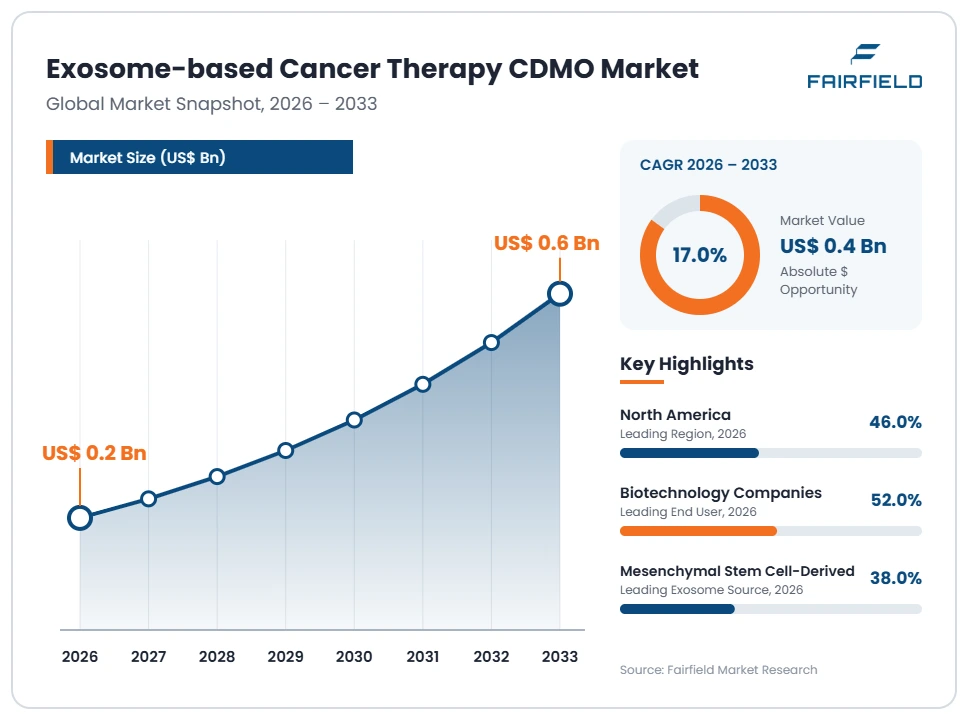
The global Exosome-based Cancer Therapy CDMO market size is expected to be valued at US$ 0.2 billion in 2026 and projected to reach US$ 0.6 billion by 2033, growing at a CAGR of 17.0% between 2026 and 2033.
Contract revenue grew at an estimated 21.9% CAGR from 2020 to 2025, rising from a very small base as academic vesicle programmes moved into formal process development. Spending reached about US$ 183 million in 2025 and is forecast at US$ 214 million in 2026, before climbing to roughly US$ 642 million by 2033. Three factors carry the ramp. Early-phase oncology pipelines are widening without matching in-house capacity. Regulators expect clinical material made under documented quality systems. Developers are moving from bench-scale ultracentrifugation to filtration-based processing. No exosome cancer therapeutic has been approved by any major regulator, so this is a pipeline-dependent services market whose direction tracks trial progress rather than product sales.
Key Report Takeaways
- By Service Type: Process development held 34% share in 2026, while clinical-scale GMP manufacturing is projected to expand at a 21.4% CAGR through 2033, driven by the first cohort of oncology vesicle programmes entering multi-site Phase I and Phase II supply.
- By Exosome Source: Mesenchymal stem cell-derived vesicles held 38% share in 2026, while engineered cell line-derived material is set to grow at a 20.8% CAGR through 2033, reflecting better batch consistency from documented, bankable producer lines.
- By Isolation Technology: Ultracentrifugation held 31% share in 2026, while tangential flow filtration is forecast to rise at a 22.1% CAGR through 2033, because closed filtration trains transfer into GMP suites far more readily.
- By End User: Biotechnology companies held 52% share in 2026, while pharmaceutical companies are projected to grow at a 19.6% CAGR through 2033, as larger sponsors in-license vesicle assets and fund external manufacturing readiness work.
- By Geography: North America held 46% share in 2026, while Asia Pacific is projected to expand at a 21.3% CAGR through 2033, supported by new translational manufacturing suites attached to university hospital networks.
Global Exosome-based Cancer Therapy CDMO Market Trends and Insights
Drivers Impact Analysis
Two forces explain most of the forecast demand for outsourced exosome manufacturing in oncology.
| Driver | Impact on CAGR Forecast | Geographic Relevance | Impact Timeline |
| Expansion of early-phase oncology vesicle pipelines without in-house capacity | High | North America, Europe, Asia Pacific | Medium term (2–4 years) |
| Regulatory pressure to source clinical material from documented GMP suppliers | Medium | Global, strongest in North America and Europe | Short term (≤2 years) |
Thin Pipeline Sponsors Push Exosome Oncology Programmes Into Outsourced GMP Suites
Outsourcing is the default operating model for exosome oncology developers, and that fact underpins most of the forecast service revenue. Nearly all sponsors in this field are small companies or university spin-outs with fewer than fifty staff. They cannot justify a dedicated cleanroom, a qualified isolation train and a quality unit for a single investigational product. Each programme that files an Investigational New Drug application therefore converts directly into a multi-year contract.
The causal chain runs through regulatory expectation rather than volume. An FDA Center for Biologics Evaluation and Research submission requires documented process control, a defined cell bank and release testing before dosing. Building that evidence demands equipment and personnel that only specialist suppliers hold. Sponsors buy process development first, then analytical work, then clinical supply, creating a long engagement from a single preclinical asset.
Regulatory Warnings on Unapproved Exosome Products Steer Sponsors to Audited Manufacturers
Public enforcement against unapproved exosome products has sharpened the commercial value of verifiable GMP provenance. Clinics marketing unregulated vesicle preparations damaged confidence in the whole field. Legitimate oncology sponsors now treat an audited manufacturing record as a prerequisite for investor diligence, hospital contracting and ethics approval. That expectation routes work toward suppliers with inspection histories and away from informal laboratory arrangements.
The mechanism is documentary. A sponsor must show the origin of its starting material, the control of its isolation process and the specifications applied at release. The FDA and the Federal Trade Commission have publicly cautioned patients about unapproved vesicle products after reported adverse events, and the European Medicines Agency applies the Advanced Therapy Medicinal Products framework through its Committee for Advanced Therapies. Meeting either standard favours established contract manufacturers with existing quality systems.
Restraints Impact Analysis
Two structural constraints hold back billable volume across the exosome contract manufacturing sector.
| Restraint | Impact on CAGR Forecast | Geographic Relevance | Impact Timeline |
| Low vesicle yields and unresolved scale-up economics per batch | High | Global | Long term (≥4 years) |
| Absence of agreed potency assays and characterisation standards | Medium | North America, Europe | Medium term (2–4 years) |
Low Vesicle Yields Cap Batch Size and Limit Billable Output per Exosome Suite
Yield is the binding constraint on revenue per cleanroom suite in this sector. A conditioned medium harvest typically delivers a particle mass measured in milligrams, not grams. Sponsors therefore commission small batches, occupy a suite for weeks and receive material sufficient only for limited dosing. The suite cost is fixed, so the per-batch price looks high to the customer while the margin remains thin for the supplier.
The cost source is upstream culture, not downstream purification. Producing enough conditioned medium requires large volumes of serum-free media, extensive single-use bioreactor consumables and long culture runs before harvest. Media and single-use plastics dominate the bill of materials. Until producer cell productivity improves or perfusion culture becomes routine, each incremental dose carries a disproportionate consumable cost that no scheduling efficiency can remove.
Unsettled Potency Assays Extend Release Timelines and Delay Contract Revenue Recognition
The absence of an agreed potency assay slows every clinical-supply contract in exosome oncology. Vesicle preparations are heterogeneous populations rather than single molecules. Without a consensus functional readout, sponsors and regulators negotiate specifications programme by programme. Release decisions stall, batches sit in quarantine, and the supplier cannot invoice milestones that depend on certified material.
The underlying cause is analytical rather than commercial. Particle counting, protein content and surface marker profiling describe a preparation but do not demonstrate biological activity against tumour cells. ICH Q6B expects specifications linked to product quality, and ICH Q5A sets viral safety expectations for biotechnological products. The International Society for Extracellular Vesicles has issued MISEV guidance precisely because reporting practice varies so widely between laboratories. Method development, qualification and comparability work must be repeated for each new cell source, adding months of unbillable or slowly billable effort to every programme.
Market Opportunities
Two revenue pools sit outside the core isolation and manufacturing contract today.
Cargo Loading and Vesicle Engineering Services Open a Premium Fee Pool Beyond Isolation
Engineered cargo work is the clearest untapped revenue pool for exosome contract manufacturers in oncology. Loading vesicles with small-molecule drugs, short interfering RNA or messenger RNA requires electroporation, sonication or producer-cell engineering, plus a method to prove loading efficiency. Few sponsors can do this at clinical scale. Suppliers who industrialise it can charge development fees well above standard isolation pricing.
Biotechnology sponsors pursuing targeted delivery create the demand, and surface-display engineering sharpens it. Programmes that display targeting peptides or antibody fragments need producer-line construction, stability testing and loading quantification as one package. Platform media and reagent suppliers have already built vesicle-specific upstream systems, which gives contract manufacturers a validated starting point. The result is a bundled engineering service that lengthens contracts and raises the value of each preclinical asset served.
Small-Batch Clinical Supply for Investigator-Initiated Oncology Trials Creates New Demand
Investigator-initiated oncology trials represent an under-served revenue pool for vesicle manufacturers. Academic cancer centres run early studies with limited budgets and no manufacturing infrastructure. They need a small number of compliant batches, a release package and documentation suitable for an ethics committee. A standardised, catalogue-priced service tier fits this demand better than bespoke full-scope contracts.
University hospital networks and cooperative oncology groups create the volume, and national translational research funding supports it. Suppliers can capture the pool with template protocols, pre-qualified analytical panels and shared master cell banks that spread qualification cost across many sponsors rather than one. Because the EU Clinical Trials Regulation and comparable national frameworks require the same dossier quality from academic and commercial sponsors, a compliant batch cannot be produced informally. This tier therefore converts low-budget investigator research into repeatable, documented and audit-ready manufacturing work.
Segment Analysis
- By Service Type: Process Development Leads While Clinical-Scale GMP Manufacturing Accelerates
Process development held 34% of service revenue in 2026 because the pipeline is overwhelmingly preclinical. Sponsors buy cell line selection, media screening, isolation train design and scale-up studies long before any clinical batch exists. Analytical development and characterization followed at 24%, reflecting the effort needed to describe heterogeneous vesicle preparations. Clinical-scale GMP manufacturing is the fastest-growing service at a 21.4% CAGR, as the earliest oncology assets reach dosing and require repeat compliant batches. Fill-finish and packaging accounted for 11%, while regulatory and quality support took 8%. The shift matters commercially because manufacturing contracts are larger, longer and more defensible than development studies. Suppliers that convert development clients into clinical supply clients capture far more lifetime value, which explains current investment in dedicated vesicle cleanroom capacity rather than additional laboratory bench space.
- By Exosome Source: Mesenchymal Stem Cell Material Dominates as Engineered Cell Lines Gain Ground
Mesenchymal stem cell-derived vesicles held 38% share in 2026, the largest source category, because donor tissue is accessible and culture protocols are widely published. Immune cell-derived vesicles, including dendritic cell and natural killer cell preparations, accounted for 22%, supported by long-standing academic interest in antigen presentation. Tumor cell-derived material held 14% and remains confined to research-stage work. Engineered cell line-derived vesicles are growing fastest at a 20.8% CAGR, because documented producer lines such as HEK293 variants allow master and working cell banks, defined passage limits and reproducible yields. That reproducibility matters to regulators assessing comparability across batches. For contract manufacturers, engineered lines reduce the qualification burden per programme, shorten tech transfer and make capacity planning far more predictable than donor-dependent primary cell workflows.
- By Isolation Technology: Ultracentrifugation Holds Installed Share While Filtration Scales Faster
Ultracentrifugation held 31% of isolation-related revenue in 2026, the largest share, simply because most installed workflows originated in academic laboratories. Tangential flow filtration followed closely at 28% and is the fastest-growing technology at a 22.1% CAGR, because it runs as a closed, single-use process that scales with volume rather than rotor capacity. Size-exclusion chromatography took 19%, often used as a polishing step, while ion-exchange and affinity chromatography held 13% and precipitation and kit-based methods 9%. The transition is driven by EU GMP Annex 1 expectations for sterile manufacture, which favour closed processing over open centrifuge handling. Contract manufacturers that offer validated filtration and chromatography trains can quote predictable cycle times, which is why tech transfer projects away from centrifugation now form a steady revenue line.
- By End User: Biotechnology Sponsors Supply the Volume While Pharmaceutical Clients Grow Fastest
Biotechnology companies accounted for 52% of spending in 2026, the dominant customer group, because nearly every clinical-stage vesicle oncology asset sits inside a small company. Academic and research institutes held 20%, buying mainly process development and characterization rather than clinical supply. Pharmaceutical companies held 21% but are expanding fastest at a 19.6% CAGR, as larger organisations in-license vesicle assets and fund manufacturing readiness before committing internal capacity. Government and nonprofit research programmes contributed 7%. The growth shift has a practical consequence for suppliers. Pharmaceutical clients bring stricter audit expectations, formal vendor qualification programmes and multi-year volume forecasting, which rewards manufacturers with mature quality systems and documented inspection histories. They also pay for comparability studies when a process moves between sites. That combination is steadily raising the entry barrier for laboratory-scale providers seeking clinical supply work.
Geography Analysis
- Which Region Is Leading the Exosome-based Cancer Therapy CDMO Market?
North America leads the exosome oncology contract manufacturing market with 46% share in 2026. The United States supplies most of that demand, with Canada contributing a smaller share through translational research centres. Three causes explain the position. The region hosts the largest concentration of early-stage vesicle companies, many spun out of cancer research institutes. The FDA Center for Biologics Evaluation and Research provides a defined Investigational New Drug pathway that sponsors understand and plan around. Venture funding, though cyclical, still supports preclinical manufacturing spend. Enforcement against unapproved vesicle clinics has also pushed credible sponsors toward audited suppliers. The main change shaping the region is capacity specialisation, with cell and gene therapy manufacturers adding vesicle-specific isolation trains rather than treating exosome work as an extension of cell therapy suites.
- Europe Converts Its Advanced Therapy Framework Into Structured Vesicle Manufacturing Demand
Europe held 27% share in 2026, supported by a regulatory structure that treats advanced therapies as a defined category. Germany, the United Kingdom, France, the Netherlands and Sweden drive most activity, often through university hospital manufacturing units rather than standalone commercial sites. Regulation (EC) No 1394/2007 on Advanced Therapy Medicinal Products and the EMA Committee for Advanced Therapies give sponsors a clear classification route, which reduces uncertainty in early planning. Public translational funding supports academic manufacturing capacity that commercial sponsors can also access. The constraint is fragmentation, since national competent authorities interpret early-phase requirements differently. The notable change is the tightening of sterile manufacturing expectations under EU GMP Annex 1, which is prompting investment in closed processing and isolator-based fill-finish for small vesicle batches.
- Which Region Is Growing Fastest in the Exosome-based Cancer Therapy CDMO Market?
Asia Pacific is the fastest-growing geography at a 21.3% CAGR between 2026 and 2033, from 19% share in 2026. South Korea, China, Japan, Singapore and Australia drive the expansion. South Korea has an unusually dense cluster of extracellular vesicle companies and supportive regenerative medicine legislation. China contributes large academic trial volumes and rapidly expanding biomanufacturing capacity. Japan offers a conditional approval pathway for regenerative products that encourages early manufacturing investment. Cost structures allow suppliers to price development work below United States levels, attracting outsourced characterisation projects. The main barrier is inconsistent regulatory recognition across borders, which complicates multinational trial supply. The change to watch is the attachment of translational manufacturing suites to university hospital networks, converting academic research into contracted, documented production.
- Latin America Builds Early Vesicle Capability Around Academic Oncology Centres
Latin America held 4% share in 2026, the smallest commercial base alongside other emerging geographies. Brazil, Mexico, Argentina and Chile account for most activity, concentrated in university oncology centres and public research institutes rather than commercial manufacturing sites. Demand is real but small, driven by investigator-initiated studies and regional interest in regenerative medicine. The barriers are structural. Few facilities hold GMP certification suitable for advanced therapy production, import of specialised single-use consumables is slow and costly, and reimbursement pathways for cell-based oncology products remain undefined. Currency volatility further discourages long capital commitments. The opportunity is regional specialisation, where one or two national centres build certified vesicle capacity and serve neighbouring countries under cross-border research agreements rather than each market attempting independent capability.
- Middle East & Africa Rely on Imported Batches as Local Quality Systems Mature
Middle East & Africa accounted for 4% share in 2026, with activity concentrated in the United Arab Emirates, Saudi Arabia, Israel and South Africa. Israel contributes genuine research depth in vesicle biology, while Saudi Arabia and the United Arab Emirates are funding advanced therapy infrastructure through national health strategies. Most clinical material is imported, because very few local sites hold the quality systems needed for advanced therapy manufacture. The barriers are shortage of trained manufacturing and quality personnel, limited cold-chain and analytical infrastructure, and regulatory frameworks for advanced therapies that are still being drafted. The opportunity lies in the specialist hospital clusters now being built, which pair clinical oncology capacity with laboratory infrastructure and could host regional manufacturing partnerships once quality systems reach international standards.
Competitive Landscape
The exosome oncology contract manufacturing market is highly fragmented with low concentration. No supplier holds a dominant position, and the field mixes large cell and gene therapy manufacturers that added vesicle capability with small specialists built around a single isolation platform. Many sponsors also still use academic manufacturing units. Consolidation has been limited, partly because the revenue pool is small and partly because vesicle know-how sits with individual scientists rather than in transferable process packages. Large manufacturers compete on quality systems and inspection history; specialists compete on technical depth.
Competition rests on four practical factors. The first is demonstrated regulatory success, meaning material that has supported a cleared Investigational New Drug application. The second is analytical capability, since sponsors need characterisation data they can defend. The third is yield per batch, which determines cost per dose. The fourth is speed of tech transfer. New entrants arrive from two directions: reagent and media suppliers moving downstream into services, and cell therapy manufacturers extending existing cleanrooms to vesicle work.
Strategic activity concentrates on capability building rather than scale. Suppliers are qualifying closed tangential flow filtration and chromatography trains, developing in-house potency assay platforms, and establishing master cell banks from engineered producer lines. Several are formalising vesicle-specific quality documentation so audits move faster. These moves matter because they convert bespoke scientific projects into repeatable service products.
Strategic direction across the sector points the same way. Vendors are standardising processes to reduce per-programme qualification cost, investing in characterisation to resolve release bottlenecks, and positioning for the moment when a first oncology vesicle asset reaches late-stage trials and demands far larger volumes.
Recent Industry Developments
- December 2019: The FDA and the Federal Trade Commission issued a joint public safety notification warning patients and clinics about unapproved exosome products marketed as treatments, after reported adverse events – it established enforcement risk for unaudited supply and pushed legitimate oncology sponsors toward documented GMP manufacturers.
- January 2022: Regulation (EU) No 536/2014, the EU Clinical Trials Regulation, became applicable across member states – it standardised early-phase trial dossiers and raised the documentation that contract manufacturers must supply for vesicle batches used in European oncology studies.
- August 2023: The revised EU GMP Annex 1 on the manufacture of sterile medicinal products came into effect – it favours closed, single-use processing and isolator-based filling, directly shaping how vesicle isolation and fill-finish suites are now designed.
- 2024: The International Society for Extracellular Vesicles published its updated MISEV guidelines on minimal information for studies of extracellular vesicles – it tightened expectations for vesicle characterisation and reporting, raising the analytical content of contract manufacturing service packages.
Companies Covered in the Report
- Lonza Group AG
- Charles River Laboratories International, Inc.
- Catalent, Inc.
- RoosterBio, Inc.
- Creative Biolabs
- Exopharm Limited
- System Biosciences, LLC
- Evox Therapeutics Limited
- ILIAS Biologics Inc.
- WuXi AppTec Co., Ltd.
- Fujifilm Diosynth Biotechnologies
- Samsung Biologics Co., Ltd.
Exosome-based Cancer Therapy CDMO Market Report Scope
| Metric | Value |
| Study Period | 2020–2033 |
| Market Size 2026 | US$ 0.2 Billion |
| Market Size 2033 | US$ 0.6 Billion |
| CAGR 2026–2033 | 17.0% |
| Absolute Dollar Opportunity | US$ 0.4 Billion |
| Largest Market | North America, with 46% share in 2026 |
| Fastest-Growing Market | Asia Pacific, at a 21.3% CAGR |
| Market Concentration | Low |
| Major Players | Lonza Group AG, Charles River Laboratories International, Inc., RoosterBio, Inc., Creative Biolabs, Exopharm Limited |
Exosome-based Cancer Therapy CDMO Market Segmentation
Service Type
- Process Development
- Analytical Development and Characterization
- Clinical-Scale GMP Manufacturing
- Fill-Finish and Packaging
- Regulatory and Quality Support
Exosome Source
- Mesenchymal Stem Cell-Derived
- Immune Cell-Derived
- Tumor Cell-Derived
- Engineered Cell Line-Derived
Isolation Technology
- Ultracentrifugation
- Tangential Flow Filtration
- Size-Exclusion Chromatography
- Ion-Exchange and Affinity Chromatography
- Precipitation and Kit-Based Methods
End User
- Biotechnology Companies
- Pharmaceutical Companies
- Academic and Research Institutes
- Government and Nonprofit Research Programs
Regions
- North America
- Europe
- Asia Pacific
- Latin America
- Middle East & Africa
- Executive Summary
- Global Exosome-based Cancer Therapy CDMO Market Snapshot
- Future Projections
- Key Report Takeaways
- Regional Snapshot
- Market Overview
- Market Definition and Report Scope
- Historical Trends 2020–2025
- Market Dynamics
- Drivers
- Thin Pipeline Sponsors Push Exosome Oncology Programmes Into Outsourced GMP Suites
- Regulatory Warnings on Unapproved Exosome Products Steer Sponsors to Audited Manufacturers
- Restraints
- Low Vesicle Yields Cap Batch Size and Limit Billable Output per Exosome Suite
- Unsettled Potency Assays Extend Release Timelines and Delay Contract Revenue Recognition
- Market Opportunities
- Cargo Loading and Vesicle Engineering Services Open a Premium Fee Pool Beyond Isolation
- Small-Batch Clinical Supply for Investigator-Initiated Oncology Trials Creates New Demand
- Drivers
- Global Exosome-based Cancer Therapy CDMO Market Outlook, 2020–2033
- Global Exosome-based Cancer Therapy CDMO Market Outlook, by Service Type, Value (US$ Billion), 2020–2033
- Process Development
- Analytical Development and Characterization
- Clinical-Scale GMP Manufacturing
- Fill-Finish and Packaging
- Regulatory and Quality Support
- Global Exosome-based Cancer Therapy CDMO Market Outlook, by Exosome Source, Value (US$ Billion), 2020–2033
- Mesenchymal Stem Cell-Derived
- Immune Cell-Derived
- Tumor Cell-Derived
- Engineered Cell Line-Derived
- Global Exosome-based Cancer Therapy CDMO Market Outlook, by Isolation Technology, Value (US$ Billion), 2020–2033
- Ultracentrifugation
- Tangential Flow Filtration
- Size-Exclusion Chromatography
- Ion-Exchange and Affinity Chromatography
- Precipitation and Kit-Based Methods
- Global Exosome-based Cancer Therapy CDMO Market Outlook, by End User, Value (US$ Billion), 2020–2033
- Biotechnology Companies
- Pharmaceutical Companies
- Academic and Research Institutes
- Government and Nonprofit Research Programs
- Global Exosome-based Cancer Therapy CDMO Market Outlook, by Region, Value (US$ Billion), 2020–2033
- North America
- Europe
- Asia Pacific
- Latin America
- Middle East & Africa
- Global Exosome-based Cancer Therapy CDMO Market Outlook, by Service Type, Value (US$ Billion), 2020–2033
- North America Exosome-based Cancer Therapy CDMO Market Outlook, 2020–2033
- North America Exosome-based Cancer Therapy CDMO Market Outlook, by Service Type, Value (US$ Billion), 2020–2033
- Process Development
- Analytical Development and Characterization
- Clinical-Scale GMP Manufacturing
- Fill-Finish and Packaging
- Regulatory and Quality Support
- North America Exosome-based Cancer Therapy CDMO Market Outlook, by Exosome Source, Value (US$ Billion), 2020–2033
- Mesenchymal Stem Cell-Derived
- Immune Cell-Derived
- Tumor Cell-Derived
- Engineered Cell Line-Derived
- North America Exosome-based Cancer Therapy CDMO Market Outlook, by Isolation Technology, Value (US$ Billion), 2020–2033
- Ultracentrifugation
- Tangential Flow Filtration
- Size-Exclusion Chromatography
- Ion-Exchange and Affinity Chromatography
- Precipitation and Kit-Based Methods
- North America Exosome-based Cancer Therapy CDMO Market Outlook, by End User, Value (US$ Billion), 2020–2033
- Biotechnology Companies
- Pharmaceutical Companies
- Academic and Research Institutes
- Government and Nonprofit Research Programs
- North America Exosome-based Cancer Therapy CDMO Market Outlook, by Country, Value (US$ Billion), 2020–2033
- United States Exosome-based Cancer Therapy CDMO Market Outlook, by Service Type, 2020–2033
- United States Exosome-based Cancer Therapy CDMO Market Outlook, by Exosome Source, 2020–2033
- United States Exosome-based Cancer Therapy CDMO Market Outlook, by Isolation Technology, 2020–2033
- United States Exosome-based Cancer Therapy CDMO Market Outlook, by End User, 2020–2033
- Canada Exosome-based Cancer Therapy CDMO Market Outlook, by Service Type, 2020–2033
- Canada Exosome-based Cancer Therapy CDMO Market Outlook, by Exosome Source, 2020–2033
- Canada Exosome-based Cancer Therapy CDMO Market Outlook, by Isolation Technology, 2020–2033
- Canada Exosome-based Cancer Therapy CDMO Market Outlook, by End User, 2020–2033
- North America Exosome-based Cancer Therapy CDMO Market Outlook, by Service Type, Value (US$ Billion), 2020–2033
- Europe Exosome-based Cancer Therapy CDMO Market Outlook, 2020–2033
- Europe Exosome-based Cancer Therapy CDMO Market Outlook, by Service Type, Value (US$ Billion), 2020–2033
- Process Development
- Analytical Development and Characterization
- Clinical-Scale GMP Manufacturing
- Fill-Finish and Packaging
- Regulatory and Quality Support
- Europe Exosome-based Cancer Therapy CDMO Market Outlook, by Exosome Source, Value (US$ Billion), 2020–2033
- Mesenchymal Stem Cell-Derived
- Immune Cell-Derived
- Tumor Cell-Derived
- Engineered Cell Line-Derived
- Europe Exosome-based Cancer Therapy CDMO Market Outlook, by Isolation Technology, Value (US$ Billion), 2020–2033
- Ultracentrifugation
- Tangential Flow Filtration
- Size-Exclusion Chromatography
- Ion-Exchange and Affinity Chromatography
- Precipitation and Kit-Based Methods
- Europe Exosome-based Cancer Therapy CDMO Market Outlook, by End User, Value (US$ Billion), 2020–2033
- Biotechnology Companies
- Pharmaceutical Companies
- Academic and Research Institutes
- Government and Nonprofit Research Programs
- Europe Exosome-based Cancer Therapy CDMO Market Outlook, by Country, Value (US$ Billion), 2020–2033
- Germany Exosome-based Cancer Therapy CDMO Market Outlook, by Service Type, 2020–2033
- Germany Exosome-based Cancer Therapy CDMO Market Outlook, by Exosome Source, 2020–2033
- Germany Exosome-based Cancer Therapy CDMO Market Outlook, by Isolation Technology, 2020–2033
- Germany Exosome-based Cancer Therapy CDMO Market Outlook, by End User, 2020–2033
- United Kingdom Exosome-based Cancer Therapy CDMO Market Outlook, by Service Type, 2020–2033
- United Kingdom Exosome-based Cancer Therapy CDMO Market Outlook, by Exosome Source, 2020–2033
- United Kingdom Exosome-based Cancer Therapy CDMO Market Outlook, by Isolation Technology, 2020–2033
- United Kingdom Exosome-based Cancer Therapy CDMO Market Outlook, by End User, 2020–2033
- France Exosome-based Cancer Therapy CDMO Market Outlook, by Service Type, 2020–2033
- France Exosome-based Cancer Therapy CDMO Market Outlook, by Exosome Source, 2020–2033
- France Exosome-based Cancer Therapy CDMO Market Outlook, by Isolation Technology, 2020–2033
- France Exosome-based Cancer Therapy CDMO Market Outlook, by End User, 2020–2033
- Netherlands Exosome-based Cancer Therapy CDMO Market Outlook, by Service Type, 2020–2033
- Netherlands Exosome-based Cancer Therapy CDMO Market Outlook, by Exosome Source, 2020–2033
- Netherlands Exosome-based Cancer Therapy CDMO Market Outlook, by Isolation Technology, 2020–2033
- Netherlands Exosome-based Cancer Therapy CDMO Market Outlook, by End User, 2020–2033
- Sweden Exosome-based Cancer Therapy CDMO Market Outlook, by Service Type, 2020–2033
- Sweden Exosome-based Cancer Therapy CDMO Market Outlook, by Exosome Source, 2020–2033
- Sweden Exosome-based Cancer Therapy CDMO Market Outlook, by Isolation Technology, 2020–2033
- Sweden Exosome-based Cancer Therapy CDMO Market Outlook, by End User, 2020–2033
- Europe Exosome-based Cancer Therapy CDMO Market Outlook, by Service Type, Value (US$ Billion), 2020–2033
- Asia Pacific Exosome-based Cancer Therapy CDMO Market Outlook, 2020–2033
- Asia Pacific Exosome-based Cancer Therapy CDMO Market Outlook, by Service Type, Value (US$ Billion), 2020–2033
- Process Development
- Analytical Development and Characterization
- Clinical-Scale GMP Manufacturing
- Fill-Finish and Packaging
- Regulatory and Quality Support
- Asia Pacific Exosome-based Cancer Therapy CDMO Market Outlook, by Exosome Source, Value (US$ Billion), 2020–2033
- Mesenchymal Stem Cell-Derived
- Immune Cell-Derived
- Tumor Cell-Derived
- Engineered Cell Line-Derived
- Asia Pacific Exosome-based Cancer Therapy CDMO Market Outlook, by Isolation Technology, Value (US$ Billion), 2020–2033
- Ultracentrifugation
- Tangential Flow Filtration
- Size-Exclusion Chromatography
- Ion-Exchange and Affinity Chromatography
- Precipitation and Kit-Based Methods
- Asia Pacific Exosome-based Cancer Therapy CDMO Market Outlook, by End User, Value (US$ Billion), 2020–2033
- Biotechnology Companies
- Pharmaceutical Companies
- Academic and Research Institutes
- Government and Nonprofit Research Programs
- Asia Pacific Exosome-based Cancer Therapy CDMO Market Outlook, by Country, Value (US$ Billion), 2020–2033
- South Korea Exosome-based Cancer Therapy CDMO Market Outlook, by Service Type, 2020–2033
- South Korea Exosome-based Cancer Therapy CDMO Market Outlook, by Exosome Source, 2020–2033
- South Korea Exosome-based Cancer Therapy CDMO Market Outlook, by Isolation Technology, 2020–2033
- South Korea Exosome-based Cancer Therapy CDMO Market Outlook, by End User, 2020–2033
- China Exosome-based Cancer Therapy CDMO Market Outlook, by Service Type, 2020–2033
- China Exosome-based Cancer Therapy CDMO Market Outlook, by Exosome Source, 2020–2033
- China Exosome-based Cancer Therapy CDMO Market Outlook, by Isolation Technology, 2020–2033
- China Exosome-based Cancer Therapy CDMO Market Outlook, by End User, 2020–2033
- Japan Exosome-based Cancer Therapy CDMO Market Outlook, by Service Type, 2020–2033
- Japan Exosome-based Cancer Therapy CDMO Market Outlook, by Exosome Source, 2020–2033
- Japan Exosome-based Cancer Therapy CDMO Market Outlook, by Isolation Technology, 2020–2033
- Japan Exosome-based Cancer Therapy CDMO Market Outlook, by End User, 2020–2033
- Singapore Exosome-based Cancer Therapy CDMO Market Outlook, by Service Type, 2020–2033
- Singapore Exosome-based Cancer Therapy CDMO Market Outlook, by Exosome Source, 2020–2033
- Singapore Exosome-based Cancer Therapy CDMO Market Outlook, by Isolation Technology, 2020–2033
- Singapore Exosome-based Cancer Therapy CDMO Market Outlook, by End User, 2020–2033
- Australia Exosome-based Cancer Therapy CDMO Market Outlook, by Service Type, 2020–2033
- Australia Exosome-based Cancer Therapy CDMO Market Outlook, by Exosome Source, 2020–2033
- Australia Exosome-based Cancer Therapy CDMO Market Outlook, by Isolation Technology, 2020–2033
- Australia Exosome-based Cancer Therapy CDMO Market Outlook, by End User, 2020–2033
- Asia Pacific Exosome-based Cancer Therapy CDMO Market Outlook, by Service Type, Value (US$ Billion), 2020–2033
- Latin America Exosome-based Cancer Therapy CDMO Market Outlook, 2020–2033
- Latin America Exosome-based Cancer Therapy CDMO Market Outlook, by Service Type, Value (US$ Billion), 2020–2033
- Process Development
- Analytical Development and Characterization
- Clinical-Scale GMP Manufacturing
- Fill-Finish and Packaging
- Regulatory and Quality Support
- Latin America Exosome-based Cancer Therapy CDMO Market Outlook, by Exosome Source, Value (US$ Billion), 2020–2033
- Mesenchymal Stem Cell-Derived
- Immune Cell-Derived
- Tumor Cell-Derived
- Engineered Cell Line-Derived
- Latin America Exosome-based Cancer Therapy CDMO Market Outlook, by Isolation Technology, Value (US$ Billion), 2020–2033
- Ultracentrifugation
- Tangential Flow Filtration
- Size-Exclusion Chromatography
- Ion-Exchange and Affinity Chromatography
- Precipitation and Kit-Based Methods
- Latin America Exosome-based Cancer Therapy CDMO Market Outlook, by End User, Value (US$ Billion), 2020–2033
- Biotechnology Companies
- Pharmaceutical Companies
- Academic and Research Institutes
- Government and Nonprofit Research Programs
- Latin America Exosome-based Cancer Therapy CDMO Market Outlook, by Country, Value (US$ Billion), 2020–2033
- Brazil Exosome-based Cancer Therapy CDMO Market Outlook, by Service Type, 2020–2033
- Brazil Exosome-based Cancer Therapy CDMO Market Outlook, by Exosome Source, 2020–2033
- Brazil Exosome-based Cancer Therapy CDMO Market Outlook, by Isolation Technology, 2020–2033
- Brazil Exosome-based Cancer Therapy CDMO Market Outlook, by End User, 2020–2033
- Mexico Exosome-based Cancer Therapy CDMO Market Outlook, by Service Type, 2020–2033
- Mexico Exosome-based Cancer Therapy CDMO Market Outlook, by Exosome Source, 2020–2033
- Mexico Exosome-based Cancer Therapy CDMO Market Outlook, by Isolation Technology, 2020–2033
- Mexico Exosome-based Cancer Therapy CDMO Market Outlook, by End User, 2020–2033
- Argentina Exosome-based Cancer Therapy CDMO Market Outlook, by Service Type, 2020–2033
- Argentina Exosome-based Cancer Therapy CDMO Market Outlook, by Exosome Source, 2020–2033
- Argentina Exosome-based Cancer Therapy CDMO Market Outlook, by Isolation Technology, 2020–2033
- Argentina Exosome-based Cancer Therapy CDMO Market Outlook, by End User, 2020–2033
- Chile Exosome-based Cancer Therapy CDMO Market Outlook, by Service Type, 2020–2033
- Chile Exosome-based Cancer Therapy CDMO Market Outlook, by Exosome Source, 2020–2033
- Chile Exosome-based Cancer Therapy CDMO Market Outlook, by Isolation Technology, 2020–2033
- Chile Exosome-based Cancer Therapy CDMO Market Outlook, by End User, 2020–2033
- Latin America Exosome-based Cancer Therapy CDMO Market Outlook, by Service Type, Value (US$ Billion), 2020–2033
- Middle East & Africa Exosome-based Cancer Therapy CDMO Market Outlook, 2020–2033
- Middle East & Africa Exosome-based Cancer Therapy CDMO Market Outlook, by Service Type, Value (US$ Billion), 2020–2033
- Process Development
- Analytical Development and Characterization
- Clinical-Scale GMP Manufacturing
- Fill-Finish and Packaging
- Regulatory and Quality Support
- Middle East & Africa Exosome-based Cancer Therapy CDMO Market Outlook, by Exosome Source, Value (US$ Billion), 2020–2033
- Mesenchymal Stem Cell-Derived
- Immune Cell-Derived
- Tumor Cell-Derived
- Engineered Cell Line-Derived
- Middle East & Africa Exosome-based Cancer Therapy CDMO Market Outlook, by Isolation Technology, Value (US$ Billion), 2020–2033
- Ultracentrifugation
- Tangential Flow Filtration
- Size-Exclusion Chromatography
- Ion-Exchange and Affinity Chromatography
- Precipitation and Kit-Based Methods
- Middle East & Africa Exosome-based Cancer Therapy CDMO Market Outlook, by End User, Value (US$ Billion), 2020–2033
- Biotechnology Companies
- Pharmaceutical Companies
- Academic and Research Institutes
- Government and Nonprofit Research Programs
- Middle East & Africa Exosome-based Cancer Therapy CDMO Market Outlook, by Country, Value (US$ Billion), 2020–2033
- United Arab Emirates Exosome-based Cancer Therapy CDMO Market Outlook, by Service Type, 2020–2033
- United Arab Emirates Exosome-based Cancer Therapy CDMO Market Outlook, by Exosome Source, 2020–2033
- United Arab Emirates Exosome-based Cancer Therapy CDMO Market Outlook, by Isolation Technology, 2020–2033
- United Arab Emirates Exosome-based Cancer Therapy CDMO Market Outlook, by End User, 2020–2033
- Saudi Arabia Exosome-based Cancer Therapy CDMO Market Outlook, by Service Type, 2020–2033
- Saudi Arabia Exosome-based Cancer Therapy CDMO Market Outlook, by Exosome Source, 2020–2033
- Saudi Arabia Exosome-based Cancer Therapy CDMO Market Outlook, by Isolation Technology, 2020–2033
- Saudi Arabia Exosome-based Cancer Therapy CDMO Market Outlook, by End User, 2020–2033
- Israel Exosome-based Cancer Therapy CDMO Market Outlook, by Service Type, 2020–2033
- Israel Exosome-based Cancer Therapy CDMO Market Outlook, by Exosome Source, 2020–2033
- Israel Exosome-based Cancer Therapy CDMO Market Outlook, by Isolation Technology, 2020–2033
- Israel Exosome-based Cancer Therapy CDMO Market Outlook, by End User, 2020–2033
- South Africa Exosome-based Cancer Therapy CDMO Market Outlook, by Service Type, 2020–2033
- South Africa Exosome-based Cancer Therapy CDMO Market Outlook, by Exosome Source, 2020–2033
- South Africa Exosome-based Cancer Therapy CDMO Market Outlook, by Isolation Technology, 2020–2033
- South Africa Exosome-based Cancer Therapy CDMO Market Outlook, by End User, 2020–2033
- Middle East & Africa Exosome-based Cancer Therapy CDMO Market Outlook, by Service Type, Value (US$ Billion), 2020–2033
- Competitive Landscape
- Market Concentration and Industry Leaders
- Competitive Differentiation
- Strategic Moves and Market Direction
- Recent Industry Developments
- Company Profiles
- Lonza Group AG
- Charles River Laboratories International, Inc.
- Catalent, Inc.
- RoosterBio, Inc.
- Creative Biolabs
- Exopharm Limited
- System Biosciences, LLC
- Evox Therapeutics Limited
- ILIAS Biologics Inc.
- WuXi AppTec Co., Ltd.
- Fujifilm Diosynth Biotechnologies
- Samsung Biologics Co., Ltd.
- Appendix
- Research Methodology
- Report Assumptions
- Acronyms and Abbreviations
Service Type
- Process Development
- Analytical Development and Characterization
- Clinical-Scale GMP Manufacturing
- Fill-Finish and Packaging
- Regulatory and Quality Support
Exosome Source
- Mesenchymal Stem Cell-Derived
- Immune Cell-Derived
- Tumor Cell-Derived
- Engineered Cell Line-Derived
Isolation Technology
- Ultracentrifugation
- Tangential Flow Filtration
- Size-Exclusion Chromatography
- Ion-Exchange and Affinity Chromatography
- Precipitation and Kit-Based Methods
End User
- Biotechnology Companies
- Pharmaceutical Companies
- Academic and Research Institutes
- Government and Nonprofit Research Programs
Regions
- North America
- Europe
- Asia Pacific
- Latin America
- Middle East & Africa
Our Research Methodology
Considering the volatility of business today, traditional approaches to strategizing a game plan can be unfruitful if not detrimental. True ambiguity is no way to determine a forecast. A myriad of predetermined factors must be accounted for such as the degree of risk involved, the magnitude of circumstances, as well as conditions or consequences that are not known or unpredictable. To circumvent binary views that cast uncertainty, the application of market research intelligence to strategically posture, move, and enable actionable outcomes is necessary.
View Methodology
Quality Assured
Rigorous Validation Process

Confidentiality Assured
End-to-end Data Security

Custom Research Services
Tailored To Your Objectives
FAQs
The market is valued at US$ 0.2 billion in 2026, equal to about US$ 214 million of outsourced development, manufacturing and analytical service spending worldwide.
The market is projected to reach US$ 0.6 billion by 2033, growing at a 17.0% CAGR and adding US$ 0.4 billion of absolute opportunity over the period.
Process development leads with 34% share in 2026, because most oncology vesicle programmes remain preclinical and require cell line, media and isolation train design work.
Clinical-scale GMP manufacturing grows fastest at a 21.4% CAGR, while Asia Pacific is the fastest-expanding geography at a 21.3% CAGR through 2033.
North America holds 46% share in 2026, and concentration is low, with fragmented supply split between large cell therapy manufacturers and small vesicle specialists.
Related Reports
Mouth Ulcers Treatment Market Size, Share, Insights, Competitive Landscape, and Forecast 2026 to 2033
The global mouth ulcers treatment market is valued at US$1.2 billion in 2026, reaching US$1.7 billion by 2033, growing at a 5.1% CAGR
Mouth Ulcers Treatment Market Size, Share, Insights, Competitive Landscape, and Forecast 2026 to 2033
The global mouth ulcers treatment market is valued at US$1.2 billion in 2026, reaching US$1.7 billion by 2033, growing at a 5.1% CAGR
Ayurveda Medicine Market Size, Share, Insights, Competitive Landscape, and Forecast 2026 to 2033
The global ayurveda medicine market is valued at US$14.8 billion in 2026, reaching US$27.8 billion by 2033, growing at a 9.4% CAGR
3D Cell Culture Market Size, Share, Insights, Competitive Landscape, and Forecast 2026 to 2033
The global 3D cell culture market is valued at US$2.42 billion in 2026, reaching US$6.05 billion by 2033, growing at a 13.99% CAGR
Western Blotting Market Size, Share, Insights, Competitive Landscape, and Forecast 2026 to 2033
The global western blotting market is valued at US$1.1 billion in 2026, reaching US$1.5 billion by 2033, growing at a 4.5% CAGR
Cold and Flu Supplements Market Size, Share, Insights, Competitive Landscape, and Forecast 2026 to 2033
The global cold and flu supplements market is valued at US$24.65 billion in 2026, reaching US$54.60 billion by 2033, growing at a 12.0% CAGR