



Gigacasting Presses Market
Gigacasting Presses Market Size, Share, Insights, Competitive Landscape, and Forecast 2026 to 2033
Gigacasting Presses Market Size and Trend Analysis
How Fast Will Gigacasting Press Demand Grow?
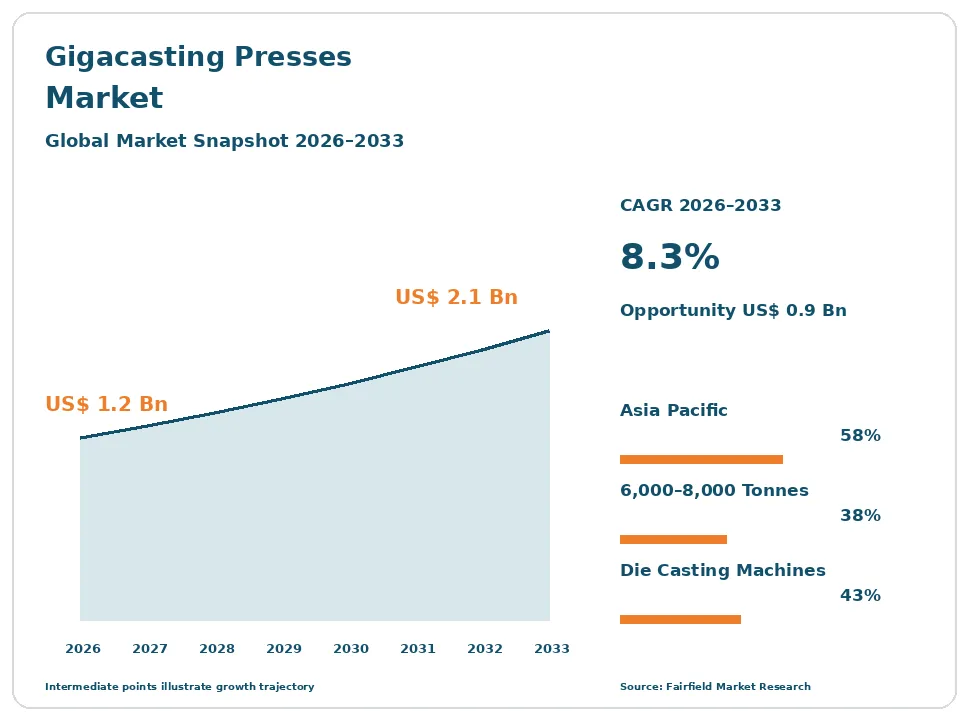
The global Gigacasting Presses market size is expected to be valued at US$ 1.2 billion in 2026 and projected to reach US$ 2.1 billion by 2033, growing at a CAGR of 8.3% between 2026 and 2033.
Growth between 2020 and 2025 was very rapid, above 40% a year, but from a base of almost nothing: only a few dozen machines above 6,000 tonnes existed at the start of the period. That arithmetic flatters the sector. Forward growth is far more measured because each machine is expensive, each installation needs a committed high-volume programme, and several manufacturers have slowed or reconsidered announced plans. Demand is supported by part consolidation savings in the body shop and by battery electric platform design. It is restrained by capital intensity, collision repair concerns and scrap economics. Adoption should be treated as contested rather than assured.
Key Report Takeaways
- By Clamping Force: the 6,000 to 8,000 Tonnes class held 38% share in 2026, while machines Above 12,000 Tonnes are projected to expand at an 11.8% CAGR through 2033, driven by attempts at full underbody and integrated platform castings.
- By Offering: Die Casting Machines held 43% share in 2026, while Aftermarket Services and Spares are projected to expand at an 11.4% CAGR through 2033, as the installed base ages and uptime becomes more valuable than acquisition price.
- By Application: Rear Underbody Structural Castings held 35% share in 2026, while Battery Enclosure and Structural Battery Components are projected to expand at a 12.4% CAGR through 2033, reflecting cell-to-body architectures that merge the enclosure with the structure.
- By End User: Automotive Original Equipment Manufacturers held 52% share in 2026, while Independent Die Casting Suppliers are projected to expand at an 11.1% CAGR through 2033, because shared capacity spreads press cost across several vehicle programmes.
- By Geography: Asia Pacific held 58% share in 2026, while North America is projected to expand at a 10.3% CAGR through 2033, supported by supplier-owned casting capacity rather than new in-house press installations.
Global Gigacasting Presses Market Trends and Insights
Drivers Impact Analysis
| Driver | Impact on CAGR Forecast | Geographic Relevance | Impact Timeline |
| Part consolidation removing stamping, welding and joining operations from the body shop | High | Asia Pacific, North America | Medium term 2–4 years |
| Battery electric platform architectures favouring large single-piece structural castings | High | Global | Long term ≥4 years |
Two engineering arguments explain why any manufacturer accepts this capital burden.
Part Consolidation Removes Body Shop Operations and Shortens the Assembly Line
The case for a very large press is made in the body shop, not the foundry. Replacing several dozen stamped steel pressings and their welded joints with one aluminium casting removes stamping dies, transfer presses, welding robots, fixtures, sealing operations and the floor space all of them occupy. Manufacturers report shorter assembly lines and fewer quality checkpoints, because a casting arrives dimensionally complete rather than accumulating tolerance through a stack of joints.
The causal mechanism is the removal of joining, which is where cost and variability concentrate. Each weld or rivet needs equipment, consumables, inspection and rework capacity. A single casting eliminates them outright, and it also removes the inventory, logistics and quality systems attached to dozens of part numbers. NADCA product specification standards for die castings and ISO 8062 dimensional tolerance grades give engineers the framework to prove that a cast structure meets the tolerances a welded assembly previously delivered.
Battery Electric Architectures Reward Large Flat Structural Castings
Battery electric platforms suit this process better than combustion architectures ever did. A flat floor with a large battery pack between the axles creates front and rear structures that are geometrically self-contained and relatively free of the packaging intrusions that complicated earlier underbodies. Those structures are exactly what a very large casting produces well, and the weight saved from eliminating flanges and overlap joints offsets part of the battery mass.
Regulation is what sustains the volume behind the engineering logic. The European Union has adopted carbon dioxide emission performance standards requiring a 100% reduction for new cars from 2035, and comparable rules elsewhere push manufacturers toward electric platforms. Those platforms concentrate production in fewer, longer model programmes, which is the volume profile a gigacasting island requires. EN 1706 aluminium casting alloy specifications give designers the material property data needed to substitute a casting for a welded steel structure.
Restraints Impact Analysis
| Restraint | Impact on CAGR Forecast | Geographic Relevance | Impact Timeline |
| Capital outlay per casting island requiring sustained high volumes over a long programme | High | Global | Long term ≥4 years |
| Collision repair difficulty, insurance classification concerns and large-part scrap rates | Medium | Europe, North America | Medium term 2–4 years |
Two counterweights explain why adoption has proved slower and more contested than early announcements implied.
Capital Outlay Per Island Demands Volumes Few Model Programmes Can Promise
Capital intensity is the hardest constraint in this market and it is widely understated. The press itself is only part of the outlay: the island also needs dies, a vacuum system, thermal management, a melting and dosing furnace, spray and extraction equipment, part handling robots, heat treatment or trimming cells and reinforced foundations. Payback requires several hundred thousand parts a year across a programme that runs for years, which only a confident, sustained model line can promise.
The underlying cause is inflexibility. A die set for a large structural casting is specific to one vehicle architecture and cannot be redeployed if the programme is cut or redesigned. When electric vehicle demand growth has proved uneven by region, that inflexibility becomes a balance sheet risk. Several manufacturers have slowed, scaled back or reconsidered announced large-casting plans, and treating adoption as inevitable would misread the sector’s actual investment behaviour.
One-Piece Castings Are Hard to Repair and Expensive to Scrap
Repairability and yield are the two cost questions that follow a large casting through its life. A one-piece underbody cannot be sectioned and replaced the way a welded assembly can, so moderate collision damage may require replacing a structure that forms much of the vehicle. Insurers and repair bodies have raised classification and total-cost-of-ownership concerns, and vehicles have been written off for damage that would previously have been repaired. That feeds back into residual values and purchase decisions.
Scrap economics apply the same pressure inside the plant. When a defect appears in a casting weighing many tens of kilograms, the whole part is lost, so porosity, cold shuts and die wear translate directly into a large material and energy write-off. Structural parts depend on specific high-ductility die-cast alloys and on consistent secondary aluminium supply, and alloy variability raises reject rates on exactly the parts that cost most to scrap.
Market Opportunities
Two revenue pools sit beyond the in-house automotive press installation.
Battery Enclosure and Structural Battery Integration Opens a Second Casting Pool
Battery structures are the most promising application outside the underbody, and they are a distinct revenue pool rather than an extension of one. Enclosure trays, cross-members and the structural frames that carry cells into the vehicle body are large, flat, dimensionally demanding and increasingly integrated with the floor. Casting them removes the extrusion, welding and sealing operations that enclosures traditionally require, and it improves sealing integrity, which is a safety-critical property in a battery system.
Cell-to-body and cell-to-pack architectures create the demand, and the buyers include battery system integrators as well as vehicle manufacturers. The opportunity is attractive because enclosure designs change less often than body styling, which lengthens die life and improves payback. Supporting this shift are thermal management requirements that favour cast channels over assembled plates, and crash protection requirements that reward a continuous structure over a joined one.
Supplier-Owned Casting Capacity Creates a Shared Contract Manufacturing Pool
Independent casting capacity serving several customers is the business model most likely to make these machines pay. A dedicated supplier can load one island with work from multiple vehicle programmes, smoothing the volume risk that defeats a single in-house installation. That turns an uncertain capital commitment into a utilisation problem the supplier is better placed to manage, and it gives smaller manufacturers access to large castings without owning a press.
The customers are vehicle manufacturers without the volume to justify in-house capacity, and the suppliers capturing the pool are established die casters expanding into larger tonnages. Non-automotive demand offers a second outlet, including large housings and frames for commercial vehicles, energy storage enclosures, agricultural equipment and industrial machinery. Spreading fixed cost across sectors is what makes the economics of a very large machine defensible.
Segment Analysis
By Clamping Force: Mid-Tonnage Machines Lead While the Largest Classes Grow Fastest
Machines of 6,000 to 8,000 Tonnes held 38% of value in 2026, the largest clamping force class, because this band covers most rear and front underbody castings and represents the lowest-risk entry point into very large casting. The 8,000 to 10,000 Tonnes class follows at 29%, used for bigger rear structures and integrated battery trays. The 10,000 to 12,000 Tonnes class accounts for 19%. Machines Above 12,000 Tonnes are the fastest-growing class at an 11.8% CAGR to 2033, driven by attempts at full underbody and integrated platform castings, though unit numbers remain very small and each installation is a significant commitment. The commercial implication is that tonnage escalation is a specification race among a handful of buyers, while the mid-tonnage band carries the sustainable volume.
By Offering: Machines Dominate Value While Aftermarket Services Expand Quickest
Die Casting Machines accounted for 43% of market value in 2026, the leading offering, reflecting the sheer cost of the press itself within a casting island. Dies and Tooling follow at 21% and recur more often than the press, since large structural dies wear and must be refurbished or replaced. Vacuum and Thermal Management Systems, Melting and Dosing Furnaces and Automation and Part-Handling Cells divide most of the remainder. Aftermarket Services and Spares is the fastest-growing offering at an 11.4% CAGR through 2033, because the installed base built over recent years is now entering its maintenance phase, and unplanned downtime on a machine producing a vehicle’s main structure is extremely costly. For suppliers, service contracts offer the steadiest earnings in an otherwise lumpy capital equipment business.
By Application: Rear Underbody Castings Lead as Battery Structures Grow Fastest
Rear Underbody Structural Castings held 35% of demand in 2026, the largest application, because the rear structure was the first to be consolidated and remains the least complex large casting to produce reliably. Front Underbody Structural Castings follow at 22%, complicated by crash load paths and packaging intrusions. Full Underbody and Integrated Platform Castings remain limited to a small number of programmes. Other Large Structural Components, including shock towers and longitudinal members, round out demand. Battery Enclosure and Structural Battery Components are the fastest-growing application at a 12.4% CAGR to 2033, as cell-to-body designs merge the enclosure with the vehicle structure and demand sealed, dimensionally stable cast frames. The implication is that battery structures, not ever-larger underbodies, are the more durable source of new press demand.
By End User: Vehicle Manufacturers Lead While Independent Casters Grow Fastest
Automotive Original Equipment Manufacturers held 52% of purchases in 2026, the leading end-user group, because the earliest adopters installed presses inside their own plants to control the process and protect the design. Tier-One Component Manufacturers account for 15%, supplying structural assemblies where the vehicle manufacturer prefers not to own the capability. Non-Automotive Industrial Users remain a small 6%. Independent Die Casting Suppliers are the fastest-growing end user at an 11.1% CAGR through 2033, holding 27% share in 2026, because serving several vehicle programmes from one island solves the utilisation problem that makes a single in-house press risky. For machine builders, this shift changes the customer profile from a handful of vehicle manufacturers to a broader base of casting specialists with different financing needs.
Geography Analysis
Which Region Is Growing Fastest in the Gigacasting Presses Market?
North America is growing fastest at a 10.3% CAGR between 2026 and 2033, from 20% share in 2026, with the United States accounting for almost all of it and Canada contributing a small share. Growth is coming from independent casting suppliers building shared capacity rather than from vehicle manufacturers installing more in-house presses. Three causes support the trajectory. Domestic electric vehicle assembly and battery plant investment create nearby demand for large structural parts. Emission standards finalised for light- and medium-duty vehicles sustain electric platform volume, although policy direction has been less stable than in other regions. Established die casters are moving up the tonnage range to defend their position. The constraint is uneven electric vehicle demand growth, which makes buyers cautious about committing to dedicated islands.
Europe Advances Cautiously as Repairability and Recycling Rules Shape Design
Europe held 17% of global value in 2026, with Germany, Italy, Hungary, Spain, Austria and Slovakia accounting for most activity. The region hosts several of the machine builders and a dense network of aluminium foundries, so technical capability is not the constraint. Adoption is nonetheless deliberate. Premium manufacturers run shorter model volumes than the business case prefers, and regulatory attention to vehicle circularity and dismantlability raises questions about very large castings that are hard to separate at end of life. Repair network concerns about sectioning and insurance classification are also more prominent here than elsewhere. The counterweight is a strong secondary aluminium supply chain and policy support for recycled content, which favours castings made from high recycled-content alloys and could become a competitive advantage.
Which Region Is Leading the Gigacasting Presses Market?
Asia Pacific leads with 58% of global value in 2026, and the margin is wide. China accounts for most of it, with Japan, South Korea and India contributing smaller volumes. Three causes explain the dominance. Most of the world’s very large die casting machines are built in the region, so buyers face shorter lead times and lower landed costs. Chinese electric vehicle manufacturers run the high, sustained model volumes that make the payback arithmetic work, and several have adopted large structural castings across multiple platforms. A deep supplier base of independent die casters has expanded into very large tonnages, adding capacity faster than vehicle manufacturers could in-house. The open question is overcapacity: aggressive domestic machine building has created price competition that compresses supplier margins even as installations continue.
Latin America Participates Mainly Through Export-Oriented Casting Capacity
Latin America accounted for 3% of global value in 2026, almost all of it in Mexico, with Brazil a distant second. Demand is export-driven rather than domestic: Mexico hosts vehicle assembly and component plants serving northern markets, and casting suppliers there are the most likely regional buyers of very large machines. Brazil has an established aluminium foundry sector but limited electric vehicle volume to justify structural castings at this scale. Barriers are significant. Financing a machine of this cost is expensive at regional interest rates, the technical workforce for large-part process control is thin, and energy costs for melting are volatile. The change worth watching is nearshoring of electric vehicle component supply, which could justify one or two shared casting islands serving several assembly plants.
Middle East & Africa Remains an Early-Stage Market Tied to Industrial Diversification
Middle East & Africa held 2% of global value in 2026, the smallest regional position, concentrated in Saudi Arabia, the United Arab Emirates, Turkey, Morocco and South Africa. Turkey and Morocco are the most plausible near-term locations, because both host vehicle and component manufacturing serving export markets. South Africa has an established automotive assembly base but limited structural casting activity. Gulf interest is tied to industrial diversification programmes and to abundant primary aluminium production, which gives the region an unusual upstream advantage. Barriers dominate for now: there is little domestic vehicle volume, almost no large-part die casting experience, and limited access to the tooling and process engineering such an island requires. The opportunity is downstream aluminium value addition, where castings could extend an existing smelting industry.
Competitive Landscape
The market is highly concentrated, because very few companies can build a reliable cold chamber machine above 6,000 tonnes. A handful of European and Asian machine builders account for almost all installed units, and the barrier is not simply scale: platen flatness, tie-bar stretch control, shot-end dynamics, vacuum integrity and thermal stability all become harder as tonnage rises. Around those builders sits a wider group of island suppliers providing dies, vacuum systems, furnaces, spray equipment and automation, where competition is more open and specialists hold strong positions.
Competition rests on demonstrated process capability rather than on tonnage claims. Buyers evaluate achievable first-pass yield on a representative large part, cycle time, die life, vacuum performance and the integration of the full cell, because a press that produces scrap at this part size destroys the business case. Service response time is close behind, since a stopped island halts a vehicle programme. Financing structures and the willingness to share process development risk increasingly decide awards, and some builders now co-develop the die and the process alongside the machine.
Strategic activity has concentrated on completing the island rather than selling a bare press. Machine builders have extended into tooling design, dosing, vacuum and automation so they can quote a single process guarantee. Independent die casters have moved up the tonnage range to serve several vehicle programmes from shared capacity, which is reshaping who the customer actually is. Competition among machine builders has intensified on price, particularly where domestic manufacturing capacity has expanded quickly.
Vendor strategy points toward three themes: proving yield rather than tonnage, supporting recycled-content and high-ductility alloy processing, and designing islands that can be re-tooled for a different part if a vehicle programme ends early.
Gigacasting Presses Industry Leaders
- Bühler AG
- IDRA Group S.r.l.
- L.K. Technology Holdings Limited
- Yizumi Holdings Co., Ltd.
- Shibaura Machine Co., Ltd.
Recent Industry Developments
- April 2023: The European Union adopted strengthened carbon dioxide emission performance standards for new cars and vans, requiring a 100% reduction from 2035 – the rule underpins the long electric platform volumes that large casting islands need to pay back.
- July 2023: The European Commission proposed a regulation on circularity requirements for vehicle design and end-of-life vehicle management – its recycled aluminium content and dismantlability provisions cut both ways for very large single-piece castings.
- October 2023: The European Union Carbon Border Adjustment Mechanism entered its transitional reporting phase, covering aluminium among other goods – it raised the commercial value of low-carbon and secondary aluminium feedstock for structural castings.
- March 2024: The United States Environmental Protection Agency finalised multi-pollutant emission standards for light- and medium-duty vehicles from model year 2027 – the standards shaped electric platform planning assumptions that underpin casting capacity decisions.
Companies Covered in the Report
- Bühler AG
- IDRA Group S.r.l.
- L.K. Technology Holdings Limited
- Yizumi Holdings Co., Ltd.
- Shibaura Machine Co., Ltd.
- UBE Machinery Corporation, Ltd.
- Toyo Machinery & Metal Co., Ltd.
- Italpresse Gauss S.p.A.
- Oskar Frech GmbH + Co. KG
- Zitai Precision Machinery Co., Ltd.
- Yantai Eddie Precision Machinery Co., Ltd.
- Guangdong Hongtu Technology (Holdings) Co., Ltd.
- Fondarex SA
- Georg Fischer AG
Gigacasting Presses Market Report Scope
This study covers cold chamber high-pressure die casting machines of 6,000 tonnes clamping force and above, together with the dies and tooling, vacuum systems, thermal management, melting and dosing furnaces, automation cells and part-handling equipment that form the casting island. Conventional die casting machines below that tonnage threshold are excluded. The base year is 2025 and the forecast period runs from 2026 to 2033, reported in US$ Billion.
Clamping Force
- 6,000 to 8,000 Tonnes
- 8,000 to 10,000 Tonnes
- 10,000 to 12,000 Tonnes
- Above 12,000 Tonnes
Offering
- Die Casting Machines
- Dies and Tooling
- Vacuum and Thermal Management Systems
- Melting and Dosing Furnaces
- Automation and Part-Handling Cells
- Aftermarket Services and Spares
Application
- Rear Underbody Structural Castings
- Front Underbody Structural Castings
- Battery Enclosure and Structural Battery Components
- Full Underbody and Integrated Platform Castings
- Other Large Structural Components
End User
- Automotive Original Equipment Manufacturers
- Independent Die Casting Suppliers
- Tier-One Component Manufacturers
- Non-Automotive Industrial Users
Regions
- North America
- Europe
- Asia Pacific
- Latin America
- Middle East & Africa
Key Questions Answered in the Report
How big is the gigacasting presses market in 2026?
The market is valued at US$ 1.2 billion in 2026, covering machines of 6,000 tonnes and above together with the dies, furnaces and automation forming the island.
What is the forecast size and CAGR for gigacasting presses through 2033?
Revenue is projected to reach US$ 2.1 billion by 2033, an 8.3% CAGR and an absolute dollar opportunity of US$ 0.9 billion over the period.
Which application holds the largest gigacasting press market share?
Rear Underbody Structural Castings lead with 35% share in 2026, because the rear structure was consolidated first and remains the least complex large casting.
Which gigacasting segment is growing fastest to 2033?
Battery Enclosure and Structural Battery Components grow fastest at a 12.4% CAGR, as cell-to-body designs merge the battery enclosure with the vehicle structure.
Which region leads the gigacasting presses market?
Asia Pacific leads with 58% share in 2026, supported by domestic machine building, high sustained model volumes and a deep base of independent die casters.
1. Executive Summary
1.1. Global Gigacasting Presses Market Snapshot
1.2. Future Projections
1.3. Key Report Takeaways
1.4. Regional Snapshot
2. Market Overview
2.1. Market Definition and Report Scope
2.2. Historical Trends 2020–2025
2.3. Market Dynamics
2.3.1. Drivers
2.3.1.1. Part Consolidation Removes Body Shop Operations and Shortens the Assembly Line
2.3.1.2. Battery Electric Architectures Reward Large Flat Structural Castings
2.3.2. Restraints
2.3.2.1. Capital Outlay Per Island Demands Volumes Few Model Programmes Can Promise
2.3.2.2. One-Piece Castings Are Hard to Repair and Expensive to Scrap
2.3.3. Market Opportunities
2.3.3.1. Battery Enclosure and Structural Battery Integration Opens a Second Casting Pool
2.3.3.2. Supplier-Owned Casting Capacity Creates a Shared Contract Manufacturing Pool
3. Global Gigacasting Presses Market Outlook, 2020–2033
3.1. Global Gigacasting Presses Market Outlook, by Clamping Force, Value (US$ Billion), 2020–2033
3.1.1. 6,000 to 8,000 Tonnes
3.1.2. 8,000 to 10,000 Tonnes
3.1.3. 10,000 to 12,000 Tonnes
3.1.4. Above 12,000 Tonnes
3.2. Global Gigacasting Presses Market Outlook, by Offering, Value (US$ Billion), 2020–2033
3.2.1. Die Casting Machines
3.2.2. Dies and Tooling
3.2.3. Vacuum and Thermal Management Systems
3.2.4. Melting and Dosing Furnaces
3.2.5. Automation and Part-Handling Cells
3.2.6. Aftermarket Services and Spares
3.3. Global Gigacasting Presses Market Outlook, by Application, Value (US$ Billion), 2020–2033
3.3.1. Rear Underbody Structural Castings
3.3.2. Front Underbody Structural Castings
3.3.3. Battery Enclosure and Structural Battery Components
3.3.4. Full Underbody and Integrated Platform Castings
3.3.5. Other Large Structural Components
3.4. Global Gigacasting Presses Market Outlook, by End User, Value (US$ Billion), 2020–2033
3.4.1. Automotive Original Equipment Manufacturers
3.4.2. Independent Die Casting Suppliers
3.4.3. Tier-One Component Manufacturers
3.4.4. Non-Automotive Industrial Users
3.5. Global Gigacasting Presses Market Outlook, by Region, Value (US$ Billion), 2020–2033
3.5.1. North America
3.5.2. Europe
3.5.3. Asia Pacific
3.5.4. Latin America
3.5.5. Middle East & Africa
4. North America Gigacasting Presses Market Outlook, 2020–2033
4.1. North America Gigacasting Presses Market Outlook, by Clamping Force, Value (US$ Billion), 2020–2033
4.1.1. 6,000 to 8,000 Tonnes
4.1.2. 8,000 to 10,000 Tonnes
4.1.3. 10,000 to 12,000 Tonnes
4.1.4. Above 12,000 Tonnes
4.2. North America Gigacasting Presses Market Outlook, by Offering, Value (US$ Billion), 2020–2033
4.2.1. Die Casting Machines
4.2.2. Dies and Tooling
4.2.3. Vacuum and Thermal Management Systems
4.2.4. Melting and Dosing Furnaces
4.2.5. Automation and Part-Handling Cells
4.2.6. Aftermarket Services and Spares
4.3. North America Gigacasting Presses Market Outlook, by Application, Value (US$ Billion), 2020–2033
4.3.1. Rear Underbody Structural Castings
4.3.2. Front Underbody Structural Castings
4.3.3. Battery Enclosure and Structural Battery Components
4.3.4. Full Underbody and Integrated Platform Castings
4.3.5. Other Large Structural Components
4.4. North America Gigacasting Presses Market Outlook, by End User, Value (US$ Billion), 2020–2033
4.4.1. Automotive Original Equipment Manufacturers
4.4.2. Independent Die Casting Suppliers
4.4.3. Tier-One Component Manufacturers
4.4.4. Non-Automotive Industrial Users
4.5. North America Gigacasting Presses Market Outlook, by Country, Value (US$ Billion), 2020–2033
4.5.1. United States Gigacasting Presses Market Outlook, by Clamping Force, 2020–2033
4.5.2. United States Gigacasting Presses Market Outlook, by Offering, 2020–2033
4.5.3. United States Gigacasting Presses Market Outlook, by Application, 2020–2033
4.5.4. United States Gigacasting Presses Market Outlook, by End User, 2020–2033
4.5.5. Canada Gigacasting Presses Market Outlook, by Clamping Force, 2020–2033
4.5.6. Canada Gigacasting Presses Market Outlook, by Offering, 2020–2033
4.5.7. Canada Gigacasting Presses Market Outlook, by Application, 2020–2033
4.5.8. Canada Gigacasting Presses Market Outlook, by End User, 2020–2033
5. Europe Gigacasting Presses Market Outlook, 2020–2033
5.1. Europe Gigacasting Presses Market Outlook, by Clamping Force, Value (US$ Billion), 2020–2033
5.1.1. 6,000 to 8,000 Tonnes
5.1.2. 8,000 to 10,000 Tonnes
5.1.3. 10,000 to 12,000 Tonnes
5.1.4. Above 12,000 Tonnes
5.2. Europe Gigacasting Presses Market Outlook, by Offering, Value (US$ Billion), 2020–2033
5.2.1. Die Casting Machines
5.2.2. Dies and Tooling
5.2.3. Vacuum and Thermal Management Systems
5.2.4. Melting and Dosing Furnaces
5.2.5. Automation and Part-Handling Cells
5.2.6. Aftermarket Services and Spares
5.3. Europe Gigacasting Presses Market Outlook, by Application, Value (US$ Billion), 2020–2033
5.3.1. Rear Underbody Structural Castings
5.3.2. Front Underbody Structural Castings
5.3.3. Battery Enclosure and Structural Battery Components
5.3.4. Full Underbody and Integrated Platform Castings
5.3.5. Other Large Structural Components
5.4. Europe Gigacasting Presses Market Outlook, by End User, Value (US$ Billion), 2020–2033
5.4.1. Automotive Original Equipment Manufacturers
5.4.2. Independent Die Casting Suppliers
5.4.3. Tier-One Component Manufacturers
5.4.4. Non-Automotive Industrial Users
5.5. Europe Gigacasting Presses Market Outlook, by Country, Value (US$ Billion), 2020–2033
5.5.1. Germany Gigacasting Presses Market Outlook, by Clamping Force, 2020–2033
5.5.2. Germany Gigacasting Presses Market Outlook, by Offering, 2020–2033
5.5.3. Germany Gigacasting Presses Market Outlook, by Application, 2020–2033
5.5.4. Germany Gigacasting Presses Market Outlook, by End User, 2020–2033
5.5.5. Italy Gigacasting Presses Market Outlook, by Clamping Force, 2020–2033
5.5.6. Italy Gigacasting Presses Market Outlook, by Offering, 2020–2033
5.5.7. Italy Gigacasting Presses Market Outlook, by Application, 2020–2033
5.5.8. Italy Gigacasting Presses Market Outlook, by End User, 2020–2033
5.5.9. Hungary Gigacasting Presses Market Outlook, by Clamping Force, 2020–2033
5.5.10. Hungary Gigacasting Presses Market Outlook, by Offering, 2020–2033
5.5.11. Hungary Gigacasting Presses Market Outlook, by Application, 2020–2033
5.5.12. Hungary Gigacasting Presses Market Outlook, by End User, 2020–2033
5.5.13. Spain Gigacasting Presses Market Outlook, by Clamping Force, 2020–2033
5.5.14. Spain Gigacasting Presses Market Outlook, by Offering, 2020–2033
5.5.15. Spain Gigacasting Presses Market Outlook, by Application, 2020–2033
5.5.16. Spain Gigacasting Presses Market Outlook, by End User, 2020–2033
5.5.17. Austria Gigacasting Presses Market Outlook, by Clamping Force, 2020–2033
5.5.18. Austria Gigacasting Presses Market Outlook, by Offering, 2020–2033
5.5.19. Austria Gigacasting Presses Market Outlook, by Application, 2020–2033
5.5.20. Austria Gigacasting Presses Market Outlook, by End User, 2020–2033
5.5.21. Slovakia Gigacasting Presses Market Outlook, by Clamping Force, 2020–2033
5.5.22. Slovakia Gigacasting Presses Market Outlook, by Offering, 2020–2033
5.5.23. Slovakia Gigacasting Presses Market Outlook, by Application, 2020–2033
5.5.24. Slovakia Gigacasting Presses Market Outlook, by End User, 2020–2033
6. Asia Pacific Gigacasting Presses Market Outlook, 2020–2033
6.1. Asia Pacific Gigacasting Presses Market Outlook, by Clamping Force, Value (US$ Billion), 2020–2033
6.1.1. 6,000 to 8,000 Tonnes
6.1.2. 8,000 to 10,000 Tonnes
6.1.3. 10,000 to 12,000 Tonnes
6.1.4. Above 12,000 Tonnes
6.2. Asia Pacific Gigacasting Presses Market Outlook, by Offering, Value (US$ Billion), 2020–2033
6.2.1. Die Casting Machines
6.2.2. Dies and Tooling
6.2.3. Vacuum and Thermal Management Systems
6.2.4. Melting and Dosing Furnaces
6.2.5. Automation and Part-Handling Cells
6.2.6. Aftermarket Services and Spares
6.3. Asia Pacific Gigacasting Presses Market Outlook, by Application, Value (US$ Billion), 2020–2033
6.3.1. Rear Underbody Structural Castings
6.3.2. Front Underbody Structural Castings
6.3.3. Battery Enclosure and Structural Battery Components
6.3.4. Full Underbody and Integrated Platform Castings
6.3.5. Other Large Structural Components
6.4. Asia Pacific Gigacasting Presses Market Outlook, by End User, Value (US$ Billion), 2020–2033
6.4.1. Automotive Original Equipment Manufacturers
6.4.2. Independent Die Casting Suppliers
6.4.3. Tier-One Component Manufacturers
6.4.4. Non-Automotive Industrial Users
6.5. Asia Pacific Gigacasting Presses Market Outlook, by Country, Value (US$ Billion), 2020–2033
6.5.1. China Gigacasting Presses Market Outlook, by Clamping Force, 2020–2033
6.5.2. China Gigacasting Presses Market Outlook, by Offering, 2020–2033
6.5.3. China Gigacasting Presses Market Outlook, by Application, 2020–2033
6.5.4. China Gigacasting Presses Market Outlook, by End User, 2020–2033
6.5.5. Japan Gigacasting Presses Market Outlook, by Clamping Force, 2020–2033
6.5.6. Japan Gigacasting Presses Market Outlook, by Offering, 2020–2033
6.5.7. Japan Gigacasting Presses Market Outlook, by Application, 2020–2033
6.5.8. Japan Gigacasting Presses Market Outlook, by End User, 2020–2033
6.5.9. South Korea Gigacasting Presses Market Outlook, by Clamping Force, 2020–2033
6.5.10. South Korea Gigacasting Presses Market Outlook, by Offering, 2020–2033
6.5.11. South Korea Gigacasting Presses Market Outlook, by Application, 2020–2033
6.5.12. South Korea Gigacasting Presses Market Outlook, by End User, 2020–2033
6.5.13. India Gigacasting Presses Market Outlook, by Clamping Force, 2020–2033
6.5.14. India Gigacasting Presses Market Outlook, by Offering, 2020–2033
6.5.15. India Gigacasting Presses Market Outlook, by Application, 2020–2033
6.5.16. India Gigacasting Presses Market Outlook, by End User, 2020–2033
7. Latin America Gigacasting Presses Market Outlook, 2020–2033
7.1. Latin America Gigacasting Presses Market Outlook, by Clamping Force, Value (US$ Billion), 2020–2033
7.1.1. 6,000 to 8,000 Tonnes
7.1.2. 8,000 to 10,000 Tonnes
7.1.3. 10,000 to 12,000 Tonnes
7.1.4. Above 12,000 Tonnes
7.2. Latin America Gigacasting Presses Market Outlook, by Offering, Value (US$ Billion), 2020–2033
7.2.1. Die Casting Machines
7.2.2. Dies and Tooling
7.2.3. Vacuum and Thermal Management Systems
7.2.4. Melting and Dosing Furnaces
7.2.5. Automation and Part-Handling Cells
7.2.6. Aftermarket Services and Spares
7.3. Latin America Gigacasting Presses Market Outlook, by Application, Value (US$ Billion), 2020–2033
7.3.1. Rear Underbody Structural Castings
7.3.2. Front Underbody Structural Castings
7.3.3. Battery Enclosure and Structural Battery Components
7.3.4. Full Underbody and Integrated Platform Castings
7.3.5. Other Large Structural Components
7.4. Latin America Gigacasting Presses Market Outlook, by End User, Value (US$ Billion), 2020–2033
7.4.1. Automotive Original Equipment Manufacturers
7.4.2. Independent Die Casting Suppliers
7.4.3. Tier-One Component Manufacturers
7.4.4. Non-Automotive Industrial Users
7.5. Latin America Gigacasting Presses Market Outlook, by Country, Value (US$ Billion), 2020–2033
7.5.1. Mexico Gigacasting Presses Market Outlook, by Clamping Force, 2020–2033
7.5.2. Mexico Gigacasting Presses Market Outlook, by Offering, 2020–2033
7.5.3. Mexico Gigacasting Presses Market Outlook, by Application, 2020–2033
7.5.4. Mexico Gigacasting Presses Market Outlook, by End User, 2020–2033
7.5.5. Brazil Gigacasting Presses Market Outlook, by Clamping Force, 2020–2033
7.5.6. Brazil Gigacasting Presses Market Outlook, by Offering, 2020–2033
7.5.7. Brazil Gigacasting Presses Market Outlook, by Application, 2020–2033
7.5.8. Brazil Gigacasting Presses Market Outlook, by End User, 2020–2033
8. Middle East & Africa Gigacasting Presses Market Outlook, 2020–2033
8.1. Middle East & Africa Gigacasting Presses Market Outlook, by Clamping Force, Value (US$ Billion), 2020–2033
8.1.1. 6,000 to 8,000 Tonnes
8.1.2. 8,000 to 10,000 Tonnes
8.1.3. 10,000 to 12,000 Tonnes
8.1.4. Above 12,000 Tonnes
8.2. Middle East & Africa Gigacasting Presses Market Outlook, by Offering, Value (US$ Billion), 2020–2033
8.2.1. Die Casting Machines
8.2.2. Dies and Tooling
8.2.3. Vacuum and Thermal Management Systems
8.2.4. Melting and Dosing Furnaces
8.2.5. Automation and Part-Handling Cells
8.2.6. Aftermarket Services and Spares
8.3. Middle East & Africa Gigacasting Presses Market Outlook, by Application, Value (US$ Billion), 2020–2033
8.3.1. Rear Underbody Structural Castings
8.3.2. Front Underbody Structural Castings
8.3.3. Battery Enclosure and Structural Battery Components
8.3.4. Full Underbody and Integrated Platform Castings
8.3.5. Other Large Structural Components
8.4. Middle East & Africa Gigacasting Presses Market Outlook, by End User, Value (US$ Billion), 2020–2033
8.4.1. Automotive Original Equipment Manufacturers
8.4.2. Independent Die Casting Suppliers
8.4.3. Tier-One Component Manufacturers
8.4.4. Non-Automotive Industrial Users
8.5. Middle East & Africa Gigacasting Presses Market Outlook, by Country, Value (US$ Billion), 2020–2033
8.5.1. Saudi Arabia Gigacasting Presses Market Outlook, by Clamping Force, 2020–2033
8.5.2. Saudi Arabia Gigacasting Presses Market Outlook, by Offering, 2020–2033
8.5.3. Saudi Arabia Gigacasting Presses Market Outlook, by Application, 2020–2033
8.5.4. Saudi Arabia Gigacasting Presses Market Outlook, by End User, 2020–2033
8.5.5. United Arab Emirates Gigacasting Presses Market Outlook, by Clamping Force, 2020–2033
8.5.6. United Arab Emirates Gigacasting Presses Market Outlook, by Offering, 2020–2033
8.5.7. United Arab Emirates Gigacasting Presses Market Outlook, by Application, 2020–2033
8.5.8. United Arab Emirates Gigacasting Presses Market Outlook, by End User, 2020–2033
8.5.9. Turkey Gigacasting Presses Market Outlook, by Clamping Force, 2020–2033
8.5.10. Turkey Gigacasting Presses Market Outlook, by Offering, 2020–2033
8.5.11. Turkey Gigacasting Presses Market Outlook, by Application, 2020–2033
8.5.12. Turkey Gigacasting Presses Market Outlook, by End User, 2020–2033
8.5.13. Morocco Gigacasting Presses Market Outlook, by Clamping Force, 2020–2033
8.5.14. Morocco Gigacasting Presses Market Outlook, by Offering, 2020–2033
8.5.15. Morocco Gigacasting Presses Market Outlook, by Application, 2020–2033
8.5.16. Morocco Gigacasting Presses Market Outlook, by End User, 2020–2033
8.5.17. South Africa Gigacasting Presses Market Outlook, by Clamping Force, 2020–2033
8.5.18. South Africa Gigacasting Presses Market Outlook, by Offering, 2020–2033
8.5.19. South Africa Gigacasting Presses Market Outlook, by Application, 2020–2033
8.5.20. South Africa Gigacasting Presses Market Outlook, by End User, 2020–2033
9. Competitive Landscape
9.1. Market Concentration and Industry Leaders
9.2. Competitive Differentiation
9.3. Strategic Moves and Market Direction
9.4. Recent Industry Developments
9.5. Company Profiles
9.5.1. Bühler AG
9.5.2. IDRA Group S.r.l.
9.5.3. L.K. Technology Holdings Limited
9.5.4. Yizumi Holdings Co., Ltd.
9.5.5. Shibaura Machine Co., Ltd.
9.5.6. UBE Machinery Corporation, Ltd.
9.5.7. Toyo Machinery & Metal Co., Ltd.
9.5.8. Italpresse Gauss S.p.A.
9.5.9. Oskar Frech GmbH + Co. KG
9.5.10. Zitai Precision Machinery Co., Ltd.
9.5.11. Yantai Eddie Precision Machinery Co., Ltd.
9.5.12. Guangdong Hongtu Technology (Holdings) Co., Ltd.
9.5.13. Fondarex SA
9.5.14. Georg Fischer AG
10. Appendix
10.1. Research Methodology
10.2. Report Assumptions
10.3. Acronyms and Abbreviations
| Clamping Force | 6,000 to 8,000 Tonnes, 8,000 to 10,000 Tonnes, 10,000 to 12,000 Tonnes, Above 12,000 Tonnes |
| Offering | Die Casting Machines, Dies and Tooling, Vacuum and Thermal Management Systems, Melting and Dosing Furnaces, Automation and Part-Handling Cells, Aftermarket Services and Spares |
| Application | Rear Underbody Structural Castings, Front Underbody Structural Castings, Battery Enclosure and Structural Battery Components, Full Underbody and Integrated Platform Castings, Other Large Structural Components |
| End User | Automotive Original Equipment Manufacturers, Independent Die Casting Suppliers, Tier-One Component Manufacturers, Non-Automotive Industrial Users |
| Regions | North America, Europe, Asia Pacific, Latin America, Middle East & Africa |
Our Research Methodology
Considering the volatility of business today, traditional approaches to strategizing a game plan can be unfruitful if not detrimental. True ambiguity is no way to determine a forecast. A myriad of predetermined factors must be accounted for such as the degree of risk involved, the magnitude of circumstances, as well as conditions or consequences that are not known or unpredictable. To circumvent binary views that cast uncertainty, the application of market research intelligence to strategically posture, move, and enable actionable outcomes is necessary.
View Methodology
Quality Assured
Rigorous Validation Process

Confidentiality Assured
End-to-end Data Security

Custom Research Services
Tailored To Your Objectives
FAQs
The market is valued at US$ 1.2 billion in 2026, covering machines of 6,000 tonnes and above together with the dies, furnaces and automation forming the island.
Revenue is projected to reach US$ 2.1 billion by 2033, an 8.3% CAGR and an absolute dollar opportunity of US$ 0.9 billion over the period.
Rear Underbody Structural Castings lead with 35% share in 2026, because the rear structure was consolidated first and remains the least complex large casting.
Battery Enclosure and Structural Battery Components grow fastest at a 12.4% CAGR, as cell-to-body designs merge the battery enclosure with the vehicle structure.
Asia Pacific leads with 58% share in 2026, supported by domestic machine building, high sustained model volumes and a deep base of independent die casters.
Related Reports
Material Handling Equipment Market Size, Share, Insights, Competitive Landscape, and Forecast 2026 to 2033
Explore the material handling equipment market, forecast to reach US$424.6 billion by 2033 at 6.1% CAGR, with equipment, industry and regional insights.
Roller Bearings Market Size, Share, Insights, Competitive Landscape, and Forecast 2026 to 2033
The roller bearings market is projected to grow from US$58.0 billion in 2026 to US$79.5 billion by 2033, at a 4.6% CAGR. Explore segments and key trends.
Pneumatic Waste Management System Market Size, Share, Insights, Competitive Landscape, and Forecast 2026 to 2033
Pneumatic waste management system market to reach US$4.55 Bn by 2033 from US$3.06 Bn in 2026 at 5.8% CAGR. Explore systems, waste types, users and regions.
Particulate Matter Monitoring Market Size, Share, Insights, Competitive Landscape, and Forecast 2026 to 2033
Particulate matter monitoring market to reach US$4.01 Bn by 2033 from US$1.99 Bn in 2026 at 10.5% CAGR. Explore technologies, deployments and regional trends.
Thresher Market Size, Share, Insights, Competitive Landscape, and Forecast 2026 to 2033
Thresher market to reach US$ 3.52 billion by 2033 at a 4.1% CAGR. Explore product types, crops, power sources, leading companies and regional trends.
Rotary Sprinkler System Market Size, Share, Insights, Competitive Landscape, and Forecast 2026 to 2033
Rotary sprinkler system market to reach US$ 4.99 billion by 2033 at a 5.5% CAGR. Explore product types, smart controls, applications and regional trends.