



Pneumatic Waste Management System Market
Pneumatic Waste Management System Market Size, Share, Insights, Competitive Landscape, and Forecast 2026 to 2033
Pneumatic Waste Management System Market Size and Trend Analysis
How Fast Is the Pneumatic Waste Management System Market Growing?
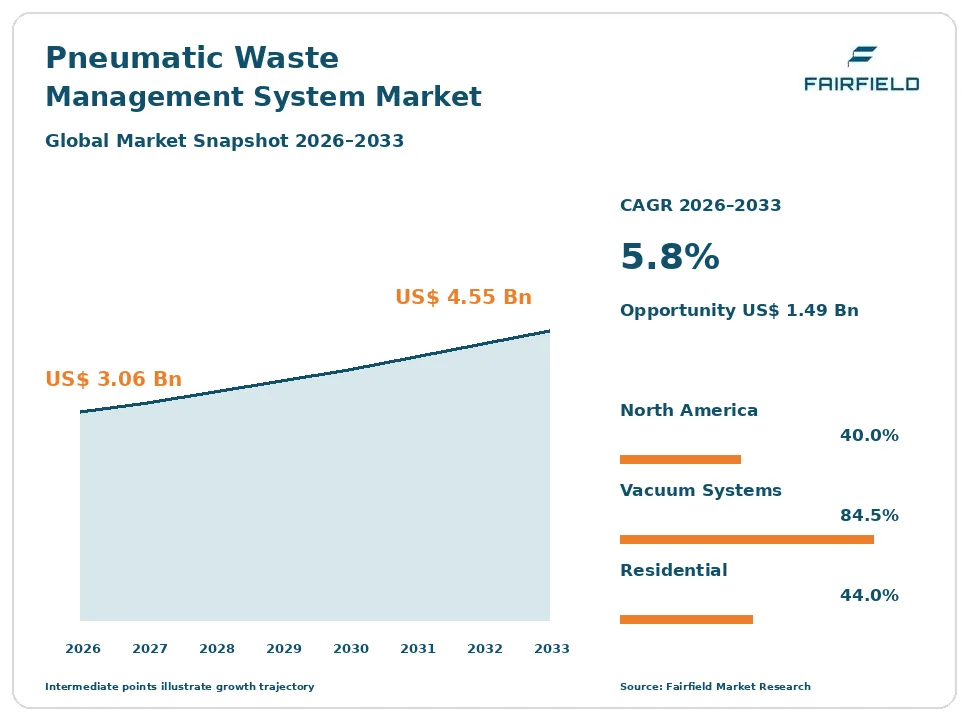
The global pneumatic waste management system market size is expected to be valued at US$ 3.06 billion in 2026 and projected to reach US$ 4.55 billion by 2033, growing at a CAGR of 5.8% between 2026 and 2033.
Between 2020 and 2025, the market grew at a CAGR of about 4.9%, as pandemic construction delays were followed by renewed investment in new districts and hospitals. Three factors now drive growth: the expansion of smart cities and dense urban developments, rules that require better waste separation and recycling, and pressure to cut truck traffic, noise, and emissions in city centers. The market is shifting toward automated waste collection and vacuum waste systems that handle several waste streams through one pipe network, supporting source separation of general waste, recyclables, and food waste. Underground waste transport is spreading from Sweden and Finland to projects in Asia Pacific, Middle East & Africa, and North America.
Key Report Takeaways
- By System Type: Vacuum Systems held 84.5% share in 2026, while Pressure Systems are projected to expand at a 7.2% CAGR through 2033, driven by longer transport distances and lower energy use in some designs.
- By Waste Type: Organic Waste held 38.2% share in 2026, while Plastic Waste is projected to expand at a 7.0% CAGR through 2033, driven by separate collection rules for packaging and recyclables.
- By End User: Residential held 44.0% share in 2026, while Commercial is projected to expand at a 6.9% CAGR through 2033, driven by hospitals, airports, malls, and office districts.
- By Region: North America held 40.0% share in 2026, while Europe is projected to expand at a 6.8% CAGR through 2033, driven by circular economy rules and new urban districts.
Global Pneumatic Waste Management System Market Trends and Insights
Drivers Impact Analysis
| Driver | Impact on CAGR Forecast | Geographic Relevance | Impact Timeline |
| Smart city development and urban density | High | Asia Pacific, Middle East & Africa, Europe | Long term (≥4 years) |
| Recycling rules and emission reduction goals | High | Europe, North America | Medium term (2-4 years) |
Two drivers carry the strongest influence on pneumatic waste management system demand during the forecast period.
Smart City Growth Is Driving the Pneumatic Waste Management System Market
Smart cities and growing urban density are the strongest driver of the pneumatic waste management system market. Cities need cleaner and quieter ways to handle waste in crowded neighborhoods.
The mechanism is the high cost and disruption of truck-based collection in dense areas. Pneumatic systems move waste through underground pipes from inlets in buildings and streets to a central station, where it is compacted and removed less often. This can eliminate up to 80% of garbage truck trips in a district, cutting traffic, noise, odors, and emissions. New districts in Saudi Arabia, the United Arab Emirates, Qatar, Singapore, South Korea, and China often include pneumatic collection from the start. Konza Technopolis in Kenya opened Africa’s first system in 2025. Waste bins disappear from streets, freeing space and improving hygiene. Developers use these systems to market premium, sustainable housing. These benefits drive adoption in large urban projects.
Recycling Rules Are Expanding the Pneumatic Waste Management System Market
Recycling rules and emission reduction goals are expanding the pneumatic waste management system market. Governments want more separated waste and fewer emissions.
The cause is stricter waste laws and climate targets. The European Union requires separate collection of food waste and textiles and sets high recycling targets for packaging. Multi-fraction pneumatic systems allow residents to sort waste into different inlets that send each stream to separate containers. Hospitals use the systems for soiled linen, general waste, and infectious waste, improving hygiene and staff safety. Envac won tenders in 2024 for two French hospitals worth almost €10 million. Cities track how much waste each building produces, supporting pay-as-you-throw programs. Reduced truck traffic helps cities meet air quality and carbon targets. These factors support new projects and upgrades.
Restraints Impact Analysis
| Restraint | Impact on CAGR Forecast | Geographic Relevance | Impact Timeline |
| High capital costs and long payback | High | Global | Long term (≥4 years) |
| Retrofit difficulty in existing cities | Medium | North America, Europe | Long term (≥4 years) |
Two restraints limit how quickly the pneumatic waste management system market grows.
High Capital Costs Slow the Pneumatic Waste Management System Market
High capital costs and long payback periods slow the pneumatic waste management system market. Pneumatic systems need large upfront investment.
The specific causes are pipe networks, stations, and planning complexity. A district system can cost several million euros, including underground pipes, inlets, valves, fans, compactors, and a central collection station. Payback can take many years and depends on high density and long operating life. Projects require coordination between developers, city authorities, and utilities, which can delay decisions. Operating costs include electricity for fans and maintenance staff. Blockages from bulky items can disrupt service. Municipal budgets are often tight, so many cities choose cheaper truck collection. Financing models such as build-operate-transfer and long service contracts help, but many cities lack experience with them. Rising steel and construction costs since 2022 have also increased project budgets. These factors limit adoption to well-funded projects.
Retrofit Difficulty Restricts the Pneumatic Waste Management System Market
Retrofit difficulty in existing cities restricts the pneumatic waste management system market. Installing pipes under built-up streets is disruptive and expensive.
The underlying causes are crowded underground space and existing infrastructure. Old city centers already have water, sewer, gas, power, and telecom lines under streets, leaving little room for new pipes. Digging causes traffic disruption and business complaints. Older buildings may lack space for inlets and chutes. As a result, most systems are installed in new districts, hospitals, and large developments rather than existing neighborhoods. Some older systems, such as Roosevelt Island in New York, need upgrades after decades of use. Trenchless installation methods and building-level systems that use smaller pipes can reduce disruption, but they remain costly. Residents may also need education on what can go into inlets to avoid blockages. These factors limit the addressable market in mature cities.
Market Opportunities
Hospitals and Commercial Facilities Open a Specialized Revenue Pool
Hospitals, airports, and commercial facilities open a specialized revenue pool in the pneumatic waste management system market. These buildings produce large volumes of waste and linen in tight spaces.
Suppliers with healthcare and commercial expertise can capture this opportunity. Hospital systems move soiled linen, general waste, and infectious waste quickly and safely, reducing staff handling and cross-contamination. Airports, shopping malls, stadiums, and office towers use systems to keep public areas clean. Place Vendôme in Lusail, Qatar, announced plans for a pneumatic system in 2024. Maintenance and service contracts provide recurring revenue for decades. Upgrades of older systems with sensors and efficient fans add business, as shown by the Roosevelt Island modernization. Data platforms that monitor fill levels and energy use help owners cut costs and plan maintenance. Hospitals also value faster linen handling and fewer staff injuries from pushing carts.
New Urban Districts in Asia Pacific and the Middle East & Africa Create a Volume Revenue Pool
New urban districts in Asia Pacific and Middle East & Africa create a volume revenue pool in the pneumatic waste management system market. Many large cities are being built from scratch.
Suppliers with local partners can capture this opportunity. Saudi Arabia’s giga-projects, Qatar’s Lusail City, and new developments in the United Arab Emirates include smart waste systems. Singapore requires pneumatic collection in many new public housing estates. South Korea and China have installed systems in new towns. India is studying them for smart city projects. Kenya’s Konza Technopolis shows potential in Middle East & Africa. Long-term service contracts add value, and underground waste transport suits hot climates where bins quickly cause odors. Governments in the region are funding sustainability features in new cities to attract residents and investors. Local manufacturing partners help reduce costs.
Segment Analysis
By System Type: Vacuum Systems Lead While Pressure Systems Grow Fastest
Vacuum Systems held 84.5% share in 2026. Vacuum waste systems use powerful fans to create negative pressure that pulls waste through pipes to a central station. They are proven over decades in Sweden, Spain, Singapore, and South Korea, and are suited to residential districts, hospitals, and airports. Envac, MariMatic, and Stream Environment supply most installations.
Pressure Systems are the fastest-growing system type, expanding at a 7.2% CAGR through 2033. Pressure-based and hybrid designs can move waste over longer distances and handle different materials efficiently. Newer designs aim to cut energy use. Some suppliers combine vacuum and pressure stages to serve very large districts. For the market, pressure systems add technical options.
By Waste Type: Organic Waste Leads While Plastic Waste Grows Fastest
Organic Waste held 38.2% share in 2026. Food and garden waste from homes, restaurants, and hospitals makes up a large share of household waste and causes odors when left in bins. Pneumatic systems remove it quickly and support composting and biogas production. Paper, cardboard, and general mixed waste form other large streams. Separate organic inlets help cities meet food waste collection rules.
Plastic Waste is the fastest-growing waste type, expanding at a 7.0% CAGR through 2033. Separate collection of packaging and plastics is growing under recycling rules in Europe and Asia Pacific. Multi-fraction systems collect plastics through dedicated inlets, delivering cleaner material to recyclers. Extended producer responsibility rules for packaging add funding for separate collection. For the market, plastics growth supports source separation.
By End User: Residential Leads While Commercial Grows Fastest
Residential held 44.0% share in 2026. Apartment complexes and new residential districts use automated waste collection to remove bins from streets and buildings. Developers market systems as premium, sustainable features, and residents value clean streets and easy disposal at any time of day. Public housing in Singapore and new towns in South Korea are major users. Large residential projects in Spain and Sweden have used systems for decades.
Commercial is the fastest-growing end user, expanding at a 6.9% CAGR through 2033. Hospitals, airports, malls, hotels, and office districts install systems to handle large waste volumes and improve hygiene. Hospitals also send soiled linen through separate pipes, cutting staff workload. Airports and stadiums handle large peaks in waste during events. For the market, commercial growth adds high-value projects.
Geography Analysis
Which Region Is Leading the Pneumatic Waste Management System Market?
North America is leading the pneumatic waste management system market with a 40.0% share in 2026. The United States is the largest country market, with systems in hospitals such as Penn Medicine and Children’s Healthcare of Atlanta, airports, stadiums, and residential complexes. Roosevelt Island in New York has operated one of the world’s oldest systems for more than 40 years and is being upgraded by Envac. Hospitals are a major growth area, as large medical campuses seek hygienic linen and waste handling. Envac strengthened its position by acquiring Precision AirConvey in 2022. Canada adds projects in new urban developments in Toronto and Vancouver. One change shaping the region is hospital adoption.
Which Region Is Growing Fastest in the Pneumatic Waste Management System Market?
Europe is growing fastest in the pneumatic waste management system market at a 6.8% CAGR through 2033. Sweden and Finland pioneered the technology, and Spain, France, the Netherlands, Norway, and the United Kingdom have many installations. Envac won a contract in 2025 for the SchieDistrict in Schiedam, Netherlands, with a 25-year service agreement. European Union recycling, packaging, and food waste rules support multi-fraction systems in new districts. Hospital projects in France are growing, and Spain has many municipal systems built in the 2000s that now need modernization. One opportunity is new sustainable districts.
Asia Pacific Advances the Pneumatic Waste Management System Market Through Smart Cities
Asia Pacific is a major pneumatic waste management system market. Singapore uses pneumatic collection in many public housing estates, and South Korea has systems in new towns such as Songdo. China has installed systems in new districts and airports. Malaysia, home to Stream Environment and AWC Berhad, has growing projects. India and Australia are exploring systems for smart city projects and hospitals. Hong Kong has used systems in some housing estates and the airport. Rapid urbanization and limited space for bins support demand across the region. Governments increasingly require waste separation in new developments. One opportunity is new town projects.
Latin America Grows the Pneumatic Waste Management System Market Through Urban Projects
Latin America is an emerging pneumatic waste management system market. Brazil, Mexico, Chile, and Colombia have dense cities such as São Paulo, Mexico City, and Santiago and growing interest in smart waste solutions. Some hospitals, airports, and new mixed-use developments are considering systems as cities look for cleaner streets. Ros Roca from Spain has experience with Spanish-speaking markets. Waste collection in many cities faces traffic congestion and informal dumping, which pneumatic systems could reduce in planned districts. Key barriers include high costs, limited financing, and few local suppliers. One opportunity is hospital projects.
Middle East & Africa Builds the Pneumatic Waste Management System Market
Middle East & Africa is a fast-developing pneumatic waste management system market. Saudi Arabia, the United Arab Emirates, and Qatar include systems in new cities and malls, and Israel has several Envac projects, including Ramat Gan in 2025. Kenya opened Konza Technopolis’s system in 2025, the first of its kind in Kenya and a model for other East African cities. Egypt’s new administrative capital is also planning smart infrastructure. Hot climates make fast waste removal important for hygiene, and malls and airports in Doha and Dubai already use pneumatic systems. Key barriers include high costs and maintenance skills. One opportunity is giga-projects.
Competitive Landscape
The pneumatic waste management system market is highly concentrated. Envac is the global leader with more than 800 installations, followed by MariMatic, Stream Environment, Ros Roca, AWC Berhad, Logiwaste, Aerbin, Ecosir Group, Caverion, and Peakway Environmental.
Companies compete on reliability, energy efficiency, multi-fraction capability, project experience, service quality, safety, and price over the system’s lifetime. Long-term service contracts are a key revenue source, often running for 15 to 25 years after installation. Large projects are usually won through public tenders or developer contracts, where references from past projects are important. Local construction partners and joint ventures help suppliers enter new countries. Newer entrants compete with modular, lower-cost designs for single buildings. Software for monitoring and billing is becoming a differentiator, as owners want to see energy use, blockages, and waste volumes in real time.
Strategic moves show how competition is changing. In March 2024, Envac won two French hospital tenders worth almost €10 million. In January 2025, it won the SchieDistrict contract in the Netherlands. In April 2025, it signed a €7 million contract in Ramat Gan, Israel, and in June 2025 it opened Konza Technopolis’s system in Kenya. These moves show competition shifting toward hospitals and new geographies.
Three themes shape vendor strategy. First, companies are adding sensors and data platforms. Second, they are targeting hospitals and airports. Third, they are expanding into new regions through joint ventures.
Pneumatic Waste Management System Market Industry Leaders
- Envac
- MariMatic
- Stream Environment
- Ros Roca
- AWC Berhad
Recent Industry Developments
- June 2025: Envac launched the first pneumatic waste collection system in Kenya at Konza Technopolis in Kenya for about €8 million - opens a new region for the technology.
- April 2025: Envac signed a contract worth about €7 million for a dual-stream system in Ramat Gan, Israel - serves about 13,700 homes.
- January 2025: Envac won a contract for SchieDistrict in Schiedam, Netherlands, with a 25-year service agreement - expands smart waste systems in Europe.
- March 2024: Envac won two tenders worth almost €10 million for hospitals in Lens and Paris, France - grows hospital waste and linen systems.
Companies Covered in the Report
- Envac
- MariMatic
- Stream Environment
- Ros Roca
- AWC Berhad
- Logiwaste
- Aerbin
- Ecosir Group
- Caverion
- Peakway Environmental
- Air-Log International
- GreenWave Solutions
Pneumatic Waste Management System Market Report Scope
This report covers pneumatic waste management systems, including vacuum and pressure systems, for organic, plastic, paper, general, and other waste streams, used in residential districts, commercial buildings, hospitals, airports, and industrial facilities. It includes equipment, installation, and service contracts but excludes conventional waste trucks and bins. The base year is 2025, and the forecast period runs from 2026 to 2033. All values are expressed in US$ Billion.
System Type
- Vacuum Systems
- Pressure Systems
Waste Type
- Organic Waste
- Plastic Waste
- Paper Waste
- General & Other Waste
End User
- Residential
- Commercial
- Industrial
Regions
- North America
- Europe
- Asia Pacific
- Latin America
- Middle East & Africa
Key Questions Answered in the Report
How big is the pneumatic waste management system market in 2026?
The pneumatic waste management system market is valued at US$ 3.06 billion in 2026, led by vacuum systems for residential districts.
What is the pneumatic waste management system market forecast to 2033?
The market is projected to reach US$ 4.55 billion by 2033, growing at a 5.8% CAGR and adding US$ 1.49 billion.
Which end user is growing fastest in pneumatic waste management systems?
Commercial users are growing fastest at a 6.9% CAGR through 2033, driven by hospitals, airports, malls, and office districts.
Which region is growing fastest in the pneumatic waste management system market?
Europe is growing fastest at a 6.8% CAGR through 2033, driven by circular economy rules and new sustainable urban districts.
Which region holds the largest pneumatic waste management system market share?
North America holds the largest share at 40.0% in 2026, supported by hospital, airport, stadium, and residential installations.
1. Executive Summary
1.1. Global Pneumatic Waste Management System Market Snapshot
1.2. Future Projections
1.3. Key Report Takeaways
1.4. Regional Snapshot
2. Market Overview
2.1. Market Definition and Report Scope
2.2. Historical Trends 2020–2025
2.3. Market Dynamics
2.3.1. Drivers
2.3.1.1. Smart City Growth Is Driving the Pneumatic Waste Management System Market
2.3.1.2. Recycling Rules Are Expanding the Pneumatic Waste Management System Market
2.3.2. Restraints
2.3.2.1. High Capital Costs Slow the Pneumatic Waste Management System Market
2.3.2.2. Retrofit Difficulty Restricts the Pneumatic Waste Management System Market
2.3.3. Market Opportunities
2.3.3.1. Hospitals and Commercial Facilities Open a Specialized Revenue Pool
2.3.3.2. New Urban Districts in Asia Pacific and the Middle East & Africa Create a Volume Revenue Pool
3. Global Pneumatic Waste Management System Market Outlook, 2020-2033
3.1. Global Pneumatic Waste Management System Market Outlook, by System Type, Value (US$ Billion), 2020-2033
3.1.1. Vacuum Systems
3.1.2. Pressure Systems
3.2. Global Pneumatic Waste Management System Market Outlook, by Waste Type, Value (US$ Billion), 2020-2033
3.2.1. Organic Waste
3.2.2. Plastic Waste
3.2.3. Paper Waste
3.2.4. General & Other Waste
3.3. Global Pneumatic Waste Management System Market Outlook, by End User, Value (US$ Billion), 2020-2033
3.3.1. Residential
3.3.2. Commercial
3.3.3. Industrial
3.4. Global Pneumatic Waste Management System Market Outlook, by Region, Value (US$ Billion), 2020-2033
3.4.1. North America
3.4.2. Europe
3.4.3. Asia Pacific
3.4.4. Latin America
3.4.5. Middle East & Africa
4. North America Pneumatic Waste Management System Market Outlook, 2020-2033
4.1. North America Pneumatic Waste Management System Market Outlook, by System Type, Value (US$ Billion), 2020-2033
4.1.1. Vacuum Systems
4.1.2. Pressure Systems
4.2. North America Pneumatic Waste Management System Market Outlook, by Waste Type, Value (US$ Billion), 2020-2033
4.2.1. Organic Waste
4.2.2. Plastic Waste
4.2.3. Paper Waste
4.2.4. General & Other Waste
4.3. North America Pneumatic Waste Management System Market Outlook, by End User, Value (US$ Billion), 2020-2033
4.3.1. Residential
4.3.2. Commercial
4.3.3. Industrial
4.4. North America Pneumatic Waste Management System Market Outlook, by Country, Value (US$ Billion), 2020-2033
4.4.1. United States Pneumatic Waste Management System Market Outlook, by System Type, 2020-2033
4.4.2. United States Pneumatic Waste Management System Market Outlook, by Waste Type, 2020-2033
4.4.3. United States Pneumatic Waste Management System Market Outlook, by End User, 2020-2033
4.4.4. Canada Pneumatic Waste Management System Market Outlook, by System Type, 2020-2033
4.4.5. Canada Pneumatic Waste Management System Market Outlook, by Waste Type, 2020-2033
4.4.6. Canada Pneumatic Waste Management System Market Outlook, by End User, 2020-2033
5. Europe Pneumatic Waste Management System Market Outlook, 2020-2033
5.1. Europe Pneumatic Waste Management System Market Outlook, by System Type, Value (US$ Billion), 2020-2033
5.1.1. Vacuum Systems
5.1.2. Pressure Systems
5.2. Europe Pneumatic Waste Management System Market Outlook, by Waste Type, Value (US$ Billion), 2020-2033
5.2.1. Organic Waste
5.2.2. Plastic Waste
5.2.3. Paper Waste
5.2.4. General & Other Waste
5.3. Europe Pneumatic Waste Management System Market Outlook, by End User, Value (US$ Billion), 2020-2033
5.3.1. Residential
5.3.2. Commercial
5.3.3. Industrial
5.4. Europe Pneumatic Waste Management System Market Outlook, by Country, Value (US$ Billion), 2020-2033
5.4.1. Sweden Pneumatic Waste Management System Market Outlook, by System Type, 2020-2033
5.4.2. Sweden Pneumatic Waste Management System Market Outlook, by Waste Type, 2020-2033
5.4.3. Sweden Pneumatic Waste Management System Market Outlook, by End User, 2020-2033
5.4.4. Finland Pneumatic Waste Management System Market Outlook, by System Type, 2020-2033
5.4.5. Finland Pneumatic Waste Management System Market Outlook, by Waste Type, 2020-2033
5.4.6. Finland Pneumatic Waste Management System Market Outlook, by End User, 2020-2033
5.4.7. Spain Pneumatic Waste Management System Market Outlook, by System Type, 2020-2033
5.4.8. Spain Pneumatic Waste Management System Market Outlook, by Waste Type, 2020-2033
5.4.9. Spain Pneumatic Waste Management System Market Outlook, by End User, 2020-2033
5.4.10. France Pneumatic Waste Management System Market Outlook, by System Type, 2020-2033
5.4.11. France Pneumatic Waste Management System Market Outlook, by Waste Type, 2020-2033
5.4.12. France Pneumatic Waste Management System Market Outlook, by End User, 2020-2033
5.4.13. Netherlands Pneumatic Waste Management System Market Outlook, by System Type, 2020-2033
5.4.14. Netherlands Pneumatic Waste Management System Market Outlook, by Waste Type, 2020-2033
5.4.15. Netherlands Pneumatic Waste Management System Market Outlook, by End User, 2020-2033
5.4.16. Norway Pneumatic Waste Management System Market Outlook, by System Type, 2020-2033
5.4.17. Norway Pneumatic Waste Management System Market Outlook, by Waste Type, 2020-2033
5.4.18. Norway Pneumatic Waste Management System Market Outlook, by End User, 2020-2033
5.4.19. United Kingdom Pneumatic Waste Management System Market Outlook, by System Type, 2020-2033
5.4.20. United Kingdom Pneumatic Waste Management System Market Outlook, by Waste Type, 2020-2033
5.4.21. United Kingdom Pneumatic Waste Management System Market Outlook, by End User, 2020-2033
6. Asia Pacific Pneumatic Waste Management System Market Outlook, 2020-2033
6.1. Asia Pacific Pneumatic Waste Management System Market Outlook, by System Type, Value (US$ Billion), 2020-2033
6.1.1. Vacuum Systems
6.1.2. Pressure Systems
6.2. Asia Pacific Pneumatic Waste Management System Market Outlook, by Waste Type, Value (US$ Billion), 2020-2033
6.2.1. Organic Waste
6.2.2. Plastic Waste
6.2.3. Paper Waste
6.2.4. General & Other Waste
6.3. Asia Pacific Pneumatic Waste Management System Market Outlook, by End User, Value (US$ Billion), 2020-2033
6.3.1. Residential
6.3.2. Commercial
6.3.3. Industrial
6.4. Asia Pacific Pneumatic Waste Management System Market Outlook, by Country, Value (US$ Billion), 2020-2033
6.4.1. Singapore Pneumatic Waste Management System Market Outlook, by System Type, 2020-2033
6.4.2. Singapore Pneumatic Waste Management System Market Outlook, by Waste Type, 2020-2033
6.4.3. Singapore Pneumatic Waste Management System Market Outlook, by End User, 2020-2033
6.4.4. South Korea Pneumatic Waste Management System Market Outlook, by System Type, 2020-2033
6.4.5. South Korea Pneumatic Waste Management System Market Outlook, by Waste Type, 2020-2033
6.4.6. South Korea Pneumatic Waste Management System Market Outlook, by End User, 2020-2033
6.4.7. China Pneumatic Waste Management System Market Outlook, by System Type, 2020-2033
6.4.8. China Pneumatic Waste Management System Market Outlook, by Waste Type, 2020-2033
6.4.9. China Pneumatic Waste Management System Market Outlook, by End User, 2020-2033
6.4.10. Malaysia Pneumatic Waste Management System Market Outlook, by System Type, 2020-2033
6.4.11. Malaysia Pneumatic Waste Management System Market Outlook, by Waste Type, 2020-2033
6.4.12. Malaysia Pneumatic Waste Management System Market Outlook, by End User, 2020-2033
6.4.13. India Pneumatic Waste Management System Market Outlook, by System Type, 2020-2033
6.4.14. India Pneumatic Waste Management System Market Outlook, by Waste Type, 2020-2033
6.4.15. India Pneumatic Waste Management System Market Outlook, by End User, 2020-2033
6.4.16. Australia Pneumatic Waste Management System Market Outlook, by System Type, 2020-2033
6.4.17. Australia Pneumatic Waste Management System Market Outlook, by Waste Type, 2020-2033
6.4.18. Australia Pneumatic Waste Management System Market Outlook, by End User, 2020-2033
6.4.19. Hong Kong Pneumatic Waste Management System Market Outlook, by System Type, 2020-2033
6.4.20. Hong Kong Pneumatic Waste Management System Market Outlook, by Waste Type, 2020-2033
6.4.21. Hong Kong Pneumatic Waste Management System Market Outlook, by End User, 2020-2033
7. Latin America Pneumatic Waste Management System Market Outlook, 2020-2033
7.1. Latin America Pneumatic Waste Management System Market Outlook, by System Type, Value (US$ Billion), 2020-2033
7.1.1. Vacuum Systems
7.1.2. Pressure Systems
7.2. Latin America Pneumatic Waste Management System Market Outlook, by Waste Type, Value (US$ Billion), 2020-2033
7.2.1. Organic Waste
7.2.2. Plastic Waste
7.2.3. Paper Waste
7.2.4. General & Other Waste
7.3. Latin America Pneumatic Waste Management System Market Outlook, by End User, Value (US$ Billion), 2020-2033
7.3.1. Residential
7.3.2. Commercial
7.3.3. Industrial
7.4. Latin America Pneumatic Waste Management System Market Outlook, by Country, Value (US$ Billion), 2020-2033
7.4.1. Brazil Pneumatic Waste Management System Market Outlook, by System Type, 2020-2033
7.4.2. Brazil Pneumatic Waste Management System Market Outlook, by Waste Type, 2020-2033
7.4.3. Brazil Pneumatic Waste Management System Market Outlook, by End User, 2020-2033
7.4.4. Mexico Pneumatic Waste Management System Market Outlook, by System Type, 2020-2033
7.4.5. Mexico Pneumatic Waste Management System Market Outlook, by Waste Type, 2020-2033
7.4.6. Mexico Pneumatic Waste Management System Market Outlook, by End User, 2020-2033
7.4.7. Chile Pneumatic Waste Management System Market Outlook, by System Type, 2020-2033
7.4.8. Chile Pneumatic Waste Management System Market Outlook, by Waste Type, 2020-2033
7.4.9. Chile Pneumatic Waste Management System Market Outlook, by End User, 2020-2033
7.4.10. Colombia Pneumatic Waste Management System Market Outlook, by System Type, 2020-2033
7.4.11. Colombia Pneumatic Waste Management System Market Outlook, by Waste Type, 2020-2033
7.4.12. Colombia Pneumatic Waste Management System Market Outlook, by End User, 2020-2033
8. Middle East & Africa Pneumatic Waste Management System Market Outlook, 2020-2033
8.1. Middle East & Africa Pneumatic Waste Management System Market Outlook, by System Type, Value (US$ Billion), 2020-2033
8.1.1. Vacuum Systems
8.1.2. Pressure Systems
8.2. Middle East & Africa Pneumatic Waste Management System Market Outlook, by Waste Type, Value (US$ Billion), 2020-2033
8.2.1. Organic Waste
8.2.2. Plastic Waste
8.2.3. Paper Waste
8.2.4. General & Other Waste
8.3. Middle East & Africa Pneumatic Waste Management System Market Outlook, by End User, Value (US$ Billion), 2020-2033
8.3.1. Residential
8.3.2. Commercial
8.3.3. Industrial
8.4. Middle East & Africa Pneumatic Waste Management System Market Outlook, by Country, Value (US$ Billion), 2020-2033
8.4.1. Saudi Arabia Pneumatic Waste Management System Market Outlook, by System Type, 2020-2033
8.4.2. Saudi Arabia Pneumatic Waste Management System Market Outlook, by Waste Type, 2020-2033
8.4.3. Saudi Arabia Pneumatic Waste Management System Market Outlook, by End User, 2020-2033
8.4.4. United Arab Emirates Pneumatic Waste Management System Market Outlook, by System Type, 2020-2033
8.4.5. United Arab Emirates Pneumatic Waste Management System Market Outlook, by Waste Type, 2020-2033
8.4.6. United Arab Emirates Pneumatic Waste Management System Market Outlook, by End User, 2020-2033
8.4.7. Qatar Pneumatic Waste Management System Market Outlook, by System Type, 2020-2033
8.4.8. Qatar Pneumatic Waste Management System Market Outlook, by Waste Type, 2020-2033
8.4.9. Qatar Pneumatic Waste Management System Market Outlook, by End User, 2020-2033
8.4.10. Israel Pneumatic Waste Management System Market Outlook, by System Type, 2020-2033
8.4.11. Israel Pneumatic Waste Management System Market Outlook, by Waste Type, 2020-2033
8.4.12. Israel Pneumatic Waste Management System Market Outlook, by End User, 2020-2033
8.4.13. Kenya Pneumatic Waste Management System Market Outlook, by System Type, 2020-2033
8.4.14. Kenya Pneumatic Waste Management System Market Outlook, by Waste Type, 2020-2033
8.4.15. Kenya Pneumatic Waste Management System Market Outlook, by End User, 2020-2033
8.4.16. Egypt Pneumatic Waste Management System Market Outlook, by System Type, 2020-2033
8.4.17. Egypt Pneumatic Waste Management System Market Outlook, by Waste Type, 2020-2033
8.4.18. Egypt Pneumatic Waste Management System Market Outlook, by End User, 2020-2033
9. Competitive Landscape
9.1. Market Concentration and Industry Leaders
9.2. Competitive Differentiation
9.3. Strategic Moves and Market Direction
9.4. Recent Industry Developments
9.5. Company Profiles
9.5.1. Envac
9.5.2. MariMatic
9.5.3. Stream Environment
9.5.4. Ros Roca
9.5.5. AWC Berhad
9.5.6. Logiwaste
9.5.7. Aerbin
9.5.8. Ecosir Group
9.5.9. Caverion
9.5.10. Peakway Environmental
9.5.11. Air-Log International
9.5.12. GreenWave Solutions
10. Appendix
10.1. Research Methodology
10.2. Report Assumptions
10.3. Acronyms and Abbreviations
| System Type | Vacuum Systems, Pressure Systems |
| Waste Type | Organic Waste, Plastic Waste, Paper Waste, General & Other Waste |
| End User | Residential, Commercial, Industrial |
| Regions | North America, Europe, Asia Pacific, Latin America, Middle East & Africa |
Our Research Methodology
Considering the volatility of business today, traditional approaches to strategizing a game plan can be unfruitful if not detrimental. True ambiguity is no way to determine a forecast. A myriad of predetermined factors must be accounted for such as the degree of risk involved, the magnitude of circumstances, as well as conditions or consequences that are not known or unpredictable. To circumvent binary views that cast uncertainty, the application of market research intelligence to strategically posture, move, and enable actionable outcomes is necessary.
View Methodology
Quality Assured
Rigorous Validation Process

Confidentiality Assured
End-to-end Data Security

Custom Research Services
Tailored To Your Objectives
FAQs
The pneumatic waste management system market is valued at US$ 3.06 billion in 2026, led by vacuum systems for residential districts.
The market is projected to reach US$ 4.55 billion by 2033, growing at a 5.8% CAGR and adding US$ 1.49 billion.
Commercial users are growing fastest at a 6.9% CAGR through 2033, driven by hospitals, airports, malls, and office districts.
Europe is growing fastest at a 6.8% CAGR through 2033, driven by circular economy rules and new sustainable urban districts.
North America holds the largest share at 40.0% in 2026, supported by hospital, airport, stadium, and residential installations.
Related Reports
Particulate Matter Monitoring Market Size, Share, Insights, Competitive Landscape, and Forecast 2026 to 2033
Particulate matter monitoring market to reach US$4.01 Bn by 2033 from US$1.99 Bn in 2026 at 10.5% CAGR. Explore technologies, deployments and regional trends.
Thresher Market Size, Share, Insights, Competitive Landscape, and Forecast 2026 to 2033
Thresher market to reach US$ 3.52 billion by 2033 at a 4.1% CAGR. Explore product types, crops, power sources, leading companies and regional trends.
Rotary Sprinkler System Market Size, Share, Insights, Competitive Landscape, and Forecast 2026 to 2033
Rotary sprinkler system market to reach US$ 4.99 billion by 2033 at a 5.5% CAGR. Explore product types, smart controls, applications and regional trends.
Greenhouse Multi-Layer Benching Systems Market Size, Share, Insights, Competitive Landscape, and Forecast 2026 to 2033
Greenhouse multi-layer benching systems market to reach US$ 2.09 billion by 2033 at a 7.0% CAGR. Explore benching types, crops and regional trends.
Food and Beverage Automated Storage Retrieval System Market Size, Share, Insights, Competitive Landscape, and Forecast 2026 to 2033
Food and beverage AS/RS market to reach US$ 3.10 billion by 2033 at a 9.7% CAGR. Explore system types, temperature ranges and regional trends.
Agricultural Haying and Forage Machinery Market Size, Share, Insights, Competitive Landscape, and Forecast 2026 to 2033
Agricultural haying and forage machinery market to reach US$ 13.06 billion by 2033 at a 4.1% CAGR. Explore products, operations and regional trends.