



Material Handling Equipment Market
Material Handling Equipment Market Size, Share, Insights, Competitive Landscape, and Forecast 2026 to 2033
Material Handling Equipment Market Size and Trend Analysis
How Fast Is the Material Handling Equipment Market Growing?
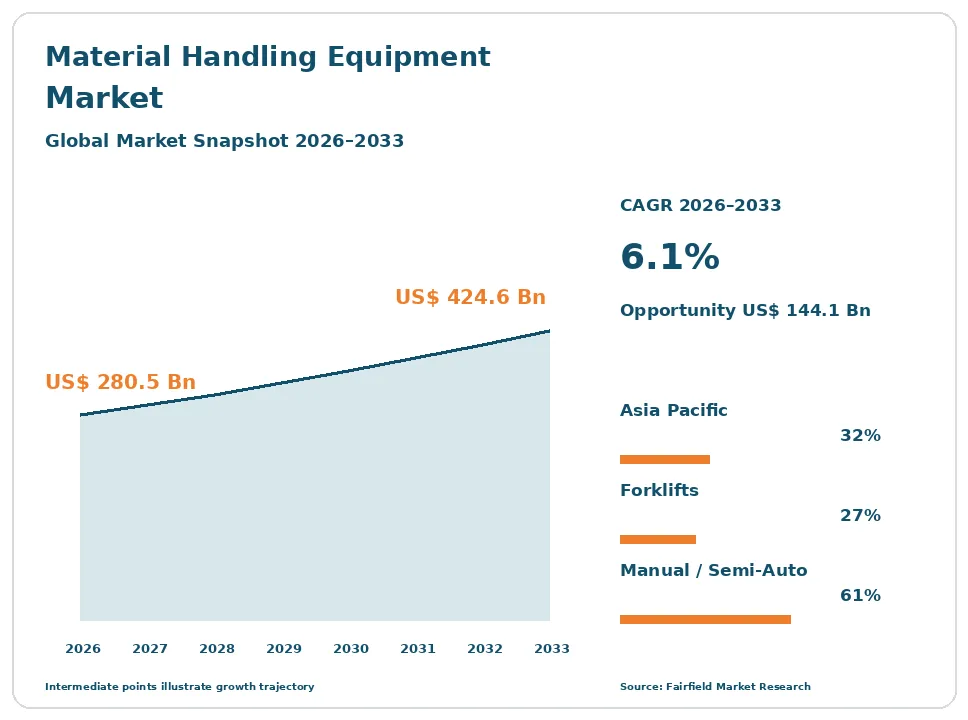
The global material handling equipment market size is expected to be valued at US$ 280.5 billion in 2026 and projected to reach US$ 424.6 billion by 2033, growing at a CAGR of 6.1% between 2026 and 2033.
Between 2020 and 2025, the market grew at a CAGR of about 6.8%, as e-commerce warehouses expanded rapidly, labor shortages pushed companies toward automation, and supply chain disruptions encouraged firms to hold more inventory closer to customers. Material handling equipment moves, stores, controls, and protects goods in factories, warehouses, distribution centers, ports, and stores. It includes forklifts, cranes and hoists, conveyor systems, storage and racking, automated guided vehicles, autonomous mobile robots, and automated storage and retrieval systems. Three factors now drive growth: e-commerce and omnichannel retail that need fast order fulfillment, shortages and rising costs of warehouse labor, and the shift to electric, lithium-ion powered fleets. The market is shifting toward warehouse automation, software-driven fleet management, and robots that work alongside people. In November 2025, Toyota Industries announced plans to combine Vanderlande, Bastian Solutions, and viastore under a new Toyota Automated Logistics brand from April 2026.
Key Report Takeaways
- By Equipment Type: Forklifts held 27.0% share in 2026, while AMRs and AGVs are projected to expand at a 9.6% CAGR through 2033, driven by flexible warehouse automation, labor shortages, and falling robot costs.
- By Industry: Automotive held 19.0% share in 2026, while E-commerce is projected to expand at a 10.8% CAGR through 2033, driven by fast order fulfillment, returns processing, and growth in micro-fulfillment centers.
- By Operation: Manual & Semi-Automated held 61.0% share in 2026, while Automated is projected to expand at a 9.2% CAGR through 2033, driven by warehouse automation that cuts labor needs and errors.
- By Region: Asia Pacific held 32.0% share in 2026, while India is projected to expand at an 8.4% CAGR through 2033, driven by warehouse construction, manufacturing growth, and e-commerce logistics investment.
Global Material Handling Equipment Market Trends and Insights
Drivers Impact Analysis
| Driver | Impact on CAGR Forecast | Geographic Relevance | Impact Timeline |
| E-commerce and omnichannel fulfillment | High | Global | Long term (≥4 years) |
| Labor shortages and warehouse automation | High | North America, Europe, Asia Pacific | Medium term (2-4 years) |
Two drivers carry the strongest influence on material handling equipment demand during the forecast period.
E-commerce Growth Is Driving the Material Handling Equipment Market
E-commerce and omnichannel fulfillment are the strongest driver of the material handling equipment market. Online orders need fast, accurate handling.
The mechanism is the growth of warehouse space and order volumes. Online retailers and logistics providers have built large fulfillment centers, regional sortation hubs, and urban micro-fulfillment sites to deliver orders quickly. Each site needs forklifts, racking, conveyor systems, sorters, and increasingly robots. E-commerce orders are small and varied, so picking individual items is labor-intensive, which favors automation. Retailers that sell both online and in stores need flexible systems that handle store replenishment and home delivery from the same building. Returns add another handling flow. Third-party logistics providers invest to serve many clients. These trends keep demand strong for both traditional equipment and warehouse automation.
Labor Shortages Are Expanding the Material Handling Equipment Market
Labor shortages and the push for automation are expanding the material handling equipment market. Companies cannot find enough warehouse workers.
The cause is tight labor markets and rising wages. Warehouse jobs are physically demanding, and turnover is high in North America and Europe. Ageing populations in Japan, Germany, and South Korea shrink the workforce. Automated guided vehicles, autonomous mobile robots, automated storage and retrieval systems, and robotic picking reduce the need for manual labor and improve safety. Electric forklifts with lithium-ion batteries run longer and need less maintenance; Godrej & Boyce launched India’s first lithium-ion forklift in August 2024, citing 15% more run time. Warehouse management software and AI optimize workflows and labor planning. These factors support investment even when economic growth slows.
Restraints Impact Analysis
| Restraint | Impact on CAGR Forecast | Geographic Relevance | Impact Timeline |
| High upfront costs of automation | High | Global | Medium term (2-4 years) |
| Economic cycles and integration complexity | Medium | Global | Medium term (2-4 years) |
Two restraints limit how quickly the material handling equipment market grows.
High Automation Costs Slow the Material Handling Equipment Market
High upfront costs of automation slow the material handling equipment market. Advanced systems require large investments.
The specific causes are capital intensity and payback uncertainty. Automated storage systems, sortation lines, and robot fleets can cost millions of dollars per site, plus software, integration, and building changes. Small and medium businesses may not have the capital or volume to justify these costs. Payback depends on labor savings and throughput gains that are hard to predict. Interest rates strongly affect financing costs and project approvals. Leasing and robots-as-a-service models help, but many firms still choose manual equipment. These factors slow the shift to automation in cost-sensitive segments and smaller warehouses. Many companies therefore automate in phases, starting with conveyors or a few robots before committing to full systems.
Economic Cycles Restrict the Material Handling Equipment Market
Economic cycles and integration complexity restrict the material handling equipment market. Equipment demand follows business investment.
The underlying causes are cyclical demand and technical challenges. When economic growth slows, manufacturers and retailers delay equipment purchases, and e-commerce companies have paused some warehouse projects after over-building during the pandemic. Integrating new equipment with existing warehouse management systems, enterprise software, and older machines is complex. Downtime during installation disrupts operations. Shortages of skilled technicians to maintain automated systems limit adoption. Supply chain disruptions can delay equipment deliveries. These factors create volatility in orders. Equipment makers have seen strong order intake in some years followed by sharp slowdowns, especially in warehouse automation. Service, spare parts, and rental businesses help stabilize revenue through these cycles, and many suppliers are growing their aftermarket teams to reduce dependence on new equipment sales.
Market Opportunities
Mobile Robots and Flexible Automation Open a Fast-Growth Revenue Pool
Autonomous mobile robots and flexible automation open a fast-growth revenue pool in the material handling equipment market. Robots can be added step by step.
Robot makers, integrators, and equipment companies can capture this opportunity. Unlike fixed conveyors, mobile robots navigate using sensors and maps and can be redeployed as needs change. They move goods between picking stations, transport pallets, and carry carts in factories and hospitals. Robots-as-a-service pricing lowers upfront costs for customers. Autonomous forklifts can handle repetitive pallet moves. AI-powered picking arms can grab varied items. Companies that offer easy-to-deploy, scalable robot fleets can win customers who cannot afford large fixed systems. Robot fleets can grow with seasonal demand. Hospitals, airports, and factories are also adopting mobile robots to move supplies and parts.
Electrification and Fleet Software Create a Service Revenue Pool
Electrification and fleet management software create a service revenue pool in the material handling equipment market. Customers want efficient, connected fleets.
Equipment makers and software firms can capture this opportunity. Electric forklifts with lithium-ion batteries replace diesel and LPG trucks indoors, cutting emissions and noise. Crown Equipment launched its C-B Series 80V electric counterbalance forklifts in September 2024. Telematics track truck usage, battery health, and operator behavior, improving safety and productivity. Predictive maintenance reduces unplanned downtime and extends equipment life, while energy management lowers charging costs. Charging infrastructure and battery services add revenue. Rental and long-term service contracts create recurring income. Companies that combine equipment with software and services can build lasting customer relationships. Hydrogen fuel cell forklifts are also used in large, multi-shift warehouses where fast refueling matters.
Segment Analysis
By Equipment Type: Forklifts Lead While AMRs and AGVs Grow Fastest
Forklifts held 27.0% share in 2026. Forklifts, including counterbalance trucks, reach trucks, and pallet trucks, are the workhorses of warehouses, factories, and ports. Toyota Industries, KION Group, Jungheinrich, Hyster-Yale, and Crown Equipment are leading forklift makers, and electric models now make up a large and growing share of new sales.
AMRs and AGVs are the fastest-growing equipment type, expanding at a 9.6% CAGR through 2033. Automated guided vehicles follow fixed paths, while autonomous mobile robots navigate freely, and both reduce labor needs. Cranes and hoists, conveyor systems, storage and racking, and automated storage and retrieval systems are other types. For the market, robot growth shifts value toward automation, software, and services.
By Industry: Automotive Leads While E-commerce Grows Fastest
Automotive held 19.0% share in 2026. Car and parts plants use conveyors, overhead cranes, AGVs, and forklifts to move components along assembly lines and between buildings.
E-commerce is the fastest-growing industry, expanding at a 10.8% CAGR through 2033. Fulfillment centers need sorters, robots, and storage systems to handle millions of small orders. Food and beverage, retail, logistics, pharmaceuticals, chemicals, and aviation are other industries. For the market, e-commerce growth drives automation demand. Food and beverage companies use cold storage automation and high-speed conveyors, while pharmaceutical firms need precise, traceable handling. Logistics providers buy equipment for many clients. Airports use baggage handling systems from suppliers such as Vanderlande and BEUMER Group, and ports use cranes and straddle carriers.
By Operation: Manual & Semi-Automated Leads While Automated Grows Fastest
Manual & Semi-Automated held 61.0% share in 2026. Most facilities still rely on operator-driven forklifts, pallet jacks, and simple conveyors because they are affordable and flexible.
Automated is the fastest-growing operation type, expanding at a 9.2% CAGR through 2033. Fully automated warehouses use robots, shuttles, and software to store and pick goods with minimal labor. For the market, automation growth raises value per site. Semi-automated solutions, such as conveyors combined with manual picking or forklifts with operator assistance systems, are a common first step. Fully automated sites are most common in grocery, apparel, and parcel operations with high and steady volumes. Software that orchestrates people, robots, and machines is becoming central to all operation types.
Geography Analysis
Why Is North America Important to the Material Handling Equipment Market?
North America is a major material handling equipment market. The United States has large e-commerce, retail, and third-party logistics sectors that invest heavily in warehouse automation. Crown Equipment, Hyster-Yale, Raymond, and Bastian Solutions are key players. Canada and Mexico add demand, with Mexico benefiting from new factories built close to US customers and supply chains. Reshoring of manufacturing and new factories for batteries and chips add demand. Key barriers include high labor costs and project delays. One change shaping the region is robot adoption, with retailers and logistics providers deploying thousands of mobile robots.
Europe Builds the Material Handling Equipment Market Through Engineering Strength
Europe is a major material handling equipment market with about 30% share. Germany, the Netherlands, France, Italy, and the United Kingdom host leading suppliers. KION Group and Jungheinrich in Germany, Vanderlande in the Netherlands, and SSI SCHAEFER are key players with global customers. Strict workplace safety and emissions rules in the region favor electric trucks and automated systems. Grocery retailers in the United Kingdom and France use highly automated distribution centers and robotic picking. Key barriers include high energy costs and slower economic growth. One opportunity is electrification of fleets and retrofit of older warehouses.
Which Region Is Leading the Material Handling Equipment Market?
Asia Pacific is leading the material handling equipment market with a 32.0% share in 2026. China has huge manufacturing and e-commerce sectors, and Japan hosts Toyota Industries and Daifuku. India is the fastest-growing country at an 8.4% CAGR through 2033. South Korea and Australia add demand, and Vietnam, Thailand, and Indonesia are attracting new factories and warehouses as companies diversify supply chains. Chinese makers such as Hangcha and Heli compete strongly in forklifts and export worldwide. Key barriers include intense price competition. One change shaping the region is automation in large e-commerce and manufacturing sites.
Latin America Grows the Material Handling Equipment Market Through Manufacturing and E-commerce
Latin America is a growing material handling equipment market. Brazil and Mexico have expanding manufacturing and e-commerce, and Mercado Libre builds large fulfillment centers. Nearshoring by global manufacturers is bringing new factories to Mexico, increasing demand for forklifts, cranes, and conveyors in industrial parks near the US border. Chile, Colombia, and Peru use material handling equipment heavily in mining, agriculture, and ports. Retailers, beverage makers, and food companies are modernizing their distribution centers with racking and conveyors. Key barriers include limited investment budgets and currency swings. One opportunity is logistics parks near major cities and ports.
Middle East & Africa Expands the Material Handling Equipment Market Through Logistics Hubs
Middle East & Africa is an emerging material handling equipment market. The United Arab Emirates and Saudi Arabia are building logistics hubs and ports. South Africa has large mining, automotive, and manufacturing sectors. Large port and airport projects, such as those in Dubai and on the Saudi Arabia Red Sea coast, need cranes, conveyors, and automated storage. Rapid e-commerce growth in the region is creating new fulfillment centers. Egypt and Morocco are expanding manufacturing, automotive, and logistics zones. Key barriers include high costs and limited local service networks. One opportunity is ports and free zones serving growing regional trade.
Competitive Landscape
The material handling equipment market is moderately concentrated. Toyota Industries, KION Group, Jungheinrich, Hyster-Yale, and Crown Equipment lead in forklifts, while Daifuku, SSI SCHAEFER, Vanderlande, Honeywell Intelligrated, Swisslog, BEUMER Group, and Murata Machinery lead in automation and conveyor systems.
Companies compete on product range, reliability, energy efficiency, automation capability, software, service networks, and price. Dealer and service networks matter, because customers need fast repairs and parts to keep operations running. Automation suppliers compete on system design, software, project delivery, and integration expertise. Robot startups compete mainly on flexibility, fast deployment, and ease of use. Chinese forklift makers compete strongly on price and are rapidly expanding abroad. Consolidation is reshaping the industry as large groups buy automation specialists to offer complete solutions.
Strategic moves show how competition is changing. In June 2025, Toyota Motor and group companies announced a plan to take Toyota Industries private in a deal worth about US$ 33 billion. In November 2025, Toyota Industries announced Toyota Automated Logistics. These moves show competition shifting toward integrated automation, with forklift makers and automation specialists combining under single brands to offer customers complete warehouse solutions covering equipment, software, and lifetime service.
Three themes shape vendor strategy. First, companies are consolidating. Second, they are adding mobile robots and software. Third, they are electrifying fleets with lithium-ion batteries. Vendors that combine broad equipment ranges, automation software, and strong service networks are best placed to win share.
Material Handling Equipment Market Industry Leaders
- Toyota Industries
- KION Group
- Jungheinrich
- Daifuku
- Hyster-Yale
Recent Industry Developments
- November 2025: Toyota Industries announced plans to combine Vanderlande, Bastian Solutions, and viastore under Toyota Automated Logistics from April 2026 - strengthens warehouse automation.
- June 2025: Toyota Motor and group companies announced a plan to take Toyota Industries private in a deal worth about US$ 33 billion - reshapes the largest forklift maker.
- September 2024: Crown Equipment introduced its C-B Series 80V electric counterbalance forklifts - supports fleet electrification.
- August 2024: Godrej & Boyce launched India’s first lithium-ion battery forklift, citing 15% more run time - advances electrification in India.
Companies Covered in the Report
- Toyota Industries
- KION Group
- Jungheinrich
- Daifuku
- Hyster-Yale
- Crown Equipment
- Vanderlande
- SSI SCHAEFER
- Honeywell Intelligrated
- Swisslog
- BEUMER Group
- Murata Machinery
Material Handling Equipment Market Report Scope
This report covers material handling equipment, including forklifts, cranes and hoists, conveyor systems, storage and racking, AGVs and AMRs, and automated storage and retrieval systems, in manual, semi-automated, and automated operation, for automotive, e-commerce, food and beverage, retail, logistics, pharmaceuticals, chemicals, aviation, and other industries. The base year is 2025, and the forecast period runs from 2026 to 2033. All values are expressed in US$ Billion.
Equipment Type
- Forklifts
- Cranes & Hoists
- Conveyor Systems
- Storage & Racking
- AMRs & AGVs
- AS/RS
Industry
- Automotive
- E-commerce
- Food & Beverage
- Retail
- Logistics
- Pharmaceuticals
- Others
Operation
- Manual & Semi-Automated
- Automated
Regions
- North America
- Europe
- Asia Pacific
- Latin America
- Middle East & Africa
Key Questions Answered in the Report
How big is the material handling equipment market in 2026?
The material handling equipment market is valued at US$ 280.5 billion in 2026, led by forklifts and Asia Pacific.
What is the material handling equipment market forecast to 2033?
The market is projected to reach US$ 424.6 billion by 2033, growing at a 6.1% CAGR and adding US$ 144.1 billion.
Which equipment type is growing fastest in the material handling equipment market?
AMRs and AGVs are growing fastest at a 9.6% CAGR through 2033, driven by flexible warehouse automation and labor shortages.
Which country is growing fastest in the material handling equipment market?
India is growing fastest at an 8.4% CAGR through 2033, driven by warehouse construction, manufacturing growth, and logistics investment.
Which region holds the largest material handling equipment market share?
Asia Pacific holds the largest share at 32.0% in 2026, supported by manufacturing and e-commerce in China and Japan.
1. Executive Summary
1.1. Global Material Handling Equipment Market Snapshot
1.2. Future Projections
1.3. Key Report Takeaways
1.4. Regional Snapshot
2. Market Overview
2.1. Market Definition and Report Scope
2.2. Historical Trends 2020–2025
2.3. Market Dynamics
2.3.1. Drivers
2.3.1.1. E-commerce Growth Is Driving the Material Handling Equipment Market
2.3.1.2. Labor Shortages Are Expanding the Material Handling Equipment Market
2.3.2. Restraints
2.3.2.1. High Automation Costs Slow the Material Handling Equipment Market
2.3.2.2. Economic Cycles Restrict the Material Handling Equipment Market
2.3.3. Market Opportunities
2.3.3.1. Mobile Robots and Flexible Automation Open a Fast-Growth Revenue Pool
2.3.3.2. Electrification and Fleet Software Create a Service Revenue Pool
3. Global Material Handling Equipment Market Outlook, 2020-2033
3.1. Global Material Handling Equipment Market Outlook, by Equipment Type, Value (US$ Billion), 2020-2033
3.1.1. Forklifts
3.1.2. Cranes & Hoists
3.1.3. Conveyor Systems
3.1.4. Storage & Racking
3.1.5. AMRs & AGVs
3.1.6. AS/RS
3.2. Global Material Handling Equipment Market Outlook, by Industry, Value (US$ Billion), 2020-2033
3.2.1. Automotive
3.2.2. E-commerce
3.2.3. Food & Beverage
3.2.4. Retail
3.2.5. Logistics
3.2.6. Pharmaceuticals
3.2.7. Others
3.3. Global Material Handling Equipment Market Outlook, by Operation, Value (US$ Billion), 2020-2033
3.3.1. Manual & Semi-Automated
3.3.2. Automated
3.4. Global Material Handling Equipment Market Outlook, by Region, Value (US$ Billion), 2020-2033
3.4.1. North America
3.4.2. Europe
3.4.3. Asia Pacific
3.4.4. Latin America
3.4.5. Middle East & Africa
4. North America Material Handling Equipment Market Outlook, 2020-2033
4.1. North America Material Handling Equipment Market Outlook, by Equipment Type, Value (US$ Billion), 2020-2033
4.1.1. Forklifts
4.1.2. Cranes & Hoists
4.1.3. Conveyor Systems
4.1.4. Storage & Racking
4.1.5. AMRs & AGVs
4.1.6. AS/RS
4.2. North America Material Handling Equipment Market Outlook, by Industry, Value (US$ Billion), 2020-2033
4.2.1. Automotive
4.2.2. E-commerce
4.2.3. Food & Beverage
4.2.4. Retail
4.2.5. Logistics
4.2.6. Pharmaceuticals
4.2.7. Others
4.3. North America Material Handling Equipment Market Outlook, by Operation, Value (US$ Billion), 2020-2033
4.3.1. Manual & Semi-Automated
4.3.2. Automated
4.4. North America Material Handling Equipment Market Outlook, by Country, Value (US$ Billion), 2020-2033
4.4.1. United States Material Handling Equipment Market Outlook, by Equipment Type, 2020-2033
4.4.2. United States Material Handling Equipment Market Outlook, by Industry, 2020-2033
4.4.3. United States Material Handling Equipment Market Outlook, by Operation, 2020-2033
4.4.4. Canada Material Handling Equipment Market Outlook, by Equipment Type, 2020-2033
4.4.5. Canada Material Handling Equipment Market Outlook, by Industry, 2020-2033
4.4.6. Canada Material Handling Equipment Market Outlook, by Operation, 2020-2033
4.4.7. Mexico Material Handling Equipment Market Outlook, by Equipment Type, 2020-2033
4.4.8. Mexico Material Handling Equipment Market Outlook, by Industry, 2020-2033
4.4.9. Mexico Material Handling Equipment Market Outlook, by Operation, 2020-2033
5. Europe Material Handling Equipment Market Outlook, 2020-2033
5.1. Europe Material Handling Equipment Market Outlook, by Equipment Type, Value (US$ Billion), 2020-2033
5.1.1. Forklifts
5.1.2. Cranes & Hoists
5.1.3. Conveyor Systems
5.1.4. Storage & Racking
5.1.5. AMRs & AGVs
5.1.6. AS/RS
5.2. Europe Material Handling Equipment Market Outlook, by Industry, Value (US$ Billion), 2020-2033
5.2.1. Automotive
5.2.2. E-commerce
5.2.3. Food & Beverage
5.2.4. Retail
5.2.5. Logistics
5.2.6. Pharmaceuticals
5.2.7. Others
5.3. Europe Material Handling Equipment Market Outlook, by Operation, Value (US$ Billion), 2020-2033
5.3.1. Manual & Semi-Automated
5.3.2. Automated
5.4. Europe Material Handling Equipment Market Outlook, by Country, Value (US$ Billion), 2020-2033
5.4.1. Germany Material Handling Equipment Market Outlook, by Equipment Type, 2020-2033
5.4.2. Germany Material Handling Equipment Market Outlook, by Industry, 2020-2033
5.4.3. Germany Material Handling Equipment Market Outlook, by Operation, 2020-2033
5.4.4. Netherlands Material Handling Equipment Market Outlook, by Equipment Type, 2020-2033
5.4.5. Netherlands Material Handling Equipment Market Outlook, by Industry, 2020-2033
5.4.6. Netherlands Material Handling Equipment Market Outlook, by Operation, 2020-2033
5.4.7. France Material Handling Equipment Market Outlook, by Equipment Type, 2020-2033
5.4.8. France Material Handling Equipment Market Outlook, by Industry, 2020-2033
5.4.9. France Material Handling Equipment Market Outlook, by Operation, 2020-2033
5.4.10. Italy Material Handling Equipment Market Outlook, by Equipment Type, 2020-2033
5.4.11. Italy Material Handling Equipment Market Outlook, by Industry, 2020-2033
5.4.12. Italy Material Handling Equipment Market Outlook, by Operation, 2020-2033
5.4.13. United Kingdom Material Handling Equipment Market Outlook, by Equipment Type, 2020-2033
5.4.14. United Kingdom Material Handling Equipment Market Outlook, by Industry, 2020-2033
5.4.15. United Kingdom Material Handling Equipment Market Outlook, by Operation, 2020-2033
6. Asia Pacific Material Handling Equipment Market Outlook, 2020-2033
6.1. Asia Pacific Material Handling Equipment Market Outlook, by Equipment Type, Value (US$ Billion), 2020-2033
6.1.1. Forklifts
6.1.2. Cranes & Hoists
6.1.3. Conveyor Systems
6.1.4. Storage & Racking
6.1.5. AMRs & AGVs
6.1.6. AS/RS
6.2. Asia Pacific Material Handling Equipment Market Outlook, by Industry, Value (US$ Billion), 2020-2033
6.2.1. Automotive
6.2.2. E-commerce
6.2.3. Food & Beverage
6.2.4. Retail
6.2.5. Logistics
6.2.6. Pharmaceuticals
6.2.7. Others
6.3. Asia Pacific Material Handling Equipment Market Outlook, by Operation, Value (US$ Billion), 2020-2033
6.3.1. Manual & Semi-Automated
6.3.2. Automated
6.4. Asia Pacific Material Handling Equipment Market Outlook, by Country, Value (US$ Billion), 2020-2033
6.4.1. China Material Handling Equipment Market Outlook, by Equipment Type, 2020-2033
6.4.2. China Material Handling Equipment Market Outlook, by Industry, 2020-2033
6.4.3. China Material Handling Equipment Market Outlook, by Operation, 2020-2033
6.4.4. Japan Material Handling Equipment Market Outlook, by Equipment Type, 2020-2033
6.4.5. Japan Material Handling Equipment Market Outlook, by Industry, 2020-2033
6.4.6. Japan Material Handling Equipment Market Outlook, by Operation, 2020-2033
6.4.7. India Material Handling Equipment Market Outlook, by Equipment Type, 2020-2033
6.4.8. India Material Handling Equipment Market Outlook, by Industry, 2020-2033
6.4.9. India Material Handling Equipment Market Outlook, by Operation, 2020-2033
6.4.10. South Korea Material Handling Equipment Market Outlook, by Equipment Type, 2020-2033
6.4.11. South Korea Material Handling Equipment Market Outlook, by Industry, 2020-2033
6.4.12. South Korea Material Handling Equipment Market Outlook, by Operation, 2020-2033
6.4.13. Australia Material Handling Equipment Market Outlook, by Equipment Type, 2020-2033
6.4.14. Australia Material Handling Equipment Market Outlook, by Industry, 2020-2033
6.4.15. Australia Material Handling Equipment Market Outlook, by Operation, 2020-2033
6.4.16. Vietnam Material Handling Equipment Market Outlook, by Equipment Type, 2020-2033
6.4.17. Vietnam Material Handling Equipment Market Outlook, by Industry, 2020-2033
6.4.18. Vietnam Material Handling Equipment Market Outlook, by Operation, 2020-2033
6.4.19. Thailand Material Handling Equipment Market Outlook, by Equipment Type, 2020-2033
6.4.20. Thailand Material Handling Equipment Market Outlook, by Industry, 2020-2033
6.4.21. Thailand Material Handling Equipment Market Outlook, by Operation, 2020-2033
6.4.22. Indonesia Material Handling Equipment Market Outlook, by Equipment Type, 2020-2033
6.4.23. Indonesia Material Handling Equipment Market Outlook, by Industry, 2020-2033
6.4.24. Indonesia Material Handling Equipment Market Outlook, by Operation, 2020-2033
7. Latin America Material Handling Equipment Market Outlook, 2020-2033
7.1. Latin America Material Handling Equipment Market Outlook, by Equipment Type, Value (US$ Billion), 2020-2033
7.1.1. Forklifts
7.1.2. Cranes & Hoists
7.1.3. Conveyor Systems
7.1.4. Storage & Racking
7.1.5. AMRs & AGVs
7.1.6. AS/RS
7.2. Latin America Material Handling Equipment Market Outlook, by Industry, Value (US$ Billion), 2020-2033
7.2.1. Automotive
7.2.2. E-commerce
7.2.3. Food & Beverage
7.2.4. Retail
7.2.5. Logistics
7.2.6. Pharmaceuticals
7.2.7. Others
7.3. Latin America Material Handling Equipment Market Outlook, by Operation, Value (US$ Billion), 2020-2033
7.3.1. Manual & Semi-Automated
7.3.2. Automated
7.4. Latin America Material Handling Equipment Market Outlook, by Country, Value (US$ Billion), 2020-2033
7.4.1. Brazil Material Handling Equipment Market Outlook, by Equipment Type, 2020-2033
7.4.2. Brazil Material Handling Equipment Market Outlook, by Industry, 2020-2033
7.4.3. Brazil Material Handling Equipment Market Outlook, by Operation, 2020-2033
7.4.4. Mexico Material Handling Equipment Market Outlook, by Equipment Type, 2020-2033
7.4.5. Mexico Material Handling Equipment Market Outlook, by Industry, 2020-2033
7.4.6. Mexico Material Handling Equipment Market Outlook, by Operation, 2020-2033
7.4.7. Chile Material Handling Equipment Market Outlook, by Equipment Type, 2020-2033
7.4.8. Chile Material Handling Equipment Market Outlook, by Industry, 2020-2033
7.4.9. Chile Material Handling Equipment Market Outlook, by Operation, 2020-2033
7.4.10. Colombia Material Handling Equipment Market Outlook, by Equipment Type, 2020-2033
7.4.11. Colombia Material Handling Equipment Market Outlook, by Industry, 2020-2033
7.4.12. Colombia Material Handling Equipment Market Outlook, by Operation, 2020-2033
7.4.13. Peru Material Handling Equipment Market Outlook, by Equipment Type, 2020-2033
7.4.14. Peru Material Handling Equipment Market Outlook, by Industry, 2020-2033
7.4.15. Peru Material Handling Equipment Market Outlook, by Operation, 2020-2033
8. Middle East & Africa Material Handling Equipment Market Outlook, 2020-2033
8.1. Middle East & Africa Material Handling Equipment Market Outlook, by Equipment Type, Value (US$ Billion), 2020-2033
8.1.1. Forklifts
8.1.2. Cranes & Hoists
8.1.3. Conveyor Systems
8.1.4. Storage & Racking
8.1.5. AMRs & AGVs
8.1.6. AS/RS
8.2. Middle East & Africa Material Handling Equipment Market Outlook, by Industry, Value (US$ Billion), 2020-2033
8.2.1. Automotive
8.2.2. E-commerce
8.2.3. Food & Beverage
8.2.4. Retail
8.2.5. Logistics
8.2.6. Pharmaceuticals
8.2.7. Others
8.3. Middle East & Africa Material Handling Equipment Market Outlook, by Operation, Value (US$ Billion), 2020-2033
8.3.1. Manual & Semi-Automated
8.3.2. Automated
8.4. Middle East & Africa Material Handling Equipment Market Outlook, by Country, Value (US$ Billion), 2020-2033
8.4.1. United Arab Emirates Material Handling Equipment Market Outlook, by Equipment Type, 2020-2033
8.4.2. United Arab Emirates Material Handling Equipment Market Outlook, by Industry, 2020-2033
8.4.3. United Arab Emirates Material Handling Equipment Market Outlook, by Operation, 2020-2033
8.4.4. Saudi Arabia Material Handling Equipment Market Outlook, by Equipment Type, 2020-2033
8.4.5. Saudi Arabia Material Handling Equipment Market Outlook, by Industry, 2020-2033
8.4.6. Saudi Arabia Material Handling Equipment Market Outlook, by Operation, 2020-2033
8.4.7. South Africa Material Handling Equipment Market Outlook, by Equipment Type, 2020-2033
8.4.8. South Africa Material Handling Equipment Market Outlook, by Industry, 2020-2033
8.4.9. South Africa Material Handling Equipment Market Outlook, by Operation, 2020-2033
8.4.10. Egypt Material Handling Equipment Market Outlook, by Equipment Type, 2020-2033
8.4.11. Egypt Material Handling Equipment Market Outlook, by Industry, 2020-2033
8.4.12. Egypt Material Handling Equipment Market Outlook, by Operation, 2020-2033
8.4.13. Morocco Material Handling Equipment Market Outlook, by Equipment Type, 2020-2033
8.4.14. Morocco Material Handling Equipment Market Outlook, by Industry, 2020-2033
8.4.15. Morocco Material Handling Equipment Market Outlook, by Operation, 2020-2033
9. Competitive Landscape
9.1. Market Concentration and Industry Leaders
9.2. Competitive Differentiation
9.3. Strategic Moves and Market Direction
9.4. Recent Industry Developments
9.5. Company Profiles
9.5.1. Toyota Industries
9.5.2. KION Group
9.5.3. Jungheinrich
9.5.4. Daifuku
9.5.5. Hyster-Yale
9.5.6. Crown Equipment
9.5.7. Vanderlande
9.5.8. SSI SCHAEFER
9.5.9. Honeywell Intelligrated
9.5.10. Swisslog
9.5.11. BEUMER Group
9.5.12. Murata Machinery
10. Appendix
10.1. Research Methodology
10.2. Report Assumptions
10.3. Acronyms and Abbreviations
| Equipment Type | Forklifts, Cranes & Hoists, Conveyor Systems, Storage & Racking, AMRs & AGVs, AS/RS |
| Industry | Automotive, E-commerce, Food & Beverage, Retail, Logistics, Pharmaceuticals, Others |
| Operation | Manual & Semi-Automated, Automated |
| Regions | North America, Europe, Asia Pacific, Latin America, Middle East & Africa |
Our Research Methodology
Considering the volatility of business today, traditional approaches to strategizing a game plan can be unfruitful if not detrimental. True ambiguity is no way to determine a forecast. A myriad of predetermined factors must be accounted for such as the degree of risk involved, the magnitude of circumstances, as well as conditions or consequences that are not known or unpredictable. To circumvent binary views that cast uncertainty, the application of market research intelligence to strategically posture, move, and enable actionable outcomes is necessary.
View Methodology
Quality Assured
Rigorous Validation Process

Confidentiality Assured
End-to-end Data Security

Custom Research Services
Tailored To Your Objectives
FAQs
The material handling equipment market is valued at US$ 280.5 billion in 2026, led by forklifts and Asia Pacific.
The market is projected to reach US$ 424.6 billion by 2033, growing at a 6.1% CAGR and adding US$ 144.1 billion.
AMRs and AGVs are growing fastest at a 9.6% CAGR through 2033, driven by flexible warehouse automation and labor shortages.
India is growing fastest at an 8.4% CAGR through 2033, driven by warehouse construction, manufacturing growth, and logistics investment.
Asia Pacific holds the largest share at 32.0% in 2026, supported by manufacturing and e-commerce in China and Japan.
Related Reports
Gigacasting Presses Market Size, Share, Insights, Competitive Landscape, and Forecast 2026 to 2033
Explore the gigacasting presses market, projected to reach US$2.1 billion by 2033 at 8.3% CAGR, with clamping force, application and regional insights.
Roller Bearings Market Size, Share, Insights, Competitive Landscape, and Forecast 2026 to 2033
The roller bearings market is projected to grow from US$58.0 billion in 2026 to US$79.5 billion by 2033, at a 4.6% CAGR. Explore segments and key trends.
Pneumatic Waste Management System Market Size, Share, Insights, Competitive Landscape, and Forecast 2026 to 2033
Pneumatic waste management system market to reach US$4.55 Bn by 2033 from US$3.06 Bn in 2026 at 5.8% CAGR. Explore systems, waste types, users and regions.
Particulate Matter Monitoring Market Size, Share, Insights, Competitive Landscape, and Forecast 2026 to 2033
Particulate matter monitoring market to reach US$4.01 Bn by 2033 from US$1.99 Bn in 2026 at 10.5% CAGR. Explore technologies, deployments and regional trends.
Thresher Market Size, Share, Insights, Competitive Landscape, and Forecast 2026 to 2033
Thresher market to reach US$ 3.52 billion by 2033 at a 4.1% CAGR. Explore product types, crops, power sources, leading companies and regional trends.
Rotary Sprinkler System Market Size, Share, Insights, Competitive Landscape, and Forecast 2026 to 2033
Rotary sprinkler system market to reach US$ 4.99 billion by 2033 at a 5.5% CAGR. Explore product types, smart controls, applications and regional trends.