



Roller Bearings Market
Roller Bearings Market Size, Share, Insights, Competitive Landscape, and Forecast 2026 to 2033
Roller Bearings Market Size and Trend Analysis
What Is the Growth Outlook for Roller Bearings?
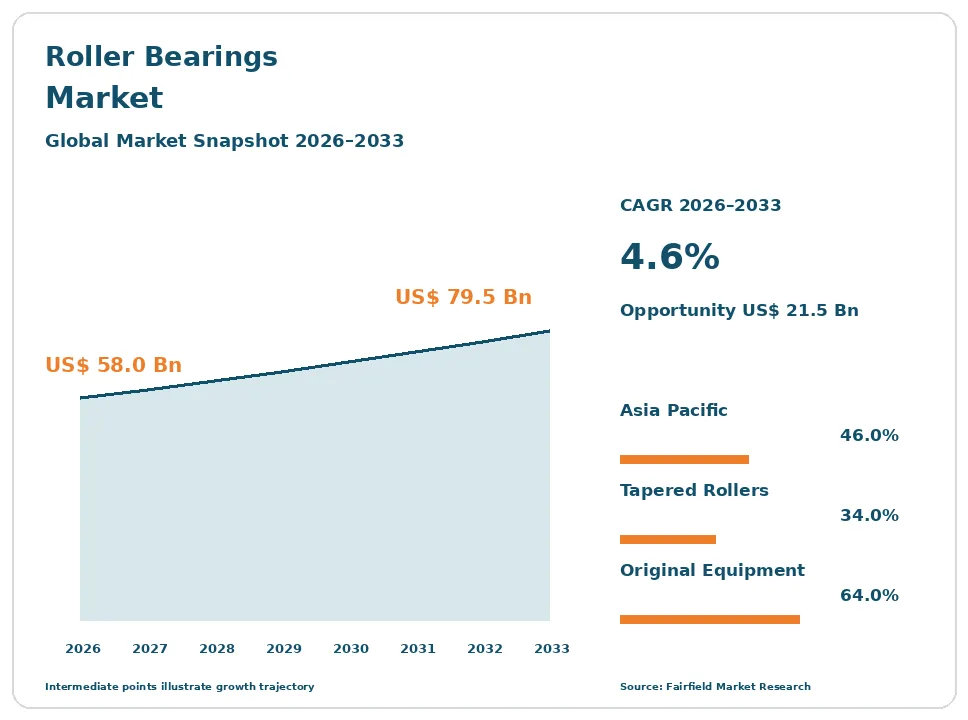
The global Roller Bearings market size is expected to be valued at US$ 58.0 billion in 2026 and projected to reach US$ 79.5 billion by 2033, growing at a CAGR of 4.6% between 2026 and 2033.
Demand grew at an estimated 3.9% CAGR between 2020 and 2025, falling sharply in the first year and then recovering with industrial output and vehicle build rates. Three factors shape the forecast. Electric drivetrains have created a new technical requirement, because motor shaft currents erode raceways, which pulls electrically insulated and hybrid ceramic designs into mainstream specification. Wind turbines, railways and mining equipment continue to need large tapered and spherical bearings that carry heavy combined loads. The aftermarket supplies steady replacement revenue at better margins than original equipment. This is a mature, consolidated market, so growth tracks industrial production rather than any single technology cycle.
Key Report Takeaways
- By Product Type: Tapered Roller Bearings held 34% share in 2026, while Cylindrical Roller Bearings are projected to expand at a 5.7% CAGR through 2033, supported by electric motor and industrial gearbox applications that need high radial capacity.
- By Design Type: Standard Open and Sealed Designs held 71% share in 2026, while Electrically Insulated and Hybrid Ceramic Designs are projected to expand at a 9.4% CAGR through 2033, as electric drivetrains require protection against shaft current damage.
- By End Use Industry: Automotive and Commercial Vehicles held 31% share in 2026, while Wind Energy is projected to expand at a 7.4% CAGR through 2033, as larger turbines raise main shaft and gearbox bearing content per unit.
- By Sales Channel: Original Equipment held 64% share in 2026, while the Aftermarket is projected to grow at a 5.3% CAGR through 2033, reflecting an ageing installed base of industrial machinery and commercial vehicles.
- By Geography: Asia Pacific held 46% share in 2026, while Middle East & Africa is projected to expand at a 5.9% CAGR through 2033, driven by mining, rail and downstream process industry investment.
Global Roller Bearings Market Trends and Insights
Drivers Impact Analysis
| Driver | Impact on CAGR Forecast | Geographic Relevance | Impact Timeline |
| Shaft current damage in electric drivetrains | High | Global, strongest in Asia Pacific and Europe | Medium term 2–4 years |
| Wind energy and rail equipment build-out | Medium | Europe, Asia Pacific, North America | Long term ≥4 years |
Electrification and heavy-duty renewable and rail equipment are the two clearest sources of incremental demand.
Electric Drivetrain Shaft Currents Create Demand for Insulated Roller Bearings
Electric drivetrains created a new failure mode that changes bearing specification. Inverter switching produces common mode voltage on the motor shaft, which discharges through the lubricant film and erodes the raceway, leaving fluting and frosting patterns. The damage is electrical rather than mechanical, so stronger steel does not solve it. Insulation does, which is why electrically insulated and hybrid ceramic bearings have moved from niche products to specified content.
The mechanism also changes the rest of the design. Traction and industrial motors run at far higher speeds than the machines they replace, so cages must resist higher centrifugal loading and lubricants must survive higher operating temperatures with thinner films. Manufacturers respond with ceramic rolling elements, oxide-coated rings, polymer cages and sealed grease formulations. IEC insulation testing and ISO 15243 damage classification give engineers a shared language for diagnosing the problem.
Wind Turbine and Railway Programmes Lift Demand for Large Tapered and Spherical Bearings
Renewable energy and rail investment add high-value units that carry exceptional loads. A single large wind turbine uses main shaft, gearbox and pitch and yaw bearings, and as rated capacity rises the bearings grow in diameter and price far faster than turbine count. Railway investment works similarly, because axleboxes, traction motors and gear units all need roller bearings certified for long service intervals.
Design requirements make these units technically demanding rather than simply large. IEC 61400-4 sets design requirements for wind turbine gearboxes, and ISO 281 rating life calculations with life modification factors govern sizing under variable loads. Turbine operators measure success in decades of unattended service offshore, so sealed, cleanliness-controlled and condition-monitored designs are specified. Rail operators apply comparable reliability requirements, supported by scheduled overhaul and remanufacturing programmes.
Restraints Impact Analysis
| Restraint | Impact on CAGR Forecast | Geographic Relevance | Impact Timeline |
| Counterfeit and falsely marked bearings in the aftermarket | Medium | Global, strongest in emerging markets | Medium term 2–4 years |
| Mature demand base, steel cost and longer service life | High | Global | Long term ≥4 years |
Maturity, input cost and the economics of longer bearing life limit the rate of expansion.
Counterfeit Bearings Erode Aftermarket Value and Force Spending on Authentication
The aftermarket carries the better margins, and counterfeiting is a genuine and well-documented problem within it. Falsely marked bearings sold through unauthorised channels capture replacement revenue, damage brand trust and expose users to failures, because a bearing that fails inside a gearbox costs far more in downtime and secondary damage than the part itself. Industry associations and manufacturers run joint enforcement, training and customs programmes against the practice.
The cause is structural. Replacement bearings are small, high-value, visually similar and bought under time pressure by maintenance teams, often through long distribution chains where provenance is hard to verify. Vendors respond with authorised distributor networks, tamper-evident packaging, serialisation and smartphone authentication, all of which raise cost to serve. Customs and anti-counterfeiting enforcement helps, but the burden of proof and policing sits largely with legitimate producers.
Mature Demand, Steel Cost and Longer Service Life Cap Volume Growth
This is a capital-intensive, consolidated and mature industry, so growth is tied directly to industrial production and vehicle build rates rather than to new adoption. Precision grinding, heat treatment and assembly lines require heavy fixed investment and run best at high utilisation, which makes earnings sensitive to short industrial cycles. Low-cost regional producers compete hard at the commodity end, compressing prices in standard sizes.
Costs and longevity squeeze from both sides. Bearing-quality steel and the energy used in forging, heat treatment and grinding form a large share of the cost base, and both have moved sharply with trade measures and power prices. At the same time, condition monitoring, predictive maintenance, better seals and cleaner lubrication genuinely extend service life. That outcome benefits users but modestly reduces replacement volumes over a machine’s life.
Market Opportunities
Sensorised Roller Bearings Open a Recurring Condition Data Revenue Pool
Bearings that report their own condition open a revenue pool beyond the hardware. Integrating speed, temperature, vibration and load sensing into the bearing unit turns a commodity component into a monitored asset, which can be sold with software, analytics subscriptions and service agreements. Because the sensor sits at the point of failure rather than on a housing, the data is cleaner and the warning time longer than external monitoring provides.
Industrial gearbox operators, rail fleets, wind farm owners and mining companies create the demand, since their downtime costs dwarf the component price. Manufacturers with application engineering and failure analysis capability can capture it, using ISO 15243 damage classification to translate signals into actionable diagnoses. Standard industrial connectivity protocols make integration with plant maintenance systems straightforward, which lowers the barrier for mid-sized plants.
Remanufacturing and Refurbishment Services Create a Margin Pool in Large Bearings
Remanufacturing large bearings is an underused revenue pool with service-level margins. A large spherical or tapered bearing from a mill stand, wind turbine or rail gear unit can often be reclaimed by inspection, regrinding, re-rollering and recertification at a fraction of new cost and lead time. For users, the attraction is availability: a refurbished unit can be returned in weeks when a new large bearing may take far longer to produce.
Heavy industry, mining, metals processing and wind operators are the natural customers, because their units are expensive, few and critical. Suppliers with inspection capability, original drawings and metallurgical records are best placed to capture it, and recertification against ISO 281 and ISO 492 restores documented load ratings and tolerance class. Carbon reporting adds pull, since reclaiming a bearing avoids most of the embodied energy in new steel.
Segment Analysis
By Product Type: Tapered Bearings Lead as Cylindrical Designs Accelerate
Tapered Roller Bearings held 34% of 2026 revenue, the largest product type, because they carry combined radial and axial loads in wheel hubs, axles, gearboxes and heavy equipment. Volume from commercial vehicles, agricultural machinery and construction equipment keeps the segment broad, and paired arrangements remain the default for shafts that must handle thrust in both directions.
Cylindrical Roller Bearings are growing fastest at a 5.7% CAGR to 2033, as electric motors, traction units and industrial gearboxes demand high radial capacity in compact envelopes, often with insulated or hybrid variants. Spherical roller bearings serve misalignment-prone heavy industry, needle roller bearings suit space-constrained transmissions, toroidal and CARB-type bearings handle axial displacement, and roller thrust bearings take pure axial loads. The resulting mix rewards producers with wide catalogues and strong application engineering.
By Design Type: Standard Designs Dominate While Insulated and Ceramic Variants Surge
Standard Open and Sealed Designs accounted for 71% of 2026 value. They dominate because most applications are well understood, tolerance classes under ISO 492 and ISO 199 and their ABEC equivalents are specified from catalogues, and interchangeability keeps procurement simple and competitive.
Electrically Insulated and Hybrid Ceramic Designs are the fastest-growing group at a 9.4% CAGR through 2033, pulled directly by shaft current damage in inverter-driven machines and by the higher speeds those machines run at. Split designs continue to serve applications where shaft removal is impractical, such as large pumps and conveyors, while sensorised designs grow from a small base. For manufacturers, the shift moves revenue toward engineered variants where ceramic element supply, coating capability and electrical testing act as real barriers to imitation.
By End Use Industry: Vehicles Lead While Wind Energy Expands Fastest
Automotive and Commercial Vehicles held 31% share in 2026, the largest end use, through wheel hubs, transmissions, differentials and electric drive units. Volume is enormous and quality expectations are governed by IATF 16949 and ISO 9001, which favours suppliers with validated processes and global footprint.
Wind Energy is the fastest-growing end use at a 7.4% CAGR to 2033, because turbine ratings keep rising and larger machines use physically bigger, higher-value main shaft and gearbox bearings. Railways, mining and construction equipment, agriculture, metals and heavy industry, machine tools and industrial gearboxes and general machinery make up the balance. The implication is a slow mix shift toward large-diameter, long-life units where engineering support, cleanliness control and documented rating life matter far more than unit price.
By Sales Channel: Original Equipment Leads While the Aftermarket Grows Faster
Original Equipment accounted for 64% of 2026 revenue. Vehicle makers, machine builders and turbine manufacturers specify bearings during design, lock them into validated assemblies and buy on long-term agreements, which concentrates volume with a small number of approved suppliers.
The Aftermarket is growing faster at a 5.3% CAGR to 2033 and carries materially better margins. An ageing installed base of industrial machinery, trucks and rail vehicles sustains replacement demand that is less cyclical than new equipment orders. The channel is also where brand value is tested most directly, since counterfeit and falsely marked product competes for the same orders. Suppliers are therefore investing in authorised distribution, authentication, failure analysis services and training, all of which defend replacement revenue and build maintenance relationships.
Geography Analysis
North America Pairs Heavy Vehicle Demand With Tariff-Exposed Steel Costs
North America held 20% of 2026 revenue and is forecast to grow at 3.8% through 2033. The United States, Mexico and Canada combine commercial vehicle and agricultural equipment production with a large installed base of industrial machinery, so replacement demand is substantial. Automotive quality requirements under IATF 16949 shape supplier qualification, and tapered designs dominate heavy truck and trailer applications.
Steel tariffs and higher domestic energy-linked conversion costs raise the regional cost base, which pressures margins in standard sizes. The clearest change is nearshoring: machinery and vehicle assembly moving into Mexico pulls bearing supply closer to final assembly. Rail freight renewal, mining equipment and data centre mechanical plant add steady demand, while wind installations support large-diameter units in the central states.
Europe Anchors Precision Bearing Engineering and Wind Turbine Content
Europe accounted for 23% of the 2026 market and should grow at 3.4% to 2033, the slowest regional rate but from a high technical base. Germany, Italy, France and Sweden host machine tool, industrial gearbox, premium vehicle and wind turbine manufacturing, which concentrates demand in high-tolerance classes and large-diameter units.
Two regional forces matter. Ecodesign requirements for electric motors push efficiency classes upward, which tightens the friction and lubrication budgets that bearing selection must meet. Trade measures on imported bearings and on steel affect both competitive dynamics and input cost. Energy prices remain a barrier for heat treatment and grinding operations. The main opportunity is offshore wind, where larger rotors increase bearing diameter, value and the service content attached to each installed unit.
Which Region Is Leading the Roller Bearings Market?
Asia Pacific leads with 46% share in 2026 and is growing at 5.1% through 2033, combining the largest production base with the largest consumption. China, Japan, India and the Republic of Korea account for most of it, supported by vehicle assembly, machine building, steel production, railways and rapidly expanding renewable capacity.
The region supplies both ends of the market. Domestic producers compete aggressively in standard sizes, while Japanese and international manufacturers hold the precision and specialty segments. Rail network expansion in China and India creates sustained axlebox and traction bearing demand, and electric vehicle production volumes make insulated and hybrid designs a mainstream requirement rather than a specialty. Counterfeit product in the replacement channel remains a persistent problem that shapes distribution strategy across the region.
Latin America Builds Bearing Demand Around Mining and Agricultural Machinery
Latin America represented 6% of 2026 revenue and is projected to grow at 4.7% through 2033. Brazil, Chile, Peru and Mexico generate most demand, concentrated in copper and iron ore mining, sugar and grain processing, agricultural machinery and commercial vehicle fleets. These applications favour large spherical and tapered bearings that tolerate contamination, shock loading and misalignment.
Barriers are significant. Limited local precision manufacturing means most specialty bearings are imported, so currency movements and freight directly affect availability and price. Maintenance practice varies widely, and unauthorised replacement channels are common, which complicates warranty and failure analysis. The opportunity lies in service: on-site inspection, lubrication management, remanufacturing of large mining bearings and condition monitoring contracts command better margins than hardware supply alone.
Which Region Is Growing Fastest in the Roller Bearings Market?
Middle East & Africa is growing fastest at a 5.9% CAGR through 2033, from a 5% base in 2026. Saudi Arabia, the United Arab Emirates, South Africa and Egypt drive it through mining, petrochemical and refining plant, cement production, new rail corridors and industrial diversification programmes that add domestic manufacturing capacity.
High ambient temperatures, dust and long distances to service centres make reliability the deciding purchase factor, which favours sealed designs, robust lubrication and condition monitoring. Rail investment adds axlebox and traction unit demand over the forecast period. Barriers include thin local technical support, dependence on imported product, and capital budgets linked to commodity and oil revenue, which can pause projects quickly. Local service and remanufacturing capacity is the clearest opening for suppliers.
Competitive Landscape
The market is highly concentrated. A handful of global manufacturers supply the majority of world demand, because bearing production requires heavy investment in forging, heat treatment, precision grinding and metrology, alongside decades of application data. That combination makes entry difficult at the precision end. The commodity end is different: a large number of regional producers, concentrated in Asia Pacific, compete in standard sizes where catalogues are interchangeable and price decides. Consolidation has been limited and incremental, mostly involving specialty, sensor and service businesses rather than large competitor combinations.
Competition rests on documented reliability rather than price alone. Vendors compete on rating life substantiated under ISO 281, tolerance class under ISO 492 and ISO 199, material cleanliness, consistency across plants, application engineering support and global availability. Original equipment approval is slow and sticky, because qualification under IATF 16949 takes years and designers avoid changing a validated bearing. In the aftermarket the basis shifts to availability, distributor coverage and authentication, since counterfeit product competes directly for the same replacement orders.
Strategically, producers are extending beyond the component. Investment is going into electrically insulated and hybrid ceramic ranges for inverter-driven machines, sensorised units that feed condition monitoring platforms, remanufacturing capacity for large bearings, and engineering services that interpret failures using ISO 15243 damage classification. Several are regionalising production to reduce tariff and freight exposure and to serve nearshored assembly. Lubrication, sealing and cage design receive sustained attention, because higher speeds and longer intervals expose those elements first. Protecting the replacement channel is a shared priority, so authorised distribution, serialisation and customs cooperation now sit alongside product development in competitive planning.
Roller Bearings Industry Leaders
- SKF AB
- Schaeffler AG
- The Timken Company
- NSK Ltd.
- NTN Corporation
Recent Industry Developments
- July 2023: The second stage of the European Union ecodesign requirements for electric motors and variable speed drives took effect, requiring IE4 efficiency for motors from 75 kW to 200 kW – tighter efficiency classes constrain the friction and lubrication budgets that bearing selection must satisfy.
- August 2023: The European Commission imposed definitive anti-dumping duties on imports of tapered roller bearings originating in China – it reset landed costs in a high-volume product class and strengthened the case for regional capacity.
- June 2024: The European Union extended its steel safeguard measures for a further two years to mid-2026 – it sustains quota pressure on bearing-quality steel, which is the largest single input in a precision cost base.
- June 2025: The United States raised Section 232 tariffs on imported steel and aluminium to 50% – it widened regional steel price differentials and raised input costs for producers serving North America.
Companies Covered in the Report
- SKF AB
- Schaeffler AG
- NSK Ltd.
- NTN Corporation
- JTEKT Corporation
- The Timken Company
- Nachi-Fujikoshi Corp.
- RBC Bearings Incorporated
- NRB Bearings Limited
- thyssenkrupp rothe erde GmbH
- C&U Group
- Luoyang LYC Bearing Co., Ltd.
- Wafangdian Bearing Group Corporation
Roller Bearings Market Report Scope
The study covers rolling-element bearings that use cylindrical rolling elements rather than balls, including cylindrical, tapered, spherical, needle, toroidal and CARB-type and roller thrust bearings, in standard and specialty forms such as split, sealed, hybrid ceramic and insulated designs. Ball bearings, plain and journal bearings and linear motion products are excluded. The base year is 2025, and the forecast period runs from 2026 to 2033 in US$ Billion.
Product Type
- Cylindrical Roller Bearings
- Tapered Roller Bearings
- Spherical Roller Bearings
- Needle Roller Bearings
- Toroidal and CARB-type Roller Bearings
- Roller Thrust Bearings
Design Type
- Standard Open and Sealed Designs
- Split Designs
- Electrically Insulated and Hybrid Ceramic Designs
- Sensorised Designs
End Use Industry
- Automotive and Commercial Vehicles
- Railways
- Wind Energy
- Mining and Construction Equipment
- Agriculture
- Metals and Heavy Industry
- Machine Tools
- Industrial Gearboxes and General Machinery
Sales Channel
- Original Equipment
- Aftermarket
Regions
- North America
- Europe
- Asia Pacific
- Latin America
- Middle East & Africa
Key Questions Answered in the Report
How big is the roller bearings market in 2026?
The market is valued at US$ 58.0 billion in 2026, covering cylindrical, tapered, spherical, needle, toroidal and roller thrust bearing types worldwide.
What is the forecast size and growth rate through 2033?
Revenue is projected to reach US$ 79.5 billion by 2033, a 4.6% CAGR and an absolute dollar opportunity of US$ 21.5 billion.
Which roller bearing type holds the largest share?
Tapered Roller Bearings lead with 34% share in 2026, because they carry combined radial and axial loads in axles, hubs and gearboxes.
Which segment and region are growing fastest?
Electrically Insulated and Hybrid Ceramic Designs grow fastest at 9.4%, and Middle East & Africa is the quickest region at a 5.9% CAGR.
How concentrated is the roller bearings market?
Concentration is high, as a few global manufacturers hold most precision demand, while regional producers compete on price in standard commodity sizes.
1. Executive Summary
1.1. Global Roller Bearings Market Snapshot
1.2. Future Projections
1.3. Key Report Takeaways
1.4. Regional Snapshot
2. Market Overview
2.1. Market Definition and Report Scope
2.2. Historical Trends 2020–2025
2.3. Market Dynamics
2.3.1. Drivers
2.3.1.1. Electric Drivetrain Shaft Currents Create Demand for Insulated Roller Bearings
2.3.1.2. Wind Turbine and Railway Programmes Lift Demand for Large Tapered and Spherical Bearings
2.3.2. Restraints
2.3.2.1. Counterfeit Bearings Erode Aftermarket Value and Force Spending on Authentication
2.3.2.2. Mature Demand, Steel Cost and Longer Service Life Cap Volume Growth
2.3.3. Market Opportunities
2.3.3.1. Sensorised Roller Bearings Open a Recurring Condition Data Revenue Pool
2.3.3.2. Remanufacturing and Refurbishment Services Create a Margin Pool in Large Bearings
3. Global Roller Bearings Market Outlook, 2020–2033
3.1. Global Roller Bearings Market Outlook, by Product Type, Value (US$ Billion), 2020–2033
3.1.1. Cylindrical Roller Bearings
3.1.2. Tapered Roller Bearings
3.1.3. Spherical Roller Bearings
3.1.4. Needle Roller Bearings
3.1.5. Toroidal and CARB-type Roller Bearings
3.1.6. Roller Thrust Bearings
3.2. Global Roller Bearings Market Outlook, by Design Type, Value (US$ Billion), 2020–2033
3.2.1. Standard Open and Sealed Designs
3.2.2. Split Designs
3.2.3. Electrically Insulated and Hybrid Ceramic Designs
3.2.4. Sensorised Designs
3.3. Global Roller Bearings Market Outlook, by End Use Industry, Value (US$ Billion), 2020–2033
3.3.1. Automotive and Commercial Vehicles
3.3.2. Railways
3.3.3. Wind Energy
3.3.4. Mining and Construction Equipment
3.3.5. Agriculture
3.3.6. Metals and Heavy Industry
3.3.7. Machine Tools
3.3.8. Industrial Gearboxes and General Machinery
3.4. Global Roller Bearings Market Outlook, by Sales Channel, Value (US$ Billion), 2020–2033
3.4.1. Original Equipment
3.4.2. Aftermarket
3.5. Global Roller Bearings Market Outlook, by Region, Value (US$ Billion), 2020–2033
3.5.1. North America
3.5.2. Europe
3.5.3. Asia Pacific
3.5.4. Latin America
3.5.5. Middle East & Africa
4. North America Roller Bearings Market Outlook, 2020–2033
4.1. North America Roller Bearings Market Outlook, by Product Type, Value (US$ Billion), 2020–2033
4.1.1. Cylindrical Roller Bearings
4.1.2. Tapered Roller Bearings
4.1.3. Spherical Roller Bearings
4.1.4. Needle Roller Bearings
4.1.5. Toroidal and CARB-type Roller Bearings
4.1.6. Roller Thrust Bearings
4.2. North America Roller Bearings Market Outlook, by Design Type, Value (US$ Billion), 2020–2033
4.2.1. Standard Open and Sealed Designs
4.2.2. Split Designs
4.2.3. Electrically Insulated and Hybrid Ceramic Designs
4.2.4. Sensorised Designs
4.3. North America Roller Bearings Market Outlook, by End Use Industry, Value (US$ Billion), 2020–2033
4.3.1. Automotive and Commercial Vehicles
4.3.2. Railways
4.3.3. Wind Energy
4.3.4. Mining and Construction Equipment
4.3.5. Agriculture
4.3.6. Metals and Heavy Industry
4.3.7. Machine Tools
4.3.8. Industrial Gearboxes and General Machinery
4.4. North America Roller Bearings Market Outlook, by Sales Channel, Value (US$ Billion), 2020–2033
4.4.1. Original Equipment
4.4.2. Aftermarket
4.5. North America Roller Bearings Market Outlook, by Country, Value (US$ Billion), 2020–2033
4.5.1. United States Roller Bearings Market Outlook, by Product Type, 2020–2033
4.5.2. United States Roller Bearings Market Outlook, by Design Type, 2020–2033
4.5.3. United States Roller Bearings Market Outlook, by End Use Industry, 2020–2033
4.5.4. United States Roller Bearings Market Outlook, by Sales Channel, 2020–2033
4.5.5. Mexico Roller Bearings Market Outlook, by Product Type, 2020–2033
4.5.6. Mexico Roller Bearings Market Outlook, by Design Type, 2020–2033
4.5.7. Mexico Roller Bearings Market Outlook, by End Use Industry, 2020–2033
4.5.8. Mexico Roller Bearings Market Outlook, by Sales Channel, 2020–2033
4.5.9. Canada Roller Bearings Market Outlook, by Product Type, 2020–2033
4.5.10. Canada Roller Bearings Market Outlook, by Design Type, 2020–2033
4.5.11. Canada Roller Bearings Market Outlook, by End Use Industry, 2020–2033
4.5.12. Canada Roller Bearings Market Outlook, by Sales Channel, 2020–2033
5. Europe Roller Bearings Market Outlook, 2020–2033
5.1. Europe Roller Bearings Market Outlook, by Product Type, Value (US$ Billion), 2020–2033
5.1.1. Cylindrical Roller Bearings
5.1.2. Tapered Roller Bearings
5.1.3. Spherical Roller Bearings
5.1.4. Needle Roller Bearings
5.1.5. Toroidal and CARB-type Roller Bearings
5.1.6. Roller Thrust Bearings
5.2. Europe Roller Bearings Market Outlook, by Design Type, Value (US$ Billion), 2020–2033
5.2.1. Standard Open and Sealed Designs
5.2.2. Split Designs
5.2.3. Electrically Insulated and Hybrid Ceramic Designs
5.2.4. Sensorised Designs
5.3. Europe Roller Bearings Market Outlook, by End Use Industry, Value (US$ Billion), 2020–2033
5.3.1. Automotive and Commercial Vehicles
5.3.2. Railways
5.3.3. Wind Energy
5.3.4. Mining and Construction Equipment
5.3.5. Agriculture
5.3.6. Metals and Heavy Industry
5.3.7. Machine Tools
5.3.8. Industrial Gearboxes and General Machinery
5.4. Europe Roller Bearings Market Outlook, by Sales Channel, Value (US$ Billion), 2020–2033
5.4.1. Original Equipment
5.4.2. Aftermarket
5.5. Europe Roller Bearings Market Outlook, by Country, Value (US$ Billion), 2020–2033
5.5.1. Germany Roller Bearings Market Outlook, by Product Type, 2020–2033
5.5.2. Germany Roller Bearings Market Outlook, by Design Type, 2020–2033
5.5.3. Germany Roller Bearings Market Outlook, by End Use Industry, 2020–2033
5.5.4. Germany Roller Bearings Market Outlook, by Sales Channel, 2020–2033
5.5.5. Italy Roller Bearings Market Outlook, by Product Type, 2020–2033
5.5.6. Italy Roller Bearings Market Outlook, by Design Type, 2020–2033
5.5.7. Italy Roller Bearings Market Outlook, by End Use Industry, 2020–2033
5.5.8. Italy Roller Bearings Market Outlook, by Sales Channel, 2020–2033
5.5.9. France Roller Bearings Market Outlook, by Product Type, 2020–2033
5.5.10. France Roller Bearings Market Outlook, by Design Type, 2020–2033
5.5.11. France Roller Bearings Market Outlook, by End Use Industry, 2020–2033
5.5.12. France Roller Bearings Market Outlook, by Sales Channel, 2020–2033
5.5.13. Sweden Roller Bearings Market Outlook, by Product Type, 2020–2033
5.5.14. Sweden Roller Bearings Market Outlook, by Design Type, 2020–2033
5.5.15. Sweden Roller Bearings Market Outlook, by End Use Industry, 2020–2033
5.5.16. Sweden Roller Bearings Market Outlook, by Sales Channel, 2020–2033
6. Asia Pacific Roller Bearings Market Outlook, 2020–2033
6.1. Asia Pacific Roller Bearings Market Outlook, by Product Type, Value (US$ Billion), 2020–2033
6.1.1. Cylindrical Roller Bearings
6.1.2. Tapered Roller Bearings
6.1.3. Spherical Roller Bearings
6.1.4. Needle Roller Bearings
6.1.5. Toroidal and CARB-type Roller Bearings
6.1.6. Roller Thrust Bearings
6.2. Asia Pacific Roller Bearings Market Outlook, by Design Type, Value (US$ Billion), 2020–2033
6.2.1. Standard Open and Sealed Designs
6.2.2. Split Designs
6.2.3. Electrically Insulated and Hybrid Ceramic Designs
6.2.4. Sensorised Designs
6.3. Asia Pacific Roller Bearings Market Outlook, by End Use Industry, Value (US$ Billion), 2020–2033
6.3.1. Automotive and Commercial Vehicles
6.3.2. Railways
6.3.3. Wind Energy
6.3.4. Mining and Construction Equipment
6.3.5. Agriculture
6.3.6. Metals and Heavy Industry
6.3.7. Machine Tools
6.3.8. Industrial Gearboxes and General Machinery
6.4. Asia Pacific Roller Bearings Market Outlook, by Sales Channel, Value (US$ Billion), 2020–2033
6.4.1. Original Equipment
6.4.2. Aftermarket
6.5. Asia Pacific Roller Bearings Market Outlook, by Country, Value (US$ Billion), 2020–2033
6.5.1. China Roller Bearings Market Outlook, by Product Type, 2020–2033
6.5.2. China Roller Bearings Market Outlook, by Design Type, 2020–2033
6.5.3. China Roller Bearings Market Outlook, by End Use Industry, 2020–2033
6.5.4. China Roller Bearings Market Outlook, by Sales Channel, 2020–2033
6.5.5. Japan Roller Bearings Market Outlook, by Product Type, 2020–2033
6.5.6. Japan Roller Bearings Market Outlook, by Design Type, 2020–2033
6.5.7. Japan Roller Bearings Market Outlook, by End Use Industry, 2020–2033
6.5.8. Japan Roller Bearings Market Outlook, by Sales Channel, 2020–2033
6.5.9. India Roller Bearings Market Outlook, by Product Type, 2020–2033
6.5.10. India Roller Bearings Market Outlook, by Design Type, 2020–2033
6.5.11. India Roller Bearings Market Outlook, by End Use Industry, 2020–2033
6.5.12. India Roller Bearings Market Outlook, by Sales Channel, 2020–2033
6.5.13. Republic of Korea Roller Bearings Market Outlook, by Product Type, 2020–2033
6.5.14. Republic of Korea Roller Bearings Market Outlook, by Design Type, 2020–2033
6.5.15. Republic of Korea Roller Bearings Market Outlook, by End Use Industry, 2020–2033
6.5.16. Republic of Korea Roller Bearings Market Outlook, by Sales Channel, 2020–2033
7. Latin America Roller Bearings Market Outlook, 2020–2033
7.1. Latin America Roller Bearings Market Outlook, by Product Type, Value (US$ Billion), 2020–2033
7.1.1. Cylindrical Roller Bearings
7.1.2. Tapered Roller Bearings
7.1.3. Spherical Roller Bearings
7.1.4. Needle Roller Bearings
7.1.5. Toroidal and CARB-type Roller Bearings
7.1.6. Roller Thrust Bearings
7.2. Latin America Roller Bearings Market Outlook, by Design Type, Value (US$ Billion), 2020–2033
7.2.1. Standard Open and Sealed Designs
7.2.2. Split Designs
7.2.3. Electrically Insulated and Hybrid Ceramic Designs
7.2.4. Sensorised Designs
7.3. Latin America Roller Bearings Market Outlook, by End Use Industry, Value (US$ Billion), 2020–2033
7.3.1. Automotive and Commercial Vehicles
7.3.2. Railways
7.3.3. Wind Energy
7.3.4. Mining and Construction Equipment
7.3.5. Agriculture
7.3.6. Metals and Heavy Industry
7.3.7. Machine Tools
7.3.8. Industrial Gearboxes and General Machinery
7.4. Latin America Roller Bearings Market Outlook, by Sales Channel, Value (US$ Billion), 2020–2033
7.4.1. Original Equipment
7.4.2. Aftermarket
7.5. Latin America Roller Bearings Market Outlook, by Country, Value (US$ Billion), 2020–2033
7.5.1. Brazil Roller Bearings Market Outlook, by Product Type, 2020–2033
7.5.2. Brazil Roller Bearings Market Outlook, by Design Type, 2020–2033
7.5.3. Brazil Roller Bearings Market Outlook, by End Use Industry, 2020–2033
7.5.4. Brazil Roller Bearings Market Outlook, by Sales Channel, 2020–2033
7.5.5. Chile Roller Bearings Market Outlook, by Product Type, 2020–2033
7.5.6. Chile Roller Bearings Market Outlook, by Design Type, 2020–2033
7.5.7. Chile Roller Bearings Market Outlook, by End Use Industry, 2020–2033
7.5.8. Chile Roller Bearings Market Outlook, by Sales Channel, 2020–2033
7.5.9. Peru Roller Bearings Market Outlook, by Product Type, 2020–2033
7.5.10. Peru Roller Bearings Market Outlook, by Design Type, 2020–2033
7.5.11. Peru Roller Bearings Market Outlook, by End Use Industry, 2020–2033
7.5.12. Peru Roller Bearings Market Outlook, by Sales Channel, 2020–2033
7.5.13. Mexico Roller Bearings Market Outlook, by Product Type, 2020–2033
7.5.14. Mexico Roller Bearings Market Outlook, by Design Type, 2020–2033
7.5.15. Mexico Roller Bearings Market Outlook, by End Use Industry, 2020–2033
7.5.16. Mexico Roller Bearings Market Outlook, by Sales Channel, 2020–2033
8. Middle East & Africa Roller Bearings Market Outlook, 2020–2033
8.1. Middle East & Africa Roller Bearings Market Outlook, by Product Type, Value (US$ Billion), 2020–2033
8.1.1. Cylindrical Roller Bearings
8.1.2. Tapered Roller Bearings
8.1.3. Spherical Roller Bearings
8.1.4. Needle Roller Bearings
8.1.5. Toroidal and CARB-type Roller Bearings
8.1.6. Roller Thrust Bearings
8.2. Middle East & Africa Roller Bearings Market Outlook, by Design Type, Value (US$ Billion), 2020–2033
8.2.1. Standard Open and Sealed Designs
8.2.2. Split Designs
8.2.3. Electrically Insulated and Hybrid Ceramic Designs
8.2.4. Sensorised Designs
8.3. Middle East & Africa Roller Bearings Market Outlook, by End Use Industry, Value (US$ Billion), 2020–2033
8.3.1. Automotive and Commercial Vehicles
8.3.2. Railways
8.3.3. Wind Energy
8.3.4. Mining and Construction Equipment
8.3.5. Agriculture
8.3.6. Metals and Heavy Industry
8.3.7. Machine Tools
8.3.8. Industrial Gearboxes and General Machinery
8.4. Middle East & Africa Roller Bearings Market Outlook, by Sales Channel, Value (US$ Billion), 2020–2033
8.4.1. Original Equipment
8.4.2. Aftermarket
8.5. Middle East & Africa Roller Bearings Market Outlook, by Country, Value (US$ Billion), 2020–2033
8.5.1. Saudi Arabia Roller Bearings Market Outlook, by Product Type, 2020–2033
8.5.2. Saudi Arabia Roller Bearings Market Outlook, by Design Type, 2020–2033
8.5.3. Saudi Arabia Roller Bearings Market Outlook, by End Use Industry, 2020–2033
8.5.4. Saudi Arabia Roller Bearings Market Outlook, by Sales Channel, 2020–2033
8.5.5. United Arab Emirates Roller Bearings Market Outlook, by Product Type, 2020–2033
8.5.6. United Arab Emirates Roller Bearings Market Outlook, by Design Type, 2020–2033
8.5.7. United Arab Emirates Roller Bearings Market Outlook, by End Use Industry, 2020–2033
8.5.8. United Arab Emirates Roller Bearings Market Outlook, by Sales Channel, 2020–2033
8.5.9. South Africa Roller Bearings Market Outlook, by Product Type, 2020–2033
8.5.10. South Africa Roller Bearings Market Outlook, by Design Type, 2020–2033
8.5.11. South Africa Roller Bearings Market Outlook, by End Use Industry, 2020–2033
8.5.12. South Africa Roller Bearings Market Outlook, by Sales Channel, 2020–2033
8.5.13. Egypt Roller Bearings Market Outlook, by Product Type, 2020–2033
8.5.14. Egypt Roller Bearings Market Outlook, by Design Type, 2020–2033
8.5.15. Egypt Roller Bearings Market Outlook, by End Use Industry, 2020–2033
8.5.16. Egypt Roller Bearings Market Outlook, by Sales Channel, 2020–2033
9. Competitive Landscape
9.1. Market Concentration and Industry Leaders
9.2. Competitive Differentiation
9.3. Strategic Moves and Market Direction
9.4. Recent Industry Developments
9.5. Company Profiles
9.5.1. SKF AB
9.5.2. Schaeffler AG
9.5.3. NSK Ltd.
9.5.4. NTN Corporation
9.5.5. JTEKT Corporation
9.5.6. The Timken Company
9.5.7. Nachi-Fujikoshi Corp.
9.5.8. RBC Bearings Incorporated
9.5.9. NRB Bearings Limited
9.5.10. thyssenkrupp rothe erde GmbH
9.5.11. C&U Group
9.5.12. Luoyang LYC Bearing Co., Ltd.
9.5.13. Wafangdian Bearing Group Corporation
10. Appendix
10.1. Research Methodology
10.2. Report Assumptions
10.3. Acronyms and Abbreviations
| Product Type | Cylindrical Roller Bearings, Tapered Roller Bearings, Spherical Roller Bearings, Needle Roller Bearings, Toroidal and CARB-type Roller Bearings, Roller Thrust Bearings |
| Design Type | Standard Open and Sealed Designs, Split Designs, Electrically Insulated and Hybrid Ceramic Designs, Sensorised Designs |
| End Use Industry | Automotive and Commercial Vehicles, Railways, Wind Energy, Mining and Construction Equipment, Agriculture, Metals and Heavy Industry, Machine Tools, Industrial Gearboxes and General Machinery |
| Sales Channel | Original Equipment, Aftermarket |
| Regions | North America, Europe, Asia Pacific, Latin America, Middle East & Africa |
Our Research Methodology
Considering the volatility of business today, traditional approaches to strategizing a game plan can be unfruitful if not detrimental. True ambiguity is no way to determine a forecast. A myriad of predetermined factors must be accounted for such as the degree of risk involved, the magnitude of circumstances, as well as conditions or consequences that are not known or unpredictable. To circumvent binary views that cast uncertainty, the application of market research intelligence to strategically posture, move, and enable actionable outcomes is necessary.
View Methodology
Quality Assured
Rigorous Validation Process

Confidentiality Assured
End-to-end Data Security

Custom Research Services
Tailored To Your Objectives
FAQs
The market is valued at US$ 58.0 billion in 2026, covering cylindrical, tapered, spherical, needle, toroidal and roller thrust bearing types worldwide.
Revenue is projected to reach US$ 79.5 billion by 2033, a 4.6% CAGR and an absolute dollar opportunity of US$ 21.5 billion.
Tapered Roller Bearings lead with 34% share in 2026, because they carry combined radial and axial loads in axles, hubs and gearboxes.
Electrically Insulated and Hybrid Ceramic Designs grow fastest at 9.4%, and Middle East & Africa is the quickest region at a 5.9% CAGR.
Concentration is high, as a few global manufacturers hold most precision demand, while regional producers compete on price in standard commodity sizes.
Related Reports
Material Handling Equipment Market Size, Share, Insights, Competitive Landscape, and Forecast 2026 to 2033
Explore the material handling equipment market, forecast to reach US$424.6 billion by 2033 at 6.1% CAGR, with equipment, industry and regional insights.
Gigacasting Presses Market Size, Share, Insights, Competitive Landscape, and Forecast 2026 to 2033
Explore the gigacasting presses market, projected to reach US$2.1 billion by 2033 at 8.3% CAGR, with clamping force, application and regional insights.
Pneumatic Waste Management System Market Size, Share, Insights, Competitive Landscape, and Forecast 2026 to 2033
Pneumatic waste management system market to reach US$4.55 Bn by 2033 from US$3.06 Bn in 2026 at 5.8% CAGR. Explore systems, waste types, users and regions.
Particulate Matter Monitoring Market Size, Share, Insights, Competitive Landscape, and Forecast 2026 to 2033
Particulate matter monitoring market to reach US$4.01 Bn by 2033 from US$1.99 Bn in 2026 at 10.5% CAGR. Explore technologies, deployments and regional trends.
Thresher Market Size, Share, Insights, Competitive Landscape, and Forecast 2026 to 2033
Thresher market to reach US$ 3.52 billion by 2033 at a 4.1% CAGR. Explore product types, crops, power sources, leading companies and regional trends.
Rotary Sprinkler System Market Size, Share, Insights, Competitive Landscape, and Forecast 2026 to 2033
Rotary sprinkler system market to reach US$ 4.99 billion by 2033 at a 5.5% CAGR. Explore product types, smart controls, applications and regional trends.