



GPS Player Tracking Systems Market
GPS Player Tracking Systems Market Size, Share, Insights, Competitive Landscape, and Forecast 2026 to 2033
GPS Player Tracking Systems Market Size and Trend Analysis
What Is the Growth Outlook for Athlete Tracking Systems?
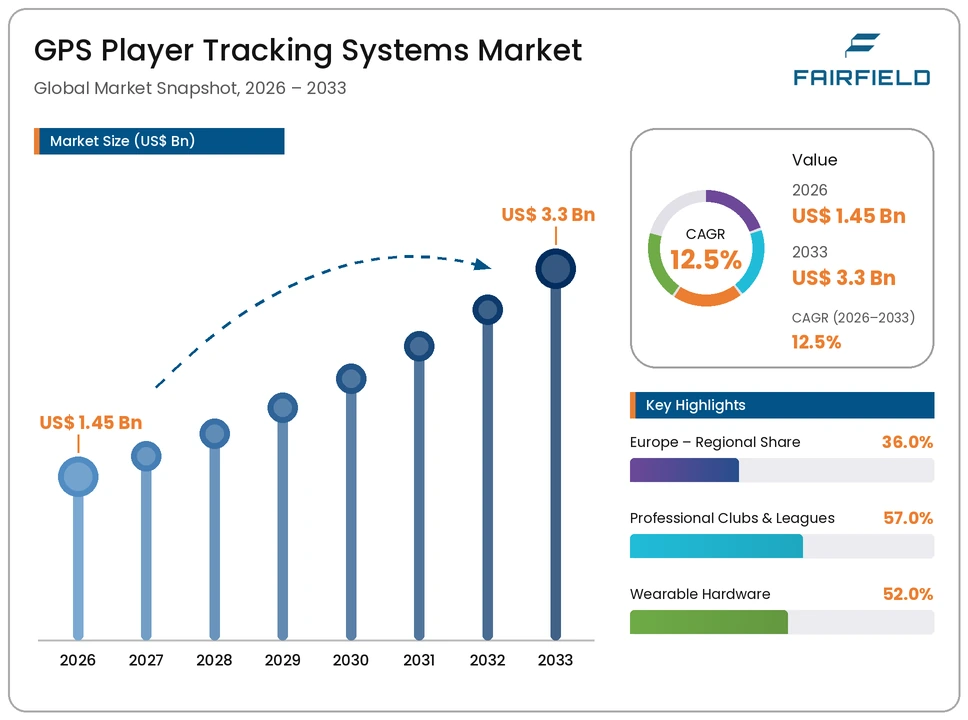
The global GPS Player Tracking Systems market size is expected to be valued at US$ 1.45 billion in 2026 and projected to reach US$ 3.3 billion by 2033, growing at a CAGR of 12.5% between 2026 and 2033.
Revenue grew at roughly 10.6% a year between 2020 and 2025, as wearable monitoring moved from a handful of elite squads into routine squad management. Three forces now sustain growth. Certification has standardised buying, because the FIFA Quality Programme for Electronic Performance and Tracking Systems has tested wearable and optical devices against published accuracy criteria since 2019. Installed scale is substantial, with Catapult Group International reporting more than 5,500 teams across over 40 sports. Software is also taking a larger share of contract value. Spending is shifting from hardware units toward recurring analytics subscriptions bought per athlete and per season.
Key Report Takeaways
- By Technology: Satellite GNSS Wearables held 48.0% share in 2026, while Hybrid GNSS and Local Positioning Systems are projected to expand at a 15.2% CAGR through 2033, because squads need one dataset covering outdoor pitches and indoor training halls.
- By Component: Wearable Hardware held 52.0% share in 2026, while Analytics Software Platforms are projected to expand at a 14.9% CAGR through 2033, as clubs pay for interpretation and reporting rather than raw positional output.
- By Sport: Football held 38.0% share in 2026, while Basketball is projected to expand at a 15.1% CAGR through 2033, driven by indoor positioning installations that outdoor satellite devices cannot serve.
- By End User: Professional Clubs and Leagues held 57.0% share in 2026, while Collegiate and School Athletics are projected to expand at a 15.6% CAGR through 2033, supported by lower-priced subscription tiers and simplified coach reporting.
- By Region: Europe held 36.0% share in 2026, while Asia Pacific is projected to expand at a 15.0% CAGR through 2033, as domestic leagues professionalise their sports science staffing.
Global GPS Player Tracking Systems Market Trends and Insights
Drivers Impact Analysis
Two forces explain most of the contracted growth in athlete monitoring through the forecast period.
| Driver | Impact on CAGR Forecast | Geographic Relevance | Impact Timeline |
| Squad availability economics driving routine workload monitoring | High | Europe, North America | Short term ≤2 years |
| Certified accuracy standards making tracking data usable in competition | Medium | Global | Medium term 2–4 years |
- Squad Availability Economics Make Workload Monitoring Standard Kit in Professional Clubs
Player availability is the clearest commercial case for athlete tracking, because an injured squad member costs wages without contributing results. Clubs measure external load, acceleration counts and high-speed running distance to manage weekly training dose. That evidence lets medical and coaching staff agree on return-to-play progressions, which reduces re-injury and shortens absence from competition.
The mechanism is fixture congestion. Expanded continental and domestic calendars compress recovery windows, so training load must be adjusted daily rather than weekly. Tracking scale reflects this: Catapult Group International reports more than 5,500 teams using its systems across over 40 sports in more than 100 countries. Device safety has been addressed directly, because the FIFA Quality Programme for Electronic Performance and Tracking Systems applied injury-simulation test criteria to wearable devices from its launch in 2017, drawing those criteria from medical and mechanical research.
- Certified Accuracy Standards Turn Tracking Precision Into a Procurement Requirement
Published accuracy testing has changed how federations and clubs buy athlete tracking. Buyers can now compare independently measured positional and velocity performance instead of relying on supplier claims, which shortens tender cycles and removes a major source of dispute. Certified status has become a practical condition of entry for competition use, so vendors invest in validation before chasing federation contracts.
The causal change sits in the testing regime itself. The FIFA Quality Programme extended from safety testing to performance testing of both wearable and optical systems in 2019, awarding a quality mark and publishing test reports that rate accuracy across different speed ranges. From 2023, lower-limb wearables that pass additional validation under the FIFA Innovation Programme can be approved following IFAB clearance. That pathway legitimised sensor placements previously barred from match play.
Restraints Impact Analysis
Two constraints limit how far athlete tracking spreads beyond well-funded professional squads.
| Restraint | Impact on CAGR Forecast | Geographic Relevance | Impact Timeline |
| Athlete consent and biometric data governance obligations | Medium | Europe, North America | Short term ≤2 years |
| Per-athlete subscription and unit replacement cost | High | Asia Pacific, Latin America | Medium term 2–4 years |
- Athlete Consent and Biometric Data Rules Slow Tracking Rollouts Below the Elite Tier
Data governance obligations limit how quickly tracking spreads into academies, schools and lower divisions. Positional, heart-rate and movement data describe an identifiable person, so collecting it requires a lawful basis, a retention schedule, access controls and a clear position on who may see individual records. Smaller organisations rarely employ staff able to run that process, so projects stall before procurement.
The underlying cause is regulatory and contractual. The European Union General Data Protection Regulation, applicable since 2018, treats biometric and health-related information as a special category needing explicit justification, and the EU Artificial Intelligence Act, in force since August 2024, adds phased obligations where analytics make automated assessments about people. In several professional leagues, wearable use and access to individual records are additionally settled through collective bargaining, so vendors must satisfy player representatives as well as clubs.
- Per-Athlete Subscription and Unit Replacement Costs Cap Budgets in Developing Leagues
Recurring cost, rather than the initial purchase, limits athlete tracking adoption outside well-funded competitions. Systems are licensed per athlete per season, so a club carrying a senior squad and two academy age groups multiplies the annual fee several times over. Budget holders in developing leagues compare that commitment against coaching salaries and facility upkeep, and tracking frequently loses.
The specific cost sources are identifiable. Wearable pods are worn in contact sport and fail from impact, sweat ingress and battery degradation, so a squad replaces units on a rolling basis rather than once a decade. Custom garments wear out faster than the electronics. Indoor positioning adds fixed anchor installation and calibration work per venue. Practitioner time is the hidden item, because the data needs a trained sports scientist to turn daily output into coaching decisions.
Market Opportunities
Two revenue pools sit outside the outdoor professional football squads that dominate installed base today.
- Indoor Hybrid Positioning Opens Court and Rink Sports to Athlete Tracking Vendors
Indoor team sports are an emerging revenue pool that satellite-only devices cannot serve, because roofs block the signal. Local positioning systems using fixed anchors deliver centimetre-level indoor accuracy, and hybrid units combine both modes so one dataset covers the pitch and the training hall. Vendors capture venue installation and calibration revenue alongside the per-athlete subscription, which raises total contract value per club.
Basketball, handball, ice hockey and indoor training facilities create the demand, and suppliers with both anchor infrastructure and wearable product are best placed to serve it. Federation adoption drives scale: in January 2025 the European Handball Federation extended its partnership with KINEXON through 2028, covering real-time player and ball tracking at the Men’s and Women’s EHF EURO 2026 and 2028. Competition-level deployment pulls member clubs onto the same platform and standardises the metrics they report.
- Expanding Women’s Professional Leagues Open an Underserved Tracking Deployment Pool
Women’s professional competitions represent a largely unequipped revenue pool with growing budgets. Most of these leagues were founded or professionalised recently, so they have no legacy tracking contracts and can standardise on one supplier across every club at launch. Vendors win whole-competition deals rather than individual club tenders, which lowers acquisition cost and produces directly comparable datasets across the whole league.
League operators and national federations create the demand, and suppliers able to supply hardware, analytics and support as a single league-wide package capture it. Evidence of the pattern exists in both indoor and continental competition: KINEXON serves as the official tracking provider for the women’s basketball league Unrivaled, and the European Handball Federation agreement explicitly covers the Women’s EHF EURO cycle alongside the men’s tournaments through 2028.
Segment Analysis
By Technology: Satellite Wearables Lead While Hybrid Positioning Advances Quickest
Satellite GNSS Wearables held 48.0% of revenue in 2026, the leading technology. Outdoor field sports account for most installed squads, and a satellite pod needs no venue infrastructure, so a club can equip a squad and move between training grounds freely. Pricing is also the most mature, which suits academy and multi-team deployments.
Hybrid GNSS and Local Positioning Systems grow fastest at a 15.2% CAGR through 2033. Clubs increasingly train indoors in winter and in covered facilities, and a single device that switches between satellite and anchor-based positioning avoids two incompatible datasets. Local Positioning Systems remain essential for permanently indoor sports, while Inertial-Only Sensor Units serve low-cost monitoring. For vendors, the implication is that venue infrastructure capability now determines which contracts they can bid for.
By Component: Hardware Holds Revenue While Analytics Platforms Grow Faster
Wearable Hardware represented 52.0% of market value in 2026, the leading component. Pods, garments and anchor infrastructure are the unavoidable first purchase, and replacement cycles are short because units are worn in contact sport. Hardware also remains where certification is assessed, since the FIFA Quality Programme publishes accuracy test reports for tested devices.
Analytics Software Platforms expand fastest at a 14.9% CAGR to 2033. Clubs pay for interpretation rather than raw coordinates, and suppliers keep extending into adjacent workflows, with Catapult Group International launching IMPECT Video Scouting in July 2026. Services and Support covers installation, calibration and sports science consulting. The business implication is a revenue mix shift toward recurring subscriptions, which raises switching costs and makes platform breadth a competitive advantage.
By Sport: Football Anchors Demand While Basketball Scales Most Quickly
Football accounted for 38.0% of revenue in 2026, the leading sport. The global club count is larger than any other team sport, squads are big, and governing-body certification work has centred on football, which makes procurement straightforward. Academy structures multiply the number of monitored athletes per organisation well beyond the senior team.
Basketball grows fastest at a 15.1% CAGR through 2033, because indoor positioning has matured to the point where arenas and practice courts can be instrumented reliably. KINEXON expanded its FC Bayern Basketball partnership to include KINEXON COMPETE Vision in September 2024, extending tracking into automated shot analysis. American Football, Rugby and Other Team Sports complete the picture. For vendors, the implication is that sport-specific metric libraries, not positional accuracy alone, now decide competitive tenders.
By End User: Professional Clubs Dominate While School and College Programmes Expand Fastest
Professional Clubs and Leagues held 57.0% of spending in 2026, the leading end-user group. These organisations employ sports scientists and physiotherapists who can act on daily load data, and player wages make availability financially material. They also buy the deepest configurations, combining wearables, indoor positioning and full analytics platforms.
Collegiate and School Athletics grow fastest at a 15.6% CAGR through 2033. Simplified dashboards and lower-priced subscription tiers let programmes without dedicated sports science staff use the data, and recruitment benchmarking adds a second use case. National Federations and Olympic Programmes buy centrally for squad camps, while Military and Tactical Performance applies the same metrics to occupational readiness. The implication for suppliers is that onboarding simplicity now matters as much as measurement depth.
Geography Analysis
North America Builds Tracking Into League-Wide Officiating and Broadcast Systems
North America held 33.0% of revenue in 2026 and is forecast to grow at 12.2% a year to 2033. The United States and Canada drive demand, and the distinguishing feature is league-level rather than club-level procurement. The National Football League operates a competition-wide tracking deployment developed with Zebra Technologies, using 20 to 30 ultra-wideband receivers per venue and radio tags in shoulder pads, officials’ uniforms, pylons and the ball. The system samples position 10 times a second and generates more than 200 data points per play. Collegiate athletics adds a large second tier of buyers. Wearable use and access to individual records are negotiated with player associations through collective bargaining, so consent terms are explicit. The defining regional change is the fusion of tracking data with broadcast and officiating workflows rather than training alone.
Which Region Is Leading the GPS Player Tracking Systems Market?
Europe leads with 36.0% of global revenue in 2026, growing at 11.2% annually through 2033. England, Spain, Germany, Italy and France account for most spending, and leadership rests on the density of professional clubs and the maturity of sports science staffing. Football clubs there have employed performance analysts for two decades, so tracking is an established budget line rather than a discretionary purchase. Certification is also concentrated in the region, since the FIFA Quality Programme for Electronic Performance and Tracking Systems publishes accuracy test reports that federations use directly in tenders. Continental competitions extend adoption, with the European Handball Federation committing to real-time player and ball tracking through 2028. Data governance is the defining constraint and advantage, because General Data Protection Regulation compliance work is already embedded in club contracts and athlete consent processes.
Which Region Is Growing Fastest in the GPS Player Tracking Systems Market?
Asia Pacific is the fastest-growing geography, at a 15.0% CAGR between 2026 and 2033, from a 19.0% share in 2026. Japan, Australia, China, South Korea and India drive the expansion. Three conditions support it. Domestic football, cricket, rugby and basketball leagues are professionalising their medical and performance departments, which creates first-time buyers rather than replacement demand. Government sports institutes fund national squad monitoring, giving vendors centralised contracts that cover many athletes at once. Local manufacturing and assembly capability also lowers landed cost relative to imported units. Adoption starts from a smaller installed base, which exaggerates percentage growth. The defining regional change is the move from occasional testing-camp use toward season-long monitoring contracts with resident analyst support.
Latin America Adopts Athlete Tracking Through Club Academies and Player Development
Latin America held 6.5% of revenue in 2026 and is forecast to grow at 12.5% a year to 2033. Brazil, Argentina, Mexico and Colombia lead demand, and the regional driver is player development economics rather than first-team performance. Clubs that sell academy graduates abroad use objective physical data to support valuations and satisfy buying clubs’ medical screening. Barriers are financial and operational: currency volatility raises the local cost of imported pods and garments, per-athlete subscriptions compete directly with coaching budgets, and qualified sports scientists are scarce outside the largest clubs. Connectivity at training grounds can also be inconsistent, which complicates live monitoring. The clearest regional opportunity is tiered academy pricing, where a club equips youth squads at reduced cost and upgrades the senior team to full analytics.
Middle East & Africa Scales Tracking Through National Squad and Federation Programmes
Middle East & Africa accounted for 5.5% of revenue in 2026 and is projected to grow at 13.5% annually through 2033, the smallest regional share. Saudi Arabia, the United Arab Emirates, Qatar, South Africa and Egypt drive activity, and purchasing is concentrated in federations and state-backed clubs rather than spread across many private buyers. Heat management gives the region a distinctive use case, since internal and external load must be interpreted together in extreme conditions. Barriers include a shortage of resident performance analysts, reliance on imported hardware with long lead times, and limited continuity when short-term coaching staff rotate out. Hosting major tournaments is the defining opportunity, because event infrastructure investment leaves permanent indoor positioning installations and trained local staff behind.
Competitive Landscape
The athlete tracking market is moderately concentrated. A small group of specialists holds most professional team business, led by Catapult Group International, STATSports, KINEXON and Polar Electro, while a longer tail of regional vendors including SPT Group, PlayerData, Johan Sports, Titan Sports and RealTrack Systems serves academies, schools and smaller clubs. Adjacent entrants come from different directions: Zebra Technologies arrived through industrial radio-frequency positioning, Sportable through instrumented ball technology, and Hawk-Eye Innovations, Second Spectrum and Genius Sports through optical and broadcast data. Consolidation has been steady rather than dramatic, with specialists absorbing analytics and scouting software firms to widen their platforms.
Competition is decided on validated accuracy, metric credibility with practitioners, platform breadth and total cost per athlete. Independent certification matters commercially, because the FIFA Quality Programme publishes test reports rating positional and velocity accuracy across speed bands, and federations reference those results in tenders. Vendors also compete on integration, since clubs want load, medical, video and scouting data in one environment. Newer approaches include markerless optical tracking that needs no athlete-worn device and instrumented balls that add event context to positional data.
Strategic moves have focused on widening the software footprint and locking in competition-level contracts. Catapult Group International launched IMPECT Video Scouting in July 2026, extending from performance monitoring into recruitment workflows, which raises switching costs for existing customers. The European Handball Federation extended its agreement with KINEXON in January 2025 through 2028, a deal that sets one tracking standard across a continental competition cycle. Club-level stack purchases followed the same logic, with Zalgiris Kaunas adopting positioning, inertial and analysis software together in August 2024.
Strategic direction is converging on hybrid indoor and outdoor positioning, recurring analytics subscriptions, documented athlete consent and data-handling practices, and interoperability with medical and video systems.
Recent Industry Developments
- August 2024: Zalgiris Kaunas adopted KINEXON local positioning, mobile inertial load monitoring and shot-analysis software together – showed clubs buying indoor tracking as a full stack rather than a single sensor product.
- September 2024: FC Bayern Basketball expanded its KINEXON partnership to include KINEXON COMPETE Vision for training shot analysis – marked the shift from positional data alone toward automated skill-execution analytics.
- January 2025: The European Handball Federation extended its partnership with KINEXON through 2028 for real-time player and ball tracking at the Men’s and Women’s EHF EURO 2026 and 2028 – set one tracking standard across a continental competition cycle.
- July 2026: Catapult Group International launched IMPECT Video Scouting – extended the company from athlete load monitoring into recruitment video, increasing the software share of contract value.
- August 2026: Catapult Group International reaffirmed its guidance in an exchange announcement accompanied by a chief executive address – signalled that subscription growth in athlete monitoring remained on plan.
Companies Covered in the Report
- Catapult Group International
- STATSports
- KINEXON
- Zebra Technologies
- Polar Electro
- RealTrack Systems
- PlayerData
- Johan Sports
- Titan Sports
- SPT Group
- Sportable
- Second Spectrum
- Genius Sports
- Hawk-Eye Innovations
- Sony
GPS Player Tracking Systems Market Report Scope
| Metric | Value |
| Study Period | 2020–2033 |
| Market Size 2026 | US$ 1.45 Billion |
| Market Size 2033 | US$ 3.3 Billion |
| CAGR 2026–2033 | 12.5% |
| Absolute Dollar Opportunity | US$ 1.85 Billion |
| Largest Market | Europe, 36.0% share in 2026 |
| Fastest-Growing Market | Asia Pacific, 15.0% CAGR |
| Market Concentration | Medium |
| Major Players | Catapult Group International, STATSports, KINEXON, Zebra Technologies, Polar Electro |
GPS Player Tracking Systems Market Segmentation
Technology
- Satellite GNSS Wearables
- Local Positioning Systems
- Hybrid GNSS and Local Positioning Systems
- Inertial-Only Sensor Units
Component
- Wearable Hardware
- Analytics Software Platforms
- Services and Support
Sport
- Football
- American Football
- Rugby
- Basketball
- Other Team Sports
End User
- Professional Clubs and Leagues
- National Federations and Olympic Programmes
- Collegiate and School Athletics
- Military and Tactical Performance
Regions
- North America
- Europe
- Asia Pacific
- Latin America
- Middle East & Africa
- Executive Summary
- Global GPS Player Tracking Systems Market Snapshot
- Market Size and Trend Analysis 2020–2033
- Historical Growth 2020–2025
- Base Year 2025
- Forecast Outlook 2026–2033
- Key Report Takeaways
- Market Overview
- Market Definition and Report Scope
- Market Dynamics
- Drivers
- Squad Availability Economics Make Workload Monitoring Standard Kit in Professional Clubs
- Certified Accuracy Standards Turn Tracking Precision Into a Procurement Requirement
- Restraints
- Athlete Consent and Biometric Data Rules Slow Tracking Rollouts Below the Elite Tier
- Per-Athlete Subscription and Unit Replacement Costs Cap Budgets in Developing Leagues
- Market Opportunities
- Indoor Hybrid Positioning Opens Court and Rink Sports to Athlete Tracking Vendors
- Expanding Women's Professional Leagues Open an Underserved Tracking Deployment Pool
- Drivers
- Segment Analysis
- By Technology: Satellite Wearables Lead While Hybrid Positioning Advances Quickest
- By Component: Hardware Holds Revenue While Analytics Platforms Grow Faster
- By Sport: Football Anchors Demand While Basketball Scales Most Quickly
- By End User: Professional Clubs Dominate While School and College Programmes Expand Fastest
- Global GPS Player Tracking Systems Market Outlook, 2020–2033
- Global GPS Player Tracking Systems Market Outlook, by Technology, Value (US$ Billion), 2020–2033
- Satellite GNSS Wearables
- Local Positioning Systems
- Hybrid GNSS and Local Positioning Systems
- Inertial-Only Sensor Units
- Global GPS Player Tracking Systems Market Outlook, by Component, Value (US$ Billion), 2020–2033
- Wearable Hardware
- Analytics Software Platforms
- Services and Support
- Global GPS Player Tracking Systems Market Outlook, by Sport, Value (US$ Billion), 2020–2033
- Football
- American Football
- Rugby
- Basketball
- Other Team Sports
- Global GPS Player Tracking Systems Market Outlook, by End User, Value (US$ Billion), 2020–2033
- Professional Clubs and Leagues
- National Federations and Olympic Programmes
- Collegiate and School Athletics
- Military and Tactical Performance
- Global GPS Player Tracking Systems Market Outlook, by Region, Value (US$ Billion), 2020–2033
- North America
- Europe
- Asia Pacific
- Latin America
- Middle East & Africa
- Global GPS Player Tracking Systems Market Outlook, by Technology, Value (US$ Billion), 2020–2033
- North America GPS Player Tracking Systems Market Outlook, 2020–2033
- North America Builds Tracking Into League-Wide Officiating and Broadcast Systems
- North America GPS Player Tracking Systems Market Outlook, by Technology, Value (US$ Billion), 2020–2033
- Satellite GNSS Wearables
- Local Positioning Systems
- Hybrid GNSS and Local Positioning Systems
- Inertial-Only Sensor Units
- North America GPS Player Tracking Systems Market Outlook, by Component, Value (US$ Billion), 2020–2033
- Wearable Hardware
- Analytics Software Platforms
- Services and Support
- North America GPS Player Tracking Systems Market Outlook, by Sport, Value (US$ Billion), 2020–2033
- Football
- American Football
- Rugby
- Basketball
- Other Team Sports
- North America GPS Player Tracking Systems Market Outlook, by End User, Value (US$ Billion), 2020–2033
- Professional Clubs and Leagues
- National Federations and Olympic Programmes
- Collegiate and School Athletics
- Military and Tactical Performance
- North America GPS Player Tracking Systems Market Outlook, by Country, Value (US$ Billion), 2020–2033
- United States GPS Player Tracking Systems Market Outlook, by Technology, 2020–2033
- United States GPS Player Tracking Systems Market Outlook, by Component, 2020–2033
- United States GPS Player Tracking Systems Market Outlook, by Sport, 2020–2033
- United States GPS Player Tracking Systems Market Outlook, by End User, 2020–2033
- Canada GPS Player Tracking Systems Market Outlook, by Technology, 2020–2033
- Canada GPS Player Tracking Systems Market Outlook, by Component, 2020–2033
- Canada GPS Player Tracking Systems Market Outlook, by Sport, 2020–2033
- Canada GPS Player Tracking Systems Market Outlook, by End User, 2020–2033
- Europe GPS Player Tracking Systems Market Outlook, 2020–2033
- Regional Market Leadership
- Europe GPS Player Tracking Systems Market Outlook, by Technology, Value (US$ Billion), 2020–2033
- Satellite GNSS Wearables
- Local Positioning Systems
- Hybrid GNSS and Local Positioning Systems
- Inertial-Only Sensor Units
- Europe GPS Player Tracking Systems Market Outlook, by Component, Value (US$ Billion), 2020–2033
- Wearable Hardware
- Analytics Software Platforms
- Services and Support
- Europe GPS Player Tracking Systems Market Outlook, by Sport, Value (US$ Billion), 2020–2033
- Football
- American Football
- Rugby
- Basketball
- Other Team Sports
- Europe GPS Player Tracking Systems Market Outlook, by End User, Value (US$ Billion), 2020–2033
- Professional Clubs and Leagues
- National Federations and Olympic Programmes
- Collegiate and School Athletics
- Military and Tactical Performance
- Europe GPS Player Tracking Systems Market Outlook, by Country, Value (US$ Billion), 2020–2033
- England GPS Player Tracking Systems Market Outlook, by Technology, 2020–2033
- England GPS Player Tracking Systems Market Outlook, by Component, 2020–2033
- England GPS Player Tracking Systems Market Outlook, by Sport, 2020–2033
- England GPS Player Tracking Systems Market Outlook, by End User, 2020–2033
- Spain GPS Player Tracking Systems Market Outlook, by Technology, 2020–2033
- Spain GPS Player Tracking Systems Market Outlook, by Component, 2020–2033
- Spain GPS Player Tracking Systems Market Outlook, by Sport, 2020–2033
- Spain GPS Player Tracking Systems Market Outlook, by End User, 2020–2033
- Germany GPS Player Tracking Systems Market Outlook, by Technology, 2020–2033
- Germany GPS Player Tracking Systems Market Outlook, by Component, 2020–2033
- Germany GPS Player Tracking Systems Market Outlook, by Sport, 2020–2033
- Germany GPS Player Tracking Systems Market Outlook, by End User, 2020–2033
- Italy GPS Player Tracking Systems Market Outlook, by Technology, 2020–2033
- Italy GPS Player Tracking Systems Market Outlook, by Component, 2020–2033
- Italy GPS Player Tracking Systems Market Outlook, by Sport, 2020–2033
- Italy GPS Player Tracking Systems Market Outlook, by End User, 2020–2033
- France GPS Player Tracking Systems Market Outlook, by Technology, 2020–2033
- France GPS Player Tracking Systems Market Outlook, by Component, 2020–2033
- France GPS Player Tracking Systems Market Outlook, by Sport, 2020–2033
- France GPS Player Tracking Systems Market Outlook, by End User, 2020–2033
- Asia Pacific GPS Player Tracking Systems Market Outlook, 2020–2033
- Regional Growth Outlook
- Asia Pacific GPS Player Tracking Systems Market Outlook, by Technology, Value (US$ Billion), 2020–2033
- Satellite GNSS Wearables
- Local Positioning Systems
- Hybrid GNSS and Local Positioning Systems
- Inertial-Only Sensor Units
- Asia Pacific GPS Player Tracking Systems Market Outlook, by Component, Value (US$ Billion), 2020–2033
- Wearable Hardware
- Analytics Software Platforms
- Services and Support
- Asia Pacific GPS Player Tracking Systems Market Outlook, by Sport, Value (US$ Billion), 2020–2033
- Football
- American Football
- Rugby
- Basketball
- Other Team Sports
- Asia Pacific GPS Player Tracking Systems Market Outlook, by End User, Value (US$ Billion), 2020–2033
- Professional Clubs and Leagues
- National Federations and Olympic Programmes
- Collegiate and School Athletics
- Military and Tactical Performance
- Asia Pacific GPS Player Tracking Systems Market Outlook, by Country, Value (US$ Billion), 2020–2033
- Japan GPS Player Tracking Systems Market Outlook, by Technology, 2020–2033
- Japan GPS Player Tracking Systems Market Outlook, by Component, 2020–2033
- Japan GPS Player Tracking Systems Market Outlook, by Sport, 2020–2033
- Japan GPS Player Tracking Systems Market Outlook, by End User, 2020–2033
- Australia GPS Player Tracking Systems Market Outlook, by Technology, 2020–2033
- Australia GPS Player Tracking Systems Market Outlook, by Component, 2020–2033
- Australia GPS Player Tracking Systems Market Outlook, by Sport, 2020–2033
- Australia GPS Player Tracking Systems Market Outlook, by End User, 2020–2033
- China GPS Player Tracking Systems Market Outlook, by Technology, 2020–2033
- China GPS Player Tracking Systems Market Outlook, by Component, 2020–2033
- China GPS Player Tracking Systems Market Outlook, by Sport, 2020–2033
- China GPS Player Tracking Systems Market Outlook, by End User, 2020–2033
- South Korea GPS Player Tracking Systems Market Outlook, by Technology, 2020–2033
- South Korea GPS Player Tracking Systems Market Outlook, by Component, 2020–2033
- South Korea GPS Player Tracking Systems Market Outlook, by Sport, 2020–2033
- South Korea GPS Player Tracking Systems Market Outlook, by End User, 2020–2033
- India GPS Player Tracking Systems Market Outlook, by Technology, 2020–2033
- India GPS Player Tracking Systems Market Outlook, by Component, 2020–2033
- India GPS Player Tracking Systems Market Outlook, by Sport, 2020–2033
- India GPS Player Tracking Systems Market Outlook, by End User, 2020–2033
- Latin America GPS Player Tracking Systems Market Outlook, 2020–2033
- Latin America Adopts Athlete Tracking Through Club Academies and Player Development
- Latin America GPS Player Tracking Systems Market Outlook, by Technology, Value (US$ Billion), 2020–2033
- Satellite GNSS Wearables
- Local Positioning Systems
- Hybrid GNSS and Local Positioning Systems
- Inertial-Only Sensor Units
- Latin America GPS Player Tracking Systems Market Outlook, by Component, Value (US$ Billion), 2020–2033
- Wearable Hardware
- Analytics Software Platforms
- Services and Support
- Latin America GPS Player Tracking Systems Market Outlook, by Sport, Value (US$ Billion), 2020–2033
- Football
- American Football
- Rugby
- Basketball
- Other Team Sports
- Latin America GPS Player Tracking Systems Market Outlook, by End User, Value (US$ Billion), 2020–2033
- Professional Clubs and Leagues
- National Federations and Olympic Programmes
- Collegiate and School Athletics
- Military and Tactical Performance
- Latin America GPS Player Tracking Systems Market Outlook, by Country, Value (US$ Billion), 2020–2033
- Brazil GPS Player Tracking Systems Market Outlook, by Technology, 2020–2033
- Brazil GPS Player Tracking Systems Market Outlook, by Component, 2020–2033
- Brazil GPS Player Tracking Systems Market Outlook, by Sport, 2020–2033
- Brazil GPS Player Tracking Systems Market Outlook, by End User, 2020–2033
- Argentina GPS Player Tracking Systems Market Outlook, by Technology, 2020–2033
- Argentina GPS Player Tracking Systems Market Outlook, by Component, 2020–2033
- Argentina GPS Player Tracking Systems Market Outlook, by Sport, 2020–2033
- Argentina GPS Player Tracking Systems Market Outlook, by End User, 2020–2033
- Mexico GPS Player Tracking Systems Market Outlook, by Technology, 2020–2033
- Mexico GPS Player Tracking Systems Market Outlook, by Component, 2020–2033
- Mexico GPS Player Tracking Systems Market Outlook, by Sport, 2020–2033
- Mexico GPS Player Tracking Systems Market Outlook, by End User, 2020–2033
- Colombia GPS Player Tracking Systems Market Outlook, by Technology, 2020–2033
- Colombia GPS Player Tracking Systems Market Outlook, by Component, 2020–2033
- Colombia GPS Player Tracking Systems Market Outlook, by Sport, 2020–2033
- Colombia GPS Player Tracking Systems Market Outlook, by End User, 2020–2033
- Middle East & Africa GPS Player Tracking Systems Market Outlook, 2020–2033
- Middle East & Africa Scales Tracking Through National Squad and Federation Programmes
- Middle East & Africa GPS Player Tracking Systems Market Outlook, by Technology, Value (US$ Billion), 2020–2033
- Satellite GNSS Wearables
- Local Positioning Systems
- Hybrid GNSS and Local Positioning Systems
- Inertial-Only Sensor Units
- Middle East & Africa GPS Player Tracking Systems Market Outlook, by Component, Value (US$ Billion), 2020–2033
- Wearable Hardware
- Analytics Software Platforms
- Services and Support
- Middle East & Africa GPS Player Tracking Systems Market Outlook, by Sport, Value (US$ Billion), 2020–2033
- Football
- American Football
- Rugby
- Basketball
- Other Team Sports
- Middle East & Africa GPS Player Tracking Systems Market Outlook, by End User, Value (US$ Billion), 2020–2033
- Professional Clubs and Leagues
- National Federations and Olympic Programmes
- Collegiate and School Athletics
- Military and Tactical Performance
- Middle East & Africa GPS Player Tracking Systems Market Outlook, by Country, Value (US$ Billion), 2020–2033
- Saudi Arabia GPS Player Tracking Systems Market Outlook, by Technology, 2020–2033
- Saudi Arabia GPS Player Tracking Systems Market Outlook, by Component, 2020–2033
- Saudi Arabia GPS Player Tracking Systems Market Outlook, by Sport, 2020–2033
- Saudi Arabia GPS Player Tracking Systems Market Outlook, by End User, 2020–2033
- United Arab Emirates GPS Player Tracking Systems Market Outlook, by Technology, 2020–2033
- United Arab Emirates GPS Player Tracking Systems Market Outlook, by Component, 2020–2033
- United Arab Emirates GPS Player Tracking Systems Market Outlook, by Sport, 2020–2033
- United Arab Emirates GPS Player Tracking Systems Market Outlook, by End User, 2020–2033
- Qatar GPS Player Tracking Systems Market Outlook, by Technology, 2020–2033
- Qatar GPS Player Tracking Systems Market Outlook, by Component, 2020–2033
- Qatar GPS Player Tracking Systems Market Outlook, by Sport, 2020–2033
- Qatar GPS Player Tracking Systems Market Outlook, by End User, 2020–2033
- South Africa GPS Player Tracking Systems Market Outlook, by Technology, 2020–2033
- South Africa GPS Player Tracking Systems Market Outlook, by Component, 2020–2033
- South Africa GPS Player Tracking Systems Market Outlook, by Sport, 2020–2033
- South Africa GPS Player Tracking Systems Market Outlook, by End User, 2020–2033
- Egypt GPS Player Tracking Systems Market Outlook, by Technology, 2020–2033
- Egypt GPS Player Tracking Systems Market Outlook, by Component, 2020–2033
- Egypt GPS Player Tracking Systems Market Outlook, by Sport, 2020–2033
- Egypt GPS Player Tracking Systems Market Outlook, by End User, 2020–2033
- Competitive Landscape
- Market Concentration and Supplier Participation
- Competitive Factors and Strategic Direction
- Recent Industry Developments
- Zalgiris Kaunas KINEXON Tracking Adoption August 2024
- FC Bayern Basketball KINEXON Partnership Expansion September 2024
- European Handball Federation KINEXON Partnership Extension January 2025
- Catapult Group International IMPECT Video Scouting Launch July 2026
- Catapult Group International Guidance Reaffirmation August 2026
- Company Profiles
- Catapult Group International
- STATSports
- KINEXON
- Zebra Technologies
- Polar Electro
- RealTrack Systems
- PlayerData
- Johan Sports
- Titan Sports
- SPT Group
- Sportable
- Second Spectrum
- Genius Sports
- Hawk-Eye Innovations
- Sony
- Appendix
- Research Methodology
- Report Assumptions
- Acronyms and Abbreviations
Technology
- Satellite GNSS Wearables
- Local Positioning Systems
- Hybrid GNSS and Local Positioning Systems
- Inertial-Only Sensor Units
Component
- Wearable Hardware
- Analytics Software Platforms
- Services and Support
Sport
- Football
- American Football
- Rugby
- Basketball
- Other Team Sports
End User
- Professional Clubs and Leagues
- National Federations and Olympic Programmes
- Collegiate and School Athletics
- Military and Tactical Performance
Regions
- North America
- Europe
- Asia Pacific
- Latin America
- Middle East & Africa
Our Research Methodology
Considering the volatility of business today, traditional approaches to strategizing a game plan can be unfruitful if not detrimental. True ambiguity is no way to determine a forecast. A myriad of predetermined factors must be accounted for such as the degree of risk involved, the magnitude of circumstances, as well as conditions or consequences that are not known or unpredictable. To circumvent binary views that cast uncertainty, the application of market research intelligence to strategically posture, move, and enable actionable outcomes is necessary.
View Methodology
Quality Assured
Rigorous Validation Process

Confidentiality Assured
End-to-end Data Security

Custom Research Services
Tailored To Your Objectives
FAQs
The market is valued at US$ 1.45 billion in 2026, covering wearable devices, indoor positioning infrastructure, analytics platforms and support services.
The market is projected to reach US$ 3.3 billion by 2033, growing at a 12.5% CAGR and adding US$ 1.85 billion in absolute dollar opportunity.
Satellite GNSS Wearables lead with 48.0% share in 2026, because outdoor field sports dominate installed squads and the devices need no venue infrastructure.
Collegiate and School Athletics grow fastest at a 15.6% CAGR through 2033, helped by simplified dashboards and lower-priced per-athlete subscription tiers.
Europe leads with 36.0% share in 2026, and the market is moderately concentrated around a small group of specialists plus regional and optical entrants.
Related Reports
Cold Monitoring Market Size, Share, Insights, Competitive Landscape, and Forecast 2026 to 2033
The cold monitoring market is projected to reach US$ 17.80 billion by 2033, growing at 12.1% CAGR from US$ 8.00 billion in 2026.
Data Center Rack Market Size, Share, Insights, Competitive Landscape, and Forecast 2026 to 2033
Explore the Data Center Rack market, forecast to reach US$11.5 billion by 2033 at 10.8% CAGR, with insights on rack types, end users, and regions.
SiC GaN Power Semiconductor Market Size, Share, Insights, Competitive Landscape, and Forecast 2026 to 2033
Explore the SiC GaN power semiconductor market outlook for 2026–2033, covering products, power ranges, applications, regions, and key companies.
Serverless Architecture Market Size, Share, Insights, Competitive Landscape, and Forecast 2026 to 2033
Explore the serverless architecture market outlook for 2026–2033, covering services, deployment models, industries, regional trends, and key companies.
Network Sandboxing Market Size, Share, Insights, Competitive Landscape, and Forecast 2026 to 2033
The global network sandboxing market is valued at US$5.8 billion in 2026, reaching US$14.7 billion by 2033, growing at a 14.2% CAGR
Location of Things Market Size, Share, Insights, Competitive Landscape, and Forecast 2026 to 2033
The global location of things market is valued at US$52.31 billion in 2026, reaching US$297.93 billion by 2033, growing at a 28.2% CAGR