



Hydrogen Cyanide Market
Hydrogen Cyanide Market
Market Overview
Hydrogen cyanide is a fundamental industrial chemical intermediate produced primarily through the ammoxidation of methane and ammonia, serving as a critical feedstock for adiponitrile production used in nylon 6,6 manufacturing, sodium cyanide used in gold and silver extraction, and various chelating agents used across industrial and agricultural applications. Given its high toxicity, hydrogen cyanide is typically produced and consumed on an integrated basis at production sites, with downstream derivatives representing the primary commercial products reaching broader markets.
Demand growth through the 2026-2033 window is closely tied to sustained global nylon and synthetic fiber production requiring adiponitrile feedstock, continued gold mining activity supporting sodium cyanide consumption for ore processing, and ongoing demand for chelating agents across water treatment, agriculture, and industrial cleaning applications. Producers' continued investment in integrated production facilities that manage the handling and transport challenges associated with this highly reactive chemical continues to shape industry structure and regional production patterns.
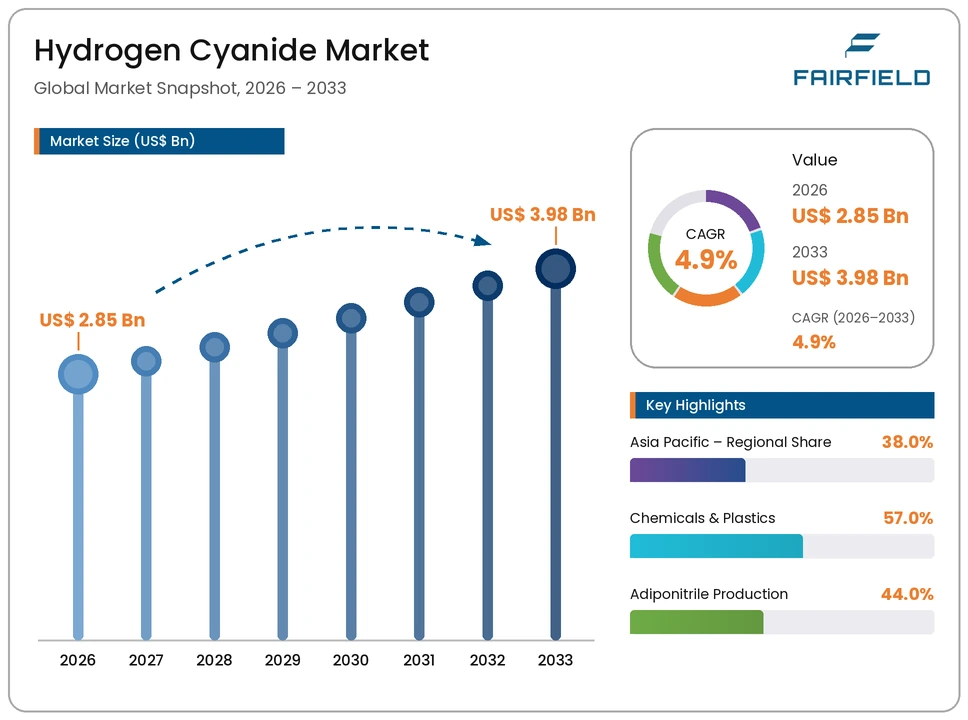
The market is valued at USD 2.85 Billion in 2026, with producers directing investment toward production efficiency and safety system enhancement given the chemical's toxicity and handling requirements. By 2033, the market is forecast to reach USD 3.98 Billion, reflecting steady growth across established adiponitrile production applications alongside expanding mining sector demand for sodium cyanide.
Key Highlights
- The global hydrogen cyanide market is valued at USD 2.85 Billion in 2026 and is projected to reach USD 3.98 Billion by 2033, expanding at a CAGR of 4.9% across the 2026-2033 forecast period.
- Chemicals & Plastics leads the end-use industry segment with a 57.0% share in 2026, equivalent to USD 1.62 Billion.
- Adiponitrile Production remains the dominant application, accounting for 44.0% of global demand, or USD 1.25 Billion, in 2026.
- Asia Pacific commands the largest regional share at 38.0% of the global market in 2026.
- Sodium cyanide production for mining applications is emerging as the fastest-growing application through 2033.
Market Dynamics
Key Growth Drivers
Growth in the hydrogen cyanide market is driven primarily by sustained global nylon and synthetic fiber production, as adiponitrile remains a critical intermediate for nylon 6,6 manufacturing serving automotive, textile, and industrial applications worldwide, supporting consistent hydrogen cyanide feedstock demand.
A second driver is continued global gold mining activity, as sodium cyanide remains the predominant chemical used for gold and silver ore processing through cyanidation, with sustained mining sector investment supporting consistent hydrogen cyanide-derived sodium cyanide demand.
Key Restraints
The extreme toxicity of hydrogen cyanide requires substantial investment in specialized handling, storage, and transport infrastructure, creating significant capital and operational cost barriers that limit production to well-established, highly regulated industrial facilities.
Additionally, stringent and evolving environmental and safety regulations governing hydrogen cyanide production and cyanide-based product use, particularly in mining applications, create ongoing compliance costs and can affect operational flexibility for producers and downstream users alike.
Market Opportunities
The expansion of sodium cyanide demand for mining applications presents a substantial opportunity, as continued global gold exploration and production activity, particularly across emerging mining regions, supports sustained sodium cyanide consumption for ore processing operations.
A second opportunity lies in the development of improved production safety and efficiency technology that reduces operational risk while maintaining cost-competitive hydrogen cyanide supply. Producers that successfully advance these safety and efficiency improvements stand to strengthen their position amid increasing regulatory scrutiny of hazardous chemical production.
Segmentation Analysis
By Application
Adiponitrile Production leads the application segment, accounting for 44.0% of global market value in 2026, equivalent to USD 1.25 Billion. Its leadership reflects sustained global nylon 6,6 production requiring adiponitrile as a key intermediate feedstock. Chelating Agents (EDTA/NTA) represent a significant, established application area. Sodium Cyanide Production represents the fastest-growing application category through 2033, driven by sustained global gold mining activity requiring cyanide-based ore processing chemistry.
By End-Use Industry
Chemicals & Plastics forms the leading end-use industry segment, representing 57.0% of global demand in 2026, or USD 1.62 Billion, reflecting hydrogen cyanide's central role as feedstock for adiponitrile and other chemical intermediate production. Agriculture represents a significant, established end-use category. Mining represents the fastest-growing end-use industry category, propelled by sustained global gold and precious metals extraction activity.
Regional Insights
Asia Pacific
Asia Pacific holds the largest regional share, at 38.0% of the global market in 2026, equivalent to USD 1.08 Billion. The region's dominance reflects its substantial nylon and synthetic fiber manufacturing base, led by China, alongside significant regional chemical production capacity.
North America
North America accounts for 29.0% of the global market in 2026, valued at USD 0.83 Billion. Demand is supported by established adiponitrile and nylon production infrastructure alongside significant gold mining activity across the United States and Canada.
Europe
Europe represents 22.0% of the global market in 2026, or USD 0.63 Billion. Steady demand is supported by the region's established chemical manufacturing base and specialty chemical production requiring hydrogen cyanide derivatives.
Latin America
Latin America contributes 7.0% of the global market in 2026, equivalent to USD 0.20 Billion. Growth is linked to substantial gold mining activity across the region, particularly in countries with significant precious metals extraction operations.
Middle East & Africa
Middle East & Africa holds 4.0% of the global market in 2026, valued at USD 0.11 Billion. Growth remains gradual, tied to gold mining activity across major African mining economies.
Competitive Landscape
The global hydrogen cyanide market is moderately concentrated, with a limited number of large integrated chemical producers holding strong positions supported by substantial safety and handling infrastructure investment and long-standing downstream customer integration. Competition centers on production safety and reliability, integration with downstream derivative production, and the ability to serve mining and chemical customers with consistent, high-quality supply. Producers are increasingly differentiating through production safety technology and integrated derivative capacity rather than competing on commodity pricing alone.
Key Market Players
- INEOS Group Limited
- Evonik Industries AG
- Mitsubishi Gas Chemical Company, Inc.
- Draslovka Holding a.s.
- AdvanSix Inc.
- INVISTA
- Asahi Kasei Corporation
- Cyanco Company, LLC
- Sasol Limited
- BASF SE
Market Segmentation
By Application
- Adiponitrile Production
- Sodium Cyanide Production
- Chelating Agents (EDTA/NTA)
- Others
By End-Use Industry
- Chemicals & Plastics
- Mining
- Agriculture
- Others
By Production Process
- Andrussow Process
- BMA Process
By Geography
- North America
- Europe
- Asia Pacific
- Latin America
- Middle East & Africa
- Executive Summary
- Global Hydrogen Cyanide Market Snapshot
- Future Projections
- Key Market Trends
- Regional Snapshot, by Value, 2026
- Analyst Recommendations
- Market Overview
- Market Definitions and Segmentations
- Market Dynamics
- Drivers
- Restraints
- Market Opportunities
- Value Chain Analysis
- COVID-19 Impact Analysis
- Porter's Five Forces Analysis
- Impact of Russia-Ukraine Conflict
- PESTLE Analysis
- Regulatory Analysis
- Price Trend Analysis
- Current Prices and Future Projections, 2025-2033
- Price Impact Factors
- Global Hydrogen Cyanide Market Outlook, 2020 - 2033
- Global Hydrogen Cyanide Market Outlook, by Production Process, Value (US$ Mn), 2020-2033
- Andrussow Process
- BMA Process
- Global Hydrogen Cyanide Market Outlook, by Application, Value (US$ Mn), 2020-2033
- Adiponitrile Production
- Sodium Cyanide Production
- Chelating Agents (EDTA/NTA)
- Others
- Global Hydrogen Cyanide Market Outlook, by End-Use Industry, Value (US$ Mn), 2020-2033
- Chemicals & Plastics
- Mining
- Agriculture
- Others
- Global Hydrogen Cyanide Market Outlook, by Region, Value (US$ Mn), 2020-2033
- North America
- Europe
- Asia Pacific
- Latin America
- Middle East & Africa
- Global Hydrogen Cyanide Market Outlook, by Production Process, Value (US$ Mn), 2020-2033
- North America Hydrogen Cyanide Market Outlook, 2020 - 2033
- North America Hydrogen Cyanide Market Outlook, by Production Process, Value (US$ Mn), 2020-2033
- Andrussow Process
- BMA Process
- North America Hydrogen Cyanide Market Outlook, by Application, Value (US$ Mn), 2020-2033
- Adiponitrile Production
- Sodium Cyanide Production
- Chelating Agents (EDTA/NTA)
- Others
- North America Hydrogen Cyanide Market Outlook, by End-Use Industry, Value (US$ Mn), 2020-2033
- Chemicals & Plastics
- Mining
- Agriculture
- Others
- North America Hydrogen Cyanide Market Outlook, by Country, Value (US$ Mn), 2020-2033
- U.S. Hydrogen Cyanide Market Outlook, by Production Process, 2020-2033
- U.S. Hydrogen Cyanide Market Outlook, by Application, 2020-2033
- U.S. Hydrogen Cyanide Market Outlook, by End-Use Industry, 2020-2033
- Canada Hydrogen Cyanide Market Outlook, by Production Process, 2020-2033
- Canada Hydrogen Cyanide Market Outlook, by Application, 2020-2033
- Canada Hydrogen Cyanide Market Outlook, by End-Use Industry, 2020-2033
- BPS Analysis/Market Attractiveness Analysis
- North America Hydrogen Cyanide Market Outlook, by Production Process, Value (US$ Mn), 2020-2033
- Europe Hydrogen Cyanide Market Outlook, 2020 - 2033
- Europe Hydrogen Cyanide Market Outlook, by Production Process, Value (US$ Mn), 2020-2033
- Andrussow Process
- BMA Process
- Europe Hydrogen Cyanide Market Outlook, by Application, Value (US$ Mn), 2020-2033
- Adiponitrile Production
- Sodium Cyanide Production
- Chelating Agents (EDTA/NTA)
- Others
- Europe Hydrogen Cyanide Market Outlook, by End-Use Industry, Value (US$ Mn), 2020-2033
- Chemicals & Plastics
- Mining
- Agriculture
- Others
- Europe Hydrogen Cyanide Market Outlook, by Country, Value (US$ Mn), 2020-2033
- Germany Hydrogen Cyanide Market Outlook, by Production Process, 2020-2033
- Germany Hydrogen Cyanide Market Outlook, by Application, 2020-2033
- Germany Hydrogen Cyanide Market Outlook, by End-Use Industry, 2020-2033
- Italy Hydrogen Cyanide Market Outlook, by Production Process, 2020-2033
- Italy Hydrogen Cyanide Market Outlook, by Application, 2020-2033
- Italy Hydrogen Cyanide Market Outlook, by End-Use Industry, 2020-2033
- France Hydrogen Cyanide Market Outlook, by Production Process, 2020-2033
- France Hydrogen Cyanide Market Outlook, by Application, 2020-2033
- France Hydrogen Cyanide Market Outlook, by End-Use Industry, 2020-2033
- U.K. Hydrogen Cyanide Market Outlook, by Production Process, 2020-2033
- U.K. Hydrogen Cyanide Market Outlook, by Application, 2020-2033
- U.K. Hydrogen Cyanide Market Outlook, by End-Use Industry, 2020-2033
- Spain Hydrogen Cyanide Market Outlook, by Production Process, 2020-2033
- Spain Hydrogen Cyanide Market Outlook, by Application, 2020-2033
- Spain Hydrogen Cyanide Market Outlook, by End-Use Industry, 2020-2033
- Russia Hydrogen Cyanide Market Outlook, by Production Process, 2020-2033
- Russia Hydrogen Cyanide Market Outlook, by Application, 2020-2033
- Russia Hydrogen Cyanide Market Outlook, by End-Use Industry, 2020-2033
- Rest of Europe Hydrogen Cyanide Market Outlook, by Production Process, 2020-2033
- Rest of Europe Hydrogen Cyanide Market Outlook, by Application, 2020-2033
- Rest of Europe Hydrogen Cyanide Market Outlook, by End-Use Industry, 2020-2033
- BPS Analysis/Market Attractiveness Analysis
- Europe Hydrogen Cyanide Market Outlook, by Production Process, Value (US$ Mn), 2020-2033
- Asia Pacific Hydrogen Cyanide Market Outlook, 2020 - 2033
- Asia Pacific Hydrogen Cyanide Market Outlook, by Production Process, Value (US$ Mn), 2020-2033
- Andrussow Process
- BMA Process
- Asia Pacific Hydrogen Cyanide Market Outlook, by Application, Value (US$ Mn), 2020-2033
- Adiponitrile Production
- Sodium Cyanide Production
- Chelating Agents (EDTA/NTA)
- Others
- Asia Pacific Hydrogen Cyanide Market Outlook, by End-Use Industry, Value (US$ Mn), 2020-2033
- Chemicals & Plastics
- Mining
- Agriculture
- Others
- Asia Pacific Hydrogen Cyanide Market Outlook, by Country, Value (US$ Mn), 2020-2033
- China Hydrogen Cyanide Market Outlook, by Production Process, 2020-2033
- China Hydrogen Cyanide Market Outlook, by Application, 2020-2033
- China Hydrogen Cyanide Market Outlook, by End-Use Industry, 2020-2033
- Japan Hydrogen Cyanide Market Outlook, by Production Process, 2020-2033
- Japan Hydrogen Cyanide Market Outlook, by Application, 2020-2033
- Japan Hydrogen Cyanide Market Outlook, by End-Use Industry, 2020-2033
- South Korea Hydrogen Cyanide Market Outlook, by Production Process, 2020-2033
- South Korea Hydrogen Cyanide Market Outlook, by Application, 2020-2033
- South Korea Hydrogen Cyanide Market Outlook, by End-Use Industry, 2020-2033
- India Hydrogen Cyanide Market Outlook, by Production Process, 2020-2033
- India Hydrogen Cyanide Market Outlook, by Application, 2020-2033
- India Hydrogen Cyanide Market Outlook, by End-Use Industry, 2020-2033
- Southeast Asia Hydrogen Cyanide Market Outlook, by Production Process, 2020-2033
- Southeast Asia Hydrogen Cyanide Market Outlook, by Application, 2020-2033
- Southeast Asia Hydrogen Cyanide Market Outlook, by End-Use Industry, 2020-2033
- Rest of SAO Hydrogen Cyanide Market Outlook, by Production Process, 2020-2033
- Rest of SAO Hydrogen Cyanide Market Outlook, by Application, 2020-2033
- Rest of SAO Hydrogen Cyanide Market Outlook, by End-Use Industry, 2020-2033
- BPS Analysis/Market Attractiveness Analysis
- Asia Pacific Hydrogen Cyanide Market Outlook, by Production Process, Value (US$ Mn), 2020-2033
- Latin America Hydrogen Cyanide Market Outlook, 2020 - 2033
- Latin America Hydrogen Cyanide Market Outlook, by Production Process, Value (US$ Mn), 2020-2033
- Andrussow Process
- BMA Process
- Latin America Hydrogen Cyanide Market Outlook, by Application, Value (US$ Mn), 2020-2033
- Adiponitrile Production
- Sodium Cyanide Production
- Chelating Agents (EDTA/NTA)
- Others
- Latin America Hydrogen Cyanide Market Outlook, by End-Use Industry, Value (US$ Mn), 2020-2033
- Chemicals & Plastics
- Mining
- Agriculture
- Others
- Latin America Hydrogen Cyanide Market Outlook, by Country, Value (US$ Mn), 2020-2033
- Brazil Hydrogen Cyanide Market Outlook, by Production Process, 2020-2033
- Brazil Hydrogen Cyanide Market Outlook, by Application, 2020-2033
- Brazil Hydrogen Cyanide Market Outlook, by End-Use Industry, 2020-2033
- Mexico Hydrogen Cyanide Market Outlook, by Production Process, 2020-2033
- Mexico Hydrogen Cyanide Market Outlook, by Application, 2020-2033
- Mexico Hydrogen Cyanide Market Outlook, by End-Use Industry, 2020-2033
- Argentina Hydrogen Cyanide Market Outlook, by Production Process, 2020-2033
- Argentina Hydrogen Cyanide Market Outlook, by Application, 2020-2033
- Argentina Hydrogen Cyanide Market Outlook, by End-Use Industry, 2020-2033
- Rest of LATAM Hydrogen Cyanide Market Outlook, by Production Process, 2020-2033
- Rest of LATAM Hydrogen Cyanide Market Outlook, by Application, 2020-2033
- Rest of LATAM Hydrogen Cyanide Market Outlook, by End-Use Industry, 2020-2033
- BPS Analysis/Market Attractiveness Analysis
- Latin America Hydrogen Cyanide Market Outlook, by Production Process, Value (US$ Mn), 2020-2033
- Middle East & Africa Hydrogen Cyanide Market Outlook, 2020 - 2033
- Middle East & Africa Hydrogen Cyanide Market Outlook, by Production Process, Value (US$ Mn), 2020-2033
- Andrussow Process
- BMA Process
- Middle East & Africa Hydrogen Cyanide Market Outlook, by Application, Value (US$ Mn), 2020-2033
- Adiponitrile Production
- Sodium Cyanide Production
- Chelating Agents (EDTA/NTA)
- Others
- Middle East & Africa Hydrogen Cyanide Market Outlook, by End-Use Industry, Value (US$ Mn), 2020-2033
- Chemicals & Plastics
- Mining
- Agriculture
- Others
- Middle East & Africa Hydrogen Cyanide Market Outlook, by Country, Value (US$ Mn), 2020-2033
- GCC Hydrogen Cyanide Market Outlook, by Production Process, 2020-2033
- GCC Hydrogen Cyanide Market Outlook, by Application, 2020-2033
- GCC Hydrogen Cyanide Market Outlook, by End-Use Industry, 2020-2033
- South Africa Hydrogen Cyanide Market Outlook, by Production Process, 2020-2033
- South Africa Hydrogen Cyanide Market Outlook, by Application, 2020-2033
- South Africa Hydrogen Cyanide Market Outlook, by End-Use Industry, 2020-2033
- Egypt Hydrogen Cyanide Market Outlook, by Production Process, 2020-2033
- Egypt Hydrogen Cyanide Market Outlook, by Application, 2020-2033
- Egypt Hydrogen Cyanide Market Outlook, by End-Use Industry, 2020-2033
- Nigeria Hydrogen Cyanide Market Outlook, by Production Process, 2020-2033
- Nigeria Hydrogen Cyanide Market Outlook, by Application, 2020-2033
- Nigeria Hydrogen Cyanide Market Outlook, by End-Use Industry, 2020-2033
- Rest of Middle East Hydrogen Cyanide Market Outlook, by Production Process, 2020-2033
- Rest of Middle East Hydrogen Cyanide Market Outlook, by Application, 2020-2033
- Rest of Middle East Hydrogen Cyanide Market Outlook, by End-Use Industry, 2020-2033
- BPS Analysis/Market Attractiveness Analysis
- Middle East & Africa Hydrogen Cyanide Market Outlook, by Production Process, Value (US$ Mn), 2020-2033
- Competitive Landscape
- Company Vs Segment Heatmap
- Company Market Share Analysis, 2025
- Competitive Dashboard
- Company Profiles
- INEOS Group Limited
- Company Overview
- Product Portfolio
- Financial Overview
- Business Strategies and Developments
- Evonik Industries AG
- Mitsubishi Gas Chemical Company, Inc.
- Draslovka Holding a.s.
- AdvanSix Inc.
- INVISTA
- Asahi Kasei Corporation
- Cyanco Company, LLC
- Sasol Limited
- BASF SE
- INEOS Group Limited
- Appendix
- Research Methodology
- Report Assumptions
- Acronyms and Abbreviations
By Application
- Adiponitrile Production
- Sodium Cyanide Production
- Chelating Agents (EDTA/NTA)
- Others
By End-Use Industry
- Chemicals & Plastics
- Mining
- Agriculture
- Others
By Production Process
- Andrussow Process
- BMA Process
By Geography
- North America
- Europe
- Asia Pacific
- Latin America
- Middle East & Africa
Our Research Methodology
Considering the volatility of business today, traditional approaches to strategizing a game plan can be unfruitful if not detrimental. True ambiguity is no way to determine a forecast. A myriad of predetermined factors must be accounted for such as the degree of risk involved, the magnitude of circumstances, as well as conditions or consequences that are not known or unpredictable. To circumvent binary views that cast uncertainty, the application of market research intelligence to strategically posture, move, and enable actionable outcomes is necessary.
View Methodology
Quality Assured
Rigorous Validation Process

Confidentiality Assured
End-to-end Data Security

Custom Research Services
Tailored To Your Objectives
FAQs
The global hydrogen cyanide market is valued at USD 2.85 Billion in 2026, reflecting sustained demand across nylon production and mining applications.
The market is projected to grow at a CAGR of 4.9%, reaching USD 3.98 Billion by 2033, driven by nylon fiber demand and gold mining activity.
Chemicals & Plastics leads with a 57.0% share in 2026, reflecting hydrogen cyanide's central role as feedstock for chemical intermediate production.
Asia Pacific leads with a 38.0% share in 2026, driven by its substantial nylon and synthetic fiber manufacturing base.
The largest opportunity lies in sodium cyanide production for mining, expanding alongside sustained global gold extraction activity.
Related Reports
Electrical Steel Coatings Market Size, Share, Insights, Competitive Landscape, and Forecast 2026 to 2033
The electrical steel coatings market, valued at US$ 1.42 billion in 2026, and forecast to reach US$ 2.41 billion by 2033, growing at a 7.85% CAGR
Self-repairing Polymers Market Size, Share, Insights, Competitive Landscape, and Forecast 2026 to 2033
The global self-repairing polymers market is projected to grow from US$ 0.42 billion in 2026 to US$ 1.18 billion by 2033, at a CAGR of 15.90%
Biomass Coating Additives Market Size, Share, Insights, Competitive Landscape, and Forecast 2026 to 2033
The Biomass Coating Additives Market is projected to reach US$3.48 billion by 2033, growing at 9.36% CAGR from US$1.86 billion in 2026.
Oxygen-Barrier Compostable Films Market Size, Share, Insights, Competitive Landscape, and Forecast 2026 to 2033
The global oxygen-barrier compostable films market is projected to reach US$2.34 billion by 2033, growing at an 11.1% CAGR from 2026 to 2033
Dielectric Ester Fluids Market Size, Share, Insights, Competitive Landscape, and Forecast 2026 to 2033
The global Dielectric Ester Fluids market is projected to grow from US$1.62 billion in 2026 to US$3.16 billion by 2033, at a CAGR of 10.02%.
CO2-Derived Chemicals Market Size, Share, Insights, Competitive Landscape, and Forecast 2026 to 2033
The global CO2-derived chemicals market is projected to reach US$22.8 billion by 2033, growing from US$9.4 billion in 2026 at a 13.5% CAGR