



Landscaping and Gardening Service Market
Landscaping and Gardening Service Market Size, Share, Insights, Competitive Landscape, and Forecast 2026 to 2033
Landscaping and Gardening Service Market Size and Trend Analysis
What Is the Growth Outlook for Landscaping Services?
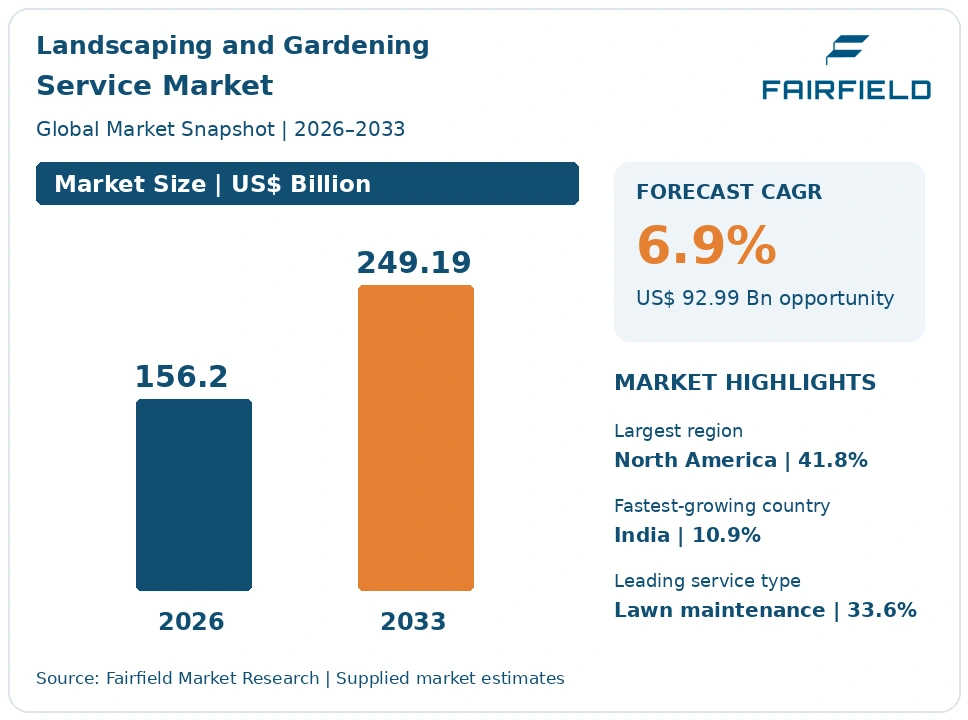
The global landscaping and gardening service market size is expected to be valued at US$ 156.20 billion in 2026 and projected to reach US$ 249.19 billion by 2033, growing at a CAGR of 6.9% between 2026 and 2033.
Between 2020 and 2025, the market grew at a CAGR of about 6.1%, as homeowners invested in outdoor living spaces during the pandemic and commercial property owners restored maintenance budgets. Three factors now drive growth: rising residential construction and outdoor living spending, demand for water-efficient and climate-resilient landscapes, and outsourcing of grounds maintenance by commercial, institutional, and government property owners. The market is shifting toward recurring maintenance contracts, smart irrigation, battery-powered and robotic equipment, and online booking platforms. Labor shortages and rising wages remain the main constraint on service capacity and margins.
Key Report Takeaways
- By Service Type: Lawn Care & Maintenance held 33.6% share in 2026, while Irrigation & Water Management is projected to expand at an 8.9% CAGR through 2033, driven by drought rules and smart irrigation upgrades.
- By End User: Residential held 51.6% share in 2026, while Institutional & Government is projected to expand at a 7.8% CAGR through 2033, driven by public park, campus, and urban greening programs.
- By Business Model: Contract-based Services held 67.5% share in 2026, while On-demand Services are projected to expand at a 7.9% CAGR through 2033, driven by app-based booking and flexible one-off jobs.
- By Provider Type: Independent Local Contractors held 45.7% share in 2026, while National & Enterprise Service Companies are projected to expand at an 8.5% CAGR through 2033, driven by acquisitions and multi-site contracts.
- By Region: North America held 41.8% share in 2026, while India is projected to expand at a 10.9% CAGR through 2033, driven by urban housing, commercial real estate, and smart city projects.
Global Landscaping and Gardening Service Market Trends and Insights
Drivers Impact Analysis
Two drivers carry the strongest influence on landscaping and gardening service demand during the forecast period.
| Driver | Impact on CAGR Forecast | Geographic Relevance | Impact Timeline |
| Outdoor living investment and outsourcing by busy households | High | North America, Europe, Asia Pacific | Medium term (2-4 years) |
| Water efficiency rules and climate-resilient landscaping | Medium | North America, Middle East & Africa, Europe | Long term (≥4 years) |
Outdoor Living Investment Is Driving Residential Landscaping Service Demand
Outdoor living investment is the strongest driver of residential landscaping and gardening service demand. Homeowners increasingly treat yards, patios, and gardens as extensions of their living space and hire professionals to design, build, and maintain them.
The mechanism combines housing trends with time pressure. Many households moved to suburban homes with larger yards after 2020, and they now spend on patios, outdoor kitchens, lighting, and planting. Dual-income families and aging homeowners have less time or ability to maintain lawns themselves, so they outsource mowing, pruning, fertilization, and seasonal cleanups. The National Association of Landscape Professionals notes that homeowners view landscaping as an investment that improves property value and curb appeal. New housing developments in the United States, Canada, and Australia add steady demand for landscape maintenance contracts. Recurring weekly or monthly service plans give providers predictable revenue.
Water Efficiency Rules Are Expanding Demand for Climate-Resilient Landscaping
Water efficiency rules are expanding demand for climate-resilient landscaping services. Property owners must replace thirsty lawns, upgrade irrigation, and choose drought-tolerant plants to meet local regulations and lower water bills.
The cause is recurring drought and stricter water policy. In Nevada, state law requires removal of nonfunctional turf from many commercial, government, and multifamily properties in the Las Vegas area by 2027. California has adopted permanent water conservation rules for urban suppliers and bans watering of nonfunctional turf on commercial properties during droughts. Cities in Arizona, Texas, and Utah offer rebates for turf replacement. In the Middle East, governments promote efficient irrigation for public landscapes. These rules create demand for xeriscaping design, drip irrigation, smart controllers, and soil moisture sensors. Providers offering irrigation services and water audits can win higher-value projects and long-term maintenance agreements.
Restraints Impact Analysis
Two restraints limit how quickly landscaping and gardening services can grow.
| Restraint | Impact on CAGR Forecast | Geographic Relevance | Impact Timeline |
| Labor shortages and rising wages | High | North America, Europe | Short term (≤2 years) |
| Seasonality, weather risk, and equipment transition costs | Medium | Global, strongest in colder climates | Medium term (2-4 years) |
Labor Shortages Limit Landscaping and Gardening Service Capacity
Labor shortages limit the capacity and profitability of landscaping and gardening service providers. Many companies turn down work or delay projects because they cannot hire enough crew members.
The specific causes are physically demanding work, seasonal employment, and immigration limits. Landscaping relies heavily on outdoor manual labor, which competes with construction, warehousing, and delivery jobs offering year-round hours. In the United States, many firms depend on the H-2B temporary visa program, which is capped at 66,000 visas per fiscal year and is often oversubscribed. Minimum wage increases in many states and cities raise payroll costs. Training workers in irrigation, tree care, and pesticide application takes time and certification. These pressures squeeze margins, especially for small contractors that cannot easily raise prices. Larger companies invest in recruitment, retention programs, and automation to reduce dependence on manual labor.
Seasonality and Equipment Transition Costs Constrain Landscaping Margins
Seasonality, weather risk, and equipment transition costs constrain margins in landscaping and gardening services. Revenue rises sharply in spring and summer, but drops in winter for many providers in colder climates.
The underlying causes are climate patterns and new emissions rules. Providers must cover equipment leases, insurance, and core staff even during slow months, and extreme heat, storms, or drought can disrupt schedules. Snow removal helps some firms balance revenue, but mild winters reduce that income. Meanwhile, California rules from the California Air Resources Board require most new small off-road engines, including those in mowers and leaf blowers, to be zero-emission from 2024. Battery-powered commercial equipment, spare batteries, and charging systems cost more upfront than gas tools. Several cities also restrict gas leaf blowers. Small contractors find these capital costs difficult, which slows equipment upgrades.
Market Opportunities
Robotic Mowers and Smart Irrigation Create a Technology-led Service Revenue Pool
Robotic mowers and smart irrigation create a technology-led service revenue pool for landscaping providers. These tools let companies maintain more properties with fewer workers and offer premium, data-driven services.
Providers that adopt automation early can capture this opportunity. Robotic mowers from Husqvarna, John Deere, and other manufacturers can mow large commercial sites, campuses, and sports fields autonomously, freeing crews for detailed work. Smart irrigation controllers adjust watering based on weather data and soil moisture, cutting water use and bills. Property managers, homeowner associations, municipalities, and corporate campuses are the main customers. Providers can sell installation, monitoring, and ongoing maintenance as subscription services. Automation also helps address labor shortages, improving margins and service consistency. Over time, data from connected equipment supports better scheduling and reporting to clients.
Urban Greening and Ecological Restoration Open a Public Sector Revenue Pool
Urban greening and ecological restoration open a public sector revenue pool for landscaping and gardening service providers. Governments are funding tree planting, green infrastructure, and habitat restoration to manage heat, stormwater, and biodiversity.
Companies with environmental expertise can capture this demand. Cities are planting street trees, building rain gardens, restoring wetlands, and greening rooftops to reduce urban heat islands and flooding. Programs such as the U.S. Forest Service urban and community forestry grants and European Union nature restoration goals support funding. Singapore and cities in China promote green building and park connectors. In September 2025, Davey Resource Group, part of The Davey Tree Expert Company, announced the acquisition of LandStudies, an ecological restoration firm. Municipalities, utilities, and developers are the main customers. These projects bring multi-year contracts and stable public funding.
Segment Analysis
By Service Type: Lawn Care & Maintenance Leads While Irrigation & Water Management Gains Momentum
Lawn Care & Maintenance held 33.6% share in 2026. Mowing, edging, fertilization, weed control, and seasonal cleanups are needed weekly or monthly, creating recurring revenue for providers. Homeowners and commercial property managers outsource these tasks to keep properties tidy and attractive. Lawn care services such as those offered by TruGreen also include pest control and aeration.
Irrigation & Water Management is the fastest-growing service type, expanding at an 8.9% CAGR through 2033. Drought rules, water price increases, and turf replacement rebates push property owners to upgrade sprinkler systems. Smart controllers, drip irrigation, and soil moisture sensors cut water use while keeping plants healthy. Water audits and leak repairs add service revenue. Landscape design and construction and tree care services remain major revenue lines. For the market, irrigation growth adds higher-value technical work and strengthens long-term maintenance relationships.
By End User: Residential Leads While Institutional & Government Expands Fastest
Residential held 51.6% share in 2026. Homeowners hire providers for lawn care, garden design, planting, and outdoor living projects. Busy schedules, aging populations, and interest in curb appeal sustain demand. Homeowner associations in planned communities also contract maintenance for shared green spaces.
Institutional & Government is the fastest-growing end user, expanding at a 7.8% CAGR through 2033. Cities, schools, universities, hospitals, and public agencies outsource maintenance of parks, campuses, and roadsides to control costs. Urban greening and climate programs fund tree planting and green infrastructure. Sports fields and golf courses managed by public bodies need specialized turf care. Commercial landscaping for offices, retail centers, and hotels remains a major segment. For the market, institutional growth brings large, multi-year contracts that favor providers with scale and compliance capabilities.
By Business Model: Contract-based Services Lead While On-demand Services Grow Faster
Contract-based Services held 67.5% share in 2026. Annual or seasonal maintenance agreements provide predictable revenue for providers and consistent service for clients. Commercial properties, homeowner associations, and public agencies usually prefer contracts with defined service levels and fixed pricing.
On-demand Services are the faster-growing business model, expanding at a 7.9% CAGR through 2033. Homeowners increasingly book one-off jobs such as cleanups, tree trimming, planting, and repairs through mobile apps and online marketplaces. Digital platforms compare prices, show reviews, and allow instant scheduling. Younger homeowners and renters prefer flexible services without long commitments. Providers use on-demand jobs to fill schedule gaps and attract new customers. For the market, on-demand growth increases digital competition and rewards providers with strong online presence and responsive scheduling.
By Provider Type: Independent Local Contractors Lead While National & Enterprise Service Companies Grow Fastest
Independent Local Contractors held 45.7% share in 2026. Small, owner-operated businesses dominate residential landscaping because they offer personal service, local knowledge, and flexible pricing. Entry barriers are low, so many new firms enter each year.
National & Enterprise Service Companies are the fastest-growing provider type, expanding at an 8.5% CAGR through 2033. Large companies acquire regional firms to expand coverage and serve clients with properties in many locations. Corporate campuses, retail chains, hospitals, and property management firms prefer one provider for consistent quality and reporting. Scale allows investment in technology, training, safety programs, and equipment. BrightView, Yellowstone Landscape, and The Davey Tree Expert Company continue to expand through acquisitions. For the market, enterprise growth drives gradual consolidation in a highly fragmented industry.
Geography Analysis
Which Region Is Leading the Landscaping and Gardening Service Market?
North America is leading the landscaping and gardening service market with a 41.8% share in 2026. The United States has large suburban housing stock, high rates of homeownership with private yards, and strong spending on outdoor living. Commercial properties, homeowner associations, and golf courses outsource maintenance to providers such as BrightView, TruGreen, Yellowstone Landscape, and The Davey Tree Expert Company. Water rules in California, Nevada, and Arizona drive irrigation upgrades and turf replacement. Canada adds demand for seasonal maintenance and snow removal. One change shaping the region is the move to battery-powered equipment under emissions rules.
Europe Combines Public Green Space Management and Garden Culture
Europe is a large, mature market where public green space management and a strong gardening culture support demand. The United Kingdom, Germany, France, and the Netherlands have high spending on private gardens and well-maintained parks. Municipalities outsource park and roadside maintenance to firms such as idverde, which operates in several European countries. European Union biodiversity goals encourage native planting and reduced pesticide use. Labor shortages and high wages raise costs. Robotic mowers are widely adopted in Scandinavia and Germany. One opportunity is green roofs and urban greening projects that support climate adaptation in dense cities.
Which Country Is Growing Fastest in the Landscaping and Gardening Service Market?
India is growing fastest in the landscaping and gardening service market at a 10.9% CAGR through 2033. Rapid urbanization is creating large gated communities, commercial office parks, and hotels that need professional landscape design and maintenance. The Smart Cities Mission and city greening programs fund parks and public spaces. China and Australia also drive regional growth, while Japan has a strong tradition of garden design. Across Asia Pacific, rising incomes increase demand for residential gardening services. Fragmented local providers and limited trained horticulture staff remain barriers. One opportunity is maintenance contracts for large residential townships and corporate campuses.
Latin America Develops Landscaping Services Through Real Estate and Tourism
Latin America is an emerging market where real estate development and tourism drive landscaping and gardening services. Brazil and Mexico have growing gated communities, resorts, and commercial centers that need landscape design and maintenance. Tourist areas such as Cancún and the Riviera Maya require well-kept hotel and resort grounds year-round. Chile and Colombia add demand from urban parks and new residential projects. Key barriers include economic volatility, widespread informal labor, and limited spending on outsourced services among middle-income households. One opportunity is water-efficient landscaping in drought-prone areas of Mexico and Chile, supported by local water conservation rules.
Middle East & Africa Invests in Landscaping Services for Megaprojects and Urban Greening
Middle East & Africa is a developing market where megaprojects and urban greening drive demand. Saudi Arabia plans to plant 10 billion trees under the Saudi Green Initiative, and giga-projects such as NEOM and Diriyah need extensive landscaping. The United Arab Emirates maintains large public parks, hotels, and golf courses in Dubai and Abu Dhabi. South Africa has an established residential gardening and estate maintenance market. Key barriers include extreme heat, water scarcity, high irrigation costs, and reliance on migrant labor. One opportunity is desert-adapted landscaping with native plants and efficient drip irrigation for public and commercial projects.
Competitive Landscape
The landscaping and gardening service market is highly fragmented. Hundreds of thousands of small, independent contractors serve local residential and commercial customers, and no company holds a large global share. BrightView, The Davey Tree Expert Company, TruGreen, Yellowstone Landscape, SavATree, Ruppert Landscape, and LandCare lead in North America, while idverde is a major provider in Europe. Private equity investment has supported consolidation among regional firms.
Companies compete on service quality, reliability, price, responsiveness, and range of services. Commercial clients value consistent standards, safety, reporting, and coverage across many sites, which favors larger firms. Residential customers often choose based on reputation, reviews, and price. Technology is becoming a differentiator, including route optimization, customer apps, robotic mowers, and smart irrigation. Online marketplaces lower entry barriers for small providers.
Strategic moves show how competition is changing. In September 2025, Davey Resource Group announced its acquisition of LandStudies, adding ecological restoration expertise. In February 2026, Davey Resource Group acquired Cal Engineering Solutions and its sister companies. Also in February 2026, BrightView expanded its golf course management at The Villages in Florida, raising its managed share of the community’s 400 golf holes to more than half. In March 2026, BrightView won new sports turf and golf maintenance contracts. These moves show providers expanding into specialized, higher-value services.
Three themes shape vendor strategy. First, companies are acquiring regional firms to expand coverage. Second, they are adopting automation and battery equipment. Third, they are adding environmental and specialty services.
Landscaping and Gardening Service Market Industry Leaders
- BrightView Holdings The Davey Tree Expert Company TruGreen Yellowstone Landscape idverde
Recent Industry Developments
March 2026: BrightView secured new sports turf and golf maintenance contracts, including Country Club of Miami - expands its specialty turf services.
February 2026: BrightView expanded golf course management at The Villages to more than half of its 400 holes - deepens a large recurring contract.
February 2026: Davey Resource Group acquired Cal Engineering Solutions and its sister companies - adds engineering and environmental capabilities.
September 2025: Davey Resource Group announced the acquisition of LandStudies - strengthens ecological restoration services.
Landscaping and Gardening Service Market Report Scope
| Metric | Value |
| Study Period | 2020-2033 |
| Market Size 2026 | US$ 156.20 Billion |
| Market Size 2033 | US$ 249.19 Billion |
| CAGR 2026-2033 | 6.9% |
| Absolute Dollar Opportunity | US$ 92.99 Billion |
| Largest Market | North America |
| Fastest-Growing Market | India |
| Market Concentration | Low |
| Major Players | BrightView Holdings, The Davey Tree Expert Company, TruGreen, Yellowstone Landscape, idverde |
This report covers professional landscaping and gardening services for residential, commercial, institutional, and government properties, including lawn care and maintenance, landscape design and construction, tree and shrub care, irrigation and water management, and related services. It excludes landscaping products sold directly to consumers, agricultural services, and do-it-yourself gardening. The base year is 2025, and the forecast period runs from 2026 to 2033. All values are expressed in US$ Billion.
Landscaping and Gardening Service Market Segmentation
Service Type
- Lawn Care & Maintenance
- Landscape Design & Construction
- Tree & Shrub Care
- Irrigation & Water Management
- Others
End User
- Residential
- Commercial
- Institutional & Government
Business Model
- Contract-based Services
- On-demand Services
Provider Type
- Independent Local Contractors
- Regional Companies
- National & Enterprise Service Companies
Regions
- North America
- Europe
- Asia Pacific
- Latin America
- Middle East & Africa
- Executive Summary
- Global Landscaping and Gardening Service Market Snapshot
- Future Projections
- Key Report Takeaways
- Regional Snapshot
- Market Overview
- Market Definition and Report Scope
- Historical Trends 2020–2025
- Market Dynamics
- Drivers
- Outdoor Living Investment Is Driving Residential Landscaping Service Demand
- Water Efficiency Rules Are Expanding Demand for Climate-Resilient Landscaping
- Restraints
- Labor Shortages Limit Landscaping and Gardening Service Capacity
- Seasonality and Equipment Transition Costs Constrain Landscaping Margins
- Market Opportunities
- Robotic Mowers and Smart Irrigation Create a Technology-led Service Revenue Pool
- Urban Greening and Ecological Restoration Open a Public Sector Revenue Pool
- Drivers
- Global Landscaping and Gardening Service Market Outlook, 2020-2033
- Global Landscaping and Gardening Service Market Outlook, by Service Type, Value (US$ Billion), 2020-2033
- Lawn Care & Maintenance
- Landscape Design & Construction
- Tree & Shrub Care
- Irrigation & Water Management
- Others
- Global Landscaping and Gardening Service Market Outlook, by End User, Value (US$ Billion), 2020-2033
- Residential
- Commercial
- Institutional & Government
- Global Landscaping and Gardening Service Market Outlook, by Business Model, Value (US$ Billion), 2020-2033
- Contract-based Services
- On-demand Services
- Global Landscaping and Gardening Service Market Outlook, by Provider Type, Value (US$ Billion), 2020-2033
- Independent Local Contractors
- Regional Companies
- National & Enterprise Service Companies
- Global Landscaping and Gardening Service Market Outlook, by Region, Value (US$ Billion), 2020-2033
- North America
- Europe
- Asia Pacific
- Latin America
- Middle East & Africa
- Global Landscaping and Gardening Service Market Outlook, by Service Type, Value (US$ Billion), 2020-2033
- North America Landscaping and Gardening Service Market Outlook, 2020-2033
- North America Landscaping and Gardening Service Market Outlook, by Service Type, Value (US$ Billion), 2020-2033
- Lawn Care & Maintenance
- Landscape Design & Construction
- Tree & Shrub Care
- Irrigation & Water Management
- Others
- North America Landscaping and Gardening Service Market Outlook, by End User, Value (US$ Billion), 2020-2033
- Residential
- Commercial
- Institutional & Government
- North America Landscaping and Gardening Service Market Outlook, by Business Model, Value (US$ Billion), 2020-2033
- Contract-based Services
- On-demand Services
- North America Landscaping and Gardening Service Market Outlook, by Provider Type, Value (US$ Billion), 2020-2033
- Independent Local Contractors
- Regional Companies
- National & Enterprise Service Companies
- North America Landscaping and Gardening Service Market Outlook, by Country, Value (US$ Billion), 2020-2033
- United States Landscaping and Gardening Service Market Outlook, by Service Type, 2020-2033
- United States Landscaping and Gardening Service Market Outlook, by End User, 2020-2033
- United States Landscaping and Gardening Service Market Outlook, by Business Model, 2020-2033
- United States Landscaping and Gardening Service Market Outlook, by Provider Type, 2020-2033
- Canada Landscaping and Gardening Service Market Outlook, by Service Type, 2020-2033
- Canada Landscaping and Gardening Service Market Outlook, by End User, 2020-2033
- Canada Landscaping and Gardening Service Market Outlook, by Business Model, 2020-2033
- Canada Landscaping and Gardening Service Market Outlook, by Provider Type, 2020-2033
- North America Landscaping and Gardening Service Market Outlook, by Service Type, Value (US$ Billion), 2020-2033
- Europe Landscaping and Gardening Service Market Outlook, 2020-2033
- Europe Landscaping and Gardening Service Market Outlook, by Service Type, Value (US$ Billion), 2020-2033
- Lawn Care & Maintenance
- Landscape Design & Construction
- Tree & Shrub Care
- Irrigation & Water Management
- Others
- Europe Landscaping and Gardening Service Market Outlook, by End User, Value (US$ Billion), 2020-2033
- Residential
- Commercial
- Institutional & Government
- Europe Landscaping and Gardening Service Market Outlook, by Business Model, Value (US$ Billion), 2020-2033
- Contract-based Services
- On-demand Services
- Europe Landscaping and Gardening Service Market Outlook, by Provider Type, Value (US$ Billion), 2020-2033
- Independent Local Contractors
- Regional Companies
- National & Enterprise Service Companies
- Europe Landscaping and Gardening Service Market Outlook, by Country, Value (US$ Billion), 2020-2033
- United Kingdom Landscaping and Gardening Service Market Outlook, by Service Type, 2020-2033
- United Kingdom Landscaping and Gardening Service Market Outlook, by End User, 2020-2033
- United Kingdom Landscaping and Gardening Service Market Outlook, by Business Model, 2020-2033
- United Kingdom Landscaping and Gardening Service Market Outlook, by Provider Type, 2020-2033
- Germany Landscaping and Gardening Service Market Outlook, by Service Type, 2020-2033
- Germany Landscaping and Gardening Service Market Outlook, by End User, 2020-2033
- Germany Landscaping and Gardening Service Market Outlook, by Business Model, 2020-2033
- Germany Landscaping and Gardening Service Market Outlook, by Provider Type, 2020-2033
- France Landscaping and Gardening Service Market Outlook, by Service Type, 2020-2033
- France Landscaping and Gardening Service Market Outlook, by End User, 2020-2033
- France Landscaping and Gardening Service Market Outlook, by Business Model, 2020-2033
- France Landscaping and Gardening Service Market Outlook, by Provider Type, 2020-2033
- Netherlands Landscaping and Gardening Service Market Outlook, by Service Type, 2020-2033
- Netherlands Landscaping and Gardening Service Market Outlook, by End User, 2020-2033
- Netherlands Landscaping and Gardening Service Market Outlook, by Business Model, 2020-2033
- Netherlands Landscaping and Gardening Service Market Outlook, by Provider Type, 2020-2033
- Scandinavia Landscaping and Gardening Service Market Outlook, by Service Type, 2020-2033
- Scandinavia Landscaping and Gardening Service Market Outlook, by End User, 2020-2033
- Scandinavia Landscaping and Gardening Service Market Outlook, by Business Model, 2020-2033
- Scandinavia Landscaping and Gardening Service Market Outlook, by Provider Type, 2020-2033
- Europe Landscaping and Gardening Service Market Outlook, by Service Type, Value (US$ Billion), 2020-2033
- Asia Pacific Landscaping and Gardening Service Market Outlook, 2020-2033
- Asia Pacific Landscaping and Gardening Service Market Outlook, by Service Type, Value (US$ Billion), 2020-2033
- Lawn Care & Maintenance
- Landscape Design & Construction
- Tree & Shrub Care
- Irrigation & Water Management
- Others
- Asia Pacific Landscaping and Gardening Service Market Outlook, by End User, Value (US$ Billion), 2020-2033
- Residential
- Commercial
- Institutional & Government
- Asia Pacific Landscaping and Gardening Service Market Outlook, by Business Model, Value (US$ Billion), 2020-2033
- Contract-based Services
- On-demand Services
- Asia Pacific Landscaping and Gardening Service Market Outlook, by Provider Type, Value (US$ Billion), 2020-2033
- Independent Local Contractors
- Regional Companies
- National & Enterprise Service Companies
- Asia Pacific Landscaping and Gardening Service Market Outlook, by Country, Value (US$ Billion), 2020-2033
- India Landscaping and Gardening Service Market Outlook, by Service Type, 2020-2033
- India Landscaping and Gardening Service Market Outlook, by End User, 2020-2033
- India Landscaping and Gardening Service Market Outlook, by Business Model, 2020-2033
- India Landscaping and Gardening Service Market Outlook, by Provider Type, 2020-2033
- China Landscaping and Gardening Service Market Outlook, by Service Type, 2020-2033
- China Landscaping and Gardening Service Market Outlook, by End User, 2020-2033
- China Landscaping and Gardening Service Market Outlook, by Business Model, 2020-2033
- China Landscaping and Gardening Service Market Outlook, by Provider Type, 2020-2033
- Australia Landscaping and Gardening Service Market Outlook, by Service Type, 2020-2033
- Australia Landscaping and Gardening Service Market Outlook, by End User, 2020-2033
- Australia Landscaping and Gardening Service Market Outlook, by Business Model, 2020-2033
- Australia Landscaping and Gardening Service Market Outlook, by Provider Type, 2020-2033
- Japan Landscaping and Gardening Service Market Outlook, by Service Type, 2020-2033
- Japan Landscaping and Gardening Service Market Outlook, by End User, 2020-2033
- Japan Landscaping and Gardening Service Market Outlook, by Business Model, 2020-2033
- Japan Landscaping and Gardening Service Market Outlook, by Provider Type, 2020-2033
- Singapore Landscaping and Gardening Service Market Outlook, by Service Type, 2020-2033
- Singapore Landscaping and Gardening Service Market Outlook, by End User, 2020-2033
- Singapore Landscaping and Gardening Service Market Outlook, by Business Model, 2020-2033
- Singapore Landscaping and Gardening Service Market Outlook, by Provider Type, 2020-2033
- Asia Pacific Landscaping and Gardening Service Market Outlook, by Service Type, Value (US$ Billion), 2020-2033
- Latin America Landscaping and Gardening Service Market Outlook, 2020-2033
- Latin America Landscaping and Gardening Service Market Outlook, by Service Type, Value (US$ Billion), 2020-2033
- Lawn Care & Maintenance
- Landscape Design & Construction
- Tree & Shrub Care
- Irrigation & Water Management
- Others
- Latin America Landscaping and Gardening Service Market Outlook, by End User, Value (US$ Billion), 2020-2033
- Residential
- Commercial
- Institutional & Government
- Latin America Landscaping and Gardening Service Market Outlook, by Business Model, Value (US$ Billion), 2020-2033
- Contract-based Services
- On-demand Services
- Latin America Landscaping and Gardening Service Market Outlook, by Provider Type, Value (US$ Billion), 2020-2033
- Independent Local Contractors
- Regional Companies
- National & Enterprise Service Companies
- Latin America Landscaping and Gardening Service Market Outlook, by Country, Value (US$ Billion), 2020-2033
- Brazil Landscaping and Gardening Service Market Outlook, by Service Type, 2020-2033
- Brazil Landscaping and Gardening Service Market Outlook, by End User, 2020-2033
- Brazil Landscaping and Gardening Service Market Outlook, by Business Model, 2020-2033
- Brazil Landscaping and Gardening Service Market Outlook, by Provider Type, 2020-2033
- Mexico Landscaping and Gardening Service Market Outlook, by Service Type, 2020-2033
- Mexico Landscaping and Gardening Service Market Outlook, by End User, 2020-2033
- Mexico Landscaping and Gardening Service Market Outlook, by Business Model, 2020-2033
- Mexico Landscaping and Gardening Service Market Outlook, by Provider Type, 2020-2033
- Chile Landscaping and Gardening Service Market Outlook, by Service Type, 2020-2033
- Chile Landscaping and Gardening Service Market Outlook, by End User, 2020-2033
- Chile Landscaping and Gardening Service Market Outlook, by Business Model, 2020-2033
- Chile Landscaping and Gardening Service Market Outlook, by Provider Type, 2020-2033
- Colombia Landscaping and Gardening Service Market Outlook, by Service Type, 2020-2033
- Colombia Landscaping and Gardening Service Market Outlook, by End User, 2020-2033
- Colombia Landscaping and Gardening Service Market Outlook, by Business Model, 2020-2033
- Colombia Landscaping and Gardening Service Market Outlook, by Provider Type, 2020-2033
- Latin America Landscaping and Gardening Service Market Outlook, by Service Type, Value (US$ Billion), 2020-2033
- Middle East & Africa Landscaping and Gardening Service Market Outlook, 2020-2033
- Middle East & Africa Landscaping and Gardening Service Market Outlook, by Service Type, Value (US$ Billion), 2020-2033
- Lawn Care & Maintenance
- Landscape Design & Construction
- Tree & Shrub Care
- Irrigation & Water Management
- Others
- Middle East & Africa Landscaping and Gardening Service Market Outlook, by End User, Value (US$ Billion), 2020-2033
- Residential
- Commercial
- Institutional & Government
- Middle East & Africa Landscaping and Gardening Service Market Outlook, by Business Model, Value (US$ Billion), 2020-2033
- Contract-based Services
- On-demand Services
- Middle East & Africa Landscaping and Gardening Service Market Outlook, by Provider Type, Value (US$ Billion), 2020-2033
- Independent Local Contractors
- Regional Companies
- National & Enterprise Service Companies
- Middle East & Africa Landscaping and Gardening Service Market Outlook, by Country, Value (US$ Billion), 2020-2033
- Saudi Arabia Landscaping and Gardening Service Market Outlook, by Service Type, 2020-2033
- Saudi Arabia Landscaping and Gardening Service Market Outlook, by End User, 2020-2033
- Saudi Arabia Landscaping and Gardening Service Market Outlook, by Business Model, 2020-2033
- Saudi Arabia Landscaping and Gardening Service Market Outlook, by Provider Type, 2020-2033
- United Arab Emirates Landscaping and Gardening Service Market Outlook, by Service Type, 2020-2033
- United Arab Emirates Landscaping and Gardening Service Market Outlook, by End User, 2020-2033
- United Arab Emirates Landscaping and Gardening Service Market Outlook, by Business Model, 2020-2033
- United Arab Emirates Landscaping and Gardening Service Market Outlook, by Provider Type, 2020-2033
- South Africa Landscaping and Gardening Service Market Outlook, by Service Type, 2020-2033
- South Africa Landscaping and Gardening Service Market Outlook, by End User, 2020-2033
- South Africa Landscaping and Gardening Service Market Outlook, by Business Model, 2020-2033
- South Africa Landscaping and Gardening Service Market Outlook, by Provider Type, 2020-2033
- Middle East & Africa Landscaping and Gardening Service Market Outlook, by Service Type, Value (US$ Billion), 2020-2033
- Competitive Landscape
- Market Concentration and Industry Leaders
- Competitive Differentiation
- Strategic Moves and Market Direction
- Recent Industry Developments
- Company Profiles
- BrightView Holdings
- The Davey Tree Expert Company
- TruGreen
- Yellowstone Landscape
- idverde
- SavATree
- Ruppert Landscape
- LandCare
- The F.A. Bartlett Tree Expert Company
- Gothic Landscape
- Juniper Landscaping
- Massey Services
- Appendix
- Research Methodology
- Report Assumptions
- Acronyms and Abbreviations
Service Type
- Lawn Care & Maintenance
- Landscape Design & Construction
- Tree & Shrub Care
- Irrigation & Water Management
- Others
End User
- Residential
- Commercial
- Institutional & Government
Business Model
- Contract-based Services
- On-demand Services
Provider Type
- Independent Local Contractors
- Regional Companies
- National & Enterprise Service Companies
Regions
- North America
- Europe
- Asia Pacific
- Latin America
- Middle East & Africa
Our Research Methodology
Considering the volatility of business today, traditional approaches to strategizing a game plan can be unfruitful if not detrimental. True ambiguity is no way to determine a forecast. A myriad of predetermined factors must be accounted for such as the degree of risk involved, the magnitude of circumstances, as well as conditions or consequences that are not known or unpredictable. To circumvent binary views that cast uncertainty, the application of market research intelligence to strategically posture, move, and enable actionable outcomes is necessary.
View Methodology
Quality Assured
Rigorous Validation Process

Confidentiality Assured
End-to-end Data Security

Custom Research Services
Tailored To Your Objectives
FAQs
The landscaping and gardening service market is valued at US$ 156.20 billion in 2026, led by lawn care and maintenance for residential properties.
The market is projected to reach US$ 249.19 billion by 2033, growing at a 6.9% CAGR and adding US$ 92.99 billion.
Irrigation & Water Management is growing fastest at an 8.9% CAGR through 2033, driven by drought rules and smart irrigation upgrades.
India is growing fastest at a 10.9% CAGR through 2033, driven by urban housing, commercial real estate, and smart city projects.
North America holds the largest share at 41.8% in 2026, supported by suburban housing, outdoor living spending, and commercial outsourcing.
Related Reports
Landscaping Products Market Size, Share, Insights, Competitive Landscape, and Forecast 2026 to 2033
Explore the landscaping products market, reaching US$ 187.02 billion by 2033 at 6.8% CAGR, with product, power source and regional insights.
Fabric Softener Sheet Market Size, Share, Insights, Competitive Landscape, and Forecast 2026 to 2033
The global fabric softener sheet market is valued at US$2.1 billion in 2026, reaching US$2.7 billion by 2033, growing at a 3.7% CAGR
Eyewear Market Size, Share, Insights, Competitive Landscape, and Forecast 2026 to 2033
The global eyewear market is valued at US$178.0 billion in 2026, reaching US$268.0 billion by 2033, growing at a 6.0% CAGR
Exotic Pets Market Size, Share, Insights, Competitive Landscape, and Forecast 2026 to 2033
The global exotic pets market is valued at US$21.4 billion in 2026, reaching US$33.6 billion by 2033, growing at a 6.7% CAGR
3D Drawing Doodle Printing Pen Market Size, Share, Insights, Competitive Landscape, and Forecast 2026 to 2033
The global 3D drawing doodle printing pen market is valued at US$0.16 billion in 2026, reaching US$0.28 billion by 2033, growing at an 8.32% CAGR
Knee High Boots Market Size, Share, Insights, Competitive Landscape, and Forecast 2026 to 2033
The global knee high boots market is valued at US$18.7 billion in 2026, reaching US$26.4 billion by 2033, growing at a 5.05% CAGR