



Landscaping Products Market
Landscaping Products Market Size, Share, Insights, Competitive Landscape, and Forecast 2026 to 2033
Landscaping Products Market Size and Trend Analysis
How Fast Is the Landscaping Products Market Growing?
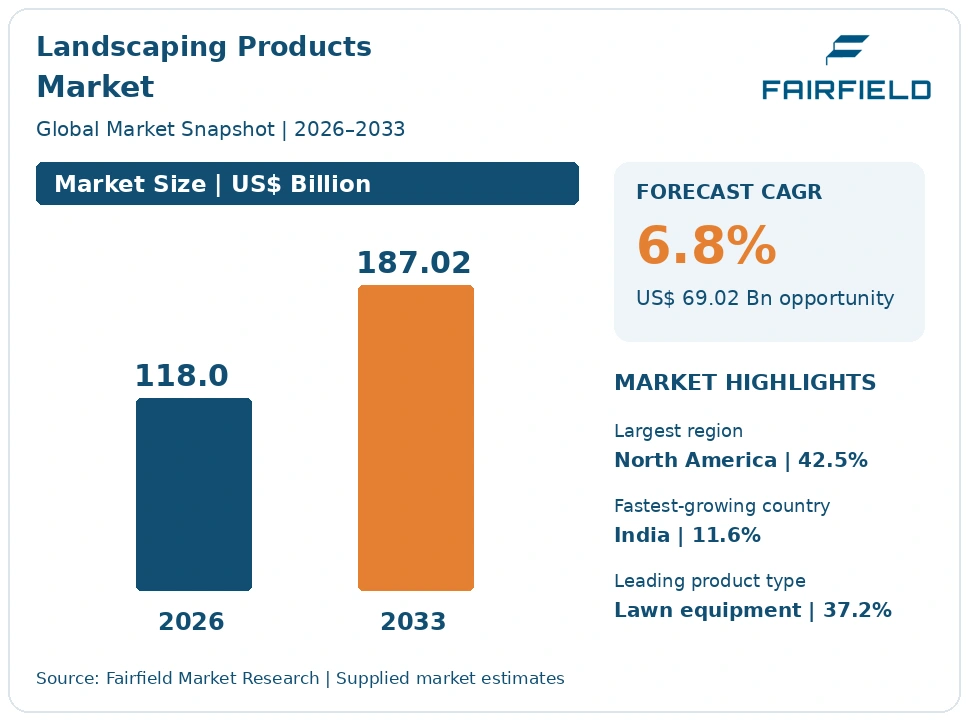
The global landscaping products market size is expected to be valued at US$ 118.00 billion in 2026 and projected to reach US$ 187.02 billion by 2033, growing at a CAGR of 6.8% between 2026 and 2033.
Between 2020 and 2025, the market grew at a CAGR of about 5.9%, boosted by a pandemic-era surge in home and garden projects, followed by a correction in 2023 as inventories normalized and interest rates rose. Three factors now drive growth: outdoor living investment in patios, walkways, and garden spaces; the shift to battery-powered and robotic equipment; and water-saving products such as smart irrigation and artificial turf. The market is moving toward cordless tools, low-maintenance materials, permeable pavers, and online sales. Housing activity and consumer confidence remain key swing factors for annual demand.
Key Report Takeaways
- By Product Type: Lawn & Garden Equipment held 37.2% share in 2026, while Artificial Turf is projected to expand at a 10.0% CAGR through 2033, driven by water restrictions and low-maintenance sports and residential surfaces.
- By Power Source: Gas-powered held 44.8% share in 2026, while Battery-powered is projected to expand at an 11.6% CAGR through 2033, driven by emissions rules and better lithium-ion batteries.
- By Distribution Channel: Home Improvement Retail held 39.6% share in 2026, while Online Retail is projected to expand at an 11.9% CAGR through 2033, driven by direct-to-consumer sales of robotic mowers and garden products.
- By End Use: Residential held 51.8% share in 2026, while Golf Courses & Sports Turf is projected to expand at an 8.1% CAGR through 2033, driven by turf renovation and synthetic field installations.
- By Region: North America held 42.5% share in 2026, while India is projected to expand at an 11.6% CAGR through 2033, driven by urban housing, commercial landscaping, and smart city parks.
Global Landscaping Products Market Trends and Insights
Drivers Impact Analysis
Two drivers carry the strongest influence on landscaping products demand during the forecast period.
| Driver | Impact on CAGR Forecast | Geographic Relevance | Impact Timeline |
| Outdoor living investment and hardscape projects | High | North America, Europe, Asia Pacific | Medium term (2-4 years) |
| Shift to battery-powered and robotic equipment | High | North America, Europe | Long term (≥4 years) |
Outdoor Living Investment Is Driving Hardscape Products Demand
Outdoor living investment is the strongest driver of landscaping products demand, especially for hardscape products. Homeowners are building patios, walkways, retaining walls, fire pits, and outdoor kitchens that need pavers, natural stone, blocks, and edging.
The mechanism links housing stock, remodeling, and lifestyle changes. Many households moved to homes with yards after 2020, and they now treat outdoor areas as extra living rooms. Aging homes in the United States and Europe need repairs and upgrades, while new suburban developments require full landscapes. Concrete pavers and segmental retaining wall blocks from brands such as Belgard, part of Oldcastle APG, Pavestone, part of The Quikrete Companies, Unilock, and Techo-Bloc offer durable, attractive surfaces. Permeable pavers also help meet stormwater rules. Professional landscapers and do-it-yourself buyers both drive purchases through dealers and home improvement stores.
Battery-Powered and Robotic Equipment Is Expanding Landscaping Product Upgrades
The shift to battery-powered and robotic equipment is expanding replacement and upgrade demand for landscaping products. Homeowners and professional crews are swapping gas mowers, trimmers, and blowers for quieter, cleaner cordless tools.
The cause is stricter emissions rules and better battery technology. The California Air Resources Board requires most new small off-road engines, including lawn and garden equipment, to be zero-emission from model year 2024, and many cities restrict gas leaf blowers. Lithium-ion batteries now deliver enough runtime for commercial mowing, with shared battery platforms across tools. Robotic lawn mowers are moving from Europe into North America as wire-free models using satellite positioning and vision become available. In 2025, Husqvarna launched 13 boundary wire-free robotic mowers, its largest product launch to date. These changes raise average selling prices and create new accessory and battery revenue.
Restraints Impact Analysis
Two restraints limit how quickly landscaping products demand grows.
| Restraint | Impact on CAGR Forecast | Geographic Relevance | Impact Timeline |
| Housing market and consumer spending cycles | High | North America, Europe | Short term (≤2 years) |
| Raw material, freight, and tariff cost volatility | Medium | Global | Short term (≤2 years) |
Housing Market Cycles Slow Landscaping Products Sales
Housing market cycles slow landscaping products sales when interest rates rise or consumer confidence weakens. Fewer home sales and new builds mean fewer landscaping projects and equipment purchases.
The underlying cause is the link between landscaping and home transactions. Buyers often invest in yards and patios within the first years after moving, and builders install landscapes in new communities. When mortgage rates climbed in 2023 and 2024, existing home sales in the United States fell to multi-decade lows, reducing discretionary outdoor projects. Equipment makers such as The Toro Company and Deere & Company reported softer residential demand as dealers reduced inventory after the pandemic boom. Homeowners also delay big-ticket purchases like riding mowers during uncertain economic periods. Weather adds volatility, since a cold or wet spring can shift sales between seasons and hurt annual results.
Raw Material and Tariff Costs Squeeze Landscaping Product Margins
Raw material, freight, and tariff cost volatility squeezes margins for landscaping product manufacturers. Many products are heavy, bulky, or depend on imported components, which makes them sensitive to input and shipping costs.
The specific cost sources are cement, aggregates, steel, resin, lithium-ion cells, and electronic controls. Concrete pavers need cement and aggregates, whose prices rose sharply in recent years. Artificial turf uses polyethylene and polypropylene fibers linked to oil prices. Battery tools and robotic mowers rely on cells and chips largely made in Asia Pacific. United States tariffs on goods from China raise costs for outdoor power equipment, garden tools, and lighting. Freight costs for heavy hardscape products limit how far they can be shipped profitably. Manufacturers must pass costs to customers or absorb them, both of which can slow demand or reduce profitability.
Market Opportunities
Water-Saving Landscaping Products Open a High-Growth Revenue Pool
Water-saving landscaping products open a high-growth revenue pool for manufacturers. Drought rules and rising water prices push homeowners, cities, and businesses to replace thirsty lawns and upgrade irrigation.
Manufacturers of artificial turf, smart controllers, drip systems, and drought-tolerant plants can capture this demand. Nevada law requires removal of nonfunctional turf from many properties in the Las Vegas area by 2027, while California, Arizona, and Utah offer turf replacement rebates. Smart irrigation equipment from Rain Bird, Hunter Industries, and The Toro Company adjusts watering using weather data and soil sensors. In January 2026, Rain Bird introduced its All-in-One Zone Control for commercial irrigation. Property managers, municipalities, and sports facilities are key customers. Artificial turf for sports fields and residential yards also reduces water and maintenance costs.
Autonomous Commercial Mowers and Connected Equipment Create a Premium Revenue Pool
Autonomous commercial mowers and connected equipment create a premium revenue pool in the landscaping products market. These products help professional landscapers cope with persistent labor shortages by letting fewer workers maintain more properties.
Equipment makers investing in autonomy, sensors, and software can capture this opportunity. Autonomous zero-turn mowers and robotic mowers can maintain large commercial sites, campuses, golf courses, and sports fields. Honda has announced its ProZision autonomous zero-turn mower for professional landscapers, while Husqvarna, John Deere, and The Toro Company are developing robotic and fleet management solutions. Connected equipment tracks usage, maintenance needs, and location, helping fleet managers improve productivity. Landscaping contractors, golf course operators, universities, and facility managers are the main buyers. Subscription software and service plans add steady recurring revenue beyond hardware sales.
Segment Analysis
By Product Type: Lawn & Garden Equipment Leads While Artificial Turf Gains Momentum
Lawn & Garden Equipment held 37.2% share in 2026. Mowers, trimmers, blowers, chainsaws, and tractors are essential for both homeowners and professional landscapers, and they are replaced every few years. Brands such as Deere & Company, The Toro Company, Husqvarna, STIHL, and Honda have extensive dealer and retail networks.
Artificial Turf is the fastest-growing product type, expanding at a 10.0% CAGR through 2033. Water restrictions, drought, and maintenance costs encourage homeowners, cities, and sports facilities to replace natural grass. Improved fibers look more natural and stay cooler in sun. Schools and municipalities install synthetic sports fields that can be used year-round. Hardscape, irrigation equipment, lawn care inputs, and outdoor lighting remain important categories. For the market, artificial turf growth shows how water policy is changing landscaping choices toward low-maintenance surfaces.
By Power Source: Gas-powered Products Lead While Battery-powered Products Grow Fastest
Gas-powered held 44.8% share in 2026. Gas engines still dominate commercial mowers, large riding mowers, and heavy-duty tools because they offer long runtime, high power, and fast refueling. Many professional crews prefer them for large properties.
Battery-powered is the fastest-growing power source, expanding at an 11.6% CAGR through 2033. Lithium-ion batteries now power mowers, trimmers, blowers, and chainsaws with enough runtime for most residential and many commercial jobs. Cordless tools are quieter, need less maintenance, and produce no direct emissions. California’s zero-emission rule for new small engines and local leaf blower bans speed adoption. Techtronic Industries, Stanley Black & Decker, Makita, and STIHL offer shared battery platforms across many tools. For the market, battery growth raises product values and creates recurring revenue from batteries and chargers.
By Distribution Channel: Home Improvement Retail Leads While Online Retail Grows Fastest
Home Improvement Retail held 39.6% share in 2026. Large chains such as The Home Depot and Lowe’s offer wide assortments of equipment, pavers, mulch, plants, and garden supplies. Shoppers value seeing products in person, seasonal promotions, and store financing.
Online Retail is the fastest-growing channel, expanding at an 11.9% CAGR through 2033. Consumers increasingly buy robotic mowers, cordless tools, lighting, seeds, and garden décor through online marketplaces and brand websites. Direct-to-consumer sales let manufacturers offer configurators and subscription services. Home delivery is convenient for bulky items such as mowers and turf rolls. Dealers, specialty landscape suppliers such as SiteOne Landscape Supply, and garden centers serve professionals. For the market, online growth increases price transparency and pushes brands to improve digital marketing and delivery.
By End Use: Residential Leads While Golf Courses & Sports Turf Grows Fastest
Residential held 51.8% share in 2026. Homeowners buy equipment, plants, pavers, and lawn care products for yards and gardens. Outdoor living trends and do-it-yourself projects keep residential demand strong, especially in North America and Europe.
Golf Courses & Sports Turf is the fastest-growing end use, expanding at an 8.1% CAGR through 2033. Golf participation has grown since 2020, encouraging course renovations and investment in turf equipment, irrigation, and fertilizers. Schools, universities, and cities are installing synthetic sports fields and upgrading natural turf for heavy use. Commercial properties and public spaces remain major end uses. Professional turf managers also buy premium seed, fertilizers, and aeration equipment to keep surfaces safe. For the market, sports turf growth supports demand for high-value mowers, precision irrigation, and specialized turf products.
Geography Analysis
Which Region Is Leading the Landscaping Products Market?
North America is leading the landscaping products market with a 42.5% share in 2026. The United States has a large stock of single-family homes with private yards and a strong culture of lawn care and outdoor living. Leading companies such as Deere & Company, The Toro Company, The Scotts Miracle-Gro Company, and Oldcastle APG have extensive dealer and retail networks. The Home Depot, Lowe’s, and SiteOne Landscape Supply distribute products nationwide. Water rules in western states drive irrigation and turf replacement. One change shaping the region is the fast switch to battery and robotic equipment after California’s small engine rule.
Europe Combines Robotic Mower Leadership and Strong Garden Culture
Europe is a large market with a strong gardening culture and early adoption of robotic mowers. Germany, the United Kingdom, France, and the Nordic countries have high spending on garden equipment, plants, and outdoor furniture. Husqvarna in Sweden, STIHL in Germany, and Bosch have built leading positions in robotic and cordless tools. European Union rules on noise, emissions, and pesticides influence product design. Stormwater rules encourage permeable paving. Smaller urban gardens favor compact, quiet tools and balcony planters. One opportunity is wire-free robotic mowers that replace older boundary wire systems across many existing users.
Which Country Is Growing Fastest in the Landscaping Products Market?
India is growing fastest in the landscaping products market at an 11.6% CAGR through 2033. Rapid urbanization is creating gated communities, office parks, hotels, and public parks that need pavers, plants, irrigation, and equipment. The Smart Cities Mission funds urban green spaces, parks, and streetscapes. China is a major producer and consumer of garden tools, outdoor lighting, and artificial turf, and Australia has a strong residential market. Japan and South Korea favor compact, high-quality products. Fragmented distribution, informal suppliers, and strong price sensitivity remain challenges. One opportunity is affordable drip irrigation and cordless tools for growing urban households.
Latin America Grows Landscaping Products Demand Through Housing and Tourism
Latin America is an emerging market where housing development, tourism, and sports facilities drive landscaping products demand. Brazil and Mexico have growing middle-class housing, resorts, and commercial centers that use pavers, plants, irrigation, and turf. Chile and Colombia add demand from urban parks and residential projects. Football fields and training centers across the region increasingly use artificial turf to cut water use and maintenance. Key barriers include currency volatility, high import duties, weak dealer networks, and price sensitivity, which favor low-cost local products. One opportunity is water-efficient irrigation and turf in drought-affected areas of Mexico and Chile.
Middle East & Africa Uses Landscaping Products for Megaprojects and Water-Efficient Greening
Middle East & Africa is a developing market where megaprojects and water scarcity shape landscaping products demand. Saudi Arabia plans to plant 10 billion trees under the Saudi Green Initiative, and giga-projects such as NEOM and Diriyah need hardscape, plants, and irrigation. The United Arab Emirates uses artificial turf, drip irrigation, and decorative lighting in public spaces, golf courses, and resorts. South Africa has a mature residential garden and hardscape market. Key barriers include extreme temperatures, scarce water, reliance on imports, and limited local manufacturing. One opportunity is desalinated-water irrigation systems and heat-tolerant materials for public landscapes.
Competitive Landscape
The landscaping products market is highly fragmented because it spans equipment, hardscape materials, lawn care inputs, irrigation, turf, and lighting. Each category has its own leaders. Deere & Company, The Toro Company, Husqvarna, STIHL, Honda, and Techtronic Industries lead outdoor power equipment. Oldcastle APG, part of CRH, The Quikrete Companies, Unilock, and Techo-Bloc lead hardscape products. The Scotts Miracle-Gro Company and Central Garden & Pet lead lawn care inputs, while Rain Bird and Hunter Industries lead irrigation.
Companies compete on product performance, durability, brand strength, dealer networks, price, and innovation. Battery platforms create customer loyalty, since users prefer tools that share batteries. Hardscape suppliers compete on design, color range, and regional production because heavy products are costly to ship. Online brands and Chinese manufacturers are entering robotic mowers and cordless tools.
Strategic moves show how competition is changing. In June 2024, The Home Depot completed its acquisition of SRS Distribution, which includes landscape supply businesses, strengthening its position with professional customers. In February 2025, The Quikrete Companies completed its acquisition of Summit Materials, adding cement and aggregates capacity that supports hardscape production. In 2025, Husqvarna launched 13 wire-free robotic mowers, and in January 2026, Rain Bird introduced its All-in-One Zone Control for commercial irrigation. These moves show competition shifting toward scale in distribution, material supply, and automated products.
Three themes shape vendor strategy. First, companies are expanding battery and robotic product lines. Second, they are securing raw materials and distribution. Third, they are developing water-efficient products.
Landscaping Products Market Industry Leaders
- Deere & Company The Toro Company Husqvarna Oldcastle APG (CRH) The Scotts Miracle-Gro Company
Recent Industry Developments
January 2026: Rain Bird introduced the All-in-One Zone Control for commercial irrigation - simplifies efficient irrigation installation.
February 2025: The Quikrete Companies completed its acquisition of Summit Materials - secures cement and aggregates for concrete and hardscape products.
2025: Husqvarna launched 13 boundary wire-free robotic mowers, its largest launch to date - expands robotic mowing into new segments.
June 2024: The Home Depot completed its acquisition of SRS Distribution - strengthens professional supply, including landscape products.
Landscaping Products Market Report Scope
| Metric | Value |
| Study Period | 2020-2033 |
| Market Size 2026 | US$ 118.00 Billion |
| Market Size 2033 | US$ 187.02 Billion |
| CAGR 2026-2033 | 6.8% |
| Absolute Dollar Opportunity | US$ 69.02 Billion |
| Largest Market | North America |
| Fastest-Growing Market | India |
| Market Concentration | Low |
| Major Players | Deere & Company, The Toro Company, Husqvarna, Oldcastle APG (CRH), The Scotts Miracle-Gro Company |
This report covers products used to build and maintain landscapes, including lawn and garden equipment, hardscape materials such as pavers and retaining walls, lawn care inputs, irrigation equipment, artificial turf, and outdoor lighting. It covers residential, commercial, and sports turf uses and excludes professional landscaping services, agricultural machinery, and outdoor furniture. The base year is 2025, and the forecast period runs from 2026 to 2033. All values are expressed in US$ Billion.
Landscaping Products Market Segmentation
Product Type
- Lawn & Garden Equipment
- Hardscape Products
- Lawn Care Inputs
- Irrigation Equipment
- Artificial Turf
- Outdoor Lighting
Power Source
- Gas-powered
- Battery-powered
- Corded Electric
- Manual
Distribution Channel
- Home Improvement Retail
- Dealers & Specialty Suppliers
- Online Retail
- Garden Centers & Others
End Use
- Residential
- Commercial
- Golf Courses & Sports Turf
- Public Spaces
Regions
- North America
- Europe
- Asia Pacific
- Latin America
- Middle East & Africa
- Executive Summary
- Global Landscaping Products Market Snapshot
- Future Projections
- Key Report Takeaways
- Regional Snapshot
- Market Overview
- Market Definition and Report Scope
- Historical Trends 2020–2025
- Market Dynamics
- Drivers
- Outdoor Living Investment Is Driving Hardscape Products Demand
- Battery-Powered and Robotic Equipment Is Expanding Landscaping Product Upgrades
- Restraints
- Housing Market Cycles Slow Landscaping Products Sales
- Raw Material and Tariff Costs Squeeze Landscaping Product Margins
- Market Opportunities
- Water-Saving Landscaping Products Open a High-Growth Revenue Pool
- Autonomous Commercial Mowers and Connected Equipment Create a Premium Revenue Pool
- Drivers
- Global Landscaping Products Market Outlook, 2020-2033
- Global Landscaping Products Market Outlook, by Product Type, Value (US$ Billion), 2020-2033
- Lawn & Garden Equipment
- Hardscape Products
- Lawn Care Inputs
- Irrigation Equipment
- Artificial Turf
- Outdoor Lighting
- Global Landscaping Products Market Outlook, by Power Source, Value (US$ Billion), 2020-2033
- Gas-powered
- Battery-powered
- Corded Electric
- Manual
- Global Landscaping Products Market Outlook, by Distribution Channel, Value (US$ Billion), 2020-2033
- Home Improvement Retail
- Dealers & Specialty Suppliers
- Online Retail
- Garden Centers & Others
- Global Landscaping Products Market Outlook, by End Use, Value (US$ Billion), 2020-2033
- Residential
- Commercial
- Golf Courses & Sports Turf
- Public Spaces
- Global Landscaping Products Market Outlook, by Region, Value (US$ Billion), 2020-2033
- North America
- Europe
- Asia Pacific
- Latin America
- Middle East & Africa
- Global Landscaping Products Market Outlook, by Product Type, Value (US$ Billion), 2020-2033
- North America Landscaping Products Market Outlook, 2020-2033
- North America Landscaping Products Market Outlook, by Product Type, Value (US$ Billion), 2020-2033
- Lawn & Garden Equipment
- Hardscape Products
- Lawn Care Inputs
- Irrigation Equipment
- Artificial Turf
- Outdoor Lighting
- North America Landscaping Products Market Outlook, by Power Source, Value (US$ Billion), 2020-2033
- Gas-powered
- Battery-powered
- Corded Electric
- Manual
- North America Landscaping Products Market Outlook, by Distribution Channel, Value (US$ Billion), 2020-2033
- Home Improvement Retail
- Dealers & Specialty Suppliers
- Online Retail
- Garden Centers & Others
- North America Landscaping Products Market Outlook, by End Use, Value (US$ Billion), 2020-2033
- Residential
- Commercial
- Golf Courses & Sports Turf
- Public Spaces
- North America Landscaping Products Market Outlook, by Country, Value (US$ Billion), 2020-2033
- United States Landscaping Products Market Outlook, by Product Type, 2020-2033
- United States Landscaping Products Market Outlook, by Power Source, 2020-2033
- United States Landscaping Products Market Outlook, by Distribution Channel, 2020-2033
- United States Landscaping Products Market Outlook, by End Use, 2020-2033
- North America Landscaping Products Market Outlook, by Product Type, Value (US$ Billion), 2020-2033
- Europe Landscaping Products Market Outlook, 2020-2033
- Europe Landscaping Products Market Outlook, by Product Type, Value (US$ Billion), 2020-2033
- Lawn & Garden Equipment
- Hardscape Products
- Lawn Care Inputs
- Irrigation Equipment
- Artificial Turf
- Outdoor Lighting
- Europe Landscaping Products Market Outlook, by Power Source, Value (US$ Billion), 2020-2033
- Gas-powered
- Battery-powered
- Corded Electric
- Manual
- Europe Landscaping Products Market Outlook, by Distribution Channel, Value (US$ Billion), 2020-2033
- Home Improvement Retail
- Dealers & Specialty Suppliers
- Online Retail
- Garden Centers & Others
- Europe Landscaping Products Market Outlook, by End Use, Value (US$ Billion), 2020-2033
- Residential
- Commercial
- Golf Courses & Sports Turf
- Public Spaces
- Europe Landscaping Products Market Outlook, by Country, Value (US$ Billion), 2020-2033
- Germany Landscaping Products Market Outlook, by Product Type, 2020-2033
- Germany Landscaping Products Market Outlook, by Power Source, 2020-2033
- Germany Landscaping Products Market Outlook, by Distribution Channel, 2020-2033
- Germany Landscaping Products Market Outlook, by End Use, 2020-2033
- United Kingdom Landscaping Products Market Outlook, by Product Type, 2020-2033
- United Kingdom Landscaping Products Market Outlook, by Power Source, 2020-2033
- United Kingdom Landscaping Products Market Outlook, by Distribution Channel, 2020-2033
- United Kingdom Landscaping Products Market Outlook, by End Use, 2020-2033
- France Landscaping Products Market Outlook, by Product Type, 2020-2033
- France Landscaping Products Market Outlook, by Power Source, 2020-2033
- France Landscaping Products Market Outlook, by Distribution Channel, 2020-2033
- France Landscaping Products Market Outlook, by End Use, 2020-2033
- Nordic countries Landscaping Products Market Outlook, by Product Type, 2020-2033
- Nordic countries Landscaping Products Market Outlook, by Power Source, 2020-2033
- Nordic countries Landscaping Products Market Outlook, by Distribution Channel, 2020-2033
- Nordic countries Landscaping Products Market Outlook, by End Use, 2020-2033
- Sweden Landscaping Products Market Outlook, by Product Type, 2020-2033
- Sweden Landscaping Products Market Outlook, by Power Source, 2020-2033
- Sweden Landscaping Products Market Outlook, by Distribution Channel, 2020-2033
- Sweden Landscaping Products Market Outlook, by End Use, 2020-2033
- Europe Landscaping Products Market Outlook, by Product Type, Value (US$ Billion), 2020-2033
- Asia Pacific Landscaping Products Market Outlook, 2020-2033
- Asia Pacific Landscaping Products Market Outlook, by Product Type, Value (US$ Billion), 2020-2033
- Lawn & Garden Equipment
- Hardscape Products
- Lawn Care Inputs
- Irrigation Equipment
- Artificial Turf
- Outdoor Lighting
- Asia Pacific Landscaping Products Market Outlook, by Power Source, Value (US$ Billion), 2020-2033
- Gas-powered
- Battery-powered
- Corded Electric
- Manual
- Asia Pacific Landscaping Products Market Outlook, by Distribution Channel, Value (US$ Billion), 2020-2033
- Home Improvement Retail
- Dealers & Specialty Suppliers
- Online Retail
- Garden Centers & Others
- Asia Pacific Landscaping Products Market Outlook, by End Use, Value (US$ Billion), 2020-2033
- Residential
- Commercial
- Golf Courses & Sports Turf
- Public Spaces
- Asia Pacific Landscaping Products Market Outlook, by Country, Value (US$ Billion), 2020-2033
- India Landscaping Products Market Outlook, by Product Type, 2020-2033
- India Landscaping Products Market Outlook, by Power Source, 2020-2033
- India Landscaping Products Market Outlook, by Distribution Channel, 2020-2033
- India Landscaping Products Market Outlook, by End Use, 2020-2033
- China Landscaping Products Market Outlook, by Product Type, 2020-2033
- China Landscaping Products Market Outlook, by Power Source, 2020-2033
- China Landscaping Products Market Outlook, by Distribution Channel, 2020-2033
- China Landscaping Products Market Outlook, by End Use, 2020-2033
- Australia Landscaping Products Market Outlook, by Product Type, 2020-2033
- Australia Landscaping Products Market Outlook, by Power Source, 2020-2033
- Australia Landscaping Products Market Outlook, by Distribution Channel, 2020-2033
- Australia Landscaping Products Market Outlook, by End Use, 2020-2033
- Japan Landscaping Products Market Outlook, by Product Type, 2020-2033
- Japan Landscaping Products Market Outlook, by Power Source, 2020-2033
- Japan Landscaping Products Market Outlook, by Distribution Channel, 2020-2033
- Japan Landscaping Products Market Outlook, by End Use, 2020-2033
- South Korea Landscaping Products Market Outlook, by Product Type, 2020-2033
- South Korea Landscaping Products Market Outlook, by Power Source, 2020-2033
- South Korea Landscaping Products Market Outlook, by Distribution Channel, 2020-2033
- South Korea Landscaping Products Market Outlook, by End Use, 2020-2033
- Asia Pacific Landscaping Products Market Outlook, by Product Type, Value (US$ Billion), 2020-2033
- Latin America Landscaping Products Market Outlook, 2020-2033
- Latin America Landscaping Products Market Outlook, by Product Type, Value (US$ Billion), 2020-2033
- Lawn & Garden Equipment
- Hardscape Products
- Lawn Care Inputs
- Irrigation Equipment
- Artificial Turf
- Outdoor Lighting
- Latin America Landscaping Products Market Outlook, by Power Source, Value (US$ Billion), 2020-2033
- Gas-powered
- Battery-powered
- Corded Electric
- Manual
- Latin America Landscaping Products Market Outlook, by Distribution Channel, Value (US$ Billion), 2020-2033
- Home Improvement Retail
- Dealers & Specialty Suppliers
- Online Retail
- Garden Centers & Others
- Latin America Landscaping Products Market Outlook, by End Use, Value (US$ Billion), 2020-2033
- Residential
- Commercial
- Golf Courses & Sports Turf
- Public Spaces
- Latin America Landscaping Products Market Outlook, by Country, Value (US$ Billion), 2020-2033
- Brazil Landscaping Products Market Outlook, by Product Type, 2020-2033
- Brazil Landscaping Products Market Outlook, by Power Source, 2020-2033
- Brazil Landscaping Products Market Outlook, by Distribution Channel, 2020-2033
- Brazil Landscaping Products Market Outlook, by End Use, 2020-2033
- Mexico Landscaping Products Market Outlook, by Product Type, 2020-2033
- Mexico Landscaping Products Market Outlook, by Power Source, 2020-2033
- Mexico Landscaping Products Market Outlook, by Distribution Channel, 2020-2033
- Mexico Landscaping Products Market Outlook, by End Use, 2020-2033
- Chile Landscaping Products Market Outlook, by Product Type, 2020-2033
- Chile Landscaping Products Market Outlook, by Power Source, 2020-2033
- Chile Landscaping Products Market Outlook, by Distribution Channel, 2020-2033
- Chile Landscaping Products Market Outlook, by End Use, 2020-2033
- Colombia Landscaping Products Market Outlook, by Product Type, 2020-2033
- Colombia Landscaping Products Market Outlook, by Power Source, 2020-2033
- Colombia Landscaping Products Market Outlook, by Distribution Channel, 2020-2033
- Colombia Landscaping Products Market Outlook, by End Use, 2020-2033
- Latin America Landscaping Products Market Outlook, by Product Type, Value (US$ Billion), 2020-2033
- Middle East & Africa Landscaping Products Market Outlook, 2020-2033
- Middle East & Africa Landscaping Products Market Outlook, by Product Type, Value (US$ Billion), 2020-2033
- Lawn & Garden Equipment
- Hardscape Products
- Lawn Care Inputs
- Irrigation Equipment
- Artificial Turf
- Outdoor Lighting
- Middle East & Africa Landscaping Products Market Outlook, by Power Source, Value (US$ Billion), 2020-2033
- Gas-powered
- Battery-powered
- Corded Electric
- Manual
- Middle East & Africa Landscaping Products Market Outlook, by Distribution Channel, Value (US$ Billion), 2020-2033
- Home Improvement Retail
- Dealers & Specialty Suppliers
- Online Retail
- Garden Centers & Others
- Middle East & Africa Landscaping Products Market Outlook, by End Use, Value (US$ Billion), 2020-2033
- Residential
- Commercial
- Golf Courses & Sports Turf
- Public Spaces
- Middle East & Africa Landscaping Products Market Outlook, by Country, Value (US$ Billion), 2020-2033
- Saudi Arabia Landscaping Products Market Outlook, by Product Type, 2020-2033
- Saudi Arabia Landscaping Products Market Outlook, by Power Source, 2020-2033
- Saudi Arabia Landscaping Products Market Outlook, by Distribution Channel, 2020-2033
- Saudi Arabia Landscaping Products Market Outlook, by End Use, 2020-2033
- United Arab Emirates Landscaping Products Market Outlook, by Product Type, 2020-2033
- United Arab Emirates Landscaping Products Market Outlook, by Power Source, 2020-2033
- United Arab Emirates Landscaping Products Market Outlook, by Distribution Channel, 2020-2033
- United Arab Emirates Landscaping Products Market Outlook, by End Use, 2020-2033
- South Africa Landscaping Products Market Outlook, by Product Type, 2020-2033
- South Africa Landscaping Products Market Outlook, by Power Source, 2020-2033
- South Africa Landscaping Products Market Outlook, by Distribution Channel, 2020-2033
- South Africa Landscaping Products Market Outlook, by End Use, 2020-2033
- Middle East & Africa Landscaping Products Market Outlook, by Product Type, Value (US$ Billion), 2020-2033
- Competitive Landscape
- Market Concentration and Industry Leaders
- Competitive Differentiation
- Strategic Moves and Market Direction
- Recent Industry Developments
- Company Profiles
- Deere & Company
- The Toro Company
- Husqvarna
- Andreas STIHL
- Honda
- Techtronic Industries
- Stanley Black & Decker
- Oldcastle APG (CRH)
- The Quikrete Companies
- Unilock
- The Scotts Miracle-Gro Company
- Central Garden & Pet
- Rain Bird
- Hunter Industries
- Appendix
- Research Methodology
- Report Assumptions
- Acronyms and Abbreviations
Product Type
- Lawn & Garden Equipment
- Hardscape Products
- Lawn Care Inputs
- Irrigation Equipment
- Artificial Turf
- Outdoor Lighting
Power Source
- Gas-powered
- Battery-powered
- Corded Electric
- Manual
Distribution Channel
- Home Improvement Retail
- Dealers & Specialty Suppliers
- Online Retail
- Garden Centers & Others
End Use
- Residential
- Commercial
- Golf Courses & Sports Turf
- Public Spaces
Regions
- North America
- Europe
- Asia Pacific
- Latin America
- Middle East & Africa
Our Research Methodology
Considering the volatility of business today, traditional approaches to strategizing a game plan can be unfruitful if not detrimental. True ambiguity is no way to determine a forecast. A myriad of predetermined factors must be accounted for such as the degree of risk involved, the magnitude of circumstances, as well as conditions or consequences that are not known or unpredictable. To circumvent binary views that cast uncertainty, the application of market research intelligence to strategically posture, move, and enable actionable outcomes is necessary.
View Methodology
Quality Assured
Rigorous Validation Process

Confidentiality Assured
End-to-end Data Security

Custom Research Services
Tailored To Your Objectives
FAQs
The landscaping products market is valued at US$ 118.00 billion in 2026, led by lawn and garden equipment for residential users.
The market is projected to reach US$ 187.02 billion by 2033, growing at a 6.8% CAGR and adding US$ 69.02 billion.
Artificial Turf is growing fastest at a 10.0% CAGR through 2033, driven by water restrictions and low-maintenance residential and sports surfaces.
India is growing fastest at an 11.6% CAGR through 2033, driven by urban housing, commercial landscaping, and smart city parks.
North America holds the largest share at 42.5% in 2026, supported by single-family homes, lawn culture, and strong retail networks.
Related Reports
Landscaping and Gardening Service Market Size, Share, Insights, Competitive Landscape, and Forecast 2026 to 2033
Landscaping and gardening services reach US$ 249.19 billion by 2033 at 6.9% CAGR. Explore service, customer, provider and regional insights.
Fabric Softener Sheet Market Size, Share, Insights, Competitive Landscape, and Forecast 2026 to 2033
The global fabric softener sheet market is valued at US$2.1 billion in 2026, reaching US$2.7 billion by 2033, growing at a 3.7% CAGR
Eyewear Market Size, Share, Insights, Competitive Landscape, and Forecast 2026 to 2033
The global eyewear market is valued at US$178.0 billion in 2026, reaching US$268.0 billion by 2033, growing at a 6.0% CAGR
Exotic Pets Market Size, Share, Insights, Competitive Landscape, and Forecast 2026 to 2033
The global exotic pets market is valued at US$21.4 billion in 2026, reaching US$33.6 billion by 2033, growing at a 6.7% CAGR
3D Drawing Doodle Printing Pen Market Size, Share, Insights, Competitive Landscape, and Forecast 2026 to 2033
The global 3D drawing doodle printing pen market is valued at US$0.16 billion in 2026, reaching US$0.28 billion by 2033, growing at an 8.32% CAGR
Knee High Boots Market Size, Share, Insights, Competitive Landscape, and Forecast 2026 to 2033
The global knee high boots market is valued at US$18.7 billion in 2026, reaching US$26.4 billion by 2033, growing at a 5.05% CAGR