



Micro-SaaS Marketplace Market
Micro-SaaS Marketplace Market Size, Share, Insights, Competitive Landscape, and Forecast 2026 to 2033
Micro-SaaS Marketplace Market Size and Trend Analysis
What Shapes the Micro-SaaS Marketplace Growth Outlook?
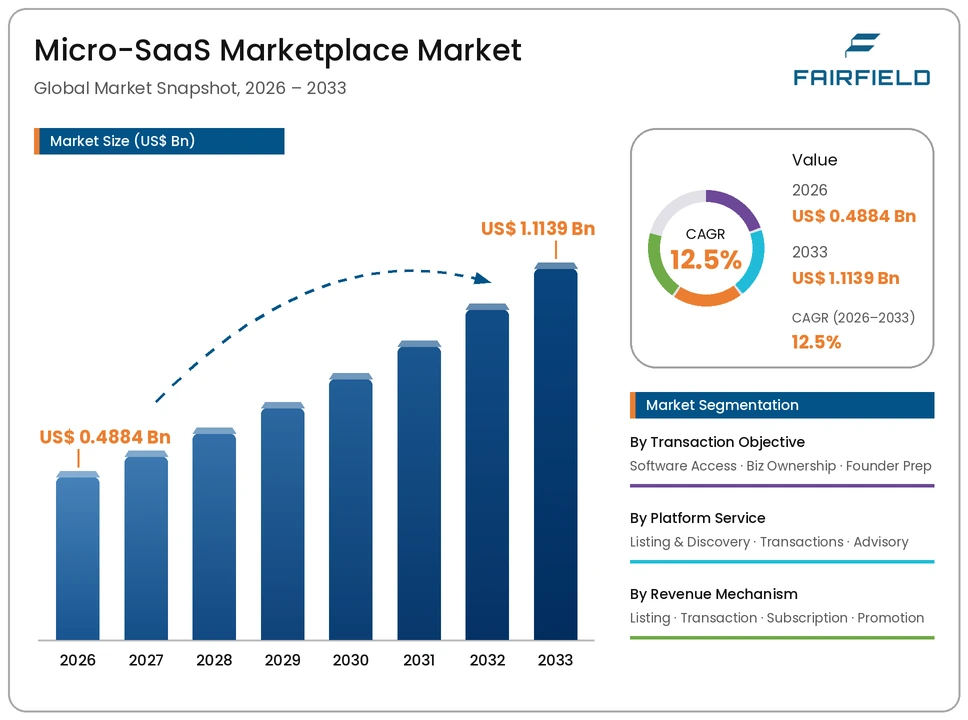
The global micro-saas marketplace market size is expected to be valued at US$0.4884 billion in 2026 and projected to reach US$1.1139 billion by 2033, growing at a CAGR of 12.5% between 2026 and 2033. The outlook applies the published benchmark growth rate to the requested forecast window. The calculated endpoint represents a constant-growth projection, rather than a separately published estimate for that year.
The 2025 benchmark is US$0.4341 billion; a consistent historical CAGR for 2020–2025 is not established. The market covers platform services that support discovery, promotion, licensing, or business transfers for narrowly focused SaaS products. Its direction reflects niche software creates a discovery problem and founder exits create separate business-transfer demand. Commercial selection depends on listing credibility, transaction quality, buyer fit, and clarity of platform fees; the supported implementation must fit the customer’s actual operating requirements.
Key Report Takeaways
- By Transaction Objective: Software Access concerns a license or commercial entitlement. Comparative revenue and growth leadership are not established for the requested period; commercial selection follows the function, supported operating conditions, and responsibilities described for each alternative.
- By Platform Service: Listing and Discovery helps users identify offers. Comparative revenue and growth leadership are not established for the requested period; commercial selection follows the function, supported operating conditions, and responsibilities described for each alternative.
- By Revenue Mechanism: Listing Charges monetize an offer’s placement. Comparative revenue and growth leadership are not established for the requested period; commercial selection follows the function, supported operating conditions, and responsibilities described for each alternative.
- By User Role: Software Operators buy tools for a task. Comparative revenue and growth leadership are not established for the requested period; commercial selection follows the function, supported operating conditions, and responsibilities described for each alternative.
- By Geography: North America, Europe, Asia Pacific, Latin America, and Middle East & Africa require separate application and customer assessments. Regional shares and growth rankings are not assigned without comparable evidence; local integration and continuing support determine practical commercial fit.
Drivers Impact Analysis
Impact ratings describe qualitative commercial relevance; they do not quantify additional CAGR contributions.
| Driver | Impact on CAGR Forecast | Geographic Relevance | Impact Timeline |
| Niche Software Creates a Discovery Problem | High | All regions; relevance varies by application | Medium term 2–4 years |
| Founder Exits Create Separate Business-Transfer Demand | Medium | All regions; relevance varies by application | Long term ≥4 years |
- Micro-SaaS Marketplace: Niche Software Creates a Discovery Problem
Niche software discovery creates a platform requirement when buyers cannot efficiently compare small products through general software categories. A marketplace can organize a specific business task, supported integrations, and commercial terms. Demand follows useful matching between a product and a buyer rather than the sheer number of listings. For a purchasing decision, the relevant benefit is the problem removed from the customer's existing workflow. A supplier should identify the required output, the conditions under which it is achieved, and the resources needed to maintain it.
AppSumo provides a software-deal route serving entrepreneurs and small businesses. The marketplace proposition needs transparent terms for the listed product and a distinction between promotion and recurring platform revenue. This mechanism creates a stronger commercial case when the customer can compare the proposed solution with an existing alternative.
- Micro-SaaS Marketplace: Founder Exits Create Separate Business-Transfer Demand
Small SaaS acquisitions create a different marketplace function from buying a software license. Founders need a way to reach suitable acquirers and provide credible commercial information. The platform can reduce search friction, but the business transfer still depends on diligence and agreement between the parties. The effect on demand depends on whether the customer can incorporate the offering into an established routine. Additional capabilities are valuable when they address a real bottleneck and remain practical for the people responsible for implementation.
Acquire.com and Flippa provide identifiable SaaS business sale routes. Their broader activity must be allocated to the relevant niche software scope. The transfer value of a business is not equivalent to marketplace revenue; platform fees and services are the measured economic boundary. Buyers should distinguish technical availability from successful deployment.
Restraints Impact Analysis
Impact ratings describe qualitative commercial relevance; they do not quantify additional CAGR contributions.
| Restraint | Impact on CAGR Forecast | Geographic Relevance | Impact Timeline |
| Unverified Listings Increase Buyer Diligence Costs | Medium | All regions; relevance varies by application | Medium term 2–4 years |
| Small Deal Economics Limit Extensive Human Support | Medium | All regions; relevance varies by application | Long term ≥4 years |
- Micro-SaaS Marketplace: Unverified Listings Increase Buyer Diligence Costs
A listing can obscure customer concentration, churn, operating expense, or reliance on the founder. These gaps increase the effort required before an acquisition decision. In software-deal discovery, unclear entitlement and support terms create a separate credibility problem. Both can reduce conversion despite a large audience. This limitation can extend the interval between first interest and a repeatable commercial relationship. Development budgets should include the work needed to resolve the problem rather than treating qualification as an incidental expense after supplier selection.
SaaS transaction services need documented evidence and a clear distinction between seller statements and platform verification. The cost sources include financial review, product access, and checking transferable rights. A marketplace should explain what it has verified without implying a guarantee of future business performance. Clear acceptance criteria can reduce disagreement between the buyer and supplier.
- Micro-SaaS Marketplace: Small Deal Economics Limit Extensive Human Support
A small transaction may not fund intensive advisory work at an acceptable platform margin. Standardization can reduce effort, but it cannot resolve every unusual contract or technical issue. The restraint is especially relevant when buyers expect service levels associated with larger acquisitions at much smaller deal sizes. The commercial consequence is a more selective purchasing process. Customers may defer adoption, narrow the intended use, or retain an alternative until the complete operating requirements are understood. A quotation should make those requirements visible before commitment.
The expense arises from diligence coordination, document review, disputes, and support after transfer. Founder exit platforms need a defined service package and escalation route. Fee design should correspond to the work delivered rather than treating all listings as equally simple to close. A credible mitigation plan addresses the actual source of the constraint.
Market Opportunities
Impact ratings describe qualitative commercial relevance; they do not quantify additional CAGR contributions.
| Opportunity | Impact on CAGR Forecast | Geographic Relevance | Impact Timeline |
| Readiness Services Open Founder Preparation Revenue | Medium | All regions; relevance varies by application | Medium term 2–4 years |
| Task-Specific Curation Opens Small-Business Buying Programs | Medium | All regions; relevance varies by application | Long term ≥4 years |
- Micro-SaaS Marketplace: Readiness Services Open Founder Preparation Revenue
Preparation services create an opportunity before a SaaS business is listed. A platform can help founders organize financial records, product documentation, and operational responsibilities. This revenue pool is distinct from discovery because it addresses the condition of the asset offered to prospective buyers. The attractive customer is one with a clearly defined unmet requirement and the resources to implement the solution. Sales development should begin with that requirement, rather than assume that a broad category trend converts automatically into an order.
Acquire.com publishes acquisition-focused analysis and serves business-transfer participants. Providers can build bounded readiness offers around evidence the buyer will need. They should avoid guaranteeing a valuation or completed exit and distinguish preparation work from seller-provided projections. Partners should agree on the application, the support provided, and the evidence needed before wider deployment.
- Micro-SaaS Marketplace: Task-Specific Curation Opens Small-Business Buying Programs
Task-specific curation creates an opportunity for buyers seeking a compact software stack for one operating need. A marketplace can compare supported workflows and explain commercial limitations. The revenue pool can include promotion or defined buyer services without treating the entire software subscription as platform income. This opportunity differs from general category expansion because it involves a new way to package technical or professional capability. The offer can address a customer group underserved by existing products, provided its practical requirements are explicitly considered.
AppSumo illustrates the software-deal route, while Flippa addresses business ownership transactions. Software deal marketplaces should keep those customer objectives separate. A curated offer needs current product terms, practical compatibility checks, and a clear account of who supports the software after purchase. Providers should test the revenue proposition against the cost of delivering it consistently.
Segment Analysis
- By Transaction Objective: Niche Software Discovery Requires Application Fit
Software Access concerns a license or commercial entitlement. SaaS Business Ownership concerns transfer of a business. Founder Preparation concerns readiness for a possible transaction. These objectives require different evidence and must remain distinct in platform accounting.
A buyer purchasing a lifetime license is not acquiring the operating business. An acquirer needs diligence about revenue and rights. Preparation services can earn revenue without a completed transfer. The platform should state the actual relationship it facilitates. The purchasing implication is to compare solutions against the required function. Buyers should document the conditions used for evaluation and consider the resources required to maintain performance. Supplier support is valuable when it helps the customer implement the chosen function consistently, rather than simply adding features to a quotation.
- By Platform Service: Small Saas Acquisitions Requires Application Fit
Listing and Discovery helps users identify offers. Transaction Facilitation supports agreed commercial steps. Advisory Support provides bounded assistance with preparation or review. A platform can provide several services, but classification should follow the primary contracted offering.
Fee descriptions should match the service delivered. Broad traffic does not demonstrate transaction quality, while a successful deal does not prove that every listing receives advisory support. Buyers and founders need a usable explanation of what is included. This distinction helps commercial teams define a meaningful application boundary. The same offering can serve several tasks, but sales should be allocated consistently to avoid double counting. Suppliers can improve adoption through application guidance that explains the supported conditions and the limits of the available evidence.
- By Revenue Mechanism: Software Deal Marketplaces Requires Application Fit
Listing Charges monetize an offer’s placement. Transaction Fees depend on a completed event under defined terms. Access Subscriptions sell platform access. Hybrid platforms should allocate revenue to the actual charge rather than count the same payment across categories.
A headline deal value cannot substitute for fee revenue. Discounts and optional services can change realized platform income. Comparisons need the same accounting boundary and should distinguish marketplace service charges from the listed SaaS product’s own recurring revenue. The business implication is a differentiated sales and support model. Purchasing decisions can involve different budgets, approval processes, and expectations for ongoing assistance. Vendors should also distinguish first purchases from recurring use, since installation or enrollment alone does not establish sustained customer value or comparative market leadership.
- By User Role: Founder Exit Platforms Requires Application Fit
Software Operators buy tools for a task. Product Founders seek customers or a business exit. These groups create different demands on product information, transaction records, and platform support.
A founder can occupy more than one role at different times. Classification should follow the current transaction rather than a permanent identity. Platform design should route users toward the evidence they need instead of placing licensing and acquisition requests in one generic funnel. Commercial positioning should follow the customer's operating requirement rather than a generalized ranking. Buyers need transparent specifications, appropriate evidence, and a practical implementation route. Bundled offerings require consistent revenue allocation, while optional functions should be explained separately so customers understand the actual basis of the proposed price and ongoing commitment.
Geography Analysis
Which Region Leads the Micro-SaaS Marketplace Market?
Comparable evidence does not establish a largest region; North America has identifiable customer and supplier activity. The United States and Canada provide founder, buyer, and software-platform participation. Acquire.com and AppSumo illustrate different transaction routes. Cross-border SaaS listings need practical records and transfer arrangements; a large software industry does not establish this market’s regional revenue share. The regional sales approach should distinguish established customer requirements from prospective expansion. Local support, procurement practices, and the actual route to repeat purchasing matter more than vendor headquarters. A useful entry proposal identifies the customer group, the delivery responsibilities, and the conditions under which the offering can remain dependable.
- Europe: Micro-SaaS Marketplace Depends on Local Delivery
The United Kingdom, Germany, and France offer different founder and business-buyer contexts. Language, contract practices, and payment arrangements can affect conversion. A platform should make its role in diligence and transaction support explicit rather than assume that a listing works identically across borders. For SaaS transaction services, local support and clear documentation are practical priorities. Country-level requirements should be reviewed separately before a broader regional launch. A product or service available in one jurisdiction does not establish identical eligibility elsewhere. Suppliers can improve commercial fit through appropriate documentation, local application support, and a clear explanation of the functions included in the purchasing relationship.
Which Region Grows Fastest in Micro-SaaS Marketplace?
Comparable evidence does not establish the fastest-growing region; Asia Pacific needs country-specific commercial assessment. India, Australia, Singapore, Japan, and South Korea provide varied software-founder and small-business ecosystems. Flippa represents identifiable marketplace activity. Opportunities depend on credible product information and transferable operating arrangements, not the number of developers or startups alone. The region should be evaluated through specific countries and customer groups rather than population size alone. Language, operating capability, and distribution or care infrastructure influence practical adoption. Partners should confirm the implementation requirements and the capacity to sustain support before translating a promising development project into a wider market commitment.
- Latin America: Micro-SaaS Marketplace Depends on Local Delivery
Brazil and Mexico require attention to payment access, language, and records used to evaluate small software businesses. Platforms can test a bounded buyer community before extending advisory services. Cross-border support costs and unclear seller documentation can limit the economics of smaller transactions. A workable regional strategy begins with a defined application and realistic ownership or service costs. Local partners can help with commissioning, communication, and replenishment, but responsibilities need to be explicit. Buyers should assess the whole operating proposition, including support continuity, instead of assuming that a low initial quotation resolves adoption barriers. The customer should evaluate the supported application and clarify responsibilities before expanding the purchasing commitment.
- Middle East & Africa: Micro-SaaS Marketplace Depends on Local Delivery
Saudi Arabia, the United Arab Emirates, and South Africa provide possible founder and business-software communities. A practical offer needs clear fees and transaction responsibilities. Product licensing and ownership transfers require different information, so platform localization should preserve that distinction. Market development should be tied to functioning local delivery arrangements. Technical or professional support, suitable documentation, and reliable supply can determine whether initial interest becomes sustained use. Partners should begin with a bounded customer requirement and evaluate performance before expanding the offer across countries with different operating conditions. The customer should evaluate the supported application and clarify responsibilities before expanding the purchasing commitment.
Competitive Landscape
Acquire.com and Flippa support SaaS business transfers, while AppSumo provides software discovery and deals. These are related but different marketplace functions. Competitive analysis should compare matching quality and the actual service package rather than combine business purchase prices with software licensing revenue.
The competitive structure cannot be assigned a reliable concentration score without comparable revenue data for the defined boundary. A large corporate portfolio does not establish category leadership because reported sales can include unrelated products or services. Customers should compare the actual offering and its commercial support. Suppliers with broader capabilities may provide useful coordination, but the relevant advantage must be demonstrated for the specific application rather than inferred from company size.
Competition centers on the combination of performance, usable implementation, and ongoing cost. Buyers need evidence under representative conditions and a clear explanation of what the supplier provides. Digital interfaces, technical documentation, or service packages can influence selection when they reduce practical friction. These features should be evaluated against the customer's requirements. An extensive feature list offers limited value if the core product or service cannot be delivered consistently within the agreed operating conditions.
Strategic direction favors clearer application boundaries and accountable delivery. Documented developments provide evidence of activity, while planned launches or partnerships remain different from completed commercialization. Suppliers can strengthen customer relationships through dependable support, transparent specifications, and communication that remains accurate as offerings change. The competitive question is whether the complete commercial proposition remains useful after the initial transaction, rather than whether a company appears prominently in general category discussions.
Micro-SaaS Marketplace Verified Participants
- Acquire.com
- Flippa
- AppSumo
Recent Industry Developments
Current product and service portfolios show documented participation by Acquire.com, Flippa, AppSumo. These offerings support the application analysis above; product availability does not establish a dated launch, completed expansion, or a new procurement award.
Companies Covered in the Report
- Acquire.com
- Flippa
- AppSumo
Micro-SaaS Marketplace Market Report Scope
| Metric | Value |
| Study Period | 2020–2033 |
| Market Size 2026 | US$0.4884 billion — published estimate |
| Market Size 2033 | US$1.1139 billion — calculated projection |
| CAGR 2026–2033 | 12.5%, applied compound-growth assumption |
| Absolute Dollar Opportunity | US$0.6255 billion |
| Largest Market (region) | Comparable regional revenue leadership not established |
| Fastest-Growing Market (region or country) | Comparative ranking for 2026–2033 not established |
| Market Concentration | Specialized participants; concentration not quantified |
| Major Players | Acquire.com, Flippa, AppSumo |
Micro-SaaS Marketplace Market Segmentation
Transaction Objective
- Software Access
- SaaS Business Ownership
- Founder Preparation
Platform Service
- Listing and Discovery
- Transaction Facilitation
- Advisory Support
Revenue Mechanism
- Listing Charges
- Transaction Fees
- Access Subscriptions
- Promotion Charges
User Role
- Software Operators
- Product Founders
- Financial and Strategic Acquirers
Regions
- North America
- Europe
- Asia Pacific
- Latin America
- Middle East & Africa
- Executive Summary
- Global Market Snapshot
- Market Size and Trend Analysis 2020–2033
- Base Year Benchmark 2025
- Key Report Takeaways
- Market Overview
- Market Definition and Report Scope
- Market Dynamics
- Drivers Impact Analysis
- Niche Software Creates a Discovery Problem
- Founder Exits Create Separate Business-Transfer Demand
- Restraints Impact Analysis
- Unverified Listings Increase Buyer Diligence Costs
- Small Deal Economics Limit Extensive Human Support
- Market Opportunities
- Readiness Services Open Founder Preparation Revenue
- Task-Specific Curation Opens Small-Business Buying Programs
- Drivers Impact Analysis
- Segment Analysis
- By Transaction Objective
- By Platform Service
- By Revenue Mechanism
- By User Role
- Global Micro-SaaS Marketplace Market Outlook 2026–2033
- Global Micro-SaaS Marketplace Market Outlook, by Transaction Objective, Value (US$ Billion), 2026–2033
- Software Access
- SaaS Business Ownership
- Founder Preparation
- Global Micro-SaaS Marketplace Market Outlook, by Platform Service, Value (US$ Billion), 2026–2033
- Listing and Discovery
- Transaction Facilitation
- Advisory Support
- Global Micro-SaaS Marketplace Market Outlook, by Revenue Mechanism, Value (US$ Billion), 2026–2033
- Listing Charges
- Transaction Fees
- Access Subscriptions
- Promotion Charges
- Global Micro-SaaS Marketplace Market Outlook, by User Role, Value (US$ Billion), 2026–2033
- Software Operators
- Product Founders
- Financial and Strategic Acquirers
- Global Micro-SaaS Marketplace Market Outlook, by Region, Value (US$ Billion), 2026–2033
- North America
- Europe
- Asia Pacific
- Latin America
- Middle East & Africa
- Global Micro-SaaS Marketplace Market Outlook, by Transaction Objective, Value (US$ Billion), 2026–2033
- North America Micro-SaaS Marketplace Market Outlook 2026–2033
- North America Market Activity and Implementation Conditions
- North America Micro-SaaS Marketplace Market Outlook, by Transaction Objective, Value (US$ Billion), 2026–2033
- Software Access
- SaaS Business Ownership
- Founder Preparation
- North America Micro-SaaS Marketplace Market Outlook, by Platform Service, Value (US$ Billion), 2026–2033
- Listing and Discovery
- Transaction Facilitation
- Advisory Support
- North America Micro-SaaS Marketplace Market Outlook, by Revenue Mechanism, Value (US$ Billion), 2026–2033
- Listing Charges
- Transaction Fees
- Access Subscriptions
- Promotion Charges
- North America Micro-SaaS Marketplace Market Outlook, by User Role, Value (US$ Billion), 2026–2033
- Software Operators
- Product Founders
- Financial and Strategic Acquirers
- North America Micro-SaaS Marketplace Market Outlook, by Country, 2026–2033
- United States Micro-SaaS Marketplace Market Outlook, by Transaction Objective, 2026–2033
- United States Micro-SaaS Marketplace Market Outlook, by Platform Service, 2026–2033
- United States Micro-SaaS Marketplace Market Outlook, by Revenue Mechanism, 2026–2033
- United States Micro-SaaS Marketplace Market Outlook, by User Role, 2026–2033
- Canada Micro-SaaS Marketplace Market Outlook, by Transaction Objective, 2026–2033
- Canada Micro-SaaS Marketplace Market Outlook, by Platform Service, 2026–2033
- Canada Micro-SaaS Marketplace Market Outlook, by Revenue Mechanism, 2026–2033
- Canada Micro-SaaS Marketplace Market Outlook, by User Role, 2026–2033
- Europe Micro-SaaS Marketplace Market Outlook 2026–2033
- Europe Market Activity and Implementation Conditions
- Europe Micro-SaaS Marketplace Market Outlook, by Transaction Objective, Value (US$ Billion), 2026–2033
- Software Access
- SaaS Business Ownership
- Founder Preparation
- Europe Micro-SaaS Marketplace Market Outlook, by Platform Service, Value (US$ Billion), 2026–2033
- Listing and Discovery
- Transaction Facilitation
- Advisory Support
- Europe Micro-SaaS Marketplace Market Outlook, by Revenue Mechanism, Value (US$ Billion), 2026–2033
- Listing Charges
- Transaction Fees
- Access Subscriptions
- Promotion Charges
- Europe Micro-SaaS Marketplace Market Outlook, by User Role, Value (US$ Billion), 2026–2033
- Software Operators
- Product Founders
- Financial and Strategic Acquirers
- Europe Micro-SaaS Marketplace Market Outlook, by Country, 2026–2033
- United Kingdom Micro-SaaS Marketplace Market Outlook, by Transaction Objective, 2026–2033
- United Kingdom Micro-SaaS Marketplace Market Outlook, by Platform Service, 2026–2033
- United Kingdom Micro-SaaS Marketplace Market Outlook, by Revenue Mechanism, 2026–2033
- United Kingdom Micro-SaaS Marketplace Market Outlook, by User Role, 2026–2033
- Germany Micro-SaaS Marketplace Market Outlook, by Transaction Objective, 2026–2033
- Germany Micro-SaaS Marketplace Market Outlook, by Platform Service, 2026–2033
- Germany Micro-SaaS Marketplace Market Outlook, by Revenue Mechanism, 2026–2033
- Germany Micro-SaaS Marketplace Market Outlook, by User Role, 2026–2033
- France Micro-SaaS Marketplace Market Outlook, by Transaction Objective, 2026–2033
- France Micro-SaaS Marketplace Market Outlook, by Platform Service, 2026–2033
- France Micro-SaaS Marketplace Market Outlook, by Revenue Mechanism, 2026–2033
- France Micro-SaaS Marketplace Market Outlook, by User Role, 2026–2033
- Asia Pacific Micro-SaaS Marketplace Market Outlook 2026–2033
- Asia Pacific Market Activity and Implementation Conditions
- Asia Pacific Micro-SaaS Marketplace Market Outlook, by Transaction Objective, Value (US$ Billion), 2026–2033
- Software Access
- SaaS Business Ownership
- Founder Preparation
- Asia Pacific Micro-SaaS Marketplace Market Outlook, by Platform Service, Value (US$ Billion), 2026–2033
- Listing and Discovery
- Transaction Facilitation
- Advisory Support
- Asia Pacific Micro-SaaS Marketplace Market Outlook, by Revenue Mechanism, Value (US$ Billion), 2026–2033
- Listing Charges
- Transaction Fees
- Access Subscriptions
- Promotion Charges
- Asia Pacific Micro-SaaS Marketplace Market Outlook, by User Role, Value (US$ Billion), 2026–2033
- Software Operators
- Product Founders
- Financial and Strategic Acquirers
- Asia Pacific Micro-SaaS Marketplace Market Outlook, by Country, 2026–2033
- India Micro-SaaS Marketplace Market Outlook, by Transaction Objective, 2026–2033
- India Micro-SaaS Marketplace Market Outlook, by Platform Service, 2026–2033
- India Micro-SaaS Marketplace Market Outlook, by Revenue Mechanism, 2026–2033
- India Micro-SaaS Marketplace Market Outlook, by User Role, 2026–2033
- Australia Micro-SaaS Marketplace Market Outlook, by Transaction Objective, 2026–2033
- Australia Micro-SaaS Marketplace Market Outlook, by Platform Service, 2026–2033
- Australia Micro-SaaS Marketplace Market Outlook, by Revenue Mechanism, 2026–2033
- Australia Micro-SaaS Marketplace Market Outlook, by User Role, 2026–2033
- Singapore Micro-SaaS Marketplace Market Outlook, by Transaction Objective, 2026–2033
- Singapore Micro-SaaS Marketplace Market Outlook, by Platform Service, 2026–2033
- Singapore Micro-SaaS Marketplace Market Outlook, by Revenue Mechanism, 2026–2033
- Singapore Micro-SaaS Marketplace Market Outlook, by User Role, 2026–2033
- Japan Micro-SaaS Marketplace Market Outlook, by Transaction Objective, 2026–2033
- Japan Micro-SaaS Marketplace Market Outlook, by Platform Service, 2026–2033
- Japan Micro-SaaS Marketplace Market Outlook, by Revenue Mechanism, 2026–2033
- Japan Micro-SaaS Marketplace Market Outlook, by User Role, 2026–2033
- South Korea Micro-SaaS Marketplace Market Outlook, by Transaction Objective, 2026–2033
- South Korea Micro-SaaS Marketplace Market Outlook, by Platform Service, 2026–2033
- South Korea Micro-SaaS Marketplace Market Outlook, by Revenue Mechanism, 2026–2033
- South Korea Micro-SaaS Marketplace Market Outlook, by User Role, 2026–2033
- Latin America Micro-SaaS Marketplace Market Outlook 2026–2033
- Latin America Market Activity and Implementation Conditions
- Latin America Micro-SaaS Marketplace Market Outlook, by Transaction Objective, Value (US$ Billion), 2026–2033
- Software Access
- SaaS Business Ownership
- Founder Preparation
- Latin America Micro-SaaS Marketplace Market Outlook, by Platform Service, Value (US$ Billion), 2026–2033
- Listing and Discovery
- Transaction Facilitation
- Advisory Support
- Latin America Micro-SaaS Marketplace Market Outlook, by Revenue Mechanism, Value (US$ Billion), 2026–2033
- Listing Charges
- Transaction Fees
- Access Subscriptions
- Promotion Charges
- Latin America Micro-SaaS Marketplace Market Outlook, by User Role, Value (US$ Billion), 2026–2033
- Software Operators
- Product Founders
- Financial and Strategic Acquirers
- Latin America Micro-SaaS Marketplace Market Outlook, by Country, 2026–2033
- Brazil Micro-SaaS Marketplace Market Outlook, by Transaction Objective, 2026–2033
- Brazil Micro-SaaS Marketplace Market Outlook, by Platform Service, 2026–2033
- Brazil Micro-SaaS Marketplace Market Outlook, by Revenue Mechanism, 2026–2033
- Brazil Micro-SaaS Marketplace Market Outlook, by User Role, 2026–2033
- Mexico Micro-SaaS Marketplace Market Outlook, by Transaction Objective, 2026–2033
- Mexico Micro-SaaS Marketplace Market Outlook, by Platform Service, 2026–2033
- Mexico Micro-SaaS Marketplace Market Outlook, by Revenue Mechanism, 2026–2033
- Mexico Micro-SaaS Marketplace Market Outlook, by User Role, 2026–2033
- Middle East & Africa Micro-SaaS Marketplace Market Outlook 2026–2033
- Middle East & Africa Market Activity and Implementation Conditions
- Middle East & Africa Micro-SaaS Marketplace Market Outlook, by Transaction Objective, Value (US$ Billion), 2026–2033
- Software Access
- SaaS Business Ownership
- Founder Preparation
- Middle East & Africa Micro-SaaS Marketplace Market Outlook, by Platform Service, Value (US$ Billion), 2026–2033
- Listing and Discovery
- Transaction Facilitation
- Advisory Support
- Middle East & Africa Micro-SaaS Marketplace Market Outlook, by Revenue Mechanism, Value (US$ Billion), 2026–2033
- Listing Charges
- Transaction Fees
- Access Subscriptions
- Promotion Charges
- Middle East & Africa Micro-SaaS Marketplace Market Outlook, by User Role, Value (US$ Billion), 2026–2033
- Software Operators
- Product Founders
- Financial and Strategic Acquirers
- Middle East & Africa Micro-SaaS Marketplace Market Outlook, by Country, 2026–2033
- Saudi Arabia Micro-SaaS Marketplace Market Outlook, by Transaction Objective, 2026–2033
- Saudi Arabia Micro-SaaS Marketplace Market Outlook, by Platform Service, 2026–2033
- Saudi Arabia Micro-SaaS Marketplace Market Outlook, by Revenue Mechanism, 2026–2033
- Saudi Arabia Micro-SaaS Marketplace Market Outlook, by User Role, 2026–2033
- United Arab Emirates Micro-SaaS Marketplace Market Outlook, by Transaction Objective, 2026–2033
- United Arab Emirates Micro-SaaS Marketplace Market Outlook, by Platform Service, 2026–2033
- United Arab Emirates Micro-SaaS Marketplace Market Outlook, by Revenue Mechanism, 2026–2033
- United Arab Emirates Micro-SaaS Marketplace Market Outlook, by User Role, 2026–2033
- South Africa Micro-SaaS Marketplace Market Outlook, by Transaction Objective, 2026–2033
- South Africa Micro-SaaS Marketplace Market Outlook, by Platform Service, 2026–2033
- South Africa Micro-SaaS Marketplace Market Outlook, by Revenue Mechanism, 2026–2033
- South Africa Micro-SaaS Marketplace Market Outlook, by User Role, 2026–2033
- Competitive Landscape
- Industry Participation and Category Boundaries
- Competitive Factors and Vendor Strategies
- Recent Industry Developments
- Company Profiles
- Acquire.com
- Flippa
- AppSumo
- Appendix
- Research Methodology
- Report Assumptions
- Acronyms and Abbreviations
Transaction Objective
- Software Access
- SaaS Business Ownership
- Founder Preparation
Platform Service
- Listing and Discovery
- Transaction Facilitation
- Advisory Support
Revenue Mechanism
- Listing Charges
- Transaction Fees
- Access Subscriptions
- Promotion Charges
User Role
- Software Operators
- Product Founders
- Financial and Strategic Acquirers
Regions
- North America
- Europe
- Asia Pacific
- Latin America
- Middle East & Africa
Our Research Methodology
Considering the volatility of business today, traditional approaches to strategizing a game plan can be unfruitful if not detrimental. True ambiguity is no way to determine a forecast. A myriad of predetermined factors must be accounted for such as the degree of risk involved, the magnitude of circumstances, as well as conditions or consequences that are not known or unpredictable. To circumvent binary views that cast uncertainty, the application of market research intelligence to strategically posture, move, and enable actionable outcomes is necessary.
View Methodology
Quality Assured
Rigorous Validation Process

Confidentiality Assured
End-to-end Data Security

Custom Research Services
Tailored To Your Objectives
FAQs
The 2026 estimate is US$0.4884 billion, based on the published benchmark for this scope; revenue from broader adjacent categories remains excluded.
The calculated 2033 value is US$1.1139 billion, assuming 12.5% annual compound growth through the requested forecast window; this endpoint is a projection.
Segment leadership is not established from comparable revenue evidence; the report compares the actual functions, operating requirements, and commercial responsibilities of defined alternatives.
Comparative growth leadership is not established for the requested period; opportunities depend on customer requirements, application evidence, local integration capability, and continuing support instead.
Competition depends on verified application fit, usable performance, clear delivery responsibilities, and sustained support; the report does not assign unsupported supplier shares or rankings.
Related Reports
Data Center Rack Market Size, Share, Insights, Competitive Landscape, and Forecast 2026 to 2033
Explore the Data Center Rack market, forecast to reach US$11.5 billion by 2033 at 10.8% CAGR, with insights on rack types, end users, and regions.
SiC GaN Power Semiconductor Market Size, Share, Insights, Competitive Landscape, and Forecast 2026 to 2033
Explore the SiC GaN power semiconductor market outlook for 2026–2033, covering products, power ranges, applications, regions, and key companies.
Serverless Architecture Market Size, Share, Insights, Competitive Landscape, and Forecast 2026 to 2033
Explore the serverless architecture market outlook for 2026–2033, covering services, deployment models, industries, regional trends, and key companies.
Network Sandboxing Market Size, Share, Insights, Competitive Landscape, and Forecast 2026 to 2033
The global network sandboxing market is valued at US$5.8 billion in 2026, reaching US$14.7 billion by 2033, growing at a 14.2% CAGR
Location of Things Market Size, Share, Insights, Competitive Landscape, and Forecast 2026 to 2033
The global location of things market is valued at US$52.31 billion in 2026, reaching US$297.93 billion by 2033, growing at a 28.2% CAGR
Chemical Mechanical Planarization Market Size, Share, Insights, Competitive Landscape, and Forecast 2026 to 2033
The global chemical mechanical planarization market is valued at US$7.2 billion in 2026, reaching US$11.95 billion by 2033, growing at a 7.5% CAGR