



Nylon 6 Market
Nylon 6 Market Size, Share, Insights, Competitive Landscape, and Forecast 2026 to 2033
Nylon 6 Market Analysis, 2026–2033
Nylon 6 Market
Nylon 6 Market Size, Share, Insights, Competitive Landscape, and Forecast 2026 to 2033
Nylon 6 Market Size and Trend Analysis
How Fast Is the Nylon 6 Market Growing?
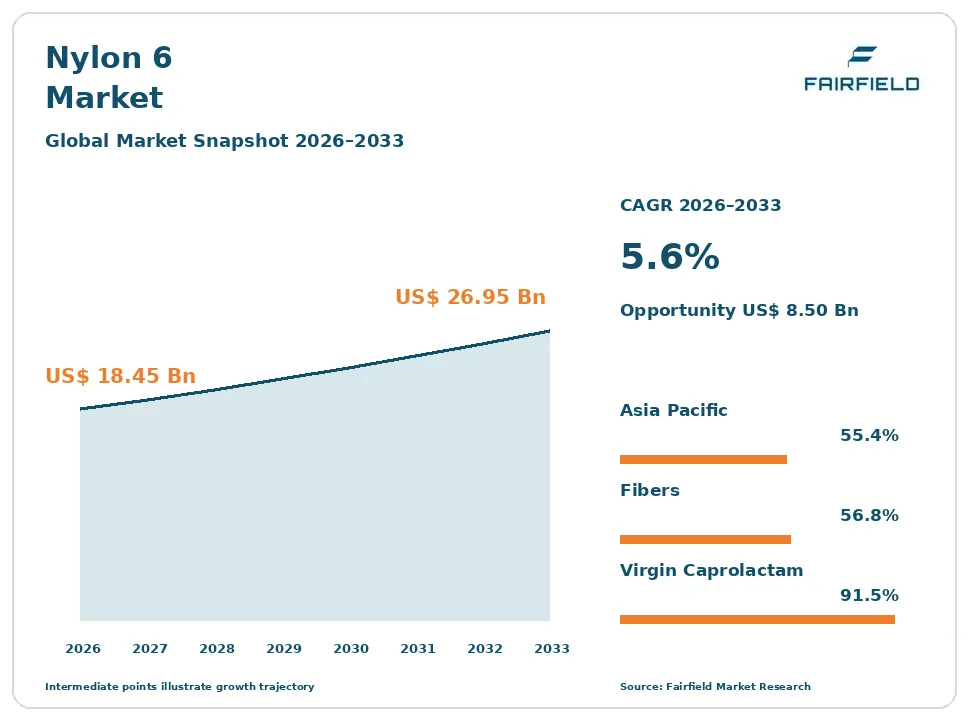
The global nylon 6 market size is expected to be valued at US$ 18.45 billion in 2026 and projected to reach US$ 26.95 billion by 2033, growing at a CAGR of 5.6% between 2026 and 2033.
Between 2020 and 2025, the market grew at a CAGR of about 4.3%, recovering from the 2020 drop in textile and car production, then facing weak demand and overcapacity in China during 2023 and 2024. Three factors now drive growth: demand for strong, light engineering plastics in vehicles and electronics, steady use of polyamide 6 fibers in apparel, carpets, and industrial yarns, and new capacity in Asia Pacific. The market is shifting toward recycled nylon from fishing nets, carpets, and textile waste, along with bio-based and mass-balanced grades. Caprolactam producers are adding chemical recycling routes, while compounders develop glass-filled and flame-retardant grades for automotive lightweighting and electric vehicles.
Key Report Takeaways
- By Product Form: Fibers held 56.8% share in 2026, while Engineering Resins are projected to expand at a 6.6% CAGR through 2033, driven by metal replacement in vehicles, electrical parts, and consumer goods.
- By Application: Textiles & Apparel held 34.5% share in 2026, while Automotive is projected to expand at a 6.9% CAGR through 2033, driven by lightweight parts and electric vehicle components.
- By Feedstock: Virgin Caprolactam held 91.5% share in 2026, while Recycled & Bio-based is projected to expand at a 14.2% CAGR through 2033, driven by brand sustainability targets and textile waste recycling.
- By Region: Asia Pacific held 55.4% share in 2026, while India is projected to expand at a 7.4% CAGR through 2033, driven by textile, automotive, and electronics manufacturing growth.
Global Nylon 6 Market Trends and Insights
Drivers Impact Analysis
Two drivers carry the strongest influence on nylon 6 demand during the forecast period.
| Driver | Impact on CAGR Forecast | Geographic Relevance | Impact Timeline |
| Automotive lightweighting and electrification | High | Asia Pacific, Europe, North America | Long term (≥4 years) |
| Textile and industrial fiber demand | High | Asia Pacific | Medium term (2-4 years) |
Automotive Lightweighting Is Driving the Nylon 6 Market
Automotive lightweighting and electrification are the strongest driver of the nylon 6 market. Carmakers replace metal parts with plastics to cut weight and cost.
The mechanism is fuel economy rules, emission targets, and electric vehicle range. Every 10% reduction in vehicle weight can improve fuel economy by about 6% to 8%. Glass-filled polyamide 6 replaces aluminum and steel in engine covers, air intake manifolds, brackets, pedals, and seat structures. Electric vehicles use nylon 6 in battery housings, connectors, cable ties, and charging components because it offers heat resistance and electrical insulation. Flame-retardant grades meet safety standards for high-voltage parts. Production of electric vehicles in China, Europe, and the United States keeps rising. Thermal management parts and cable systems in electric cars add further volume. These factors support strong demand for nylon 6 engineering plastics.
Textile and Industrial Fiber Demand Is Expanding the Nylon 6 Market
Textile and industrial fiber demand is expanding the nylon 6 market. Nylon 6 yarns are strong, elastic, and easy to dye.
The cause is rising consumption of apparel, sportswear, carpets, and technical textiles. Activewear, swimwear, hosiery, and lingerie use fine nylon 6 filament for softness and stretch. Carpet makers use bulked continuous filament for durability. Industrial yarns go into tire cord, fishing nets, ropes, airbags, and conveyor belts. China is the world’s largest producer of nylon 6 chips and yarn, and India, Vietnam, and Bangladesh are expanding garment production. Rising incomes in Asia Pacific increase demand for clothing and home textiles. Outdoor and athleisure trends support premium fibers, and airbag and tire cord demand rises with vehicle output. Technical textiles for filtration, geotextiles, and protective clothing also use nylon 6. These trends sustain volume growth in fiber applications.
Restraints Impact Analysis
Two restraints limit how quickly the nylon 6 market grows.
| Restraint | Impact on CAGR Forecast | Geographic Relevance | Impact Timeline |
| Raw material price volatility and overcapacity | High | Global | Short term (≤2 years) |
| Competition from polyester and other polymers | Medium | Asia Pacific, Europe | Medium term (2-4 years) |
Price Volatility and Overcapacity Slow the Nylon 6 Market
Raw material price volatility and overcapacity slow the nylon 6 market. Caprolactam prices follow benzene, cyclohexane, and energy costs.
The specific causes are feedstock swings and rapid capacity growth. Benzene and natural gas prices rose sharply in 2022, then fell, causing large swings in nylon 6 prices. China added large caprolactam and polymer capacity in recent years, creating oversupply and pushing prices below costs for many producers. Producers in Europe face high energy costs and have cut output or closed lines. BASF announced several price increases for caprolactam and polyamide in North America in 2025 and 2026 to offset costs. Margin pressure delays investment in new plants. Trade disputes and anti-dumping duties add uncertainty. Some older plants in Europe and Japan have closed because they cannot compete. These factors slow value growth and hurt profitability.
Polymer Competition Restricts the Nylon 6 Market
Competition from polyester and other polymers restricts the nylon 6 market. Many applications can use cheaper or alternative materials.
The underlying causes are cost differences and material performance trade-offs. Polyester fiber is cheaper than nylon 6 and dominates apparel, so many brands choose it for basic garments. Polypropylene competes in carpets and some automotive parts. Nylon 6,6 offers higher heat resistance for demanding engine applications. Polybutylene terephthalate and polyphenylene sulfide compete in electrical parts. Nylon 6 absorbs moisture, which can change its dimensions and properties, limiting some uses. Recycled polyester has a larger and cheaper supply than recycled nylon. Bio-based polymers and new specialty polyamides also target some premium uses. Customers often switch materials when price gaps widen. These factors cap nylon 6 share in price-sensitive markets.
Market Opportunities
Recycled and Circular Nylon 6 Open a Premium Revenue Pool
Recycled nylon and circular polyamide 6 open a premium revenue pool in the nylon 6 market. Fashion and auto brands want lower-carbon materials.
Producers with chemical recycling technology can capture this opportunity. Nylon 6 can be depolymerized back to caprolactam and repolymerized with near-virgin quality. Aquafil makes ECONYL from fishing nets and carpets. BASF opened a commercial plant in Shanghai in 2025 for loopamid, made from textile waste, and partnered with Lindex on lingerie in 2026. Car makers in Europe target higher recycled content under proposed end-of-life vehicle rules. Brands pay premiums for certified recycled yarn. Bio-based feedstocks and mass-balanced grades offer additional differentiation. Take-back programs for carpets, nets, and garments secure waste supply, and digital product passports in Europe will reward traceable recycled content.
India and Emerging Asia Pacific Markets Create a Volume Revenue Pool
Manufacturing growth in India and other emerging Asia Pacific markets creates a volume revenue pool in the nylon 6 market. These countries are expanding textile, auto, and electronics production.
Producers and compounders with local plants can capture this opportunity. India has government incentive schemes for technical textiles, automobiles, and electronics. Car production in India passed 5 million units a year, raising demand for engineering resins. Vietnam, Indonesia, and Bangladesh are expanding garment and footwear exports. Thailand is building an electric vehicle supply chain. Local nylon 6 capacity is limited in several of these countries, so imports fill gaps. New polymerization and compounding plants can serve fast-growing local demand, cut freight costs, and shorten lead times. Partnerships with local yarn spinners and auto parts suppliers help secure offtake.
Segment Analysis
By Product Form: Fibers Lead While Engineering Resins Grow Fastest
Fibers held 56.8% share in 2026. Nylon 6 fibers include textile filament yarn for apparel, bulked continuous filament for carpets, and high-tenacity industrial yarn for tire cord, airbags, ropes, and fishing nets. China dominates fiber production, with large integrated producers such as Highsun Holding Group. Fibers benefit from nylon’s strength, elasticity, and dye uptake. Films serve food packaging, where nylon 6 provides oxygen barrier and puncture resistance.
Engineering Resins are the fastest-growing product form, expanding at a 6.6% CAGR through 2033. Nylon 6 resins are injection molded into car parts, electrical connectors, power tool housings, and appliance components. Glass-fiber reinforcement raises stiffness and heat resistance. BASF, Domo, Lanxess, and Envalior supply branded engineering plastics. Electrical and electronics makers use flame-retardant grades for circuit breakers and connectors. For the market, resin growth adds higher-value sales.
By Application: Textiles & Apparel Lead While Automotive Grows Fastest
Textiles & Apparel held 34.5% share in 2026. Activewear, swimwear, hosiery, lingerie, and outdoor garments use nylon 6 for softness, stretch, and durability. Carpets and home furnishings add large volumes. Brands increasingly specify recycled nylon to meet sustainability goals. Industrial uses, electrical and electronics, packaging films, and consumer goods form other major applications.
Automotive is the fastest-growing application, expanding at a 6.9% CAGR through 2033. Nylon 6 is used in air intake manifolds, engine covers, radiator end tanks, fuel lines, seat parts, and door handles. Automotive lightweighting and electric vehicles increase plastic content per car. Battery modules, connectors, and charging parts need heat-resistant and flame-retardant grades. Thermal management systems and lightweight seat frames add new uses. For the market, automotive growth supports demand for high-performance compounds.
By Feedstock: Virgin Caprolactam Leads While Recycled & Bio-based Grows Fastest
Virgin Caprolactam held 91.5% share in 2026. Most nylon 6 is made by polymerizing caprolactam produced from benzene through cyclohexanone. Large integrated producers in China, Europe, Japan, South Korea, and the United States make caprolactam and polymer at the same site, lowering costs. AdvanSix, UBE Corporation, BASF, and Domo are major producers outside China.
Recycled & Bio-based is the fastest-growing feedstock, expanding at a 14.2% CAGR through 2033. This includes mechanically and chemically recycled nylon from industrial waste, carpets, fishing nets, and textiles, along with bio-based and mass-balanced grades. Fashion brands and car makers set recycled content targets. Aquafil and BASF lead in chemical recycling. For the market, recycled growth adds premium value.
Geography Analysis
North America Advances the Nylon 6 Market Through Automotive and Carpets
North America is a significant nylon 6 market with strong demand from automotive, carpets, packaging, and industrial uses. The United States has large carpet production in Georgia and major caprolactam and polymer plants operated by AdvanSix in Virginia and BASF in Texas. Car production in the United States and Mexico uses glass-filled nylon 6 compounds. Canada adds demand from packaging and automotive parts, and food processors use nylon 6 films for meat and cheese packaging. Electric vehicle and battery plants are increasing demand for heat-resistant grades. Nylon recycling programs for carpets are expanding. One change shaping the region is reshoring of manufacturing.
Europe Builds the Nylon 6 Market Through Recycling and Engineering Plastics
Europe is a mature nylon 6 market focused on engineering plastics and recycling. Germany, Italy, France, Spain, and Poland have strong automotive and electrical industries using nylon 6 compounds. BASF, Lanxess, Domo, Envalior, and Aquafil are major producers. High energy costs have pressured caprolactam production, leading to capacity cuts and restructuring, including a proposed joint venture between BASF and HSCC in 2026. European Union rules on recycled content support circular nylon, and textile collection rules from 2025 increase waste supply. Key barriers include energy costs and imports. One opportunity is chemical recycling.
Which Region Is Leading the Nylon 6 Market?
Asia Pacific is leading the nylon 6 market with a 55.4% share in 2026. China is the largest producer and consumer, with huge caprolactam, polymer, and fiber capacity serving textile, carpet, tire cord, and engineering plastic markets. Japan, South Korea, and Taiwan host major producers such as UBE Corporation, Toray Industries, and Kolon Industries. Vietnam, Indonesia, and Thailand are expanding garment and auto production. The region benefits from integrated supply chains, low-cost benzene, and large domestic markets. Electric vehicle production in China is the largest in the world. One change shaping the region is consolidation after Chinese overcapacity.
Which Country Is Growing Fastest in the Nylon 6 Market?
India is growing fastest in the nylon 6 market at a 7.4% CAGR through 2033, within Asia Pacific. India is expanding textile and technical textile production under government incentive schemes, and car output has passed 5 million units a year. Electronics manufacturing in Tamil Nadu, Karnataka, and Uttar Pradesh is growing rapidly. Domestic caprolactam capacity at GSFC is limited, so imports from China and other countries fill most demand. Nylon filament yarn producers in Gujarat and Maharashtra serve apparel, hosiery, and industrial uses, and fishing net demand is rising in coastal states. One opportunity is new local polymer capacity.
Latin America Grows the Nylon 6 Market Through Automotive and Textiles
Latin America is a growing nylon 6 market. Mexico has a large automotive industry that uses nylon 6 compounds and is gaining investment from nearshoring. Brazil produces nylon yarn for apparel, hosiery, and tire cord, and has a large auto sector. Argentina, Colombia, and Peru add textile, fishing net, and packaging demand. Food packaging films use nylon 6 for meat and cheese exports from Brazil and Argentina. Tire makers in Brazil and Mexico use nylon tire cord. Key barriers include currency swings, high interest rates, and import dependence. One opportunity is nearshored auto parts and wiring production.
Middle East & Africa Builds the Nylon 6 Market
Middle East & Africa is an emerging nylon 6 market. Saudi Arabia has petrochemical producers that make benzene and could support caprolactam production. The United Arab Emirates and Saudi Arabia use nylon 6 in construction, packaging, and consumer goods. South Africa and Morocco have growing auto industries that use engineering resins. Egypt and Ethiopia are expanding textile production for export to Europe, and Morocco has a growing auto parts and wiring harness industry that uses nylon 6 parts. Key barriers include limited local polymer capacity, import dependence, and small downstream industries. One opportunity is textile and auto supply chains.
Competitive Landscape
The nylon 6 market is moderately concentrated. BASF, UBE Corporation, Toray Industries, AdvanSix, Domo, Lanxess, Envalior, and Aquafil compete with large Chinese producers such as Highsun Holding Group, Sinopec, and Fujian Shenyuan. Fiber producers such as Hyosung, Kolon Industries, and Nilit add downstream competition.
Companies compete on cost, integration from caprolactam to polymer, product quality, specialty grades, technical support, and sustainability credentials. Integrated producers with low-cost benzene and energy have a strong advantage. Compounders differentiate through glass-filled, flame-retardant, and impact-modified grades for automotive and electrical customers. Recycled and bio-based offerings are becoming key differentiators with fashion and auto brands. Chinese producers compete mainly on scale and price in fibers and chips, while Western and Japanese firms focus on specialty grades. Trade duties and logistics costs shape regional competition.
Strategic moves show how competition is changing. In March 2025, BASF started its first commercial loopamid plant in Shanghai. In May 2026, Lone Star Funds acquired Domo Engineered Materials and its Technyl brand, and Lindex and BASF introduced loopamid lingerie. In October 2026, BASF and HSCC signed a memorandum to explore a joint venture for European polyamide 6 activities. These moves show competition shifting toward restructuring in Europe and circular materials.
Three themes shape vendor strategy. First, producers in Europe are consolidating and restructuring to cut energy and fixed costs. Second, companies are investing in recycled and bio-based nylon to meet brand targets. Third, they are expanding specialty compounds for electric vehicles and electronics.
Nylon 6 Market Industry Leaders
BASF UBE Corporation Toray Industries Highsun Holding Group AdvanSix
Recent Industry Developments
- October 2026: BASF and HSCC signed a memorandum of understanding to explore a 50:50 joint venture for European polyamide 6 activities - aims to restore competitiveness in Europe.
- May 2026: Lone Star Funds acquired Domo Engineered Materials, including the Technyl brand - reshapes ownership of a key polyamide producer.
- May 2026: Lindex and BASF introduced loopamid recycled polyamide 6 for lingerie - brings textile-to-textile recycled nylon into apparel.
- March 2025: BASF began operating the first commercial loopamid plant in Shanghai with 500 tonnes per year capacity - scales textile waste recycling into nylon 6.
Companies Covered in the Report
- BASF
- UBE Corporation
- Toray Industries
- Highsun Holding Group
- AdvanSix
- Domo Chemicals
- Lanxess
- Envalior
- Aquafil
- Sinopec
- Hyosung
- Kolon Industries
Nylon 6 Market Report Scope
This report covers nylon 6, also called polyamide 6, made from caprolactam, in fiber, engineering resin, and film forms, from virgin, recycled, and bio-based feedstocks, used in textiles and apparel, automotive, electrical and electronics, industrial, packaging, and consumer goods. It excludes nylon 6,6, specialty polyamides, and caprolactam sold separately. The base year is 2025, and the forecast period runs from 2026 to 2033. All values are expressed in US$ Billion.
Product Form
- Fibers
- Engineering Resins
- Films
Application
- Textiles & Apparel
- Automotive
- Electrical & Electronics
- Industrial
- Packaging
- Consumer Goods
Feedstock
- Virgin Caprolactam
- Recycled & Bio-based
Regions
- North America
- Europe
- Asia Pacific
- Latin America
- Middle East & Africa
Key Questions Answered in the Report
How big is the nylon 6 market in 2026?
The nylon 6 market is valued at US$ 18.45 billion in 2026, led by fibers for textiles, carpets, and industrial yarns.
What is the nylon 6 market forecast to 2033?
The nylon 6 market is projected to reach US$ 26.95 billion by 2033, growing at a 5.6% CAGR and adding US$ 8.50 billion.
Which application is growing fastest in the nylon 6 market?
Automotive is growing fastest at a 6.9% CAGR through 2033, driven by lightweight metal-replacement parts and electric vehicle components.
Which country is growing fastest in the nylon 6 market?
India is growing fastest at a 7.4% CAGR through 2033, driven by rapid growth in textile, automotive, and electronics manufacturing.
Which region holds the largest nylon 6 market share?
Asia Pacific holds the largest share at 55.4% in 2026, supported by large-scale China production and integrated supply chains.
1. Executive Summary
1.1. Global Nylon 6 Market Snapshot
1.2. Future Projections
1.3. Key Report Takeaways
1.4. Regional Snapshot
2. Market Overview
2.1. Market Definition and Report Scope
2.2. Historical Trends 2020–2025
2.3. Market Dynamics
2.3.1. Drivers
2.3.1.1. Automotive Lightweighting Is Driving the Nylon 6 Market
2.3.1.2. Textile and Industrial Fiber Demand Is Expanding the Nylon 6 Market
2.3.2. Restraints
2.3.2.1. Price Volatility and Overcapacity Slow the Nylon 6 Market
2.3.2.2. Polymer Competition Restricts the Nylon 6 Market
2.3.3. Market Opportunities
2.3.3.1. Recycled and Circular Nylon 6 Open a Premium Revenue Pool
2.3.3.2. India and Emerging Asia Pacific Markets Create a Volume Revenue Pool
3. Global Nylon 6 Market Outlook, 2020-2033
3.1. Global Nylon 6 Market Outlook, by Product Form, Value (US$ Billion), 2020-2033
3.1.1. Fibers
3.1.2. Engineering Resins
3.1.3. Films
3.2. Global Nylon 6 Market Outlook, by Application, Value (US$ Billion), 2020-2033
3.2.1. Textiles & Apparel
3.2.2. Automotive
3.2.3. Electrical & Electronics
3.2.4. Industrial
3.2.5. Packaging
3.2.6. Consumer Goods
3.3. Global Nylon 6 Market Outlook, by Feedstock, Value (US$ Billion), 2020-2033
3.3.1. Virgin Caprolactam
3.3.2. Recycled & Bio-based
3.4. Global Nylon 6 Market Outlook, by Region, Value (US$ Billion), 2020-2033
3.4.1. North America
3.4.2. Europe
3.4.3. Asia Pacific
3.4.4. Latin America
3.4.5. Middle East & Africa
4. North America Nylon 6 Market Outlook, 2020-2033
4.1. North America Nylon 6 Market Outlook, by Product Form, Value (US$ Billion), 2020-2033
4.1.1. Fibers
4.1.2. Engineering Resins
4.1.3. Films
4.2. North America Nylon 6 Market Outlook, by Application, Value (US$ Billion), 2020-2033
4.2.1. Textiles & Apparel
4.2.2. Automotive
4.2.3. Electrical & Electronics
4.2.4. Industrial
4.2.5. Packaging
4.2.6. Consumer Goods
4.3. North America Nylon 6 Market Outlook, by Feedstock, Value (US$ Billion), 2020-2033
4.3.1. Virgin Caprolactam
4.3.2. Recycled & Bio-based
4.4. North America Nylon 6 Market Outlook, by Country, Value (US$ Billion), 2020-2033
4.4.1. United States Nylon 6 Market Outlook, by Product Form, 2020-2033
4.4.2. United States Nylon 6 Market Outlook, by Application, 2020-2033
4.4.3. United States Nylon 6 Market Outlook, by Feedstock, 2020-2033
4.4.4. Mexico Nylon 6 Market Outlook, by Product Form, 2020-2033
4.4.5. Mexico Nylon 6 Market Outlook, by Application, 2020-2033
4.4.6. Mexico Nylon 6 Market Outlook, by Feedstock, 2020-2033
4.4.7. Canada Nylon 6 Market Outlook, by Product Form, 2020-2033
4.4.8. Canada Nylon 6 Market Outlook, by Application, 2020-2033
4.4.9. Canada Nylon 6 Market Outlook, by Feedstock, 2020-2033
5. Europe Nylon 6 Market Outlook, 2020-2033
5.1. Europe Nylon 6 Market Outlook, by Product Form, Value (US$ Billion), 2020-2033
5.1.1. Fibers
5.1.2. Engineering Resins
5.1.3. Films
5.2. Europe Nylon 6 Market Outlook, by Application, Value (US$ Billion), 2020-2033
5.2.1. Textiles & Apparel
5.2.2. Automotive
5.2.3. Electrical & Electronics
5.2.4. Industrial
5.2.5. Packaging
5.2.6. Consumer Goods
5.3. Europe Nylon 6 Market Outlook, by Feedstock, Value (US$ Billion), 2020-2033
5.3.1. Virgin Caprolactam
5.3.2. Recycled & Bio-based
5.4. Europe Nylon 6 Market Outlook, by Country, Value (US$ Billion), 2020-2033
5.4.1. Germany Nylon 6 Market Outlook, by Product Form, 2020-2033
5.4.2. Germany Nylon 6 Market Outlook, by Application, 2020-2033
5.4.3. Germany Nylon 6 Market Outlook, by Feedstock, 2020-2033
5.4.4. Italy Nylon 6 Market Outlook, by Product Form, 2020-2033
5.4.5. Italy Nylon 6 Market Outlook, by Application, 2020-2033
5.4.6. Italy Nylon 6 Market Outlook, by Feedstock, 2020-2033
5.4.7. France Nylon 6 Market Outlook, by Product Form, 2020-2033
5.4.8. France Nylon 6 Market Outlook, by Application, 2020-2033
5.4.9. France Nylon 6 Market Outlook, by Feedstock, 2020-2033
5.4.10. Spain Nylon 6 Market Outlook, by Product Form, 2020-2033
5.4.11. Spain Nylon 6 Market Outlook, by Application, 2020-2033
5.4.12. Spain Nylon 6 Market Outlook, by Feedstock, 2020-2033
5.4.13. Poland Nylon 6 Market Outlook, by Product Form, 2020-2033
5.4.14. Poland Nylon 6 Market Outlook, by Application, 2020-2033
5.4.15. Poland Nylon 6 Market Outlook, by Feedstock, 2020-2033
6. Asia Pacific Nylon 6 Market Outlook, 2020-2033
6.1. Asia Pacific Nylon 6 Market Outlook, by Product Form, Value (US$ Billion), 2020-2033
6.1.1. Fibers
6.1.2. Engineering Resins
6.1.3. Films
6.2. Asia Pacific Nylon 6 Market Outlook, by Application, Value (US$ Billion), 2020-2033
6.2.1. Textiles & Apparel
6.2.2. Automotive
6.2.3. Electrical & Electronics
6.2.4. Industrial
6.2.5. Packaging
6.2.6. Consumer Goods
6.3. Asia Pacific Nylon 6 Market Outlook, by Feedstock, Value (US$ Billion), 2020-2033
6.3.1. Virgin Caprolactam
6.3.2. Recycled & Bio-based
6.4. Asia Pacific Nylon 6 Market Outlook, by Country, Value (US$ Billion), 2020-2033
6.4.1. China Nylon 6 Market Outlook, by Product Form, 2020-2033
6.4.2. China Nylon 6 Market Outlook, by Application, 2020-2033
6.4.3. China Nylon 6 Market Outlook, by Feedstock, 2020-2033
6.4.4. Japan Nylon 6 Market Outlook, by Product Form, 2020-2033
6.4.5. Japan Nylon 6 Market Outlook, by Application, 2020-2033
6.4.6. Japan Nylon 6 Market Outlook, by Feedstock, 2020-2033
6.4.7. South Korea Nylon 6 Market Outlook, by Product Form, 2020-2033
6.4.8. South Korea Nylon 6 Market Outlook, by Application, 2020-2033
6.4.9. South Korea Nylon 6 Market Outlook, by Feedstock, 2020-2033
6.4.10. Taiwan Nylon 6 Market Outlook, by Product Form, 2020-2033
6.4.11. Taiwan Nylon 6 Market Outlook, by Application, 2020-2033
6.4.12. Taiwan Nylon 6 Market Outlook, by Feedstock, 2020-2033
6.4.13. Vietnam Nylon 6 Market Outlook, by Product Form, 2020-2033
6.4.14. Vietnam Nylon 6 Market Outlook, by Application, 2020-2033
6.4.15. Vietnam Nylon 6 Market Outlook, by Feedstock, 2020-2033
6.4.16. Indonesia Nylon 6 Market Outlook, by Product Form, 2020-2033
6.4.17. Indonesia Nylon 6 Market Outlook, by Application, 2020-2033
6.4.18. Indonesia Nylon 6 Market Outlook, by Feedstock, 2020-2033
6.4.19. Thailand Nylon 6 Market Outlook, by Product Form, 2020-2033
6.4.20. Thailand Nylon 6 Market Outlook, by Application, 2020-2033
6.4.21. Thailand Nylon 6 Market Outlook, by Feedstock, 2020-2033
6.4.22. India Nylon 6 Market Outlook, by Product Form, 2020-2033
6.4.23. India Nylon 6 Market Outlook, by Application, 2020-2033
6.4.24. India Nylon 6 Market Outlook, by Feedstock, 2020-2033
7. Latin America Nylon 6 Market Outlook, 2020-2033
7.1. Latin America Nylon 6 Market Outlook, by Product Form, Value (US$ Billion), 2020-2033
7.1.1. Fibers
7.1.2. Engineering Resins
7.1.3. Films
7.2. Latin America Nylon 6 Market Outlook, by Application, Value (US$ Billion), 2020-2033
7.2.1. Textiles & Apparel
7.2.2. Automotive
7.2.3. Electrical & Electronics
7.2.4. Industrial
7.2.5. Packaging
7.2.6. Consumer Goods
7.3. Latin America Nylon 6 Market Outlook, by Feedstock, Value (US$ Billion), 2020-2033
7.3.1. Virgin Caprolactam
7.3.2. Recycled & Bio-based
7.4. Latin America Nylon 6 Market Outlook, by Country, Value (US$ Billion), 2020-2033
7.4.1. Mexico Nylon 6 Market Outlook, by Product Form, 2020-2033
7.4.2. Mexico Nylon 6 Market Outlook, by Application, 2020-2033
7.4.3. Mexico Nylon 6 Market Outlook, by Feedstock, 2020-2033
7.4.4. Brazil Nylon 6 Market Outlook, by Product Form, 2020-2033
7.4.5. Brazil Nylon 6 Market Outlook, by Application, 2020-2033
7.4.6. Brazil Nylon 6 Market Outlook, by Feedstock, 2020-2033
7.4.7. Argentina Nylon 6 Market Outlook, by Product Form, 2020-2033
7.4.8. Argentina Nylon 6 Market Outlook, by Application, 2020-2033
7.4.9. Argentina Nylon 6 Market Outlook, by Feedstock, 2020-2033
7.4.10. Colombia Nylon 6 Market Outlook, by Product Form, 2020-2033
7.4.11. Colombia Nylon 6 Market Outlook, by Application, 2020-2033
7.4.12. Colombia Nylon 6 Market Outlook, by Feedstock, 2020-2033
7.4.13. Peru Nylon 6 Market Outlook, by Product Form, 2020-2033
7.4.14. Peru Nylon 6 Market Outlook, by Application, 2020-2033
7.4.15. Peru Nylon 6 Market Outlook, by Feedstock, 2020-2033
8. Middle East & Africa Nylon 6 Market Outlook, 2020-2033
8.1. Middle East & Africa Nylon 6 Market Outlook, by Product Form, Value (US$ Billion), 2020-2033
8.1.1. Fibers
8.1.2. Engineering Resins
8.1.3. Films
8.2. Middle East & Africa Nylon 6 Market Outlook, by Application, Value (US$ Billion), 2020-2033
8.2.1. Textiles & Apparel
8.2.2. Automotive
8.2.3. Electrical & Electronics
8.2.4. Industrial
8.2.5. Packaging
8.2.6. Consumer Goods
8.3. Middle East & Africa Nylon 6 Market Outlook, by Feedstock, Value (US$ Billion), 2020-2033
8.3.1. Virgin Caprolactam
8.3.2. Recycled & Bio-based
8.4. Middle East & Africa Nylon 6 Market Outlook, by Country, Value (US$ Billion), 2020-2033
8.4.1. Saudi Arabia Nylon 6 Market Outlook, by Product Form, 2020-2033
8.4.2. Saudi Arabia Nylon 6 Market Outlook, by Application, 2020-2033
8.4.3. Saudi Arabia Nylon 6 Market Outlook, by Feedstock, 2020-2033
8.4.4. United Arab Emirates Nylon 6 Market Outlook, by Product Form, 2020-2033
8.4.5. United Arab Emirates Nylon 6 Market Outlook, by Application, 2020-2033
8.4.6. United Arab Emirates Nylon 6 Market Outlook, by Feedstock, 2020-2033
8.4.7. South Africa Nylon 6 Market Outlook, by Product Form, 2020-2033
8.4.8. South Africa Nylon 6 Market Outlook, by Application, 2020-2033
8.4.9. South Africa Nylon 6 Market Outlook, by Feedstock, 2020-2033
8.4.10. Morocco Nylon 6 Market Outlook, by Product Form, 2020-2033
8.4.11. Morocco Nylon 6 Market Outlook, by Application, 2020-2033
8.4.12. Morocco Nylon 6 Market Outlook, by Feedstock, 2020-2033
8.4.13. Egypt Nylon 6 Market Outlook, by Product Form, 2020-2033
8.4.14. Egypt Nylon 6 Market Outlook, by Application, 2020-2033
8.4.15. Egypt Nylon 6 Market Outlook, by Feedstock, 2020-2033
8.4.16. Ethiopia Nylon 6 Market Outlook, by Product Form, 2020-2033
8.4.17. Ethiopia Nylon 6 Market Outlook, by Application, 2020-2033
8.4.18. Ethiopia Nylon 6 Market Outlook, by Feedstock, 2020-2033
9. Competitive Landscape
9.1. Market Concentration and Industry Leaders
9.2. Competitive Differentiation
9.3. Strategic Moves and Market Direction
9.4. Recent Industry Developments
9.5. Company Profiles
9.5.1. BASF
9.5.2. UBE Corporation
9.5.3. Toray Industries
9.5.4. Highsun Holding Group
9.5.5. AdvanSix
9.5.6. Domo Chemicals
9.5.7. Lanxess
9.5.8. Envalior
9.5.9. Aquafil
9.5.10. Sinopec
9.5.11. Hyosung
9.5.12. Kolon Industries
10. Appendix
10.1. Research Methodology
10.2. Report Assumptions
10.3. Acronyms and Abbreviations
| Product Form | Fibers, Engineering Resins, Films |
| Application | Textiles & Apparel, Automotive, Electrical & Electronics, Industrial, Packaging, Consumer Goods |
| Feedstock | Virgin Caprolactam, Recycled & Bio-based |
| Regions | North America, Europe, Asia Pacific, Latin America, Middle East & Africa |
Our Research Methodology
Considering the volatility of business today, traditional approaches to strategizing a game plan can be unfruitful if not detrimental. True ambiguity is no way to determine a forecast. A myriad of predetermined factors must be accounted for such as the degree of risk involved, the magnitude of circumstances, as well as conditions or consequences that are not known or unpredictable. To circumvent binary views that cast uncertainty, the application of market research intelligence to strategically posture, move, and enable actionable outcomes is necessary.
View Methodology
Quality Assured
Rigorous Validation Process

Confidentiality Assured
End-to-end Data Security

Custom Research Services
Tailored To Your Objectives
FAQs
The nylon 6 market is valued at US$ 18.45 billion in 2026, led by fibers for textiles, carpets, and industrial yarns.
The nylon 6 market is projected to reach US$ 26.95 billion by 2033, growing at a 5.6% CAGR and adding US$ 8.50 billion.
Automotive is growing fastest at a 6.9% CAGR through 2033, driven by lightweight metal-replacement parts and electric vehicle components.
India is growing fastest at a 7.4% CAGR through 2033, driven by rapid growth in textile, automotive, and electronics manufacturing.
Asia Pacific holds the largest share at 55.4% in 2026, supported by large-scale China production and integrated supply chains.
Related Reports
On The Go Packaging Market Size, Share, Insights, Competitive Landscape, and Forecast 2026 to 2033
On the go packaging market to grow from US$2.19 Bn in 2026 to US$3.00 Bn by 2033 at 4.6% CAGR. Explore materials, products, applications and regions.
Vitamin A-Acetate Market Size, Share, Insights, Competitive Landscape, and Forecast 2026 to 2033
Vitamin A-acetate market to reach US$ 2.68 billion by 2033 at a 5.9% CAGR. Explore forms, grades, applications, leading companies and regional trends.
Spinosad Active Ingredient Market Size, Share, Insights, Competitive Landscape, and Forecast 2026 to 2033
Spinosad active ingredient market to reach US$ 1.257 billion by 2033 at an 8.6% CAGR. Explore forms, crops, applications, companies and regional trends.
D-Psicose (Allulose) Market Size, Share, Insights, Competitive Landscape, and Forecast 2026 to 2033
D-psicose (allulose) market to reach US$ 0.749 billion by 2033 at a 15.7% CAGR. Explore forms, applications, sales channels and regional trends.
Butter Packaging Market Size, Share, Insights, Competitive Landscape, and Forecast 2026 to 2033
Butter packaging market to reach US$ 4.83 billion by 2033 at a 6.4% CAGR. Explore materials, packaging types, end uses and regional trends.
Plastic Films and Sheets Market Size, Share, Insights, Competitive Landscape, and Forecast 2026 to 2033
Plastic films and sheets market to reach US$ 237.30 billion by 2033 at a 6.0% CAGR. Explore product types, end uses and regional trends.