



On The Go Packaging Market
On The Go Packaging Market Size, Share, Insights, Competitive Landscape, and Forecast 2026 to 2033
On The Go Packaging Market Analysis, 2026–2033
On The Go Packaging Market
On The Go Packaging Market Size, Share, Insights, Competitive Landscape, and Forecast 2026 to 2033
On The Go Packaging Market Size and Trend Analysis
How Fast Is the On The Go Packaging Market Growing?
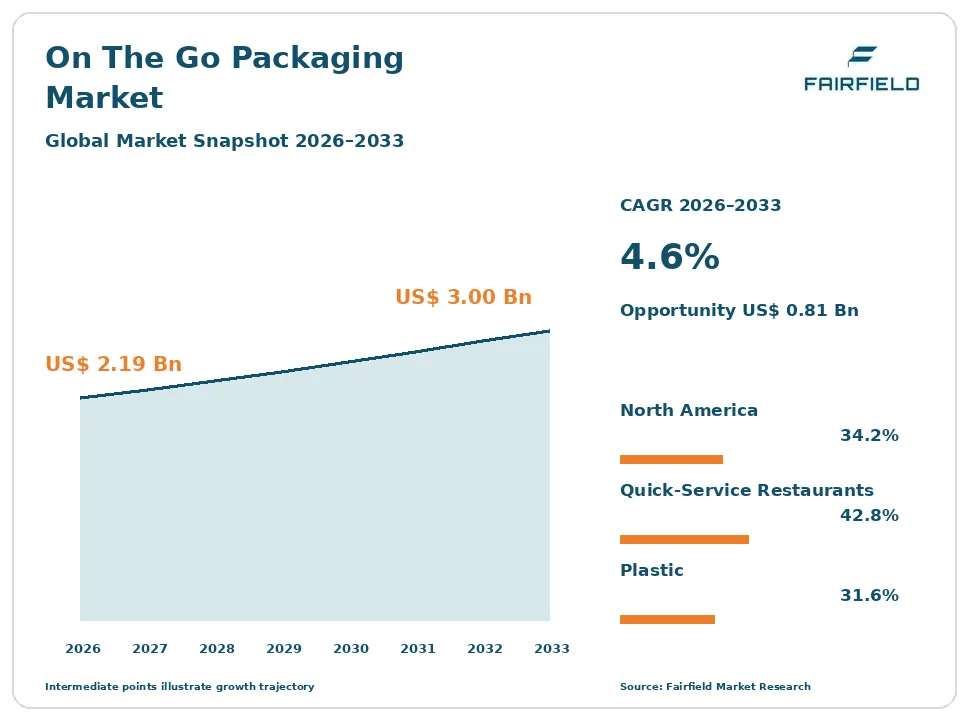
The global on the go packaging market size is expected to be valued at US$ 2.19 billion in 2026 and projected to reach US$ 3.00 billion by 2033, growing at a CAGR of 4.6% between 2026 and 2033.
Between 2020 and 2025, the market grew at a CAGR of about 3.4%, as pandemic lockdowns cut commuter and café sales in 2020, then food delivery packaging and takeaway demand surged and kept growing after reopening. Three factors drive growth: busy urban lifestyles that favor quick meals and snacks, the expansion of quick-service restaurants and delivery apps, and rising demand for single-serve packaging in beverages, dairy, and snacks. The market is shifting from single-use plastic toward paper-based packaging, mono-material flexible pouches, and recyclable packaging that meets new laws in Europe, India, and parts of the United States. Brands also want packs that are easy to open, reseal, and carry.
Key Report Takeaways
- By Material: Plastic held 31.6% share in 2026, while Paper & Paperboard is projected to expand at a 6.3% CAGR through 2033, driven by plastic bans, deposit rules, and brand recyclability goals.
- By Product Type: Bottles held 27.4% share in 2026, while Bags & Pouches are projected to expand at a 5.9% CAGR through 2033, driven by lightweight snack and drink formats and lower material use.
- By Application: Quick-Service Restaurants held 42.8% share in 2026, while Food Delivery Services are projected to expand at a 5.7% CAGR through 2033, driven by app-based ordering and cloud kitchens.
- By Region: North America held 34.2% share in 2026, while India is projected to expand at an 8.2% CAGR through 2033, driven by urbanization, quick commerce, and fast food chain expansion.
Global On The Go Packaging Market Trends and Insights
Drivers Impact Analysis
| Driver | Impact on CAGR Forecast | Geographic Relevance | Impact Timeline |
| Urban lifestyles and convenience food demand | High | Global | Long term (≥4 years) |
| Quick-service restaurant and food delivery growth | High | Asia Pacific, North America, Latin America | Medium term (2-4 years) |
Two drivers carry the strongest influence on on the go packaging demand during the forecast period.
Convenience Lifestyles Are Driving the On The Go Packaging Market
Urban lifestyles and demand for convenience food are the strongest driver of the on the go packaging market. More people eat and drink while commuting, working, or traveling.
The mechanism is changing work patterns, smaller households, and time pressure. More than half of the world’s population lives in cities, where long commutes and busy schedules leave less time for cooking. Single-person households are growing in Japan, South Korea, Germany, and the United States, raising demand for small portions. Snacking has replaced some traditional meals, especially among younger consumers. Ready-to-drink coffee, protein shakes, yogurt cups, salad bowls, and sandwich packs all need portable packaging. Convenience stores, vending machines, and railway and airport outlets sell large volumes of single-serve packaging. Hybrid work has created new lunchtime and snack occasions near homes. These trends support steady demand for on the go formats.
Food Service Growth Is Expanding the On The Go Packaging Market
Quick-service restaurant and food delivery growth is expanding the on the go packaging market. Every takeaway or delivered meal needs cups, boxes, bags, and lids.
The cause is the rapid spread of fast food chains, coffee shops, and delivery platforms. McDonald’s, Starbucks, KFC, Subway, and local chains keep opening outlets, especially in Asia Pacific, Latin America, and Middle East & Africa. Delivery apps such as Uber Eats, DoorDash, Zomato, Swiggy, and Meituan have made ordering meals simple, while cloud kitchens produce food only for delivery. Food delivery packaging must keep food hot, prevent leaks, and survive transport. Drive-through and pickup orders also increased after the pandemic. Packaging suppliers are developing insulated, vented, and tamper-evident containers. These factors raise packaging volumes per meal and per outlet.
Restraints Impact Analysis
| Restraint | Impact on CAGR Forecast | Geographic Relevance | Impact Timeline |
| Single-use plastic bans and environmental pressure | High | Europe, Asia Pacific, North America | Medium term (2-4 years) |
| Raw material cost volatility | Medium | Global | Short term (≤2 years) |
Two restraints limit how quickly the on the go packaging market grows.
Plastic Regulations Slow the On The Go Packaging Market
Single-use plastic bans and environmental pressure slow the on the go packaging market. On the go packs are a visible part of litter and waste.
The specific causes are new laws and consumer concerns about waste. The European Union Single-Use Plastics Directive banned plastic cutlery, plates, straws, and expanded polystyrene food containers, and the Packaging and Packaging Waste Regulation sets recyclability and reuse targets. India banned many single-use plastic items in 2022. Extended producer responsibility rules in Canada, France, and several United States states make brands pay for collection and recycling. Some cities require reusable cups and containers for dine-in or offer deposit schemes. Redesigning packs to meet new rules raises costs and can reduce performance. Reuse systems may reduce demand for single-use packs over time. These factors slow growth for traditional formats.
Raw Material Costs Restrict the On The Go Packaging Market
Raw material cost volatility restricts the on the go packaging market. Packaging makers depend on resin, paper pulp, aluminum, and energy.
The underlying causes are commodity price swings and supply disruptions. Plastic resin prices follow oil and natural gas, which rose sharply in 2022. Pulp and paperboard prices increased as demand for fiber-based packaging grew, and some mills closed in Europe and North America. Aluminum can prices have been affected by energy costs and trade tariffs. Barrier coatings that make paper packs resistant to grease and moisture add cost. Small converters struggle to pass on price increases to large food service customers with strong buying power. Freight and labor costs also rose. Converting lines for fiber formats need new equipment, adding capital costs. These pressures reduce margins and slow investment in new lines.
Market Opportunities
Fiber-Based and Recyclable Formats Open a Premium Revenue Pool
Paper-based packaging and recyclable packaging open a premium revenue pool in the on the go packaging market. Brands need compliant packs that still perform well.
Converters with fiber-forming, barrier coating, and mono-material technology can capture this opportunity. Molded fiber bowls, paperboard trays, and plastic-free cups replace foam and plastic containers. Coveris launched fiber-based hot-to-go packs in 2024, and Sabert introduced its dual-ovenable Hot2Go container. Mono-material polyethylene and polypropylene flexible pouches are easier to recycle than multi-layer laminates. Water-based and bio-based coatings replace PFAS chemicals, which are being banned in several markets. Brands pay premiums for packs that carry recycling labels and help them meet sustainability targets. Partnerships with quick-service chains create large, stable contracts, and recyclable packaging certified by local schemes eases compliance.
India and Emerging Markets Create a Volume Revenue Pool
Urbanization and food service growth in India and other emerging markets create a volume revenue pool in the on the go packaging market. Large young populations are adopting takeaway and delivery habits.
Packaging makers with local plants can capture this opportunity. India’s quick commerce apps such as Blinkit, Zepto, and Swiggy Instamart deliver snacks and drinks in minutes, and fast food chains are opening hundreds of outlets each year. Indonesia, Vietnam, the Philippines, and Thailand have strong street food and convenience store cultures moving into packaged formats. Brazil and Mexico have large delivery markets. Saudi Arabia and the United Arab Emirates are expanding cafés and delivery. Affordable, compliant packaging made locally reduces costs. Growth in these markets can offset slower demand in mature regions, and local suppliers that meet global chain standards can win long-term contracts.
Segment Analysis
By Material: Plastic Leads While Paper & Paperboard Grows Fastest
Plastic held 31.6% share in 2026. Plastic bottles, cups, clamshells, lids, and flexible pouches are light, strong, clear, and moisture-resistant, making them ideal for drinks, salads, and snacks. PET bottles and polypropylene containers are widely recycled in many countries. Producers such as Amcor, Berry Global, and ALPLA supply rigid and flexible plastic packs, and recycled PET content is rising. Metal cans and glass bottles serve beverages, while aluminum cans are gaining from recycling benefits.
Paper & Paperboard is the fastest-growing material, expanding at a 6.3% CAGR through 2033. Paper-based packaging includes cups, clamshells, boxes, bags, and trays used by coffee shops and fast food chains. Plastic bans and brand goals are shifting packs to fiber. Huhtamaki, Smurfit Westrock, Graphic Packaging International, and Stora Enso are major suppliers. For the market, fiber growth raises value per pack.
By Product Type: Bottles Lead While Bags & Pouches Grow Fastest
Bottles held 27.4% share in 2026. Bottles for water, soft drinks, juices, dairy drinks, and coffee are the most common on the go beverage format. Resealable caps make them easy to carry and drink from over time. Lightweight PET bottles and recycled content are growing. Cups and lids, boxes and cartons, cans, and trays and clamshells form other large product groups.
Bags & Pouches are the fastest-growing product type, expanding at a 5.9% CAGR through 2033. Stand-up flexible pouches with spouts hold baby food, smoothies, yogurt, and energy gels, while snack bags and stick packs serve chips, nuts, and powdered drinks. Pouches use less material than rigid packs and lower shipping costs. Mono-material designs are improving recyclability. For the market, pouch growth supports lightweight, efficient formats.
By Application: Quick-Service Restaurants Lead While Food Delivery Services Grow Fastest
Quick-Service Restaurants held 42.8% share in 2026. Fast food chains and coffee shops use large volumes of cups, lids, sandwich wraps, burger boxes, fry cartons, and carry bags. Global chains set packaging standards that suppliers must meet across many countries. Retail convenience foods, beverages, and dairy also use on the go packs sold through supermarkets and convenience stores.
Food Delivery Services are the fastest-growing application, expanding at a 5.7% CAGR through 2033. Food delivery packaging must protect food during longer trips, keep it at the right temperature, and prevent spills. Cloud kitchens and delivery-only brands buy packaging in bulk. Tamper-evident seals build customer trust. ProAmpac launched the RotiBag in 2024 to replace clamshells. For the market, delivery growth adds new packaging needs.
Geography Analysis
Which Region Is Leading the On The Go Packaging Market?
North America is leading the on the go packaging market with a 34.2% share in 2026. The United States has the world’s largest quick-service restaurant industry, high coffee consumption, and a strong convenience store network. Drive-through and delivery orders account for a large share of restaurant sales. Amcor, Berry Global, Graphic Packaging International, Dart Container, Pactiv Evergreen, and Sabert are major suppliers. States such as California, Oregon, and Colorado have passed extended producer responsibility laws for packaging, pushing redesigns. Canada is banning several single-use plastics. One change shaping the region is the shift to fiber-based cups and containers.
Europe Advances the On The Go Packaging Market Through Sustainability Rules
Europe is a major on the go packaging market. The United Kingdom, Germany, France, Italy, and Spain have large café, sandwich, and convenience food sectors. The European Union Single-Use Plastics Directive and Packaging and Packaging Waste Regulation are driving the shift to fiber-based, reusable, and recyclable formats. Huhtamaki, Smurfit Westrock, Mondi, Coveris, and Stora Enso lead innovation. Deposit return schemes for bottles and cans are expanding, including new systems in the United Kingdom and Poland. Key barriers include compliance costs and reuse mandates. One opportunity is compliant fiber and mono-material packs.
Which Country Is Growing Fastest in the On The Go Packaging Market?
India is growing fastest in the on the go packaging market at an 8.2% CAGR through 2033, within Asia Pacific. Rapid urbanization, a young workforce, and rising incomes are boosting demand for packaged snacks, beverages, and takeaway meals. Quick commerce apps and food delivery platforms such as Zomato and Swiggy are expanding into smaller cities. International and local fast food chains are opening many new outlets. The single-use plastic ban is pushing demand for paper and compostable options. China is also growing quickly at about 4.9%, while Japan has a mature convenience store market. One opportunity is affordable compliant packaging made locally.
Latin America Grows the On The Go Packaging Market Through Delivery Apps
Latin America is a growing on the go packaging market. Brazil and Mexico have large delivery markets led by iFood, Rappi, and DiDi Food, along with expanding fast food chains and convenience stores such as OXXO. Colombia, Chile, and Argentina add demand from busy urban consumers. Several countries and cities have banned plastic bags, straws, and foam takeaway containers. Local converters compete with global suppliers, and convenience food brands are adding single-serve packaging for snacks and drinks. Key barriers include currency swings and price sensitivity. One opportunity is low-cost fiber containers for delivery.
Middle East & Africa Builds the On The Go Packaging Market
Middle East & Africa is an emerging on the go packaging market. Saudi Arabia and the United Arab Emirates have fast-growing café, fast food, and delivery sectors supported by young populations and tourism. Delivery apps such as Talabat, Careem, and Jahez are widely used. South Africa, Egypt, Nigeria, and Kenya have growing urban food service markets. Kenya and Rwanda have strict plastic bag bans that push demand for paper alternatives. Tourism and large events in the region add peaks in demand. Key barriers include limited recycling infrastructure. One opportunity is local production of paper-based packs.
Competitive Landscape
The on the go packaging market is fragmented. The top five players, Amcor, Ball Corporation, Berry Global (now part of Amcor), Huhtamaki, and Smurfit Westrock, hold just over 30% of the market. Other important players include Tetra Pak, Graphic Packaging International, Stora Enso, Mondi, Coveris, ProAmpac, Sabert, Pactiv Evergreen, Dart Container, and Constantia Flexibles, along with many regional converters.
Companies compete on material innovation, recyclability, food safety, performance, design, cost, and supply reliability. Large food service chains and beverage brands award multi-year contracts to suppliers that can serve many countries. Fiber-forming, barrier coatings, and mono-material film technology are key differentiators, and suppliers with in-house design teams help brands launch new formats faster. Consolidation is reshaping the industry, as large players combine to gain scale, purchasing power, and broader product ranges. Regional converters compete on price and fast delivery, especially for independent restaurants and cafés.
Strategic moves show how competition is changing. In July 2024, Coveris launched fiber-based hot-to-go packs. In September 2024, Sabert launched the Hot2Go recyclable hot food container. In October 2024, ProAmpac launched the RotiBag to replace clamshells. In April 2025, Amcor completed its combination with Berry Global, creating a global leader in consumer packaging. These moves show competition shifting toward fiber-based formats and scale.
Three themes shape vendor strategy. First, companies are replacing plastic with fiber. Second, they are designing recyclable mono-material packs. Third, they are consolidating to gain scale.
On The Go Packaging Market Industry Leaders
- Amcor
- Huhtamaki
- Ball Corporation
- Smurfit Westrock
- Tetra Pak
Recent Industry Developments
- April 2025: Amcor completed its all-stock combination with Berry Global - creates a larger supplier of rigid and flexible consumer packaging.
- October 2024: ProAmpac launched the RotiBag, designed to replace traditional clamshell containers - reduces material use for hot food to go.
- September 2024: Sabert launched the Hot2Go fiber-based, recyclable hot food container - supports the shift away from plastic trays.
- July 2024: Coveris launched fiber-composite, dual-ovenable hot-to-go packs - offers recyclable options for ready meals and takeaway.
Companies Covered in the Report
- Amcor
- Huhtamaki
- Ball Corporation
- Smurfit Westrock
- Tetra Pak
- Graphic Packaging International
- Stora Enso
- Mondi
- Coveris
- ProAmpac
- Sabert
- Pactiv Evergreen
On The Go Packaging Market Report Scope
This report covers on the go packaging, including bottles, cups and lids, cans, boxes and cartons, trays and clamshells, and bags and pouches, made from plastic, paper and paperboard, metal, and glass, used by quick-service restaurants, food delivery services, retail convenience food, beverages, and dairy. It excludes bulk food service supplies and reusable containers. The base year is 2025, and the forecast period runs from 2026 to 2033. All values are expressed in US$ Billion.
Material
- Plastic
- Paper & Paperboard
- Metal
- Glass
Product Type
- Bottles
- Cups & Lids
- Cans
- Boxes & Cartons
- Trays & Clamshells
- Bags & Pouches
Application
- Quick-Service Restaurants
- Food Delivery Services
- Retail Convenience Food
- Beverages & Dairy
Regions
- North America
- Europe
- Asia Pacific
- Latin America
- Middle East & Africa
Key Questions Answered in the Report
How big is the on the go packaging market in 2026?
The on the go packaging market is valued at US$ 2.19 billion in 2026, led by quick-service restaurant packaging and plastic bottles.
What is the on the go packaging market forecast to 2033?
The on the go packaging market is projected to reach US$ 3.00 billion by 2033, growing at a 4.6% CAGR and adding US$ 0.81 billion.
Which material is growing fastest in the on the go packaging market?
Paper and paperboard are growing fastest at a 6.3% CAGR through 2033, driven by plastic bans and brand recyclability goals.
Which country is growing fastest in the on the go packaging market?
India is growing fastest at an 8.2% CAGR through 2033, driven by urbanization, quick commerce, and fast food chain expansion.
Which region holds the largest on the go packaging market share?
North America holds the largest share at 34.2% in 2026, supported by the large quick-service restaurant and coffee sector.
1. Executive Summary
1.1. Global On The Go Packaging Market Snapshot
1.2. Future Projections
1.3. Key Report Takeaways
1.4. Regional Snapshot
2. Market Overview
2.1. Market Definition and Report Scope
2.2. Historical Trends 2020–2025
2.3. Market Dynamics
2.3.1. Drivers
2.3.1.1. Convenience Lifestyles Are Driving the On The Go Packaging Market
2.3.1.2. Food Service Growth Is Expanding the On The Go Packaging Market
2.3.2. Restraints
2.3.2.1. Plastic Regulations Slow the On The Go Packaging Market
2.3.2.2. Raw Material Costs Restrict the On The Go Packaging Market
2.3.3. Market Opportunities
2.3.3.1. Fiber-Based and Recyclable Formats Open a Premium Revenue Pool
2.3.3.2. India and Emerging Markets Create a Volume Revenue Pool
3. Global On The Go Packaging Market Outlook, 2020-2033
3.1. Global On The Go Packaging Market Outlook, by Material, Value (US$ Billion), 2020-2033
3.1.1. Plastic
3.1.2. Paper & Paperboard
3.1.3. Metal
3.1.4. Glass
3.2. Global On The Go Packaging Market Outlook, by Product Type, Value (US$ Billion), 2020-2033
3.2.1. Bottles
3.2.2. Cups & Lids
3.2.3. Cans
3.2.4. Boxes & Cartons
3.2.5. Trays & Clamshells
3.2.6. Bags & Pouches
3.3. Global On The Go Packaging Market Outlook, by Application, Value (US$ Billion), 2020-2033
3.3.1. Quick-Service Restaurants
3.3.2. Food Delivery Services
3.3.3. Retail Convenience Food
3.3.4. Beverages & Dairy
3.4. Global On The Go Packaging Market Outlook, by Region, Value (US$ Billion), 2020-2033
3.4.1. North America
3.4.2. Europe
3.4.3. Asia Pacific
3.4.4. Latin America
3.4.5. Middle East & Africa
4. North America On The Go Packaging Market Outlook, 2020-2033
4.1. North America On The Go Packaging Market Outlook, by Material, Value (US$ Billion), 2020-2033
4.1.1. Plastic
4.1.2. Paper & Paperboard
4.1.3. Metal
4.1.4. Glass
4.2. North America On The Go Packaging Market Outlook, by Product Type, Value (US$ Billion), 2020-2033
4.2.1. Bottles
4.2.2. Cups & Lids
4.2.3. Cans
4.2.4. Boxes & Cartons
4.2.5. Trays & Clamshells
4.2.6. Bags & Pouches
4.3. North America On The Go Packaging Market Outlook, by Application, Value (US$ Billion), 2020-2033
4.3.1. Quick-Service Restaurants
4.3.2. Food Delivery Services
4.3.3. Retail Convenience Food
4.3.4. Beverages & Dairy
4.4. North America On The Go Packaging Market Outlook, by Country, Value (US$ Billion), 2020-2033
4.4.1. United States On The Go Packaging Market Outlook, by Material, 2020-2033
4.4.2. United States On The Go Packaging Market Outlook, by Product Type, 2020-2033
4.4.3. United States On The Go Packaging Market Outlook, by Application, 2020-2033
4.4.4. Canada On The Go Packaging Market Outlook, by Material, 2020-2033
4.4.5. Canada On The Go Packaging Market Outlook, by Product Type, 2020-2033
4.4.6. Canada On The Go Packaging Market Outlook, by Application, 2020-2033
5. Europe On The Go Packaging Market Outlook, 2020-2033
5.1. Europe On The Go Packaging Market Outlook, by Material, Value (US$ Billion), 2020-2033
5.1.1. Plastic
5.1.2. Paper & Paperboard
5.1.3. Metal
5.1.4. Glass
5.2. Europe On The Go Packaging Market Outlook, by Product Type, Value (US$ Billion), 2020-2033
5.2.1. Bottles
5.2.2. Cups & Lids
5.2.3. Cans
5.2.4. Boxes & Cartons
5.2.5. Trays & Clamshells
5.2.6. Bags & Pouches
5.3. Europe On The Go Packaging Market Outlook, by Application, Value (US$ Billion), 2020-2033
5.3.1. Quick-Service Restaurants
5.3.2. Food Delivery Services
5.3.3. Retail Convenience Food
5.3.4. Beverages & Dairy
5.4. Europe On The Go Packaging Market Outlook, by Country, Value (US$ Billion), 2020-2033
5.4.1. United Kingdom On The Go Packaging Market Outlook, by Material, 2020-2033
5.4.2. United Kingdom On The Go Packaging Market Outlook, by Product Type, 2020-2033
5.4.3. United Kingdom On The Go Packaging Market Outlook, by Application, 2020-2033
5.4.4. Germany On The Go Packaging Market Outlook, by Material, 2020-2033
5.4.5. Germany On The Go Packaging Market Outlook, by Product Type, 2020-2033
5.4.6. Germany On The Go Packaging Market Outlook, by Application, 2020-2033
5.4.7. France On The Go Packaging Market Outlook, by Material, 2020-2033
5.4.8. France On The Go Packaging Market Outlook, by Product Type, 2020-2033
5.4.9. France On The Go Packaging Market Outlook, by Application, 2020-2033
5.4.10. Italy On The Go Packaging Market Outlook, by Material, 2020-2033
5.4.11. Italy On The Go Packaging Market Outlook, by Product Type, 2020-2033
5.4.12. Italy On The Go Packaging Market Outlook, by Application, 2020-2033
5.4.13. Spain On The Go Packaging Market Outlook, by Material, 2020-2033
5.4.14. Spain On The Go Packaging Market Outlook, by Product Type, 2020-2033
5.4.15. Spain On The Go Packaging Market Outlook, by Application, 2020-2033
5.4.16. Poland On The Go Packaging Market Outlook, by Material, 2020-2033
5.4.17. Poland On The Go Packaging Market Outlook, by Product Type, 2020-2033
5.4.18. Poland On The Go Packaging Market Outlook, by Application, 2020-2033
6. Asia Pacific On The Go Packaging Market Outlook, 2020-2033
6.1. Asia Pacific On The Go Packaging Market Outlook, by Material, Value (US$ Billion), 2020-2033
6.1.1. Plastic
6.1.2. Paper & Paperboard
6.1.3. Metal
6.1.4. Glass
6.2. Asia Pacific On The Go Packaging Market Outlook, by Product Type, Value (US$ Billion), 2020-2033
6.2.1. Bottles
6.2.2. Cups & Lids
6.2.3. Cans
6.2.4. Boxes & Cartons
6.2.5. Trays & Clamshells
6.2.6. Bags & Pouches
6.3. Asia Pacific On The Go Packaging Market Outlook, by Application, Value (US$ Billion), 2020-2033
6.3.1. Quick-Service Restaurants
6.3.2. Food Delivery Services
6.3.3. Retail Convenience Food
6.3.4. Beverages & Dairy
6.4. Asia Pacific On The Go Packaging Market Outlook, by Country, Value (US$ Billion), 2020-2033
6.4.1. India On The Go Packaging Market Outlook, by Material, 2020-2033
6.4.2. India On The Go Packaging Market Outlook, by Product Type, 2020-2033
6.4.3. India On The Go Packaging Market Outlook, by Application, 2020-2033
6.4.4. China On The Go Packaging Market Outlook, by Material, 2020-2033
6.4.5. China On The Go Packaging Market Outlook, by Product Type, 2020-2033
6.4.6. China On The Go Packaging Market Outlook, by Application, 2020-2033
6.4.7. Japan On The Go Packaging Market Outlook, by Material, 2020-2033
6.4.8. Japan On The Go Packaging Market Outlook, by Product Type, 2020-2033
6.4.9. Japan On The Go Packaging Market Outlook, by Application, 2020-2033
7. Latin America On The Go Packaging Market Outlook, 2020-2033
7.1. Latin America On The Go Packaging Market Outlook, by Material, Value (US$ Billion), 2020-2033
7.1.1. Plastic
7.1.2. Paper & Paperboard
7.1.3. Metal
7.1.4. Glass
7.2. Latin America On The Go Packaging Market Outlook, by Product Type, Value (US$ Billion), 2020-2033
7.2.1. Bottles
7.2.2. Cups & Lids
7.2.3. Cans
7.2.4. Boxes & Cartons
7.2.5. Trays & Clamshells
7.2.6. Bags & Pouches
7.3. Latin America On The Go Packaging Market Outlook, by Application, Value (US$ Billion), 2020-2033
7.3.1. Quick-Service Restaurants
7.3.2. Food Delivery Services
7.3.3. Retail Convenience Food
7.3.4. Beverages & Dairy
7.4. Latin America On The Go Packaging Market Outlook, by Country, Value (US$ Billion), 2020-2033
7.4.1. Brazil On The Go Packaging Market Outlook, by Material, 2020-2033
7.4.2. Brazil On The Go Packaging Market Outlook, by Product Type, 2020-2033
7.4.3. Brazil On The Go Packaging Market Outlook, by Application, 2020-2033
7.4.4. Mexico On The Go Packaging Market Outlook, by Material, 2020-2033
7.4.5. Mexico On The Go Packaging Market Outlook, by Product Type, 2020-2033
7.4.6. Mexico On The Go Packaging Market Outlook, by Application, 2020-2033
7.4.7. Colombia On The Go Packaging Market Outlook, by Material, 2020-2033
7.4.8. Colombia On The Go Packaging Market Outlook, by Product Type, 2020-2033
7.4.9. Colombia On The Go Packaging Market Outlook, by Application, 2020-2033
7.4.10. Chile On The Go Packaging Market Outlook, by Material, 2020-2033
7.4.11. Chile On The Go Packaging Market Outlook, by Product Type, 2020-2033
7.4.12. Chile On The Go Packaging Market Outlook, by Application, 2020-2033
7.4.13. Argentina On The Go Packaging Market Outlook, by Material, 2020-2033
7.4.14. Argentina On The Go Packaging Market Outlook, by Product Type, 2020-2033
7.4.15. Argentina On The Go Packaging Market Outlook, by Application, 2020-2033
8. Middle East & Africa On The Go Packaging Market Outlook, 2020-2033
8.1. Middle East & Africa On The Go Packaging Market Outlook, by Material, Value (US$ Billion), 2020-2033
8.1.1. Plastic
8.1.2. Paper & Paperboard
8.1.3. Metal
8.1.4. Glass
8.2. Middle East & Africa On The Go Packaging Market Outlook, by Product Type, Value (US$ Billion), 2020-2033
8.2.1. Bottles
8.2.2. Cups & Lids
8.2.3. Cans
8.2.4. Boxes & Cartons
8.2.5. Trays & Clamshells
8.2.6. Bags & Pouches
8.3. Middle East & Africa On The Go Packaging Market Outlook, by Application, Value (US$ Billion), 2020-2033
8.3.1. Quick-Service Restaurants
8.3.2. Food Delivery Services
8.3.3. Retail Convenience Food
8.3.4. Beverages & Dairy
8.4. Middle East & Africa On The Go Packaging Market Outlook, by Country, Value (US$ Billion), 2020-2033
8.4.1. Saudi Arabia On The Go Packaging Market Outlook, by Material, 2020-2033
8.4.2. Saudi Arabia On The Go Packaging Market Outlook, by Product Type, 2020-2033
8.4.3. Saudi Arabia On The Go Packaging Market Outlook, by Application, 2020-2033
8.4.4. United Arab Emirates On The Go Packaging Market Outlook, by Material, 2020-2033
8.4.5. United Arab Emirates On The Go Packaging Market Outlook, by Product Type, 2020-2033
8.4.6. United Arab Emirates On The Go Packaging Market Outlook, by Application, 2020-2033
8.4.7. South Africa On The Go Packaging Market Outlook, by Material, 2020-2033
8.4.8. South Africa On The Go Packaging Market Outlook, by Product Type, 2020-2033
8.4.9. South Africa On The Go Packaging Market Outlook, by Application, 2020-2033
8.4.10. Egypt On The Go Packaging Market Outlook, by Material, 2020-2033
8.4.11. Egypt On The Go Packaging Market Outlook, by Product Type, 2020-2033
8.4.12. Egypt On The Go Packaging Market Outlook, by Application, 2020-2033
8.4.13. Nigeria On The Go Packaging Market Outlook, by Material, 2020-2033
8.4.14. Nigeria On The Go Packaging Market Outlook, by Product Type, 2020-2033
8.4.15. Nigeria On The Go Packaging Market Outlook, by Application, 2020-2033
8.4.16. Kenya On The Go Packaging Market Outlook, by Material, 2020-2033
8.4.17. Kenya On The Go Packaging Market Outlook, by Product Type, 2020-2033
8.4.18. Kenya On The Go Packaging Market Outlook, by Application, 2020-2033
8.4.19. Rwanda On The Go Packaging Market Outlook, by Material, 2020-2033
8.4.20. Rwanda On The Go Packaging Market Outlook, by Product Type, 2020-2033
8.4.21. Rwanda On The Go Packaging Market Outlook, by Application, 2020-2033
9. Competitive Landscape
9.1. Market Concentration and Industry Leaders
9.2. Competitive Differentiation
9.3. Strategic Moves and Market Direction
9.4. Recent Industry Developments
9.5. Company Profiles
9.5.1. Amcor
9.5.2. Huhtamaki
9.5.3. Ball Corporation
9.5.4. Smurfit Westrock
9.5.5. Tetra Pak
9.5.6. Graphic Packaging International
9.5.7. Stora Enso
9.5.8. Mondi
9.5.9. Coveris
9.5.10. ProAmpac
9.5.11. Sabert
9.5.12. Pactiv Evergreen
10. Appendix
10.1. Research Methodology
10.2. Report Assumptions
10.3. Acronyms and Abbreviations
| Material | Plastic, Paper & Paperboard, Metal, Glass |
| Product Type | Bottles, Cups & Lids, Cans, Boxes & Cartons, Trays & Clamshells, Bags & Pouches |
| Application | Quick-Service Restaurants, Food Delivery Services, Retail Convenience Food, Beverages & Dairy |
| Regions | North America, Europe, Asia Pacific, Latin America, Middle East & Africa |
Our Research Methodology
Considering the volatility of business today, traditional approaches to strategizing a game plan can be unfruitful if not detrimental. True ambiguity is no way to determine a forecast. A myriad of predetermined factors must be accounted for such as the degree of risk involved, the magnitude of circumstances, as well as conditions or consequences that are not known or unpredictable. To circumvent binary views that cast uncertainty, the application of market research intelligence to strategically posture, move, and enable actionable outcomes is necessary.
View Methodology
Quality Assured
Rigorous Validation Process

Confidentiality Assured
End-to-end Data Security

Custom Research Services
Tailored To Your Objectives
FAQs
The on the go packaging market is valued at US$ 2.19 billion in 2026, led by quick-service restaurant packaging and plastic bottles.
The on the go packaging market is projected to reach US$ 3.00 billion by 2033, growing at a 4.6% CAGR and adding US$ 0.81 billion.
Paper and paperboard are growing fastest at a 6.3% CAGR through 2033, driven by plastic bans and brand recyclability goals.
India is growing fastest at an 8.2% CAGR through 2033, driven by urbanization, quick commerce, and fast food chain expansion.
North America holds the largest share at 34.2% in 2026, supported by the large quick-service restaurant and coffee sector.
Related Reports
Nylon 6 Market Size, Share, Insights, Competitive Landscape, and Forecast 2026 to 2033
Nylon 6 market to reach US$ 26.95 billion by 2033 at a 5.6% CAGR. Explore product forms, applications, feedstocks, leading companies and regional trends.
Vitamin A-Acetate Market Size, Share, Insights, Competitive Landscape, and Forecast 2026 to 2033
Vitamin A-acetate market to reach US$ 2.68 billion by 2033 at a 5.9% CAGR. Explore forms, grades, applications, leading companies and regional trends.
Spinosad Active Ingredient Market Size, Share, Insights, Competitive Landscape, and Forecast 2026 to 2033
Spinosad active ingredient market to reach US$ 1.257 billion by 2033 at an 8.6% CAGR. Explore forms, crops, applications, companies and regional trends.
D-Psicose (Allulose) Market Size, Share, Insights, Competitive Landscape, and Forecast 2026 to 2033
D-psicose (allulose) market to reach US$ 0.749 billion by 2033 at a 15.7% CAGR. Explore forms, applications, sales channels and regional trends.
Butter Packaging Market Size, Share, Insights, Competitive Landscape, and Forecast 2026 to 2033
Butter packaging market to reach US$ 4.83 billion by 2033 at a 6.4% CAGR. Explore materials, packaging types, end uses and regional trends.
Plastic Films and Sheets Market Size, Share, Insights, Competitive Landscape, and Forecast 2026 to 2033
Plastic films and sheets market to reach US$ 237.30 billion by 2033 at a 6.0% CAGR. Explore product types, end uses and regional trends.