



Vitamin A-Acetate Market
Vitamin A-Acetate Market Size, Share, Insights, Competitive Landscape, and Forecast 2026 to 2033
Vitamin A-Acetate Market Analysis, 2026–2033
Vitamin A-Acetate Market
Vitamin A-Acetate Market Size, Share, Insights, Competitive Landscape, and Forecast 2026 to 2033
Vitamin A-Acetate Market Size and Trend Analysis
How Fast Is the Vitamin A-Acetate Market Growing?
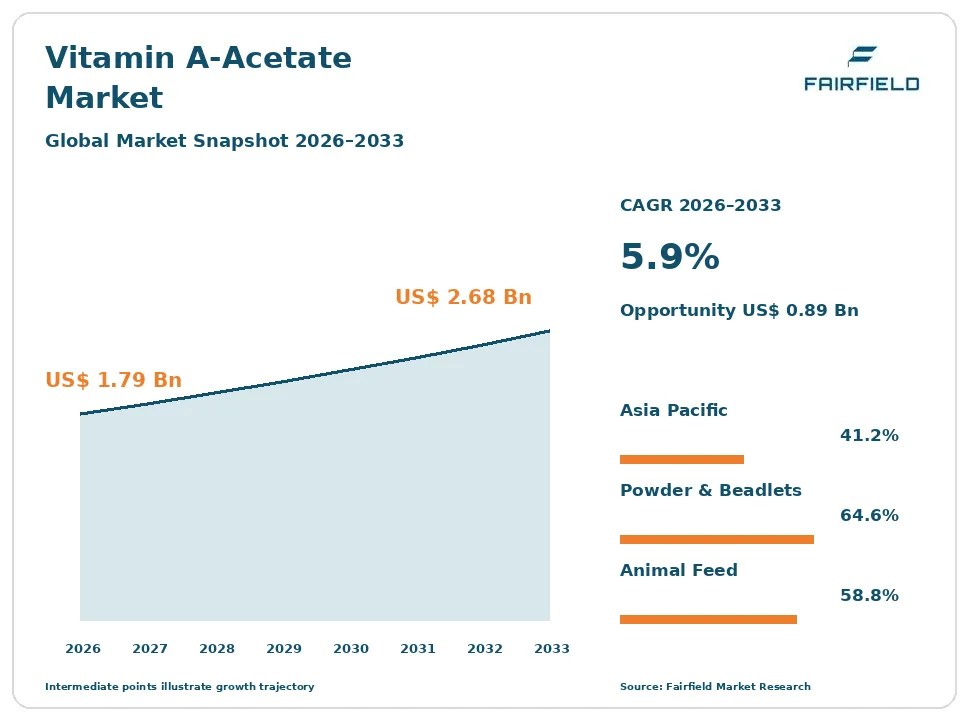
The global vitamin A-acetate market size is expected to be valued at US$ 1.79 billion in 2026 and projected to reach US$ 2.68 billion by 2033, growing at a CAGR of 5.9% between 2026 and 2033.
Between 2020 and 2025, the market grew at a CAGR of about 4.6%, but values swung sharply with prices. A fire at a BASF plant in 2024 cut supply of citral, a key raw material, and sent prices soaring, before prices fell by about 42% in 2025 as supply returned. Three factors now drive growth: rising meat, poultry, and aquaculture production that needs feed additives, government food fortification programs to fight vitamin A deficiency, and demand from cosmetics and supplements. The market is shifting toward stable beadlet forms, higher-purity grades of retinyl acetate and vitamin A palmitate, and more diversified supply beyond a few large producers.
Key Report Takeaways
- By Form: Powder & Beadlets held 64.6% share in 2026, while Oil is projected to expand at a 6.7% CAGR through 2033, driven by soft-gel supplements, cosmetics, and liquid fortification.
- By Grade: Feed Grade held 60.4% share in 2026, while Pharmaceutical Grade is projected to expand at a 7.0% CAGR through 2033, driven by supplements and treatment of deficiency in emerging markets.
- By Application: Animal Feed held 58.8% share in 2026, while Cosmetics & Personal Care is projected to expand at a 7.4% CAGR through 2033, driven by anti-aging skincare demand.
- By Region: Asia Pacific held 41.2% share in 2026, while India is projected to expand at a 7.6% CAGR through 2033, driven by livestock growth, fortification programs, and supplement demand.
Global Vitamin A-Acetate Market Trends and Insights
Drivers Impact Analysis
Two drivers carry the strongest influence on vitamin A-acetate demand during the forecast period.
| Driver | Impact on CAGR Forecast | Geographic Relevance | Impact Timeline |
| Growth in livestock, poultry, and aquaculture production | High | Asia Pacific, Latin America, Middle East & Africa | Long term (≥4 years) |
| Food fortification and nutritional supplement demand | Medium | Asia Pacific, Middle East & Africa, North America | Medium term (2-4 years) |
Livestock and Aquaculture Growth Is Driving the Vitamin A-Acetate Market
Growth in livestock, poultry, and aquaculture production is the strongest driver of the vitamin A-acetate market. Animals need vitamin A for growth, vision, reproduction, and immune health.
The mechanism is rising meat and protein demand. Global meat consumption keeps growing with population and income growth, especially in China, India, Vietnam, Indonesia, Brazil, and Africa. Modern intensive farms use compound feed with feed additives such as vitamin A acetate to support animal health and productivity. Poultry, pigs, dairy cattle, and farmed fish all need vitamin A in their diets. Aquaculture is one of the fastest-growing food sectors, especially in Asia Pacific. Feed makers such as Cargill, New Hope, Haid Group, and Charoen Pokphand Group buy large volumes of vitamin premixes. Recovery in pig herds in China after disease outbreaks also supports demand.
Food Fortification and Supplements Are Expanding the Vitamin A-Acetate Market
Food fortification and nutritional supplement demand are expanding the vitamin A-acetate market. Vitamin A deficiency remains a public health problem in many countries.
The cause is government nutrition programs and health awareness. The World Health Organization estimates that vitamin A deficiency affects millions of young children, causing blindness and higher disease risk. Many countries require or encourage food fortification of edible oil, flour, milk, and sugar with vitamin A. India mandates fortification of some foods and runs programs through the Food Safety and Standards Authority of India. Supplement makers use retinyl acetate in multivitamins, eye health products, and prenatal vitamins. Infant formula requires vitamin A. Rising interest in immunity and eye health supports supplement sales. Pet food makers in many countries also add vitamin A to dog and cat foods. These uses add stable demand beyond animal feed.
Restraints Impact Analysis
Two restraints limit how quickly the vitamin A-acetate market grows.
| Restraint | Impact on CAGR Forecast | Geographic Relevance | Impact Timeline |
| Price volatility and concentrated supply | High | Global | Short term (≤2 years) |
| Regulatory limits and safety concerns | Medium | Europe, North America | Medium term (2-4 years) |
Price Volatility and Concentrated Supply Slow the Vitamin A-Acetate Market
Price volatility and concentrated supply slow the vitamin A-acetate market. A small number of producers make most of the world’s vitamin A.
The specific causes are complex chemistry and single points of failure. Vitamin A synthesis is a multi-step process that depends on intermediates such as citral, and only a few companies can produce them at scale. When a fire hit a BASF plant in Ludwigshafen in July 2024, BASF declared force majeure, and Chinese spot prices more than doubled within two weeks. When supply returned in 2025, average prices fell by about 42%. These swings make planning difficult for feed and food makers and squeeze margins. Some buyers reduce vitamin inclusion rates when prices spike. Environmental inspections in China can also disrupt supply. These factors create uncertainty and slow investment.
Regulatory Limits and Safety Concerns Restrict the Vitamin A-Acetate Market
Regulatory limits and safety concerns restrict the vitamin A-acetate market. Vitamin A is essential, but too much can be harmful.
The underlying causes are toxicity risks and strict rules. High doses of vitamin A can cause liver damage, bone problems, and birth defects, so regulators set upper limits for food, supplements, and feed. The European Union has set maximum vitamin A levels in animal feed and reviews retinoid use in cosmetics, with proposed limits on concentrations in body lotions and face products. Pregnant women are advised to avoid high-dose vitamin A supplements. These rules limit how much vitamin A acetate can be used in some products and markets. Registration, testing, and documentation requirements add costs for suppliers. These factors restrict growth in some segments, especially in Europe.
Market Opportunities
Stable Beadlets and Premixes for Feed and Food Open a Value-added Revenue Pool
Stable beadlets and premixes for feed and food open a value-added revenue pool in the vitamin A-acetate market. Vitamin A is sensitive to heat, light, and oxygen, so stable forms command higher prices.
Formulation specialists and premix makers can capture this opportunity. Beadlet and microencapsulated forms protect vitamin A during feed pelleting, food processing, and storage, reducing losses. Premixes combine vitamins and minerals in ready-to-use blends for feed mills and food manufacturers. Water-dispersible forms suit beverages and liquid fortification. dsm-firmenich, BASF, and Chinese producers offer stabilized products. Technical service helps customers choose the right forms, doses, and processing conditions. Long-term supply contracts with large feed companies provide stable revenue. Suppliers that combine quality, stability, and reliable supply can win premium customers.
Supply Diversification and Emerging Markets Create a Growth Revenue Pool
Supply diversification and emerging markets create a growth revenue pool in the vitamin A-acetate market. Buyers want more reliable supply after recent disruptions.
Producers that add capacity or new routes can capture this opportunity. The 2024 BASF fire showed the risks of depending on few suppliers, encouraging buyers to diversify. Chinese producers such as Zhejiang NHU and Zhejiang Medicine are well placed with integrated citral production. Ownership changes, such as dsm-firmenich’s sale of its Animal Nutrition & Health business to CVC in 2026, may reshape supply strategies. Demand is growing fastest in India, Vietnam, Indonesia, Africa, and Latin America, where feed production and fortification are expanding. Local premix plants near customers can win share. Biotechnology routes to vitamin A could add future supply.
Segment Analysis
By Form: Powder & Beadlets Lead While Oil Grows Fastest
Powder & Beadlets held 64.6% share in 2026. Powder and beadlet forms are stable, easy to handle, and mix well into feed premixes, dry foods, and tablets. They are the standard form for animal feed, which is the largest application. Producers offer forms with different strengths, such as 500,000 and 1,000,000 international units per gram.
Oil is the fastest-growing form, expanding at a 6.7% CAGR through 2033. Vitamin A acetate oil is used in soft-gel supplements, cosmetic creams and serums, edible oil fortification, and liquid feed. Growth in skincare and liquid supplements supports demand. Oil forms need protection from oxidation through antioxidants and careful packaging. Vitamin A palmitate is also widely used in oil form for food fortification. For the market, oil growth reflects human nutrition and cosmetic demand.
By Grade: Feed Grade Leads While Pharmaceutical Grade Grows Fastest
Feed Grade held 60.4% share in 2026. Feed-grade vitamin A acetate is used in compound feed and premixes for poultry, pigs, cattle, and fish. Large volumes and price sensitivity characterize this grade. Chinese producers supply much of the global feed market.
Pharmaceutical Grade is the fastest-growing grade, expanding at a 7.0% CAGR through 2033. Pharmaceutical-grade retinyl acetate meets strict purity standards for supplements, prescription products, and treatment of deficiency. Public health programs that distribute high-dose vitamin A capsules to children use pharmaceutical-grade material. Supplement growth in Asia Pacific and North America supports demand. Food grade forms a middle segment. Strict testing for purity and stability adds value. For the market, pharmaceutical growth raises average prices.
By Application: Animal Feed Leads While Cosmetics & Personal Care Grows Fastest
Animal Feed held 58.8% share in 2026. Animal feed is the largest use of vitamin A acetate, supporting growth, fertility, and immunity in livestock and fish. Poultry and pig feed account for the most volume, with aquaculture growing quickly. Dietary supplements and food fortification form other major applications.
Cosmetics & Personal Care is the fastest-growing application, expanding at a 7.4% CAGR through 2033. Retinoids, including retinyl acetate, are used in anti-aging creams, serums, and skin treatments because they support skin renewal. Consumer interest in skincare, especially in Asia Pacific and North America, drives demand. Regulatory limits in Europe may affect formulations. Brands in South Korea, Japan, and France lead skincare innovation. For the market, cosmetics growth adds higher-value demand.
Geography Analysis
North America Advances the Vitamin A-Acetate Market Through Supplements and Cosmetics
North America is an important vitamin A-acetate market driven by animal feed, supplements, and cosmetics. The United States has large poultry, beef, pork, and dairy industries that use vitamin premixes. Supplement makers and cosmetics brands use vitamin A acetate in multivitamins, eye health products, and anti-aging skincare. The U.S. Food and Drug Administration regulates vitamin A in foods and supplements. Canada and Mexico have large meat industries. Most vitamin A is imported from Europe and China. Feed makers and premix companies are building safety stocks after the 2024 supply shock. Pet food is another growing use. One change shaping the region is demand for supply security from more than one region.
Europe Advances the Vitamin A-Acetate Market Through Production and Regulation
Europe is a major vitamin A-acetate market and production center. Germany hosts BASF’s Ludwigshafen site, Switzerland and the Netherlands host dsm-firmenich, and France hosts Adisseo. The region has large feed and food industries and strict rules on vitamin A levels. dsm-firmenich agreed in February 2026 to sell its Animal Nutrition & Health business to CVC. Spain, Poland, and the Netherlands have large pig and poultry industries that use vitamin premixes. European buyers value traceable, high-quality supply and sustainability data. One opportunity is high-quality stabilized forms for feed and food.
Which Region Is Leading the Vitamin A-Acetate Market?
Asia Pacific is leading the vitamin A-acetate market with a 41.2% share in 2026. China is both the largest producer and a huge consumer, with leading producers Zhejiang NHU, Zhejiang Medicine, and Kingdomway, and the world’s largest pig, poultry, and aquaculture industries. Vietnam, Thailand, and Indonesia have growing feed and aquaculture sectors. Japan and South Korea have large supplement and cosmetics industries that use high-grade vitamin A. India is growing fastest, as detailed below. One change shaping the region is integrated production, as Chinese makers control key intermediates such as citral.
Which Country Is Growing Fastest in the Vitamin A-Acetate Market?
India is growing fastest in the vitamin A-acetate market at a 7.6% CAGR through 2033. Poultry and aquaculture are expanding rapidly, and India has the world’s largest dairy herd. Government food fortification programs add vitamin A to edible oil, milk, and rice. Supplement demand is growing quickly among urban consumers, and Divi’s Laboratories produces nutraceutical ingredients locally. The government’s nutrition programs, such as POSHAN Abhiyaan, aim to reduce deficiency among children and mothers. One challenge is heavy reliance on imports from China and Europe. One opportunity is local premix production near feed mills and food processors.
Latin America Grows the Vitamin A-Acetate Market Through Meat Exports
Latin America is a growing vitamin A-acetate market. Brazil and Argentina are major exporters of poultry, beef, and pork, and Mexico has a large feed industry. BRF and JBS in Brazil operate some of the world’s largest meat businesses, and their feed mills use large volumes of vitamin premixes. Feed demand grows as export markets expand. Chile, Ecuador, and Peru have growing aquaculture sectors for salmon and shrimp. Brazil fortifies some foods, and several countries add vitamin A to sugar, a practice pioneered in Guatemala. Key barriers include currency swings and reliance on imported vitamins. One opportunity is feed premixes for poultry and aquaculture exporters.
Middle East & Africa Builds the Vitamin A-Acetate Market Through Fortification
Middle East & Africa is an emerging vitamin A-acetate market. Many African countries, including Nigeria, Kenya, and Ethiopia, run fortification and supplementation programs against vitamin A deficiency, often supported by UNICEF and the Global Alliance for Improved Nutrition. Saudi Arabia, Egypt, and Iran have large and growing poultry sectors that rely on imported premixes. Key barriers include funding, weak enforcement of fortification rules, limited local premix plants, and price swings. South Africa has a modern feed industry that serves neighboring countries. One opportunity is fortification of edible oil and flour in Africa.
Competitive Landscape
The vitamin A-acetate market is highly concentrated. Zhejiang NHU, dsm-firmenich, BASF, Adisseo, Zhejiang Medicine, and Kingdomway produce most of the world’s supply.
Companies compete on cost, intermediate integration, product stability, quality, and supply reliability. Control of citral production is a key advantage, since it is the main bottleneck for vitamin A synthesis. Chinese producers have grown their share through low costs and large integrated plants, while European producers focus on quality, formulation, and technical service. Premix makers and distributors such as Prinova and Glanbia Nutritionals link producers with feed mills and food companies. Long-term contracts help buyers manage price swings. New production routes, including fermentation-based vitamin A from engineered microbes, are being researched and could add new competitors in the future. Buyers increasingly ask for documentation on carbon footprint and responsible sourcing, giving an edge to producers with strong sustainability data.
Strategic moves show how competition is changing. In August 2024, BASF declared force majeure after a fire. In April 2025, BASF’s vitamin A capacity reportedly returned to production. In February 2026, dsm-firmenich agreed to sell its Animal Nutrition & Health business to CVC. These moves show competition shifting toward supply security and new ownership structures in the vitamin industry.
Three themes shape vendor strategy. First, companies are securing supply of intermediates such as citral. Second, they are improving product stability through beadlets and encapsulation. Third, they are restructuring portfolios to focus on core businesses.
Vitamin A-Acetate Market Industry Leaders
Zhejiang NHU dsm-firmenich BASF Adisseo Zhejiang Medicine
Recent Industry Developments
- February 2026: dsm-firmenich agreed to sell its Animal Nutrition & Health business, including vitamins, to CVC for about €2.2 billion - changes ownership of a major vitamin A supplier.
- April 2025: BASF’s vitamin A capacity at Ludwigshafen reportedly returned to production - restored global supply and lowered prices.
- August 2024: BASF declared force majeure on vitamin A after a fire at its Ludwigshafen aroma ingredients plant - triggered a sharp global price spike.
Companies Covered in the Report
- Zhejiang NHU
- dsm-firmenich
- BASF
- Adisseo
- Zhejiang Medicine
- Xiamen Kingdomway Group
- Divi’s Laboratories
- RIKEN Vitamin
- Anhui Tiger Biotech
- Brother Enterprises
- Glanbia Nutritionals
- Prinova
Vitamin A-Acetate Market Report Scope
This report covers vitamin A-acetate, also known as retinyl acetate, in powder, beadlet, and oil forms, in feed, food, and pharmaceutical grades, used in animal feed, dietary supplements, food fortification, cosmetics and personal care, and pharmaceuticals. It excludes beta-carotene and vitamin A palmitate sold separately. The base year is 2025, and the forecast period runs from 2026 to 2033. All values are expressed in US$ Billion.
Form
- Powder & Beadlets
- Oil
Grade
- Feed Grade
- Food Grade
- Pharmaceutical Grade
Application
- Animal Feed
- Dietary Supplements
- Food Fortification
- Cosmetics & Personal Care
- Pharmaceuticals
Regions
- North America
- Europe
- Asia Pacific
- Latin America
- Middle East & Africa
Key Questions Answered in the Report
How big is the vitamin A-acetate market in 2026?
The vitamin A-acetate market is valued at US$ 1.79 billion in 2026, led by powder and beadlet forms for animal feed.
What is the vitamin A-acetate market forecast to 2033?
The market is projected to reach US$ 2.68 billion by 2033, growing at a 5.9% CAGR and adding US$ 0.89 billion.
Which application is growing fastest in the vitamin A-acetate market?
Cosmetics & Personal Care is growing fastest at a 7.4% CAGR through 2033, driven by anti-aging skincare demand worldwide.
Which country is growing fastest in the vitamin A-acetate market?
India is growing fastest at a 7.6% CAGR through 2033, driven by livestock growth, fortification programs, and supplement demand.
Which region holds the largest vitamin A-acetate market share?
Asia Pacific holds the largest share at 41.2% in 2026, supported by large production and feed consumption in China.
1. Executive Summary
1.1. Global Vitamin A-Acetate Market Snapshot
1.2. Future Projections
1.3. Key Report Takeaways
1.4. Regional Snapshot
2. Market Overview
2.1. Market Definition and Report Scope
2.2. Historical Trends 2020–2025
2.3. Market Dynamics
2.3.1. Drivers
2.3.1.1. Livestock and Aquaculture Growth Is Driving the Vitamin A-Acetate Market
2.3.1.2. Food Fortification and Supplements Are Expanding the Vitamin A-Acetate Market
2.3.2. Restraints
2.3.2.1. Price Volatility and Concentrated Supply Slow the Vitamin A-Acetate Market
2.3.2.2. Regulatory Limits and Safety Concerns Restrict the Vitamin A-Acetate Market
2.3.3. Market Opportunities
2.3.3.1. Stable Beadlets and Premixes for Feed and Food Open a Value-added Revenue Pool
2.3.3.2. Supply Diversification and Emerging Markets Create a Growth Revenue Pool
3. Global Vitamin A-Acetate Market Outlook, 2020-2033
3.1. Global Vitamin A-Acetate Market Outlook, by Form, Value (US$ Billion), 2020-2033
3.1.1. Powder & Beadlets
3.1.2. Oil
3.2. Global Vitamin A-Acetate Market Outlook, by Grade, Value (US$ Billion), 2020-2033
3.2.1. Feed Grade
3.2.2. Food Grade
3.2.3. Pharmaceutical Grade
3.3. Global Vitamin A-Acetate Market Outlook, by Application, Value (US$ Billion), 2020-2033
3.3.1. Animal Feed
3.3.2. Dietary Supplements
3.3.3. Food Fortification
3.3.4. Cosmetics & Personal Care
3.3.5. Pharmaceuticals
3.4. Global Vitamin A-Acetate Market Outlook, by Region, Value (US$ Billion), 2020-2033
3.4.1. North America
3.4.2. Europe
3.4.3. Asia Pacific
3.4.4. Latin America
3.4.5. Middle East & Africa
4. North America Vitamin A-Acetate Market Outlook, 2020-2033
4.1. North America Vitamin A-Acetate Market Outlook, by Form, Value (US$ Billion), 2020-2033
4.1.1. Powder & Beadlets
4.1.2. Oil
4.2. North America Vitamin A-Acetate Market Outlook, by Grade, Value (US$ Billion), 2020-2033
4.2.1. Feed Grade
4.2.2. Food Grade
4.2.3. Pharmaceutical Grade
4.3. North America Vitamin A-Acetate Market Outlook, by Application, Value (US$ Billion), 2020-2033
4.3.1. Animal Feed
4.3.2. Dietary Supplements
4.3.3. Food Fortification
4.3.4. Cosmetics & Personal Care
4.3.5. Pharmaceuticals
4.4. North America Vitamin A-Acetate Market Outlook, by Country, Value (US$ Billion), 2020-2033
4.4.1. United States Vitamin A-Acetate Market Outlook, by Form, 2020-2033
4.4.2. United States Vitamin A-Acetate Market Outlook, by Grade, 2020-2033
4.4.3. United States Vitamin A-Acetate Market Outlook, by Application, 2020-2033
4.4.4. Canada Vitamin A-Acetate Market Outlook, by Form, 2020-2033
4.4.5. Canada Vitamin A-Acetate Market Outlook, by Grade, 2020-2033
4.4.6. Canada Vitamin A-Acetate Market Outlook, by Application, 2020-2033
4.4.7. Mexico Vitamin A-Acetate Market Outlook, by Form, 2020-2033
4.4.8. Mexico Vitamin A-Acetate Market Outlook, by Grade, 2020-2033
4.4.9. Mexico Vitamin A-Acetate Market Outlook, by Application, 2020-2033
5. Europe Vitamin A-Acetate Market Outlook, 2020-2033
5.1. Europe Vitamin A-Acetate Market Outlook, by Form, Value (US$ Billion), 2020-2033
5.1.1. Powder & Beadlets
5.1.2. Oil
5.2. Europe Vitamin A-Acetate Market Outlook, by Grade, Value (US$ Billion), 2020-2033
5.2.1. Feed Grade
5.2.2. Food Grade
5.2.3. Pharmaceutical Grade
5.3. Europe Vitamin A-Acetate Market Outlook, by Application, Value (US$ Billion), 2020-2033
5.3.1. Animal Feed
5.3.2. Dietary Supplements
5.3.3. Food Fortification
5.3.4. Cosmetics & Personal Care
5.3.5. Pharmaceuticals
5.4. Europe Vitamin A-Acetate Market Outlook, by Country, Value (US$ Billion), 2020-2033
5.4.1. Germany Vitamin A-Acetate Market Outlook, by Form, 2020-2033
5.4.2. Germany Vitamin A-Acetate Market Outlook, by Grade, 2020-2033
5.4.3. Germany Vitamin A-Acetate Market Outlook, by Application, 2020-2033
5.4.4. Switzerland Vitamin A-Acetate Market Outlook, by Form, 2020-2033
5.4.5. Switzerland Vitamin A-Acetate Market Outlook, by Grade, 2020-2033
5.4.6. Switzerland Vitamin A-Acetate Market Outlook, by Application, 2020-2033
5.4.7. Netherlands Vitamin A-Acetate Market Outlook, by Form, 2020-2033
5.4.8. Netherlands Vitamin A-Acetate Market Outlook, by Grade, 2020-2033
5.4.9. Netherlands Vitamin A-Acetate Market Outlook, by Application, 2020-2033
5.4.10. France Vitamin A-Acetate Market Outlook, by Form, 2020-2033
5.4.11. France Vitamin A-Acetate Market Outlook, by Grade, 2020-2033
5.4.12. France Vitamin A-Acetate Market Outlook, by Application, 2020-2033
5.4.13. Spain Vitamin A-Acetate Market Outlook, by Form, 2020-2033
5.4.14. Spain Vitamin A-Acetate Market Outlook, by Grade, 2020-2033
5.4.15. Spain Vitamin A-Acetate Market Outlook, by Application, 2020-2033
5.4.16. Poland Vitamin A-Acetate Market Outlook, by Form, 2020-2033
5.4.17. Poland Vitamin A-Acetate Market Outlook, by Grade, 2020-2033
5.4.18. Poland Vitamin A-Acetate Market Outlook, by Application, 2020-2033
6. Asia Pacific Vitamin A-Acetate Market Outlook, 2020-2033
6.1. Asia Pacific Vitamin A-Acetate Market Outlook, by Form, Value (US$ Billion), 2020-2033
6.1.1. Powder & Beadlets
6.1.2. Oil
6.2. Asia Pacific Vitamin A-Acetate Market Outlook, by Grade, Value (US$ Billion), 2020-2033
6.2.1. Feed Grade
6.2.2. Food Grade
6.2.3. Pharmaceutical Grade
6.3. Asia Pacific Vitamin A-Acetate Market Outlook, by Application, Value (US$ Billion), 2020-2033
6.3.1. Animal Feed
6.3.2. Dietary Supplements
6.3.3. Food Fortification
6.3.4. Cosmetics & Personal Care
6.3.5. Pharmaceuticals
6.4. Asia Pacific Vitamin A-Acetate Market Outlook, by Country, Value (US$ Billion), 2020-2033
6.4.1. China Vitamin A-Acetate Market Outlook, by Form, 2020-2033
6.4.2. China Vitamin A-Acetate Market Outlook, by Grade, 2020-2033
6.4.3. China Vitamin A-Acetate Market Outlook, by Application, 2020-2033
6.4.4. Vietnam Vitamin A-Acetate Market Outlook, by Form, 2020-2033
6.4.5. Vietnam Vitamin A-Acetate Market Outlook, by Grade, 2020-2033
6.4.6. Vietnam Vitamin A-Acetate Market Outlook, by Application, 2020-2033
6.4.7. Thailand Vitamin A-Acetate Market Outlook, by Form, 2020-2033
6.4.8. Thailand Vitamin A-Acetate Market Outlook, by Grade, 2020-2033
6.4.9. Thailand Vitamin A-Acetate Market Outlook, by Application, 2020-2033
6.4.10. Indonesia Vitamin A-Acetate Market Outlook, by Form, 2020-2033
6.4.11. Indonesia Vitamin A-Acetate Market Outlook, by Grade, 2020-2033
6.4.12. Indonesia Vitamin A-Acetate Market Outlook, by Application, 2020-2033
6.4.13. Japan Vitamin A-Acetate Market Outlook, by Form, 2020-2033
6.4.14. Japan Vitamin A-Acetate Market Outlook, by Grade, 2020-2033
6.4.15. Japan Vitamin A-Acetate Market Outlook, by Application, 2020-2033
6.4.16. South Korea Vitamin A-Acetate Market Outlook, by Form, 2020-2033
6.4.17. South Korea Vitamin A-Acetate Market Outlook, by Grade, 2020-2033
6.4.18. South Korea Vitamin A-Acetate Market Outlook, by Application, 2020-2033
6.4.19. India Vitamin A-Acetate Market Outlook, by Form, 2020-2033
6.4.20. India Vitamin A-Acetate Market Outlook, by Grade, 2020-2033
6.4.21. India Vitamin A-Acetate Market Outlook, by Application, 2020-2033
7. Latin America Vitamin A-Acetate Market Outlook, 2020-2033
7.1. Latin America Vitamin A-Acetate Market Outlook, by Form, Value (US$ Billion), 2020-2033
7.1.1. Powder & Beadlets
7.1.2. Oil
7.2. Latin America Vitamin A-Acetate Market Outlook, by Grade, Value (US$ Billion), 2020-2033
7.2.1. Feed Grade
7.2.2. Food Grade
7.2.3. Pharmaceutical Grade
7.3. Latin America Vitamin A-Acetate Market Outlook, by Application, Value (US$ Billion), 2020-2033
7.3.1. Animal Feed
7.3.2. Dietary Supplements
7.3.3. Food Fortification
7.3.4. Cosmetics & Personal Care
7.3.5. Pharmaceuticals
7.4. Latin America Vitamin A-Acetate Market Outlook, by Country, Value (US$ Billion), 2020-2033
7.4.1. Brazil Vitamin A-Acetate Market Outlook, by Form, 2020-2033
7.4.2. Brazil Vitamin A-Acetate Market Outlook, by Grade, 2020-2033
7.4.3. Brazil Vitamin A-Acetate Market Outlook, by Application, 2020-2033
7.4.4. Argentina Vitamin A-Acetate Market Outlook, by Form, 2020-2033
7.4.5. Argentina Vitamin A-Acetate Market Outlook, by Grade, 2020-2033
7.4.6. Argentina Vitamin A-Acetate Market Outlook, by Application, 2020-2033
7.4.7. Mexico Vitamin A-Acetate Market Outlook, by Form, 2020-2033
7.4.8. Mexico Vitamin A-Acetate Market Outlook, by Grade, 2020-2033
7.4.9. Mexico Vitamin A-Acetate Market Outlook, by Application, 2020-2033
7.4.10. Chile Vitamin A-Acetate Market Outlook, by Form, 2020-2033
7.4.11. Chile Vitamin A-Acetate Market Outlook, by Grade, 2020-2033
7.4.12. Chile Vitamin A-Acetate Market Outlook, by Application, 2020-2033
7.4.13. Ecuador Vitamin A-Acetate Market Outlook, by Form, 2020-2033
7.4.14. Ecuador Vitamin A-Acetate Market Outlook, by Grade, 2020-2033
7.4.15. Ecuador Vitamin A-Acetate Market Outlook, by Application, 2020-2033
7.4.16. Peru Vitamin A-Acetate Market Outlook, by Form, 2020-2033
7.4.17. Peru Vitamin A-Acetate Market Outlook, by Grade, 2020-2033
7.4.18. Peru Vitamin A-Acetate Market Outlook, by Application, 2020-2033
7.4.19. Guatemala Vitamin A-Acetate Market Outlook, by Form, 2020-2033
7.4.20. Guatemala Vitamin A-Acetate Market Outlook, by Grade, 2020-2033
7.4.21. Guatemala Vitamin A-Acetate Market Outlook, by Application, 2020-2033
8. Middle East & Africa Vitamin A-Acetate Market Outlook, 2020-2033
8.1. Middle East & Africa Vitamin A-Acetate Market Outlook, by Form, Value (US$ Billion), 2020-2033
8.1.1. Powder & Beadlets
8.1.2. Oil
8.2. Middle East & Africa Vitamin A-Acetate Market Outlook, by Grade, Value (US$ Billion), 2020-2033
8.2.1. Feed Grade
8.2.2. Food Grade
8.2.3. Pharmaceutical Grade
8.3. Middle East & Africa Vitamin A-Acetate Market Outlook, by Application, Value (US$ Billion), 2020-2033
8.3.1. Animal Feed
8.3.2. Dietary Supplements
8.3.3. Food Fortification
8.3.4. Cosmetics & Personal Care
8.3.5. Pharmaceuticals
8.4. Middle East & Africa Vitamin A-Acetate Market Outlook, by Country, Value (US$ Billion), 2020-2033
8.4.1. Nigeria Vitamin A-Acetate Market Outlook, by Form, 2020-2033
8.4.2. Nigeria Vitamin A-Acetate Market Outlook, by Grade, 2020-2033
8.4.3. Nigeria Vitamin A-Acetate Market Outlook, by Application, 2020-2033
8.4.4. Kenya Vitamin A-Acetate Market Outlook, by Form, 2020-2033
8.4.5. Kenya Vitamin A-Acetate Market Outlook, by Grade, 2020-2033
8.4.6. Kenya Vitamin A-Acetate Market Outlook, by Application, 2020-2033
8.4.7. Ethiopia Vitamin A-Acetate Market Outlook, by Form, 2020-2033
8.4.8. Ethiopia Vitamin A-Acetate Market Outlook, by Grade, 2020-2033
8.4.9. Ethiopia Vitamin A-Acetate Market Outlook, by Application, 2020-2033
8.4.10. Saudi Arabia Vitamin A-Acetate Market Outlook, by Form, 2020-2033
8.4.11. Saudi Arabia Vitamin A-Acetate Market Outlook, by Grade, 2020-2033
8.4.12. Saudi Arabia Vitamin A-Acetate Market Outlook, by Application, 2020-2033
8.4.13. Egypt Vitamin A-Acetate Market Outlook, by Form, 2020-2033
8.4.14. Egypt Vitamin A-Acetate Market Outlook, by Grade, 2020-2033
8.4.15. Egypt Vitamin A-Acetate Market Outlook, by Application, 2020-2033
8.4.16. Iran Vitamin A-Acetate Market Outlook, by Form, 2020-2033
8.4.17. Iran Vitamin A-Acetate Market Outlook, by Grade, 2020-2033
8.4.18. Iran Vitamin A-Acetate Market Outlook, by Application, 2020-2033
8.4.19. South Africa Vitamin A-Acetate Market Outlook, by Form, 2020-2033
8.4.20. South Africa Vitamin A-Acetate Market Outlook, by Grade, 2020-2033
8.4.21. South Africa Vitamin A-Acetate Market Outlook, by Application, 2020-2033
9. Competitive Landscape
9.1. Market Concentration and Industry Leaders
9.2. Competitive Differentiation
9.3. Strategic Moves and Market Direction
9.4. Recent Industry Developments
9.5. Company Profiles
9.5.1. Zhejiang NHU
9.5.2. dsm-firmenich
9.5.3. BASF
9.5.4. Adisseo
9.5.5. Zhejiang Medicine
9.5.6. Xiamen Kingdomway Group
9.5.7. Divi's Laboratories
9.5.8. RIKEN Vitamin
9.5.9. Anhui Tiger Biotech
9.5.10. Brother Enterprises
9.5.11. Glanbia Nutritionals
9.5.12. Prinova
10. Appendix
10.1. Research Methodology
10.2. Report Assumptions
10.3. Acronyms and Abbreviations
| Form | Powder & Beadlets, Oil |
| Grade | Feed Grade, Food Grade, Pharmaceutical Grade |
| Application | Animal Feed, Dietary Supplements, Food Fortification, Cosmetics & Personal Care, Pharmaceuticals |
| Regions | North America, Europe, Asia Pacific, Latin America, Middle East & Africa |
Our Research Methodology
Considering the volatility of business today, traditional approaches to strategizing a game plan can be unfruitful if not detrimental. True ambiguity is no way to determine a forecast. A myriad of predetermined factors must be accounted for such as the degree of risk involved, the magnitude of circumstances, as well as conditions or consequences that are not known or unpredictable. To circumvent binary views that cast uncertainty, the application of market research intelligence to strategically posture, move, and enable actionable outcomes is necessary.
View Methodology
Quality Assured
Rigorous Validation Process

Confidentiality Assured
End-to-end Data Security

Custom Research Services
Tailored To Your Objectives
FAQs
The vitamin A-acetate market is valued at US$ 1.79 billion in 2026, led by powder and beadlet forms for animal feed.
The market is projected to reach US$ 2.68 billion by 2033, growing at a 5.9% CAGR and adding US$ 0.89 billion.
Cosmetics & Personal Care is growing fastest at a 7.4% CAGR through 2033, driven by anti-aging skincare demand worldwide.
India is growing fastest at a 7.6% CAGR through 2033, driven by livestock growth, fortification programs, and supplement demand.
Asia Pacific holds the largest share at 41.2% in 2026, supported by large production and feed consumption in China.
Related Reports
On The Go Packaging Market Size, Share, Insights, Competitive Landscape, and Forecast 2026 to 2033
On the go packaging market to grow from US$2.19 Bn in 2026 to US$3.00 Bn by 2033 at 4.6% CAGR. Explore materials, products, applications and regions.
Nylon 6 Market Size, Share, Insights, Competitive Landscape, and Forecast 2026 to 2033
Nylon 6 market to reach US$ 26.95 billion by 2033 at a 5.6% CAGR. Explore product forms, applications, feedstocks, leading companies and regional trends.
Spinosad Active Ingredient Market Size, Share, Insights, Competitive Landscape, and Forecast 2026 to 2033
Spinosad active ingredient market to reach US$ 1.257 billion by 2033 at an 8.6% CAGR. Explore forms, crops, applications, companies and regional trends.
D-Psicose (Allulose) Market Size, Share, Insights, Competitive Landscape, and Forecast 2026 to 2033
D-psicose (allulose) market to reach US$ 0.749 billion by 2033 at a 15.7% CAGR. Explore forms, applications, sales channels and regional trends.
Butter Packaging Market Size, Share, Insights, Competitive Landscape, and Forecast 2026 to 2033
Butter packaging market to reach US$ 4.83 billion by 2033 at a 6.4% CAGR. Explore materials, packaging types, end uses and regional trends.
Plastic Films and Sheets Market Size, Share, Insights, Competitive Landscape, and Forecast 2026 to 2033
Plastic films and sheets market to reach US$ 237.30 billion by 2033 at a 6.0% CAGR. Explore product types, end uses and regional trends.