



Passenger Vehicle ADAS Market
Passenger Vehicle ADAS Market Size, Share, Insights, Competitive Landscape, and Forecast 2026 to 2033
How Fast Is the Passenger Vehicle ADAS Market Growing?
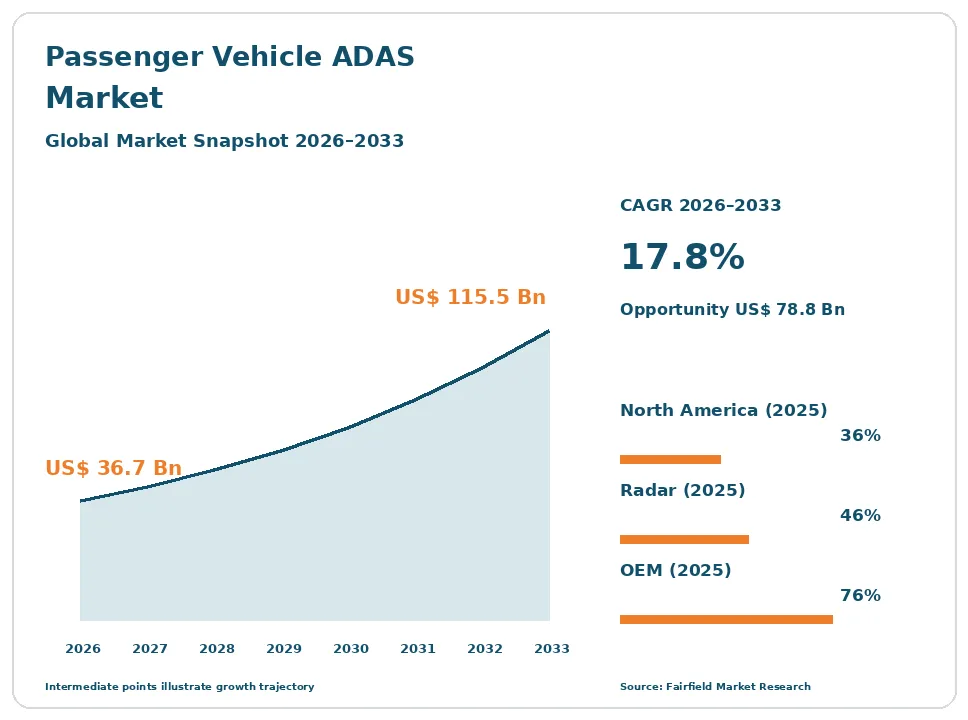
The global passenger vehicle ADAS market size is expected to be valued at US$ 36.7 billion in 2026 and projected to reach US$ 115.5 billion by 2033, growing at a CAGR of 17.8% between 2026 and 2033.
Between 2020 and 2025, the market grew at a CAGR of about 15.5%, as automakers fitted automatic emergency braking, lane keeping, adaptive cruise control, and parking assistance to more models, and as safety ratings and regulations made these features standard. Advanced driver assistance systems use cameras, radar, ultrasonic sensors, LiDAR, and computing chips to watch the road and help drivers avoid crashes or drive with less effort. In passenger cars and SUVs, ADAS features range from simple warnings to Level 2 automation that steers, brakes, and accelerates on highways while the driver supervises. Growth comes from safety mandates, consumer demand for comfort and safety, falling sensor costs, and the race toward software-defined vehicles. The market is shifting toward hands-free highway driving, centralized computing, and conditional Level 3 systems. In December 2025, China approved its first Level 3 passenger cars for limited public use.
Key Report Takeaways
- By Sensor Type: Radar held 46.0% share in 2025, while LiDAR is projected to expand at a 22.5% CAGR through 2033, driven by falling prices, Chinese automaker adoption, and higher automation levels that need precise three-dimensional sensing.
- By Automation Level: Level 2 held 49.0% share in 2025, while Level 3 is projected to expand at a 24.0% CAGR through 2033, driven by new approvals for conditional automated driving in China, Germany, and Japan.
- By Distribution Channel: OEM held 76.0% share in 2025, while Aftermarket is projected to expand at a 18.6% CAGR through 2033, driven by dash cameras, retrofit warning systems, and calibration services for repaired vehicles.
- By Region: North America held 36.0% share in 2025, while Asia Pacific is projected to expand at a 19.4% CAGR through 2033, driven by rapid ADAS adoption in Chinese electric vehicles, rising safety ratings, and growing car sales in India.
Global Passenger Vehicle ADAS Market Trends and Insights
Drivers Impact Analysis
Two drivers carry the strongest influence on passenger vehicle ADAS demand during the forecast period.
Safety Regulations Are Driving the Passenger Vehicle ADAS Market
Safety regulations and crash-test rating programs are the strongest driver of the passenger vehicle ADAS market. Governments are making driver assistance standard.
The mechanism is mandatory fitment and rating pressure. The European Union General Safety Regulation requires new cars to include automatic emergency braking, intelligent speed assistance, lane keeping, and driver drowsiness warnings. In the United States, the National Highway Traffic Safety Administration finalized a rule requiring automatic emergency braking, including pedestrian detection, on all new light vehicles by 2029, and updated its New Car Assessment Program to reward lane keeping and blind spot features. Euro NCAP, China NCAP, and Bharat NCAP give higher star ratings to cars with advanced safety systems, which strongly influences buyers. Insurance companies offer discounts for ADAS-equipped cars. These rules turn ADAS features from options into standard equipment, lifting sensor and software content in every new car.
Hands-Free Driving Demand Is Expanding the Passenger Vehicle ADAS Market
Consumer demand for hands-free and assisted driving is expanding the passenger vehicle ADAS market. Drivers now pay for convenience features.
The cause is changing buyer expectations and competition among automakers. Highway assist, traffic jam assist, automated lane changes, and automated parking reduce driver fatigue, and they are now key selling points in mid-range and premium cars. Chinese electric vehicle makers offer advanced navigation-based driver assistance on city streets, pushing rivals to respond. Ford’s BlueCruise, GM’s Super Cruise, and Rivian’s hands-free system expand hands-free driving on mapped highways. Over-the-air updates let carmakers add features and earn subscription revenue after sale. Younger buyers often rank driver assistance and connected features above engine performance. These trends raise the value of sensors, chips, and software per vehicle.
| Driver | Impact on CAGR Forecast | Geographic Relevance | Impact Timeline |
| Safety regulations and crash-test rating programs | High | Global | Long term (≥4 years) |
| Consumer demand for hands-free and assisted driving | High | Asia Pacific, North America, Europe | Medium term (2-4 years) |
Restraints Impact Analysis
Two restraints limit how quickly the passenger vehicle ADAS market grows.
High Costs Slow the Passenger Vehicle ADAS Market
High system costs and price pressure slow the passenger vehicle ADAS market. Advanced sensor suites are expensive.
The specific causes are hardware, software, and validation costs. Higher-level systems require multiple cameras, radars, ultrasonic sensors, sometimes LiDAR, and powerful computing chips, which can add hundreds or thousands of dollars to each car. Developing and validating software across millions of driving scenarios requires large engineering teams and test fleets. In price-sensitive markets such as India, Latin America, and Middle East & Africa, buyers often choose base models with few features. Automakers face strong pressure to cut costs, especially in the competitive electric vehicle segment. Repair and recalibration costs after minor accidents also raise ownership costs. These factors slow adoption of advanced features in entry-level and budget vehicles.
Liability Concerns Restrict the Passenger Vehicle ADAS Market
Safety concerns, liability, and regulatory uncertainty restrict the passenger vehicle ADAS market. Trust in automation is still developing.
The underlying causes are high-profile crashes and unclear rules. Investigations into crashes involving driver assistance systems have raised questions about driver monitoring, misuse, and marketing claims. Regulators require crash reporting and may order recalls. Liability for crashes during Level 3 operation, when the car is responsible, is still being defined in many countries. Rules for hands-free and eyes-off driving differ between markets. False alerts and phantom braking frustrate some drivers, who switch features off. Driver monitoring cameras are becoming mandatory to ensure attention, adding cost. Cybersecurity rules for connected vehicles add further compliance work. Consumer surveys show mixed trust in automated features, especially among older drivers. These issues slow approvals and adoption of higher automation.
| Restraint | Impact on CAGR Forecast | Geographic Relevance | Impact Timeline |
| High system costs and price pressure | High | Global | Long term (≥4 years) |
| Safety concerns, liability, and regulatory uncertainty | Medium | North America, Europe | Medium term (2-4 years) |
Market Opportunities
Level 3 and Navigation-Based Assistance Open a Fast-Growth Revenue Pool
Level 3 and navigation-based driver assistance open a fast-growth revenue pool in the passenger vehicle ADAS market. Higher automation adds major value per car.
Suppliers and automakers can capture this opportunity. Conditional Level 3 systems let drivers take their eyes off the road in defined conditions, and approvals are expanding: Mercedes-Benz operates Level 3 in Germany and the United States, China approved its first Level 3 cars in December 2025, and work on a second batch was underway in October 2026. These systems need redundant sensors, LiDAR, high-performance computing, and driver monitoring. City navigation assistance adds further content. Automakers may charge thousands of dollars or monthly fees for these features. Companies that deliver safe, certified, and affordable higher-level systems can capture premium margins and long-term contracts.
Software, Data, and Aftermarket Services Create a Recurring Revenue Pool
Software, data, and aftermarket services create a recurring revenue pool in the passenger vehicle ADAS market. Value is shifting to software.
Software firms, chipmakers, and service providers can capture this opportunity. Over-the-air updates, feature subscriptions, and data-driven improvements generate revenue after sale. Fleet data trains AI models. Repair shops need calibration equipment for cameras and radars after windscreen replacements and collisions. Aftermarket dash cameras with collision and lane warnings serve older vehicles. Insurers increasingly use driving data to price policies and reward safe use of assistance features. Mapping providers supply high-definition maps for hands-free driving and earn licensing fees. Chipmakers such as NVIDIA and Qualcomm sell powerful central computers that can be upgraded over a vehicle’s life. Companies that build scalable software platforms, data pipelines, and service networks can earn recurring revenue well beyond the initial vehicle sale.
Segment Analysis
By Sensor Type: Radar Leads While LiDAR Grows Fastest
Radar held 46.0% share in 2025. Radar sensors measure distance and speed reliably in rain, fog, and darkness, making them essential for adaptive cruise control, emergency braking, and blind spot detection. Front and corner radars are fitted to most new cars with advanced safety features. Bosch, Continental, Denso, ZF, and Aptiv are major radar suppliers, and new 4D imaging radars improve object detection.
LiDAR is the fastest-growing sensor type, expanding at a 22.5% CAGR through 2033. LiDAR builds precise three-dimensional maps of surroundings, supporting city driving assistance and Level 3 systems. Prices have fallen sharply, and many Chinese electric vehicles now include LiDAR. Cameras remain essential for lane and sign recognition, and ultrasonic sensors support parking. For the market, LiDAR growth reflects higher automation levels.
By Automation Level: Level 2 Leads While Level 3 Grows Fastest
Level 2 held 49.0% share in 2025. Level 2 automation combines steering and speed control under driver supervision and is now common in mid-range cars, SUVs, and electric vehicles. Level 2+ hands-free systems on mapped highways are expanding quickly.
Level 3 is the fastest-growing automation level, expanding at a 24.0% CAGR through 2033. Conditional automation is approved in a few markets, including Germany, Japan, the United States, and China. These systems need redundant braking and steering, LiDAR, and driver monitoring, so content per car is much higher. Level 1 systems provide single functions such as adaptive cruise or lane warnings and remain common in budget cars and emerging markets. For the market, Level 3 growth adds premium value.
By Distribution Channel: OEM Leads While Aftermarket Grows Fastest
OEM held 76.0% share in 2025. Most ADAS is factory-fitted by automakers, integrated with vehicle electronics, braking, and steering, and validated for safety ratings and regulations. Automakers buy systems from Tier 1 suppliers or develop software in-house, and they increasingly bundle ADAS into trim packages or subscriptions.
Aftermarket is the fastest-growing channel, expanding at a 18.6% CAGR through 2033. Dash cameras, retrofit collision warning systems, and blind spot kits serve the large base of older vehicles without factory ADAS. Repair shops and windscreen specialists need calibration equipment and services after collisions and glass replacements, a fast-growing service segment. Fleet operators and ride-hailing drivers also install aftermarket safety devices to reduce accidents and insurance costs. For the market, aftermarket growth extends ADAS to the existing fleet.
Geography Analysis
Which Region Is Leading the Passenger Vehicle ADAS Market?
North America is leading the passenger vehicle ADAS market with a 36.0% share in 2025. The United States has high sales of SUVs and pickups with advanced safety packages, strong consumer interest in hands-free driving, and federal rules that will require automatic emergency braking on all new light vehicles. GM’s Super Cruise, Ford’s BlueCruise, Tesla’s driver assistance, and Rivian’s hands-free system are widely marketed. Mobileye, Aptiv, Magna, and NVIDIA supply hardware and software. Canada and Mexico add demand. Key barriers include liability concerns and regulatory investigations. One change shaping the region is the spread of hands-free highway driving.
Europe Advances the Passenger Vehicle ADAS Market Through Mandatory Safety Rules
Europe is a major passenger vehicle ADAS market. Germany, France, the United Kingdom, Italy, and Spain lead, and Germany accounts for the largest share of regional demand. The European Union General Safety Regulation makes many ADAS features mandatory, and Euro NCAP ratings reward advanced systems. Bosch, Continental, ZF, and Valeo are headquartered in the region, and Mercedes-Benz and BMW offer Level 3 systems. European automakers are also adding hands-free systems approved for cross-border use. Key barriers include high costs and complex type-approval rules. One opportunity is cross-border hands-free driving approvals.
Which Region Is Growing Fastest in the Passenger Vehicle ADAS Market?
Asia Pacific is growing fastest in the passenger vehicle ADAS market at a 19.4% CAGR through 2033. China leads adoption, with electric vehicle makers offering city navigation assistance and LiDAR, and approved its first Level 3 cars in December 2025. Japan and South Korea have strong automakers and suppliers such as Denso and Hyundai Mobis. India is adding ADAS rapidly, with Tata Motors planning ADAS across its brands. Bharat NCAP ratings in India encourage safety features. Key barriers include price sensitivity in entry-level cars. One change shaping the region is the rise of software-defined vehicles.
Latin America Grows the Passenger Vehicle ADAS Market Through Safety Ratings
Latin America is a growing passenger vehicle ADAS market. Brazil, Mexico, Argentina, and Chile are adding emergency braking and lane assistance to more models, encouraged by Latin NCAP ratings that now require advanced safety for top scores. Chinese brands bring well-equipped electric and hybrid cars to the region at competitive prices, pushing local and global automakers to add more features. Governments are gradually tightening vehicle safety standards, and insurers are beginning to reward safer cars. Key barriers include price sensitivity, older vehicle fleets, and limited calibration networks. One opportunity is standard emergency braking in compact cars.
Middle East & Africa Develops the Passenger Vehicle ADAS Market Through Premium Demand
Middle East & Africa is a developing passenger vehicle ADAS market. Saudi Arabia and the United Arab Emirates have strong demand for premium SUVs with advanced driver assistance, and smart mobility programs support new technology. South Africa has local car production and growing safety rating awareness, while Morocco and Egypt are expanding vehicle assembly. Premium car buyers in the region expect the latest technology, and dealers promote ADAS packages. Key barriers include price sensitivity in many countries and harsh desert climates with dust and heat that challenge sensors. One change shaping the region is the growth of Chinese car brands with standard ADAS.
Competitive Landscape
The passenger vehicle ADAS market is fragmented. ZF, Bosch, Continental, Valeo, and Mobileye are leading players, with the top five holding about 29% combined share, while Denso, Autoliv, Aptiv, Magna International, Hyundai Mobis, NVIDIA, and Qualcomm compete strongly. Chinese suppliers such as Huawei, Horizon Robotics, and Hesai are growing quickly.
Companies compete on sensor performance, software capability, computing power, cost, safety validation, and relationships with automakers. Traditional Tier 1 suppliers offer complete systems, while chipmakers and software firms supply central computers and driving software. Many automakers are developing their own software stacks, changing supplier roles and pressuring prices. Partnerships between automakers, chipmakers, and software firms are common, and Chinese suppliers offer complete low-cost systems that are expanding beyond China. Scale and validation data are key advantages, because systems must be proven safe across millions of kilometers.
Strategic moves show how competition is changing. In January 2025, Rivian announced hands-free driving and plans for eyes-off capability. In December 2025, Changan and BAIC received China’s first Level 3 approvals. In October 2026, China’s industry ministry said work on a second batch of Level 3 approvals was underway. These moves show competition shifting toward higher automation levels.
Three themes shape vendor strategy. First, companies are developing Level 3 and city driving systems. Second, they are moving to centralized computing and software platforms. Third, they are cutting sensor costs for mass-market cars.
Passenger Vehicle ADAS Market Industry Leaders
- ZF
- Bosch
- Continental
- Valeo
- Mobileye
Recent Industry Developments
- October 2026: China’s Ministry of Industry and Information Technology said work on a second batch of Level 3 pilot approvals for passenger cars was underway - expands conditional advanced driver assistance systems in China.
- December 2025: Changan and BAIC received conditional Level 3 approval for the Deepal SL03 and Arcfox Alpha S on designated roads in Chongqing and Beijing - marks China’s first Level 3 product approvals.
- January 2025: Rivian announced a hands-free highway assist system for 2025 and plans for an eyes-off system in 2026 - raises competition in Level 2 automation and beyond.
- October 2024: Tata Motors announced plans to offer ADAS across all its passenger vehicle brands - broadens ADAS features in India.
Companies Covered in the Report
- ZF
- Bosch
- Continental
- Valeo
- Mobileye
- Denso
- Autoliv
- Aptiv
- Magna International
- Hyundai Mobis
- NVIDIA
- Qualcomm
Passenger Vehicle ADAS Market Report Scope
This report covers advanced driver assistance systems for passenger vehicles, including radar, camera, LiDAR, and ultrasonic sensors, Level 1, Level 2, and Level 3 automation, systems such as adaptive cruise control, emergency braking, lane departure warning, and parking assistance, for hatchbacks, sedans, and SUVs, sold through OEM and aftermarket channels. The base year is 2025, and the forecast period runs from 2026 to 2033. All values are expressed in US$ Billion.
Sensor Type
- Radar
- Camera
- LiDAR
- Ultrasonic
Automation Level
- Level 1
- Level 2
- Level 3
Distribution Channel
- OEM
- Aftermarket
Regions
- North America
- Europe
- Asia Pacific
- Latin America
- Middle East & Africa
1. Executive Summary
1.1. Global Passenger Vehicle ADAS Market Snapshot
1.2. Future Projections, 2026-2033
1.3. Key Market Trends
1.4. Regional Snapshot
2. Market Overview
2.1. Market Definition and Report Scope
2.2. Historical Market Trends, 2020-2025
2.3. Market Dynamics
2.3.1. Drivers Impact Analysis
2.3.1.1. Safety Regulations Are Driving the Passenger Vehicle ADAS Market
2.3.1.2. Hands-Free Driving Demand Is Expanding the Passenger Vehicle ADAS Market
2.3.2. Restraints Impact Analysis
2.3.2.1. High Costs Slow the Passenger Vehicle ADAS Market
2.3.2.2. Liability Concerns Restrict the Passenger Vehicle ADAS Market
2.3.3. Market Opportunities
2.3.3.1. Level 3 and Navigation-Based Assistance Open a Fast-Growth Revenue Pool
2.3.3.2. Software, Data, and Aftermarket Services Create a Recurring Revenue Pool
3. Global Passenger Vehicle ADAS Market Outlook, 2020-2033
3.1. Global Passenger Vehicle ADAS Market Outlook, by Sensor Type, Value (US$ Billion), 2020-2033
3.1.1. Radar
3.1.2. Camera
3.1.3. LiDAR
3.1.4. Ultrasonic
3.2. Global Passenger Vehicle ADAS Market Outlook, by Automation Level, Value (US$ Billion), 2020-2033
3.2.1. Level 1
3.2.2. Level 2
3.2.3. Level 3
3.3. Global Passenger Vehicle ADAS Market Outlook, by Distribution Channel, Value (US$ Billion), 2020-2033
3.3.1. OEM
3.3.2. Aftermarket
3.4. Global Passenger Vehicle ADAS Market Outlook, by Region, Value (US$ Billion), 2020-2033
3.4.1. North America
3.4.2. Europe
3.4.3. Asia Pacific
3.4.4. Latin America
3.4.5. Middle East & Africa
4. North America Passenger Vehicle ADAS Market Outlook, 2020-2033
4.1. North America Passenger Vehicle ADAS Market Outlook, by Sensor Type, Value (US$ Billion), 2020-2033
4.1.1. Radar
4.1.2. Camera
4.1.3. LiDAR
4.1.4. Ultrasonic
4.2. North America Passenger Vehicle ADAS Market Outlook, by Automation Level, Value (US$ Billion), 2020-2033
4.2.1. Level 1
4.2.2. Level 2
4.2.3. Level 3
4.3. North America Passenger Vehicle ADAS Market Outlook, by Distribution Channel, Value (US$ Billion), 2020-2033
4.3.1. OEM
4.3.2. Aftermarket
4.4. North America Passenger Vehicle ADAS Market Outlook, by Country, Value (US$ Billion), 2020-2033
4.4.1. United States Passenger Vehicle ADAS Market Outlook, by Sensor Type, 2020-2033
4.4.2. United States Passenger Vehicle ADAS Market Outlook, by Automation Level, 2020-2033
4.4.3. United States Passenger Vehicle ADAS Market Outlook, by Distribution Channel, 2020-2033
4.4.4. Canada Passenger Vehicle ADAS Market Outlook, by Sensor Type, 2020-2033
4.4.5. Canada Passenger Vehicle ADAS Market Outlook, by Automation Level, 2020-2033
4.4.6. Canada Passenger Vehicle ADAS Market Outlook, by Distribution Channel, 2020-2033
4.4.7. Mexico Passenger Vehicle ADAS Market Outlook, by Sensor Type, 2020-2033
4.4.8. Mexico Passenger Vehicle ADAS Market Outlook, by Automation Level, 2020-2033
4.4.9. Mexico Passenger Vehicle ADAS Market Outlook, by Distribution Channel, 2020-2033
5. Europe Passenger Vehicle ADAS Market Outlook, 2020-2033
5.1. Europe Passenger Vehicle ADAS Market Outlook, by Sensor Type, Value (US$ Billion), 2020-2033
5.1.1. Radar
5.1.2. Camera
5.1.3. LiDAR
5.1.4. Ultrasonic
5.2. Europe Passenger Vehicle ADAS Market Outlook, by Automation Level, Value (US$ Billion), 2020-2033
5.2.1. Level 1
5.2.2. Level 2
5.2.3. Level 3
5.3. Europe Passenger Vehicle ADAS Market Outlook, by Distribution Channel, Value (US$ Billion), 2020-2033
5.3.1. OEM
5.3.2. Aftermarket
5.4. Europe Passenger Vehicle ADAS Market Outlook, by Country, Value (US$ Billion), 2020-2033
5.4.1. Germany Passenger Vehicle ADAS Market Outlook, by Sensor Type, 2020-2033
5.4.2. Germany Passenger Vehicle ADAS Market Outlook, by Automation Level, 2020-2033
5.4.3. Germany Passenger Vehicle ADAS Market Outlook, by Distribution Channel, 2020-2033
5.4.4. France Passenger Vehicle ADAS Market Outlook, by Sensor Type, 2020-2033
5.4.5. France Passenger Vehicle ADAS Market Outlook, by Automation Level, 2020-2033
5.4.6. France Passenger Vehicle ADAS Market Outlook, by Distribution Channel, 2020-2033
5.4.7. United Kingdom Passenger Vehicle ADAS Market Outlook, by Sensor Type, 2020-2033
5.4.8. United Kingdom Passenger Vehicle ADAS Market Outlook, by Automation Level, 2020-2033
5.4.9. United Kingdom Passenger Vehicle ADAS Market Outlook, by Distribution Channel, 2020-2033
5.4.10. Italy Passenger Vehicle ADAS Market Outlook, by Sensor Type, 2020-2033
5.4.11. Italy Passenger Vehicle ADAS Market Outlook, by Automation Level, 2020-2033
5.4.12. Italy Passenger Vehicle ADAS Market Outlook, by Distribution Channel, 2020-2033
5.4.13. Spain Passenger Vehicle ADAS Market Outlook, by Sensor Type, 2020-2033
5.4.14. Spain Passenger Vehicle ADAS Market Outlook, by Automation Level, 2020-2033
5.4.15. Spain Passenger Vehicle ADAS Market Outlook, by Distribution Channel, 2020-2033
6. Asia Pacific Passenger Vehicle ADAS Market Outlook, 2020-2033
6.1. Asia Pacific Passenger Vehicle ADAS Market Outlook, by Sensor Type, Value (US$ Billion), 2020-2033
6.1.1. Radar
6.1.2. Camera
6.1.3. LiDAR
6.1.4. Ultrasonic
6.2. Asia Pacific Passenger Vehicle ADAS Market Outlook, by Automation Level, Value (US$ Billion), 2020-2033
6.2.1. Level 1
6.2.2. Level 2
6.2.3. Level 3
6.3. Asia Pacific Passenger Vehicle ADAS Market Outlook, by Distribution Channel, Value (US$ Billion), 2020-2033
6.3.1. OEM
6.3.2. Aftermarket
6.4. Asia Pacific Passenger Vehicle ADAS Market Outlook, by Country, Value (US$ Billion), 2020-2033
6.4.1. China Passenger Vehicle ADAS Market Outlook, by Sensor Type, 2020-2033
6.4.2. China Passenger Vehicle ADAS Market Outlook, by Automation Level, 2020-2033
6.4.3. China Passenger Vehicle ADAS Market Outlook, by Distribution Channel, 2020-2033
6.4.4. Japan Passenger Vehicle ADAS Market Outlook, by Sensor Type, 2020-2033
6.4.5. Japan Passenger Vehicle ADAS Market Outlook, by Automation Level, 2020-2033
6.4.6. Japan Passenger Vehicle ADAS Market Outlook, by Distribution Channel, 2020-2033
6.4.7. South Korea Passenger Vehicle ADAS Market Outlook, by Sensor Type, 2020-2033
6.4.8. South Korea Passenger Vehicle ADAS Market Outlook, by Automation Level, 2020-2033
6.4.9. South Korea Passenger Vehicle ADAS Market Outlook, by Distribution Channel, 2020-2033
6.4.10. India Passenger Vehicle ADAS Market Outlook, by Sensor Type, 2020-2033
6.4.11. India Passenger Vehicle ADAS Market Outlook, by Automation Level, 2020-2033
6.4.12. India Passenger Vehicle ADAS Market Outlook, by Distribution Channel, 2020-2033
7. Latin America Passenger Vehicle ADAS Market Outlook, 2020-2033
7.1. Latin America Passenger Vehicle ADAS Market Outlook, by Sensor Type, Value (US$ Billion), 2020-2033
7.1.1. Radar
7.1.2. Camera
7.1.3. LiDAR
7.1.4. Ultrasonic
7.2. Latin America Passenger Vehicle ADAS Market Outlook, by Automation Level, Value (US$ Billion), 2020-2033
7.2.1. Level 1
7.2.2. Level 2
7.2.3. Level 3
7.3. Latin America Passenger Vehicle ADAS Market Outlook, by Distribution Channel, Value (US$ Billion), 2020-2033
7.3.1. OEM
7.3.2. Aftermarket
7.4. Latin America Passenger Vehicle ADAS Market Outlook, by Country, Value (US$ Billion), 2020-2033
7.4.1. Brazil Passenger Vehicle ADAS Market Outlook, by Sensor Type, 2020-2033
7.4.2. Brazil Passenger Vehicle ADAS Market Outlook, by Automation Level, 2020-2033
7.4.3. Brazil Passenger Vehicle ADAS Market Outlook, by Distribution Channel, 2020-2033
7.4.4. Mexico Passenger Vehicle ADAS Market Outlook, by Sensor Type, 2020-2033
7.4.5. Mexico Passenger Vehicle ADAS Market Outlook, by Automation Level, 2020-2033
7.4.6. Mexico Passenger Vehicle ADAS Market Outlook, by Distribution Channel, 2020-2033
7.4.7. Argentina Passenger Vehicle ADAS Market Outlook, by Sensor Type, 2020-2033
7.4.8. Argentina Passenger Vehicle ADAS Market Outlook, by Automation Level, 2020-2033
7.4.9. Argentina Passenger Vehicle ADAS Market Outlook, by Distribution Channel, 2020-2033
7.4.10. Chile Passenger Vehicle ADAS Market Outlook, by Sensor Type, 2020-2033
7.4.11. Chile Passenger Vehicle ADAS Market Outlook, by Automation Level, 2020-2033
7.4.12. Chile Passenger Vehicle ADAS Market Outlook, by Distribution Channel, 2020-2033
8. Middle East & Africa Passenger Vehicle ADAS Market Outlook, 2020-2033
8.1. Middle East & Africa Passenger Vehicle ADAS Market Outlook, by Sensor Type, Value (US$ Billion), 2020-2033
8.1.1. Radar
8.1.2. Camera
8.1.3. LiDAR
8.1.4. Ultrasonic
8.2. Middle East & Africa Passenger Vehicle ADAS Market Outlook, by Automation Level, Value (US$ Billion), 2020-2033
8.2.1. Level 1
8.2.2. Level 2
8.2.3. Level 3
8.3. Middle East & Africa Passenger Vehicle ADAS Market Outlook, by Distribution Channel, Value (US$ Billion), 2020-2033
8.3.1. OEM
8.3.2. Aftermarket
8.4. Middle East & Africa Passenger Vehicle ADAS Market Outlook, by Country, Value (US$ Billion), 2020-2033
8.4.1. Saudi Arabia Passenger Vehicle ADAS Market Outlook, by Sensor Type, 2020-2033
8.4.2. Saudi Arabia Passenger Vehicle ADAS Market Outlook, by Automation Level, 2020-2033
8.4.3. Saudi Arabia Passenger Vehicle ADAS Market Outlook, by Distribution Channel, 2020-2033
8.4.4. United Arab Emirates Passenger Vehicle ADAS Market Outlook, by Sensor Type, 2020-2033
8.4.5. United Arab Emirates Passenger Vehicle ADAS Market Outlook, by Automation Level, 2020-2033
8.4.6. United Arab Emirates Passenger Vehicle ADAS Market Outlook, by Distribution Channel, 2020-2033
8.4.7. South Africa Passenger Vehicle ADAS Market Outlook, by Sensor Type, 2020-2033
8.4.8. South Africa Passenger Vehicle ADAS Market Outlook, by Automation Level, 2020-2033
8.4.9. South Africa Passenger Vehicle ADAS Market Outlook, by Distribution Channel, 2020-2033
8.4.10. Morocco Passenger Vehicle ADAS Market Outlook, by Sensor Type, 2020-2033
8.4.11. Morocco Passenger Vehicle ADAS Market Outlook, by Automation Level, 2020-2033
8.4.12. Morocco Passenger Vehicle ADAS Market Outlook, by Distribution Channel, 2020-2033
8.4.13. Egypt Passenger Vehicle ADAS Market Outlook, by Sensor Type, 2020-2033
8.4.14. Egypt Passenger Vehicle ADAS Market Outlook, by Automation Level, 2020-2033
8.4.15. Egypt Passenger Vehicle ADAS Market Outlook, by Distribution Channel, 2020-2033
9. Competitive Landscape
9.1. Market Concentration and Industry Leaders
9.2. Competitive Differentiation
9.3. Strategic Initiatives
9.4. Recent Industry Developments
9.5. Company Profiles
9.5.1. ZF
9.5.2. Bosch
9.5.3. Continental
9.5.4. Valeo
9.5.5. Mobileye
9.5.6. Denso
9.5.7. Autoliv
9.5.8. Aptiv
9.5.9. Magna International
9.5.10. Hyundai Mobis
9.5.11. NVIDIA
9.5.12. Qualcomm
10. Appendix
10.1. Research Methodology
10.2. Report Assumptions
10.3. Acronyms and Abbreviations
| Sensor Type | Radar, Camera, LiDAR, Ultrasonic |
| Automation Level | Level 1, Level 2, Level 3 |
| Distribution Channel | OEM, Aftermarket |
| Regions | North America, Europe, Asia Pacific, Latin America, Middle East & Africa |
Our Research Methodology
Considering the volatility of business today, traditional approaches to strategizing a game plan can be unfruitful if not detrimental. True ambiguity is no way to determine a forecast. A myriad of predetermined factors must be accounted for such as the degree of risk involved, the magnitude of circumstances, as well as conditions or consequences that are not known or unpredictable. To circumvent binary views that cast uncertainty, the application of market research intelligence to strategically posture, move, and enable actionable outcomes is necessary.
View Methodology
Quality Assured
Rigorous Validation Process

Confidentiality Assured
End-to-end Data Security

Custom Research Services
Tailored To Your Objectives
FAQs
The passenger vehicle ADAS market is valued at US$ 36.7 billion in 2026, led by radar sensors and North America.
The market is projected to reach US$ 115.5 billion by 2033, growing at a 17.8% CAGR and adding US$ 78.8 billion.
Level 3 is growing fastest at a 24.0% CAGR through 2033, driven by new conditional automated driving approvals in major markets.
Asia Pacific is growing fastest at a 19.4% CAGR through 2033, driven by rapid ADAS adoption in Chinese electric vehicles.
North America holds the largest share at 36.0% in 2025, supported by SUV demand, hands-free systems, and new braking rules.
Related Reports
Smart Oil Dipstick Market Size, Share, Insights, Competitive Landscape, and Forecast 2026 to 2033
Smart Oil Dipstick Market is projected to rise from US$ 4.03 billion in 2026 to US$ 13.02 billion by 2033 at an 18.2% CAGR. Explore key uses and trends.
Rail Glazing Market Size, Share, Insights, Competitive Landscape, and Forecast 2026 to 2033
Rail Glazing Market is projected to grow from US$ 2.37 billion in 2026 to US$ 3.56 billion by 2033 at a 6.0% CAGR. Explore materials and applications.
Container Fleet Market Size, Share, Insights, Competitive Landscape, and Forecast 2026 to 2033
Explore the container fleet market, projected to reach US$ 26.8 billion by 2033 at a 5.4% CAGR, with container types, ownership and regional insights.
Micro-mobility Charging Infrastructure Market Size, Share, Insights, Competitive Landscape, and Forecast 2026 to 2033
The global micro-mobility charging infrastructure market is valued at US$9.06 billion in 2026, reaching US$34.02 billion by 2033, growing at a 20.8% CAGR
eCTOL Aircraft Market Size, Share, Insights, Competitive Landscape, and Forecast 2026 to 2033
Explore the eCTOL aircraft market, projected to reach US$ 11.14 billion by 2033 at a 10.6% CAGR, with propulsion, application and regional insights.
Smart EV Charging Networks Market Size, Share, Insights, Competitive Landscape, and Forecast 2026 to 2033
The global smart EV charging networks market is valued at US$9.43 billion in 2026, reaching US$37.07 billion by 2033, growing at a 21.6% CAGR