



Smart Oil Dipstick Market
Smart Oil Dipstick Market Size, Share, Insights, Competitive Landscape, and Forecast 2026 to 2033
How Fast Is the Smart Oil Dipstick Market Growing?
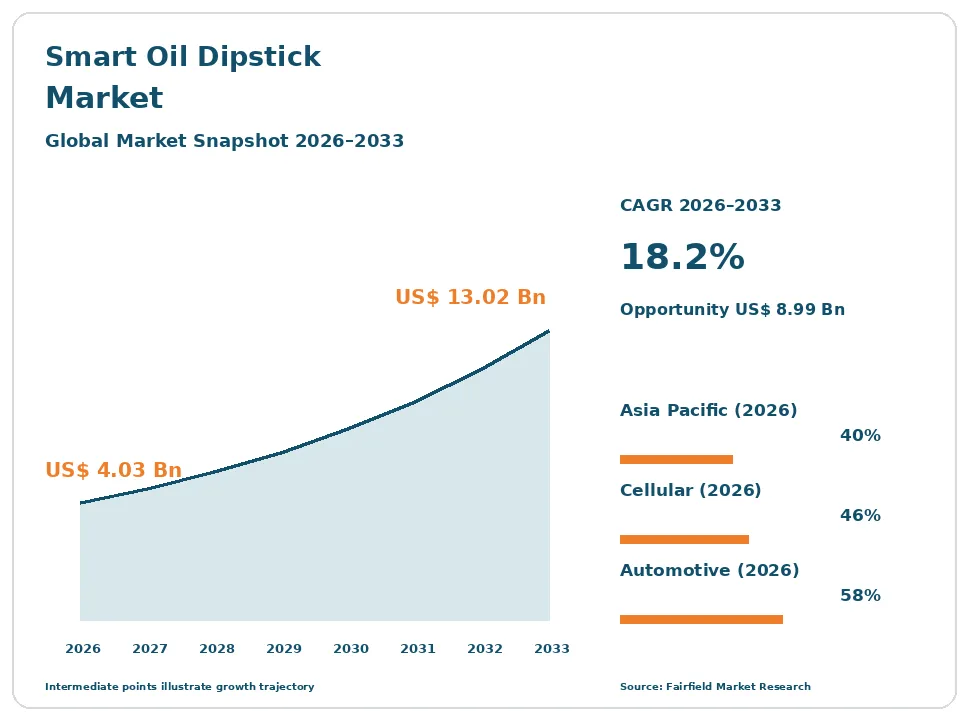
The global smart oil dipstick market size is expected to be valued at US$ 4.03 billion in 2026 and projected to reach US$ 13.02 billion by 2033, growing at a CAGR of 18.2% between 2026 and 2033.
Between 2020 and 2025, the market grew at a CAGR of about 16.5%, as automakers replaced traditional dipsticks with electronic oil level sensing, fleet operators adopted connected maintenance tools, and industrial users added sensors to engines, gearboxes, and hydraulic systems. A smart oil dipstick is a sensor-based device that measures oil level, and often oil temperature and quality, then sends the data to a dashboard, mobile app, or fleet platform instead of requiring a person to pull out a metal stick and read it. More advanced oil condition sensors detect oxidation, fuel dilution, water or coolant contamination, and wear particles. These tools help prevent engine damage, extend oil change intervals, and reduce maintenance costs. Growth comes from connected vehicles, predictive maintenance, fleet telematics, and Industry 4.0 programs. The market is shifting toward wireless, cloud-connected, multi-parameter sensors. In April 2026, Gastops launched a real-time oil condition monitoring system for marine and industrial engines.
Key Report Takeaways
- By Technology: Cellular held 46.0% share in 2026, while Bluetooth & Short-Range Wireless is projected to expand at a 19.6% CAGR through 2033, driven by low-cost retrofit devices that connect to smartphones and on-site gateways in workshops and plants.
- By Application: Automotive held 58.0% share in 2026, while Industrial Equipment is projected to expand at a 20.1% CAGR through 2033, driven by predictive maintenance of generators, compressors, gearboxes, and hydraulic systems in factories and power plants.
- By Sales Channel: OEM held 64.0% share in 2026, while Aftermarket is projected to expand at a 19.9% CAGR through 2033, driven by retrofit kits for existing trucks, machinery, and marine engines and growing fleet telematics adoption.
- By Region: Asia Pacific held 40.0% share in 2026, while North America is projected to expand at a 19.6% CAGR through 2033, driven by fleet telematics, predictive maintenance programs, and connected vehicle features in the United States.
Global Smart Oil Dipstick Market Trends and Insights
Drivers Impact Analysis
Two drivers carry the strongest influence on smart oil dipstick demand during the forecast period.
Connected Vehicles Are Driving the Smart Oil Dipstick Market
Connected vehicles and fleet telematics are the strongest driver of the smart oil dipstick market. Vehicles now report their own health.
The mechanism is the shift from manual checks to digital monitoring. Many new cars and trucks no longer have a traditional dipstick, and drivers instead read oil level on the dashboard or in an app, because electronic sensors are more accurate and prevent spills and contamination. Automakers use oil data to set flexible service intervals, which saves money for owners and reduces waste oil. Fleet operators running trucks, buses, delivery vans, and construction vehicles connect sensors to telematics platforms so that maintenance managers can see the oil condition of every vehicle in real time. Low oil levels or degraded oil trigger alerts before engines fail, avoiding costly breakdowns and downtime. Insurance and leasing companies value the data. These trends make oil level monitoring a standard connected feature.
Predictive Maintenance Is Expanding the Smart Oil Dipstick Market
Predictive maintenance in industry and marine sectors is expanding the smart oil dipstick market. Operators want to fix machines before they break.
The cause is the high cost of unplanned downtime. Factories, power plants, ships, mines, and oil and gas sites run engines, turbines, gearboxes, and hydraulic systems where lubricant failure can cause major damage. Traditionally, operators took oil samples and sent them to laboratories, waiting days for results. Real-time sensors now measure oil quality continuously. Gastops launched FluidSIGHT in April 2026, and NAG Marine began offering Tan Delta oil quality sensors in March 2026. Wind farms and data center generators also need reliable lubrication. Combining oil data with vibration and temperature readings gives a fuller picture of machine health. These tools cut maintenance costs and extend equipment life.
| Driver | Impact on CAGR Forecast | Geographic Relevance | Impact Timeline |
| Connected vehicles and fleet telematics | High | Global | Long term (≥4 years) |
| Predictive maintenance in industry and marine sectors | High | North America, Europe, Asia Pacific | Medium term (2-4 years) |
Restraints Impact Analysis
Two restraints limit how quickly the smart oil dipstick market grows.
High Costs Slow the Smart Oil Dipstick Market
High cost of advanced sensors and integration slows the smart oil dipstick market. Smart sensors cost much more than a metal stick.
The specific causes are sensor technology and system integration. Multi-parameter oil quality sensors use precise electronics and materials that withstand heat, pressure, and vibration, so they can cost hundreds of dollars each. Connecting sensors to vehicle networks, telematics units, and cloud software adds further cost, and users may pay monthly data fees. Small fleet owners and farmers in price-sensitive markets often see manual checks as good enough. Calibration for different oils and engines adds complexity. Many users also lack the skills to interpret oil data, so suppliers must provide software that turns readings into simple actions. These cost barriers slow adoption outside large fleets and high-value equipment.
Electric Vehicles Restrict the Smart Oil Dipstick Market
Electric vehicle adoption reducing engine oil needs restricts the smart oil dipstick market. Battery electric cars have no engine oil to monitor.
The underlying cause is the steady shift to electric drivetrains. As electric car sales rise quickly in China, Europe, and other markets, fewer new passenger cars will need engine oil level and quality sensors, which shrinks one of the largest application areas over time. Electric vehicles still use gear oil in reduction gearboxes and special fluids for battery and motor cooling, but these need less frequent monitoring and smaller sensors. Commercial trucks, buses, construction machinery, agricultural equipment, ships, and generators are expected to rely on combustion engines much longer, especially in heavy-duty uses. Suppliers must shift focus toward these segments. These changes limit long-term growth in passenger cars and push the market toward commercial and industrial users.
| Restraint | Impact on CAGR Forecast | Geographic Relevance | Impact Timeline |
| High cost of advanced sensors and integration | High | Asia Pacific, Latin America, Middle East & Africa | Long term (≥4 years) |
| Electric vehicle adoption reducing engine oil needs | Medium | Europe, Asia Pacific, North America | Long term (≥4 years) |
Market Opportunities
Industrial and Marine Monitoring Opens a Fast-Growth Revenue Pool
Industrial and marine monitoring opens a fast-growth revenue pool in the smart oil dipstick market. Heavy equipment owners want real-time oil data.
Sensor makers and monitoring firms can capture this opportunity. Ships, power generators, compressors, wind turbine gearboxes, mining trucks, hydraulic presses, and oil and gas equipment all rely on lubricants, and a single failure can cost hundreds of thousands of dollars in repairs and lost production. Continuous oil monitoring replaces slow laboratory sampling with instant alerts. Retrofit sensors install directly in existing oil lines with little disruption, and data feeds into plant maintenance systems. Gastops and Tan Delta Systems target these markets, and classification societies and navies are paying closer attention to condition monitoring. Companies that combine rugged sensors with analytics software and expert support can earn recurring service revenue and long-term contracts.
Aftermarket Retrofit and Data Services Create a Recurring Revenue Pool
Aftermarket retrofit and data services create a recurring revenue pool in the smart oil dipstick market. Millions of existing vehicles and machines lack smart sensors.
Telematics providers and aftermarket suppliers can capture this opportunity. Plug-in sensors and replacement dipsticks with built-in electronics can upgrade older trucks, tractors, buses, boats, motorcycles, and generators at low cost. Mobile apps show oil level and condition and remind owners when to service. Fleet telematics companies can add oil data to existing tracking subscriptions, increasing revenue per vehicle. Lubricant brands are exploring sensors as a way to build loyalty and sell oil at the right time. Insurance companies may reward fleets that monitor engine health. Companies with simple, affordable, easy-to-install retrofit kits and strong distribution through workshops and dealers can grow quickly.
Segment Analysis
By Technology: Cellular Leads While Bluetooth & Short-Range Wireless Grows Fastest
Cellular held 46.0% share in 2026. Cellular-connected sensors send oil data directly to cloud platforms from vehicles and remote equipment, making them ideal for trucks, buses, and machines that move across large areas or work far from Wi-Fi. They are often built into vehicle telematics units by automakers and fleet service providers, and new low-power cellular standards reduce data costs.
Bluetooth & Short-Range Wireless is the fastest-growing technology, expanding at a 19.6% CAGR through 2033. Low-cost Bluetooth and similar wireless devices connect to smartphones, tablets, and on-site gateways in workshops, farms, and factories, making them popular for retrofits and small fleets. Wired sensors connected through vehicle networks such as CAN bus form another segment, common in factory-fitted systems. For the market, short-range growth supports affordable retrofits.
By Application: Automotive Leads While Industrial Equipment Grows Fastest
Automotive held 58.0% share in 2026. Passenger cars, light commercial vehicles, trucks, and buses are the largest users, with electronic oil level sensors now common in new models and fleet operators adding oil condition monitoring. Motorcycles are an emerging application in Asia Pacific.
Industrial Equipment is the fastest-growing application, expanding at a 20.1% CAGR through 2033. Factories, power plants, mines, and oil and gas sites are adopting predictive maintenance, and oil sensors are a key data source for generators, compressors, pumps, gearboxes, and hydraulic systems. Marine engines, agricultural machinery, and construction equipment form other applications, with marine users adopting continuous monitoring to meet reliability goals. For the market, industrial growth reflects the spread of predictive maintenance.
By Sales Channel: OEM Leads While Aftermarket Grows Fastest
OEM held 64.0% share in 2026. Automakers and machinery builders fit oil level and quality sensors at the factory, integrated with dashboards, engine control units, and connected services. Suppliers such as Bosch, Continental, HELLA, and TE Connectivity sell to these manufacturers in large volumes.
Aftermarket is the fastest-growing channel, expanding at a 19.9% CAGR through 2033. Retrofit kits for existing trucks, machinery, generators, and boats, sold through workshops, dealers, and online stores, let owners add smart monitoring cheaply without buying new equipment. Telematics service providers bundle sensors with their platforms, and lubricant distributors sell them alongside oil. Prices for retrofit devices are falling as sensor production scales up. For the market, aftermarket growth extends smart monitoring to older fleets.
Geography Analysis
Which Region Is Growing Fastest in the Smart Oil Dipstick Market?
North America is growing fastest in the smart oil dipstick market at a 19.6% CAGR through 2033. The United States has large truck, bus, and service vehicle fleets that widely use telematics, and fleet managers are quick to adopt predictive maintenance tools to reduce breakdowns and labor costs. Automakers such as Stellantis and GM use electronic oil level monitoring in many engines. Industrial plants, oil and gas operators, and the U.S. Navy invest in condition monitoring, and NAG Marine offers oil quality sensors to these markets. Canada and Mexico add demand. Key barriers include sensor costs for small fleets. One change shaping the region is the integration of oil data into fleet management software.
Europe Advances the Smart Oil Dipstick Market Through Connected Vehicles
Europe is a major smart oil dipstick market. Germany, France, the United Kingdom, Italy, and Sweden have premium automakers that adopted electronic oil level sensing early, and suppliers such as Bosch, Continental, and HELLA are based in the region. Truck makers offer connected services that monitor engine health, and strict environmental rules encourage longer oil change intervals that reduce waste. Industrial and marine users in Norway and Germany adopt condition monitoring for ships, wind turbines, and factories. Key barriers include the rapid shift to electric cars. One opportunity is commercial vehicle and machinery monitoring.
Which Region Is Leading the Smart Oil Dipstick Market?
Asia Pacific is leading the smart oil dipstick market with a 40.0% share in 2026. China, Japan, South Korea, and India produce large numbers of vehicles, motorcycles, and industrial machines, and automakers are adding electronic sensors to new models. Denso and other regional suppliers serve local automakers. India has a huge motorcycle and commercial vehicle fleet, and two-wheeler makers have explored low-cost smart dipsticks. Large factories, power plants, and shipyards across the region are adopting predictive maintenance under smart manufacturing programs. Key barriers include price sensitivity. One change shaping the region is the growth of connected two-wheelers and trucks.
Latin America Grows the Smart Oil Dipstick Market Through Fleet Telematics
Latin America is a growing smart oil dipstick market. Brazil, Mexico, Chile, and Colombia have large truck fleets moving agricultural and mining goods over long distances, and telematics adoption is rising to fight theft, improve safety, and control maintenance costs. Mining companies in Chile and Peru use condition monitoring for haul trucks and heavy equipment, where breakdowns are very costly. Key barriers include high device costs and limited cellular connectivity in remote mining and farming areas. Agricultural machinery dealers are beginning to offer connected maintenance services to large farms. One opportunity is oil monitoring for mining and agricultural fleets.
Middle East & Africa Develops the Smart Oil Dipstick Market Through Industrial Assets
Middle East & Africa is a developing smart oil dipstick market. Saudi Arabia, the United Arab Emirates, and Qatar operate large oil and gas facilities, power plants, and desalination plants where engines and turbines run around the clock in extreme heat, making oil condition monitoring valuable. Fleets and mining operations in South Africa add demand. Ports, shipping companies, and airlines in the region are adopting digital maintenance tools, and remote sites benefit from monitoring that reduces the need for technician visits. Key barriers include limited awareness and high costs. One change shaping the region is digital maintenance programs at national energy companies.
Competitive Landscape
The smart oil dipstick market is fragmented. Bosch, Continental, HELLA, Sensata Technologies, and TE Connectivity are leading players, while Denso, Infineon Technologies, NXP Semiconductors, STMicroelectronics, Aptiv, Tan Delta Systems, and Gastops compete strongly. Automotive suppliers dominate factory-fitted oil level sensors, while specialists lead in industrial and marine oil quality monitoring.
Companies compete on sensor accuracy, number of measured parameters, durability in harsh conditions, ease of integration, connectivity, software analytics, and price. Chipmakers such as Infineon Technologies and NXP Semiconductors supply sensing and communication components, while telematics providers bundle oil data with fleet services. Partnerships between sensor makers, distributors, and software companies are common. Specialists win where deep fluid expertise and validation matter. Startups offer low-cost wireless sensors and apps for small fleets, while larger players compete for contracts with automakers and machinery builders that run for many years.
Strategic moves show how competition is changing. In December 2025, Dodge highlighted the shift from dipsticks to electronic oil level monitoring. In March 2026, NAG Marine launched Tan Delta oil quality sensors for marine and industrial markets. In April 2026, Gastops launched its FluidSIGHT system. These moves show competition shifting toward real-time oil quality monitoring in demanding commercial uses.
Three themes shape vendor strategy. First, companies are adding more measurement parameters to single sensors. Second, they are linking sensors to cloud analytics and maintenance software. Third, they are expanding into industrial, marine, and retrofit markets as electric cars reduce passenger car demand.
Smart Oil Dipstick Market Industry Leaders
- Bosch
- Continental
- HELLA
- Sensata Technologies
- TE Connectivity
Recent Industry Developments
- April 2026: Gastops launched FluidSIGHT, a real-time oil condition monitoring system that installs in the oil line of marine and industrial engines, at Singapore Maritime Week 2026 - advances continuous oil condition sensors.
- March 2026: NAG Marine launched the Tan Delta Oil Quality Sensor through a partnership with Tan Delta Systems for propulsion systems, generators, and gearboxes - expands smart oil dipstick technology in marine markets.
- December 2025: Dodge highlighted how electronic oil level monitoring is replacing mechanical dipsticks in modern engines - reflects the shift to oil level monitoring in vehicles.
Companies Covered in the Report
- Bosch
- Continental
- HELLA
- Sensata Technologies
- TE Connectivity
- Denso
- Infineon Technologies
- NXP Semiconductors
- STMicroelectronics
- Aptiv
- Tan Delta Systems
- Gastops
Smart Oil Dipstick Market Report Scope
This report covers smart oil dipsticks and electronic oil monitoring devices, including oil level, temperature, and multi-parameter oil quality sensors, connected through cellular, Bluetooth and short-range wireless, and wired networks, for automotive, industrial equipment, marine, and other applications, sold through OEM and aftermarket channels. The base year is 2025, and the forecast period runs from 2026 to 2033. All values are expressed in US$ Billion.
Technology
- Cellular
- Bluetooth & Short-Range Wireless
- Wired
Application
- Automotive
- Industrial Equipment
- Marine
- Others
Sales Channel
- OEM
- Aftermarket
Regions
- North America
- Europe
- Asia Pacific
- Latin America
- Middle East & Africa
- 1. Executive Summary
- 1.1. Global Smart Oil Dipstick Market Snapshot
- 1.2. Future Projections, 2026-2033
- 1.3. Key Market Trends
- 1.4. Regional Snapshot
- 2. Market Overview
- 2.1. Market Definition and Report Scope
- 2.2. Historical Market Trends, 2020-2025
- 2.3. Market Dynamics
- 2.3.1. Drivers Impact Analysis
- 2.3.1.1. Connected Vehicles Are Driving the Smart Oil Dipstick Market
- 2.3.1.2. Predictive Maintenance Is Expanding the Smart Oil Dipstick Market
- 2.3.2. Restraints Impact Analysis
- 2.3.2.1. High Costs Slow the Smart Oil Dipstick Market
- 2.3.2.2. Electric Vehicles Restrict the Smart Oil Dipstick Market
- 2.3.3. Market Opportunities
- 2.3.3.1. Industrial and Marine Monitoring Opens a Fast-Growth Revenue Pool
- 2.3.3.2. Aftermarket Retrofit and Data Services Create a Recurring Revenue Pool
- 2.3.1. Drivers Impact Analysis
- 3. Global Smart Oil Dipstick Market Outlook, 2020-2033
- 3.1. Global Smart Oil Dipstick Market Outlook, by Technology, Value (US$ Billion), 2020-2033
- 3.1.1. Cellular
- 3.1.2. Bluetooth & Short-Range Wireless
- 3.1.3. Wired
- 3.2. Global Smart Oil Dipstick Market Outlook, by Application, Value (US$ Billion), 2020-2033
- 3.2.1. Automotive
- 3.2.2. Industrial Equipment
- 3.2.3. Marine
- 3.2.4. Others
- 3.3. Global Smart Oil Dipstick Market Outlook, by Sales Channel, Value (US$ Billion), 2020-2033
- 3.3.1. OEM
- 3.3.2. Aftermarket
- 3.4. Global Smart Oil Dipstick Market Outlook, by Region, Value (US$ Billion), 2020-2033
- 3.4.1. North America
- 3.4.2. Europe
- 3.4.3. Asia Pacific
- 3.4.4. Latin America
- 3.4.5. Middle East & Africa
- 3.1. Global Smart Oil Dipstick Market Outlook, by Technology, Value (US$ Billion), 2020-2033
- 4. North America Smart Oil Dipstick Market Outlook, 2020-2033
- 4.1. North America Smart Oil Dipstick Market Outlook, by Technology, Value (US$ Billion), 2020-2033
- 4.1.1. Cellular
- 4.1.2. Bluetooth & Short-Range Wireless
- 4.1.3. Wired
- 4.2. North America Smart Oil Dipstick Market Outlook, by Application, Value (US$ Billion), 2020-2033
- 4.2.1. Automotive
- 4.2.2. Industrial Equipment
- 4.2.3. Marine
- 4.2.4. Others
- 4.3. North America Smart Oil Dipstick Market Outlook, by Sales Channel, Value (US$ Billion), 2020-2033
- 4.3.1. OEM
- 4.3.2. Aftermarket
- 4.4. North America Smart Oil Dipstick Market Outlook, by Country, Value (US$ Billion), 2020-2033
- 4.4.1. United States Smart Oil Dipstick Market Outlook, by Technology, 2020-2033
- 4.4.2. United States Smart Oil Dipstick Market Outlook, by Application, 2020-2033
- 4.4.3. United States Smart Oil Dipstick Market Outlook, by Sales Channel, 2020-2033
- 4.4.4. Canada Smart Oil Dipstick Market Outlook, by Technology, 2020-2033
- 4.4.5. Canada Smart Oil Dipstick Market Outlook, by Application, 2020-2033
- 4.4.6. Canada Smart Oil Dipstick Market Outlook, by Sales Channel, 2020-2033
- 4.4.7. Mexico Smart Oil Dipstick Market Outlook, by Technology, 2020-2033
- 4.4.8. Mexico Smart Oil Dipstick Market Outlook, by Application, 2020-2033
- 4.4.9. Mexico Smart Oil Dipstick Market Outlook, by Sales Channel, 2020-2033
- 4.1. North America Smart Oil Dipstick Market Outlook, by Technology, Value (US$ Billion), 2020-2033
- 5. Europe Smart Oil Dipstick Market Outlook, 2020-2033
- 5.1. Europe Smart Oil Dipstick Market Outlook, by Technology, Value (US$ Billion), 2020-2033
- 5.1.1. Cellular
- 5.1.2. Bluetooth & Short-Range Wireless
- 5.1.3. Wired
- 5.2. Europe Smart Oil Dipstick Market Outlook, by Application, Value (US$ Billion), 2020-2033
- 5.2.1. Automotive
- 5.2.2. Industrial Equipment
- 5.2.3. Marine
- 5.2.4. Others
- 5.3. Europe Smart Oil Dipstick Market Outlook, by Sales Channel, Value (US$ Billion), 2020-2033
- 5.3.1. OEM
- 5.3.2. Aftermarket
- 5.4. Europe Smart Oil Dipstick Market Outlook, by Country, Value (US$ Billion), 2020-2033
- 5.4.1. Germany Smart Oil Dipstick Market Outlook, by Technology, 2020-2033
- 5.4.2. Germany Smart Oil Dipstick Market Outlook, by Application, 2020-2033
- 5.4.3. Germany Smart Oil Dipstick Market Outlook, by Sales Channel, 2020-2033
- 5.4.4. France Smart Oil Dipstick Market Outlook, by Technology, 2020-2033
- 5.4.5. France Smart Oil Dipstick Market Outlook, by Application, 2020-2033
- 5.4.6. France Smart Oil Dipstick Market Outlook, by Sales Channel, 2020-2033
- 5.4.7. United Kingdom Smart Oil Dipstick Market Outlook, by Technology, 2020-2033
- 5.4.8. United Kingdom Smart Oil Dipstick Market Outlook, by Application, 2020-2033
- 5.4.9. United Kingdom Smart Oil Dipstick Market Outlook, by Sales Channel, 2020-2033
- 5.4.10. Italy Smart Oil Dipstick Market Outlook, by Technology, 2020-2033
- 5.4.11. Italy Smart Oil Dipstick Market Outlook, by Application, 2020-2033
- 5.4.12. Italy Smart Oil Dipstick Market Outlook, by Sales Channel, 2020-2033
- 5.4.13. Sweden Smart Oil Dipstick Market Outlook, by Technology, 2020-2033
- 5.4.14. Sweden Smart Oil Dipstick Market Outlook, by Application, 2020-2033
- 5.4.15. Sweden Smart Oil Dipstick Market Outlook, by Sales Channel, 2020-2033
- 5.4.16. Norway Smart Oil Dipstick Market Outlook, by Technology, 2020-2033
- 5.4.17. Norway Smart Oil Dipstick Market Outlook, by Application, 2020-2033
- 5.4.18. Norway Smart Oil Dipstick Market Outlook, by Sales Channel, 2020-2033
- 5.1. Europe Smart Oil Dipstick Market Outlook, by Technology, Value (US$ Billion), 2020-2033
- 6. Asia Pacific Smart Oil Dipstick Market Outlook, 2020-2033
- 6.1. Asia Pacific Smart Oil Dipstick Market Outlook, by Technology, Value (US$ Billion), 2020-2033
- 6.1.1. Cellular
- 6.1.2. Bluetooth & Short-Range Wireless
- 6.1.3. Wired
- 6.2. Asia Pacific Smart Oil Dipstick Market Outlook, by Application, Value (US$ Billion), 2020-2033
- 6.2.1. Automotive
- 6.2.2. Industrial Equipment
- 6.2.3. Marine
- 6.2.4. Others
- 6.3. Asia Pacific Smart Oil Dipstick Market Outlook, by Sales Channel, Value (US$ Billion), 2020-2033
- 6.3.1. OEM
- 6.3.2. Aftermarket
- 6.4. Asia Pacific Smart Oil Dipstick Market Outlook, by Country, Value (US$ Billion), 2020-2033
- 6.4.1. China Smart Oil Dipstick Market Outlook, by Technology, 2020-2033
- 6.4.2. China Smart Oil Dipstick Market Outlook, by Application, 2020-2033
- 6.4.3. China Smart Oil Dipstick Market Outlook, by Sales Channel, 2020-2033
- 6.4.4. Japan Smart Oil Dipstick Market Outlook, by Technology, 2020-2033
- 6.4.5. Japan Smart Oil Dipstick Market Outlook, by Application, 2020-2033
- 6.4.6. Japan Smart Oil Dipstick Market Outlook, by Sales Channel, 2020-2033
- 6.4.7. South Korea Smart Oil Dipstick Market Outlook, by Technology, 2020-2033
- 6.4.8. South Korea Smart Oil Dipstick Market Outlook, by Application, 2020-2033
- 6.4.9. South Korea Smart Oil Dipstick Market Outlook, by Sales Channel, 2020-2033
- 6.4.10. India Smart Oil Dipstick Market Outlook, by Technology, 2020-2033
- 6.4.11. India Smart Oil Dipstick Market Outlook, by Application, 2020-2033
- 6.4.12. India Smart Oil Dipstick Market Outlook, by Sales Channel, 2020-2033
- 6.1. Asia Pacific Smart Oil Dipstick Market Outlook, by Technology, Value (US$ Billion), 2020-2033
- 7. Latin America Smart Oil Dipstick Market Outlook, 2020-2033
- 7.1. Latin America Smart Oil Dipstick Market Outlook, by Technology, Value (US$ Billion), 2020-2033
- 7.1.1. Cellular
- 7.1.2. Bluetooth & Short-Range Wireless
- 7.1.3. Wired
- 7.2. Latin America Smart Oil Dipstick Market Outlook, by Application, Value (US$ Billion), 2020-2033
- 7.2.1. Automotive
- 7.2.2. Industrial Equipment
- 7.2.3. Marine
- 7.2.4. Others
- 7.3. Latin America Smart Oil Dipstick Market Outlook, by Sales Channel, Value (US$ Billion), 2020-2033
- 7.3.1. OEM
- 7.3.2. Aftermarket
- 7.4. Latin America Smart Oil Dipstick Market Outlook, by Country, Value (US$ Billion), 2020-2033
- 7.4.1. Brazil Smart Oil Dipstick Market Outlook, by Technology, 2020-2033
- 7.4.2. Brazil Smart Oil Dipstick Market Outlook, by Application, 2020-2033
- 7.4.3. Brazil Smart Oil Dipstick Market Outlook, by Sales Channel, 2020-2033
- 7.4.4. Mexico Smart Oil Dipstick Market Outlook, by Technology, 2020-2033
- 7.4.5. Mexico Smart Oil Dipstick Market Outlook, by Application, 2020-2033
- 7.4.6. Mexico Smart Oil Dipstick Market Outlook, by Sales Channel, 2020-2033
- 7.4.7. Chile Smart Oil Dipstick Market Outlook, by Technology, 2020-2033
- 7.4.8. Chile Smart Oil Dipstick Market Outlook, by Application, 2020-2033
- 7.4.9. Chile Smart Oil Dipstick Market Outlook, by Sales Channel, 2020-2033
- 7.4.10. Colombia Smart Oil Dipstick Market Outlook, by Technology, 2020-2033
- 7.4.11. Colombia Smart Oil Dipstick Market Outlook, by Application, 2020-2033
- 7.4.12. Colombia Smart Oil Dipstick Market Outlook, by Sales Channel, 2020-2033
- 7.4.13. Peru Smart Oil Dipstick Market Outlook, by Technology, 2020-2033
- 7.4.14. Peru Smart Oil Dipstick Market Outlook, by Application, 2020-2033
- 7.4.15. Peru Smart Oil Dipstick Market Outlook, by Sales Channel, 2020-2033
- 7.1. Latin America Smart Oil Dipstick Market Outlook, by Technology, Value (US$ Billion), 2020-2033
- 8. Middle East & Africa Smart Oil Dipstick Market Outlook, 2020-2033
- 8.1. Middle East & Africa Smart Oil Dipstick Market Outlook, by Technology, Value (US$ Billion), 2020-2033
- 8.1.1. Cellular
- 8.1.2. Bluetooth & Short-Range Wireless
- 8.1.3. Wired
- 8.2. Middle East & Africa Smart Oil Dipstick Market Outlook, by Application, Value (US$ Billion), 2020-2033
- 8.2.1. Automotive
- 8.2.2. Industrial Equipment
- 8.2.3. Marine
- 8.2.4. Others
- 8.3. Middle East & Africa Smart Oil Dipstick Market Outlook, by Sales Channel, Value (US$ Billion), 2020-2033
- 8.3.1. OEM
- 8.3.2. Aftermarket
- 8.4. Middle East & Africa Smart Oil Dipstick Market Outlook, by Country, Value (US$ Billion), 2020-2033
- 8.4.1. Saudi Arabia Smart Oil Dipstick Market Outlook, by Technology, 2020-2033
- 8.4.2. Saudi Arabia Smart Oil Dipstick Market Outlook, by Application, 2020-2033
- 8.4.3. Saudi Arabia Smart Oil Dipstick Market Outlook, by Sales Channel, 2020-2033
- 8.4.4. United Arab Emirates Smart Oil Dipstick Market Outlook, by Technology, 2020-2033
- 8.4.5. United Arab Emirates Smart Oil Dipstick Market Outlook, by Application, 2020-2033
- 8.4.6. United Arab Emirates Smart Oil Dipstick Market Outlook, by Sales Channel, 2020-2033
- 8.4.7. Qatar Smart Oil Dipstick Market Outlook, by Technology, 2020-2033
- 8.4.8. Qatar Smart Oil Dipstick Market Outlook, by Application, 2020-2033
- 8.4.9. Qatar Smart Oil Dipstick Market Outlook, by Sales Channel, 2020-2033
- 8.4.10. South Africa Smart Oil Dipstick Market Outlook, by Technology, 2020-2033
- 8.4.11. South Africa Smart Oil Dipstick Market Outlook, by Application, 2020-2033
- 8.4.12. South Africa Smart Oil Dipstick Market Outlook, by Sales Channel, 2020-2033
- 8.1. Middle East & Africa Smart Oil Dipstick Market Outlook, by Technology, Value (US$ Billion), 2020-2033
- 9. Competitive Landscape
- 9.1. Market Concentration and Industry Leaders
- 9.2. Competitive Differentiation
- 9.3. Strategic Initiatives
- 9.4. Recent Industry Developments
- 9.5. Company Profiles
- 9.5.1. Bosch
- 9.5.2. Continental
- 9.5.3. HELLA
- 9.5.4. Sensata Technologies
- 9.5.5. TE Connectivity
- 9.5.6. Denso
- 9.5.7. Infineon Technologies
- 9.5.8. NXP Semiconductors
- 9.5.9. STMicroelectronics
- 9.5.10. Aptiv
- 9.5.11. Tan Delta Systems
- 9.5.12. Gastops
- 10. Appendix
- 10.1. Research Methodology
- 10.2. Report Assumptions
- 10.3. Acronyms and Abbreviations
| Technology | Cellular, Bluetooth & Short-Range Wireless, Wired |
| Application | Automotive, Industrial Equipment, Marine, Others |
| Sales Channel | OEM, Aftermarket |
| Regions | North America, Europe, Asia Pacific, Latin America, Middle East & Africa |
Our Research Methodology
Considering the volatility of business today, traditional approaches to strategizing a game plan can be unfruitful if not detrimental. True ambiguity is no way to determine a forecast. A myriad of predetermined factors must be accounted for such as the degree of risk involved, the magnitude of circumstances, as well as conditions or consequences that are not known or unpredictable. To circumvent binary views that cast uncertainty, the application of market research intelligence to strategically posture, move, and enable actionable outcomes is necessary.
View Methodology
Quality Assured
Rigorous Validation Process

Confidentiality Assured
End-to-end Data Security

Custom Research Services
Tailored To Your Objectives
FAQs
The smart oil dipstick market is valued at US$ 4.03 billion in 2026, led by automotive applications and Asia Pacific.
The market is projected to reach US$ 13.02 billion by 2033, growing at an 18.2% CAGR and adding US$ 8.99 billion.
Industrial equipment is growing fastest at a 20.1% CAGR through 2033, driven by predictive maintenance in factories, plants, and ships.
North America is growing fastest at a 19.6% CAGR through 2033, driven by fleet telematics and predictive maintenance programs.
Asia Pacific holds the largest share at 40.0% in 2026, supported by large vehicle production and industrial bases in China and India.
Related Reports
Rail Glazing Market Size, Share, Insights, Competitive Landscape, and Forecast 2026 to 2033
Rail Glazing Market is projected to grow from US$ 2.37 billion in 2026 to US$ 3.56 billion by 2033 at a 6.0% CAGR. Explore materials and applications.
Passenger Vehicle ADAS Market Size, Share, Insights, Competitive Landscape, and Forecast 2026 to 2033
Passenger Vehicle ADAS Market is set to grow from US$ 36.7 billion in 2026 to US$ 115.5 billion by 2033 at a 17.8% CAGR. Explore sensors and trends.
Container Fleet Market Size, Share, Insights, Competitive Landscape, and Forecast 2026 to 2033
Explore the container fleet market, projected to reach US$ 26.8 billion by 2033 at a 5.4% CAGR, with container types, ownership and regional insights.
Micro-mobility Charging Infrastructure Market Size, Share, Insights, Competitive Landscape, and Forecast 2026 to 2033
The global micro-mobility charging infrastructure market is valued at US$9.06 billion in 2026, reaching US$34.02 billion by 2033, growing at a 20.8% CAGR
eCTOL Aircraft Market Size, Share, Insights, Competitive Landscape, and Forecast 2026 to 2033
Explore the eCTOL aircraft market, projected to reach US$ 11.14 billion by 2033 at a 10.6% CAGR, with propulsion, application and regional insights.
Smart EV Charging Networks Market Size, Share, Insights, Competitive Landscape, and Forecast 2026 to 2033
The global smart EV charging networks market is valued at US$9.43 billion in 2026, reaching US$37.07 billion by 2033, growing at a 21.6% CAGR