



Pleated Filters Market
Pleated Filters Market Size, Share, Insights, Competitive Landscape, and Forecast 2026 to 2033
Report Overview
Pleated Filters Market Size and Trend Analysis
How Fast Will the Pleated Filters Market Grow?
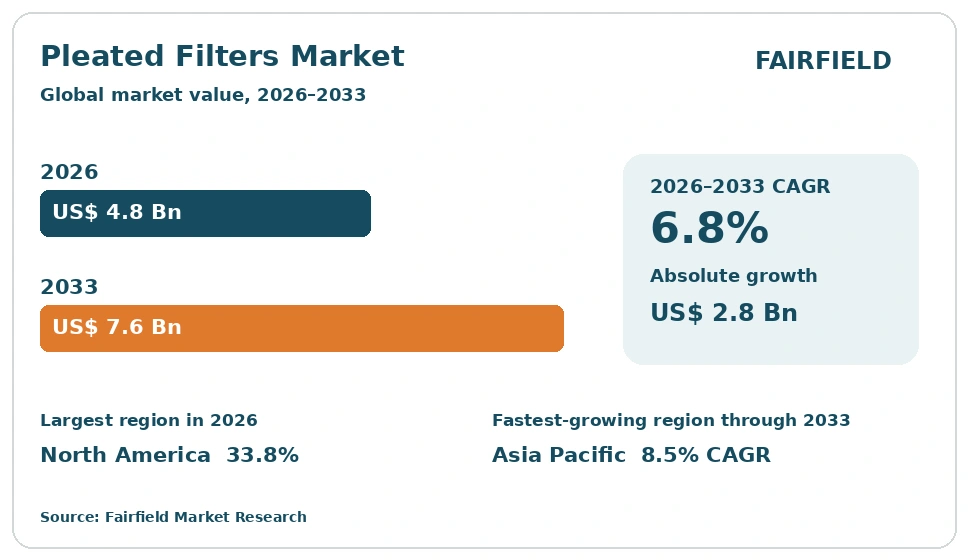
The global Pleated Filters market size is expected to be valued at US$ 4.8 billion in 2026 and projected to reach US$ 7.6 billion by 2033, growing at a CAGR of 6.8% between 2026 and 2033. Growth ran at about 5.6% between 2020 and 2025, so the pace is quickening. Tighter indoor air quality expectations, wider cleanroom construction and rising water reuse capacity are the main pulls. Pleated designs pack more media into the same housing, which lowers pressure drop and cuts fan energy cost over a filter’s service life. The absolute dollar opportunity across the forecast period is US$ 2.8 billion, and most of it comes from replacement sales rather than first-fit equipment.
Key Report Takeaways
- By Product Type: Pleated panel filters led with 34.6% share in 2026, while HEPA and ULPA pleated elements are projected to expand at an 8.4% CAGR through 2033, driven by new cleanroom and hospital isolation capacity.
- By Filtration Media: Synthetic media held 41.3% share in 2026, while PTFE membrane media is set to grow at a 9.1% CAGR through 2033, supported by demand for elements that hold efficiency in humid, chemically aggressive service.
- By Application: HVAC air filtration accounted for 38.9% of revenue in 2026, while cleanroom air filtration should rise at an 8.7% CAGR through 2033, reflecting validated filtration specified in pharmaceutical and semiconductor fit-outs.
- By End-use Industry: Commercial and institutional buildings led with 29.7% share in 2026, while pharmaceutical and healthcare sites are forecast to grow at an 8.9% CAGR through 2033, helped by stricter contamination control audits.
- By Region: North America led with 33.8% share in 2026, while Asia Pacific is projected to expand at an 8.5% CAGR through 2033; Europe, Latin America and Middle East & Africa add replacement demand from retrofit and industrial projects.
Market Trends and Insights
Market Growth Drivers
Tighter Indoor Air Quality Expectations in Commercial Buildings
Stricter indoor air quality expectations are lifting pleated filter demand across offices, schools, hospitals and airports. Building owners now specify higher efficiency panel and bag filters at the air handling unit, which raises both unit prices and replacement volumes. Pleated construction suits this shift because it adds media area without enlarging the housing, so operators can upgrade efficiency without rebuilding ductwork. Retrofit work has become a steady revenue line rather than a one-off project.
The shift follows years of guidance from ventilation and standards bodies such as ASHRAE, and from classification frameworks published by ISO and EN, which give buyers a common way to compare filter performance. Facility teams increasingly tie filter selection to measurable outcomes, including particle counts, energy use and occupant complaints. Documented testing also favours manufacturers with laboratory capability, since buyers want performance data before approving a specification change.
Energy Cost Pressure Is Reshaping Filter Specification
Rising electricity prices are pushing buyers toward pleated filters that deliver efficiency at a lower pressure drop. Fan energy dominates the lifetime cost of an air filter, so a design that breathes easier pays back quickly. Pleated media geometry spreads airflow over a larger surface, which lowers resistance and extends service life between change-outs. Procurement teams now compare total cost of ownership rather than unit price, and that comparison usually favours pleated elements.
Manufacturers have responded with deeper pleat packs, mini-pleat constructions and lighter synthetic media that hold efficiency longer in service. Energy benchmarking in commercial real estate has made fan power visible to building operators, who can trace savings directly to a filter change. The same logic applies in liquid service, where pleated cartridges reduce pump load and cut the frequency of element replacement in continuous process plants.
Restraints Impact Analysis of Market
Input Cost Volatility in Media, Resins and Frames
Swings in polymer and glass fibre input costs squeeze margins and slow pleated filter price negotiations. Polyester and polypropylene media, polyurethane sealants and moulded frames all track petrochemical feedstocks, so a sharp move upstream reaches filter pricing within a quarter. Many supply contracts with large facility operators are fixed for a year, leaving manufacturers to absorb the gap. Smaller converters with limited media inventory feel the pressure first and often delay capacity decisions.
Media supply is also concentrated, since relatively few producers make wet-laid glass and meltblown synthetic rolls at filtration grade. Freight and energy costs add further variability to delivered media prices. Buyers respond by qualifying second sources, but each alternative media must be retested before a filter can be sold against a rated efficiency class. That qualification work takes time and discourages rapid switching, so cost shocks pass through slowly.
Commodity Imports and Deferred Replacement Cycles
Low-cost commodity filters and stretched replacement intervals cap revenue growth in price-sensitive segments. Standard pleated panels for light commercial duty are easy to copy, so imported product competes hard on price through distribution channels. At the same time, maintenance budgets in older building stock often push change-outs well beyond the recommended interval. Both behaviours reduce the volume and the value that manufacturers capture from a given installed base.
Washable and cleanable alternatives add further substitution pressure in industrial dust collection and coarse pre-filtration duty. Independent verification of filter performance is uncommon outside regulated sites, which makes it harder for premium suppliers to prove value at the point of sale. Education efforts by manufacturers and trade associations help, but adoption is slow where filters are bought by procurement teams rather than specified by engineering teams.
Market Opportunities
Cleanroom Construction in Pharmaceutical and Electronics Plants
New cleanroom capacity creates high-value demand for HEPA and ULPA pleated elements and matched pre-filters. A single cleanroom suite uses many terminal filters plus several upstream stages, and each stage is replaced on a documented schedule. Pharmaceutical, biologics, medical device and semiconductor projects all specify validated filtration, which supports premium pricing and recurring service revenue. Suppliers that can certify, install and scan filters on site capture more of that spend.
Investment in domestic pharmaceutical and chip manufacturing capacity across several economies is widening the addressable base. Modular cleanroom construction shortens project timelines and standardises filter formats, which helps manufacturers plan production runs. Demand extends to adjacent spaces such as laboratories, compounding pharmacies and battery dry rooms. These projects favour vendors with testing laboratories, local technical support and the documentation that qualification and audit processes require.
Water Reuse and Process Liquid Filtration Growth
Water reuse and tighter process liquid standards open a growing market for pleated filter cartridges. Municipal and industrial reuse schemes need dependable pre-filtration ahead of membrane systems, and pleated cartridges offer high dirt-holding capacity in a compact housing. Food, beverage, chemical and electronics plants also use pleated elements to protect downstream equipment and finished product quality. Each installation creates a recurring consumable stream rather than a single equipment sale.
Water scarcity and discharge limits are pushing industrial sites to recycle process water instead of drawing fresh supply. Semiconductor and battery plants need ultrapure water, which depends on multi-stage pleated and membrane filtration. Suppliers are extending cartridge ranges with pleated PTFE and polyethersulphone membranes for finer retention and better chemical resistance. Revenue is shifting steadily from coarse cartridges toward validated, higher-value liquid filtration elements.
Category-wise Insights
Which Product Type Leads Pleated Filter Demand?
Pleated panel filters lead the market with 34.6% share in 2026, because they fit the standard air handling units used across commercial and institutional buildings. Their position rests on replacement volume rather than unit price, since panels are changed several times a year in most ventilation systems. HEPA and ULPA pleated elements are the growth leader, advancing at an 8.4% CAGR between 2026 and 2033, as cleanroom, hospital and electronics capacity expands. Pleated cartridge filters hold 27.2% share and pleated bag filters 21.5%, serving liquid process lines and multi-stage air systems respectively. The split matters for strategy: panel volume funds factory utilisation, while HEPA work carries higher margins, testing obligations and service attachment. Suppliers that cover both can defend scale and value at the same time.
Synthetic Media Carries Volume While PTFE Membranes Set the Pace
Synthetic media holds 41.3% of the market in 2026, helped by low cost, moisture resistance and consistent quality in high-volume production. Polyester and polypropylene constructions dominate panel and bag filters where price and pressure drop matter more than ultimate efficiency. PTFE membrane media is the fastest riser at a 9.1% CAGR through 2033, since it combines high efficiency with stable resistance and tolerates humidity and chemical exposure. Cellulose and cellulose blends retain 24.8% share in industrial and automotive duty, while glass fibre media accounts for 21.6%, mainly in HEPA and high-temperature applications. Media choice increasingly decides competitive position, because it sets energy cost, service life and tested performance. Vendors with in-house media conversion capability therefore control a larger share of the value created.
HVAC Air Filtration Anchors Revenue as Cleanroom Work Accelerates
HVAC air filtration accounts for 38.9% of revenue in 2026, reflecting the sheer number of air handling units in offices, schools, hospitals, retail space and transport hubs. These systems generate predictable replacement demand on quarterly or semi-annual cycles. Cleanroom air filtration grows fastest at an 8.7% CAGR through 2033, following pharmaceutical, biologics and semiconductor construction that specifies validated terminal filters and documented change control. Process liquid filtration contributes 26.4% share and water treatment filtration 19.2%, both tied to food, beverage, chemical and municipal reuse projects. The pattern describes a market with a broad consumable base and a narrower, faster, higher-value tier above it. Suppliers increasingly use the large HVAC installed base to sell engineering support into regulated applications, where qualification work raises switching costs.
Commercial Buildings Lead Spending While Pharmaceutical Sites Grow Fastest
Commercial and institutional buildings lead end-use demand with 29.7% share in 2026, driven by the scale of the installed ventilation base and by occupant health expectations. Industrial manufacturing and automotive plants follow at 26.8%, using pleated elements in paint finishing, compressed air, coolant and hydraulic systems. Pharmaceutical and healthcare sites are the fastest-growing end use at an 8.9% CAGR through 2033, because contamination control audits and facility expansion both raise filter counts. Food and beverage processing holds 18.4% share, while power, utilities and other uses account for 10.5%. The contrast is useful for planning: building demand is broad and price competitive, whereas regulated end uses reward documentation, validation support and reliable supply, and they tend to hold pricing through procurement cycles.
Geography Analysis
Which Region Is Leading the Pleated Filters Market?
North America leads the Pleated Filters market with 33.8% share in 2026. The United States contributes most of that total, supported by a large commercial building stock, strict healthcare ventilation practice and steady cleanroom construction. Canada adds demand from hospitals, data centres and food processing plants. A decade of attention to indoor air quality has lifted average efficiency levels in offices, schools and airports, which raises revenue per change-out. Pharmaceutical and semiconductor investment has expanded the installed base of HEPA terminal filters and the certification work that follows. Distribution is mature, and national facility management contracts standardise filter specifications across property portfolios, so replacement volumes stay predictable through economic cycles.
Energy Rules and Regulated Industries Sustain European Demand
Europe holds second position with 28.1% share in 2026, anchored by Germany, France, the United Kingdom and Italy. Building energy performance rules push designers toward low pressure drop pleated media, since fan power counts against a building’s energy rating. The region’s pharmaceutical, chemical and food processing base sustains demand for validated air and liquid filtration. Classification and testing frameworks published by ISO and EN give buyers a common language for efficiency, which supports rated products over unrated imports. Nordic and Benelux markets are active in cleanroom and laboratory projects, while southern Europe adds hotel, retail and public building retrofit work that favours standard pleated panels.
Which Region Is Growing Fastest in the Pleated Filters Market?
Asia Pacific is the fastest-growing region, expanding at an 8.5% CAGR between 2026 and 2033. China, India, Japan, South Korea and Taiwan set that pace. Semiconductor fabs, display plants and battery facilities require large volumes of HEPA and ULPA pleated elements, while new pharmaceutical capacity in India adds cleanroom demand. Urban air quality concerns have normalised higher efficiency filtration in offices, hospitals, metro systems and residential buildings. Local manufacturing capacity is expanding, which shortens lead times and lowers delivered cost for regional buyers. Rising industrial water reuse across the region supports pleated cartridge sales alongside the larger air filtration business.
Industrial Investment Cycles Shape Latin American Filter Demand
Latin America is a smaller but steady market, led by Brazil, Mexico and Chile. Automotive and appliance plants in Mexico use pleated filters in paint booths, compressed air systems and process liquid lines. Brazil contributes food processing, sugar and ethanol, and pharmaceutical demand. Hospital construction and commercial refurbishment in larger cities lift replacement volumes for panel and bag filters. Growth depends on industrial investment cycles and currency movements, because much high efficiency media is imported. Regional assemblers increasingly convert imported media into finished filters locally, which trims landed cost and improves availability for maintenance buyers working to short lead times.
Harsh Climates and Project Work Drive Middle East & Africa
Middle East & Africa remains the smallest region but shows improving fundamentals. Saudi Arabia, the United Arab Emirates, Qatar and South Africa account for most demand. Hot, dusty conditions shorten filter life in HVAC systems, so replacement frequency is high in commercial towers, airports and hospitality assets. Desalination, petrochemical and power projects use pleated cartridges in process water, fuel and lubrication duty. Healthcare and laboratory construction linked to national development programmes is adding cleanroom filtration demand. Local assembly is limited, so distributors and project contractors shape supply, and specifications for large schemes often follow the standards applied by the international design and engineering firms that lead them.
Competitive Landscape
The Pleated Filters market is moderately fragmented. A group of global manufacturers, including Camfil, MANN+HUMMEL, Donaldson Company, Parker Hannifin, Freudenberg Filtration Technologies and AAF International, competes alongside many regional converters serving local building and industrial accounts. Scale matters in media sourcing, testing capability and multi-site service contracts, which is why larger vendors tend to gain ground in regulated applications. Consolidation continues as groups acquire regional filter assemblers to add capacity and local distribution, while commodity panel filters remain closely contested by smaller suppliers.
Competition centres on measurable performance. Vendors differentiate through media technology, pleat geometry, pressure drop at rated efficiency, service life and the quality of test documentation. Sustainability has become a practical selling point, covering recyclable frames, lower fan energy and reduced landfill volume per change-out. Automation in pleating, sealing and assembly supports consistent quality at high volume. New entrants come mainly from media producers moving downstream and from regional assemblers upgrading into rated, tested products.
Strategic activity follows the demand shift. Manufacturers are adding capacity closer to growth markets in Asia Pacific, extending liquid cartridge ranges, and investing in testing laboratories so products can be certified for cleanroom and process duty. Partnerships with building controls and air quality monitoring providers let vendors sell filtration as part of a managed service rather than as a loose consumable, which deepens customer relationships.
The competitive direction points toward documented performance and total cost of ownership. Vendors that combine media know-how, local manufacturing and credible testing are positioned to respond as specifications tighten across both air and liquid filtration.
Industry Leaders
- Camfil AB
- MANN+HUMMEL GmbH
- Donaldson Company, Inc.
- Parker Hannifin Corporation
- Freudenberg Filtration Technologies SE & Co. KG
- AAF International
- Pall Corporation
- 3M Company
Companies Covered in the Report
- Camfil AB
- MANN+HUMMEL GmbH
- Donaldson Company, Inc.
- Parker Hannifin Corporation
- Freudenberg Filtration Technologies SE & Co. KG
- AAF International
- Pall Corporation
- 3M Company
- Atmus Filtration Technologies Inc.
- Filtration Group Corporation
- Alkegen
- Porvair Filtration Group
- Eaton Corporation plc
- Nippon Muki Co., Ltd.
- Nederman Holding AB
- Sogefi S.p.A.
Pleated Filters Market Report Scope
The Pleated Filters market is segmented by product type, filtration media, application, end-use industry and region.
| By Product Type | Pleated panel filters, Pleated cartridge filters, Pleated bag filters, HEPA and ULPA pleated elements |
| By Filtration Media | Synthetic media, Cellulose and cellulose blends, Glass fibre media, PTFE membrane media |
| By Application | HVAC air filtration, Process liquid filtration, Water treatment filtration, Cleanroom air filtration |
| By End-use Industry | Commercial and institutional buildings, Industrial manufacturing and automotive, Food and beverage, Pharmaceutical and healthcare, Others |
| By Region | North America, Europe, Asia Pacific, Latin America, Middle East & Africa |
1. Executive Summary
1.1 Global Pleated Filters Market Snapshot
1.2 Future Projections, 2026–2033
1.3 Key Industry Highlights
1.4 Regional Snapshot
2. Market Overview
2.1 Market Definition and Report Scope
2.2 Historical Market Trends
2.3 Market Dynamics
2.3.1 Drivers
2.3.1.1 Tighter Indoor Air Quality Expectations in Commercial Buildings
2.3.1.2 Energy Cost Pressure Is Reshaping Filter Specification
2.3.2 Restraints
2.3.2.1 Input Cost Volatility in Media, Resins and Frames
2.3.2.2 Commodity Imports and Deferred Replacement Cycles
2.3.3 Market Opportunities
2.3.3.1 Cleanroom Construction in Pharmaceutical and Electronics Plants
2.3.3.2 Water Reuse and Process Liquid Filtration Growth
3. Global Pleated Filters Market Outlook, 2026–2033
3.1 Global Pleated Filters Market Outlook, by Product Type, Value (US$ Billion), 2026–2033
3.1.1 Pleated panel filters
3.1.2 Pleated cartridge filters
3.1.3 Pleated bag filters
3.1.4 HEPA and ULPA pleated elements
3.2 Global Pleated Filters Market Outlook, by Filtration Media, Value (US$ Billion), 2026–2033
3.2.1 Synthetic media
3.2.2 Cellulose and cellulose blends
3.2.3 Glass fibre media
3.2.4 PTFE membrane media
3.3 Global Pleated Filters Market Outlook, by Application, Value (US$ Billion), 2026–2033
3.3.1 HVAC air filtration
3.3.2 Process liquid filtration
3.3.3 Water treatment filtration
3.3.4 Cleanroom air filtration
3.4 Global Pleated Filters Market Outlook, by End-use Industry, Value (US$ Billion), 2026–2033
3.4.1 Commercial and institutional buildings
3.4.2 Industrial manufacturing and automotive
3.4.3 Food and beverage
3.4.4 Pharmaceutical and healthcare
3.4.5 Others
3.5 Global Pleated Filters Market Outlook, by Region, Value (US$ Billion), 2026–2033
3.5.1 North America
3.5.2 Europe
3.5.3 Asia Pacific
3.5.4 Latin America
3.5.5 Middle East & Africa
4. North America Pleated Filters Market Outlook, 2026–2033
4.1 North America Pleated Filters Market Outlook, by Product Type, Value (US$ Billion), 2026–2033
4.1.1 Pleated panel filters
4.1.2 Pleated cartridge filters
4.1.3 Pleated bag filters
4.1.4 HEPA and ULPA pleated elements
4.2 North America Pleated Filters Market Outlook, by Filtration Media, Value (US$ Billion), 2026–2033
4.2.1 Synthetic media
4.2.2 Cellulose and cellulose blends
4.2.3 Glass fibre media
4.2.4 PTFE membrane media
4.3 North America Pleated Filters Market Outlook, by Application, Value (US$ Billion), 2026–2033
4.3.1 HVAC air filtration
4.3.2 Process liquid filtration
4.3.3 Water treatment filtration
4.3.4 Cleanroom air filtration
4.4 North America Pleated Filters Market Outlook, by End-use Industry, Value (US$ Billion), 2026–2033
4.4.1 Commercial and institutional buildings
4.4.2 Industrial manufacturing and automotive
4.4.3 Food and beverage
4.4.4 Pharmaceutical and healthcare
4.4.5 Others
4.5 North America Pleated Filters Market Outlook, by Country, Value (US$ Billion), 2026–2033
4.5.1 United States Pleated Filters Market Outlook, by Product Type, 2026–2033
4.5.2 United States Pleated Filters Market Outlook, by Filtration Media, 2026–2033
4.5.3 United States Pleated Filters Market Outlook, by Application, 2026–2033
4.5.4 United States Pleated Filters Market Outlook, by End-use Industry, 2026–2033
4.5.5 Canada Pleated Filters Market Outlook, by Product Type, 2026–2033
4.5.6 Canada Pleated Filters Market Outlook, by Filtration Media, 2026–2033
4.5.7 Canada Pleated Filters Market Outlook, by Application, 2026–2033
4.5.8 Canada Pleated Filters Market Outlook, by End-use Industry, 2026–2033
5. Europe Pleated Filters Market Outlook, 2026–2033
5.1 Europe Pleated Filters Market Outlook, by Product Type, Value (US$ Billion), 2026–2033
5.1.1 Pleated panel filters
5.1.2 Pleated cartridge filters
5.1.3 Pleated bag filters
5.1.4 HEPA and ULPA pleated elements
5.2 Europe Pleated Filters Market Outlook, by Filtration Media, Value (US$ Billion), 2026–2033
5.2.1 Synthetic media
5.2.2 Cellulose and cellulose blends
5.2.3 Glass fibre media
5.2.4 PTFE membrane media
5.3 Europe Pleated Filters Market Outlook, by Application, Value (US$ Billion), 2026–2033
5.3.1 HVAC air filtration
5.3.2 Process liquid filtration
5.3.3 Water treatment filtration
5.3.4 Cleanroom air filtration
5.4 Europe Pleated Filters Market Outlook, by End-use Industry, Value (US$ Billion), 2026–2033
5.4.1 Commercial and institutional buildings
5.4.2 Industrial manufacturing and automotive
5.4.3 Food and beverage
5.4.4 Pharmaceutical and healthcare
5.4.5 Others
5.5 Europe Pleated Filters Market Outlook, by Country, Value (US$ Billion), 2026–2033
5.5.1 Germany Pleated Filters Market Outlook, by Product Type, 2026–2033
5.5.2 Germany Pleated Filters Market Outlook, by Filtration Media, 2026–2033
5.5.3 Germany Pleated Filters Market Outlook, by Application, 2026–2033
5.5.4 Germany Pleated Filters Market Outlook, by End-use Industry, 2026–2033
5.5.5 France Pleated Filters Market Outlook, by Product Type, 2026–2033
5.5.6 France Pleated Filters Market Outlook, by Filtration Media, 2026–2033
5.5.7 France Pleated Filters Market Outlook, by Application, 2026–2033
5.5.8 France Pleated Filters Market Outlook, by End-use Industry, 2026–2033
5.5.9 United Kingdom Pleated Filters Market Outlook, by Product Type, 2026–2033
5.5.10 United Kingdom Pleated Filters Market Outlook, by Filtration Media, 2026–2033
5.5.11 United Kingdom Pleated Filters Market Outlook, by Application, 2026–2033
5.5.12 United Kingdom Pleated Filters Market Outlook, by End-use Industry, 2026–2033
5.5.13 Italy Pleated Filters Market Outlook, by Product Type, 2026–2033
5.5.14 Italy Pleated Filters Market Outlook, by Filtration Media, 2026–2033
5.5.15 Italy Pleated Filters Market Outlook, by Application, 2026–2033
5.5.16 Italy Pleated Filters Market Outlook, by End-use Industry, 2026–2033
6. Asia Pacific Pleated Filters Market Outlook, 2026–2033
6.1 Asia Pacific Pleated Filters Market Outlook, by Product Type, Value (US$ Billion), 2026–2033
6.1.1 Pleated panel filters
6.1.2 Pleated cartridge filters
6.1.3 Pleated bag filters
6.1.4 HEPA and ULPA pleated elements
6.2 Asia Pacific Pleated Filters Market Outlook, by Filtration Media, Value (US$ Billion), 2026–2033
6.2.1 Synthetic media
6.2.2 Cellulose and cellulose blends
6.2.3 Glass fibre media
6.2.4 PTFE membrane media
6.3 Asia Pacific Pleated Filters Market Outlook, by Application, Value (US$ Billion), 2026–2033
6.3.1 HVAC air filtration
6.3.2 Process liquid filtration
6.3.3 Water treatment filtration
6.3.4 Cleanroom air filtration
6.4 Asia Pacific Pleated Filters Market Outlook, by End-use Industry, Value (US$ Billion), 2026–2033
6.4.1 Commercial and institutional buildings
6.4.2 Industrial manufacturing and automotive
6.4.3 Food and beverage
6.4.4 Pharmaceutical and healthcare
6.4.5 Others
6.5 Asia Pacific Pleated Filters Market Outlook, by Country, Value (US$ Billion), 2026–2033
6.5.1 China Pleated Filters Market Outlook, by Product Type, 2026–2033
6.5.2 China Pleated Filters Market Outlook, by Filtration Media, 2026–2033
6.5.3 China Pleated Filters Market Outlook, by Application, 2026–2033
6.5.4 China Pleated Filters Market Outlook, by End-use Industry, 2026–2033
6.5.5 India Pleated Filters Market Outlook, by Product Type, 2026–2033
6.5.6 India Pleated Filters Market Outlook, by Filtration Media, 2026–2033
6.5.7 India Pleated Filters Market Outlook, by Application, 2026–2033
6.5.8 India Pleated Filters Market Outlook, by End-use Industry, 2026–2033
6.5.9 Japan Pleated Filters Market Outlook, by Product Type, 2026–2033
6.5.10 Japan Pleated Filters Market Outlook, by Filtration Media, 2026–2033
6.5.11 Japan Pleated Filters Market Outlook, by Application, 2026–2033
6.5.12 Japan Pleated Filters Market Outlook, by End-use Industry, 2026–2033
6.5.13 South Korea Pleated Filters Market Outlook, by Product Type, 2026–2033
6.5.14 South Korea Pleated Filters Market Outlook, by Filtration Media, 2026–2033
6.5.15 South Korea Pleated Filters Market Outlook, by Application, 2026–2033
6.5.16 South Korea Pleated Filters Market Outlook, by End-use Industry, 2026–2033
6.5.17 Taiwan Pleated Filters Market Outlook, by Product Type, 2026–2033
6.5.18 Taiwan Pleated Filters Market Outlook, by Filtration Media, 2026–2033
6.5.19 Taiwan Pleated Filters Market Outlook, by Application, 2026–2033
6.5.20 Taiwan Pleated Filters Market Outlook, by End-use Industry, 2026–2033
7. Latin America Pleated Filters Market Outlook, 2026–2033
7.1 Latin America Pleated Filters Market Outlook, by Product Type, Value (US$ Billion), 2026–2033
7.1.1 Pleated panel filters
7.1.2 Pleated cartridge filters
7.1.3 Pleated bag filters
7.1.4 HEPA and ULPA pleated elements
7.2 Latin America Pleated Filters Market Outlook, by Filtration Media, Value (US$ Billion), 2026–2033
7.2.1 Synthetic media
7.2.2 Cellulose and cellulose blends
7.2.3 Glass fibre media
7.2.4 PTFE membrane media
7.3 Latin America Pleated Filters Market Outlook, by Application, Value (US$ Billion), 2026–2033
7.3.1 HVAC air filtration
7.3.2 Process liquid filtration
7.3.3 Water treatment filtration
7.3.4 Cleanroom air filtration
7.4 Latin America Pleated Filters Market Outlook, by End-use Industry, Value (US$ Billion), 2026–2033
7.4.1 Commercial and institutional buildings
7.4.2 Industrial manufacturing and automotive
7.4.3 Food and beverage
7.4.4 Pharmaceutical and healthcare
7.4.5 Others
7.5 Latin America Pleated Filters Market Outlook, by Country, Value (US$ Billion), 2026–2033
7.5.1 Brazil Pleated Filters Market Outlook, by Product Type, 2026–2033
7.5.2 Brazil Pleated Filters Market Outlook, by Filtration Media, 2026–2033
7.5.3 Brazil Pleated Filters Market Outlook, by Application, 2026–2033
7.5.4 Brazil Pleated Filters Market Outlook, by End-use Industry, 2026–2033
7.5.5 Mexico Pleated Filters Market Outlook, by Product Type, 2026–2033
7.5.6 Mexico Pleated Filters Market Outlook, by Filtration Media, 2026–2033
7.5.7 Mexico Pleated Filters Market Outlook, by Application, 2026–2033
7.5.8 Mexico Pleated Filters Market Outlook, by End-use Industry, 2026–2033
7.5.9 Chile Pleated Filters Market Outlook, by Product Type, 2026–2033
7.5.10 Chile Pleated Filters Market Outlook, by Filtration Media, 2026–2033
7.5.11 Chile Pleated Filters Market Outlook, by Application, 2026–2033
7.5.12 Chile Pleated Filters Market Outlook, by End-use Industry, 2026–2033
8. Middle East & Africa Pleated Filters Market Outlook, 2026–2033
8.1 Middle East & Africa Pleated Filters Market Outlook, by Product Type, Value (US$ Billion), 2026–2033
8.1.1 Pleated panel filters
8.1.2 Pleated cartridge filters
8.1.3 Pleated bag filters
8.1.4 HEPA and ULPA pleated elements
8.2 Middle East & Africa Pleated Filters Market Outlook, by Filtration Media, Value (US$ Billion), 2026–2033
8.2.1 Synthetic media
8.2.2 Cellulose and cellulose blends
8.2.3 Glass fibre media
8.2.4 PTFE membrane media
8.3 Middle East & Africa Pleated Filters Market Outlook, by Application, Value (US$ Billion), 2026–2033
8.3.1 HVAC air filtration
8.3.2 Process liquid filtration
8.3.3 Water treatment filtration
8.3.4 Cleanroom air filtration
8.4 Middle East & Africa Pleated Filters Market Outlook, by End-use Industry, Value (US$ Billion), 2026–2033
8.4.1 Commercial and institutional buildings
8.4.2 Industrial manufacturing and automotive
8.4.3 Food and beverage
8.4.4 Pharmaceutical and healthcare
8.4.5 Others
8.5 Middle East & Africa Pleated Filters Market Outlook, by Country, Value (US$ Billion), 2026–2033
8.5.1 Saudi Arabia Pleated Filters Market Outlook, by Product Type, 2026–2033
8.5.2 Saudi Arabia Pleated Filters Market Outlook, by Filtration Media, 2026–2033
8.5.3 Saudi Arabia Pleated Filters Market Outlook, by Application, 2026–2033
8.5.4 Saudi Arabia Pleated Filters Market Outlook, by End-use Industry, 2026–2033
8.5.5 United Arab Emirates Pleated Filters Market Outlook, by Product Type, 2026–2033
8.5.6 United Arab Emirates Pleated Filters Market Outlook, by Filtration Media, 2026–2033
8.5.7 United Arab Emirates Pleated Filters Market Outlook, by Application, 2026–2033
8.5.8 United Arab Emirates Pleated Filters Market Outlook, by End-use Industry, 2026–2033
8.5.9 Qatar Pleated Filters Market Outlook, by Product Type, 2026–2033
8.5.10 Qatar Pleated Filters Market Outlook, by Filtration Media, 2026–2033
8.5.11 Qatar Pleated Filters Market Outlook, by Application, 2026–2033
8.5.12 Qatar Pleated Filters Market Outlook, by End-use Industry, 2026–2033
8.5.13 South Africa Pleated Filters Market Outlook, by Product Type, 2026–2033
8.5.14 South Africa Pleated Filters Market Outlook, by Filtration Media, 2026–2033
8.5.15 South Africa Pleated Filters Market Outlook, by Application, 2026–2033
8.5.16 South Africa Pleated Filters Market Outlook, by End-use Industry, 2026–2033
9. Competitive Landscape
9.1 Industry Leaders
9.2 Company Profiles
9.2.1 Camfil AB
9.2.2 MANN+HUMMEL GmbH
9.2.3 Donaldson Company, Inc.
9.2.4 Parker Hannifin Corporation
9.2.5 Freudenberg Filtration Technologies SE & Co. KG
9.2.6 AAF International
9.2.7 Pall Corporation
9.2.8 3M Company
9.2.9 Atmus Filtration Technologies Inc.
9.2.10 Filtration Group Corporation
9.2.11 Alkegen
9.2.12 Porvair Filtration Group
9.2.13 Eaton Corporation plc
9.2.14 Nippon Muki Co., Ltd.
9.2.15 Nederman Holding AB
9.2.16 Sogefi S.p.A.
10. Appendix
10.1 Research Methodology
10.2 Report Assumptions
10.3 Acronyms and Abbreviations
| By Product Type | Pleated panel filters, Pleated cartridge filters, Pleated bag filters, HEPA and ULPA pleated elements |
| By Filtration Media | Synthetic media, Cellulose and cellulose blends, Glass fibre media, PTFE membrane media |
| By Application | HVAC air filtration, Process liquid filtration, Water treatment filtration, Cleanroom air filtration |
| By End-use Industry | Commercial and institutional buildings, Industrial manufacturing and automotive, Food and beverage, Pharmaceutical and healthcare, Others |
| By Region | North America, Europe, Asia Pacific, Latin America, Middle East & Africa |
Our Research Methodology
Considering the volatility of business today, traditional approaches to strategizing a game plan can be unfruitful if not detrimental. True ambiguity is no way to determine a forecast. A myriad of predetermined factors must be accounted for such as the degree of risk involved, the magnitude of circumstances, as well as conditions or consequences that are not known or unpredictable. To circumvent binary views that cast uncertainty, the application of market research intelligence to strategically posture, move, and enable actionable outcomes is necessary.
View Methodology
Quality Assured
Rigorous Validation Process

Confidentiality Assured
End-to-end Data Security

Custom Research Services
Tailored To Your Objectives
FAQs
The global Pleated Filters market is valued at US$ 4.8 billion in 2026, supported by building ventilation upgrades and industrial liquid filtration demand.
The market is projected to grow at a 6.8% CAGR between 2026 and 2033, reaching US$ 7.6 billion and adding US$ 2.8 billion in value.
Pleated panel filters lead with 34.6% share in 2026, while HEPA and ULPA pleated elements grow fastest at an 8.4% CAGR through 2033.
North America leads with 33.8% share in 2026, while Asia Pacific grows fastest at an 8.5% CAGR through 2033, driven by electronics and pharmaceutical plants.
Related Reports
Pre-Engineered Buildings Market Size, Share, Insights, Competitive Landscape, and Forecast 2026 to 2033
The pre-engineered buildings market is projected to grow from US$22.4 billion in 2026 to US$43.1 billion by 2033 at a 9.8% CAGR.
Precision Reduction Gears Market Size, Share, Insights, Competitive Landscape, and Forecast 2026 to 2033
The precision reduction gears market is projected to grow from US$3.4 billion in 2026 to US$6.46 billion by 2033 at a 9.6% CAGR.
Machine Automation Controller Market Size, Share, Insights, Competitive Landscape, and Forecast 2026 to 2033
The global machine automation controller market is valued at US$2.4 billion in 2026, reaching US$4.5 billion by 2033, growing at a 9.4% CAGR
Lined Valve Market Size, Share, Insights, Competitive Landscape, and Forecast 2026 to 2033
The global lined valve market is valued at US$2.8 billion in 2026, reaching US$4.1 billion by 2033, growing at a 5.6% CAGR
Hydraulic Intensifiers Market Size, Share, Insights, Competitive Landscape, and Forecast 2026 to 2033
The global hydraulic intensifiers market is valued at US$1.28 billion in 2026, reaching US$1.92 billion by 2033, growing at a 6.0% CAGR
Dual Chamber Syringe Filling Machine Market Size, Share, Insights, Competitive Landscape, and Forecast 2026 to 2033
The dual chamber syringe filling machine market is projected to grow from US$430 million in 2026 to US$771 million by 2033 at an 8.7% CAGR.