



Power Quality Meter Market
Power Quality Meter Insights, Competitive Landscape, and Market Forecast - 2033
Market Overview
Power quality meters measure and monitor electrical parameters such as voltage fluctuations, harmonics, power factor, and transient events that affect the reliability and efficiency of electrical systems. As industrial facilities, utilities, and commercial buildings increasingly rely on sensitive electronic equipment vulnerable to power quality disturbances, these meters have become essential tools for identifying and diagnosing electrical issues before they cause equipment damage, production downtime, or energy inefficiency.
Demand growth through the 2026-2033 window is closely tied to expanding industrial automation and the growing prevalence of sensitive electronic and variable-speed equipment vulnerable to power quality disturbances, rising grid integration of renewable energy sources that introduce new power quality management challenges, and growing commercial building energy management initiatives that incorporate power quality monitoring as part of broader energy efficiency programs. Utility-side grid modernization investment is also supporting demand for advanced power quality monitoring infrastructure.
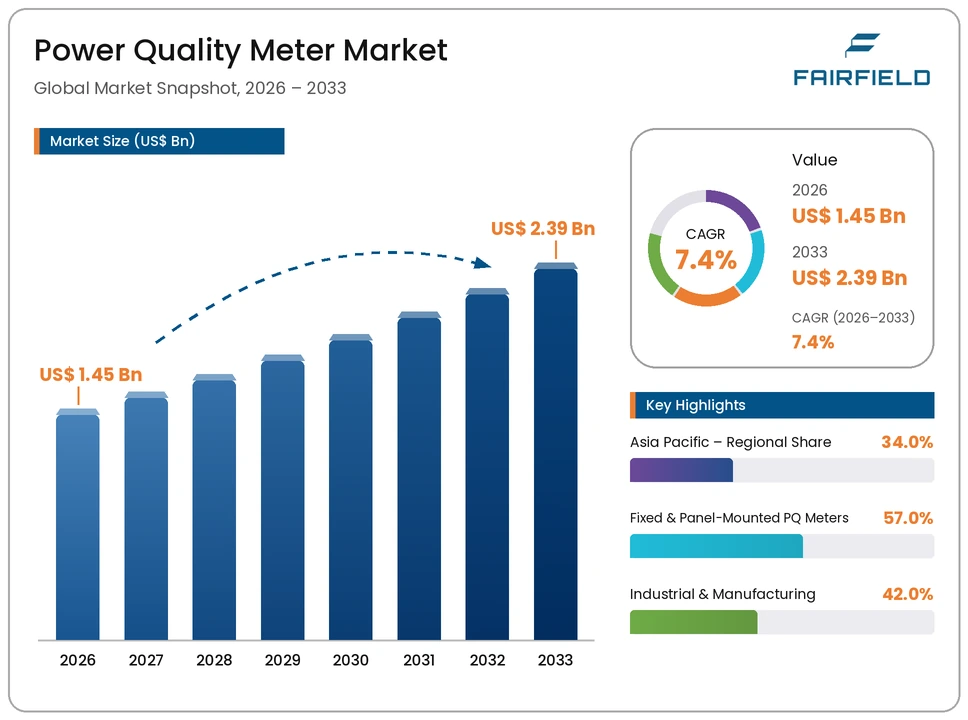
The market is valued at USD 1.45 Billion in 2026, with manufacturers directing investment toward improved measurement accuracy, wireless connectivity, and integration with broader energy management software platforms. By 2033, the market is forecast to reach USD 2.39 Billion, reflecting sustained growth across established industrial applications alongside expanding commercial building adoption.
Key Highlights
- The global power quality meter market is valued at USD 1.45 Billion in 2026 and is projected to reach USD 2.39 Billion by 2033, expanding at a CAGR of 7.4% across the 2026-2033 forecast period.
- Fixed & Panel-Mounted Power Quality Meters lead the type segment with a 57.0% share in 2026, equivalent to USD 0.83 Billion.
- Industrial & Manufacturing remains the dominant end-use segment, accounting for 42.0% of global demand, or USD 0.61 Billion, in 2026.
- Asia Pacific commands the largest regional share at 34.0% of the global market in 2026.
- Commercial building applications are emerging as the fastest-growing end-use segment through 2033.
Market Dynamics
Key Growth Drivers
Growth in the power quality meter market is driven primarily by expanding industrial automation and the growing prevalence of variable-speed drives, sensitive electronic controls, and automated equipment that are more vulnerable to power quality disturbances than older, simpler electrical equipment, creating sustained demand for monitoring solutions that help facilities identify and address these issues proactively.
A second driver is rising grid integration of renewable energy sources, which introduces new power quality management challenges related to voltage fluctuation and harmonic distortion that utilities and industrial facilities increasingly need to monitor and manage as renewable energy penetration continues to grow across electrical grids worldwide.
Key Restraints
The technical complexity of interpreting power quality data and translating it into actionable corrective measures requires specialized expertise that many facilities lack in-house, creating a barrier to fully realizing the value of power quality monitoring investments without additional consulting or training support.
Additionally, budget prioritization challenges within facility capital expenditure planning can delay power quality meter adoption, particularly among smaller industrial and commercial facilities that may not prioritize power quality monitoring investment relative to other operational technology needs competing for limited capital budgets.
Market Opportunities
The integration of power quality monitoring with broader energy management and building automation software platforms presents a substantial opportunity, as facility operators increasingly seek unified visibility into both energy consumption and power quality parameters rather than managing these as separate monitoring systems.
A second opportunity lies in expanding commercial building adoption, as growing corporate energy management and sustainability commitments drive interest in power quality monitoring as part of broader building energy optimization initiatives, an application area that has historically lagged industrial adoption but offers significant growth potential.
Segmentation Analysis
By Type
Fixed & Panel-Mounted Power Quality Meters lead the type segment, accounting for 57.0% of global market value in 2026, equivalent to USD 0.83 Billion. Their leadership reflects their widespread integration into permanent electrical distribution infrastructure across industrial and commercial facilities. Portable Power Quality Meters represent the fastest-growing type category through 2033, valued for their flexibility in troubleshooting and periodic assessment applications across multiple sites without requiring permanent installation.
By End Use
Industrial & Manufacturing forms the leading end-use segment, representing 42.0% of global demand in 2026, or USD 0.61 Billion, reflecting the sector's reliance on sensitive automated equipment vulnerable to power quality disturbances. Utilities represent a significant, established end-use segment tied to grid monitoring infrastructure. Commercial Buildings represent the fastest-growing end-use category, propelled by expanding corporate energy management initiatives.
Regional Insights
Asia Pacific
Asia Pacific holds the largest regional share, at 34.0% of the global market in 2026, equivalent to USD 0.49 Billion. The region's leadership reflects its large and expanding industrial manufacturing base, led by China and India, alongside substantial grid modernization and renewable energy integration investment.
North America
North America accounts for 28.0% of the global market in 2026, valued at USD 0.41 Billion. Demand is supported by grid modernization initiatives and growing industrial and commercial energy management adoption across the United States and Canada.
Europe
Europe represents 26.0% of the global market in 2026, or USD 0.38 Billion. The region's strong renewable energy integration and established industrial automation base sustain steady demand for power quality monitoring solutions.
Latin America
Latin America contributes 7.0% of the global market in 2026, equivalent to USD 0.10 Billion. Growth is linked to gradual industrial automation expansion in Brazil and Mexico alongside growing grid modernization investment.
Middle East & Africa
Middle East & Africa holds 5.0% of the global market in 2026, valued at USD 0.07 Billion. Growth remains gradual, tied to expanding industrial and utility infrastructure investment across the region.
Competitive Landscape
The global power quality meter market is moderately concentrated, with a limited number of established industrial automation and electrical equipment manufacturers holding strong positions supported by broad product portfolios and established utility and industrial customer relationships. A broader base of specialized manufacturers competes in portable and application-specific meter segments. Competition centers on measurement accuracy, software integration capability, and the ability to provide comprehensive energy and power quality monitoring platforms rather than standalone hardware.
Key Market Players
- Schneider Electric SE
- Siemens AG
- ABB Ltd.
- Eaton Corporation plc
- Fluke Corporation
- Yokogawa Electric Corporation
- Landis+Gyr Group AG
- Itron, Inc.
- Socomec Group
- Honeywell International Inc.
Market Segmentation
By Type
- Fixed & Panel-Mounted Power Quality Meters
- Portable Power Quality Meters
By End Use
- Industrial & Manufacturing
- Utilities
- Commercial Buildings
- Others
By Communication
- Wired Connectivity
- Wireless Connectivity
By Geography
- North America
- Europe
- Asia Pacific
- Latin America
- Middle East & Africa
- Executive Summary
- Global Power Quality Meter Market Snapshot
- Future Projections
- Key Market Trends
- Regional Snapshot, by Value, 2026
- Analyst Recommendations
- Market Overview
- Market Definitions and Segmentations
- Market Dynamics
- Drivers
- Restraints
- Market Opportunities
- Value Chain Analysis
- COVID-19 Impact Analysis
- Porter's Five Forces Analysis
- Impact of Russia-Ukraine Conflict
- PESTLE Analysis
- Regulatory Analysis
- Price Trend Analysis
- Current Prices and Future Projections, 2025-2033
- Price Impact Factors
- Global Power Quality Meter Market Outlook, 2020 - 2033
- Global Power Quality Meter Market Outlook, by Type, Value (US$ Mn), 2020-2033
- Fixed & Panel-Mounted Power Quality Meters
- Portable Power Quality Meters
- Global Power Quality Meter Market Outlook, by End Use, Value (US$ Mn), 2020-2033
- Industrial & Manufacturing
- Utilities
- Commercial Buildings
- Others
- Global Power Quality Meter Market Outlook, by Communication, Value (US$ Mn), 2020-2033
- Wired Connectivity
- Wireless Connectivity
- Global Power Quality Meter Market Outlook, by Region, Value (US$ Mn), 2020-2033
- North America
- Europe
- Asia Pacific
- Latin America
- Middle East & Africa
- Global Power Quality Meter Market Outlook, by Type, Value (US$ Mn), 2020-2033
- North America Power Quality Meter Market Outlook, 2020 - 2033
- North America Power Quality Meter Market Outlook, by Type, Value (US$ Mn), 2020-2033
- Fixed & Panel-Mounted Power Quality Meters
- Portable Power Quality Meters
- North America Power Quality Meter Market Outlook, by End Use, Value (US$ Mn), 2020-2033
- Industrial & Manufacturing
- Utilities
- Commercial Buildings
- Others
- North America Power Quality Meter Market Outlook, by Communication, Value (US$ Mn), 2020-2033
- Wired Connectivity
- Wireless Connectivity
- North America Power Quality Meter Market Outlook, by Country, Value (US$ Mn), 2020-2033
- U.S. Power Quality Meter Market Outlook, by Type, 2020-2033
- U.S. Power Quality Meter Market Outlook, by End Use, 2020-2033
- U.S. Power Quality Meter Market Outlook, by Communication, 2020-2033
- Canada Power Quality Meter Market Outlook, by Type, 2020-2033
- Canada Power Quality Meter Market Outlook, by End Use, 2020-2033
- Canada Power Quality Meter Market Outlook, by Communication, 2020-2033
- BPS Analysis/Market Attractiveness Analysis
- North America Power Quality Meter Market Outlook, by Type, Value (US$ Mn), 2020-2033
- Europe Power Quality Meter Market Outlook, 2020 - 2033
- Europe Power Quality Meter Market Outlook, by Type, Value (US$ Mn), 2020-2033
- Fixed & Panel-Mounted Power Quality Meters
- Portable Power Quality Meters
- Europe Power Quality Meter Market Outlook, by End Use, Value (US$ Mn), 2020-2033
- Industrial & Manufacturing
- Utilities
- Commercial Buildings
- Others
- Europe Power Quality Meter Market Outlook, by Communication, Value (US$ Mn), 2020-2033
- Wired Connectivity
- Wireless Connectivity
- Europe Power Quality Meter Market Outlook, by Country, Value (US$ Mn), 2020-2033
- Germany Power Quality Meter Market Outlook, by Type, 2020-2033
- Germany Power Quality Meter Market Outlook, by End Use, 2020-2033
- Germany Power Quality Meter Market Outlook, by Communication, 2020-2033
- Italy Power Quality Meter Market Outlook, by Type, 2020-2033
- Italy Power Quality Meter Market Outlook, by End Use, 2020-2033
- Italy Power Quality Meter Market Outlook, by Communication, 2020-2033
- France Power Quality Meter Market Outlook, by Type, 2020-2033
- France Power Quality Meter Market Outlook, by End Use, 2020-2033
- France Power Quality Meter Market Outlook, by Communication, 2020-2033
- U.K. Power Quality Meter Market Outlook, by Type, 2020-2033
- U.K. Power Quality Meter Market Outlook, by End Use, 2020-2033
- U.K. Power Quality Meter Market Outlook, by Communication, 2020-2033
- Spain Power Quality Meter Market Outlook, by Type, 2020-2033
- Spain Power Quality Meter Market Outlook, by End Use, 2020-2033
- Spain Power Quality Meter Market Outlook, by Communication, 2020-2033
- Russia Power Quality Meter Market Outlook, by Type, 2020-2033
- Russia Power Quality Meter Market Outlook, by End Use, 2020-2033
- Russia Power Quality Meter Market Outlook, by Communication, 2020-2033
- Rest of Europe Power Quality Meter Market Outlook, by Type, 2020-2033
- Rest of Europe Power Quality Meter Market Outlook, by End Use, 2020-2033
- Rest of Europe Power Quality Meter Market Outlook, by Communication, 2020-2033
- BPS Analysis/Market Attractiveness Analysis
- Europe Power Quality Meter Market Outlook, by Type, Value (US$ Mn), 2020-2033
- Asia Pacific Power Quality Meter Market Outlook, 2020 - 2033
- Asia Pacific Power Quality Meter Market Outlook, by Type, Value (US$ Mn), 2020-2033
- Fixed & Panel-Mounted Power Quality Meters
- Portable Power Quality Meters
- Asia Pacific Power Quality Meter Market Outlook, by End Use, Value (US$ Mn), 2020-2033
- Industrial & Manufacturing
- Utilities
- Commercial Buildings
- Others
- Asia Pacific Power Quality Meter Market Outlook, by Communication, Value (US$ Mn), 2020-2033
- Wired Connectivity
- Wireless Connectivity
- Asia Pacific Power Quality Meter Market Outlook, by Country, Value (US$ Mn), 2020-2033
- China Power Quality Meter Market Outlook, by Type, 2020-2033
- China Power Quality Meter Market Outlook, by End Use, 2020-2033
- China Power Quality Meter Market Outlook, by Communication, 2020-2033
- Japan Power Quality Meter Market Outlook, by Type, 2020-2033
- Japan Power Quality Meter Market Outlook, by End Use, 2020-2033
- Japan Power Quality Meter Market Outlook, by Communication, 2020-2033
- South Korea Power Quality Meter Market Outlook, by Type, 2020-2033
- South Korea Power Quality Meter Market Outlook, by End Use, 2020-2033
- South Korea Power Quality Meter Market Outlook, by Communication, 2020-2033
- India Power Quality Meter Market Outlook, by Type, 2020-2033
- India Power Quality Meter Market Outlook, by End Use, 2020-2033
- India Power Quality Meter Market Outlook, by Communication, 2020-2033
- Southeast Asia Power Quality Meter Market Outlook, by Type, 2020-2033
- Southeast Asia Power Quality Meter Market Outlook, by End Use, 2020-2033
- Southeast Asia Power Quality Meter Market Outlook, by Communication, 2020-2033
- Rest of SAO Power Quality Meter Market Outlook, by Type, 2020-2033
- Rest of SAO Power Quality Meter Market Outlook, by End Use, 2020-2033
- Rest of SAO Power Quality Meter Market Outlook, by Communication, 2020-2033
- BPS Analysis/Market Attractiveness Analysis
- Asia Pacific Power Quality Meter Market Outlook, by Type, Value (US$ Mn), 2020-2033
- Latin America Power Quality Meter Market Outlook, 2020 - 2033
- Latin America Power Quality Meter Market Outlook, by Type, Value (US$ Mn), 2020-2033
- Fixed & Panel-Mounted Power Quality Meters
- Portable Power Quality Meters
- Latin America Power Quality Meter Market Outlook, by End Use, Value (US$ Mn), 2020-2033
- Industrial & Manufacturing
- Utilities
- Commercial Buildings
- Others
- Latin America Power Quality Meter Market Outlook, by Communication, Value (US$ Mn), 2020-2033
- Wired Connectivity
- Wireless Connectivity
- Latin America Power Quality Meter Market Outlook, by Country, Value (US$ Mn), 2020-2033
- Brazil Power Quality Meter Market Outlook, by Type, 2020-2033
- Brazil Power Quality Meter Market Outlook, by End Use, 2020-2033
- Brazil Power Quality Meter Market Outlook, by Communication, 2020-2033
- Mexico Power Quality Meter Market Outlook, by Type, 2020-2033
- Mexico Power Quality Meter Market Outlook, by End Use, 2020-2033
- Mexico Power Quality Meter Market Outlook, by Communication, 2020-2033
- Argentina Power Quality Meter Market Outlook, by Type, 2020-2033
- Argentina Power Quality Meter Market Outlook, by End Use, 2020-2033
- Argentina Power Quality Meter Market Outlook, by Communication, 2020-2033
- Rest of LATAM Power Quality Meter Market Outlook, by Type, 2020-2033
- Rest of LATAM Power Quality Meter Market Outlook, by End Use, 2020-2033
- Rest of LATAM Power Quality Meter Market Outlook, by Communication, 2020-2033
- BPS Analysis/Market Attractiveness Analysis
- Latin America Power Quality Meter Market Outlook, by Type, Value (US$ Mn), 2020-2033
- Middle East & Africa Power Quality Meter Market Outlook, 2020 - 2033
- Middle East & Africa Power Quality Meter Market Outlook, by Type, Value (US$ Mn), 2020-2033
- Fixed & Panel-Mounted Power Quality Meters
- Portable Power Quality Meters
- Middle East & Africa Power Quality Meter Market Outlook, by End Use, Value (US$ Mn), 2020-2033
- Industrial & Manufacturing
- Utilities
- Commercial Buildings
- Others
- Middle East & Africa Power Quality Meter Market Outlook, by Communication, Value (US$ Mn), 2020-2033
- Wired Connectivity
- Wireless Connectivity
- Middle East & Africa Power Quality Meter Market Outlook, by Country, Value (US$ Mn), 2020-2033
- GCC Power Quality Meter Market Outlook, by Type, 2020-2033
- GCC Power Quality Meter Market Outlook, by End Use, 2020-2033
- GCC Power Quality Meter Market Outlook, by Communication, 2020-2033
- South Africa Power Quality Meter Market Outlook, by Type, 2020-2033
- South Africa Power Quality Meter Market Outlook, by End Use, 2020-2033
- South Africa Power Quality Meter Market Outlook, by Communication, 2020-2033
- Egypt Power Quality Meter Market Outlook, by Type, 2020-2033
- Egypt Power Quality Meter Market Outlook, by End Use, 2020-2033
- Egypt Power Quality Meter Market Outlook, by Communication, 2020-2033
- Nigeria Power Quality Meter Market Outlook, by Type, 2020-2033
- Nigeria Power Quality Meter Market Outlook, by End Use, 2020-2033
- Nigeria Power Quality Meter Market Outlook, by Communication, 2020-2033
- Rest of Middle East Power Quality Meter Market Outlook, by Type, 2020-2033
- Rest of Middle East Power Quality Meter Market Outlook, by End Use, 2020-2033
- Rest of Middle East Power Quality Meter Market Outlook, by Communication, 2020-2033
- BPS Analysis/Market Attractiveness Analysis
- Middle East & Africa Power Quality Meter Market Outlook, by Type, Value (US$ Mn), 2020-2033
- Competitive Landscape
- Company Vs Segment Heatmap
- Company Market Share Analysis, 2025
- Competitive Dashboard
- Company Profiles
- Schneider Electric SE
- Company Overview
- Product Portfolio
- Financial Overview
- Business Strategies and Developments
- Siemens AG
- ABB Ltd.
- Eaton Corporation plc
- Fluke Corporation
- Yokogawa Electric Corporation
- Landis+Gyr Group AG
- Itron, Inc.
- Socomec Group
- Honeywell International Inc.
- Schneider Electric SE
- Appendix
- Research Methodology
- Report Assumptions
- Acronyms and Abbreviations
By Type
- Fixed & Panel-Mounted Power Quality Meters
- Portable Power Quality Meters
By End Use
- Industrial & Manufacturing
- Utilities
- Commercial Buildings
- Others
By Communication
- Wired Connectivity
- Wireless Connectivity
By Geography
- North America
- Europe
- Asia Pacific
- Latin America
- Middle East & Africa
Our Research Methodology
Considering the volatility of business today, traditional approaches to strategizing a game plan can be unfruitful if not detrimental. True ambiguity is no way to determine a forecast. A myriad of predetermined factors must be accounted for such as the degree of risk involved, the magnitude of circumstances, as well as conditions or consequences that are not known or unpredictable. To circumvent binary views that cast uncertainty, the application of market research intelligence to strategically posture, move, and enable actionable outcomes is necessary.
View Methodology
Quality Assured
Rigorous Validation Process

Confidentiality Assured
End-to-end Data Security

Custom Research Services
Tailored To Your Objectives
FAQs
The global power quality meter market is valued at USD 1.45 Billion in 2026, reflecting growing demand for electrical monitoring across industrial and grid applications.
The market is projected to grow at a CAGR of 7.4%, reaching USD 2.39 Billion by 2033, driven by industrial automation growth and renewable energy grid integration.
Fixed & Panel-Mounted Power Quality Meters lead with a 57.0% share in 2026, reflecting their widespread integration into permanent electrical infrastructure.
Asia Pacific leads with a 34.0% share in 2026, driven by its large industrial manufacturing base and grid modernization investment.
The largest opportunity lies in commercial building adoption, driven by expanding corporate energy management and sustainability initiatives.
Related Reports
Intelligent Power Module for AWHP Market Size, Share, Insights, Competitive Landscape, and Forecast 2026 to 2033
Intelligent Power Module for AWHP market is projected to grow from US$0.89 billion in 2026 to US$2.34 billion by 2033, at a CAGR of 14.8%.
LTE & 5G NR-based CBRS Networks Market Size, Share, Insights, Competitive Landscape, and Forecast 2026 to 2033
The LTE & 5G NR-based CBRS Networks market in 2026, valued at US$ 3.4 billion and projected to reach US$ 13.2 billion by 2033, growing at a 21.4% CAGR.
GPS Player Tracking Systems Market Size, Share, Insights, Competitive Landscape, and Forecast 2026 to 2033
GPS Player Tracking Systems Market to reach US$3.3 Bn by 2033, growing at 12.5% CAGR, driven by sports analytics,and performance monitoring.
Smart Watch and Smart Ring LED Market Size, Share, Insights, Competitive Landscape, and Forecast 2026 to 2033
The global smartwatch and smart ring LED market will reach US$ 8.00 Bn by 2033, growing at 15.6% CAGR, driven by wearable adoption and health monitoring
Data Center LV/MV Power Distribution Market Size, Share, Insights, Competitive Landscape, and Forecast 2026 to 2033
The global data center LV/MV power distribution market will reach US$ 62.0 Bn by 2033, growing at 11.8% CAGR, driven by data center demand and AI growth
Perimeter Sensing Satellites Market Size, Share, Insights, Competitive Landscape, and Forecast 2026 to 2033
The blue GIS technologies market is projected to reach US$9.7592 billion by 2033, growing at a 12.8% CAGR from US$4.2 billion in 2026