



Software-Defined Defence Satellites Market
Software-Defined Defence Satellites Market Size, Share, Insights, Competitive Landscape, and Forecast 2026 to 2033
Software-Defined Defence Satellites Market Size and Trend Analysis
- What Shapes the Software-Defined Defence Satellites Growth Outlook?
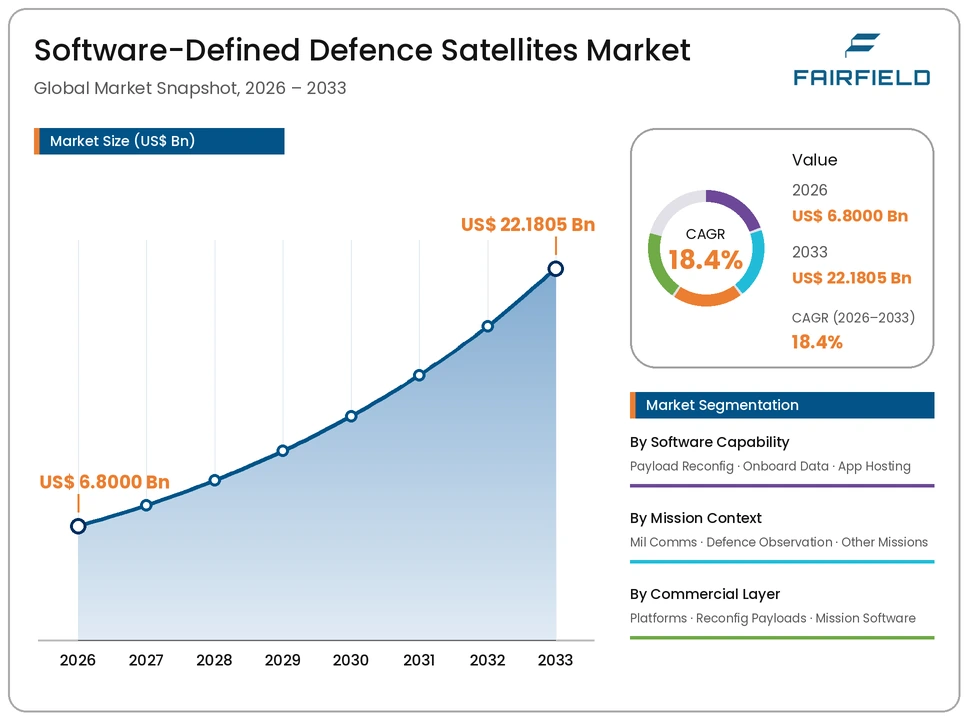
The global software-defined defence satellites market size is expected to be valued at US$6.8000 billion in 2026 and projected to reach US$22.1805 billion by 2033, growing at a CAGR of 18.4% between 2026 and 2033. The outlook applies the published benchmark growth rate to the requested forecast window. The calculated endpoint represents a constant-growth projection, rather than a separately published estimate for that year.
The 2025 benchmark is US$5.7000 billion; a consistent historical CAGR for 2020–2025 is not established. The market covers defence-oriented satellite platforms and payload systems with documented software reconfiguration or onboard mission-processing capability. Its direction reflects mission reconfiguration extends spacecraft usefulness and onboard processing reduces dependence on raw downlink. Commercial selection depends on mission-software assurance, onboard resource control, ground integration, and configuration support; the supported implementation must fit the customer’s actual operating requirements.
Key Report Takeaways
- By Software Capability: Payload Reconfiguration changes supported payload behavior. Comparative revenue and growth leadership are not established for the requested period; commercial selection follows the function, supported operating conditions, and responsibilities described for each alternative.
- By Mission Context: Military Communications, Defence Observation, and Other Qualified Defence Missions have different payload and assurance requirements. Comparative revenue and growth leadership are not established for the requested period; commercial selection follows the function, supported operating conditions, and responsibilities described for each alternative.
- By Commercial Layer: Spacecraft Platforms supply the supporting vehicle. Comparative revenue and growth leadership are not established for the requested period; commercial selection follows the function, supported operating conditions, and responsibilities described for each alternative.
- By Program Stage: Development and Demonstration evaluates a proposed capability. Comparative revenue and growth leadership are not established for the requested period; commercial selection follows the function, supported operating conditions, and responsibilities described for each alternative.
- By Geography: North America, Europe, Asia Pacific, Latin America, and Middle East & Africa require separate application and customer assessments. Regional shares and growth rankings are not assigned without comparable evidence; local integration and continuing support determine practical commercial fit.
Global Software-Defined Defence Satellites Market Trends and Insights
Drivers Impact Analysis
Impact ratings describe qualitative commercial relevance; they do not quantify additional CAGR contributions.
| Driver | Impact on CAGR Forecast | Geographic Relevance | Impact Timeline |
| Mission Reconfiguration Extends Spacecraft Usefulness | High | All regions; relevance varies by application | Medium term 2–4 years |
| Onboard Processing Reduces Dependence on Raw Downlink | Medium | All regions; relevance varies by application | Long term ≥4 years |
- Software-Defined Defence Satellites: Mission Reconfiguration Extends Spacecraft Usefulness
Reconfigurable defence payloads create a procurement rationale when the customer needs supported mission changes after launch. Software can alter defined processing or communications functions within the installed hardware’s limits. The value depends on approved capabilities and available resources, not a promise that a spacecraft can perform any future task. For a purchasing decision, the relevant benefit is the problem removed from the customer's existing workflow. A supplier should identify the required output, the conditions under which it is achieved, and the resources needed to maintain it.
Lockheed Martin identifies SmartSat as a software-defined architecture within its LM 400 platform. This establishes an onboard-processing route for multiple customer types, including military users. This mechanism creates a stronger commercial case when the customer can compare the proposed solution with an existing alternative.
- Software-Defined Defence Satellites: Onboard Processing Reduces Dependence on Raw Downlink
Onboard mission processing can reduce the volume of information that must be transferred before a useful output is available. A supported application can filter or organize data within the spacecraft. Demand follows a defined mission workload, with processing capability evaluated against energy, memory, and communications constraints. The effect on demand depends on whether the customer can incorporate the offering into an established routine. Additional capabilities are valuable when they address a real bottleneck and remain practical for the people responsible for implementation.
Lockheed Martin describes onboard processing in the LM 400 architecture. Airbus Defence and Space provides military communications spacecraft engineering through Skynet 6A. The two examples demonstrate different platform roles; a digital payload is not automatically evidence of unrestricted software reconfiguration. Buyers should distinguish technical availability from successful deployment.
Restraints Impact Analysis
Impact ratings describe qualitative commercial relevance; they do not quantify additional CAGR contributions.
| Restraint | Impact on CAGR Forecast | Geographic Relevance | Impact Timeline |
| Assurance Work Limits the Speed of Software Changes | Medium | All regions; relevance varies by application | Medium term 2–4 years |
| Power and Memory Budgets Constrain New Applications | Medium | All regions; relevance varies by application | Long term ≥4 years |
- Software-Defined Defence Satellites: Assurance Work Limits the Speed of Software Changes
A software-defined platform cannot accept every proposed update without review. Changes can affect resource use, interfaces, and the accepted mission baseline. Customers therefore need a controlled evaluation and approval route, which can make a theoretically rapid update commercially slower than a demonstration suggests. This limitation can extend the interval between first interest and a repeatable commercial relationship. Development budgets should include the work needed to resolve the problem rather than treating qualification as an incidental expense after supplier selection.
Secure satellite update workflows incur engineering, verification, and ground-system coordination costs. Suppliers should define supported changes and the evidence required for acceptance. A remote update mechanism establishes a delivery route, but does not prove that every new application can run safely within the existing platform. Clear acceptance criteria can reduce disagreement between the buyer and supplier.
- Software-Defined Defence Satellites: Power and Memory Budgets Constrain New Applications
An installed spacecraft has finite computing, power, and thermal resources. Adding a mission application can compete with existing functions even when software makes the change technically possible. The constraint can reduce the range of commercially useful upgrades and increase the effort needed to verify coexistence. The commercial consequence is a more selective purchasing process. Customers may defer adoption, narrow the intended use, or retain an alternative until the complete operating requirements are understood. A quotation should make those requirements visible before commitment.
Software-defined spacecraft platforms need measured resource allocation and supported interfaces. Cost sources include workload testing, configuration review, and mission simulation. Buyers should examine the actual installed hardware and operating envelope rather than infer unlimited flexibility from a general software-defined description. A credible mitigation plan addresses the actual source of the constraint.
Market Opportunities
Impact ratings describe qualitative commercial relevance; they do not quantify additional CAGR contributions.
| Opportunity | Impact on CAGR Forecast | Geographic Relevance | Impact Timeline |
| Mission Application Support Opens Lifecycle Revenue | Medium | All regions; relevance varies by application | Medium term 2–4 years |
| Ground Integration Services Support Controlled Retasking | Medium | All regions; relevance varies by application | Long term ≥4 years |
- Software-Defined Defence Satellites: Mission Application Support Opens Lifecycle Revenue
A mission-application support contract creates an opportunity after the spacecraft platform is selected. Suppliers can maintain approved applications, document interfaces, and support bounded changes. The revenue pool is continuing mission software work, distinct from the initial spacecraft construction and launch contract. The attractive customer is one with a clearly defined unmet requirement and the resources to implement the solution. Sales development should begin with that requirement, rather than assume that a broad category trend converts automatically into an order.
Lockheed Martin’s SmartSat architecture provides an identifiable platform example. Qualified application partners can capture value where customer-approved interfaces permit their participation. Contracts should define the supported workload and approval responsibilities rather than promise independent software changes across all defence spacecraft. Capturing this opportunity requires a bounded offer with understandable deliverables.
- Software-Defined Defence Satellites: Ground Integration Services Support Controlled Retasking
Ground integration creates an opportunity where mission software has to connect with command, planning, and delivery systems. A service provider can coordinate the approved workflow and maintain configuration records. This commercial offer addresses operational implementation rather than treating an onboard processor as a complete software-defined mission service. This opportunity differs from general category expansion because it involves a new way to package technical or professional capability. The offer can address a customer group underserved by existing products, provided its practical requirements are explicitly considered.
Airbus Defence and Space reported a Skynet 6A module-coupling milestone in May 2025. The development demonstrates continuing spacecraft integration, with entry into service still a separate milestone. Digital military communications payloads require a coordinated ground relationship and clear customer acceptance criteria. Providers should test the revenue proposition against the cost of delivering it consistently.
Segment Analysis
By Software Capability: Reconfigurable Defence Payloads Requires Application Fit
Payload Reconfiguration changes supported payload behavior. Onboard Data Processing transforms mission information locally. Mission Application Hosting provides an approved execution environment. The capabilities can coexist, but classification should follow the principal contracted function.
An ordinary command interface does not establish application hosting. A processor does not prove every reconfiguration mode. Buyers need a supported capability description and resource limits, with clear ownership of software verification and the final mission acceptance decision. The purchasing implication is to compare solutions against the required function. Buyers should document the conditions used for evaluation and consider the resources required to maintain performance. Supplier support is valuable when it helps the customer implement the chosen function consistently, rather than simply adding features to a quotation.
By Mission Context: Onboard Mission Processing Requires Application Fit
Military Communications, Defence Observation, and Other Qualified Defence Missions have different payload and assurance requirements. The category should include only documented software-defined capability associated with the mission, rather than every defence satellite carrying a computer.
A communications update and an observation algorithm create different validation tasks. Suppliers should match the application with supported hardware and interfaces. A common platform can reduce repeated development but does not eliminate mission-specific engineering or acceptance work. The same offering can serve several tasks, but sales should be allocated consistently to avoid double counting. Buyers need a clear connection between the proposed capability and their required output. Suppliers can improve adoption through application guidance that explains the supported conditions and the limits of the available evidence.
By Commercial Layer: Software-Defined Spacecraft Platforms Requires Application Fit
Spacecraft Platforms supply the supporting vehicle. Reconfigurable Payload Systems provide defined mission capability. Mission Software Services support approved applications and changes. The layers have different revenue boundaries and should not count a bundled spacecraft contract repeatedly.
A prime contractor can coordinate several layers, while another provider supplies a bounded function. Procurement needs clear interfaces and delivery milestones. A software service’s commercial scope should identify the supported platform and mission rather than claim access to every installed spacecraft. The business implication is a differentiated sales and support model. Purchasing decisions can involve different budgets, approval processes, and expectations for ongoing assistance. Vendors should also distinguish first purchases from recurring use, since installation or enrollment alone does not establish sustained customer value or comparative market leadership.
By Program Stage: Secure Satellite Update Workflows Requires Application Fit
Development and Demonstration evaluates a proposed capability. Accepted Mission Systems meet a customer’s defined baseline. Lifecycle Updates maintain or extend supported functions. These stages distinguish a planned launch or integration milestone from an already operational service.
Software flexibility can be demonstrated before the complete mission is accepted. Customers should request evidence appropriate to the reported stage. An update contract needs an approved baseline, resource information, and a route for verifying the resulting mission configuration. Commercial positioning should follow the customer's operating requirement rather than a generalized ranking. Buyers need transparent specifications, appropriate evidence, and a practical implementation route. Bundled offerings require consistent revenue allocation, while optional functions should be explained separately so customers understand the actual basis of the proposed price and ongoing commitment.
Geography Analysis
Which Region Leads the Software-Defined Defence Satellites Market?
Comparable evidence does not establish a largest region; North America has identifiable customer and supplier activity. The United States and Canada provide defence-space and software integration contexts. Lockheed Martin demonstrates identifiable platform participation in the United States. A general space procurement award does not establish the software-defined share of a program; capability and contract layers need separate assessment. The regional sales approach should distinguish established customer requirements from prospective expansion. Local support, procurement practices, and the actual route to repeat purchasing matter more than vendor headquarters. A useful entry proposal identifies the customer group, the delivery responsibilities, and the conditions under which the offering can remain dependable.
Europe: Software-Defined Defence Satellites Depends on Local Delivery
The United Kingdom has documented military spacecraft integration through Airbus Defence and Space. France and Germany provide other space-engineering contexts. Sovereign mission requirements and ground integration shape procurement, while planned entry into service remains separate from completed spacecraft engineering milestones. For digital military communications payloads, local support and clear documentation are practical priorities. Country-level requirements should be reviewed separately before a broader regional launch. A product or service available in one jurisdiction does not establish identical eligibility elsewhere. Suppliers can improve commercial fit through appropriate documentation, local application support, and a clear explanation of the functions included in the purchasing relationship.
Which Region Grows Fastest in Software-Defined Defence Satellites?
Comparable evidence does not establish the fastest-growing region; Asia Pacific needs country-specific commercial assessment. Japan, South Korea, India, and Australia have different military-space structures and supplier relationships. Software-defined capabilities need approved interfaces and assurance responsibilities. Local partnerships should define their actual software or payload role rather than infer opportunity from broader national space ambitions. The region should be evaluated through specific countries and customer groups rather than population size alone. Language, operating capability, and distribution or care infrastructure influence practical adoption. Partners should confirm the implementation requirements and the capacity to sustain support before translating a promising development project into a wider market commitment.
Latin America: Software-Defined Defence Satellites Depends on Local Delivery
Brazil and Mexico require a defined defence customer and mission before a commercial opportunity can be established. Ground operations and sustained software support can be limiting factors. A platform proposal should specify the usable mission capability and acceptance route instead of emphasizing flexibility alone. A workable regional strategy begins with a defined application and realistic ownership or service costs. Local partners can help with commissioning, communication, and replenishment, but responsibilities need to be explicit. Buyers should assess the whole operating proposition, including support continuity, instead of assuming that a low initial quotation resolves adoption barriers. The customer should evaluate the supported application and clarify responsibilities before expanding the purchasing commitment.
Middle East & Africa: Software-Defined Defence Satellites Depends on Local Delivery
Saudi Arabia, the United Arab Emirates, and South Africa provide differing space-program and integration environments. Sovereign control and technical support can influence supplier selection. A bounded development partnership needs clear software ownership and lifecycle responsibilities before it becomes a credible recurring service proposition. Market development should be tied to functioning local delivery arrangements. Technical or professional support, suitable documentation, and reliable supply can determine whether initial interest becomes sustained use. Partners should begin with a bounded customer requirement and evaluate performance before expanding the offer across countries with different operating conditions. The customer should evaluate the supported application and clarify responsibilities before expanding the purchasing commitment.
Competitive Landscape
Lockheed Martin supplies the LM 400 platform with documented SmartSat software-defined capability. Airbus Defence and Space supplies military communications spacecraft engineering; its role is treated as related digital-payload and integration participation rather than proof of every software-defined function.
The competitive structure cannot be assigned a reliable concentration score without comparable revenue data for the defined boundary. A large corporate portfolio does not establish category leadership because reported sales can include unrelated products or services. Customers should compare the actual offering and its commercial support. Suppliers with broader capabilities may provide useful coordination, but the relevant advantage must be demonstrated for the specific application rather than inferred from company size.
Competition centers on the combination of performance, usable implementation, and ongoing cost. Buyers need evidence under representative conditions and a clear explanation of what the supplier provides. Digital interfaces, technical documentation, or service packages can influence selection when they reduce practical friction. These features should be evaluated against the customer's requirements. An extensive feature list offers limited value if the core product or service cannot be delivered consistently within the agreed operating conditions.
Strategic direction favors clearer application boundaries and accountable delivery. Documented developments provide evidence of activity, while planned launches or partnerships remain different from completed commercialization. Suppliers can strengthen customer relationships through dependable support, transparent specifications, and communication that remains accurate as offerings change. The competitive question is whether the complete commercial proposition remains useful after the initial transaction, rather than whether a company appears prominently in general category discussions.
Software-Defined Defence Satellites Verified Participants
- Lockheed Martin
- Airbus Defence and Space
Recent Industry Developments
- November 2024: Lockheed Martin reported completion of testing for an LM 400 technology demonstrator with SmartSat — the milestone documented prelaunch platform progress, not a completed orbital mission.
- May 2025: Airbus Defence and Space reported coupling of Skynet 6A communications and service modules — the milestone advanced military spacecraft integration ahead of later service entry.
Software-Defined Defence Satellites Market Report Scope
| Metric | Value |
| Study Period | 2020–2033 |
| Market Size 2026 | US$6.8000 billion — published estimate |
| Market Size 2033 | US$22.1805 billion — calculated projection |
| CAGR 2026–2033 | 18.4%, applied compound-growth assumption |
| Absolute Dollar Opportunity | US$15.3805 billion |
| Largest Market (region) | Comparable regional revenue leadership not established |
| Fastest-Growing Market (region or country) | Comparative ranking for 2026–2033 not established |
| Market Concentration | Specialized participants; concentration not quantified |
| Major Players | Lockheed Martin — software-defined platform; Airbus Defence and Space — related military payload integration |
Software-Defined Defence Satellites Market Segmentation
Software Capability
- Payload Reconfiguration
- Onboard Data Processing
- Mission Application Hosting
Mission Context
- Military Communications
- Defence Observation
- Other Qualified Defence Missions
Commercial Layer
- Spacecraft Platforms
- Reconfigurable Payload Systems
- Mission Software Services
Program Stage
- Development and Demonstration
- Accepted Mission Systems
- Lifecycle Updates
Regions
- North America
- Europe
- Asia Pacific
- Latin America
- Middle East & Africa
- Executive Summary
- Global Market Snapshot
- Market Size and Trend Analysis 2020–2033
- Base Year Benchmark 2025
- Key Report Takeaways
- Market Overview
- Market Definition and Report Scope
- Market Dynamics
- Drivers Impact Analysis
- Mission Reconfiguration Extends Spacecraft Usefulness
- Onboard Processing Reduces Dependence on Raw Downlink
- Restraints Impact Analysis
- Assurance Work Limits the Speed of Software Changes
- Power and Memory Budgets Constrain New Applications
- Market Opportunities
- Mission Application Support Opens Lifecycle Revenue
- Ground Integration Services Support Controlled Retasking
- Drivers Impact Analysis
- Segment Analysis
- By Software Capability
- By Mission Context
- By Commercial Layer
- By Program Stage
- Global Software-Defined Defence Satellites Market Outlook 2026–2033
- Global Software-Defined Defence Satellites Market Outlook, by Software Capability, Value (US$ Billion), 2026–2033
- Payload Reconfiguration
- Onboard Data Processing
- Mission Application Hosting
- Global Software-Defined Defence Satellites Market Outlook, by Mission Context, Value (US$ Billion), 2026–2033
- Military Communications
- Defence Observation
- Other Qualified Defence Missions
- Global Software-Defined Defence Satellites Market Outlook, by Commercial Layer, Value (US$ Billion), 2026–2033
- Spacecraft Platforms
- Reconfigurable Payload Systems
- Mission Software Services
- Global Software-Defined Defence Satellites Market Outlook, by Program Stage, Value (US$ Billion), 2026–2033
- Development and Demonstration
- Accepted Mission Systems
- Lifecycle Updates
- Global Software-Defined Defence Satellites Market Outlook, by Region, Value (US$ Billion), 2026–2033
- North America
- Europe
- Asia Pacific
- Latin America
- Middle East & Africa
- Global Software-Defined Defence Satellites Market Outlook, by Software Capability, Value (US$ Billion), 2026–2033
- North America Software-Defined Defence Satellites Market Outlook 2026–2033
- North America Market Activity and Implementation Conditions
- North America Software-Defined Defence Satellites Market Outlook, by Software Capability, Value (US$ Billion), 2026–2033
- Payload Reconfiguration
- Onboard Data Processing
- Mission Application Hosting
- North America Software-Defined Defence Satellites Market Outlook, by Mission Context, Value (US$ Billion), 2026–2033
- Military Communications
- Defence Observation
- Other Qualified Defence Missions
- North America Software-Defined Defence Satellites Market Outlook, by Commercial Layer, Value (US$ Billion), 2026–2033
- Spacecraft Platforms
- Reconfigurable Payload Systems
- Mission Software Services
- North America Software-Defined Defence Satellites Market Outlook, by Program Stage, Value (US$ Billion), 2026–2033
- Development and Demonstration
- Accepted Mission Systems
- Lifecycle Updates
- North America Software-Defined Defence Satellites Market Outlook, by Country, 2026–2033
- United States Software-Defined Defence Satellites Market Outlook, by Software Capability, 2026–2033
- United States Software-Defined Defence Satellites Market Outlook, by Mission Context, 2026–2033
- United States Software-Defined Defence Satellites Market Outlook, by Commercial Layer, 2026–2033
- United States Software-Defined Defence Satellites Market Outlook, by Program Stage, 2026–2033
- Canada Software-Defined Defence Satellites Market Outlook, by Software Capability, 2026–2033
- Canada Software-Defined Defence Satellites Market Outlook, by Mission Context, 2026–2033
- Canada Software-Defined Defence Satellites Market Outlook, by Commercial Layer, 2026–2033
- Canada Software-Defined Defence Satellites Market Outlook, by Program Stage, 2026–2033
- Europe Software-Defined Defence Satellites Market Outlook 2026–2033
- Europe Market Activity and Implementation Conditions
- Europe Software-Defined Defence Satellites Market Outlook, by Software Capability, Value (US$ Billion), 2026–2033
- Payload Reconfiguration
- Onboard Data Processing
- Mission Application Hosting
- Europe Software-Defined Defence Satellites Market Outlook, by Mission Context, Value (US$ Billion), 2026–2033
- Military Communications
- Defence Observation
- Other Qualified Defence Missions
- Europe Software-Defined Defence Satellites Market Outlook, by Commercial Layer, Value (US$ Billion), 2026–2033
- Spacecraft Platforms
- Reconfigurable Payload Systems
- Mission Software Services
- Europe Software-Defined Defence Satellites Market Outlook, by Program Stage, Value (US$ Billion), 2026–2033
- Development and Demonstration
- Accepted Mission Systems
- Lifecycle Updates
- Europe Software-Defined Defence Satellites Market Outlook, by Country, 2026–2033
- United Kingdom Software-Defined Defence Satellites Market Outlook, by Software Capability, 2026–2033
- United Kingdom Software-Defined Defence Satellites Market Outlook, by Mission Context, 2026–2033
- United Kingdom Software-Defined Defence Satellites Market Outlook, by Commercial Layer, 2026–2033
- United Kingdom Software-Defined Defence Satellites Market Outlook, by Program Stage, 2026–2033
- France Software-Defined Defence Satellites Market Outlook, by Software Capability, 2026–2033
- France Software-Defined Defence Satellites Market Outlook, by Mission Context, 2026–2033
- France Software-Defined Defence Satellites Market Outlook, by Commercial Layer, 2026–2033
- France Software-Defined Defence Satellites Market Outlook, by Program Stage, 2026–2033
- Germany Software-Defined Defence Satellites Market Outlook, by Software Capability, 2026–2033
- Germany Software-Defined Defence Satellites Market Outlook, by Mission Context, 2026–2033
- Germany Software-Defined Defence Satellites Market Outlook, by Commercial Layer, 2026–2033
- Germany Software-Defined Defence Satellites Market Outlook, by Program Stage, 2026–2033
- Asia Pacific Software-Defined Defence Satellites Market Outlook 2026–2033
- Asia Pacific Market Activity and Implementation Conditions
- Asia Pacific Software-Defined Defence Satellites Market Outlook, by Software Capability, Value (US$ Billion), 2026–2033
- Payload Reconfiguration
- Onboard Data Processing
- Mission Application Hosting
- Asia Pacific Software-Defined Defence Satellites Market Outlook, by Mission Context, Value (US$ Billion), 2026–2033
- Military Communications
- Defence Observation
- Other Qualified Defence Missions
- Asia Pacific Software-Defined Defence Satellites Market Outlook, by Commercial Layer, Value (US$ Billion), 2026–2033
- Spacecraft Platforms
- Reconfigurable Payload Systems
- Mission Software Services
- Asia Pacific Software-Defined Defence Satellites Market Outlook, by Program Stage, Value (US$ Billion), 2026–2033
- Development and Demonstration
- Accepted Mission Systems
- Lifecycle Updates
- Asia Pacific Software-Defined Defence Satellites Market Outlook, by Country, 2026–2033
- Japan Software-Defined Defence Satellites Market Outlook, by Software Capability, 2026–2033
- Japan Software-Defined Defence Satellites Market Outlook, by Mission Context, 2026–2033
- Japan Software-Defined Defence Satellites Market Outlook, by Commercial Layer, 2026–2033
- Japan Software-Defined Defence Satellites Market Outlook, by Program Stage, 2026–2033
- South Korea Software-Defined Defence Satellites Market Outlook, by Software Capability, 2026–2033
- South Korea Software-Defined Defence Satellites Market Outlook, by Mission Context, 2026–2033
- South Korea Software-Defined Defence Satellites Market Outlook, by Commercial Layer, 2026–2033
- South Korea Software-Defined Defence Satellites Market Outlook, by Program Stage, 2026–2033
- India Software-Defined Defence Satellites Market Outlook, by Software Capability, 2026–2033
- India Software-Defined Defence Satellites Market Outlook, by Mission Context, 2026–2033
- India Software-Defined Defence Satellites Market Outlook, by Commercial Layer, 2026–2033
- India Software-Defined Defence Satellites Market Outlook, by Program Stage, 2026–2033
- Australia Software-Defined Defence Satellites Market Outlook, by Software Capability, 2026–2033
- Australia Software-Defined Defence Satellites Market Outlook, by Mission Context, 2026–2033
- Australia Software-Defined Defence Satellites Market Outlook, by Commercial Layer, 2026–2033
- Australia Software-Defined Defence Satellites Market Outlook, by Program Stage, 2026–2033
- Latin America Software-Defined Defence Satellites Market Outlook 2026–2033
- Latin America Market Activity and Implementation Conditions
- Latin America Software-Defined Defence Satellites Market Outlook, by Software Capability, Value (US$ Billion), 2026–2033
- Payload Reconfiguration
- Onboard Data Processing
- Mission Application Hosting
- Latin America Software-Defined Defence Satellites Market Outlook, by Mission Context, Value (US$ Billion), 2026–2033
- Military Communications
- Defence Observation
- Other Qualified Defence Missions
- Latin America Software-Defined Defence Satellites Market Outlook, by Commercial Layer, Value (US$ Billion), 2026–2033
- Spacecraft Platforms
- Reconfigurable Payload Systems
- Mission Software Services
- Latin America Software-Defined Defence Satellites Market Outlook, by Program Stage, Value (US$ Billion), 2026–2033
- Development and Demonstration
- Accepted Mission Systems
- Lifecycle Updates
- Latin America Software-Defined Defence Satellites Market Outlook, by Country, 2026–2033
- Brazil Software-Defined Defence Satellites Market Outlook, by Software Capability, 2026–2033
- Brazil Software-Defined Defence Satellites Market Outlook, by Mission Context, 2026–2033
- Brazil Software-Defined Defence Satellites Market Outlook, by Commercial Layer, 2026–2033
- Brazil Software-Defined Defence Satellites Market Outlook, by Program Stage, 2026–2033
- Mexico Software-Defined Defence Satellites Market Outlook, by Software Capability, 2026–2033
- Mexico Software-Defined Defence Satellites Market Outlook, by Mission Context, 2026–2033
- Mexico Software-Defined Defence Satellites Market Outlook, by Commercial Layer, 2026–2033
- Mexico Software-Defined Defence Satellites Market Outlook, by Program Stage, 2026–2033
- Middle East & Africa Software-Defined Defence Satellites Market Outlook 2026–2033
- Middle East & Africa Market Activity and Implementation Conditions
- Middle East & Africa Software-Defined Defence Satellites Market Outlook, by Software Capability, Value (US$ Billion), 2026–2033
- Payload Reconfiguration
- Onboard Data Processing
- Mission Application Hosting
- Middle East & Africa Software-Defined Defence Satellites Market Outlook, by Mission Context, Value (US$ Billion), 2026–2033
- Military Communications
- Defence Observation
- Other Qualified Defence Missions
- Middle East & Africa Software-Defined Defence Satellites Market Outlook, by Commercial Layer, Value (US$ Billion), 2026–2033
- Spacecraft Platforms
- Reconfigurable Payload Systems
- Mission Software Services
- Middle East & Africa Software-Defined Defence Satellites Market Outlook, by Program Stage, Value (US$ Billion), 2026–2033
- Development and Demonstration
- Accepted Mission Systems
- Lifecycle Updates
- Middle East & Africa Software-Defined Defence Satellites Market Outlook, by Country, 2026–2033
- Saudi Arabia Software-Defined Defence Satellites Market Outlook, by Software Capability, 2026–2033
- Saudi Arabia Software-Defined Defence Satellites Market Outlook, by Mission Context, 2026–2033
- Saudi Arabia Software-Defined Defence Satellites Market Outlook, by Commercial Layer, 2026–2033
- Saudi Arabia Software-Defined Defence Satellites Market Outlook, by Program Stage, 2026–2033
- United Arab Emirates Software-Defined Defence Satellites Market Outlook, by Software Capability, 2026–2033
- United Arab Emirates Software-Defined Defence Satellites Market Outlook, by Mission Context, 2026–2033
- United Arab Emirates Software-Defined Defence Satellites Market Outlook, by Commercial Layer, 2026–2033
- United Arab Emirates Software-Defined Defence Satellites Market Outlook, by Program Stage, 2026–2033
- South Africa Software-Defined Defence Satellites Market Outlook, by Software Capability, 2026–2033
- South Africa Software-Defined Defence Satellites Market Outlook, by Mission Context, 2026–2033
- South Africa Software-Defined Defence Satellites Market Outlook, by Commercial Layer, 2026–2033
- South Africa Software-Defined Defence Satellites Market Outlook, by Program Stage, 2026–2033
- Competitive Landscape
- Industry Participation and Category Boundaries
- Competitive Factors and Vendor Strategies
- Recent Industry Developments
- Lockheed Martin LM 400 Demonstrator Testing Completion November 2024
- Airbus Defence and Space Skynet 6A Module Coupling May 2025
- Company Profiles
- Lockheed Martin
- Airbus Defence and Space
- Appendix
- Research Methodology
- Report Assumptions
- Acronyms and Abbreviations
Software Capability
- Payload Reconfiguration
- Onboard Data Processing
- Mission Application Hosting
Mission Context
- Military Communications
- Defence Observation
- Other Qualified Defence Missions
Commercial Layer
- Spacecraft Platforms
- Reconfigurable Payload Systems
- Mission Software Services
Program Stage
- Development and Demonstration
- Accepted Mission Systems
- Lifecycle Updates
Regions
- North America
- Europe
- Asia Pacific
- Latin America
- Middle East & Africa
Our Research Methodology
Considering the volatility of business today, traditional approaches to strategizing a game plan can be unfruitful if not detrimental. True ambiguity is no way to determine a forecast. A myriad of predetermined factors must be accounted for such as the degree of risk involved, the magnitude of circumstances, as well as conditions or consequences that are not known or unpredictable. To circumvent binary views that cast uncertainty, the application of market research intelligence to strategically posture, move, and enable actionable outcomes is necessary.
View Methodology
Quality Assured
Rigorous Validation Process

Confidentiality Assured
End-to-end Data Security

Custom Research Services
Tailored To Your Objectives
FAQs
The 2026 estimate is US$6.8000 billion, based on the published benchmark for this scope; revenue from broader adjacent categories remains excluded.
The calculated 2033 value is US$22.1805 billion, assuming 18.4% annual compound growth through the requested forecast window; this endpoint is a projection.
Segment leadership is not established from comparable revenue evidence; the report compares the actual functions, operating requirements, and commercial responsibilities of defined alternatives.
Comparative growth leadership is not established for the requested period; opportunities depend on customer requirements, application evidence, local integration capability, and continuing support instead.
Competition depends on verified application fit, usable performance, clear delivery responsibilities, and sustained support; the report does not assign unsupported supplier shares or rankings.
Related Reports
Plastic Transistors Market Size, Share, Insights, Competitive Landscape, and Forecast 2026 to 2033
The global plastic transistors market is valued at US$0.4 billion in 2026, reaching US$0.9 billion by 2033, growing at a 12.3% CAGR
Multi-Access Edge Computing Market Size, Share, Insights, Competitive Landscape, and Forecast 2026 to 2033
Explore the multi-access edge computing market, valued at US$ 4.2 billion in 2026 and projected to reach US$ 9.8 billion by 2033 at a 12.9% CAGR.
M-commerce Payment Market Size, Share, Insights, Competitive Landscape, and Forecast 2026 to 2033
Explore the m-commerce payment market, valued at US$ 10.05 billion in 2026 and forecast to reach US$ 22.70 billion by 2033, growing at a 12.3% CAGR.
Irrigation Automation Market Size, Share, Insights, Competitive Landscape, and Forecast 2026 to 2033
Irrigation automation market to grow from US$ 6.2 billion in 2026 to US$ 18.5 billion by 2033 at a 16.9% CAGR. Explore components, end users and regional trends.
Underwater LiDAR Market Size, Share, Insights, Competitive Landscape, and Forecast 2026 to 2033
Explore the underwater LiDAR market, projected to reach US$0.9 billion by 2033 at 12.3% CAGR, with platform, application and regional insights.
Aerial Imaging Market Size, Share, Insights, Competitive Landscape, and Forecast 2026 to 2033
The global aerial imaging market is valued at US$3.83 billion in 2026, reaching US$8.13 billion by 2033, growing at an 11.4% CAGR