



Sports Eyewear Market
Sports Eyewear Market Insights, Competitive Landscape, and Market Forecast 2026–2033
Global Sports Eyewear Market Forecast
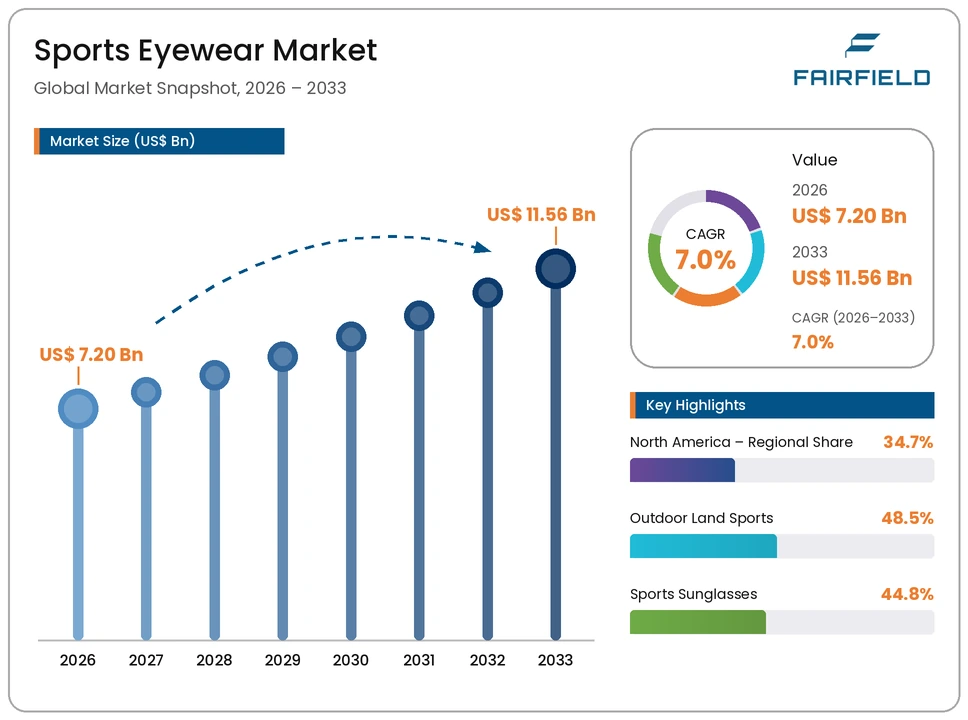
The global sports eyewear market is expected to be valued at US$ 7.20 Billion in 2026 and is projected to reach US$ 11.56 Billion by 2033, growing at a CAGR of 7.0% between 2026 and 2033.
This trajectory reflects a structural shift rather than cyclical momentum. The World Health Organization (WHO) estimates that over 2.2 billion people globally suffer from vision impairment, a figure intensifying demand for corrective and protective eyewear across athletic contexts. Simultaneously, the post-pandemic outdoor recreation surge has permanently expanded the consumer base for specialised lens technologies, polarised coatings, and wrap-around frame architectures sustaining volume growth well beyond pandemic-era highs.
Key Highlights
- North America generated US$ 2.50 Billion in the global sports eyewear market in 2026, supported by strong consumer awareness and widespread adoption of performance eyewear.
- Asia Pacific is projected to be the fastest-growing region with a CAGR of 8.2%, driven by rising sports participation and increasing disposable incomes.
- Outdoor land sports accounted for 48.5% of the global sports eyewear market in 2026, fueled by the popularity of cycling, running, and hiking.
- Sports prescription eyewear is expected to be the fastest-growing segment, driven by innovations in high-performance corrective lenses.
- The women's sports eyewear segment represents the largest growth opportunity, supported by increasing female participation in sports and dedicated product innovation.
Key Growth Determinants
- Advances in Lens Technology and Photochromic Coating Innovation
Optical performance has become the primary basis of product differentiation in the sports eyewear industry. Manufacturers are deploying photochromic lenses that adapt across a full luminance range in under 30 seconds, high-definition polarisation that eliminates glare on water and snow, and category-specific tints including Prizm lens technology by Oakley, Inc. engineered to enhance contrast in defined environments. EssilorLuxottica has scaled its Transitions photochromic platform into the sport segment, bridging prescription and performance use cases. These advances shorten replacement cycles and justify premium price positioning, both of which expand total category revenue.
Key Growth Barriers
- Counterfeit Products Eroding Brand Equity and Consumer Trust
The Organisation for Economic Co-operation and Development (OECD) identifies eyewear consistently among the top five counterfeit product categories in global trade. Fake sports sunglasses falsely marketed with UV400 or polarisation claims are prevalent across unregulated e-commerce channels in Southeast Asia and Eastern Europe. Counterfeit proliferation suppresses willingness to pay for authentic premium products, compresses branded revenue in affected channels, and critically poses documented ocular health risks that can generate negative regulatory and media scrutiny across the broader sports eyewear landscape.
Sports Eyewear Market Opportunities
- Women's Sports Eyewear: An Underserved and Rapidly Expanding Segment
Female sport participation is growing faster than any other demographic cohort in many markets. FIFA reported that women's football registered over 30 million active players globally by 2023, with participation doubling across several Asia Pacific and Latin American federations within five years. Yet purpose-built women's sports eyewear with gender-specific temple geometry, narrower bridge fit, and lighter frame mass remains underrepresented on retail floors. Brands including Adidas AG and Under Armour, Inc. are expanding dedicated women's performance eyewear lines, creating white space for product innovation and marketing investment that incumbents are only beginning to exploit.
Market Segmentation Analysis
- Product Type Analysis
Sports sunglasses account for 44.8% of the global sports eyewear market in 2026, equivalent to US$ 3.23 Billion. This dominance reflects the segment's dual function simultaneous UV protection and optical performance enhancement which resonates with cyclists on high-exposure routes, golfers tracking ball flight against bright skies, and trail runners navigating variable light conditions. Unlike goggles or shields, sports sunglasses translate naturally from performance contexts to casual wear, giving the segment a broader addressable market and higher repeat-purchase frequency. Distribution through general sporting goods retail reinforces volume.
Sports prescription eyewear is the fastest-growing segment. Hoya Corporation's 2023 expansion of sport-specific high-index lens blanks compatible with wrap-around geometries has enabled optical laboratories to fulfil prescriptions in frame formats previously considered optically unworkable, directly unlocking a large cohort of vision-corrected athletes who previously defaulted to contact lenses or non-specialist frames.
- Sports Type Analysis
Outdoor land sports account for 48.5% of the global sports eyewear market in 2026, equivalent to US$ 3.49 Billion. Cycling and running are the anchor use cases both disciplines demand wrap-around coverage, anti-fog ventilation, and UV400-rated lenses across extended exposure windows. The explosive growth of gravel cycling and ultra-trail running events such as the Ultra-Trail du Mont-Blanc (UTMB) has elevated performance eyewear from optional accessory to mandatory kit, with event organisers and coaching communities actively recommending category-specific lens tints and frame architectures.
Adventure and extreme sports represent the fastest-growing sports type segment. The mainstreaming of activities including mountain biking, paragliding, and via ferrata driven by platforms such as Komoot directing urban athletes toward technical outdoor routes is expanding the addressable buyer base for impact-resistant, standards-compliant eyewear at a rate that legacy segment volumes cannot match.
- End-user Analysis
Men account for 57.6% of the global sports eyewear market in 2026, equivalent to US$ 4.15 Billion. Male athletes have historically driven premium sports eyewear adoption, particularly across cycling, golf, and motorsport, where technical performance credentials carry strong purchase intent signals.
Brand partnerships with male professional athletes Oakley, Inc.'s longstanding relationships with Tour de France competitors, for instance sustain high brand visibility within this cohort and support above-average willingness to pay for optically advanced product lines.
Women are the fastest-growing end-user segment. Nike, Inc.'s 2024 expansion of its women's sport performance collection including running and tennis-specific sunglass models with narrower temple profiles and lighter TR-90 nylon frames signals that major brands are now allocating dedicated development resources to this demographic rather than adapting male-oriented designs.
Regional Insights
- North America Sports Eyewear Market Trends and Insights
North America is anticipated to dominate capture around 34.7% of the sports eyewear market in 2026, representing US$ 2.50 Billion. The region's leadership rests on mature retail infrastructure, high per-capita sport participation, and an established premium eyewear culture reinforced by the American Optometric Association (AOA) which actively promotes UV-protective eyewear as a clinical recommendation across all outdoor activities. Brand loyalty to Oakley, Inc. and Nike, Inc. remains robust, and growing e-commerce penetration is sustaining unit volume while raising average selling prices through direct-to-consumer channel expansion.
U.S. Sports Eyewear Market Size
The U.S. sports eyewear market represents 84.8% of the North America regional market in 2026, equivalent to US$ 2.12 Billion. Consumer spending on outdoor recreation reached a record US$ 862 Billion in 2022 according to the Outdoor Industry Association, sustaining strong underlying demand. The continued expansion of direct-to-consumer channels by premium brands is expected to sustain above-regional-average growth through 2033.
Canada Sports Eyewear Market Size
The Canada sports eyewear market represents 15.2% of the North America regional market in 2026, equivalent to US$ 0.38 Billion. Demand is anchored in skiing, ice hockey, and cycling disciplines that collectively command high average unit values in protective and performance eyewear. Rising provincial investment in recreational trail and cycling infrastructure is expected to expand the addressable participant base through the forecast period.
- Asia Pacific Sports Eyewear Market Trends and Insights
Asia Pacific accounts for 24.5% of the sports eyewear market in 2026, representing US$ 1.76 Billion, and is the fastest-growing region at an estimated CAGR of 8.2%. China's 14th Five-Year Plan targets 500 million citizens engaged in regular physical exercise by 2025 a policy mandate that has directly accelerated spending on sport-specific equipment including performance eyewear. Premiumisation trends across urban consumer cohorts in China, India, and South Korea further reinforce the region's growth trajectory.
China Sports Eyewear Market Size
The China sports eyewear market represents 33.6% of the Asia Pacific regional market in 2026, equivalent to US$ 0.59 Billion. Domestic cycling and running participation surged following the government's Healthy China 2030 initiative, creating a large and motivated consumer base for performance eyewear. Premium international brands are investing in localised retail formats and digital flagship stores on Tmall to capture this demand.
Japan Sports Eyewear Market Size
The Japan sports eyewear market represents 19.2% of the Asia Pacific regional market in 2026, equivalent to US$ 0.34 Billion. Japan's high rates of myopia among the highest in the Asia Pacific region drive disproportionate demand for sports prescription eyewear relative to market size. Domestic brands including SWANS (Yamamoto Kogaku Co., Ltd.) maintain strong distribution across swimming and cycling channels, competing credibly against international incumbents.
India Sports Eyewear Market Size
The India sports eyewear market represents 18.4% of the Asia Pacific regional market in 2026, equivalent to US$ 0.32 Billion. Cricket and cycling are the primary demand drivers, with the Board of Control for Cricket in India (BCCI)-affiliated professional leagues elevating performance eyewear visibility among a vast consumer base. Rising disposable incomes in Tier 1 and Tier 2 cities are expected to drive meaningful premiumisation through 2033.
Competitive Landscape
The global sports eyewear industry is moderately consolidated at the premium tier and highly fragmented in the mid and value segments. EssilorLuxottica which controls Oakley, Inc. as a wholly owned subsidiary commands the most significant premium share, leveraging integrated lens manufacturing and global optical distribution infrastructure that independent brands cannot replicate. Safilo Group S.p.A. and Rudy Project S.p.A. compete on heritage and technical specification, targeting performance-oriented enthusiast buyers. Athletic apparel majors including Nike, Inc., Adidas AG, and Under Armour, Inc. leverage athlete endorsement ecosystems and sports retail distribution to drive volume without matching the optical engineering depth of specialist players. Competitive advantage in this market ultimately resolves to three variables: lens optical quality, fit system ergonomics, and athlete-driven brand credibility.
Companies Covered in Sports Eyewear Market
- EssilorLuxottica
- Safilo Group S.p.A.
- Oakley, Inc. (subsidiary of EssilorLuxottica)
- Nike, Inc.
- Adidas AG
- Under Armour, Inc.
- Rudy Project S.p.A.
- Bolle Brands
- Smith Optics
Market Segmentation
By Product Type
- Sports Sunglasses
- Sports Goggles
- Sports Prescription Eyewear
- Shield/Wraparound Performance Eyewear
- Others
By Sports Type
- Outdoor Land Sports
- Water Sports
- Winter Sports
- Adventure & Extreme Sports
- Others
By End-user
- Men
- Women
- Children
By Region
- North America
- Europe
- Asia Pacific
- Latin America
- Middle East & Africa
- Executive Summary
- Global Sports Eyewear Market Snapshot
- Future Projections
- Key Market Trends
- Regional Snapshot, by Value, 2026
- Analyst Recommendations
- Market Overview
- Market Definitions and Segmentations
- Market Dynamics
- Drivers
- Restraints
- Market Opportunities
- Value Chain Analysis
- COVID-19 Impact Analysis
- Porter's Five Forces Analysis
- Impact of Russia-Ukraine Conflict
- PESTLE Analysis
- Regulatory Analysis
- Price Trend Analysis
- Current Prices and Future Projections, 2025-2033
- Price Impact Factors
- Global Sports Eyewear Market Outlook, 2020 - 2033
- Global Sports Eyewear Market Outlook, by Product Type, Value (US$ Bn), 2020-2033
- Sports Sunglasses
- Sports Goggles
- Sports Prescription Eyewear
- Shield/Wraparound Performance Eyewear
- Others
- Global Sports Eyewear Market Outlook, by Sports Type, Value (US$ Bn), 2020-2033
- Outdoor Land Sports
- Water Sports
- Winter Sports
- Adventure & Extreme Sports
- Others
- Global Sports Eyewear Market Outlook, by End-user, Value (US$ Bn), 2020-2033
- Men
- Women
- Children
- Global Sports Eyewear Market Outlook, by Region, Value (US$ Bn), 2020-2033
- North America
- Europe
- Asia Pacific
- Latin America
- Middle East & Africa
- Global Sports Eyewear Market Outlook, by Product Type, Value (US$ Bn), 2020-2033
- North America Sports Eyewear Market Outlook, 2020 - 2033
- North America Sports Eyewear Market Outlook, by Product Type, Value (US$ Bn), 2020-2033
- Sports Sunglasses
- Sports Goggles
- Sports Prescription Eyewear
- Shield/Wraparound Performance Eyewear
- Others
- North America Sports Eyewear Market Outlook, by Sports Type, Value (US$ Bn), 2020-2033
- Outdoor Land Sports
- Water Sports
- Winter Sports
- Adventure & Extreme Sports
- Others
- North America Sports Eyewear Market Outlook, by End-user, Value (US$ Bn), 2020-2033
- Men
- Women
- Children
- North America Sports Eyewear Market Outlook, by Country, Value (US$ Bn), 2020-2033
- U.S. Sports Eyewear Market Outlook, by Product Type, 2020-2033
- U.S. Sports Eyewear Market Outlook, by Sports Type, 2020-2033
- U.S. Sports Eyewear Market Outlook, by End-user, 2020-2033
- Canada Sports Eyewear Market Outlook, by Product Type, 2020-2033
- Canada Sports Eyewear Market Outlook, by Sports Type, 2020-2033
- Canada Sports Eyewear Market Outlook, by End-user, 2020-2033
- BPS Analysis/Market Attractiveness Analysis
- North America Sports Eyewear Market Outlook, by Product Type, Value (US$ Bn), 2020-2033
- Europe Sports Eyewear Market Outlook, 2020 - 2033
- Europe Sports Eyewear Market Outlook, by Product Type, Value (US$ Bn), 2020-2033
- Sports Sunglasses
- Sports Goggles
- Sports Prescription Eyewear
- Shield/Wraparound Performance Eyewear
- Others
- Europe Sports Eyewear Market Outlook, by Sports Type, Value (US$ Bn), 2020-2033
- Outdoor Land Sports
- Water Sports
- Winter Sports
- Adventure & Extreme Sports
- Others
- Europe Sports Eyewear Market Outlook, by End-user, Value (US$ Bn), 2020-2033
- Men
- Women
- Children
- Europe Sports Eyewear Market Outlook, by Country, Value (US$ Bn), 2020-2033
- Germany Sports Eyewear Market Outlook, by Product Type, 2020-2033
- Germany Sports Eyewear Market Outlook, by Sports Type, 2020-2033
- Germany Sports Eyewear Market Outlook, by End-user, 2020-2033
- Italy Sports Eyewear Market Outlook, by Product Type, 2020-2033
- Italy Sports Eyewear Market Outlook, by Sports Type, 2020-2033
- Italy Sports Eyewear Market Outlook, by End-user, 2020-2033
- France Sports Eyewear Market Outlook, by Product Type, 2020-2033
- France Sports Eyewear Market Outlook, by Sports Type, 2020-2033
- France Sports Eyewear Market Outlook, by End-user, 2020-2033
- U.K. Sports Eyewear Market Outlook, by Product Type, 2020-2033
- U.K. Sports Eyewear Market Outlook, by Sports Type, 2020-2033
- U.K. Sports Eyewear Market Outlook, by End-user, 2020-2033
- Spain Sports Eyewear Market Outlook, by Product Type, 2020-2033
- Spain Sports Eyewear Market Outlook, by Sports Type, 2020-2033
- Spain Sports Eyewear Market Outlook, by End-user, 2020-2033
- Russia Sports Eyewear Market Outlook, by Product Type, 2020-2033
- Russia Sports Eyewear Market Outlook, by Sports Type, 2020-2033
- Russia Sports Eyewear Market Outlook, by End-user, 2020-2033
- Rest of Europe Sports Eyewear Market Outlook, by Product Type, 2020-2033
- Rest of Europe Sports Eyewear Market Outlook, by Sports Type, 2020-2033
- Rest of Europe Sports Eyewear Market Outlook, by End-user, 2020-2033
- BPS Analysis/Market Attractiveness Analysis
- Europe Sports Eyewear Market Outlook, by Product Type, Value (US$ Bn), 2020-2033
- Asia Pacific Sports Eyewear Market Outlook, 2020 - 2033
- Asia Pacific Sports Eyewear Market Outlook, by Product Type, Value (US$ Bn), 2020-2033
- Sports Sunglasses
- Sports Goggles
- Sports Prescription Eyewear
- Shield/Wraparound Performance Eyewear
- Others
- Asia Pacific Sports Eyewear Market Outlook, by Sports Type, Value (US$ Bn), 2020-2033
- Outdoor Land Sports
- Water Sports
- Winter Sports
- Adventure & Extreme Sports
- Others
- Asia Pacific Sports Eyewear Market Outlook, by End-user, Value (US$ Bn), 2020-2033
- Men
- Women
- Children
- Asia Pacific Sports Eyewear Market Outlook, by Country, Value (US$ Bn), 2020-2033
- China Sports Eyewear Market Outlook, by Product Type, 2020-2033
- China Sports Eyewear Market Outlook, by Sports Type, 2020-2033
- China Sports Eyewear Market Outlook, by End-user, 2020-2033
- Japan Sports Eyewear Market Outlook, by Product Type, 2020-2033
- Japan Sports Eyewear Market Outlook, by Sports Type, 2020-2033
- Japan Sports Eyewear Market Outlook, by End-user, 2020-2033
- South Korea Sports Eyewear Market Outlook, by Product Type, 2020-2033
- South Korea Sports Eyewear Market Outlook, by Sports Type, 2020-2033
- South Korea Sports Eyewear Market Outlook, by End-user, 2020-2033
- India Sports Eyewear Market Outlook, by Product Type, 2020-2033
- India Sports Eyewear Market Outlook, by Sports Type, 2020-2033
- India Sports Eyewear Market Outlook, by End-user, 2020-2033
- Southeast Asia Sports Eyewear Market Outlook, by Product Type, 2020-2033
- Southeast Asia Sports Eyewear Market Outlook, by Sports Type, 2020-2033
- Southeast Asia Sports Eyewear Market Outlook, by End-user, 2020-2033
- Rest of SAO Sports Eyewear Market Outlook, by Product Type, 2020-2033
- Rest of SAO Sports Eyewear Market Outlook, by Sports Type, 2020-2033
- Rest of SAO Sports Eyewear Market Outlook, by End-user, 2020-2033
- BPS Analysis/Market Attractiveness Analysis
- Asia Pacific Sports Eyewear Market Outlook, by Product Type, Value (US$ Bn), 2020-2033
- Latin America Sports Eyewear Market Outlook, 2020 - 2033
- Latin America Sports Eyewear Market Outlook, by Product Type, Value (US$ Bn), 2020-2033
- Sports Sunglasses
- Sports Goggles
- Sports Prescription Eyewear
- Shield/Wraparound Performance Eyewear
- Others
- Latin America Sports Eyewear Market Outlook, by Sports Type, Value (US$ Bn), 2020-2033
- Outdoor Land Sports
- Water Sports
- Winter Sports
- Adventure & Extreme Sports
- Others
- Latin America Sports Eyewear Market Outlook, by End-user, Value (US$ Bn), 2020-2033
- Men
- Women
- Children
- Latin America Sports Eyewear Market Outlook, by Country, Value (US$ Bn), 2020-2033
- Brazil Sports Eyewear Market Outlook, by Product Type, 2020-2033
- Brazil Sports Eyewear Market Outlook, by Sports Type, 2020-2033
- Brazil Sports Eyewear Market Outlook, by End-user, 2020-2033
- Mexico Sports Eyewear Market Outlook, by Product Type, 2020-2033
- Mexico Sports Eyewear Market Outlook, by Sports Type, 2020-2033
- Mexico Sports Eyewear Market Outlook, by End-user, 2020-2033
- Argentina Sports Eyewear Market Outlook, by Product Type, 2020-2033
- Argentina Sports Eyewear Market Outlook, by Sports Type, 2020-2033
- Argentina Sports Eyewear Market Outlook, by End-user, 2020-2033
- Rest of LATAM Sports Eyewear Market Outlook, by Product Type, 2020-2033
- Rest of LATAM Sports Eyewear Market Outlook, by Sports Type, 2020-2033
- Rest of LATAM Sports Eyewear Market Outlook, by End-user, 2020-2033
- BPS Analysis/Market Attractiveness Analysis
- Latin America Sports Eyewear Market Outlook, by Product Type, Value (US$ Bn), 2020-2033
- Middle East & Africa Sports Eyewear Market Outlook, 2020 - 2033
- Middle East & Africa Sports Eyewear Market Outlook, by Product Type, Value (US$ Bn), 2020-2033
- Sports Sunglasses
- Sports Goggles
- Sports Prescription Eyewear
- Shield/Wraparound Performance Eyewear
- Others
- Middle East & Africa Sports Eyewear Market Outlook, by Sports Type, Value (US$ Bn), 2020-2033
- Outdoor Land Sports
- Water Sports
- Winter Sports
- Adventure & Extreme Sports
- Others
- Middle East & Africa Sports Eyewear Market Outlook, by End-user, Value (US$ Bn), 2020-2033
- Men
- Women
- Children
- Middle East & Africa Sports Eyewear Market Outlook, by Country, Value (US$ Bn), 2020-2033
- GCC Sports Eyewear Market Outlook, by Product Type, 2020-2033
- GCC Sports Eyewear Market Outlook, by Sports Type, 2020-2033
- GCC Sports Eyewear Market Outlook, by End-user, 2020-2033
- South Africa Sports Eyewear Market Outlook, by Product Type, 2020-2033
- South Africa Sports Eyewear Market Outlook, by Sports Type, 2020-2033
- South Africa Sports Eyewear Market Outlook, by End-user, 2020-2033
- Egypt Sports Eyewear Market Outlook, by Product Type, 2020-2033
- Egypt Sports Eyewear Market Outlook, by Sports Type, 2020-2033
- Egypt Sports Eyewear Market Outlook, by End-user, 2020-2033
- Nigeria Sports Eyewear Market Outlook, by Product Type, 2020-2033
- Nigeria Sports Eyewear Market Outlook, by Sports Type, 2020-2033
- Nigeria Sports Eyewear Market Outlook, by End-user, 2020-2033
- Rest of Middle East Sports Eyewear Market Outlook, by Product Type, 2020-2033
- Rest of Middle East Sports Eyewear Market Outlook, by Sports Type, 2020-2033
- Rest of Middle East Sports Eyewear Market Outlook, by End-user, 2020-2033
- BPS Analysis/Market Attractiveness Analysis
- Middle East & Africa Sports Eyewear Market Outlook, by Product Type, Value (US$ Bn), 2020-2033
- Competitive Landscape
- Company Vs Segment Heatmap
- Company Market Share Analysis, 2025
- Competitive Dashboard
- Company Profiles
- EssilorLuxottica
- Company Overview
- Product Portfolio
- Financial Overview
- Business Strategies and Developments
- Safilo Group S.p.A.
- Luxottica Group S.p.A.
- Nike, Inc.
- Adidas AG
- Under Armour, Inc.
- Oakley, Inc.
- Rudy Project S.p.A.
- Bolle Brands
- Smith Optics
- EssilorLuxottica
- Appendix
- Research Methodology
- Report Assumptions
- Acronyms and Abbreviations
By Product Type
- Sports Sunglasses
- Sports Goggles
- Sports Prescription Eyewear
- Shield/Wraparound Performance Eyewear
- Others
By Sports Type
- Outdoor Land Sports
- Water Sports
- Winter Sports
- Adventure & Extreme Sports
- Others
By End-user
- Men
- Women
- Children
By Region
- North America
- Europe
- Asia Pacific
- Latin America
- Middle East & Africa
Our Research Methodology
Considering the volatility of business today, traditional approaches to strategizing a game plan can be unfruitful if not detrimental. True ambiguity is no way to determine a forecast. A myriad of predetermined factors must be accounted for such as the degree of risk involved, the magnitude of circumstances, as well as conditions or consequences that are not known or unpredictable. To circumvent binary views that cast uncertainty, the application of market research intelligence to strategically posture, move, and enable actionable outcomes is necessary.
View Methodology
Quality Assured
Rigorous Validation Process

Confidentiality Assured
End-to-end Data Security

Custom Research Services
Tailored To Your Objectives
FAQs
The global sports eyewear market is valued at US$ 7.20 Billion in 2026 and is forecast to reach US$ 11.56 Billion by 2033, expanding at a CAGR of 7.0%.
Market growth is driven by increasing participation in outdoor sports, advancements in lens technologies, and rising awareness of UV eye protection.
Sports sunglasses lead the market with a 44.8% share due to their versatility for both sports and everyday outdoor use.
North America dominates with a 34.7% market share, supported by high sports participation, strong consumer spending, and an extensive optometry network.
The greatest opportunity lies in sports prescription eyewear, driven by rising demand for sport-specific vision correction solutions.
Related Reports
Fabric Softener Sheet Market Size, Share, Insights, Competitive Landscape, and Forecast 2026 to 2033
The global fabric softener sheet market is valued at US$2.1 billion in 2026, reaching US$2.7 billion by 2033, growing at a 3.7% CAGR
Eyewear Market Size, Share, Insights, Competitive Landscape, and Forecast 2026 to 2033
The global eyewear market is valued at US$178.0 billion in 2026, reaching US$268.0 billion by 2033, growing at a 6.0% CAGR
Exotic Pets Market Size, Share, Insights, Competitive Landscape, and Forecast 2026 to 2033
The global exotic pets market is valued at US$21.4 billion in 2026, reaching US$33.6 billion by 2033, growing at a 6.7% CAGR
3D Drawing Doodle Printing Pen Market Size, Share, Insights, Competitive Landscape, and Forecast 2026 to 2033
The global 3D drawing doodle printing pen market is valued at US$0.16 billion in 2026, reaching US$0.28 billion by 2033, growing at an 8.32% CAGR
Knee High Boots Market Size, Share, Insights, Competitive Landscape, and Forecast 2026 to 2033
The global knee high boots market is valued at US$18.7 billion in 2026, reaching US$26.4 billion by 2033, growing at a 5.05% CAGR
Drop Shipping Market Size, Share, Insights, Competitive Landscape, and Forecast 2026 to 2033
The global drop shipping market is valued at US$420.0 billion in 2026, reaching US$985.0 billion by 2033, growing at a 12.95% CAGR