



3D Electronics / Additive Electronics Market
3D Electronics / Additive Electronics Market Size, Share, Insights, Competitive Landscape, and Forecast 2026 to 2033
3D Electronics / Additive Electronics Market Size and Trend Analysis
How Large Will the 3D Electronics Market Be by 2033?
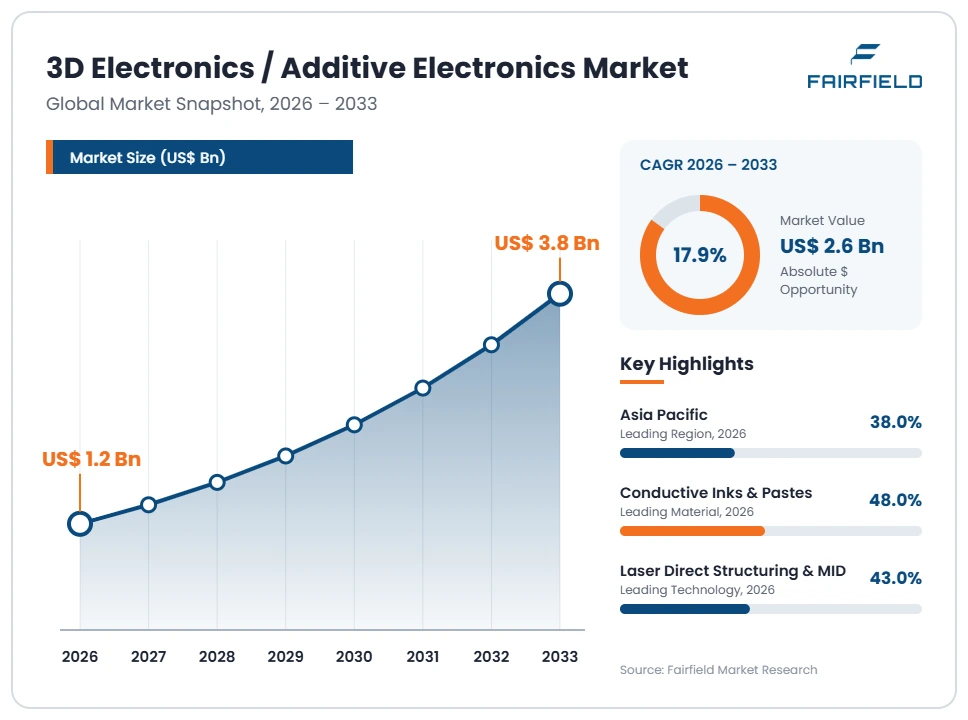
The global 3D Electronics / Additive Electronics market size is expected to be valued at US$ 1.2 billion in 2026 and projected to reach US$ 3.8 billion by 2033, growing at a CAGR of 17.9% between 2026 and 2033.
The sector grew from roughly US$ 520 million in 2020 to about US$ 1.04 billion in 2025, a historical CAGR of 14.9%. This estimate counts production equipment, functional materials and manufacturing services for circuitry formed directly on three-dimensional and non-planar surfaces. Three forces shape the outlook: automotive interiors adopting integrated electronic surfaces, compact wireless products needing antennas on curved housings, and medical devices requiring conformal sensing. Growth is strong in percentage terms but from a small base. Conventional rigid board assembly remains far cheaper per function, so additive methods win in specific geometries rather than displacing printed circuit assembly broadly.
Key Report Takeaways
- By Technology: Laser Direct Structuring & Molded Interconnect Devices held 43% share in 2026, while In-Mold Electronics is projected to expand at a 21.6% CAGR through 2033, as automotive interior suppliers move integrated control surfaces from prototypes into series production programmes.
- By Material: Conductive Inks & Pastes held 48% share in 2026, while Substrates & Thermoplastics are projected to expand at a 19.2% CAGR through 2033, because formable resins that survive thermoforming and injection overmoulding determine achievable part geometry.
- By Device Type: Antennas held 34% share in 2026, while Sensors are projected to expand at a 20.4% CAGR through 2033, driven by capacitive, strain and temperature sensing printed directly onto curved mechanical housings.
- By End Use: Consumer Electronics held 31% share in 2026, while Automotive is projected to expand at a 20.9% CAGR through 2033, as cabin surfaces combine lighting, touch sensing and structural function in a single moulded component.
- By Geography: Asia Pacific held 38% share in 2026, while Europe is projected to expand at a 19.6% CAGR through 2033, supported by vehicle manufacturers specifying integrated electronic surfaces for interior programmes.
Global 3D Electronics / Additive Electronics Market Trends and Insights
Drivers Impact Analysis
Two application pulls account for most forecast growth in conformal and additively manufactured electronics.
| Driver | Impact on CAGR Forecast | Geographic Relevance | Impact Timeline |
| Part-count and weight reduction in vehicle interiors | High | Europe, Asia Pacific | Medium term (2–4 years) |
| Antenna integration on curved housings in compact wireless devices | High | Asia Pacific, North America | Short term (≤2 years) |
Interior Part Consolidation Moves In-Mold Electronics Into Vehicle Series Production
Part-count reduction is the strongest commercial argument for additive electronics today. A single in-mould electronic panel can replace a moulded trim piece, a printed circuit board, a light guide, a connector harness and several mechanical switches. Vehicle manufacturers value the resulting weight saving, thinner packaging and fewer assembly operations, and interior suppliers value the reduced bill of materials complexity across a programme.
The mechanism is process integration. Conductive traces are screen printed onto a flat film, components are attached, the film is thermoformed to the target shape, and the assembly is injection overmoulded into a finished structural part. That consolidates several supply chains into one moulding operation. Interior panels must still satisfy automotive qualification practice, including component stress testing under AEC-Q methods and quality management under IATF 16949, so suppliers that already hold those systems convert pilots into awarded programmes fastest.
Conformal Antenna Fabrication Replaces Discrete Modules in Compact Wireless Devices
Antennas are the application where additive electronics is already standard practice rather than an emerging option. Printing or laser-structuring an antenna directly onto a device housing recovers internal volume that a separate flexible antenna module and its connector would occupy. For smartphones, hearables, smart watches, trackers and connected medical wearables, that reclaimed space goes to battery capacity, which is a decisive product advantage.
The causal chain starts with radio count. Devices now carry cellular, wireless networking, short-range, positioning and ultra-wideband radios, each needing radiating structures with specific geometry and separation. Fitting them onto flat boards is impractical, so designers move them onto curved internal surfaces where three-dimensional placement improves isolation. Laser direct structuring activates a catalytic plastic surface for selective metallisation, giving repeatable trace geometry on complex shapes. IPC design guidance for printed electronics supports the documentation these high-volume programmes require.
Restraints Impact Analysis
Two constraints keep additive electronics in niches rather than mainstream circuit production.
| Restraint | Impact on CAGR Forecast | Geographic Relevance | Impact Timeline |
| Silver conductive ink consumption and metal price volatility | High | Global | Medium term (2–4 years) |
| Non-repairable assemblies and end-of-life recycling difficulty | Medium | Europe | Long term (≥4 years) |
Silver Ink Consumption Keeps Printed Conductors Above Etched Copper on Cost
Material cost is the clearest barrier to displacing conventional circuit assembly. Most printed conductors rely on silver flake or silver nanoparticle inks, and silver is both expensive and volatile in price. Conventional boards built to IPC-6012 use etched copper foil, a commodity input, so a printed conductor can cost many times more per unit of conductive area even before equipment and yield effects are counted.
The cost source is specific rather than general. Printed traces have higher sheet resistance than rolled copper, so designers compensate by printing wider or thicker tracks, which increases silver consumption exactly where savings are needed. Sintering steps add energy and cycle time, and substrate temperature limits cap how far sintering can improve conductivity. Copper and carbon-based alternatives exist but face oxidation, adhesion and conductivity trade-offs, so they have not yet displaced silver in demanding applications.
Embedding Circuits in Structural Plastics Blocks Repair and Complicates Recycling
Integration creates a durability and compliance problem that buyers weigh against its benefits. Once electronics are overmoulded inside a structural plastic part, no component can be replaced. A single failed light-emitting diode or cracked trace turns the whole moulded assembly into scrap, and warranty exposure rises for parts expected to last a vehicle’s service life. Field repair, routine in board-based designs, disappears entirely.
The regulatory cause sits in end-of-life rules. The WEEE Directive sets collection and treatment obligations for electrical equipment, and recyclers separate value by material stream. A thermoplastic part with printed silver, embedded dies and dielectric layers resists that separation, so it is downcycled or discarded. Restrictions under the RoHS Directive and substance obligations under REACH also constrain ink and substrate formulation, narrowing the chemistry available to material developers.
Market Opportunities
Two revenue pools sit beyond the consumer antenna and automotive interior applications that dominate today.
Conformal Sensing on Patient-Contact Devices Opens a Medical Revenue Pool
Medical devices offer an attractive revenue pool because clinical products tolerate higher material cost than consumer hardware. Printing electrodes, strain gauges and temperature sensors directly onto catheter bodies, surgical instrument handles, prosthetic sockets and wearable monitors removes the rigid board and its connector from the patient-contact region. That improves comfort and allows shapes that a flat assembly cannot follow.
Material suppliers and contract manufacturers with medical quality systems are best placed to capture it, since the barrier is validation rather than printing capability. Demand comes from device makers building single-use and limited-use instruments, where non-repairability is irrelevant because the product is disposable by design. Biocompatible ink formulations and sterilisation-tolerant substrates are the enabling development, supported by IPC base material specifications for printed electronics, which give device designers documented substrate performance data to use in regulatory submissions.
Lightweight Conformal RF Structures Create an Aerospace and Satellite Revenue Stream
Aerospace and satellite programmes open a high-value pool where mass savings justify premium manufacturing. Additively fabricated waveguides, conformal phased-array feeds and antennas built onto curved structural panels remove brackets, cables and separate radomes. On a spacecraft, every kilogram removed converts directly into launch cost saved or payload gained, which supports prices far above commercial electronics norms.
Specialist additive manufacturing firms partnering with defence and space primes are positioned to serve this, because qualification and traceability matter more than throughput. Demand comes from satellite constellation builders, unmanned aircraft developers and radar system integrators that need many near-identical RF structures with short lead times. Low production volumes suit additive methods, since tooling amortisation, the usual advantage of conventional manufacturing, barely applies when a programme builds hundreds rather than millions of units.
Segment Analysis
- By Technology: Laser Direct Structuring Leads While In-Mold Electronics Scales Fastest
Laser Direct Structuring & Molded Interconnect Devices held 43% share in 2026, the largest technology position, because it is the only additive electronics route already running at consumer volumes. Laser activation of a doped thermoplastic followed by electroless plating produces repeatable traces on complex housings, and the process is well understood by handset and wearable manufacturers. In-Mold Electronics is the fastest-growing technology at a 21.6% CAGR to 2033, as automotive interior programmes move from validation builds into series production of integrated control surfaces. Aerosol Jet Printing serves fine-feature, high-mix work in semiconductor packaging, sensors and aerospace radio-frequency structures, while Inkjet & Dispensing Printing handles conformal coatings, interconnects and repair paths. The implication is that technology choice tracks volume: structuring for high-volume housings, in-mould for formed panels, and jetting for low-volume precision work.
- By Material: Conductive Inks Dominate Value While Formable Substrates Grow Quickest
Conductive Inks & Pastes accounted for 48% of material value in 2026, reflecting silver content and the fact that every printed structure consumes them. Their price sets the economics of the whole process, which is why copper, carbon and hybrid formulations attract continuous development. Substrates & Thermoplastics are the fastest-growing material segment at a 19.2% CAGR through 2033, because the substrate determines what geometry is achievable: films must stretch during thermoforming without breaking traces, then survive injection overmoulding temperatures and pressures. Dielectric & Insulating Materials enable multi-layer crossovers on curved surfaces, while Encapsulants & Adhesives protect components against humidity, vibration and thermal cycling. Material compliance under the RoHS Directive and REACH governs which chemistries reach production. For suppliers, the implication is that formulation knowledge, not printing hardware, is the defensible position.
- By Device Type: Antennas Hold the Largest Share While Printed Sensors Expand Fastest
Antennas represented 34% of demand in 2026, the leading device type, because conformal radiating structures on plastic housings are already standard in smartphones, wearables and connected modules, where internal volume is the scarcest design resource. Sensors are the fastest-growing device type at a 20.4% CAGR to 2033, covering capacitive touch surfaces, strain gauges, temperature sensors, proximity detection and occupancy sensing printed onto curved mechanical parts. Interconnects & Circuitry replace wiring harnesses and flexible cables inside compact assemblies, cutting connector count and failure points. Lighting & Human-Machine Interface Elements combine light-emitting diodes, light guides and touch zones in moulded panels for vehicles and appliances. The business implication is that growth is strongest where the function must physically match a curved surface, rather than where it merely could be printed.
- By End Use: Consumer Electronics Leads Volume While Automotive Delivers the Fastest Growth
Consumer Electronics held 31% share in 2026, the largest end use, driven by antenna structuring in handsets, hearables, watches and tracking devices manufactured in very large quantities. Short product cycles let designers adopt new processes quickly. Automotive is the fastest-growing end use at a 20.9% CAGR through 2033, because interior programmes are moving to integrated surfaces that combine trim, lighting, touch sensing and structural function in one moulded part, with qualification under IATF 16949 and AEC-Q methods. Healthcare & Medical Devices contributes high-margin conformal sensing on instruments and wearables. Aerospace & Defense buys low-volume radio-frequency structures where mass savings dominate cost, and Industrial applications cover sensors on machinery housings. The implication is that automotive wins will determine whether the industry reaches genuine manufacturing scale.
Geography Analysis
- North America Concentrates on Aerospace, Medical and Equipment Development
North America holds 25% share in 2026, with demand led by the United States across aerospace, defence, medical devices and semiconductor packaging. Buyers here value capability over unit cost, so aerosol jet and precision dispensing systems used for low-volume radio-frequency structures, conformal sensors and advanced packaging find a receptive market. Several of the industry’s equipment developers and ink formulators are based in the region, giving it a strong position in process technology even though high-volume part production happens elsewhere. Defence programmes fund qualification work that commercial budgets would not support. Canada and Mexico contribute through contract electronics manufacturing capacity. The constraint is limited domestic volume moulding for consumer housings, which pushes high-rate production offshore. The clearest opportunity is satellite and unmanned systems, where many near-identical conformal antennas are needed on short lead times.
- Which Region Is Growing Fastest in the 3D Electronics / Additive Electronics Market?
Europe is growing fastest in the 3D electronics and additive electronics market, at a 19.6% CAGR between 2026 and 2033 from 26% share in 2026. Germany, Finland, France, Austria and Italy drive this through automotive interiors, where vehicle manufacturers and tier-one suppliers are specifying in-mould electronic panels for overhead consoles, door trims, steering wheel surfaces and climate controls. The region also hosts leading in-mould technology developers, laser structuring equipment makers and conductive material formulators, so design and supply sit close together. Regulatory pressure cuts both ways: substance restrictions and end-of-life obligations raise compliance effort, while weight reduction targets reward part consolidation. The main barrier is the long automotive validation cycle, which delays revenue recognition for several years after a design win is announced.
- Which Region Is Leading the 3D Electronics / Additive Electronics Market?
Asia Pacific leads the 3D electronics and additive electronics market with 38% share in 2026, because the high-volume applications are manufactured there. China, Taiwan, South Korea, Japan and Vietnam host the handset, wearable and connected device assembly capacity that consumes laser direct structuring at scale, and the moulding, plating and metrology supply chains sit alongside those plants. Japan supplies precision materials, including dielectric and conductive formulations, while South Korea contributes advanced packaging demand. Regional equipment vendors have driven down the capital cost of structuring and plating lines, widening access for mid-sized manufacturers. The constraint is price pressure: contract manufacturers compete on cost and resist processes that raise bill of materials value. The opportunity is appliance and industrial control surfaces, a large domestic market that has barely begun adopting integrated electronics.
- Latin America Builds Capability Through Automotive and Appliance Manufacturing
Latin America accounts for 6% share in 2026, anchored by automotive and appliance manufacturing in Mexico and Brazil. Vehicle assembly plants and their interior suppliers in northern Mexico are the most likely route to adoption, since they build trim components for programmes designed elsewhere and can receive validated processes through parent companies. Appliance manufacturers represent a second path, as control panels suit printed touch surfaces. The barriers are structural: equipment and specialist inks are imported, local materials formulation capability is thin, and process engineers experienced in printed electronics are scarce. Validation for automotive parts is typically carried out in the design region, which delays local process transfer. The clearest opportunity is nearshoring, where buyers seeking shorter supply chains move interior component production closer to final assembly plants.
- Middle East & Africa Remains an Early-Stage Market Led by Research Investment
Middle East & Africa represents 5% share in 2026, the smallest regional position, with activity concentrated in the United Arab Emirates, Saudi Arabia, Israel and South Africa. Israel is the most developed location, with additive electronics equipment development and defence electronics demand for conformal radio-frequency structures. Gulf states fund research centres and advanced manufacturing initiatives as part of economic diversification strategies, which brings equipment into universities and pilot lines before commercial volume exists. South Africa has limited activity tied to automotive component supply. The barriers are the absence of a local electronics manufacturing base, dependence on imported materials and few qualified process engineers. The main opportunity is defence and aerospace work, where governments are investing in domestic production capability and small-batch conformal antenna manufacturing fits national industrial policy.
Competitive Landscape
The 3D electronics and additive electronics market is fragmented, with low concentration and no supplier controlling more than a modest share. The field splits into four groups. Equipment makers such as Optomec Inc., LPKF Laser & Electronics SE, Nano Dimension Ltd. and Neotech AMT GmbH sell printing, structuring and dispensing systems. Technology licensors, most visibly TactoTek Oy, develop in-mould electronics processes and license them to moulders rather than manufacturing at scale. Material suppliers including DuPont, Henkel AG & Co. KGaA, Heraeus Holding, Canatu Oyj and Dycotec Materials provide conductive inks, dielectrics and formable substrates. Interconnect and manufacturing groups such as Molex LLC, TE Connectivity, Harting Technology Group, Jabil Inc. and Flex Ltd. integrate these processes into production parts.
Competition turns on qualification evidence rather than printing capability. Automotive and medical buyers ask for thermal cycling, humidity, adhesion and vibration data, process capability indices, and whether the supplier operates a recognised quality system. Cost per part against a conventional assembly built to IPC-6012 is the benchmark every proposal must beat. New entrants come mainly from materials science, offering lower-silver or copper-based inks, and from injection moulders adding electronics capability rather than from traditional electronics manufacturers.
Strategic activity centres on licensing and partnership structures. Technology owners license processes to moulders who already hold automotive approvals, material suppliers co-develop ink and substrate pairs with equipment vendors to guarantee compatibility, and contract manufacturers add structuring and in-mould lines to existing plants instead of building dedicated facilities.
Strategic direction is converging on automotive qualification, lower-cost conductor chemistry and recyclability, since these determine whether the technology moves beyond niches.
Recent Industry Developments
- 2012: The recast WEEE Directive 2012/19/EU was adopted in the European Union, setting collection and treatment obligations for electrical and electronic equipment – it frames the end-of-life challenge for electronics embedded in structural plastic parts that resist material separation.
- 2016: IATF 16949:2016 replaced ISO/TS 16949 as the automotive quality management standard – it remains the qualification gate that any supplier of printed or in-mould electronic interior components must pass before a programme award.
- July 2019: The four phthalates added by Directive (EU) 2015/863 became applicable under the RoHS Directive 2011/65/EU – the extended restriction list narrowed the plasticiser and substrate chemistry available to formulators of films used in formed electronic parts.
- July 2024: The Ecodesign for Sustainable Products Regulation (EU) 2024/1781 entered into force, extending ecodesign requirements toward durability, repairability and recycled content across product groups – it raises the compliance stakes for non-repairable integrated assemblies.
Companies Covered in the Report
- TactoTek Oy
- Optomec Inc.
- LPKF Laser & Electronics SE
- Nano Dimension Ltd.
- Neotech AMT GmbH
- Molex LLC
- TE Connectivity
- Harting Technology Group
- Jabil Inc.
- Flex Ltd.
- DuPont
- Henkel AG & Co. KGaA
- Heraeus Holding
- Canatu Oyj
- Dycotec Materials
3D Electronics / Additive Electronics Market Report Scope
| Metric | Value |
| Study Period | 2020–2033 |
| Market Size 2026 | US$ 1.2 Billion |
| Market Size 2033 | US$ 3.8 Billion |
| CAGR 2026–2033 | 17.9% |
| Absolute Dollar Opportunity | US$ 2.6 Billion |
| Largest Market | Asia Pacific (38% share in 2026) |
| Fastest-Growing Market | Europe (19.6% CAGR) |
| Market Concentration | Low |
| Major Players | TactoTek Oy, Optomec Inc., LPKF Laser & Electronics SE, DuPont, Molex LLC |
3D Electronics / Additive Electronics Market Segmentation
Technology
- Laser Direct Structuring & Molded Interconnect Devices
- Aerosol Jet Printing
- Inkjet & Dispensing Printing
- In-Mold Electronics
Material
- Conductive Inks & Pastes
- Dielectric & Insulating Materials
- Substrates & Thermoplastics
- Encapsulants & Adhesives
Device Type
- Antennas
- Sensors
- Interconnects & Circuitry
- Lighting & Human-Machine Interface Elements
End Use
- Consumer Electronics
- Automotive
- Healthcare & Medical Devices
- Aerospace & Defense
- Industrial
Regions
- North America
- Europe
- Asia Pacific
- Latin America
- Middle East & Africa
- Executive Summary
- Global 3D Electronics / Additive Electronics Market Snapshot
- Future Projections
- Key Report Takeaways
- Regional Snapshot
- Market Overview
- Market Definition and Report Scope
- Historical Trends 2020–2025
- Market Dynamics
- Drivers
- Interior Part Consolidation Moves In-Mold Electronics Into Vehicle Series Production
- Conformal Antenna Fabrication Replaces Discrete Modules in Compact Wireless Devices
- Restraints
- Silver Ink Consumption Keeps Printed Conductors Above Etched Copper on Cost
- Embedding Circuits in Structural Plastics Blocks Repair and Complicates Recycling
- Market Opportunities
- Conformal Sensing on Patient-Contact Devices Opens a Medical Revenue Pool
- Lightweight Conformal RF Structures Create an Aerospace and Satellite Revenue Stream
- Drivers
- Global 3D Electronics / Additive Electronics Market Outlook, 2020–2033
- Global 3D Electronics / Additive Electronics Market Outlook, by Technology, Value (US$ Billion), 2020–2033
- Laser Direct Structuring & Molded Interconnect Devices
- Aerosol Jet Printing
- Inkjet & Dispensing Printing
- In-Mold Electronics
- Global 3D Electronics / Additive Electronics Market Outlook, by Material, Value (US$ Billion), 2020–2033
- Conductive Inks & Pastes
- Dielectric & Insulating Materials
- Substrates & Thermoplastics
- Encapsulants & Adhesives
- Global 3D Electronics / Additive Electronics Market Outlook, by Device Type, Value (US$ Billion), 2020–2033
- Antennas
- Sensors
- Interconnects & Circuitry
- Lighting & Human-Machine Interface Elements
- Global 3D Electronics / Additive Electronics Market Outlook, by End Use, Value (US$ Billion), 2020–2033
- Consumer Electronics
- Automotive
- Healthcare & Medical Devices
- Aerospace & Defense
- Industrial
- Global 3D Electronics / Additive Electronics Market Outlook, by Region, Value (US$ Billion), 2020–2033
- North America
- Europe
- Asia Pacific
- Latin America
- Middle East & Africa
- Global 3D Electronics / Additive Electronics Market Outlook, by Technology, Value (US$ Billion), 2020–2033
- North America 3D Electronics / Additive Electronics Market Outlook, 2020–2033
- North America 3D Electronics / Additive Electronics Market Outlook, by Technology, Value (US$ Billion), 2020–2033
- Laser Direct Structuring & Molded Interconnect Devices
- Aerosol Jet Printing
- Inkjet & Dispensing Printing
- In-Mold Electronics
- North America 3D Electronics / Additive Electronics Market Outlook, by Material, Value (US$ Billion), 2020–2033
- Conductive Inks & Pastes
- Dielectric & Insulating Materials
- Substrates & Thermoplastics
- Encapsulants & Adhesives
- North America 3D Electronics / Additive Electronics Market Outlook, by Device Type, Value (US$ Billion), 2020–2033
- Antennas
- Sensors
- Interconnects & Circuitry
- Lighting & Human-Machine Interface Elements
- North America 3D Electronics / Additive Electronics Market Outlook, by End Use, Value (US$ Billion), 2020–2033
- Consumer Electronics
- Automotive
- Healthcare & Medical Devices
- Aerospace & Defense
- Industrial
- North America 3D Electronics / Additive Electronics Market Outlook, by Country, Value (US$ Billion), 2020–2033
- United States 3D Electronics / Additive Electronics Market Outlook, by Technology, 2020–2033
- United States 3D Electronics / Additive Electronics Market Outlook, by Material, 2020–2033
- United States 3D Electronics / Additive Electronics Market Outlook, by Device Type, 2020–2033
- United States 3D Electronics / Additive Electronics Market Outlook, by End Use, 2020–2033
- Canada 3D Electronics / Additive Electronics Market Outlook, by Technology, 2020–2033
- Canada 3D Electronics / Additive Electronics Market Outlook, by Material, 2020–2033
- Canada 3D Electronics / Additive Electronics Market Outlook, by Device Type, 2020–2033
- Canada 3D Electronics / Additive Electronics Market Outlook, by End Use, 2020–2033
- Mexico 3D Electronics / Additive Electronics Market Outlook, by Technology, 2020–2033
- Mexico 3D Electronics / Additive Electronics Market Outlook, by Material, 2020–2033
- Mexico 3D Electronics / Additive Electronics Market Outlook, by Device Type, 2020–2033
- Mexico 3D Electronics / Additive Electronics Market Outlook, by End Use, 2020–2033
- North America 3D Electronics / Additive Electronics Market Outlook, by Technology, Value (US$ Billion), 2020–2033
- Europe 3D Electronics / Additive Electronics Market Outlook, 2020–2033
- Europe 3D Electronics / Additive Electronics Market Outlook, by Technology, Value (US$ Billion), 2020–2033
- Laser Direct Structuring & Molded Interconnect Devices
- Aerosol Jet Printing
- Inkjet & Dispensing Printing
- In-Mold Electronics
- Europe 3D Electronics / Additive Electronics Market Outlook, by Material, Value (US$ Billion), 2020–2033
- Conductive Inks & Pastes
- Dielectric & Insulating Materials
- Substrates & Thermoplastics
- Encapsulants & Adhesives
- Europe 3D Electronics / Additive Electronics Market Outlook, by Device Type, Value (US$ Billion), 2020–2033
- Antennas
- Sensors
- Interconnects & Circuitry
- Lighting & Human-Machine Interface Elements
- Europe 3D Electronics / Additive Electronics Market Outlook, by End Use, Value (US$ Billion), 2020–2033
- Consumer Electronics
- Automotive
- Healthcare & Medical Devices
- Aerospace & Defense
- Industrial
- Europe 3D Electronics / Additive Electronics Market Outlook, by Country, Value (US$ Billion), 2020–2033
- Germany 3D Electronics / Additive Electronics Market Outlook, by Technology, 2020–2033
- Germany 3D Electronics / Additive Electronics Market Outlook, by Material, 2020–2033
- Germany 3D Electronics / Additive Electronics Market Outlook, by Device Type, 2020–2033
- Germany 3D Electronics / Additive Electronics Market Outlook, by End Use, 2020–2033
- Finland 3D Electronics / Additive Electronics Market Outlook, by Technology, 2020–2033
- Finland 3D Electronics / Additive Electronics Market Outlook, by Material, 2020–2033
- Finland 3D Electronics / Additive Electronics Market Outlook, by Device Type, 2020–2033
- Finland 3D Electronics / Additive Electronics Market Outlook, by End Use, 2020–2033
- France 3D Electronics / Additive Electronics Market Outlook, by Technology, 2020–2033
- France 3D Electronics / Additive Electronics Market Outlook, by Material, 2020–2033
- France 3D Electronics / Additive Electronics Market Outlook, by Device Type, 2020–2033
- France 3D Electronics / Additive Electronics Market Outlook, by End Use, 2020–2033
- Austria 3D Electronics / Additive Electronics Market Outlook, by Technology, 2020–2033
- Austria 3D Electronics / Additive Electronics Market Outlook, by Material, 2020–2033
- Austria 3D Electronics / Additive Electronics Market Outlook, by Device Type, 2020–2033
- Austria 3D Electronics / Additive Electronics Market Outlook, by End Use, 2020–2033
- Italy 3D Electronics / Additive Electronics Market Outlook, by Technology, 2020–2033
- Italy 3D Electronics / Additive Electronics Market Outlook, by Material, 2020–2033
- Italy 3D Electronics / Additive Electronics Market Outlook, by Device Type, 2020–2033
- Italy 3D Electronics / Additive Electronics Market Outlook, by End Use, 2020–2033
- Europe 3D Electronics / Additive Electronics Market Outlook, by Technology, Value (US$ Billion), 2020–2033
- Asia Pacific 3D Electronics / Additive Electronics Market Outlook, 2020–2033
- Asia Pacific 3D Electronics / Additive Electronics Market Outlook, by Technology, Value (US$ Billion), 2020–2033
- Laser Direct Structuring & Molded Interconnect Devices
- Aerosol Jet Printing
- Inkjet & Dispensing Printing
- In-Mold Electronics
- Asia Pacific 3D Electronics / Additive Electronics Market Outlook, by Material, Value (US$ Billion), 2020–2033
- Conductive Inks & Pastes
- Dielectric & Insulating Materials
- Substrates & Thermoplastics
- Encapsulants & Adhesives
- Asia Pacific 3D Electronics / Additive Electronics Market Outlook, by Device Type, Value (US$ Billion), 2020–2033
- Antennas
- Sensors
- Interconnects & Circuitry
- Lighting & Human-Machine Interface Elements
- Asia Pacific 3D Electronics / Additive Electronics Market Outlook, by End Use, Value (US$ Billion), 2020–2033
- Consumer Electronics
- Automotive
- Healthcare & Medical Devices
- Aerospace & Defense
- Industrial
- Asia Pacific 3D Electronics / Additive Electronics Market Outlook, by Country, Value (US$ Billion), 2020–2033
- China 3D Electronics / Additive Electronics Market Outlook, by Technology, 2020–2033
- China 3D Electronics / Additive Electronics Market Outlook, by Material, 2020–2033
- China 3D Electronics / Additive Electronics Market Outlook, by Device Type, 2020–2033
- China 3D Electronics / Additive Electronics Market Outlook, by End Use, 2020–2033
- Taiwan 3D Electronics / Additive Electronics Market Outlook, by Technology, 2020–2033
- Taiwan 3D Electronics / Additive Electronics Market Outlook, by Material, 2020–2033
- Taiwan 3D Electronics / Additive Electronics Market Outlook, by Device Type, 2020–2033
- Taiwan 3D Electronics / Additive Electronics Market Outlook, by End Use, 2020–2033
- South Korea 3D Electronics / Additive Electronics Market Outlook, by Technology, 2020–2033
- South Korea 3D Electronics / Additive Electronics Market Outlook, by Material, 2020–2033
- South Korea 3D Electronics / Additive Electronics Market Outlook, by Device Type, 2020–2033
- South Korea 3D Electronics / Additive Electronics Market Outlook, by End Use, 2020–2033
- Japan 3D Electronics / Additive Electronics Market Outlook, by Technology, 2020–2033
- Japan 3D Electronics / Additive Electronics Market Outlook, by Material, 2020–2033
- Japan 3D Electronics / Additive Electronics Market Outlook, by Device Type, 2020–2033
- Japan 3D Electronics / Additive Electronics Market Outlook, by End Use, 2020–2033
- Vietnam 3D Electronics / Additive Electronics Market Outlook, by Technology, 2020–2033
- Vietnam 3D Electronics / Additive Electronics Market Outlook, by Material, 2020–2033
- Vietnam 3D Electronics / Additive Electronics Market Outlook, by Device Type, 2020–2033
- Vietnam 3D Electronics / Additive Electronics Market Outlook, by End Use, 2020–2033
- Asia Pacific 3D Electronics / Additive Electronics Market Outlook, by Technology, Value (US$ Billion), 2020–2033
- Latin America 3D Electronics / Additive Electronics Market Outlook, 2020–2033
- Latin America 3D Electronics / Additive Electronics Market Outlook, by Technology, Value (US$ Billion), 2020–2033
- Laser Direct Structuring & Molded Interconnect Devices
- Aerosol Jet Printing
- Inkjet & Dispensing Printing
- In-Mold Electronics
- Latin America 3D Electronics / Additive Electronics Market Outlook, by Material, Value (US$ Billion), 2020–2033
- Conductive Inks & Pastes
- Dielectric & Insulating Materials
- Substrates & Thermoplastics
- Encapsulants & Adhesives
- Latin America 3D Electronics / Additive Electronics Market Outlook, by Device Type, Value (US$ Billion), 2020–2033
- Antennas
- Sensors
- Interconnects & Circuitry
- Lighting & Human-Machine Interface Elements
- Latin America 3D Electronics / Additive Electronics Market Outlook, by End Use, Value (US$ Billion), 2020–2033
- Consumer Electronics
- Automotive
- Healthcare & Medical Devices
- Aerospace & Defense
- Industrial
- Latin America 3D Electronics / Additive Electronics Market Outlook, by Country, Value (US$ Billion), 2020–2033
- Mexico 3D Electronics / Additive Electronics Market Outlook, by Technology, 2020–2033
- Mexico 3D Electronics / Additive Electronics Market Outlook, by Material, 2020–2033
- Mexico 3D Electronics / Additive Electronics Market Outlook, by Device Type, 2020–2033
- Mexico 3D Electronics / Additive Electronics Market Outlook, by End Use, 2020–2033
- Brazil 3D Electronics / Additive Electronics Market Outlook, by Technology, 2020–2033
- Brazil 3D Electronics / Additive Electronics Market Outlook, by Material, 2020–2033
- Brazil 3D Electronics / Additive Electronics Market Outlook, by Device Type, 2020–2033
- Brazil 3D Electronics / Additive Electronics Market Outlook, by End Use, 2020–2033
- Latin America 3D Electronics / Additive Electronics Market Outlook, by Technology, Value (US$ Billion), 2020–2033
- Middle East & Africa 3D Electronics / Additive Electronics Market Outlook, 2020–2033
- Middle East & Africa 3D Electronics / Additive Electronics Market Outlook, by Technology, Value (US$ Billion), 2020–2033
- Laser Direct Structuring & Molded Interconnect Devices
- Aerosol Jet Printing
- Inkjet & Dispensing Printing
- In-Mold Electronics
- Middle East & Africa 3D Electronics / Additive Electronics Market Outlook, by Material, Value (US$ Billion), 2020–2033
- Conductive Inks & Pastes
- Dielectric & Insulating Materials
- Substrates & Thermoplastics
- Encapsulants & Adhesives
- Middle East & Africa 3D Electronics / Additive Electronics Market Outlook, by Device Type, Value (US$ Billion), 2020–2033
- Antennas
- Sensors
- Interconnects & Circuitry
- Lighting & Human-Machine Interface Elements
- Middle East & Africa 3D Electronics / Additive Electronics Market Outlook, by End Use, Value (US$ Billion), 2020–2033
- Consumer Electronics
- Automotive
- Healthcare & Medical Devices
- Aerospace & Defense
- Industrial
- Middle East & Africa 3D Electronics / Additive Electronics Market Outlook, by Country, Value (US$ Billion), 2020–2033
- United Arab Emirates 3D Electronics / Additive Electronics Market Outlook, by Technology, 2020–2033
- United Arab Emirates 3D Electronics / Additive Electronics Market Outlook, by Material, 2020–2033
- United Arab Emirates 3D Electronics / Additive Electronics Market Outlook, by Device Type, 2020–2033
- United Arab Emirates 3D Electronics / Additive Electronics Market Outlook, by End Use, 2020–2033
- Saudi Arabia 3D Electronics / Additive Electronics Market Outlook, by Technology, 2020–2033
- Saudi Arabia 3D Electronics / Additive Electronics Market Outlook, by Material, 2020–2033
- Saudi Arabia 3D Electronics / Additive Electronics Market Outlook, by Device Type, 2020–2033
- Saudi Arabia 3D Electronics / Additive Electronics Market Outlook, by End Use, 2020–2033
- Israel 3D Electronics / Additive Electronics Market Outlook, by Technology, 2020–2033
- Israel 3D Electronics / Additive Electronics Market Outlook, by Material, 2020–2033
- Israel 3D Electronics / Additive Electronics Market Outlook, by Device Type, 2020–2033
- Israel 3D Electronics / Additive Electronics Market Outlook, by End Use, 2020–2033
- South Africa 3D Electronics / Additive Electronics Market Outlook, by Technology, 2020–2033
- South Africa 3D Electronics / Additive Electronics Market Outlook, by Material, 2020–2033
- South Africa 3D Electronics / Additive Electronics Market Outlook, by Device Type, 2020–2033
- South Africa 3D Electronics / Additive Electronics Market Outlook, by End Use, 2020–2033
- Middle East & Africa 3D Electronics / Additive Electronics Market Outlook, by Technology, Value (US$ Billion), 2020–2033
- Competitive Landscape
- Market Concentration and Industry Leaders
- Competitive Differentiation
- Strategic Moves and Market Direction
- Recent Industry Developments
- Company Profiles
- TactoTek Oy
- Optomec Inc.
- LPKF Laser & Electronics SE
- Nano Dimension Ltd.
- Neotech AMT GmbH
- Molex LLC
- TE Connectivity
- Harting Technology Group
- Jabil Inc.
- Flex Ltd.
- DuPont
- Henkel AG & Co. KGaA
- Heraeus Holding
- Canatu Oyj
- Dycotec Materials
- Appendix
- Research Methodology
- Report Assumptions
- Acronyms and Abbreviations
Technology
- Laser Direct Structuring & Molded Interconnect Devices
- Aerosol Jet Printing
- Inkjet & Dispensing Printing
- In-Mold Electronics
Material
- Conductive Inks & Pastes
- Dielectric & Insulating Materials
- Substrates & Thermoplastics
- Encapsulants & Adhesives
Device Type
- Antennas
- Sensors
- Interconnects & Circuitry
- Lighting & Human-Machine Interface Elements
End Use
- Consumer Electronics
- Automotive
- Healthcare & Medical Devices
- Aerospace & Defense
- Industrial
Regions
- North America
- Europe
- Asia Pacific
- Latin America
- Middle East & Africa
Our Research Methodology
Considering the volatility of business today, traditional approaches to strategizing a game plan can be unfruitful if not detrimental. True ambiguity is no way to determine a forecast. A myriad of predetermined factors must be accounted for such as the degree of risk involved, the magnitude of circumstances, as well as conditions or consequences that are not known or unpredictable. To circumvent binary views that cast uncertainty, the application of market research intelligence to strategically posture, move, and enable actionable outcomes is necessary.
View Methodology
Quality Assured
Rigorous Validation Process

Confidentiality Assured
End-to-end Data Security

Custom Research Services
Tailored To Your Objectives
FAQs
The market is valued at US$ 1.2 billion in 2026, covering equipment, functional materials and manufacturing services for circuitry formed on non-planar surfaces.
It is projected to reach US$ 3.8 billion by 2033 at a 17.9% CAGR, representing US$ 2.6 billion of absolute dollar opportunity.
Laser Direct Structuring & Molded Interconnect Devices lead with 43% share in 2026, as it is the only additive electronics route already running at consumer volumes.
In-Mold Electronics grows fastest at a 21.6% CAGR, as automotive interior programmes move integrated control surfaces from validation builds into series production.
Asia Pacific holds 38% share in 2026, because handset, wearable and connected device assembly capacity consuming laser direct structuring is concentrated there.
Related Reports
3D Glasses Market Size, Share, Insights, Competitive Landscape, and Forecast 2026 to 2033
The global 3D glasses market is valued at US$16.65 billion in 2026, reaching US$22.06 billion by 2033, growing at a 4.1% CAGR
3D Display Market Size, Share, Insights, Competitive Landscape, and Forecast 2026 to 2033
The global 3D display market is valued at US$8.5 billion in 2026, reaching US$18.9 billion by 2033, growing at a 12.1% CAGR
360 Degree Camera Market Size, Share, Insights, Competitive Landscape, and Forecast 2026 to 2033
The global 360 degree camera market is valued at US$1.86 billion in 2026, reaching US$4.20 billion by 2033, growing at a 12.3% CAGR
3D Camera Market Size, Share, Insights, Competitive Landscape, and Forecast 2026 to 2033
The global 3D camera market is valued at US$1.86 billion in 2026, reaching US$5.58 billion by 2033, growing at a 17.0% CAGR
2D Material Transistor Market Size, Share, Insights, Competitive Landscape, and Forecast 2026 to 2033
The global 2D material transistor market is valued at US$0.2 billion in 2026, reaching US$0.9 billion by 2033, growing at a 24.0% CAGR
2D Barcode Reader Market Size, Share, Insights, Competitive Landscape, and Forecast 2026 to 2033
The global 2D barcode reader market is valued at US$4.8 billion in 2026, reaching US$8.6 billion by 2033, growing at an 8.7% CAGR