



360 Degree Camera Market
360 Degree Camera Market Size, Share, Insights, Competitive Landscape, and Forecast 2026 to 2033
360 Degree Camera Market Size and Trend Analysis
How Fast Is the 360 Degree Camera Market Growing?
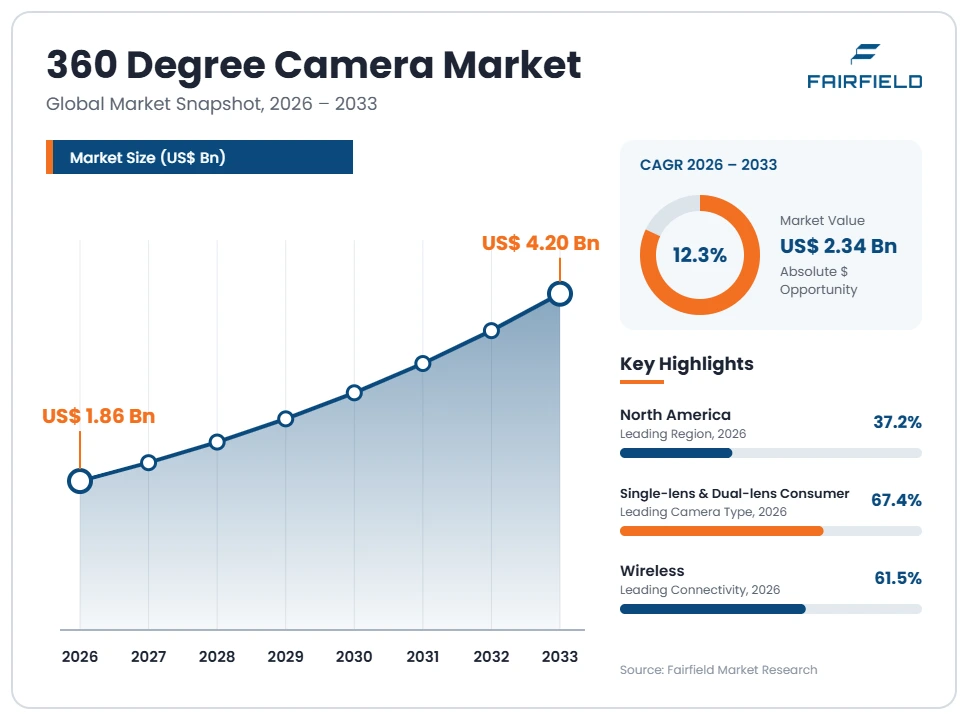
The global 360 degree camera market size is expected to be valued at US$ 1.86 billion in 2026 and projected to reach US$ 4.20 billion by 2033, growing at a CAGR of 12.3% between 2026 and 2033.
Between 2020 and 2025, the market grew at a CAGR of about 10.6%, as creators adopted pocket-sized 360 cameras with in-camera stitching and phone-based editing. Three factors now drive growth: short-form video on social platforms, demand for virtual tours in real estate and construction, and competition that is pushing image quality toward 8K resolution and 1-inch-class sensors. The market is shifting from niche virtual reality content toward mainstream action and vlogging use, supported by AI reframing that lets users choose the shot after recording.
Key Report Takeaways
- By Camera Type: Single-lens & Dual-lens Consumer held 67.4% share in 2026, while Professional Multi-lens is projected to expand at a 14.1% CAGR through 2033, driven by virtual production, live events, and high-resolution mapping.
- By Resolution: HD & 4K held 52.8% share in 2026, while 8K & Above is projected to expand at a 18.6% CAGR through 2033, driven by creators reframing 360 footage into sharp flat video.
- By Connectivity: Wireless held 61.5% share in 2026, while Wired is projected to expand at a 9.4% CAGR through 2033, driven by live streaming rigs and fixed security installations.
- By Application: Consumer & Personal held 54.2% share in 2026, while Real Estate & Construction is projected to expand at a 15.3% CAGR through 2033, driven by virtual tours and site progress documentation.
- By Region: North America held 37.2% share in 2026, while Asia Pacific is projected to expand at a 14.6% CAGR through 2033, driven by strong creator communities and manufacturing in China.
Global 360 Degree Camera Market Trends and Insights
Drivers Impact Analysis
Two drivers carry the strongest influence on 360 degree camera demand during the forecast period.
| Driver | Impact on CAGR Forecast | Geographic Relevance | Impact Timeline |
| Creator economy and short-form video | High | Global | Short term (≤2 years) |
| Virtual tours and digital twins in property and construction | Medium | North America, Europe | Medium term (2–4 years) |
Short-Form Video and the Creator Economy Are Driving 360 Degree Camera Sales
The creator economy and short-form video are the strongest drivers of 360 degree camera sales. Vloggers, athletes, and travelers use 360 cameras to capture everything around them, then reframe the footage into dramatic flat videos for social platforms.
The mechanism is the shift from capturing a shot to choosing it later. A 360 camera records the full scene, and AI software tracks subjects, removes the selfie stick, and creates smooth camera moves on a phone. This makes it easy to produce eye-catching clips without filming skills. Insta360, which held about 67.2% of global consumer-grade panoramic camera sales by volume in 2023, grew revenue from about RMB 3.6 billion in 2023 to about RMB 5.6 billion in 2024. Its ONE X series of consumer 360 cameras generated about half of revenue, showing strong consumer demand.
Virtual Tours and Digital Twins Expand Professional 360 Degree Camera Use
Virtual tours and digital twins are expanding professional use of 360 degree cameras in real estate, construction, and facility management. Buyers and renters increasingly expect immersive online tours before visiting a property in person.
The cause is digital transformation in property and building industries. Real estate agents use 360 cameras to create virtual tours that reduce wasted viewings and widen the pool of remote buyers. Construction firms use 360 photos for site progress documentation, allowing managers to check work and resolve disputes without traveling. Platforms that create digital twins of buildings rely on 360 imagery to map spaces quickly. Insurance companies and facility managers use the same images for inspections and asset records. These uses favor cameras with high resolution, consistent exposure, and cloud integration, supporting professional and prosumer models.
Restraints Impact Analysis
Two restraints limit how quickly 360 degree cameras spread to mainstream users.
| Restraint | Impact on CAGR Forecast | Geographic Relevance | Impact Timeline |
| Competition from smartphones and action cameras | Medium | Global | Short term (≤2 years) |
| Workflow complexity, data size, and privacy concerns | Medium | Europe, North America | Medium term (2–4 years) |
Smartphone and Action Camera Competition Limits 360 Degree Camera Demand
Competition from smartphones and traditional action cameras limits 360 degree camera demand among casual users. Many consumers feel their phone cameras are good enough for daily video, and they may not see the need for a separate device.
The underlying cause is rapid improvement in phone cameras. Modern smartphones offer ultra-wide lenses, strong stabilization, and AI editing features that cover many everyday needs. Traditional action cameras offer rugged designs and simple point-and-shoot recording that suits sports users who do not want to reframe footage. 360 cameras also have smaller individual sensor areas per lens than many flagship phones, which can limit low-light quality. Price matters, since premium 360 cameras cost several hundred dollars. These factors keep 360 cameras focused on enthusiasts, creators, and professionals rather than the mass consumer market.
Large Files, Editing Complexity, and Privacy Concerns Slow 360 Degree Camera Adoption
Large file sizes, editing complexity, and privacy concerns slow 360 degree camera adoption. Recording the full sphere at high resolution produces very large files that consume storage, battery, and processing power.
The specific causes are data volume and regulation. 8K 360 video can fill memory cards and phone storage quickly, and stitching or exporting can take a long time on older devices. New users may find reframing, keyframing, and file transfer confusing. Because 360 cameras capture everyone in view, they raise privacy questions in public places and workplaces. Rules such as the European Union’s General Data Protection Regulation require care when recording identifiable people. Businesses must manage consent, face blurring, and data storage for virtual tours and site records. These issues add friction that software and AI tools are only partly solving.
Market Opportunities
Automotive and Robotics Vision Opens a New Revenue Pool for 360 Degree Cameras
Automotive surround-view and robotics vision create a large new revenue pool for 360 degree imaging. Vehicles, delivery robots, and drones need full awareness of their surroundings for parking, safety, and navigation.
Camera makers with wide-angle optics and image processing expertise can capture this demand. Carmakers are adding 360-degree surround-view systems to mid-range models in India, China, and other growth markets. In July 2025, Pioneer India introduced an automotive 360-degree surround-view camera system, and in June 2026, Tata Motors launched a facelifted Tiago hatchback with a 360-degree camera. Robot makers and drone builders also need compact panoramic sensing. Automakers, tier-one suppliers, and robotics developers are the main customers. These markets demand reliable, automotive-grade hardware, which offers long product cycles and stable volumes.
Live Events, Virtual Production, and Immersive Media Create a Professional Revenue Pool
Live events, virtual production, and immersive media create a premium revenue pool for professional 360 degree cameras. Sports leagues, concert organizers, and broadcasters are testing immersive views that let fans choose their own angle at home or in headsets.
Professional camera makers and immersive media platforms can capture this demand. Multi-lens 360 rigs record very high-resolution video for virtual reality headsets, dome theaters, and mixed reality experiences. Virtual production studios use 360 images to capture real locations for LED wall backgrounds. The launch of new mixed reality headsets has renewed interest in building immersive content libraries. Broadcasters, event organizers, film studios, museums, and tourism boards are the main customers. Professional systems typically sell at much higher prices than consumer cameras and often include software, services, and streaming support.
Segment Analysis
- By Camera Type: Consumer Cameras Lead While Professional Multi-lens Grows Fastest
Single-lens & Dual-lens Consumer held 67.4% share in 2026. Compact dual-lens cameras such as Insta360’s X series, DJI’s Osmo 360, and GoPro’s MAX line dominate sales to creators, travelers, and sports users. They combine easy capture with phone-based editing at affordable prices.
Professional Multi-lens is the fastest-growing camera type, expanding at a 14.1% CAGR through 2033. Professional rigs with several lenses capture very high-resolution 360 video for virtual reality, immersive events, and mapping. They support live streaming and higher dynamic range. Virtual production and digital twin projects use these systems to capture detailed environments. For the broader market, professional growth adds higher-value units and service revenue, which helps offset price competition in consumer cameras.
- By Resolution: HD & 4K Leads While 8K & Above Grows Fastest
HD & 4K held 52.8% share in 2026. Many entry-level and older 360 cameras record at these resolutions, which are adequate for virtual tours, security, and casual social sharing. They also produce smaller files and keep device costs lower.
8K & Above is the fastest-growing resolution, expanding at an 18.6% CAGR through 2033. Because 360 video spreads pixels across the whole sphere, higher resolution is needed for sharp reframed clips. Flagship models such as Insta360’s X series and DJI’s Osmo 360 offer 8K recording. Professional rigs go even higher. Better processors and larger sensors make high-resolution recording practical. For the market, the move to 8K raises average selling prices and encourages upgrades from users of older models.
- By Connectivity: Wireless Leads While Wired Grows Fastest
Wireless held 61.5% share in 2026. Most consumer 360 cameras connect to phones through Wi-Fi and Bluetooth for live previewing, transferring files, and editing in companion apps. Wireless convenience is central to the creator experience and cloud uploads.
Wired is the fastest-growing connectivity type, expanding at a 9.4% CAGR through 2033. Fixed 360 cameras for security, conferencing, and live event streaming often use wired connections for stable power and data. Professional rigs use wired links to send high-bitrate video to production systems. Enterprise and broadcast users value reliability, continuous power, and lower latency. For the market, wired growth reflects rising professional and commercial installations, while consumer devices continue to rely on wireless links and mobile apps.
- By Application: Consumer & Personal Leads While Real Estate & Construction Grows Fastest
Consumer & Personal held 54.2% share in 2026. Vlogging, travel, action sports, and family recording remain the largest uses. Social platforms reward dynamic footage, and AI editing makes 360 video accessible to everyday users without editing skills.
Real Estate & Construction is the fastest-growing application, expanding at a 15.3% CAGR through 2033. Agents create virtual tours, and builders use 360 photos for site progress documentation and digital twins. Cloud platforms link 360 images to floor plans, building models, and project schedules. Media and entertainment, security and surveillance, automotive, and tourism also use 360 cameras. For the market, real estate and construction growth adds steady business demand that is less seasonal than consumer sales and supports subscription software revenue.
Geography Analysis
- Which Region Is Leading the 360 Degree Camera Market?
North America is leading the 360 degree camera market with a 37.2% share in 2026. The United States has a large creator economy, strong spending on action sports, and early adoption of virtual tours in real estate. The U.S. 360 degree camera market was about US$ 610 million in 2025. GoPro, headquartered in California, has a strong brand, while Insta360 is expanding its marketing and retail presence in the region. Construction technology firms use 360 imaging widely. Canada adds demand from outdoor sports and real estate. One change shaping the region is AI-driven editing that turns raw 360 footage into ready-to-post clips.
- Europe Adopts 360 Degree Cameras for Tourism and Industry
Europe is a mature market where travel, tourism, and industrial uses drive demand. The United Kingdom, Germany, France, Italy, and Spain all have large consumer markets and active creator communities. Tourism boards and museums use 360 content to promote destinations and collections. Construction and engineering firms use 360 imaging for documentation, inspections, and building handover records. General Data Protection Regulation rules require careful handling of images that show people, which adds compliance work for businesses. One opportunity is virtual tours for heritage sites and hotels, which can attract international visitors and support bookings across the region.
- Which Region Is Growing Fastest in the 360 Degree Camera Market?
Asia Pacific is growing fastest in the 360 degree camera market at a 14.6% CAGR through 2033. China is home to leading makers Insta360 and DJI, which design and manufacture 360 cameras for global markets. Insta360 listed on Shanghai’s STAR Market in June 2025. Large creator communities in China, Japan, South Korea, and Southeast Asia drive strong consumer demand. Japan hosts Ricoh, maker of the Theta series. Automotive surround-view systems are growing quickly in India and China as carmakers add safety features. One opportunity is affordable models for fast-growing creator markets.
- Latin America Grows Creator and Tourism Demand in the 360 Degree Camera Market
Latin America is an emerging region where creators, tourism, and real estate drive demand. Brazil and Mexico have large social media audiences and active travel and sports creators. Real estate agents in major cities such as São Paulo and Mexico City are starting to use virtual tours. Chile, Argentina, and Colombia use 360 content to promote tourism and outdoor adventures. Key barriers include high import prices, currency volatility, and limited retail availability for premium cameras. Many buyers purchase through online marketplaces rather than specialist stores. One opportunity is lower-priced models and financing options that make 360 cameras accessible to regional creators.
- Middle East & Africa Uses 360 Degree Cameras for Tourism and Construction
Middle East & Africa is a developing region where tourism and construction projects support demand. Saudi Arabia and the United Arab Emirates use 360 cameras to document giga-projects, market real estate, and promote tourism. Events, hotels, and the wider hospitality sector also use immersive content to attract international visitors. In Africa, operators in South Africa, Kenya, and Nigeria use 360 imagery for safari tourism, media, and real estate. Key barriers include price sensitivity, limited retail presence, and low consumer awareness of 360 formats. One opportunity is construction documentation for large Gulf projects that need visual progress records.
Competitive Landscape
The 360 degree camera market is highly concentrated in consumer devices. Insta360 leads, with about 67.2% of global consumer-grade panoramic camera sales and about 61.4% of professional-grade panoramic camera sales in 2023. GoPro, DJI, Ricoh, and Samsung Electronics are other well-known brands. Kandao and other specialists serve professional and virtual reality markets with multi-lens rigs. Automotive surround-view systems involve suppliers such as Denso, Sony, and Pioneer.
Companies compete mainly on image quality, sensor size, resolution, stabilization, AI editing, battery life, durability, and price. Mobile apps and software ecosystems are key differentiators, because they determine how easily users create shareable content and how often they return to the brand.
Strategic moves show how competition is changing. Insta360 listed on the STAR Market in June 2025 and plans to invest in manufacturing and research facilities in Shenzhen. DJI launched its first consumer 360 camera, the Osmo 360, on 31 July 2025, with a 1-inch-class square sensor and 8K recording, directly challenging Insta360’s X5. GoPro continues to update its MAX line for existing users. Together, these moves show rising competition that is pushing faster product cycles, lower prices, and higher image quality.
Three themes shape vendor strategy. First, companies are steadily improving sensors and resolution to raise image quality. Second, they are investing heavily in AI editing software and mobile apps. Third, they are steadily expanding into professional, enterprise, and automotive uses to diversify beyond consumer sales.
Recent Industry Developments
- June 2026: Tata Motors launched a facelifted Tiago with a 360-degree camera – shows surround-view cameras moving into affordable cars.
- July 2025: DJI launched the Osmo 360 consumer 360 camera – intensifies competition in the premium consumer segment.
- July 2025: Pioneer India introduced an automotive 360-degree surround-view camera system – targets aftermarket and vehicle safety demand.
- June 2025: Insta360 listed on Shanghai’s STAR Market – funds manufacturing and research expansion.
Companies Covered in the Report
- Insta360 (Arashi Vision)
- GoPro
- DJI
- Ricoh
- Samsung Electronics
- Kandao
- Xiaomi
- Nikon
- LG Electronics
- Immervision
- Panono (Professional 360)
- YI Technology
360 Degree Camera Market Report Scope
| Metric | Value |
| Study Period | 2020–2033 |
| Market Size 2026 | US$ 1.86 Billion |
| Market Size 2033 | US$ 4.20 Billion |
| CAGR 2026–2033 | 12.3% |
| Absolute Dollar Opportunity | US$ 2.34 Billion |
| Largest Market | North America |
| Fastest-Growing Market | Asia Pacific |
| Market Concentration | High |
| Major Players | Insta360 (Arashi Vision), GoPro, DJI, Ricoh, Samsung Electronics |
360 Degree Camera Market Segmentation
Camera Type
- Single-lens & Dual-lens Consumer
- Professional Multi-lens
- Fixed & Surround-view
Resolution
- HD & 4K
- 5.7K & 6K
- 8K & Above
Connectivity
- Wireless
- Wired
Application
- Consumer & Personal
- Media & Entertainment
- Real Estate & Construction
- Security & Surveillance
- Automotive
- Travel & Tourism
Regions
- North America
- Europe
- Asia Pacific
- Latin America
- Middle East & Africa
- Executive Summary
- Global 360 Degree Camera Market Snapshot
- Future Projections
- Key Report Takeaways
- Regional Snapshot
- Market Overview
- Market Definition and Report Scope
- Historical Trends 2020–2025
- Market Dynamics
- Drivers
- Short-Form Video and the Creator Economy Are Driving 360 Degree Camera Sales
- Virtual Tours and Digital Twins Expand Professional 360 Degree Camera Use
- Restraints
- Smartphone and Action Camera Competition Limits 360 Degree Camera Demand
- Large Files, Editing Complexity, and Privacy Concerns Slow 360 Degree Camera Adoption
- Market Opportunities
- Automotive and Robotics Vision Opens a New Revenue Pool for 360 Degree Cameras
- Live Events, Virtual Production, and Immersive Media Create a Professional Revenue Pool
- Drivers
- Global 360 Degree Camera Market Outlook, 2020–2033
- Global 360 Degree Camera Market Outlook, by Camera Type, Value (US$ Billion), 2020–2033
- Single-lens & Dual-lens Consumer
- Professional Multi-lens
- Fixed & Surround-view
- Global 360 Degree Camera Market Outlook, by Resolution, Value (US$ Billion), 2020–2033
- HD & 4K
- 5.7K & 6K
- 8K & Above
- Global 360 Degree Camera Market Outlook, by Connectivity, Value (US$ Billion), 2020–2033
- Wireless
- Wired
- Global 360 Degree Camera Market Outlook, by Application, Value (US$ Billion), 2020–2033
- Consumer & Personal
- Media & Entertainment
- Real Estate & Construction
- Security & Surveillance
- Automotive
- Travel & Tourism
- Global 360 Degree Camera Market Outlook, by Region, Value (US$ Billion), 2020–2033
- North America
- Europe
- Asia Pacific
- Latin America
- Middle East & Africa
- Global 360 Degree Camera Market Outlook, by Camera Type, Value (US$ Billion), 2020–2033
- North America 360 Degree Camera Market Outlook, 2020–2033
- North America 360 Degree Camera Market Outlook, by Camera Type, Value (US$ Billion), 2020–2033
- Single-lens & Dual-lens Consumer
- Professional Multi-lens
- Fixed & Surround-view
- North America 360 Degree Camera Market Outlook, by Resolution, Value (US$ Billion), 2020–2033
- HD & 4K
- 5.7K & 6K
- 8K & Above
- North America 360 Degree Camera Market Outlook, by Connectivity, Value (US$ Billion), 2020–2033
- Wireless
- Wired
- North America 360 Degree Camera Market Outlook, by Application, Value (US$ Billion), 2020–2033
- Consumer & Personal
- Media & Entertainment
- Real Estate & Construction
- Security & Surveillance
- Automotive
- Travel & Tourism
- North America 360 Degree Camera Market Outlook, by Country, Value (US$ Billion), 2020–2033
- United States 360 Degree Camera Market Outlook, by Camera Type, 2020–2033
- United States 360 Degree Camera Market Outlook, by Resolution, 2020–2033
- United States 360 Degree Camera Market Outlook, by Connectivity, 2020–2033
- United States 360 Degree Camera Market Outlook, by Application, 2020–2033
- Canada 360 Degree Camera Market Outlook, by Camera Type, 2020–2033
- Canada 360 Degree Camera Market Outlook, by Resolution, 2020–2033
- Canada 360 Degree Camera Market Outlook, by Connectivity, 2020–2033
- Canada 360 Degree Camera Market Outlook, by Application, 2020–2033
- North America 360 Degree Camera Market Outlook, by Camera Type, Value (US$ Billion), 2020–2033
- Europe 360 Degree Camera Market Outlook, 2020–2033
- Europe 360 Degree Camera Market Outlook, by Camera Type, Value (US$ Billion), 2020–2033
- Single-lens & Dual-lens Consumer
- Professional Multi-lens
- Fixed & Surround-view
- Europe 360 Degree Camera Market Outlook, by Resolution, Value (US$ Billion), 2020–2033
- HD & 4K
- 5.7K & 6K
- 8K & Above
- Europe 360 Degree Camera Market Outlook, by Connectivity, Value (US$ Billion), 2020–2033
- Wireless
- Wired
- Europe 360 Degree Camera Market Outlook, by Application, Value (US$ Billion), 2020–2033
- Consumer & Personal
- Media & Entertainment
- Real Estate & Construction
- Security & Surveillance
- Automotive
- Travel & Tourism
- Europe 360 Degree Camera Market Outlook, by Country, Value (US$ Billion), 2020–2033
- United Kingdom 360 Degree Camera Market Outlook, by Camera Type, 2020–2033
- United Kingdom 360 Degree Camera Market Outlook, by Resolution, 2020–2033
- United Kingdom 360 Degree Camera Market Outlook, by Connectivity, 2020–2033
- United Kingdom 360 Degree Camera Market Outlook, by Application, 2020–2033
- Germany 360 Degree Camera Market Outlook, by Camera Type, 2020–2033
- Germany 360 Degree Camera Market Outlook, by Resolution, 2020–2033
- Germany 360 Degree Camera Market Outlook, by Connectivity, 2020–2033
- Germany 360 Degree Camera Market Outlook, by Application, 2020–2033
- France 360 Degree Camera Market Outlook, by Camera Type, 2020–2033
- France 360 Degree Camera Market Outlook, by Resolution, 2020–2033
- France 360 Degree Camera Market Outlook, by Connectivity, 2020–2033
- France 360 Degree Camera Market Outlook, by Application, 2020–2033
- Italy 360 Degree Camera Market Outlook, by Camera Type, 2020–2033
- Italy 360 Degree Camera Market Outlook, by Resolution, 2020–2033
- Italy 360 Degree Camera Market Outlook, by Connectivity, 2020–2033
- Italy 360 Degree Camera Market Outlook, by Application, 2020–2033
- Spain 360 Degree Camera Market Outlook, by Camera Type, 2020–2033
- Spain 360 Degree Camera Market Outlook, by Resolution, 2020–2033
- Spain 360 Degree Camera Market Outlook, by Connectivity, 2020–2033
- Spain 360 Degree Camera Market Outlook, by Application, 2020–2033
- Europe 360 Degree Camera Market Outlook, by Camera Type, Value (US$ Billion), 2020–2033
- Asia Pacific 360 Degree Camera Market Outlook, 2020–2033
- Asia Pacific 360 Degree Camera Market Outlook, by Camera Type, Value (US$ Billion), 2020–2033
- Single-lens & Dual-lens Consumer
- Professional Multi-lens
- Fixed & Surround-view
- Asia Pacific 360 Degree Camera Market Outlook, by Resolution, Value (US$ Billion), 2020–2033
- HD & 4K
- 5.7K & 6K
- 8K & Above
- Asia Pacific 360 Degree Camera Market Outlook, by Connectivity, Value (US$ Billion), 2020–2033
- Wireless
- Wired
- Asia Pacific 360 Degree Camera Market Outlook, by Application, Value (US$ Billion), 2020–2033
- Consumer & Personal
- Media & Entertainment
- Real Estate & Construction
- Security & Surveillance
- Automotive
- Travel & Tourism
- Asia Pacific 360 Degree Camera Market Outlook, by Country, Value (US$ Billion), 2020–2033
- China 360 Degree Camera Market Outlook, by Camera Type, 2020–2033
- China 360 Degree Camera Market Outlook, by Resolution, 2020–2033
- China 360 Degree Camera Market Outlook, by Connectivity, 2020–2033
- China 360 Degree Camera Market Outlook, by Application, 2020–2033
- Japan 360 Degree Camera Market Outlook, by Camera Type, 2020–2033
- Japan 360 Degree Camera Market Outlook, by Resolution, 2020–2033
- Japan 360 Degree Camera Market Outlook, by Connectivity, 2020–2033
- Japan 360 Degree Camera Market Outlook, by Application, 2020–2033
- South Korea 360 Degree Camera Market Outlook, by Camera Type, 2020–2033
- South Korea 360 Degree Camera Market Outlook, by Resolution, 2020–2033
- South Korea 360 Degree Camera Market Outlook, by Connectivity, 2020–2033
- South Korea 360 Degree Camera Market Outlook, by Application, 2020–2033
- India 360 Degree Camera Market Outlook, by Camera Type, 2020–2033
- India 360 Degree Camera Market Outlook, by Resolution, 2020–2033
- India 360 Degree Camera Market Outlook, by Connectivity, 2020–2033
- India 360 Degree Camera Market Outlook, by Application, 2020–2033
- Asia Pacific 360 Degree Camera Market Outlook, by Camera Type, Value (US$ Billion), 2020–2033
- Latin America 360 Degree Camera Market Outlook, 2020–2033
- Latin America 360 Degree Camera Market Outlook, by Camera Type, Value (US$ Billion), 2020–2033
- Single-lens & Dual-lens Consumer
- Professional Multi-lens
- Fixed & Surround-view
- Latin America 360 Degree Camera Market Outlook, by Resolution, Value (US$ Billion), 2020–2033
- HD & 4K
- 5.7K & 6K
- 8K & Above
- Latin America 360 Degree Camera Market Outlook, by Connectivity, Value (US$ Billion), 2020–2033
- Wireless
- Wired
- Latin America 360 Degree Camera Market Outlook, by Application, Value (US$ Billion), 2020–2033
- Consumer & Personal
- Media & Entertainment
- Real Estate & Construction
- Security & Surveillance
- Automotive
- Travel & Tourism
- Latin America 360 Degree Camera Market Outlook, by Country, Value (US$ Billion), 2020–2033
- Brazil 360 Degree Camera Market Outlook, by Camera Type, 2020–2033
- Brazil 360 Degree Camera Market Outlook, by Resolution, 2020–2033
- Brazil 360 Degree Camera Market Outlook, by Connectivity, 2020–2033
- Brazil 360 Degree Camera Market Outlook, by Application, 2020–2033
- Mexico 360 Degree Camera Market Outlook, by Camera Type, 2020–2033
- Mexico 360 Degree Camera Market Outlook, by Resolution, 2020–2033
- Mexico 360 Degree Camera Market Outlook, by Connectivity, 2020–2033
- Mexico 360 Degree Camera Market Outlook, by Application, 2020–2033
- Chile 360 Degree Camera Market Outlook, by Camera Type, 2020–2033
- Chile 360 Degree Camera Market Outlook, by Resolution, 2020–2033
- Chile 360 Degree Camera Market Outlook, by Connectivity, 2020–2033
- Chile 360 Degree Camera Market Outlook, by Application, 2020–2033
- Argentina 360 Degree Camera Market Outlook, by Camera Type, 2020–2033
- Argentina 360 Degree Camera Market Outlook, by Resolution, 2020–2033
- Argentina 360 Degree Camera Market Outlook, by Connectivity, 2020–2033
- Argentina 360 Degree Camera Market Outlook, by Application, 2020–2033
- Colombia 360 Degree Camera Market Outlook, by Camera Type, 2020–2033
- Colombia 360 Degree Camera Market Outlook, by Resolution, 2020–2033
- Colombia 360 Degree Camera Market Outlook, by Connectivity, 2020–2033
- Colombia 360 Degree Camera Market Outlook, by Application, 2020–2033
- Latin America 360 Degree Camera Market Outlook, by Camera Type, Value (US$ Billion), 2020–2033
- Middle East & Africa 360 Degree Camera Market Outlook, 2020–2033
- Middle East & Africa 360 Degree Camera Market Outlook, by Camera Type, Value (US$ Billion), 2020–2033
- Single-lens & Dual-lens Consumer
- Professional Multi-lens
- Fixed & Surround-view
- Middle East & Africa 360 Degree Camera Market Outlook, by Resolution, Value (US$ Billion), 2020–2033
- HD & 4K
- 5.7K & 6K
- 8K & Above
- Middle East & Africa 360 Degree Camera Market Outlook, by Connectivity, Value (US$ Billion), 2020–2033
- Wireless
- Wired
- Middle East & Africa 360 Degree Camera Market Outlook, by Application, Value (US$ Billion), 2020–2033
- Consumer & Personal
- Media & Entertainment
- Real Estate & Construction
- Security & Surveillance
- Automotive
- Travel & Tourism
- Middle East & Africa 360 Degree Camera Market Outlook, by Country, Value (US$ Billion), 2020–2033
- Saudi Arabia 360 Degree Camera Market Outlook, by Camera Type, 2020–2033
- Saudi Arabia 360 Degree Camera Market Outlook, by Resolution, 2020–2033
- Saudi Arabia 360 Degree Camera Market Outlook, by Connectivity, 2020–2033
- Saudi Arabia 360 Degree Camera Market Outlook, by Application, 2020–2033
- United Arab Emirates 360 Degree Camera Market Outlook, by Camera Type, 2020–2033
- United Arab Emirates 360 Degree Camera Market Outlook, by Resolution, 2020–2033
- United Arab Emirates 360 Degree Camera Market Outlook, by Connectivity, 2020–2033
- United Arab Emirates 360 Degree Camera Market Outlook, by Application, 2020–2033
- South Africa 360 Degree Camera Market Outlook, by Camera Type, 2020–2033
- South Africa 360 Degree Camera Market Outlook, by Resolution, 2020–2033
- South Africa 360 Degree Camera Market Outlook, by Connectivity, 2020–2033
- South Africa 360 Degree Camera Market Outlook, by Application, 2020–2033
- Kenya 360 Degree Camera Market Outlook, by Camera Type, 2020–2033
- Kenya 360 Degree Camera Market Outlook, by Resolution, 2020–2033
- Kenya 360 Degree Camera Market Outlook, by Connectivity, 2020–2033
- Kenya 360 Degree Camera Market Outlook, by Application, 2020–2033
- Nigeria 360 Degree Camera Market Outlook, by Camera Type, 2020–2033
- Nigeria 360 Degree Camera Market Outlook, by Resolution, 2020–2033
- Nigeria 360 Degree Camera Market Outlook, by Connectivity, 2020–2033
- Nigeria 360 Degree Camera Market Outlook, by Application, 2020–2033
- Middle East & Africa 360 Degree Camera Market Outlook, by Camera Type, Value (US$ Billion), 2020–2033
- Competitive Landscape
- Market Concentration and Industry Leaders
- Competitive Differentiation
- Strategic Moves and Market Direction
- Recent Industry Developments
- Company Profiles
- Insta360 (Arashi Vision)
- GoPro
- DJI
- Ricoh
- Samsung Electronics
- Kandao
- Xiaomi
- Nikon
- LG Electronics
- Immervision
- Panono (Professional 360)
- YI Technology
- Appendix
- Research Methodology
- Report Assumptions
- Acronyms and Abbreviations
Camera Type
- Single-lens & Dual-lens Consumer
- Professional Multi-lens
- Fixed & Surround-view
Resolution
- HD & 4K
- 5.7K & 6K
- 8K & Above
Connectivity
- Wireless
- Wired
Application
- Consumer & Personal
- Media & Entertainment
- Real Estate & Construction
- Security & Surveillance
- Automotive
- Travel & Tourism
Regions
- North America
- Europe
- Asia Pacific
- Latin America
- Middle East & Africa
Our Research Methodology
Considering the volatility of business today, traditional approaches to strategizing a game plan can be unfruitful if not detrimental. True ambiguity is no way to determine a forecast. A myriad of predetermined factors must be accounted for such as the degree of risk involved, the magnitude of circumstances, as well as conditions or consequences that are not known or unpredictable. To circumvent binary views that cast uncertainty, the application of market research intelligence to strategically posture, move, and enable actionable outcomes is necessary.
View Methodology
Quality Assured
Rigorous Validation Process

Confidentiality Assured
End-to-end Data Security

Custom Research Services
Tailored To Your Objectives
FAQs
The 360 degree camera market is valued at US$ 1.86 billion in 2026, led by consumer dual-lens cameras used by creators.
The market is projected to reach US$ 4.20 billion by 2033, growing at a 12.3% CAGR and adding US$ 2.34 billion.
Real Estate & Construction is growing fastest at a 15.3% CAGR through 2033, driven by virtual tours and site documentation.
Asia Pacific is growing fastest at a 14.6% CAGR through 2033, driven by creator communities and manufacturing in China.
North America holds the largest share at 37.2% in 2026, supported by a large creator economy and virtual tour adoption.
Related Reports
3D Camera Market Size, Share, Insights, Competitive Landscape, and Forecast 2026 to 2033
The global 3D camera market is valued at US$1.86 billion in 2026, reaching US$5.58 billion by 2033, growing at a 17.0% CAGR
2D Material Transistor Market Size, Share, Insights, Competitive Landscape, and Forecast 2026 to 2033
The global 2D material transistor market is valued at US$0.2 billion in 2026, reaching US$0.9 billion by 2033, growing at a 24.0% CAGR
2D Barcode Reader Market Size, Share, Insights, Competitive Landscape, and Forecast 2026 to 2033
The global 2D barcode reader market is valued at US$4.8 billion in 2026, reaching US$8.6 billion by 2033, growing at an 8.7% CAGR
Tunnel Construction Market Size, Share, Insights, Competitive Landscape, and Forecast 2026 to 2033
The global tunnel construction market is valued at US$29.52 billion in 2026, reaching US$47.09 billion by 2033, growing at a 6.9% CAGR
Sports Analytics Market Size, Share, Insights, Competitive Landscape, and Forecast 2026 to 2033
The global sports analytics market is valued at US$7.06 billion in 2026, reaching US$23.15 billion by 2033, growing at an 18.5% CAGR
Distributed Acoustic Sensing Market Size, Share, Insights, Competitive Landscape, and Forecast 2026 to 2033
The global distributed acoustic sensing market is valued at US$0.565 billion in 2026, reaching US$1.173 billion by 2033, growing at an 11.0% CAGR