



3D Camera Market
3D Camera Market Size, Share, Insights, Competitive Landscape, and Forecast 2026 to 2033
3D Camera Market Size and Trend Analysis
How Fast Is the 3D Camera Market Growing?
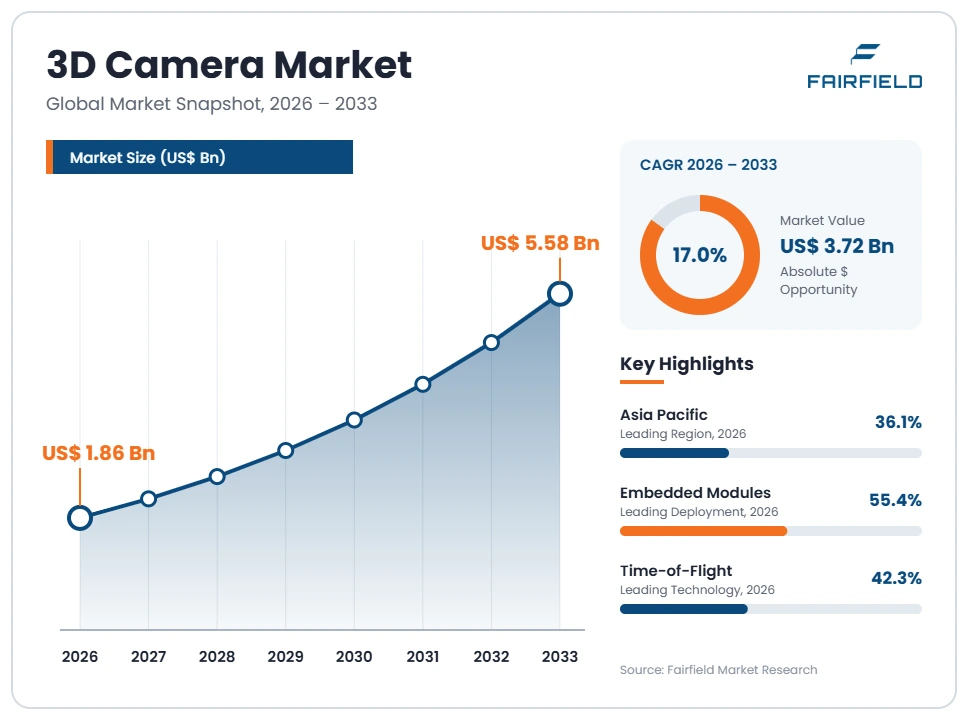
The global 3D camera market size is expected to be valued at US$ 1.86 billion in 2026 and projected to reach US$ 5.58 billion by 2033, growing at a CAGR of 17.0% between 2026 and 2033.
Between 2020 and 2025, the market grew at a CAGR of about 14.2%, as warehouses, factories, and consumer devices adopted depth sensing for automation, face recognition, and augmented reality. Three factors now drive faster growth: the rapid rise of autonomous mobile robots and humanoid robots, wider use of in-cabin and surround sensing in vehicles, and AI processing built directly into cameras. The market is shifting from simple depth capture toward smart 3D vision modules that combine time-of-flight, stereo, and RGB data with on-device AI for real-time perception.
Key Report Takeaways
- By Technology: Time-of-Flight held 42.3% share in 2026, while Stereo Vision is projected to expand at a 19.4% CAGR through 2033, driven by AI depth processing that makes passive stereo reliable for outdoor robots.
- By Type: Target Camera held 58.6% share in 2026, while Target-free Camera is projected to expand at an 18.7% CAGR through 2033, driven by markerless scanning in logistics and construction.
- By Deployment: Embedded Modules held 55.4% share in 2026, while Standalone Industrial Cameras are projected to expand at an 18.2% CAGR through 2033, driven by bin picking, inspection, and robot guidance.
- By End-user Industry: Consumer Electronics held 33.7% share in 2026, while Automotive is projected to expand at a 21.6% CAGR through 2033, driven by driver monitoring rules and autonomous driving sensors.
- By Region: Asia Pacific held 36.1% share in 2026, while India is projected to expand at a 21.3% CAGR through 2033, driven by factory automation, smartphone manufacturing, and warehouse robotics.
Global 3D Camera Market Trends and Insights
Drivers Impact Analysis
Two drivers carry the strongest influence on 3D camera demand during the forecast period.
| Driver | Impact on CAGR Forecast | Geographic Relevance | Impact Timeline |
| Robotics and warehouse automation | High | Global, strongest in Asia Pacific and North America | Medium term (2–4 years) |
| Automotive in-cabin and safety sensing | High | Europe, Asia Pacific, North America | Long term (≥4 years) |
Robotics and Warehouse Automation Are Driving 3D Camera Demand
Robotics and warehouse automation are the strongest drivers of 3D camera demand. Autonomous mobile robots, robot arms, and humanoid robots need depth perception to navigate, avoid obstacles, and grasp objects.
The evidence is rising investment in robot vision. In July 2025, Intel spun out its RealSense depth camera business as an independent company, which raised US$ 50 million in a Series A round with participation from Intel Capital and the MediaTek Innovation Fund, to focus on AI-powered robotics and biometrics. In June 2026, RealSense unveiled the D585 Pro depth camera at Automate 2026, targeting humanoids, autonomous mobile robots, and cobot arms. Orbbec partnered with Advantech in October 2024 on AI vision for mobile robot developers. Labor shortages and e-commerce growth keep warehouse automation spending high, supporting demand for robotic vision systems.
Automotive Safety Rules Are Expanding 3D Camera Use in Vehicles
Automotive safety rules and new driver assistance features are expanding 3D camera use in vehicles. Carmakers use depth cameras to monitor driver attention, detect occupants and child seats, and support gesture control.
The mechanism is regulation and safety ratings. The European Union’s General Safety Regulation requires advanced driver drowsiness and attention warning systems in new vehicles. Euro NCAP rewards driver monitoring and occupant detection in its safety ratings. Time-of-flight cameras measure head position and eye gaze accurately in changing light, day or night. Sony expects the number of automotive cameras per vehicle to rise from about eight in 2024 to about 12 by fiscal 2028. Autonomous driving systems also use 3D sensing for close-range detection. These trends create strong long-term demand for automotive-grade 3D cameras.
Restraints Impact Analysis
Two restraints limit how quickly 3D cameras reach more applications.
| Restraint | Impact on CAGR Forecast | Geographic Relevance | Impact Timeline |
| Performance limits in sunlight and on difficult surfaces | Medium | Global | Medium term (2–4 years) |
| Cost, integration complexity, and privacy concerns | Medium | Europe, North America | Short term (≤2 years) |
Sunlight and Surface Limits Constrain 3D Camera Performance
Performance limits in bright sunlight and on difficult surfaces constrain 3D camera use. Many depth cameras rely on projected infrared light, which can be overwhelmed by direct sunlight outdoors and in bright factories.
The underlying causes are physics and materials. Time-of-flight and structured light cameras measure reflected infrared light, so strong ambient light adds noise. Shiny, transparent, or very dark objects reflect light poorly or unpredictably, causing missing or wrong depth data. Stereo vision struggles with surfaces that lack texture. Multi-path interference can distort measurements in corners and cluttered scenes. These limits create errors in robot picking, outdoor navigation, and inspection, which reduce system reliability and customer confidence. Manufacturers are adding better filters, higher-power illuminators, and AI processing, but these improvements raise cost and power use.
Cost, Integration Complexity, and Privacy Concerns Slow 3D Camera Adoption
Cost, integration complexity, and privacy concerns slow 3D camera adoption, especially among smaller manufacturers and in public spaces. Integrating a depth camera into a robot or machine requires calibration, software development, and testing.
The specific causes are engineering effort and regulation. Industrial 3D cameras with high accuracy and rugged housings can cost thousands of dollars per unit. Developers need specialized expertise in point cloud processing and sensor fusion to use 3D data effectively. Synchronizing multiple cameras adds further complexity. In public and retail settings, 3D cameras that capture faces and body shapes raise privacy concerns under rules such as the European Union’s General Data Protection Regulation and the EU AI Act, which restricts some biometric uses. These factors lengthen sales cycles and limit use in small and medium businesses.
Market Opportunities
Humanoid Robots Open a High-Growth Revenue Pool for 3D Cameras
Humanoid robots create a new, high-growth revenue pool for 3D cameras. Each humanoid needs several depth cameras in its head, hands, and body to see its surroundings, recognize objects, and move safely around people.
Depth camera makers with compact, AI-enabled modules can capture this demand. RealSense designed its D585 Pro, unveiled in June 2026, with on-camera AI for person detection, visual-inertial odometry, and occupancy mapping, aiming directly at humanoids. Robot makers in the United States, China, and Europe are building pilot fleets for factories, warehouses, and retail. Orbbec supplies depth cameras to many Chinese service robot makers. Humanoid and service robot companies are the main customers. If humanoids scale into mass production, demand for multiple cameras per robot could become a major market.
Digital Twins and Reality Capture Create a Professional Revenue Pool for 3D Cameras
Digital twins and reality capture create a professional revenue pool for 3D cameras. Real estate, construction, and facilities management companies want accurate, up-to-date 3D models of buildings for marketing, planning, renovation, and maintenance.
Companies offering 3D capture cameras and cloud platforms can capture this demand. Matterport reported that its partnership with Resi in March 2024 cut survey times by about 25% and reduced hardware costs by about 85%. Construction firms use 3D scanning to compare built work with design models and catch errors early. Manufacturers create digital twins of factories to plan layouts, simulate automation, and train robots. Real estate agents, construction companies, insurers, retailers, and facility managers are the main customers. Subscription-based software linked to camera hardware creates recurring revenue and stronger customer retention for vendors.
Segment Analysis
- By Technology: Time-of-Flight Leads While Stereo Vision Grows Fastest
Time-of-Flight held 42.3% share in 2026. Time-of-flight cameras measure how long light takes to return from objects, producing fast and accurate depth maps. They are widely used in smartphones, driver monitoring systems, robot navigation, people counting, and gesture recognition.
Stereo Vision is the fastest-growing technology, expanding at a 19.4% CAGR through 2033. Stereo cameras use two lenses to calculate depth, much like human eyes, and they work well outdoors without depending on projected light. AI-based depth processing has improved stereo accuracy on low-texture surfaces. Robotics, autonomous vehicles, and drones increasingly use stereo cameras. Structured light remains important for high-precision scanning. For the broader market, stereo growth supports outdoor and long-range applications.
- By Type: Target Camera Leads While Target-free Camera Grows Fastest
Target Camera held 58.6% share in 2026. These systems use reference markers, patterns, or controlled setups to achieve high accuracy. They are common in industrial metrology, quality inspection, reverse engineering, and motion capture, where precision is critical.
Target-free Camera is the fastest-growing camera type, expanding at an 18.7% CAGR through 2033. These cameras capture 3D data without markers, which makes them easier to use in logistics, construction, retail, and robotics. AI processing and better image sensors have greatly improved their accuracy and speed. Workers can scan objects, parcels, and spaces quickly without preparing the scene or placing markers. For the market, target-free growth broadens adoption beyond specialist engineers to everyday operational users in many industries.
- By Deployment: Embedded Modules Lead While Standalone Industrial Cameras Grow Fastest
Embedded Modules held 55.4% share in 2026. Compact 3D sensing modules are built into smartphones, tablets, laptops, vehicles, and consumer robots. High production volumes, low unit costs, and integration with device processors keep embedded modules the largest segment.
Standalone Industrial Cameras are the fastest-growing deployment type, expanding at an 18.2% CAGR through 2033. Factories and warehouses use rugged 3D cameras for bin picking, palletizing, parcel dimensioning, and quality inspection. Companies such as Basler, Cognex, Photoneo, and Zivid supply these systems to integrators and end users. Photoneo introduced the MotionCam-3D Color in May 2025. For the market, industrial camera growth raises average selling prices and supports software, calibration, and integration revenue from system integrators.
- By End-user Industry: Consumer Electronics Leads While Automotive Grows Fastest
Consumer Electronics held 33.7% share in 2026. Smartphones, tablets, gaming devices, and extended reality headsets use 3D cameras for face unlock, portrait photography, room mapping, and augmented reality. High global shipment volumes make this the largest end-user industry, although unit prices are low.
Automotive is the fastest-growing end-user industry, expanding at a 21.6% CAGR through 2033. Driver monitoring, occupant detection, gesture control, and autonomous driving all use 3D sensing. Safety regulations in Europe and rating programs such as Euro NCAP support adoption. Industrial and robotics, healthcare, security and surveillance, and media and entertainment are also important end users. For the market, automotive growth brings long product cycles and high reliability requirements, which favor established sensor suppliers.
Geography Analysis
- North America Advances Robotics and Reality Capture in the 3D Camera Market
North America is a major market where robotics, warehouse automation, and reality capture drive demand. The United States has large e-commerce fulfillment networks, humanoid robot developers, and technology companies such as RealSense, Cognex, Apple, and Matterport. RealSense raised US$ 50 million after its spin-off from Intel in 2025. Automakers and suppliers use 3D cameras for driver monitoring. Construction and real estate firms widely use 3D capture for virtual tours and as-built documentation. Canada adds demand from robotics research, mining automation, and agriculture. One change shaping the region is the shift toward AI processing inside cameras, which reduces reliance on external computers.
- Europe Leads Automotive and Industrial 3D Camera Adoption
Europe is a key market for automotive and industrial 3D cameras. Germany is home to Basler, Infineon, and pmdtechnologies, three important companies which supply 3D sensors and time-of-flight chips. Slovakia’s Photoneo and Norway’s Zivid offer industrial 3D cameras. The General Safety Regulation and Euro NCAP support strong demand for in-cabin sensing in new vehicles. Strong automotive and machinery manufacturing sectors use 3D vision for inspection, measurement, and robot guidance. Privacy rules under the General Data Protection Regulation and EU AI Act affect biometric uses. One opportunity is 3D vision for automated factories facing skilled labor shortages.
- Which Region Is Leading the 3D Camera Market?
Asia Pacific is leading the 3D camera market with a 36.1% share in 2026. China has large electronics manufacturing, factory automation, and service robot industries, with suppliers such as Orbbec and Hikrobot. Japan is home to Sony, a major time-of-flight sensor maker, and strong industrial robotics firms such as Fanuc. South Korea has large smartphone and display industries led by Samsung and LG. Taiwan supplies optical components, chips, and contract manufacturing. High electronics production volumes support strong demand for embedded 3D modules. One opportunity is 3D cameras for the region’s growing humanoid and service robot makers.
- Which Country Is Growing Fastest in the 3D Camera Market?
India is growing fastest in the 3D camera market at a 21.3% CAGR through 2033. The country is rapidly expanding smartphone and electronics manufacturing under the Production Linked Incentive scheme, which increases demand for embedded 3D modules. Rapid e-commerce growth is driving investment in warehouse automation and robotic parcel sorting. Automakers are adding driver assistance features and surround sensing to mass-market models. Smart city, retail analytics, and security projects also use 3D vision. Limited local sensor manufacturing and integration expertise remain barriers. One opportunity is affordable 3D cameras for warehouse and factory automation among mid-sized companies.
- Latin America Grows Industrial and Retail 3D Camera Demand
Latin America is an emerging region in this market, where manufacturing, logistics, and retail drive 3D camera demand. Mexico has many large automotive and electronics factories that use 3D vision for inspection and robot guidance, supported by nearshoring investment. Brazil has fast-growing e-commerce warehouses and agribusiness automation projects. Chile and Peru use 3D scanning in mining for stockpile measurement and equipment monitoring. Key barriers include high import costs, currency volatility, and limited technical integration skills among local manufacturers. One opportunity is warehouse dimensioning and parcel sorting systems for fast-growing e-commerce operators in Brazil and Mexico.
- Middle East & Africa Adopts 3D Cameras for Smart Cities and Construction
Middle East & Africa is a developing region where smart city projects, construction, and security drive demand. Saudi Arabia and the United Arab Emirates increasingly use 3D cameras in giga-projects, airports, retail, and security systems. Reality capture also supports construction documentation, progress tracking, and digital twins for large developments. In Africa, South Africa uses 3D vision in mining, automotive assembly, and manufacturing. Key barriers include limited local technical expertise, high equipment costs, harsh outdoor conditions, and privacy concerns. One opportunity is digital twin projects for Gulf smart cities, which need large-scale 3D capture of buildings and infrastructure.
Competitive Landscape
The 3D camera market is moderately concentrated across sensors and finished cameras. Sony, Infineon, pmdtechnologies, ams-OSRAM, and STMicroelectronics supply key time-of-flight sensors and components. RealSense, Orbbec, Basler, Cognex, Photoneo, Zivid, and Hikrobot sell 3D cameras for robotics and industry. Apple, Samsung, and other device makers integrate 3D modules into phones and headsets, while Matterport and Insta360 serve reality capture.
Companies compete mainly on depth accuracy, range, frame rate, outdoor performance, size, power use, AI features, and price. Software development kits, open-source drivers, and integration support are important differentiators for robot builders. Automotive-grade quality, functional safety, and long-term supply commitments are required for vehicle uses.
Recent strategic moves show clearly how competition is changing. RealSense spun out of Intel in July 2025 with US$ 50 million in funding and launched the D585 Pro for humanoids in June 2026. Photoneo introduced the MotionCam-3D Color in May 2025. Orbbec partnered with Advantech in October 2024 on mobile robot vision. Cognex launched the In-Sight L38 3D vision system in April 2024. Together, these moves show competition shifting toward AI-native cameras for robotics and industrial automation.
Three themes shape vendor strategy. First, companies are embedding AI processing directly in cameras to reduce latency and host compute. Second, they are targeting humanoid robots, autonomous mobile robots, and cobots. Third, they are improving outdoor performance, ruggedness, and long-range accuracy for automotive and industrial use.
Recent Industry Developments
- June 2026: RealSense unveiled the D585 Pro AI-native depth camera at Automate 2026 – targets humanoids and autonomous mobile robots.
- July 2025: Intel spun out RealSense, which raised US$ 50 million – creates an independent depth camera company focused on robotics.
- May 2025: Photoneo introduced MotionCam-3D Color – adds color 3D capture for industrial robot guidance.
- October 2024: Orbbec partnered with Advantech on AI vision for mobile robots – eases 3D camera integration for robot developers.
Companies Covered in the Report
- Sony
- RealSense
- Orbbec
- Basler
- Cognex
- Infineon Technologies
- pmdtechnologies
- Photoneo
- Zivid
- Hikrobot
- Matterport
- ams-OSRAM
3D Camera Market Report Scope
| Metric | Value |
| Study Period | 2020–2033 |
| Market Size 2026 | US$ 1.86 Billion |
| Market Size 2033 | US$ 5.58 Billion |
| CAGR 2026–2033 | 17.0% |
| Absolute Dollar Opportunity | US$ 3.72 Billion |
| Largest Market | Asia Pacific |
| Fastest-Growing Market | India |
| Market Concentration | Medium |
| Major Players | Sony, RealSense, Orbbec, Basler, Cognex |
3D Camera Market Segmentation
Technology
- Time-of-Flight
- Stereo Vision
- Structured Light
Type
- Target Camera
- Target-free Camera
Deployment
- Embedded Modules
- Standalone Industrial Cameras
- Professional Capture Cameras
End-user Industry
- Consumer Electronics
- Automotive
- Industrial & Robotics
- Healthcare
- Security & Surveillance
- Media & Entertainment
Regions
- North America
- Europe
- Asia Pacific
- Latin America
- Middle East & Africa
- Executive Summary
- Global 3D Camera Market Snapshot
- Future Projections
- Key Report Takeaways
- Regional Snapshot
- Market Overview
- Market Definition and Report Scope
- Historical Trends 2020–2025
- Market Dynamics
- Drivers
- Robotics and Warehouse Automation Are Driving 3D Camera Demand
- Automotive Safety Rules Are Expanding 3D Camera Use in Vehicles
- Restraints
- Sunlight and Surface Limits Constrain 3D Camera Performance
- Cost, Integration Complexity, and Privacy Concerns Slow 3D Camera Adoption
- Market Opportunities
- Humanoid Robots Open a High-Growth Revenue Pool for 3D Cameras
- Digital Twins and Reality Capture Create a Professional Revenue Pool for 3D Cameras
- Drivers
- Global 3D Camera Market Outlook, 2020–2033
- Global 3D Camera Market Outlook, by Technology, Value (US$ Billion), 2020–2033
- Time-of-Flight
- Stereo Vision
- Structured Light
- Global 3D Camera Market Outlook, by Type, Value (US$ Billion), 2020–2033
- Target Camera
- Target-free Camera
- Global 3D Camera Market Outlook, by Deployment, Value (US$ Billion), 2020–2033
- Embedded Modules
- Standalone Industrial Cameras
- Professional Capture Cameras
- Global 3D Camera Market Outlook, by End-user Industry, Value (US$ Billion), 2020–2033
- Consumer Electronics
- Automotive
- Industrial & Robotics
- Healthcare
- Security & Surveillance
- Media & Entertainment
- Global 3D Camera Market Outlook, by Region, Value (US$ Billion), 2020–2033
- North America
- Europe
- Asia Pacific
- Latin America
- Middle East & Africa
- Global 3D Camera Market Outlook, by Technology, Value (US$ Billion), 2020–2033
- North America 3D Camera Market Outlook, 2020–2033
- North America 3D Camera Market Outlook, by Technology, Value (US$ Billion), 2020–2033
- Time-of-Flight
- Stereo Vision
- Structured Light
- North America 3D Camera Market Outlook, by Type, Value (US$ Billion), 2020–2033
- Target Camera
- Target-free Camera
- North America 3D Camera Market Outlook, by Deployment, Value (US$ Billion), 2020–2033
- Embedded Modules
- Standalone Industrial Cameras
- Professional Capture Cameras
- North America 3D Camera Market Outlook, by End-user Industry, Value (US$ Billion), 2020–2033
- Consumer Electronics
- Automotive
- Industrial & Robotics
- Healthcare
- Security & Surveillance
- Media & Entertainment
- North America 3D Camera Market Outlook, by Country, Value (US$ Billion), 2020–2033
- United States 3D Camera Market Outlook, by Technology, 2020–2033
- United States 3D Camera Market Outlook, by Type, 2020–2033
- United States 3D Camera Market Outlook, by Deployment, 2020–2033
- United States 3D Camera Market Outlook, by End-user Industry, 2020–2033
- Canada 3D Camera Market Outlook, by Technology, 2020–2033
- Canada 3D Camera Market Outlook, by Type, 2020–2033
- Canada 3D Camera Market Outlook, by Deployment, 2020–2033
- Canada 3D Camera Market Outlook, by End-user Industry, 2020–2033
- North America 3D Camera Market Outlook, by Technology, Value (US$ Billion), 2020–2033
- Europe 3D Camera Market Outlook, 2020–2033
- Europe 3D Camera Market Outlook, by Technology, Value (US$ Billion), 2020–2033
- Time-of-Flight
- Stereo Vision
- Structured Light
- Europe 3D Camera Market Outlook, by Type, Value (US$ Billion), 2020–2033
- Target Camera
- Target-free Camera
- Europe 3D Camera Market Outlook, by Deployment, Value (US$ Billion), 2020–2033
- Embedded Modules
- Standalone Industrial Cameras
- Professional Capture Cameras
- Europe 3D Camera Market Outlook, by End-user Industry, Value (US$ Billion), 2020–2033
- Consumer Electronics
- Automotive
- Industrial & Robotics
- Healthcare
- Security & Surveillance
- Media & Entertainment
- Europe 3D Camera Market Outlook, by Country, Value (US$ Billion), 2020–2033
- Germany 3D Camera Market Outlook, by Technology, 2020–2033
- Germany 3D Camera Market Outlook, by Type, 2020–2033
- Germany 3D Camera Market Outlook, by Deployment, 2020–2033
- Germany 3D Camera Market Outlook, by End-user Industry, 2020–2033
- Slovakia 3D Camera Market Outlook, by Technology, 2020–2033
- Slovakia 3D Camera Market Outlook, by Type, 2020–2033
- Slovakia 3D Camera Market Outlook, by Deployment, 2020–2033
- Slovakia 3D Camera Market Outlook, by End-user Industry, 2020–2033
- Norway 3D Camera Market Outlook, by Technology, 2020–2033
- Norway 3D Camera Market Outlook, by Type, 2020–2033
- Norway 3D Camera Market Outlook, by Deployment, 2020–2033
- Norway 3D Camera Market Outlook, by End-user Industry, 2020–2033
- Europe 3D Camera Market Outlook, by Technology, Value (US$ Billion), 2020–2033
- Asia Pacific 3D Camera Market Outlook, 2020–2033
- Asia Pacific 3D Camera Market Outlook, by Technology, Value (US$ Billion), 2020–2033
- Time-of-Flight
- Stereo Vision
- Structured Light
- Asia Pacific 3D Camera Market Outlook, by Type, Value (US$ Billion), 2020–2033
- Target Camera
- Target-free Camera
- Asia Pacific 3D Camera Market Outlook, by Deployment, Value (US$ Billion), 2020–2033
- Embedded Modules
- Standalone Industrial Cameras
- Professional Capture Cameras
- Asia Pacific 3D Camera Market Outlook, by End-user Industry, Value (US$ Billion), 2020–2033
- Consumer Electronics
- Automotive
- Industrial & Robotics
- Healthcare
- Security & Surveillance
- Media & Entertainment
- Asia Pacific 3D Camera Market Outlook, by Country, Value (US$ Billion), 2020–2033
- China 3D Camera Market Outlook, by Technology, 2020–2033
- China 3D Camera Market Outlook, by Type, 2020–2033
- China 3D Camera Market Outlook, by Deployment, 2020–2033
- China 3D Camera Market Outlook, by End-user Industry, 2020–2033
- Japan 3D Camera Market Outlook, by Technology, 2020–2033
- Japan 3D Camera Market Outlook, by Type, 2020–2033
- Japan 3D Camera Market Outlook, by Deployment, 2020–2033
- Japan 3D Camera Market Outlook, by End-user Industry, 2020–2033
- South Korea 3D Camera Market Outlook, by Technology, 2020–2033
- South Korea 3D Camera Market Outlook, by Type, 2020–2033
- South Korea 3D Camera Market Outlook, by Deployment, 2020–2033
- South Korea 3D Camera Market Outlook, by End-user Industry, 2020–2033
- Taiwan 3D Camera Market Outlook, by Technology, 2020–2033
- Taiwan 3D Camera Market Outlook, by Type, 2020–2033
- Taiwan 3D Camera Market Outlook, by Deployment, 2020–2033
- Taiwan 3D Camera Market Outlook, by End-user Industry, 2020–2033
- India 3D Camera Market Outlook, by Technology, 2020–2033
- India 3D Camera Market Outlook, by Type, 2020–2033
- India 3D Camera Market Outlook, by Deployment, 2020–2033
- India 3D Camera Market Outlook, by End-user Industry, 2020–2033
- Asia Pacific 3D Camera Market Outlook, by Technology, Value (US$ Billion), 2020–2033
- Latin America 3D Camera Market Outlook, 2020–2033
- Latin America 3D Camera Market Outlook, by Technology, Value (US$ Billion), 2020–2033
- Time-of-Flight
- Stereo Vision
- Structured Light
- Latin America 3D Camera Market Outlook, by Type, Value (US$ Billion), 2020–2033
- Target Camera
- Target-free Camera
- Latin America 3D Camera Market Outlook, by Deployment, Value (US$ Billion), 2020–2033
- Embedded Modules
- Standalone Industrial Cameras
- Professional Capture Cameras
- Latin America 3D Camera Market Outlook, by End-user Industry, Value (US$ Billion), 2020–2033
- Consumer Electronics
- Automotive
- Industrial & Robotics
- Healthcare
- Security & Surveillance
- Media & Entertainment
- Latin America 3D Camera Market Outlook, by Country, Value (US$ Billion), 2020–2033
- Mexico 3D Camera Market Outlook, by Technology, 2020–2033
- Mexico 3D Camera Market Outlook, by Type, 2020–2033
- Mexico 3D Camera Market Outlook, by Deployment, 2020–2033
- Mexico 3D Camera Market Outlook, by End-user Industry, 2020–2033
- Brazil 3D Camera Market Outlook, by Technology, 2020–2033
- Brazil 3D Camera Market Outlook, by Type, 2020–2033
- Brazil 3D Camera Market Outlook, by Deployment, 2020–2033
- Brazil 3D Camera Market Outlook, by End-user Industry, 2020–2033
- Chile 3D Camera Market Outlook, by Technology, 2020–2033
- Chile 3D Camera Market Outlook, by Type, 2020–2033
- Chile 3D Camera Market Outlook, by Deployment, 2020–2033
- Chile 3D Camera Market Outlook, by End-user Industry, 2020–2033
- Peru 3D Camera Market Outlook, by Technology, 2020–2033
- Peru 3D Camera Market Outlook, by Type, 2020–2033
- Peru 3D Camera Market Outlook, by Deployment, 2020–2033
- Peru 3D Camera Market Outlook, by End-user Industry, 2020–2033
- Latin America 3D Camera Market Outlook, by Technology, Value (US$ Billion), 2020–2033
- Middle East & Africa 3D Camera Market Outlook, 2020–2033
- Middle East & Africa 3D Camera Market Outlook, by Technology, Value (US$ Billion), 2020–2033
- Time-of-Flight
- Stereo Vision
- Structured Light
- Middle East & Africa 3D Camera Market Outlook, by Type, Value (US$ Billion), 2020–2033
- Target Camera
- Target-free Camera
- Middle East & Africa 3D Camera Market Outlook, by Deployment, Value (US$ Billion), 2020–2033
- Embedded Modules
- Standalone Industrial Cameras
- Professional Capture Cameras
- Middle East & Africa 3D Camera Market Outlook, by End-user Industry, Value (US$ Billion), 2020–2033
- Consumer Electronics
- Automotive
- Industrial & Robotics
- Healthcare
- Security & Surveillance
- Media & Entertainment
- Middle East & Africa 3D Camera Market Outlook, by Country, Value (US$ Billion), 2020–2033
- Saudi Arabia 3D Camera Market Outlook, by Technology, 2020–2033
- Saudi Arabia 3D Camera Market Outlook, by Type, 2020–2033
- Saudi Arabia 3D Camera Market Outlook, by Deployment, 2020–2033
- Saudi Arabia 3D Camera Market Outlook, by End-user Industry, 2020–2033
- United Arab Emirates 3D Camera Market Outlook, by Technology, 2020–2033
- United Arab Emirates 3D Camera Market Outlook, by Type, 2020–2033
- United Arab Emirates 3D Camera Market Outlook, by Deployment, 2020–2033
- United Arab Emirates 3D Camera Market Outlook, by End-user Industry, 2020–2033
- South Africa 3D Camera Market Outlook, by Technology, 2020–2033
- South Africa 3D Camera Market Outlook, by Type, 2020–2033
- South Africa 3D Camera Market Outlook, by Deployment, 2020–2033
- South Africa 3D Camera Market Outlook, by End-user Industry, 2020–2033
- Middle East & Africa 3D Camera Market Outlook, by Technology, Value (US$ Billion), 2020–2033
- Competitive Landscape
- Market Concentration and Industry Leaders
- Competitive Differentiation
- Strategic Moves and Market Direction
- Recent Industry Developments
- Company Profiles
- Sony
- RealSense
- Orbbec
- Basler
- Cognex
- Infineon Technologies
- pmdtechnologies
- Photoneo
- Zivid
- Hikrobot
- Matterport
- ams-OSRAM
- Appendix
- Research Methodology
- Report Assumptions
- Acronyms and Abbreviations
Technology
- Time-of-Flight
- Stereo Vision
- Structured Light
Type
- Target Camera
- Target-free Camera
Deployment
- Embedded Modules
- Standalone Industrial Cameras
- Professional Capture Cameras
End-user Industry
- Consumer Electronics
- Automotive
- Industrial & Robotics
- Healthcare
- Security & Surveillance
- Media & Entertainment
Regions
- North America
- Europe
- Asia Pacific
- Latin America
- Middle East & Africa
Our Research Methodology
Considering the volatility of business today, traditional approaches to strategizing a game plan can be unfruitful if not detrimental. True ambiguity is no way to determine a forecast. A myriad of predetermined factors must be accounted for such as the degree of risk involved, the magnitude of circumstances, as well as conditions or consequences that are not known or unpredictable. To circumvent binary views that cast uncertainty, the application of market research intelligence to strategically posture, move, and enable actionable outcomes is necessary.
View Methodology
Quality Assured
Rigorous Validation Process

Confidentiality Assured
End-to-end Data Security

Custom Research Services
Tailored To Your Objectives
FAQs
The 3D camera market is valued at US$ 1.86 billion in 2026, led by time-of-flight cameras used in consumer devices.
The market is projected to reach US$ 5.58 billion by 2033, growing at a 17.0% CAGR and adding US$ 3.72 billion.
Automotive is growing fastest at a 21.6% CAGR through 2033, driven by driver monitoring rules and autonomous driving sensors.
India is growing fastest at a 21.3% CAGR through 2033, driven by electronics manufacturing, warehouse robotics, and factory automation.
Asia Pacific holds the largest share at 36.1% in 2026, supported by electronics manufacturing and robotics industries in China and Japan.
Related Reports
360 Degree Camera Market Size, Share, Insights, Competitive Landscape, and Forecast 2026 to 2033
The global 360 degree camera market is valued at US$1.86 billion in 2026, reaching US$4.20 billion by 2033, growing at a 12.3% CAGR
2D Material Transistor Market Size, Share, Insights, Competitive Landscape, and Forecast 2026 to 2033
The global 2D material transistor market is valued at US$0.2 billion in 2026, reaching US$0.9 billion by 2033, growing at a 24.0% CAGR
2D Barcode Reader Market Size, Share, Insights, Competitive Landscape, and Forecast 2026 to 2033
The global 2D barcode reader market is valued at US$4.8 billion in 2026, reaching US$8.6 billion by 2033, growing at an 8.7% CAGR
Tunnel Construction Market Size, Share, Insights, Competitive Landscape, and Forecast 2026 to 2033
The global tunnel construction market is valued at US$29.52 billion in 2026, reaching US$47.09 billion by 2033, growing at a 6.9% CAGR
Sports Analytics Market Size, Share, Insights, Competitive Landscape, and Forecast 2026 to 2033
The global sports analytics market is valued at US$7.06 billion in 2026, reaching US$23.15 billion by 2033, growing at an 18.5% CAGR
Distributed Acoustic Sensing Market Size, Share, Insights, Competitive Landscape, and Forecast 2026 to 2033
The global distributed acoustic sensing market is valued at US$0.565 billion in 2026, reaching US$1.173 billion by 2033, growing at an 11.0% CAGR