



3D Glasses Market
3D Glasses Market Size, Share, Insights, Competitive Landscape, and Forecast 2026 to 2033
3D Glasses Market Size and Trend Analysis
How Fast Is the 3D Glasses Market Growing?
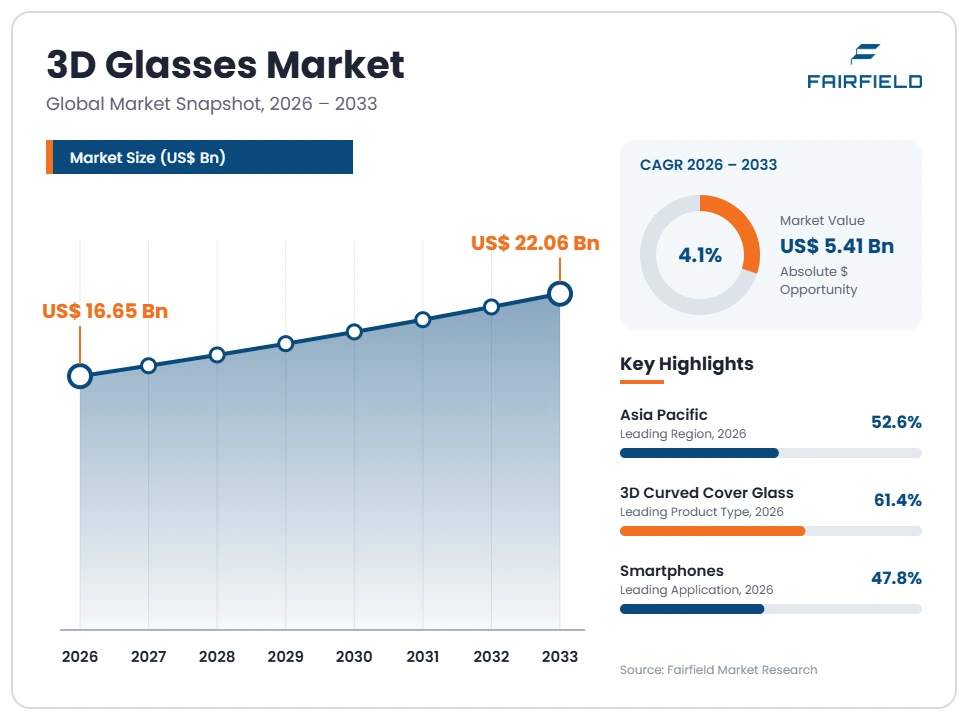
The global 3D glasses market size is expected to be valued at US$ 16.65 billion in 2026 and projected to reach US$ 22.06 billion by 2033, growing at a CAGR of 4.1% between 2026 and 2033.
Between 2020 and 2025, the market grew at a CAGR of about 3.4%, as weak cinema attendance during the pandemic offset steady demand for curved 3D cover glass in premium smartphones and wearables. Three main factors now support growth: rising shipments of devices with curved and contoured glass, renewed interest in premium 3D cinema formats, and growth in extended reality headsets. The market is shifting from simple disposable cinema eyewear toward high-value 3D-formed glass for devices, lightweight active shutter and polarized eyewear for immersive viewing, and 3D visualization in surgery.
Key Report Takeaways
- By Product Type: 3D Curved Cover Glass held 61.4% share in 2026, while Active Shutter Eyewear is projected to expand at a 5.6% CAGR through 2033, driven by gaming projectors, home theaters, and XR viewing.
- By Application: Smartphones held 47.8% share in 2026, while VR & AR Headsets are projected to expand at a 7.8% CAGR through 2033, driven by lightweight mixed reality devices that need precision-formed optics and glass.
- By End User: Consumer Electronics held 82.3% share in 2026, while Healthcare is projected to expand at a 6.9% CAGR through 2033, driven by 3D laparoscopic and robotic surgery that uses polarized viewing glasses.
- By Distribution Channel: Offline & OEM Supply held 71.2% share in 2026, while Online is projected to expand at a 6.2% CAGR through 2033, driven by direct sales of replacement and premium eyewear.
- By Region: Asia Pacific held 52.6% share in 2026, while North America is projected to expand at a 5.3% CAGR through 2033, driven by premium home entertainment, gaming, and premium large-format cinema.
Global 3D Glasses Market Trends and Insights
Drivers Impact Analysis
Two drivers carry the strongest influence on 3D glasses demand during the forecast period.
| Driver | Impact on CAGR Forecast | Geographic Relevance | Impact Timeline |
| Curved 3D cover glass in smartphones and wearables | High | Asia Pacific, North America | Medium term (2–4 years) |
| Premium 3D cinema and immersive viewing formats | Medium | North America, Asia Pacific, Europe | Short term (≤2 years) |
Curved 3D Cover Glass in Premium Devices Is Driving 3D Glasses Demand
Curved and contoured 3D cover glass in smartphones, smartwatches, and wearables is the largest source of value in the 3D glasses market. Device makers use 3D-formed glass on the front and back of premium phones to create seamless edges, better grip, and a high-end look.
The mechanism is precision thermal forming. Flat glass is heated and pressed in molds to create curved shapes, then strengthened, polished, and coated. Each step requires specialized equipment and careful quality control, which raises unit value compared with flat glass. Lens Technology, BYD Electronic, Foxconn, and Corning are major suppliers to brands such as Apple, Samsung, Huawei, Xiaomi, and Vivo. Smartwatches and foldables also need thin curved glass. As consumers upgrade to premium devices, demand for 3D-formed glass rises, supporting stable revenue for glass processors in China, South Korea, and Vietnam.
Premium 3D Cinema Releases Are Reviving Demand for 3D Viewing Glasses
Premium 3D cinema releases and large-format screens are reviving demand for 3D viewing glasses. Studios release major films in 3D formats that require polarized or active glasses for audiences.
The evidence is recent box office performance and theater upgrades. In December 2025, IMAX reported a US$ 43.6 million global opening for James Cameron’s Avatar: Fire and Ash, released exclusively in IMAX 3D at its locations and accounting for 12.6% of the film’s worldwide debut. That same month, RealD and CJ 4DPLEX partnered to add RealD 3D to SCREENX auditoriums, with Regal Cinemas upgrading sites for the film’s release. Premium large-format screens command higher ticket prices, and each 3D screening needs glasses, either reusable or disposable. These events support recurring demand for cinema eyewear and related cleaning and logistics services.
Restraints Impact Analysis
Two restraints limit how quickly the 3D glasses market can grow.
| Restraint | Impact on CAGR Forecast | Geographic Relevance | Impact Timeline |
| Rise of glasses-free 3D displays and decline of 3D TVs | Medium | Global | Long term (≥4 years) |
| Smartphone market maturity and glass price pressure | Medium | Asia Pacific | Short term (≤2 years) |
Glasses-Free 3D Displays Limit Demand for 3D Viewing Glasses
The rise of glasses-free 3D displays and the decline of 3D televisions limit demand for 3D viewing eyewear. Many viewers find glasses inconvenient, and some experience eye strain or headaches during long viewing.
The underlying cause is new display technology. Autostereoscopic screens use lenticular lenses and eye-tracking cameras to show 3D images without glasses. In April 2025, Samsung launched a glasses-free 3D gaming monitor, and companies such as MOPIC have promoted glasses-free 3D for consumer and professional displays. Major television makers largely stopped producing 3D TVs in the late 2010s, removing a key home market for active shutter glasses. Streaming platforms also offer limited 3D content. As glasses-free displays improve, demand for stereoscopic eyewear in homes and offices may continue to shrink outside cinemas and specialized uses.
Smartphone Market Maturity Pressures 3D Glasses Revenue
Smartphone market maturity and strong price competition pressure revenue from 3D curved cover glass. Global smartphone shipments have grown only slowly in recent years as consumers keep phones longer.
The specific causes are longer replacement cycles and supplier competition. Many consumers now upgrade only every three to four years, which limits volume growth. Device makers negotiate hard with glass suppliers to reduce component costs, especially for mid-range phones. Some brands have moved back toward flatter designs to reduce breakage and repair cost, which lowers demand for strongly curved glass. Glass processors must invest in new molds and equipment for each design change. Overcapacity among Chinese glass processors adds further pricing pressure. These factors cap average selling prices and squeeze margins, even as unit shipments of premium devices remain steady.
Market Opportunities
XR Headsets and Smart Glasses Open a New Revenue Pool for 3D Glasses
Extended reality headsets and smart glasses create a new, fast-growing revenue pool for 3D glasses suppliers. These devices need precision-formed glass, lenses, and covers that are thin, light, and optically clear.
Glass processors and optical component makers with forming expertise can capture this demand. Mixed reality headsets use curved front glass and multiple lenses, while smart glasses need lightweight lenses with integrated displays. Companies such as Rokid and XGIMI are actively developing consumer AR glasses and projectors that support 3D content. Major technology companies are investing heavily in lighter, more stylish smart glasses. Device makers and optical module suppliers in China, the United States, and South Korea are the main customers. As XR shipments rise, demand for precision 3D-formed glass and optics will increase steadily.
Surgical 3D Visualization Creates a Professional Revenue Pool for 3D Glasses
Surgical 3D visualization creates a specialized, professional revenue pool for 3D glasses. Surgeons use 3D laparoscopic and robotic systems that display high-definition stereoscopic images, and operating room teams often wear polarized glasses to view them.
Suppliers of medical-grade passive and active eyewear can capture this demand. 3D vision clearly improves depth perception during minimally invasive surgery, helping surgeons suture, dissect, and navigate more precisely. Hospitals in North America, Europe, and Asia Pacific are steadily expanding robotic and laparoscopic surgery programs. 3D microscopes and exoscopes in neurosurgery and ophthalmology also use stereoscopic displays. Hospitals, surgical system makers, and medical training centers are the main customers. Medical eyewear must be comfortable for long procedures, anti-fog, and easy to disinfect, which supports higher prices than consumer cinema glasses.
Segment Analysis
- By Product Type: 3D Curved Cover Glass Leads While Active Shutter Eyewear Grows Fastest
3D Curved Cover Glass held 61.4% share in 2026. Curved front and back glass for premium smartphones, smartwatches, and tablets carries far higher value per unit than viewing eyewear. Large device volumes and complex forming processes make this the largest product type.
Active Shutter Eyewear is the fastest-growing product type, expanding at a 5.6% CAGR through 2033. These battery-powered glasses alternate lenses in sync with a display to create full-resolution 3D images. They are used with home theater projectors, gaming displays, simulation systems, and some cinema formats. Lightweight, rechargeable designs improve comfort. Passive polarized eyewear remains the standard in most cinemas, while anaglyph glasses serve low-cost uses. For the market, active shutter growth adds premium eyewear sales to home entertainment and professional visualization.
- By Application: Smartphones Lead While VR & AR Headsets Grow Fastest
Smartphones held 47.8% share in 2026. Premium phones from major brands use 3D curved cover glass on the front, back, or both. High annual shipments keep smartphones the largest application for 3D-formed glass.
VR & AR Headsets are the fastest-growing application, expanding at a 7.8% CAGR through 2033. Mixed reality headsets and smart glasses need curved cover glass, precision lenses, and stereoscopic optics. New lightweight designs and enterprise use cases in training, design, and remote assistance support adoption. Wearable devices such as smartwatches and fitness bands add steady demand for small curved glass. Cinema and home entertainment remain important for viewing eyewear. For the market, headset growth links 3D glasses suppliers to the expanding spatial computing industry, which values precision optics and premium materials.
- By End User: Consumer Electronics Leads While Healthcare Grows Fastest
Consumer Electronics held 82.3% share in 2026. Smartphones, wearables, tablets, gaming systems, and home theaters account for most demand for 3D glass and eyewear. Device makers and consumers in Asia Pacific and North America drive the largest purchases.
Healthcare is the fastest-growing end user, expanding at a 6.9% CAGR through 2033. Hospitals use 3D laparoscopic towers, robotic surgery systems, surgical microscopes, and exoscopes that rely on stereoscopic displays. Surgical teams wear polarized or active glasses to view 3D images. Medical schools and simulation centers use 3D visualization for surgical training. Industrial and aerospace users also use 3D eyewear for design review, flight simulation, and engineering visualization. For the market, healthcare growth adds steady, higher-value demand for durable, medical-grade eyewear.
- By Distribution Channel: Offline & OEM Supply Leads While Online Grows Fastest
Offline & OEM Supply held 71.2% share in 2026. Most 3D curved glass is sold directly to device makers under long-term supply agreements. Cinema chains buy eyewear in bulk from distributors and technology partners, while retailers sell eyewear alongside televisions and projectors.
Online is the fastest-growing channel, expanding at a 6.2% CAGR through 2033. Consumers buy replacement active shutter glasses, premium polarized glasses, and gaming accessories on e-commerce platforms. Online stores offer wider product choice, compatibility guides, and lower prices. Small brands use marketplaces to reach global buyers. For the market, online growth improves access to specialty eyewear for home theater, gaming, and simulation, though it represents a smaller share of total value than OEM glass supply.
Geography Analysis
- Which Region Is Growing Fastest in the 3D Glasses Market?
North America is growing fastest in the 3D glasses market at a 5.3% CAGR through 2033. The United States has a large premium cinema market, with IMAX, RealD, and chains such as Regal Cinemas investing in 3D presentation. Avatar: Fire and Ash generated US$ 13 million of its IMAX opening in North America in December 2025. Gaming, home theater, and simulation users buy active shutter glasses. Hospitals use 3D surgical visualization widely. Apple and other device makers drive demand for curved glass. Canada adds cinema and healthcare demand. One opportunity is medical-grade eyewear for robotic surgery programs.
- Europe Supports Cinema and Medical 3D Viewing in the 3D Glasses Market
Europe is a mature market where cinema, medical, and industrial uses support demand for 3D eyewear. Germany, the United Kingdom, France, Spain, and Italy have large cinema audiences and premium screens. The Avatar sequel revived 3D attendance in markets such as Spain in December 2025, after years of decline. European hospitals widely use 3D laparoscopic and robotic surgery systems. Automotive and aerospace companies use 3D visualization for design review. Strict environmental rules encourage reusable cinema glasses, washing services, and recycling programs. One opportunity is sustainable, washable eyewear that lowers waste for cinema chains across the region.
- Which Region Is Leading the 3D Glasses Market?
Asia Pacific is leading the 3D glasses market with a 52.6% share in 2026. China is the world’s largest producer of 3D curved cover glass, with suppliers such as Lens Technology, BYD Electronic, and Holitech serving global smartphone brands. South Korea and Japan have major device and display makers, including Samsung and LG. Vietnam and India are fast-growing smartphone assembly hubs that use imported and locally finished glass. China also has a large cinema market, where IMAX delivered about 23% of Avatar: Fire and Ash’s opening. One opportunity is precision glass for regional XR headset makers.
- Latin America Grows Cinema and Device Demand in the 3D Glasses Market
Latin America is an emerging region where cinema attendance and smartphone sales drive demand. Brazil and Mexico have large cinema chains and growing premium screen networks, which use 3D glasses for major releases. Smartphone adoption is high, though most phones sold are mid-range models with less curved glass. Argentina, Colombia, and Chile add cinema demand from expanding multiplex chains. Key barriers include price sensitivity, currency volatility, and lower premium device penetration. Most curved glass is imported in finished phones. One opportunity is reusable cinema eyewear programs that cut costs for theater operators while supporting more 3D screenings.
- Middle East & Africa Expands Premium Cinema in the 3D Glasses Market
Middle East & Africa is a developing region where new cinemas and premium devices support demand. Saudi Arabia reopened cinemas in 2018 and has rapidly built multiplexes with premium formats, creating new demand for 3D eyewear. The United Arab Emirates has a strong premium cinema, gaming, and electronics retail market. In Africa, South Africa, Nigeria, and Kenya have growing cinema and smartphone markets in large cities. Key barriers include price sensitivity, low 3D content availability, and limited premium screen numbers outside major cities. One opportunity is supplying 3D eyewear to new multiplexes opening under Gulf entertainment strategies.
Competitive Landscape
The 3D glasses market is moderately concentrated. In 3D curved cover glass, Lens Technology, BYD Electronic, Foxconn, Holitech, and Corning hold strong positions through long-term supply contracts with major smartphone brands. In viewing eyewear, RealD, IMAX, Xpand, American Paper Optics, and many Chinese manufacturers compete. Samsung, Sony, LG, and NVIDIA have historically supplied active shutter glasses for their displays and gaming systems.
Companies compete mainly on optical quality, durability, weight, comfort, manufacturing yield, and price. For curved glass, forming precision, optical clarity, and scratch and drop resistance are critical. For eyewear, compatibility with display systems, comfort, and durability over repeated use matter most.
Strategic moves show how competition is changing. RealD and CJ 4DPLEX partnered in December 2025 to bring RealD 3D to SCREENX auditoriums. IMAX reported a US$ 43.6 million global opening for Avatar: Fire and Ash in IMAX 3D in December 2025. Samsung launched a glasses-free 3D gaming monitor in April 2025, showing competition from autostereoscopic displays. Glass processors continue to invest in thinner, stronger curved glass for foldables and wearables. Together, these moves show demand shifting toward premium formats, immersive cinema, and high-value device glass.
Three main themes now shape vendor strategy. First, glass suppliers are steadily expanding into XR headsets and foldable devices. Second, cinema technology firms are increasingly pairing 3D with premium large-format screens. Third, eyewear makers are developing lighter, reusable, and medical-grade glasses for professional users.
Recent Industry Developments
- December 2025: IMAX reported a US$ 43.6 million global opening for Avatar: Fire and Ash in IMAX 3D – shows strong audience demand for premium 3D screenings.
- December 2025: RealD and CJ 4DPLEX partnered to add RealD 3D to SCREENX auditoriums – expands 3D eyewear use in immersive formats.
- April 2025: Samsung launched a glasses-free 3D gaming monitor – signals competition from autostereoscopic displays.
Companies Covered in the Report
- Lens Technology
- Corning
- BYD Electronic
- Foxconn
- Holitech Technology
- RealD
- IMAX
- Samsung Electronics
- Sony
- NVIDIA
- American Paper Optics
- XGIMI Technology
3D Glasses Market Report Scope
| Metric | Value |
| Study Period | 2020–2033 |
| Market Size 2026 | US$ 16.65 Billion |
| Market Size 2033 | US$ 22.06 Billion |
| CAGR 2026–2033 | 4.1% |
| Absolute Dollar Opportunity | US$ 5.41 Billion |
| Largest Market | Asia Pacific |
| Fastest-Growing Market | North America |
| Market Concentration | Medium |
| Major Players | Lens Technology, Corning, BYD Electronic, RealD, Samsung Electronics |
3D Glasses Market Segmentation
Product Type
- 3D Curved Cover Glass
- Active Shutter Eyewear
- Passive Polarized Eyewear
- Anaglyph Eyewear
Application
- Smartphones
- Wearable Devices
- VR & AR Headsets
- Cinema & Home Entertainment
- Others
End User
- Consumer Electronics
- Healthcare
- Industrial
- Aerospace & Defense
Distribution Channel
- Offline & OEM Supply
- Online
Regions
- North America
- Europe
- Asia Pacific
- Latin America
- Middle East & Africa
- Executive Summary
- Global 3D Glasses Market Snapshot
- Future Projections
- Key Report Takeaways
- Regional Snapshot
- Market Overview
- Market Definition and Report Scope
- Historical Trends 2020–2025
- Market Dynamics
- Drivers
- Curved 3D Cover Glass in Premium Devices Is Driving 3D Glasses Demand
- Premium 3D Cinema Releases Are Reviving Demand for 3D Viewing Glasses
- Restraints
- Glasses-Free 3D Displays Limit Demand for 3D Viewing Glasses
- Smartphone Market Maturity Pressures 3D Glasses Revenue
- Market Opportunities
- XR Headsets and Smart Glasses Open a New Revenue Pool for 3D Glasses
- Surgical 3D Visualization Creates a Professional Revenue Pool for 3D Glasses
- Drivers
- Global 3D Glasses Market Outlook, 2020–2033
- Global 3D Glasses Market Outlook, by Product Type, Value (US$ Billion), 2020–2033
- 3D Curved Cover Glass
- Active Shutter Eyewear
- Passive Polarized Eyewear
- Anaglyph Eyewear
- Global 3D Glasses Market Outlook, by Application, Value (US$ Billion), 2020–2033
- Smartphones
- Wearable Devices
- VR & AR Headsets
- Cinema & Home Entertainment
- Others
- Global 3D Glasses Market Outlook, by End User, Value (US$ Billion), 2020–2033
- Consumer Electronics
- Healthcare
- Industrial
- Aerospace & Defense
- Global 3D Glasses Market Outlook, by Distribution Channel, Value (US$ Billion), 2020–2033
- Offline & OEM Supply
- Online
- Global 3D Glasses Market Outlook, by Region, Value (US$ Billion), 2020–2033
- North America
- Europe
- Asia Pacific
- Latin America
- Middle East & Africa
- Global 3D Glasses Market Outlook, by Product Type, Value (US$ Billion), 2020–2033
- North America 3D Glasses Market Outlook, 2020–2033
- North America 3D Glasses Market Outlook, by Product Type, Value (US$ Billion), 2020–2033
- 3D Curved Cover Glass
- Active Shutter Eyewear
- Passive Polarized Eyewear
- Anaglyph Eyewear
- North America 3D Glasses Market Outlook, by Application, Value (US$ Billion), 2020–2033
- Smartphones
- Wearable Devices
- VR & AR Headsets
- Cinema & Home Entertainment
- Others
- North America 3D Glasses Market Outlook, by End User, Value (US$ Billion), 2020–2033
- Consumer Electronics
- Healthcare
- Industrial
- Aerospace & Defense
- North America 3D Glasses Market Outlook, by Distribution Channel, Value (US$ Billion), 2020–2033
- Offline & OEM Supply
- Online
- North America 3D Glasses Market Outlook, by Country, Value (US$ Billion), 2020–2033
- United States 3D Glasses Market Outlook, by Product Type, 2020–2033
- United States 3D Glasses Market Outlook, by Application, 2020–2033
- United States 3D Glasses Market Outlook, by End User, 2020–2033
- United States 3D Glasses Market Outlook, by Distribution Channel, 2020–2033
- Canada 3D Glasses Market Outlook, by Product Type, 2020–2033
- Canada 3D Glasses Market Outlook, by Application, 2020–2033
- Canada 3D Glasses Market Outlook, by End User, 2020–2033
- Canada 3D Glasses Market Outlook, by Distribution Channel, 2020–2033
- North America 3D Glasses Market Outlook, by Product Type, Value (US$ Billion), 2020–2033
- Europe 3D Glasses Market Outlook, 2020–2033
- Europe 3D Glasses Market Outlook, by Product Type, Value (US$ Billion), 2020–2033
- 3D Curved Cover Glass
- Active Shutter Eyewear
- Passive Polarized Eyewear
- Anaglyph Eyewear
- Europe 3D Glasses Market Outlook, by Application, Value (US$ Billion), 2020–2033
- Smartphones
- Wearable Devices
- VR & AR Headsets
- Cinema & Home Entertainment
- Others
- Europe 3D Glasses Market Outlook, by End User, Value (US$ Billion), 2020–2033
- Consumer Electronics
- Healthcare
- Industrial
- Aerospace & Defense
- Europe 3D Glasses Market Outlook, by Distribution Channel, Value (US$ Billion), 2020–2033
- Offline & OEM Supply
- Online
- Europe 3D Glasses Market Outlook, by Country, Value (US$ Billion), 2020–2033
- Germany 3D Glasses Market Outlook, by Product Type, 2020–2033
- Germany 3D Glasses Market Outlook, by Application, 2020–2033
- Germany 3D Glasses Market Outlook, by End User, 2020–2033
- Germany 3D Glasses Market Outlook, by Distribution Channel, 2020–2033
- United Kingdom 3D Glasses Market Outlook, by Product Type, 2020–2033
- United Kingdom 3D Glasses Market Outlook, by Application, 2020–2033
- United Kingdom 3D Glasses Market Outlook, by End User, 2020–2033
- United Kingdom 3D Glasses Market Outlook, by Distribution Channel, 2020–2033
- France 3D Glasses Market Outlook, by Product Type, 2020–2033
- France 3D Glasses Market Outlook, by Application, 2020–2033
- France 3D Glasses Market Outlook, by End User, 2020–2033
- France 3D Glasses Market Outlook, by Distribution Channel, 2020–2033
- Spain 3D Glasses Market Outlook, by Product Type, 2020–2033
- Spain 3D Glasses Market Outlook, by Application, 2020–2033
- Spain 3D Glasses Market Outlook, by End User, 2020–2033
- Spain 3D Glasses Market Outlook, by Distribution Channel, 2020–2033
- Italy 3D Glasses Market Outlook, by Product Type, 2020–2033
- Italy 3D Glasses Market Outlook, by Application, 2020–2033
- Italy 3D Glasses Market Outlook, by End User, 2020–2033
- Italy 3D Glasses Market Outlook, by Distribution Channel, 2020–2033
- Europe 3D Glasses Market Outlook, by Product Type, Value (US$ Billion), 2020–2033
- Asia Pacific 3D Glasses Market Outlook, 2020–2033
- Asia Pacific 3D Glasses Market Outlook, by Product Type, Value (US$ Billion), 2020–2033
- 3D Curved Cover Glass
- Active Shutter Eyewear
- Passive Polarized Eyewear
- Anaglyph Eyewear
- Asia Pacific 3D Glasses Market Outlook, by Application, Value (US$ Billion), 2020–2033
- Smartphones
- Wearable Devices
- VR & AR Headsets
- Cinema & Home Entertainment
- Others
- Asia Pacific 3D Glasses Market Outlook, by End User, Value (US$ Billion), 2020–2033
- Consumer Electronics
- Healthcare
- Industrial
- Aerospace & Defense
- Asia Pacific 3D Glasses Market Outlook, by Distribution Channel, Value (US$ Billion), 2020–2033
- Offline & OEM Supply
- Online
- Asia Pacific 3D Glasses Market Outlook, by Country, Value (US$ Billion), 2020–2033
- China 3D Glasses Market Outlook, by Product Type, 2020–2033
- China 3D Glasses Market Outlook, by Application, 2020–2033
- China 3D Glasses Market Outlook, by End User, 2020–2033
- China 3D Glasses Market Outlook, by Distribution Channel, 2020–2033
- South Korea 3D Glasses Market Outlook, by Product Type, 2020–2033
- South Korea 3D Glasses Market Outlook, by Application, 2020–2033
- South Korea 3D Glasses Market Outlook, by End User, 2020–2033
- South Korea 3D Glasses Market Outlook, by Distribution Channel, 2020–2033
- Japan 3D Glasses Market Outlook, by Product Type, 2020–2033
- Japan 3D Glasses Market Outlook, by Application, 2020–2033
- Japan 3D Glasses Market Outlook, by End User, 2020–2033
- Japan 3D Glasses Market Outlook, by Distribution Channel, 2020–2033
- Vietnam 3D Glasses Market Outlook, by Product Type, 2020–2033
- Vietnam 3D Glasses Market Outlook, by Application, 2020–2033
- Vietnam 3D Glasses Market Outlook, by End User, 2020–2033
- Vietnam 3D Glasses Market Outlook, by Distribution Channel, 2020–2033
- India 3D Glasses Market Outlook, by Product Type, 2020–2033
- India 3D Glasses Market Outlook, by Application, 2020–2033
- India 3D Glasses Market Outlook, by End User, 2020–2033
- India 3D Glasses Market Outlook, by Distribution Channel, 2020–2033
- Asia Pacific 3D Glasses Market Outlook, by Product Type, Value (US$ Billion), 2020–2033
- Latin America 3D Glasses Market Outlook, 2020–2033
- Latin America 3D Glasses Market Outlook, by Product Type, Value (US$ Billion), 2020–2033
- 3D Curved Cover Glass
- Active Shutter Eyewear
- Passive Polarized Eyewear
- Anaglyph Eyewear
- Latin America 3D Glasses Market Outlook, by Application, Value (US$ Billion), 2020–2033
- Smartphones
- Wearable Devices
- VR & AR Headsets
- Cinema & Home Entertainment
- Others
- Latin America 3D Glasses Market Outlook, by End User, Value (US$ Billion), 2020–2033
- Consumer Electronics
- Healthcare
- Industrial
- Aerospace & Defense
- Latin America 3D Glasses Market Outlook, by Distribution Channel, Value (US$ Billion), 2020–2033
- Offline & OEM Supply
- Online
- Latin America 3D Glasses Market Outlook, by Country, Value (US$ Billion), 2020–2033
- Brazil 3D Glasses Market Outlook, by Product Type, 2020–2033
- Brazil 3D Glasses Market Outlook, by Application, 2020–2033
- Brazil 3D Glasses Market Outlook, by End User, 2020–2033
- Brazil 3D Glasses Market Outlook, by Distribution Channel, 2020–2033
- Mexico 3D Glasses Market Outlook, by Product Type, 2020–2033
- Mexico 3D Glasses Market Outlook, by Application, 2020–2033
- Mexico 3D Glasses Market Outlook, by End User, 2020–2033
- Mexico 3D Glasses Market Outlook, by Distribution Channel, 2020–2033
- Argentina 3D Glasses Market Outlook, by Product Type, 2020–2033
- Argentina 3D Glasses Market Outlook, by Application, 2020–2033
- Argentina 3D Glasses Market Outlook, by End User, 2020–2033
- Argentina 3D Glasses Market Outlook, by Distribution Channel, 2020–2033
- Colombia 3D Glasses Market Outlook, by Product Type, 2020–2033
- Colombia 3D Glasses Market Outlook, by Application, 2020–2033
- Colombia 3D Glasses Market Outlook, by End User, 2020–2033
- Colombia 3D Glasses Market Outlook, by Distribution Channel, 2020–2033
- Chile 3D Glasses Market Outlook, by Product Type, 2020–2033
- Chile 3D Glasses Market Outlook, by Application, 2020–2033
- Chile 3D Glasses Market Outlook, by End User, 2020–2033
- Chile 3D Glasses Market Outlook, by Distribution Channel, 2020–2033
- Latin America 3D Glasses Market Outlook, by Product Type, Value (US$ Billion), 2020–2033
- Middle East & Africa 3D Glasses Market Outlook, 2020–2033
- Middle East & Africa 3D Glasses Market Outlook, by Product Type, Value (US$ Billion), 2020–2033
- 3D Curved Cover Glass
- Active Shutter Eyewear
- Passive Polarized Eyewear
- Anaglyph Eyewear
- Middle East & Africa 3D Glasses Market Outlook, by Application, Value (US$ Billion), 2020–2033
- Smartphones
- Wearable Devices
- VR & AR Headsets
- Cinema & Home Entertainment
- Others
- Middle East & Africa 3D Glasses Market Outlook, by End User, Value (US$ Billion), 2020–2033
- Consumer Electronics
- Healthcare
- Industrial
- Aerospace & Defense
- Middle East & Africa 3D Glasses Market Outlook, by Distribution Channel, Value (US$ Billion), 2020–2033
- Offline & OEM Supply
- Online
- Middle East & Africa 3D Glasses Market Outlook, by Country, Value (US$ Billion), 2020–2033
- Saudi Arabia 3D Glasses Market Outlook, by Product Type, 2020–2033
- Saudi Arabia 3D Glasses Market Outlook, by Application, 2020–2033
- Saudi Arabia 3D Glasses Market Outlook, by End User, 2020–2033
- Saudi Arabia 3D Glasses Market Outlook, by Distribution Channel, 2020–2033
- United Arab Emirates 3D Glasses Market Outlook, by Product Type, 2020–2033
- United Arab Emirates 3D Glasses Market Outlook, by Application, 2020–2033
- United Arab Emirates 3D Glasses Market Outlook, by End User, 2020–2033
- United Arab Emirates 3D Glasses Market Outlook, by Distribution Channel, 2020–2033
- South Africa 3D Glasses Market Outlook, by Product Type, 2020–2033
- South Africa 3D Glasses Market Outlook, by Application, 2020–2033
- South Africa 3D Glasses Market Outlook, by End User, 2020–2033
- South Africa 3D Glasses Market Outlook, by Distribution Channel, 2020–2033
- Nigeria 3D Glasses Market Outlook, by Product Type, 2020–2033
- Nigeria 3D Glasses Market Outlook, by Application, 2020–2033
- Nigeria 3D Glasses Market Outlook, by End User, 2020–2033
- Nigeria 3D Glasses Market Outlook, by Distribution Channel, 2020–2033
- Kenya 3D Glasses Market Outlook, by Product Type, 2020–2033
- Kenya 3D Glasses Market Outlook, by Application, 2020–2033
- Kenya 3D Glasses Market Outlook, by End User, 2020–2033
- Kenya 3D Glasses Market Outlook, by Distribution Channel, 2020–2033
- Middle East & Africa 3D Glasses Market Outlook, by Product Type, Value (US$ Billion), 2020–2033
- Competitive Landscape
- Market Concentration and Industry Leaders
- Competitive Differentiation
- Strategic Moves and Market Direction
- Recent Industry Developments
- Company Profiles
- Lens Technology
- Corning
- BYD Electronic
- Foxconn
- Holitech Technology
- RealD
- IMAX
- Samsung Electronics
- Sony
- NVIDIA
- American Paper Optics
- XGIMI Technology
- Appendix
- Research Methodology
- Report Assumptions
- Acronyms and Abbreviations
Product Type
- 3D Curved Cover Glass
- Active Shutter Eyewear
- Passive Polarized Eyewear
- Anaglyph Eyewear
Application
- Smartphones
- Wearable Devices
- VR & AR Headsets
- Cinema & Home Entertainment
- Others
End User
- Consumer Electronics
- Healthcare
- Industrial
- Aerospace & Defense
Distribution Channel
- Offline & OEM Supply
- Online
Regions
- North America
- Europe
- Asia Pacific
- Latin America
- Middle East & Africa
Our Research Methodology
Considering the volatility of business today, traditional approaches to strategizing a game plan can be unfruitful if not detrimental. True ambiguity is no way to determine a forecast. A myriad of predetermined factors must be accounted for such as the degree of risk involved, the magnitude of circumstances, as well as conditions or consequences that are not known or unpredictable. To circumvent binary views that cast uncertainty, the application of market research intelligence to strategically posture, move, and enable actionable outcomes is necessary.
View Methodology
Quality Assured
Rigorous Validation Process

Confidentiality Assured
End-to-end Data Security

Custom Research Services
Tailored To Your Objectives
Related Reports
3D Electronics / Additive Electronics Market Size, Share, Insights, Competitive Landscape, and Forecast 2026 to 2033
The global 3D electronics / additive electronics market is valued at US$1.2 billion in 2026, reaching US$3.8 billion by 2033, growing at a 17.9% CAGR
3D Display Market Size, Share, Insights, Competitive Landscape, and Forecast 2026 to 2033
The global 3D display market is valued at US$8.5 billion in 2026, reaching US$18.9 billion by 2033, growing at a 12.1% CAGR
360 Degree Camera Market Size, Share, Insights, Competitive Landscape, and Forecast 2026 to 2033
The global 360 degree camera market is valued at US$1.86 billion in 2026, reaching US$4.20 billion by 2033, growing at a 12.3% CAGR
3D Camera Market Size, Share, Insights, Competitive Landscape, and Forecast 2026 to 2033
The global 3D camera market is valued at US$1.86 billion in 2026, reaching US$5.58 billion by 2033, growing at a 17.0% CAGR
2D Material Transistor Market Size, Share, Insights, Competitive Landscape, and Forecast 2026 to 2033
The global 2D material transistor market is valued at US$0.2 billion in 2026, reaching US$0.9 billion by 2033, growing at a 24.0% CAGR
2D Barcode Reader Market Size, Share, Insights, Competitive Landscape, and Forecast 2026 to 2033
The global 2D barcode reader market is valued at US$4.8 billion in 2026, reaching US$8.6 billion by 2033, growing at an 8.7% CAGR