



5G Edge Computing Market
5G Edge Computing Market Size, Share, Insights, Competitive Landscape, and Forecast 2026 to 2033
5G Edge Computing Market Size and Trend Analysis
How Fast Is the 5G Edge Computing Market Growing?
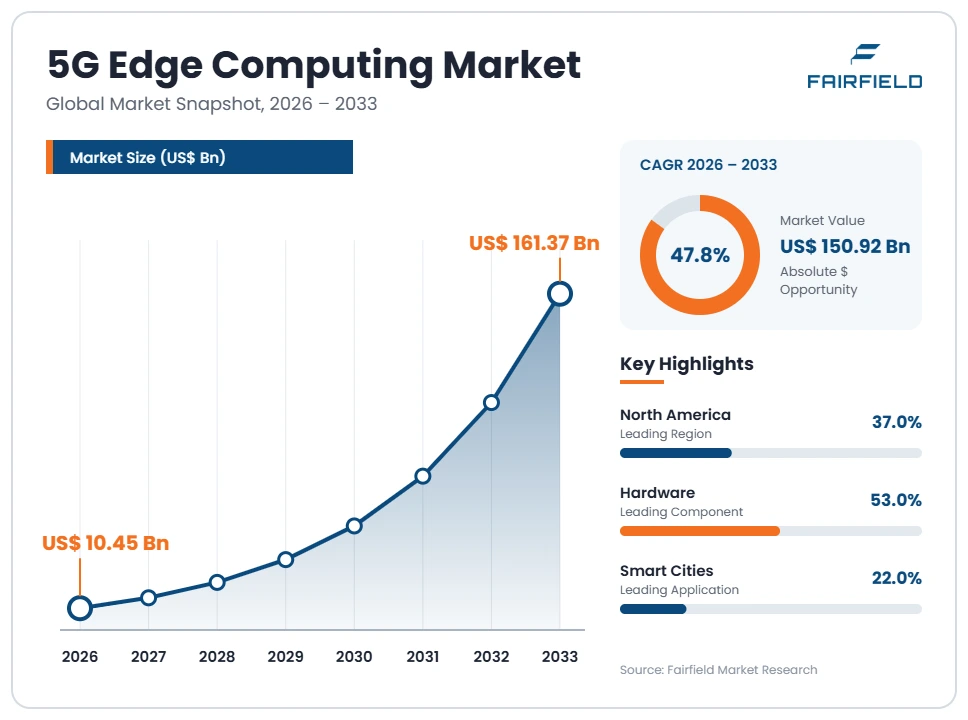
The global 5G edge computing market size is expected to be valued at US$ 10.45 billion in 2026 and projected to reach US$ 161.37 billion by 2033, growing at a CAGR of 47.8% between 2026 and 2033.
Between 2020 and 2025, the market grew rapidly from a small base, as operators launched standalone 5G networks, cloud providers placed computing inside telecom networks, and factories, ports, and hospitals began testing private 5G with on-site computing. 5G edge computing places servers, storage, and software close to where data is created, at cell sites, operator data centers, or customer premises, so applications can respond with very low latency. Three factors now drive growth: the rise of edge AI inference for video analytics, robotics, and generative AI, demand from manufacturing, logistics, and smart cities for real-time processing, and operator investment in multi-access edge computing to earn more from 5G networks. The market is shifting toward AI-ready edge servers with GPUs, network slicing that guarantees performance, and partnerships between telecom operators and cloud providers. In January 2025, Verizon launched AI Connect, offering its 5G network, fiber, and edge sites for AI inference workloads.
Key Report Takeaways
- By Component: Hardware held 53.0% share in 2026, while Software is projected to expand at a 50.9% CAGR through 2033, driven by orchestration platforms, edge AI frameworks, and cloud-native network functions.
- By Application: Smart Cities held 22.0% share in 2026, while Industrial Automation is projected to expand at a 52.1% CAGR through 2033, driven by private 5G in factories, robotics, machine vision, and predictive maintenance.
- By End Use: IT & Telecom held 20.0% share in 2026, while Energy & Utilities is projected to expand at a 54.0% CAGR through 2033, driven by smart grids, remote asset monitoring, and real-time control of renewable energy.
- By Region: North America held 37.0% share in 2026, while Asia Pacific is projected to expand at a 52.6% CAGR through 2033, driven by large 5G networks and smart city programs in China, India, South Korea, and Japan.
Global 5G Edge Computing Market Trends and Insights
Drivers Impact Analysis
Two drivers carry the strongest influence on 5G edge computing demand during the forecast period.
| Driver | Impact on CAGR Forecast | Geographic Relevance | Impact Timeline |
| Edge AI inference and real-time applications | High | Global | Long term (≥4 years) |
| Industrial digitalization and private 5G | High | North America, Europe, Asia Pacific | Medium term (2–4 years) |
Edge AI Is Driving the 5G Edge Computing Market
Edge AI inference and real-time applications are the strongest driver of the 5G edge computing market. Many AI tasks must run close to users and machines.
The mechanism is the need for fast, local processing. Video analytics, autonomous robots, augmented reality, connected vehicles, and AI assistants generate large amounts of data that must be processed in milliseconds. Sending everything to distant cloud data centers adds delay and network cost. 5G provides fast wireless links, and edge servers provide nearby computing, together delivering low latency and high reliability. Generative AI is creating new demand for inference near users. Verizon launched AI Connect in January 2025 to sell network and edge capacity for AI workloads, and NVIDIA has partnered with Nokia and others on AI-capable radio networks. Retail, media, gaming, and healthcare apps also benefit from edge processing. These trends make edge computing a key layer of the AI economy.
Industrial Digitalization Is Expanding the 5G Edge Computing Market
Industrial digitalization and private 5G are expanding the 5G edge computing market. Factories and ports want reliable wireless control.
The cause is the push for automation and efficiency. Manufacturers use private 5G networks with on-site edge computing to connect robots, automated guided vehicles, sensors, and cameras without cables. Machine vision checks product quality in real time. Ports, mines, and airports use edge platforms to coordinate vehicles and equipment. Energy companies monitor grids and remote assets. Ericsson, Nokia, and Siemens sell private 5G and edge solutions to industry. Governments in Germany, Japan, and South Korea have set aside spectrum for enterprise networks. These deployments create steady demand for edge hardware, software, and services. Once a site proves the value, companies often expand to more plants and warehouses, creating repeat orders.
Restraints Impact Analysis
Two restraints limit how quickly the 5G edge computing market grows.
| Restraint | Impact on CAGR Forecast | Geographic Relevance | Impact Timeline |
| High deployment costs and unclear business models | High | Global | Medium term (2–4 years) |
| Security, complexity, and skills gaps | Medium | Global | Medium term (2–4 years) |
High Costs Slow the 5G Edge Computing Market
High deployment costs and unclear business models slow the 5G edge computing market. Operators have struggled to earn returns from 5G.
The specific causes are heavy investment and slow demand in some areas. Building edge sites with power, cooling, servers, and security across many locations is expensive. Standalone 5G networks, needed for features such as network slicing, are still rolling out in many countries. Some early operator edge offerings attracted few customers because developers lacked killer applications. Enterprises are unsure whether to use operator edge, cloud provider edge, or their own on-site systems. Revenue sharing between operators and cloud providers can be complex. Economic uncertainty can delay projects. These factors slow investment. Some operators have scaled back stand-alone edge offerings and instead resell cloud provider platforms, which lowers their own risk but also their share of revenue from edge services.
Complexity and Security Concerns Restrict the 5G Edge Computing Market
Security, complexity, and skills gaps restrict the 5G edge computing market. Distributed systems are harder to manage and protect.
The underlying causes are technical and organizational challenges. Edge computing spreads infrastructure across thousands of sites, each of which must be secured, updated, and monitored. More devices and connections increase the attack surface. Integrating 5G networks, edge platforms, cloud services, and industrial systems requires skills that many companies lack. Standards for interoperability are still maturing. Data privacy rules can limit where data is processed. Vendor lock-in worries buyers. These factors lengthen sales cycles and increase project risk. Buyers increasingly ask for zero-trust security, automated updates, and remote management tools before they approve large rollouts across many sites. Clear service-level guarantees on latency and uptime also matter to industrial buyers.
Market Opportunities
Private 5G and Industrial Edge Open a Fast-Growth Revenue Pool
Private 5G and industrial edge platforms open a fast-growth revenue pool in the 5G edge computing market. Enterprises want dedicated, secure networks.
Network equipment makers, system integrators, and cloud providers can capture this opportunity. Factories, warehouses, ports, mines, hospitals, and campuses deploy private networks with on-site computing for automation and safety. Packaged solutions that combine radio equipment, core network, edge servers, and applications make deployment easier. Managed services reduce the need for in-house skills. Amazon Web Services, Microsoft, and Google Cloud offer edge platforms that connect to private networks. Vendors with strong industry partnerships can win multi-site contracts. Spectrum set aside for enterprises in several countries lowers the barrier to building private networks, and neutral-host providers offer shared infrastructure for campuses and venues.
AI-RAN and Operator Edge Clouds Create a Network Revenue Pool
AI-capable radio networks and operator edge clouds create a network revenue pool in the 5G edge computing market. Operators can use the same infrastructure for networks and AI.
Telecom operators and equipment makers can capture this opportunity. AI-RAN places GPU computing at cell sites and local data centers, allowing operators to run both radio functions and AI applications on shared hardware. NVIDIA agreed to invest US$ 1 billion in Nokia to advance AI-RAN. Ericsson and Supermicro partnered in June 2025 to speed 5G-AI edge deployment. Network slicing lets operators sell guaranteed performance to enterprises. Operators that monetize edge capacity can improve 5G returns. Multi-access edge computing sites inside operator networks can host AI models, gaming servers, and video processing for nearby users. Open APIs let developers request network quality on demand, creating new revenue streams for operators.
Segment Analysis
- By Component: Hardware Leads While Software Grows Fastest
Hardware held 53.0% share in 2026. Edge servers, routers, gateways, base stations, and storage systems are the largest share of spending as operators and enterprises build infrastructure. Dell Technologies, Hewlett Packard Enterprise, Cisco Systems, and Huawei Technologies supply edge hardware.
Software is the fastest-growing component, expanding at a 50.9% CAGR through 2033. Orchestration, container platforms, edge AI frameworks, security software, and cloud-native network functions allow thousands of sites to be managed centrally. Services, including integration and managed operations, are also growing. For the market, software growth shifts value toward platforms. Cloud providers extend their management tools to edge sites, so developers can use the same services they use in central data centers. Network functions such as the 5G core increasingly run as software on standard servers at the edge.
- By Application: Smart Cities Lead While Industrial Automation Grows Fastest
Smart Cities held 22.0% share in 2026. Cities use 5G edge platforms for traffic management, video surveillance, public safety, and environmental monitoring, often with government funding.
Industrial Automation is the fastest-growing application, expanding at a 52.1% CAGR through 2033. Factories use private 5G and edge computing to connect robots and machines and run real-time quality checks. Connected vehicles, AR and VR, remote healthcare, and content delivery are other applications. For the market, industrial growth adds high-value enterprise contracts. Connected vehicles use edge platforms for traffic safety alerts and high-definition maps, while AR and VR need low latency for comfortable experiences. Hospitals test remote monitoring and imaging analysis at the edge, and media companies use edge nodes for live streaming and cloud gaming.
- By End Use: IT & Telecom Leads While Energy & Utilities Grows Fastest
IT & Telecom held 20.0% share in 2026. Operators and IT companies deploy edge infrastructure to support their own services and sell capacity to customers.
Energy & Utilities is the clear fastest-growing end use, expanding at a 54.0% CAGR through 2033. Utilities use edge computing for smart grids, substation automation, and renewable energy control. Manufacturing, healthcare, retail, transportation, and media are other end uses. For the market, utility growth adds critical infrastructure demand. Manufacturing is a large and fast-growing user through private 5G factories. Retailers use edge computing for cashier-free stores, inventory tracking, and video analytics. Transportation companies use it at ports, airports, and rail yards, and healthcare providers use it for connected medical devices.
Geography Analysis
- Which Region Is Leading the 5G Edge Computing Market?
North America is leading the 5G edge computing market with a 37.0% share in 2026. The United States has major cloud providers, including Amazon Web Services, Microsoft, and Google Cloud, and operators such as Verizon, AT&T, and T-Mobile that partner with them on edge services. Verizon launched AI Connect in January 2025. Canada adds operator investment. AWS Wavelength zones place cloud computing inside operator networks in major cities. Key barriers include high deployment costs and slow enterprise adoption. One change shaping the region is AI inference at the edge, as operators sell network and power capacity to AI companies.
- Europe Builds the 5G Edge Computing Market Through Industrial Use
Europe is a major 5G edge computing market. Germany, the United Kingdom, France, Finland, and Sweden lead in industrial private 5G. Ericsson in Sweden and Nokia in Finland are global leaders, and Vodafone and Deutsche Telekom offer edge services. Car makers and machine builders in Germany run private 5G networks in plants, and ports such as Hamburg and Rotterdam use edge platforms for logistics. The European Union funds research on cloud-edge infrastructure for data sovereignty. Key barriers include slow standalone 5G rollout and fragmented national markets. One opportunity is Industry 4.0 in automotive and machinery plants.
- Which Region Is Growing Fastest in the 5G Edge Computing Market?
Asia Pacific is growing fastest in the 5G edge computing market at a 52.6% CAGR through 2033. China has the world’s largest 5G network and many smart factory projects, led by Huawei Technologies and ZTE. South Korea and Japan have advanced networks, and India is rolling out 5G rapidly. Australia uses private 5G in mining. Operators in China have deployed thousands of multi-access edge computing nodes for factories, ports, and hospitals. Key barriers include fragmented standards and security rules across countries. One change shaping the region is smart cities, with large government programs for traffic, safety, and public services.
- Latin America Grows the 5G Edge Computing Market Through Network Rollout
Latin America is a growing 5G edge computing market. Brazil, Mexico, and Chile are expanding 5G networks, and mining and ports test private networks. Mining companies in Chile and Peru use private networks and edge computing to run autonomous trucks and drills, improving safety and productivity. Ports in Brazil and Mexico test automated cranes, container tracking, and remote equipment control. Operators are partnering with global cloud providers to launch edge zones in several major cities. Key barriers include investment limits, spectrum costs, and slow standalone 5G rollout. One opportunity is mining, where remote sites need fast local processing.
- Middle East & Africa Expands the 5G Edge Computing Market Through Smart Cities
Middle East & Africa is an emerging 5G edge computing market. Saudi Arabia, the United Arab Emirates, and Qatar have advanced 5G networks and smart city projects. Operators in the United Arab Emirates and Saudi Arabia have launched edge cloud services with global cloud providers, and new city projects plan edge-based traffic, security, and utility systems. Oil and gas companies use private networks and edge servers at remote desert facilities. South Africa has the most advanced 5G market in its part of the region. Key barriers include high costs and limited local skills. One opportunity is smart cities.
Competitive Landscape
The 5G edge computing market is moderately concentrated. Amazon Web Services, Microsoft, and Google Cloud lead in edge cloud platforms, while Ericsson, Nokia, Huawei Technologies, and ZTE lead in network equipment. Dell Technologies, Hewlett Packard Enterprise, Cisco Systems, Intel, and NVIDIA supply hardware and chips.
Companies compete on latency, reliability, ecosystem partnerships, ease of deployment, security, and price. Partnerships are central, because no single company provides the full stack of radio networks, edge hardware, cloud platforms, and applications. Cloud providers bring developer ecosystems, operators bring network coverage and local sites, and equipment makers bring radio and core technology. Chip makers such as NVIDIA and Intel shape the computing platforms used at the edge.
Strategic moves show how competition is changing. In January 2025, Verizon launched AI Connect. In June 2025, Ericsson and Supermicro partnered on 5G-AI edge deployment. In October 2025, NVIDIA agreed to invest US$ 1 billion in Nokia to advance AI-RAN. These moves show competition shifting toward AI at the edge, with operators, equipment makers, and chip companies working together to turn 5G networks into distributed computing platforms that can host AI workloads close to users and machines.
Three themes shape vendor strategy. First, companies are adding AI. Second, they are forming cross-industry partnerships. Third, they are targeting industry with packaged private network and edge solutions. Vendors that combine AI computing, strong networks, and broad partner ecosystems are best placed to win share.
Recent Industry Developments
- October 2025: NVIDIA agreed to invest US$ 1 billion in Nokia to develop AI-native radio access networks for 5G and 6G – links edge AI with network infrastructure.
- June 2025: Ericsson and Supermicro announced a collaboration to accelerate 5G-AI edge deployment – combines connectivity with edge hardware.
- January 2025: Verizon launched AI Connect, offering network, fiber, and edge capacity for AI inference – positions operators as AI infrastructure providers.
Companies Covered in the Report
- Amazon Web Services
- Microsoft
- Google Cloud
- Ericsson
- Nokia
- Huawei Technologies
- ZTE
- Cisco Systems
- Dell Technologies
- Hewlett Packard Enterprise
- Intel
- NVIDIA
5G Edge Computing Market Report Scope
| Metric | Value |
| Study Period | 2020–2033 |
| Market Size 2026 | US$ 10.45 Billion |
| Market Size 2033 | US$ 161.37 Billion |
| CAGR 2026–2033 | 47.8% |
| Absolute Dollar Opportunity | US$ 150.92 Billion |
| Largest Market | North America |
| Fastest-Growing Market | Asia Pacific |
| Market Concentration | Moderate |
| Major Players | Amazon Web Services, Microsoft, Ericsson, Nokia, Huawei Technologies |
5G Edge Computing Market Segmentation
Component
- Hardware
- Software
- Services
Application
- Smart Cities
- Industrial Automation
- Connected Vehicles
- AR and VR
- Remote Healthcare
- Content Delivery
- Others
End Use
- IT & Telecom
- Manufacturing
- Energy & Utilities
- Healthcare
- Retail
- Transportation
- Media & Entertainment
- Others
Regions
- North America
- Europe
- Asia Pacific
- Latin America
- Middle East & Africa
- Executive Summary
- Global 5G Edge Computing Market Snapshot
- Future Projections
- Key Report Takeaways
- Regional Snapshot
- Market Overview
- Market Definition and Report Scope
- Historical Trends 2020–2025
- Market Dynamics
- Drivers
- Edge AI Is Driving the 5G Edge Computing Market
- Industrial Digitalization Is Expanding the 5G Edge Computing Market
- Restraints
- High Costs Slow the 5G Edge Computing Market
- Complexity and Security Concerns Restrict the 5G Edge Computing Market
- Market Opportunities
- Private 5G and Industrial Edge Open a Fast-Growth Revenue Pool
- AI-RAN and Operator Edge Clouds Create a Network Revenue Pool
- Drivers
- Global 5G Edge Computing Market Outlook, 2020-2033
- Global 5G Edge Computing Market Outlook, by Component, Value (US$ Billion), 2020-2033
- Hardware
- Software
- Services
- Global 5G Edge Computing Market Outlook, by Application, Value (US$ Billion), 2020-2033
- Smart Cities
- Industrial Automation
- Connected Vehicles
- AR and VR
- Remote Healthcare
- Content Delivery
- Others
- Global 5G Edge Computing Market Outlook, by End Use, Value (US$ Billion), 2020-2033
- IT & Telecom
- Manufacturing
- Energy & Utilities
- Healthcare
- Retail
- Transportation
- Media & Entertainment
- Others
- Global 5G Edge Computing Market Outlook, by Region, Value (US$ Billion), 2020-2033
- North America
- Europe
- Asia Pacific
- Latin America
- Middle East & Africa
- Global 5G Edge Computing Market Outlook, by Component, Value (US$ Billion), 2020-2033
- North America 5G Edge Computing Market Outlook, 2020-2033
- North America 5G Edge Computing Market Outlook, by Component, Value (US$ Billion), 2020-2033
- Hardware
- Software
- Services
- North America 5G Edge Computing Market Outlook, by Application, Value (US$ Billion), 2020-2033
- Smart Cities
- Industrial Automation
- Connected Vehicles
- AR and VR
- Remote Healthcare
- Content Delivery
- Others
- North America 5G Edge Computing Market Outlook, by End Use, Value (US$ Billion), 2020-2033
- IT & Telecom
- Manufacturing
- Energy & Utilities
- Healthcare
- Retail
- Transportation
- Media & Entertainment
- Others
- North America 5G Edge Computing Market Outlook, by Country, Value (US$ Billion), 2020-2033
- United States 5G Edge Computing Market Outlook, by Component, 2020-2033
- United States 5G Edge Computing Market Outlook, by Application, 2020-2033
- United States 5G Edge Computing Market Outlook, by End Use, 2020-2033
- Canada 5G Edge Computing Market Outlook, by Component, 2020-2033
- Canada 5G Edge Computing Market Outlook, by Application, 2020-2033
- Canada 5G Edge Computing Market Outlook, by End Use, 2020-2033
- North America 5G Edge Computing Market Outlook, by Component, Value (US$ Billion), 2020-2033
- Europe 5G Edge Computing Market Outlook, 2020-2033
- Europe 5G Edge Computing Market Outlook, by Component, Value (US$ Billion), 2020-2033
- Hardware
- Software
- Services
- Europe 5G Edge Computing Market Outlook, by Application, Value (US$ Billion), 2020-2033
- Smart Cities
- Industrial Automation
- Connected Vehicles
- AR and VR
- Remote Healthcare
- Content Delivery
- Others
- Europe 5G Edge Computing Market Outlook, by End Use, Value (US$ Billion), 2020-2033
- IT & Telecom
- Manufacturing
- Energy & Utilities
- Healthcare
- Retail
- Transportation
- Media & Entertainment
- Others
- Europe 5G Edge Computing Market Outlook, by Country, Value (US$ Billion), 2020-2033
- Germany 5G Edge Computing Market Outlook, by Component, 2020-2033
- Germany 5G Edge Computing Market Outlook, by Application, 2020-2033
- Germany 5G Edge Computing Market Outlook, by End Use, 2020-2033
- United Kingdom 5G Edge Computing Market Outlook, by Component, 2020-2033
- United Kingdom 5G Edge Computing Market Outlook, by Application, 2020-2033
- United Kingdom 5G Edge Computing Market Outlook, by End Use, 2020-2033
- France 5G Edge Computing Market Outlook, by Component, 2020-2033
- France 5G Edge Computing Market Outlook, by Application, 2020-2033
- France 5G Edge Computing Market Outlook, by End Use, 2020-2033
- Finland 5G Edge Computing Market Outlook, by Component, 2020-2033
- Finland 5G Edge Computing Market Outlook, by Application, 2020-2033
- Finland 5G Edge Computing Market Outlook, by End Use, 2020-2033
- Sweden 5G Edge Computing Market Outlook, by Component, 2020-2033
- Sweden 5G Edge Computing Market Outlook, by Application, 2020-2033
- Sweden 5G Edge Computing Market Outlook, by End Use, 2020-2033
- Europe 5G Edge Computing Market Outlook, by Component, Value (US$ Billion), 2020-2033
- Asia Pacific 5G Edge Computing Market Outlook, 2020-2033
- Asia Pacific 5G Edge Computing Market Outlook, by Component, Value (US$ Billion), 2020-2033
- Hardware
- Software
- Services
- Asia Pacific 5G Edge Computing Market Outlook, by Application, Value (US$ Billion), 2020-2033
- Smart Cities
- Industrial Automation
- Connected Vehicles
- AR and VR
- Remote Healthcare
- Content Delivery
- Others
- Asia Pacific 5G Edge Computing Market Outlook, by End Use, Value (US$ Billion), 2020-2033
- IT & Telecom
- Manufacturing
- Energy & Utilities
- Healthcare
- Retail
- Transportation
- Media & Entertainment
- Others
- Asia Pacific 5G Edge Computing Market Outlook, by Country, Value (US$ Billion), 2020-2033
- China 5G Edge Computing Market Outlook, by Component, 2020-2033
- China 5G Edge Computing Market Outlook, by Application, 2020-2033
- China 5G Edge Computing Market Outlook, by End Use, 2020-2033
- South Korea 5G Edge Computing Market Outlook, by Component, 2020-2033
- South Korea 5G Edge Computing Market Outlook, by Application, 2020-2033
- South Korea 5G Edge Computing Market Outlook, by End Use, 2020-2033
- Japan 5G Edge Computing Market Outlook, by Component, 2020-2033
- Japan 5G Edge Computing Market Outlook, by Application, 2020-2033
- Japan 5G Edge Computing Market Outlook, by End Use, 2020-2033
- India 5G Edge Computing Market Outlook, by Component, 2020-2033
- India 5G Edge Computing Market Outlook, by Application, 2020-2033
- India 5G Edge Computing Market Outlook, by End Use, 2020-2033
- Australia 5G Edge Computing Market Outlook, by Component, 2020-2033
- Australia 5G Edge Computing Market Outlook, by Application, 2020-2033
- Australia 5G Edge Computing Market Outlook, by End Use, 2020-2033
- Asia Pacific 5G Edge Computing Market Outlook, by Component, Value (US$ Billion), 2020-2033
- Latin America 5G Edge Computing Market Outlook, 2020-2033
- Latin America 5G Edge Computing Market Outlook, by Component, Value (US$ Billion), 2020-2033
- Hardware
- Software
- Services
- Latin America 5G Edge Computing Market Outlook, by Application, Value (US$ Billion), 2020-2033
- Smart Cities
- Industrial Automation
- Connected Vehicles
- AR and VR
- Remote Healthcare
- Content Delivery
- Others
- Latin America 5G Edge Computing Market Outlook, by End Use, Value (US$ Billion), 2020-2033
- IT & Telecom
- Manufacturing
- Energy & Utilities
- Healthcare
- Retail
- Transportation
- Media & Entertainment
- Others
- Latin America 5G Edge Computing Market Outlook, by Country, Value (US$ Billion), 2020-2033
- Brazil 5G Edge Computing Market Outlook, by Component, 2020-2033
- Brazil 5G Edge Computing Market Outlook, by Application, 2020-2033
- Brazil 5G Edge Computing Market Outlook, by End Use, 2020-2033
- Mexico 5G Edge Computing Market Outlook, by Component, 2020-2033
- Mexico 5G Edge Computing Market Outlook, by Application, 2020-2033
- Mexico 5G Edge Computing Market Outlook, by End Use, 2020-2033
- Chile 5G Edge Computing Market Outlook, by Component, 2020-2033
- Chile 5G Edge Computing Market Outlook, by Application, 2020-2033
- Chile 5G Edge Computing Market Outlook, by End Use, 2020-2033
- Peru 5G Edge Computing Market Outlook, by Component, 2020-2033
- Peru 5G Edge Computing Market Outlook, by Application, 2020-2033
- Peru 5G Edge Computing Market Outlook, by End Use, 2020-2033
- Latin America 5G Edge Computing Market Outlook, by Component, Value (US$ Billion), 2020-2033
- Middle East & Africa 5G Edge Computing Market Outlook, 2020-2033
- Middle East & Africa 5G Edge Computing Market Outlook, by Component, Value (US$ Billion), 2020-2033
- Hardware
- Software
- Services
- Middle East & Africa 5G Edge Computing Market Outlook, by Application, Value (US$ Billion), 2020-2033
- Smart Cities
- Industrial Automation
- Connected Vehicles
- AR and VR
- Remote Healthcare
- Content Delivery
- Others
- Middle East & Africa 5G Edge Computing Market Outlook, by End Use, Value (US$ Billion), 2020-2033
- IT & Telecom
- Manufacturing
- Energy & Utilities
- Healthcare
- Retail
- Transportation
- Media & Entertainment
- Others
- Middle East & Africa 5G Edge Computing Market Outlook, by Country, Value (US$ Billion), 2020-2033
- Saudi Arabia 5G Edge Computing Market Outlook, by Component, 2020-2033
- Saudi Arabia 5G Edge Computing Market Outlook, by Application, 2020-2033
- Saudi Arabia 5G Edge Computing Market Outlook, by End Use, 2020-2033
- United Arab Emirates 5G Edge Computing Market Outlook, by Component, 2020-2033
- United Arab Emirates 5G Edge Computing Market Outlook, by Application, 2020-2033
- United Arab Emirates 5G Edge Computing Market Outlook, by End Use, 2020-2033
- Qatar 5G Edge Computing Market Outlook, by Component, 2020-2033
- Qatar 5G Edge Computing Market Outlook, by Application, 2020-2033
- Qatar 5G Edge Computing Market Outlook, by End Use, 2020-2033
- South Africa 5G Edge Computing Market Outlook, by Component, 2020-2033
- South Africa 5G Edge Computing Market Outlook, by Application, 2020-2033
- South Africa 5G Edge Computing Market Outlook, by End Use, 2020-2033
- Middle East & Africa 5G Edge Computing Market Outlook, by Component, Value (US$ Billion), 2020-2033
- Competitive Landscape
- Market Concentration and Industry Leaders
- Competitive Differentiation
- Strategic Moves and Market Direction
- Recent Industry Developments
- Company Profiles
- Amazon Web Services
- Microsoft
- Google Cloud
- Ericsson
- Nokia
- Huawei Technologies
- ZTE
- Cisco Systems
- Dell Technologies
- Hewlett Packard Enterprise
- Intel
- NVIDIA
- Appendix
- Research Methodology
- Report Assumptions
- Acronyms and Abbreviations
Component
- Hardware
- Software
- Services
Application
- Smart Cities
- Industrial Automation
- Connected Vehicles
- AR and VR
- Remote Healthcare
- Content Delivery
- Others
End Use
- IT & Telecom
- Manufacturing
- Energy & Utilities
- Healthcare
- Retail
- Transportation
- Media & Entertainment
- Others
Regions
- North America
- Europe
- Asia Pacific
- Latin America
- Middle East & Africa
Our Research Methodology
Considering the volatility of business today, traditional approaches to strategizing a game plan can be unfruitful if not detrimental. True ambiguity is no way to determine a forecast. A myriad of predetermined factors must be accounted for such as the degree of risk involved, the magnitude of circumstances, as well as conditions or consequences that are not known or unpredictable. To circumvent binary views that cast uncertainty, the application of market research intelligence to strategically posture, move, and enable actionable outcomes is necessary.
View Methodology
Quality Assured
Rigorous Validation Process

Confidentiality Assured
End-to-end Data Security

Custom Research Services
Tailored To Your Objectives
FAQs
The 5G edge computing market is valued at US$ 10.45 billion in 2026, led by hardware and North America.
The market is projected to reach US$ 161.37 billion by 2033, growing at a 47.8% CAGR and adding US$ 150.92 billion.
Industrial automation is growing fastest at a 52.1% CAGR through 2033, driven by private 5G, robotics, and machine vision in factories.
Asia Pacific is growing fastest at a 52.6% CAGR through 2033, driven by large 5G networks and smart cities in China and India.
North America holds the largest share at 37.0% in 2026, supported by leading cloud providers and operator edge partnerships.
Related Reports
Satcom Terminal Market Size, Share, Insights, Competitive Landscape, and Forecast 2026 to 2033
The satcom terminal market is projected to grow from US$8.6 billion in 2026 to US$20.6 billion by 2033, at a 13.3% CAGR. Explore segments and key trends.
Non-Dispersive Infrared Market Size, Share, Insights, Competitive Landscape, and Forecast 2026 to 2033
The non-dispersive infrared market is projected to grow from US$1.6 billion in 2026 to US$2.7 billion by 2033, at a 7.8% CAGR. Explore segments and trends.
Aerial Imaging Market Size, Share, Insights, Competitive Landscape, and Forecast 2026 to 2033
The global aerial imaging market is valued at US$3.83 billion in 2026, reaching US$8.13 billion by 2033, growing at an 11.4% CAGR
Wearable Cameras Market Size, Share, Insights, Competitive Landscape, and Forecast 2026 to 2033
The global wearable cameras market is valued at US$8.80 billion in 2026, reaching US$20.80 billion by 2033, growing at a 13.1% CAGR
Spend Analytics Market Size, Share, Insights, Competitive Landscape, and Forecast 2026 to 2033
The global spend analytics market is valued at US$3.90 billion in 2026, reaching US$10.40 billion by 2033, growing at a 15.0% CAGR
IoT Security Market Size, Share, Insights, Competitive Landscape, and Forecast 2026 to 2033
The global IoT security market is valued at US$21.40 billion in 2026, reaching US$66.60 billion by 2033, growing at a 17.6% CAGR