



3D Imaging Market
3D Imaging Market Size, Share, Insights, Competitive Landscape, and Forecast 2026 to 2033
3D Imaging Market Size and Trend Analysis
How Fast Is the 3D Imaging Market Growing?
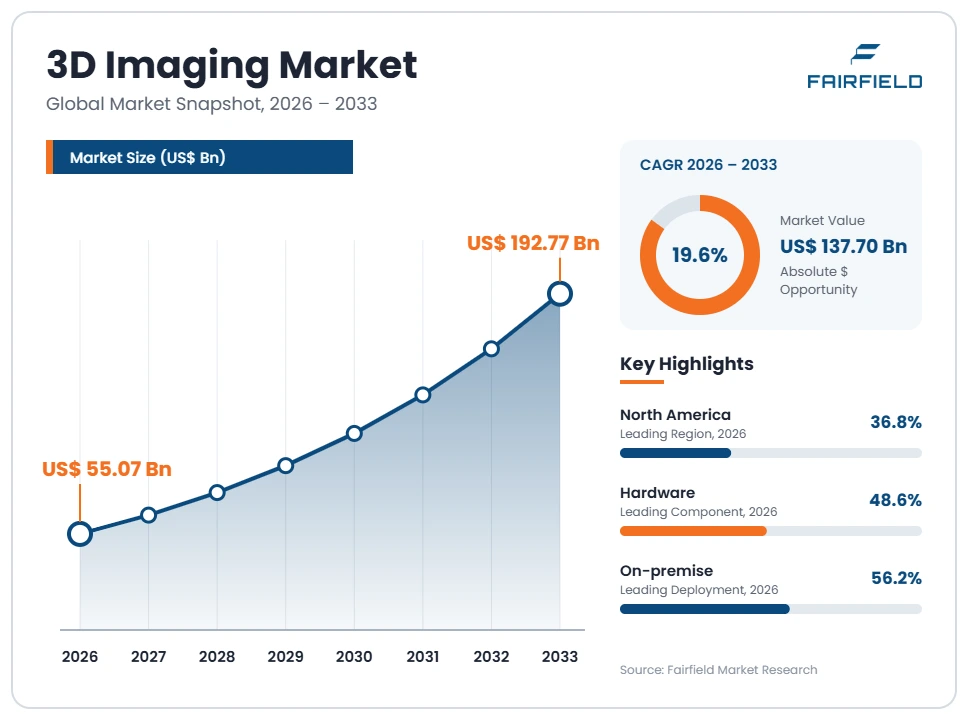
The global 3D imaging market size is expected to be valued at US$ 55.07 billion in 2026 and projected to reach US$ 192.77 billion by 2033, growing at a CAGR of 19.6% between 2026 and 2033.
Between 2020 and 2025, the market grew at a CAGR of about 17.8%, as hospitals, factories, and construction firms adopted 3D scanning, reconstruction, and visualization software. Three factors now drive growth: advanced medical imaging such as photon-counting CT, the spread of digital twins and reality capture in construction and manufacturing, and AI tools that turn point clouds and volumetric data into usable insights. The market is shifting from standalone imaging devices toward integrated platforms that combine sensors, cloud software, and analytics across the full workflow from capture to decision.
Key Report Takeaways
- By Component: Hardware held 48.6% share in 2026, while Software is projected to expand at a 22.4% CAGR through 2033, driven by AI reconstruction, visualization, and cloud-based point cloud processing.
- By Technology: Laser-based Imaging & Lidar held 31.4% share in 2026, while Depth Sensing is projected to expand at a 22.8% CAGR through 2033, driven by compact sensors in robots, phones, and vehicles.
- By Deployment: On-premise held 56.2% share in 2026, while Cloud is projected to expand at a 23.5% CAGR through 2033, driven by collaborative digital twins and remote access to large 3D datasets.
- By End Use: Healthcare & Life Sciences held 27.6% share in 2026, while Architecture & Construction is projected to expand at a 23.4% CAGR through 2033, driven by building information modeling and reality capture mandates.
- By Region: North America held 36.8% share in 2026, while Asia Pacific is projected to expand at a 22.1% CAGR through 2033, driven by manufacturing automation and hospital expansion in China and India.
Global 3D Imaging Market Trends and Insights
Drivers Impact Analysis
Two drivers carry the strongest influence on 3D imaging demand during the forecast period.
| Driver | Impact on CAGR Forecast | Geographic Relevance | Impact Timeline |
| Advanced 3D medical imaging adoption | High | North America, Europe, Asia Pacific | Medium term (2–4 years) |
| Digital twins and reality capture in industry | High | Global | Long term (≥4 years) |
Advanced Medical Imaging Is Driving Growth in the 3D Imaging Market
Advanced medical imaging is a major driver of the 3D imaging market. Hospitals use 3D CT, MRI, ultrasound, and dental cone-beam imaging to diagnose disease, plan surgery, and guide treatment.
The evidence is new technology reaching patients. In March 2026, GE HealthCare received U.S. Food and Drug Administration clearance for Photonova Spectra, a photon-counting CT system that captures spectral and ultra-high-definition images in one scan, using NVIDIA GPU computing to process much larger data volumes. In the same month, MARS Bioimaging gained clearance for a portable photon-counting CT scanner for upper extremity imaging in clinics. Siemens Healthineers pioneered clinical photon-counting CT with NAEOTOM Alpha. These systems produce detailed 3D images with lower radiation doses. Aging populations and rising cancer and heart disease rates increase demand for 3D medical imaging.
Digital Twins and Reality Capture Are Expanding Industrial 3D Imaging
Digital twins and reality capture are expanding industrial use of 3D imaging. Construction firms, manufacturers, utilities, and property managers want accurate 3D models of buildings, plants, and infrastructure.
The cause is digital transformation and efficiency pressure. Laser scanners, drones, and 3D cameras capture existing conditions quickly, and software converts the data into building information models and digital twins. These models help teams detect clashes, track progress, and plan maintenance. Major acquisitions show the strategic value of reality capture. In February 2025, CoStar Group completed its acquisition of Matterport, a digital twin platform for real estate. In July 2025, AMETEK completed its roughly US$ 920 million acquisition of FARO Technologies, a 3D measurement and imaging company. Governments that require building information modeling for public projects further support adoption.
Restraints Impact Analysis
Two restraints limit how quickly 3D imaging spreads across industries.
| Restraint | Impact on CAGR Forecast | Geographic Relevance | Impact Timeline |
| High cost of advanced systems and skills gaps | Medium | Global, strongest in emerging markets | Medium term (2–4 years) |
| Data volume, integration, and security challenges | Medium | North America, Europe | Medium term (2–4 years) |
High System Costs and Skills Gaps Limit 3D Imaging Adoption
High costs for advanced systems and shortages of skilled users limit 3D imaging adoption, especially among smaller organizations. Advanced CT scanners, MRI systems, and industrial laser scanners require large upfront investments and long payback periods.
The specific cost sources are hardware, software licenses, and training. Photon-counting CT systems and high-field MRI scanners can cost millions of dollars, plus installation and service contracts. Professional laser scanners, mobile mapping kits, and metrology systems also carry high prices. Software for processing, modeling, and analysis often requires annual subscriptions. Operating 3D imaging tools and interpreting data requires trained technicians, radiologists, surveyors, and engineers, who are in short supply in many countries. Small and medium-sized enterprises and smaller hospitals in emerging markets often cannot justify these costs, which slows adoption outside large organizations.
Data Volume and Integration Challenges Slow 3D Imaging Workflows
Large data volumes and integration challenges slow 3D imaging workflows. High-resolution scans and volumetric images create huge files that strain storage, networks, and computing resources.
The underlying causes are data size and fragmented systems. A single building scan or photon-counting CT study can easily produce many gigabytes of data. Moving, storing, and processing this data requires powerful workstations, fast networks, or cloud services. Many organizations use different software tools that do not easily share 3D data, which creates slow manual conversion steps. Medical images must also meet strict privacy rules, such as the Health Insurance Portability and Accountability Act, and industrial data may include sensitive designs. These factors raise IT costs, slow projects, and make it harder to scale 3D imaging across large organizations with many sites.
Market Opportunities
AI-Powered 3D Analysis Software Opens a High-Margin Revenue Pool
AI-powered 3D analysis software creates a high-margin revenue pool in the 3D imaging market. Organizations collect far more 3D data than they can analyze manually, so they need tools that automatically detect, measure, and classify objects and anomalies.
Software companies and imaging vendors with AI capabilities can capture this demand. In medicine, AI tools segment organs, detect tumors, and measure plaque in 3D scans, reducing radiologist workload. In construction, AI converts point clouds into building models and automatically flags deviations from design. In manufacturing, AI compares scanned parts with digital designs to find defects in seconds. Hospitals, construction firms, manufacturers, and insurers are the main customers for these tools. Subscription-based AI software creates recurring revenue and helps vendors differentiate beyond hardware, especially as sensor prices continue to fall.
Spatial Computing and Immersive Content Create a New Revenue Pool for 3D Imaging
Spatial computing and immersive content create a new revenue pool for 3D imaging. Mixed reality headsets, 3D displays, and digital commerce need large amounts of realistic 3D content of products, people, and places.
Content capture companies, software platforms, and device makers are well placed to capture this demand. Retailers use 3D product models for online shopping, configurators, and augmented reality try-ons. Media companies create volumetric video and 3D environments for games, films, sports broadcasts, and virtual events. Gaussian splatting and other new reconstruction methods let users create realistic 3D scenes from ordinary smartphone photos or videos. Technology firms such as Apple, Meta, and Google are building platforms and app ecosystems for spatial content. Retailers, media studios, game developers, advertisers, and marketers are the main customers for this content.
Segment Analysis
- By Component: Hardware Leads While Software Grows Fastest
Hardware held 48.6% share in 2026. CT and MRI scanners, ultrasound systems, laser scanners, lidar sensors, 3D cameras, and displays account for the largest share of spending. These devices carry high prices, especially in healthcare and industrial metrology, which keeps hardware the largest revenue component.
Software is the fastest-growing component, expanding at a 22.4% CAGR through 2033. Organizations need tools to process, visualize, analyze, and share 3D data. AI-based reconstruction, segmentation, and comparison features increase the value of software. Cloud platforms enable collaboration and remote access. Services, including scanning, modeling, and support, also grow as companies outsource specialized work. For the broader market, software growth shifts revenue toward recurring subscriptions and raises the importance of data platforms.
- By Technology: Laser-based Imaging & Lidar Leads While Depth Sensing Grows Fastest
Laser-based Imaging & Lidar held 31.4% share in 2026. Terrestrial laser scanners, mobile mapping systems, and lidar sensors capture precise 3D measurements for construction, surveying, mining, and autonomous vehicles. Their accuracy makes them the standard for professional reality capture.
Depth Sensing is the fastest-growing technology, expanding at a 22.8% CAGR through 2033. Compact time-of-flight and structured light sensors are built into smartphones, robots, vehicles, and extended reality headsets. Their low cost and small size allow 3D imaging in mass-market devices. Stereoscopic imaging, facial recognition, and gesture recognition also expand in security and consumer devices. For the market, depth sensing growth broadens 3D imaging from specialist tools to everyday devices, which multiplies the volume of 3D data created.
- By Deployment: On-premise Leads While Cloud Grows Fastest
On-premise held 56.2% share in 2026. Hospitals, defense agencies, and manufacturers often keep 3D data on local servers and workstations to meet security, privacy, and performance requirements. Large medical imaging archives and design data remain on-site in many organizations.
Cloud is the fastest-growing deployment mode, expanding at a 23.5% CAGR through 2033. Cloud platforms allow teams to process large datasets, share digital twins, and collaborate across locations. Construction and real estate firms use cloud tools to share scans with clients and contractors. Medical imaging providers are moving archives and AI analysis to secure clouds. For the market, cloud growth enables subscription business models and makes advanced 3D processing available to smaller organizations without large hardware investments.
- By End Use: Healthcare & Life Sciences Leads While Architecture & Construction Grows Fastest
Healthcare & Life Sciences held 27.6% share in 2026. Hospitals and clinics use 3D imaging for diagnosis, surgical planning, radiation therapy, and dental care. Advanced CT, MRI, and ultrasound systems carry high values, and new photon-counting CT systems add premium demand.
Architecture & Construction is the fastest-growing end use, expanding at a 23.4% CAGR through 2033. Builders, engineers, and owners use laser scanning, drones, and digital twins to capture site conditions, track progress, and manage assets. Governments increasingly require building information modeling for public projects. Manufacturing, automotive, media, and security also use 3D imaging for inspection, safety, content, and monitoring. For the market, construction growth adds large volumes of reality capture work and supports software and service revenue.
Geography Analysis
- Which Region Is Leading the 3D Imaging Market?
North America is leading the 3D imaging market with a 36.8% share in 2026. The United States has advanced hospitals, strong construction and manufacturing sectors, and leading technology companies such as GE HealthCare, Autodesk, Trimble, and Matterport. GE HealthCare received FDA clearance for its photon-counting CT system in March 2026. AMETEK’s acquisition of FARO in 2025 shows consolidation in 3D measurement. Canada adds steady demand from mining, oil and gas, and large infrastructure projects. One change shaping the region is the rapid use of AI tools to analyze medical and industrial 3D data.
- Europe Combines Medical Imaging Leadership and Industrial Use in the 3D Imaging Market
Europe is a major regional market with strong medical imaging and industrial sectors. Germany hosts Siemens Healthineers, while the Netherlands hosts Philips, both leaders in 3D medical imaging. Sweden’s Hexagon and France’s Dassault Systèmes lead globally in reality capture and 3D design software. The United Kingdom and several European Union countries require building information modeling for public construction projects. Leading automotive and aerospace manufacturers use 3D scanning for quality control and reverse engineering. Strict data protection rules affect cloud adoption, especially for medical images. One opportunity is digital twins for energy-efficient building renovation under European climate targets.
- Which Region Is Growing Fastest in the 3D Imaging Market?
Asia Pacific is growing fastest in the 3D imaging market at a 22.1% CAGR through 2033. China is investing in hospitals, smart factories, and infrastructure, and has strong local makers of imaging equipment and lidar. India is expanding hospital capacity, diagnostic chains, and large infrastructure projects. Japan and South Korea use 3D imaging extensively in electronics, automotive, and healthcare. Australia applies 3D scanning and lidar widely in mining and surveying. Rapid urbanization, infrastructure investment, and manufacturing growth support demand. Cost sensitivity and limited specialist staff remain challenges in smaller cities. One opportunity is affordable 3D imaging for district hospitals and construction projects.
- Latin America Expands 3D Imaging in Mining, Construction, and Healthcare
Latin America is an emerging region where mining, construction, and healthcare drive 3D imaging demand. Brazil and Mexico are investing in hospital equipment and transport infrastructure. Chile and Peru use laser scanning and lidar extensively in large copper mining operations. Colombia and Argentina add growing construction and infrastructure demand. Key barriers include high equipment costs, currency volatility, and limited numbers of trained staff. Many public hospitals still rely on older imaging systems with limited 3D capability. One opportunity is drone-based 3D mapping for mining, agriculture, and infrastructure, which offers lower costs than traditional surveying and suits large, remote areas.
- Middle East & Africa Invests in 3D Imaging for Megaprojects and Healthcare
Middle East & Africa is a developing region where megaprojects and healthcare investment drive demand. Saudi Arabia and the United Arab Emirates use 3D imaging, digital twins, and reality capture for giga-projects and smart cities. Gulf governments are also expanding hospitals with advanced CT and MRI systems. In Africa, South Africa uses 3D imaging in mining, healthcare, and infrastructure, while Morocco and Egypt invest in hospitals. Key barriers include limited skilled staff, high costs outside major cities, and reliance on imported equipment. One opportunity is digital twin platforms for Gulf smart cities, which need continuous 3D capture of buildings and infrastructure.
Competitive Landscape
The 3D imaging market is fragmented across medical, industrial, and software segments. GE HealthCare, Siemens Healthineers, Philips, and Canon Medical lead in 3D medical imaging systems for hospitals. Hexagon, Trimble, FARO, now part of AMETEK, and Topcon lead in reality capture, surveying, and measurement. Autodesk, Dassault Systèmes, Bentley Systems, and PTC provide 3D design and digital twin software. Device and chip companies such as Sony and Intel supply key sensors.
Companies compete mainly on image quality, measurement accuracy, speed, software features, AI capabilities, service networks, and integration with customer workflows. Cloud platforms, open data formats, and partner ecosystems increasingly decide customer loyalty, because customers want 3D data to flow easily between capture, design, and analysis tools. Regulatory clearances are critical for medical imaging vendors.
Strategic moves show how competition is changing. CoStar Group completed its acquisition of Matterport in February 2025, adding digital twins to its real estate platforms. AMETEK completed its roughly US$ 920 million acquisition of FARO in July 2025. GE HealthCare and MARS Bioimaging received clearances for photon-counting CT systems in March 2026. Together, these moves show companies combining hardware, software, and data to offer complete 3D solutions.
Three main themes now shape vendor strategy. First, companies are adding AI to automate analysis and reporting. Second, they are moving software to the cloud and to subscription pricing models. Third, they are consolidating hardware and software through acquisitions to offer end-to-end platforms.
Recent Industry Developments
- March 2026: GE HealthCare received FDA clearance for Photonova Spectra photon-counting CT – brings higher-resolution spectral 3D imaging to more hospitals.
- March 2026: MARS Bioimaging received FDA clearance for a portable photon-counting CT extremity scanner – extends 3D imaging into clinics.
- July 2025: AMETEK completed its acquisition of FARO Technologies – consolidates 3D measurement and imaging capabilities.
- February 2025: CoStar Group completed its acquisition of Matterport – links digital twin capture with real estate marketplaces.
Companies Covered in the Report
- GE HealthCare
- Siemens Healthineers
- Philips
- Hexagon
- Autodesk
- Trimble
- FARO Technologies (AMETEK)
- Dassault Systèmes
- Bentley Systems
- Matterport (CoStar Group)
- Sony
- Topcon
3D Imaging Market Report Scope
| Metric | Value |
| Study Period | 2020–2033 |
| Market Size 2026 | US$ 55.07 Billion |
| Market Size 2033 | US$ 192.77 Billion |
| CAGR 2026–2033 | 19.6% |
| Absolute Dollar Opportunity | US$ 137.70 Billion |
| Largest Market | North America |
| Fastest-Growing Market | Asia Pacific |
| Market Concentration | Low |
| Major Players | GE HealthCare, Siemens Healthineers, Hexagon, Autodesk, Trimble |
3D Imaging Market Segmentation
Component
- Hardware
- Software
- Services
Technology
- Laser-based Imaging & Lidar
- Depth Sensing
- Stereoscopic Imaging
- Facial & Gesture Recognition
- Others
Deployment
- On-premise
- Cloud
End Use
- Healthcare & Life Sciences
- Architecture & Construction
- Manufacturing
- Automotive
- Media & Entertainment
- Security & Surveillance
Regions
- North America
- Europe
- Asia Pacific
- Latin America
- Middle East & Africa
- Executive Summary
- Global 3D Imaging Market Snapshot
- Future Projections
- Key Report Takeaways
- Regional Snapshot
- Market Overview
- Market Definition and Report Scope
- Historical Trends 2020–2025
- Market Dynamics
- Drivers
- Advanced Medical Imaging Is Driving Growth in the 3D Imaging Market
- Digital Twins and Reality Capture Are Expanding Industrial 3D Imaging
- Restraints
- High System Costs and Skills Gaps Limit 3D Imaging Adoption
- Data Volume and Integration Challenges Slow 3D Imaging Workflows
- Market Opportunities
- AI-Powered 3D Analysis Software Opens a High-Margin Revenue Pool
- Spatial Computing and Immersive Content Create a New Revenue Pool for 3D Imaging
- Drivers
- Global 3D Imaging Market Outlook, 2020–2033
- Global 3D Imaging Market Outlook, by Component, Value (US$ Billion), 2020–2033
- Hardware
- Software
- Services
- Global 3D Imaging Market Outlook, by Technology, Value (US$ Billion), 2020–2033
- Laser-based Imaging & Lidar
- Depth Sensing
- Stereoscopic Imaging
- Facial & Gesture Recognition
- Others
- Global 3D Imaging Market Outlook, by Deployment, Value (US$ Billion), 2020–2033
- On-premise
- Cloud
- Global 3D Imaging Market Outlook, by End Use, Value (US$ Billion), 2020–2033
- Healthcare & Life Sciences
- Architecture & Construction
- Manufacturing
- Automotive
- Media & Entertainment
- Security & Surveillance
- Global 3D Imaging Market Outlook, by Region, Value (US$ Billion), 2020–2033
- North America
- Europe
- Asia Pacific
- Latin America
- Middle East & Africa
- Global 3D Imaging Market Outlook, by Component, Value (US$ Billion), 2020–2033
- North America 3D Imaging Market Outlook, 2020–2033
- North America 3D Imaging Market Outlook, by Component, Value (US$ Billion), 2020–2033
- Hardware
- Software
- Services
- North America 3D Imaging Market Outlook, by Technology, Value (US$ Billion), 2020–2033
- Laser-based Imaging & Lidar
- Depth Sensing
- Stereoscopic Imaging
- Facial & Gesture Recognition
- Others
- North America 3D Imaging Market Outlook, by Deployment, Value (US$ Billion), 2020–2033
- On-premise
- Cloud
- North America 3D Imaging Market Outlook, by End Use, Value (US$ Billion), 2020–2033
- Healthcare & Life Sciences
- Architecture & Construction
- Manufacturing
- Automotive
- Media & Entertainment
- Security & Surveillance
- North America 3D Imaging Market Outlook, by Country, Value (US$ Billion), 2020–2033
- United States 3D Imaging Market Outlook, by Component, 2020–2033
- United States 3D Imaging Market Outlook, by Technology, 2020–2033
- United States 3D Imaging Market Outlook, by Deployment, 2020–2033
- United States 3D Imaging Market Outlook, by End Use, 2020–2033
- Canada 3D Imaging Market Outlook, by Component, 2020–2033
- Canada 3D Imaging Market Outlook, by Technology, 2020–2033
- Canada 3D Imaging Market Outlook, by Deployment, 2020–2033
- Canada 3D Imaging Market Outlook, by End Use, 2020–2033
- North America 3D Imaging Market Outlook, by Component, Value (US$ Billion), 2020–2033
- Europe 3D Imaging Market Outlook, 2020–2033
- Europe 3D Imaging Market Outlook, by Component, Value (US$ Billion), 2020–2033
- Hardware
- Software
- Services
- Europe 3D Imaging Market Outlook, by Technology, Value (US$ Billion), 2020–2033
- Laser-based Imaging & Lidar
- Depth Sensing
- Stereoscopic Imaging
- Facial & Gesture Recognition
- Others
- Europe 3D Imaging Market Outlook, by Deployment, Value (US$ Billion), 2020–2033
- On-premise
- Cloud
- Europe 3D Imaging Market Outlook, by End Use, Value (US$ Billion), 2020–2033
- Healthcare & Life Sciences
- Architecture & Construction
- Manufacturing
- Automotive
- Media & Entertainment
- Security & Surveillance
- Europe 3D Imaging Market Outlook, by Country, Value (US$ Billion), 2020–2033
- Germany 3D Imaging Market Outlook, by Component, 2020–2033
- Germany 3D Imaging Market Outlook, by Technology, 2020–2033
- Germany 3D Imaging Market Outlook, by Deployment, 2020–2033
- Germany 3D Imaging Market Outlook, by End Use, 2020–2033
- Netherlands 3D Imaging Market Outlook, by Component, 2020–2033
- Netherlands 3D Imaging Market Outlook, by Technology, 2020–2033
- Netherlands 3D Imaging Market Outlook, by Deployment, 2020–2033
- Netherlands 3D Imaging Market Outlook, by End Use, 2020–2033
- Sweden 3D Imaging Market Outlook, by Component, 2020–2033
- Sweden 3D Imaging Market Outlook, by Technology, 2020–2033
- Sweden 3D Imaging Market Outlook, by Deployment, 2020–2033
- Sweden 3D Imaging Market Outlook, by End Use, 2020–2033
- France 3D Imaging Market Outlook, by Component, 2020–2033
- France 3D Imaging Market Outlook, by Technology, 2020–2033
- France 3D Imaging Market Outlook, by Deployment, 2020–2033
- France 3D Imaging Market Outlook, by End Use, 2020–2033
- United Kingdom 3D Imaging Market Outlook, by Component, 2020–2033
- United Kingdom 3D Imaging Market Outlook, by Technology, 2020–2033
- United Kingdom 3D Imaging Market Outlook, by Deployment, 2020–2033
- United Kingdom 3D Imaging Market Outlook, by End Use, 2020–2033
- Europe 3D Imaging Market Outlook, by Component, Value (US$ Billion), 2020–2033
- Asia Pacific 3D Imaging Market Outlook, 2020–2033
- Asia Pacific 3D Imaging Market Outlook, by Component, Value (US$ Billion), 2020–2033
- Hardware
- Software
- Services
- Asia Pacific 3D Imaging Market Outlook, by Technology, Value (US$ Billion), 2020–2033
- Laser-based Imaging & Lidar
- Depth Sensing
- Stereoscopic Imaging
- Facial & Gesture Recognition
- Others
- Asia Pacific 3D Imaging Market Outlook, by Deployment, Value (US$ Billion), 2020–2033
- On-premise
- Cloud
- Asia Pacific 3D Imaging Market Outlook, by End Use, Value (US$ Billion), 2020–2033
- Healthcare & Life Sciences
- Architecture & Construction
- Manufacturing
- Automotive
- Media & Entertainment
- Security & Surveillance
- Asia Pacific 3D Imaging Market Outlook, by Country, Value (US$ Billion), 2020–2033
- China 3D Imaging Market Outlook, by Component, 2020–2033
- China 3D Imaging Market Outlook, by Technology, 2020–2033
- China 3D Imaging Market Outlook, by Deployment, 2020–2033
- China 3D Imaging Market Outlook, by End Use, 2020–2033
- India 3D Imaging Market Outlook, by Component, 2020–2033
- India 3D Imaging Market Outlook, by Technology, 2020–2033
- India 3D Imaging Market Outlook, by Deployment, 2020–2033
- India 3D Imaging Market Outlook, by End Use, 2020–2033
- Japan 3D Imaging Market Outlook, by Component, 2020–2033
- Japan 3D Imaging Market Outlook, by Technology, 2020–2033
- Japan 3D Imaging Market Outlook, by Deployment, 2020–2033
- Japan 3D Imaging Market Outlook, by End Use, 2020–2033
- South Korea 3D Imaging Market Outlook, by Component, 2020–2033
- South Korea 3D Imaging Market Outlook, by Technology, 2020–2033
- South Korea 3D Imaging Market Outlook, by Deployment, 2020–2033
- South Korea 3D Imaging Market Outlook, by End Use, 2020–2033
- Australia 3D Imaging Market Outlook, by Component, 2020–2033
- Australia 3D Imaging Market Outlook, by Technology, 2020–2033
- Australia 3D Imaging Market Outlook, by Deployment, 2020–2033
- Australia 3D Imaging Market Outlook, by End Use, 2020–2033
- Asia Pacific 3D Imaging Market Outlook, by Component, Value (US$ Billion), 2020–2033
- Latin America 3D Imaging Market Outlook, 2020–2033
- Latin America 3D Imaging Market Outlook, by Component, Value (US$ Billion), 2020–2033
- Hardware
- Software
- Services
- Latin America 3D Imaging Market Outlook, by Technology, Value (US$ Billion), 2020–2033
- Laser-based Imaging & Lidar
- Depth Sensing
- Stereoscopic Imaging
- Facial & Gesture Recognition
- Others
- Latin America 3D Imaging Market Outlook, by Deployment, Value (US$ Billion), 2020–2033
- On-premise
- Cloud
- Latin America 3D Imaging Market Outlook, by End Use, Value (US$ Billion), 2020–2033
- Healthcare & Life Sciences
- Architecture & Construction
- Manufacturing
- Automotive
- Media & Entertainment
- Security & Surveillance
- Latin America 3D Imaging Market Outlook, by Country, Value (US$ Billion), 2020–2033
- Brazil 3D Imaging Market Outlook, by Component, 2020–2033
- Brazil 3D Imaging Market Outlook, by Technology, 2020–2033
- Brazil 3D Imaging Market Outlook, by Deployment, 2020–2033
- Brazil 3D Imaging Market Outlook, by End Use, 2020–2033
- Mexico 3D Imaging Market Outlook, by Component, 2020–2033
- Mexico 3D Imaging Market Outlook, by Technology, 2020–2033
- Mexico 3D Imaging Market Outlook, by Deployment, 2020–2033
- Mexico 3D Imaging Market Outlook, by End Use, 2020–2033
- Chile 3D Imaging Market Outlook, by Component, 2020–2033
- Chile 3D Imaging Market Outlook, by Technology, 2020–2033
- Chile 3D Imaging Market Outlook, by Deployment, 2020–2033
- Chile 3D Imaging Market Outlook, by End Use, 2020–2033
- Peru 3D Imaging Market Outlook, by Component, 2020–2033
- Peru 3D Imaging Market Outlook, by Technology, 2020–2033
- Peru 3D Imaging Market Outlook, by Deployment, 2020–2033
- Peru 3D Imaging Market Outlook, by End Use, 2020–2033
- Colombia 3D Imaging Market Outlook, by Component, 2020–2033
- Colombia 3D Imaging Market Outlook, by Technology, 2020–2033
- Colombia 3D Imaging Market Outlook, by Deployment, 2020–2033
- Colombia 3D Imaging Market Outlook, by End Use, 2020–2033
- Argentina 3D Imaging Market Outlook, by Component, 2020–2033
- Argentina 3D Imaging Market Outlook, by Technology, 2020–2033
- Argentina 3D Imaging Market Outlook, by Deployment, 2020–2033
- Argentina 3D Imaging Market Outlook, by End Use, 2020–2033
- Latin America 3D Imaging Market Outlook, by Component, Value (US$ Billion), 2020–2033
- Middle East & Africa 3D Imaging Market Outlook, 2020–2033
- Middle East & Africa 3D Imaging Market Outlook, by Component, Value (US$ Billion), 2020–2033
- Hardware
- Software
- Services
- Middle East & Africa 3D Imaging Market Outlook, by Technology, Value (US$ Billion), 2020–2033
- Laser-based Imaging & Lidar
- Depth Sensing
- Stereoscopic Imaging
- Facial & Gesture Recognition
- Others
- Middle East & Africa 3D Imaging Market Outlook, by Deployment, Value (US$ Billion), 2020–2033
- On-premise
- Cloud
- Middle East & Africa 3D Imaging Market Outlook, by End Use, Value (US$ Billion), 2020–2033
- Healthcare & Life Sciences
- Architecture & Construction
- Manufacturing
- Automotive
- Media & Entertainment
- Security & Surveillance
- Middle East & Africa 3D Imaging Market Outlook, by Country, Value (US$ Billion), 2020–2033
- Saudi Arabia 3D Imaging Market Outlook, by Component, 2020–2033
- Saudi Arabia 3D Imaging Market Outlook, by Technology, 2020–2033
- Saudi Arabia 3D Imaging Market Outlook, by Deployment, 2020–2033
- Saudi Arabia 3D Imaging Market Outlook, by End Use, 2020–2033
- United Arab Emirates 3D Imaging Market Outlook, by Component, 2020–2033
- United Arab Emirates 3D Imaging Market Outlook, by Technology, 2020–2033
- United Arab Emirates 3D Imaging Market Outlook, by Deployment, 2020–2033
- United Arab Emirates 3D Imaging Market Outlook, by End Use, 2020–2033
- South Africa 3D Imaging Market Outlook, by Component, 2020–2033
- South Africa 3D Imaging Market Outlook, by Technology, 2020–2033
- South Africa 3D Imaging Market Outlook, by Deployment, 2020–2033
- South Africa 3D Imaging Market Outlook, by End Use, 2020–2033
- Morocco 3D Imaging Market Outlook, by Component, 2020–2033
- Morocco 3D Imaging Market Outlook, by Technology, 2020–2033
- Morocco 3D Imaging Market Outlook, by Deployment, 2020–2033
- Morocco 3D Imaging Market Outlook, by End Use, 2020–2033
- Egypt 3D Imaging Market Outlook, by Component, 2020–2033
- Egypt 3D Imaging Market Outlook, by Technology, 2020–2033
- Egypt 3D Imaging Market Outlook, by Deployment, 2020–2033
- Egypt 3D Imaging Market Outlook, by End Use, 2020–2033
- Middle East & Africa 3D Imaging Market Outlook, by Component, Value (US$ Billion), 2020–2033
- Competitive Landscape
- Market Concentration and Industry Leaders
- Competitive Differentiation
- Strategic Moves and Market Direction
- Recent Industry Developments
- Company Profiles
- GE HealthCare
- Siemens Healthineers
- Philips
- Hexagon
- Autodesk
- Trimble
- FARO Technologies (AMETEK)
- Dassault Systèmes
- Bentley Systems
- Matterport (CoStar Group)
- Sony
- Topcon
- Appendix
- Research Methodology
- Report Assumptions
- Acronyms and Abbreviations
Component
- Hardware
- Software
- Services
Technology
- Laser-based Imaging & Lidar
- Depth Sensing
- Stereoscopic Imaging
- Facial & Gesture Recognition
- Others
Deployment
- On-premise
- Cloud
End Use
- Healthcare & Life Sciences
- Architecture & Construction
- Manufacturing
- Automotive
- Media & Entertainment
- Security & Surveillance
Regions
- North America
- Europe
- Asia Pacific
- Latin America
- Middle East & Africa
Our Research Methodology
Considering the volatility of business today, traditional approaches to strategizing a game plan can be unfruitful if not detrimental. True ambiguity is no way to determine a forecast. A myriad of predetermined factors must be accounted for such as the degree of risk involved, the magnitude of circumstances, as well as conditions or consequences that are not known or unpredictable. To circumvent binary views that cast uncertainty, the application of market research intelligence to strategically posture, move, and enable actionable outcomes is necessary.
View Methodology
Quality Assured
Rigorous Validation Process

Confidentiality Assured
End-to-end Data Security

Custom Research Services
Tailored To Your Objectives
FAQs
The 3D imaging market is valued at US$ 55.07 billion in 2026, led by hardware used in healthcare and industry.
The market is projected to reach US$ 192.77 billion by 2033, growing at a 19.6% CAGR and adding US$ 137.70 billion.
Architecture & Construction is growing fastest at a 23.4% CAGR through 2033, driven by building information modeling and reality capture.
Asia Pacific is growing fastest at a 22.1% CAGR through 2033, driven by manufacturing automation and hospital expansion.
North America holds the largest share at 36.8% in 2026, supported by advanced hospitals and leading 3D technology companies.
Related Reports
3D IC and 2.5D IC Packaging Market Size, Share, Insights, Competitive Landscape, and Forecast 2026 to 2033
The global 3D IC and 2.5D IC packaging market is valued at US$75.31 billion in 2026, reaching US$154.89 billion by 2033, growing at a 10.9% CAGR
3D Glasses Market Size, Share, Insights, Competitive Landscape, and Forecast 2026 to 2033
The global 3D glasses market is valued at US$16.65 billion in 2026, reaching US$22.06 billion by 2033, growing at a 4.1% CAGR
3D Electronics / Additive Electronics Market Size, Share, Insights, Competitive Landscape, and Forecast 2026 to 2033
The global 3D electronics / additive electronics market is valued at US$1.2 billion in 2026, reaching US$3.8 billion by 2033, growing at a 17.9% CAGR
3D Display Market Size, Share, Insights, Competitive Landscape, and Forecast 2026 to 2033
The global 3D display market is valued at US$8.5 billion in 2026, reaching US$18.9 billion by 2033, growing at a 12.1% CAGR
360 Degree Camera Market Size, Share, Insights, Competitive Landscape, and Forecast 2026 to 2033
The global 360 degree camera market is valued at US$1.86 billion in 2026, reaching US$4.20 billion by 2033, growing at a 12.3% CAGR
3D Camera Market Size, Share, Insights, Competitive Landscape, and Forecast 2026 to 2033
The global 3D camera market is valued at US$1.86 billion in 2026, reaching US$5.58 billion by 2033, growing at a 17.0% CAGR