



Agrochemicals Market
Agrochemicals Market Insights, Competitive Landscape, and Market Forecast - 2033
The Agrochemicals Market is valued at USD 252.1 Bn in 2026 and is projected to reach USD 364.3 Bn, growing at a CAGR of 5% by 2033.
Agrochemicals Market Insights
A Look Back and a Look Forward - Comparative Analysis
The agrochemicals market demonstrated steady growth during the historical period from 2019 to 2024, driven by increasing global food demand and shrinking arable land. Crop protection chemicals, particularly herbicides and insecticides, gained traction as farmers sought to protect crops from pests and weeds. Regulatory advancements and technological innovations also supported market expansion during this period.
The market is projected to experience accelerated growth over the forecast period, driven by innovations in bio-based agrochemicals and the adoption of sustainable farming practices. The crop protection segment is likely to witness higher growth due to increased demand for eco-friendly pesticides and herbicides. Advanced nutrient formulations in fertilizers will address environmental concerns and promote precision agriculture.
Emerging markets in Africa and Southeast Asia will play a pivotal role in sustaining growth, supported by government subsidies and infrastructure development in agriculture.
Key Growth Determinants
- Growing Pest and Disease Infestations Due to Climate Change
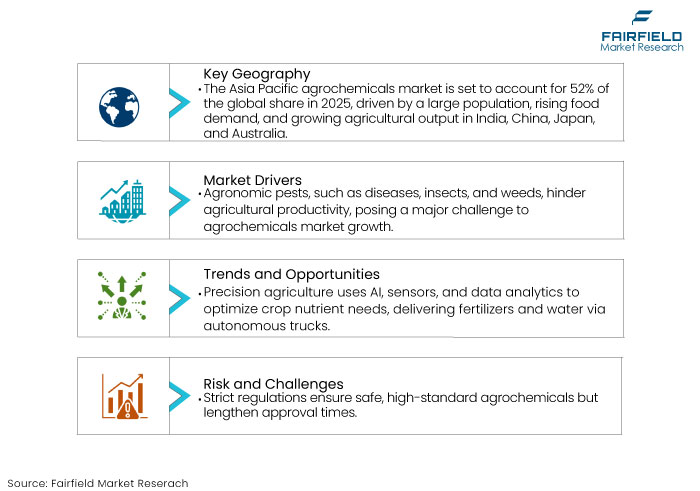
The proliferation of agronomic pests, including diseases, insects, and weeds, poses a significant threat to agricultural productivity and global food output. This factor remains a key barrier for agrochemicals market growth.
Climate change effects have worsened the situation, altering the ecosystem and resulting in new challenges for pest management in leading farming systems. The alteration in precipitation patterns and increasing temperatures need the development of innovative and efficient chemicals for crop protection.
A change in precipitation patterns that increases humidity and moisture can precipitate fungal epidemics in crops such as rice and wheat, necessitating more advanced fungicides. Elevated CO2 concentrations can increase aphid populations on soybean plants, necessitating improved pesticides and integrated pest management approaches.
Weeds, animal pests, and illnesses significantly contribute to these losses. Pests typically diminish global yields by 20-40%, resulting in an economic loss of approximately USD 300 billion worldwide.
-
Increasing Global Food Demand Remains a Key Driver
The global population is projected to exceed 10 billion by 2050, creating immense pressure on agricultural systems to produce more food. With finite arable land and escalating food demand, agrochemicals and crop protection products have become indispensable.
Fertilizers, particularly nitrogen-based variants, are critical in replenishing soil nutrients and enhancing crop productivity. These products enable farmers to achieve higher yields per unit of land, a necessity given the constraints on expanding agricultural areas.
Developing regions, such as Asia Pacific, are experiencing rapid urbanization, further reducing the availability of farmland. Governments and private stakeholders have invested significantly in fertilizer distribution networks and subsidization programs to support smallholder farmers in countries like India and China.
Crop protection chemicals like pesticides and herbicides play a vital role in safeguarding yields. Pests, weeds, and diseases threaten up to 40% of global crop production annually, and the increasing reliance on agrochemicals has been pivotal in mitigating these losses. Thus, the need for sustainable yet effective agrochemical solutions continues to drive market growth globally.
Key Growth Barriers
- Stringent Regulatory Policies to Constrain Market Growth
Stringent regulatory frameworks necessitate the development of comprehensive environmental, health, and safety profiles for each new agrochemical product, which must adhere to these profiles for safety and efficacy. Such laws guarantee the circulation of items with high standards; nonetheless, they contribute to prolonged approval durations.
The lengthy and intricate method postpones the market introduction of novel products, elevating expenses for producers required to perform studies, trials, and compliance activities.
In Europe, plant protection goods undergo an authorization process by Regulation No. (EC) 1107/2009 delineates the approval duration for active chemicals and the EU-level authorization for plant protection products.
The outcome would entail comprehensively evaluating the product's safety, efficacy, and environmental effects. Issuing a regulation that either grants or denies approval for the initial authorization of an active substance, safeness, or synergists significantly restricts agrochemicals market growth.
- Expanding Share of Organic Fertilizers May Impede Demand
The market for organic food in developing nations has been swiftly growing due to increased awareness of the significance of compliance with health standards, food safety, environmental protection, and animal welfare.
The consumption of organic food is experiencing an increasing trend in popularity. The anticipated increase in demand for nutritious and safe food is expected to propel the organic food sector and enhance the utilization of bio fertilizers. Also, the growth of the organic fertilizer business will counteract the increase in the global market in the upcoming decade, which eventually hampers the market share of agrochemicals globally.
Agrochemicals Market Trends and Opportunities
- Utilization of Agrochemicals in Precision Agriculture Boosts Sales
The subsequent instruments of precision agriculture assist farmers in assessing the nutrient requirements of crops. Precision farming integrates data analytics, artificial intelligence, and sensor systems to ascertain the precise quantities of fertilizer and water needed by plants at specific times, utilizing autonomous trucks for the targeted delivery of nutrients.
Fertilizers are essential for enhancing soil productivity. Excessive fertilizing, however, can result in severe consequences for soil health. In 2022, researchers at Imperial College London developed an innovative predictive testing kit.
The kit enables farmers to ascertain the current levels of ammonia and nitrate in the soil and potential future concentrations influenced by climatic conditions. It can assist in customizing the fertilizer to specific soil and crop requirements, eventually aiding farmers in their farm produce.
- Advancements in Research by the Agricultural and Chemical Sectors
Research has revealed that insecticides and pesticides facilitate accelerated crop development. Creating synthetic pesticides to expedite planting and growing has greatly enhanced the agrochemicals market growth. Several agricultural experts believe utilizing organic fertilizers is one of the most effective methods to enhance crop yields.
Agriculturalists have an obligation to optimize the utilization of their resources. Organizations exert substantial effort to procure seeds and fertilizers of the utmost quality. Such advancements in research by the agriculture and chemical sectors present profitable opportunities for the growth of the market throughout the forecast period.
How Does Regulatory Scenario Shape the Industry?
The regulatory environment plays a crucial role in shaping the agrochemicals market, balancing agricultural productivity with environmental and health concerns. Governments and international organizations have introduced stringent regulations governing agrochemical production, distribution, and application to minimize ecological and human health risks.
Regulatory frameworks in regions like the European Union emphasize sustainability, encouraging the use of bio-based and organic agrochemicals. The EU’s Green Deal and Farm to Fork Strategy aim to reduce chemical pesticide use by 50% by 2030.
In emerging economies, regulatory bodies are focusing on improving product standards and combating counterfeit agrochemicals to ensure safe usage. At the same time, governments are incentivizing innovations in sustainable agrochemical solutions through research and development subsidies and certification programs.
The evolving regulations challenge traditional manufacturers to adapt while fostering opportunities for eco-friendly and precision agriculture solutions. Consequently, reshaping the market toward sustainability and innovation.
Segments Covered in the Report
- Fertilizers Being Essential in Promoting Plant Growth Accounts for a Notable Market Share
Fertilizers constitute a substantial segment of the market, driven by the increasing demand for food production to support a growing global population.Nitrogenous Fertilizers, such as urea and ammonium nitrate, are extensively used to enhance soil fertility and boost agricultural productivity. Their application improves crop yields, making them indispensable in modern farming practices.
Fertilizers, particularly nitrogen-based types, will continue to dominate the agrochemicals market over the forecast period. Their essential role in enhancing crop productivity positions them as a cornerstone in meeting the escalating global food demand.
As per reports, in 2022-2023, India's estimated urea consumption was 35.73 million metric tons, reflecting a 4.5% increase from the previous year, which shows the dominance of fertilizers in the agrochemicals market
- Cereals Crop Type Dominates with 48% of the Market Share
Cereal crop type leads the market share with a 48% market share owing to the increasing consumption of cereals and grains, including rice, wheat, rye, corn, oats, sorghum, and barley in diverse locations. Agrochemicals are primarily utilized for cereals in Asia Pacific and North America, attributed to the extensive growth of wheat and corn in nations such as China and the United States.
Non-ionic surfactants, in conjunction with agrochemicals, are predominantly advised for cereals and grains. Reports indicate that worldwide grain use for 2025 is expected to increase relative to prior years. Global cereal stocks are projected to increase by 2025, which indicates a consistent provision of cereals to satisfy demand.
The increasing demand for cereals underscores the necessity of enhancing agricultural production, which may result in a growing application of agrochemicals to maximize yields and satisfy global needs.
Regional Analysis
- Asia Pacific’s Dominance Prevails in Agrochemicals Market
Asia Pacific agrochemicals market accounts for 52% of total market share in 2025, ascribed to the substantial population, escalating food consumption, and increased agricultural output, especially in nations such as India, China, Japan, and Australia.
According to Baojing Gu, a researcher from the University of Melbourne and Zhejiang, China significantly influences pesticide utilization. It represents approximately 30% of global pesticide and fertilizer usage and provides over 90% of the world's technical raw material requirements.
China is a prominent player in the global fertilizer and pesticide sector, serving as a leading user, exporter, and manufacturer of these agricultural products. The nation's significant utilization of fertilizers and agrochemicals is propelled by its substantial agricultural production, which is essential for satisfying the needs of an expanding populace.
As the need for food grains and other agricultural goods escalates, so does the necessity for fertilizers and agrochemicals.
- North America Agrochemicals Market Emerges Lucrative
The presence of numerous agrochemical firms makes North American one of the notably growing regions in the market. Owing to rigorous environmental restrictions, North America is anticipated to become the foremost market for organic agrochemicals, encompassing bio-fertilizers and bio-pesticides.
The expanding dairy sector and conducive climatic conditions for crops like corn and maize have been the primary catalysts for the market in this region. The existence of agrochemical manufacturers in the U.S. substantially influences the market by diminishing reliance on foreign agrochemical imports. It enables farmers and enterprises in the agricultural industry to obtain items within their local market.
The increasing consumer inclination towards organically produced foods compels corporations to concentrate on creating bio-based, environmentally sustainable agrochemical goods, such as organo-modified siloxanes, modified vegetable oils, and methylated seed oil.
Fairfield’s Competitive Landscape Analysis
The agrochemicals market is highly competitive, dominated by multinational corporations and regional players. Key industry leaders include Bayer AG, BASF SE, Syngenta AG, Corteva Agriscience, and FMC Corporation.
Companies focus on extensive research and development to innovate bio-based and sustainable agrochemical solutions, aligning with strict regulatory norms and environmental concerns. Strategic mergers, acquisitions, and partnerships have strengthened market positions. Regional players in Asia Pacific and Latin America leverage cost advantages to effectively serve local markets.
Digital agriculture platforms and precision farming innovations are becoming critical differentiators, enabling companies to offer integrated solutions that optimize agrochemical usage and improve farm productivity.
Key Market Companies
- Bayer AG
- YARA International ASA
- BASF SE
- Israel Chemicals Ltd.
- Nutrien Ltd.
- FMC Corporation
- The Mosaic Company
- Fengro Industries Corp.
- PhosAgro
- DowDuPont Inc.
- OCI N.V.
- Fertilizantes Heringer S.A.
- WinHarvest Pty Ltd
- Syngenta AG
- K+S KALI GmbH
- Saudi Arabia Fertilizer Company (SAFCO)
- Jordan Abyad Fertilizers and Chemicals Company
An Expert’s Eye
- Growing consensus on the need for sustainable and bio-based agrochemicals to align with regulatory trends and environmental goals.
- Precision agriculture and digital tools are increasingly seen as transformative, enabling efficient agrochemical usage and enhanced crop productivity.
- Analysts highlight the significant growth potential in emerging economies due to increased government subsidies and expanding agricultural infrastructure.
- A trend of mergers and acquisitions is viewed as a strategy to expand portfolios and address changing market dynamics.
Global Agrochemicals Market is Segmented as-
By Product Type
- Fertilizers
- Nitrogen Based
- Potassium Based
- Phosphorous Based
- Others
- Pesticides
- Insecticides
- Fungicides
- Herbicides
- Bactericides
- Others
By Crop Type
- Cereals
- Pulses and Oilseeds
- Fruits and Vegetables
- Lawns and Turfs
- Others
By Application
- Crop Protection
- Foliar Spray
- Soil Treatment
- Seed Treatment
- Crop Nutrition
By Region
- North America
- Europe
- Asia Pacific
- Latin America
- The Middle East & Africa
- Executive Summary
- Global Agrochemicals Market Snapshot
- Future Projections
- Key Market Trends
- Regional Snapshot, by Value, 2026
- Analyst Recommendations
- Market Overview
- Market Definitions and Segmentations
- Market Dynamics
- Drivers
- Restraints
- Market Opportunities
- Value Chain Analysis
- COVID-19 Impact Analysis
- Porter's Five Forces Analysis
- Impact of Russia-Ukraine Conflict
- PESTLE Analysis
- Regulatory Analysis
- Price Trend Analysis
- Current Prices and Future Projections, 2025-2033
- Price Impact Factors
- Global Agrochemicals Market Outlook, 2020 - 2033
- Global Agrochemicals Market Outlook, by Product Type, Value (US$ Mn), 2020-2033
- Fertilizers
- Nitrogen Based
- Potassium Based
- Phosphorous Based
- Others
- Pesticides
- Insecticides
- Fungicides
- Herbicides
- Bactericides
- Others
- Global Agrochemicals Market Outlook, by Crop Type, Value (US$ Mn), 2020-2033
- Cereals
- Pulses and Oilseeds
- Fruits and Vegetables
- Lawns and Turfs
- Others
- Global Agrochemicals Market Outlook, by Application, Value (US$ Mn), 2020-2033
- Crop Protection
- Crop Nutrition
- Global Agrochemicals Market Outlook, by Region, Value (US$ Mn), 2020-2033
- North America
- Europe
- Asia Pacific
- Latin America
- Middle East & Africa
- Fertilizers
- Global Agrochemicals Market Outlook, by Product Type, Value (US$ Mn), 2020-2033
- North America Agrochemicals Market Outlook, 2020 - 2033
- North America Agrochemicals Market Outlook, by Product Type, Value (US$ Mn), 2020-2033
- Fertilizers
- Nitrogen Based
- Potassium Based
- Phosphorous Based
- Others
- Pesticides
- Insecticides
- Fungicides
- Herbicides
- Bactericides
- Others
- North America Agrochemicals Market Outlook, by Crop Type, Value (US$ Mn), 2020-2033
- Cereals
- Pulses and Oilseeds
- Fruits and Vegetables
- Lawns and Turfs
- Others
- North America Agrochemicals Market Outlook, by Application, Value (US$ Mn), 2020-2033
- Crop Protection
- Crop Nutrition
- North America Agrochemicals Market Outlook, by Country, Value (US$ Mn), 2020-2033
- U.S. Agrochemicals Market Outlook, by Product Type, 2020-2033
- U.S. Agrochemicals Market Outlook, by Crop Type, 2020-2033
- U.S. Agrochemicals Market Outlook, by Application, 2020-2033
- Canada Agrochemicals Market Outlook, by Product Type, 2020-2033
- Canada Agrochemicals Market Outlook, by Crop Type, 2020-2033
- Canada Agrochemicals Market Outlook, by Application, 2020-2033
- BPS Analysis/Market Attractiveness Analysis
- Fertilizers
- North America Agrochemicals Market Outlook, by Product Type, Value (US$ Mn), 2020-2033
- Europe Agrochemicals Market Outlook, 2020 - 2033
- Europe Agrochemicals Market Outlook, by Product Type, Value (US$ Mn), 2020-2033
- Fertilizers
- Nitrogen Based
- Potassium Based
- Phosphorous Based
- Others
- Pesticides
- Insecticides
- Fungicides
- Herbicides
- Bactericides
- Others
- Europe Agrochemicals Market Outlook, by Crop Type, Value (US$ Mn), 2020-2033
- Cereals
- Pulses and Oilseeds
- Fruits and Vegetables
- Lawns and Turfs
- Others
- Europe Agrochemicals Market Outlook, by Application, Value (US$ Mn), 2020-2033
- Crop Protection
- Crop Nutrition
- Europe Agrochemicals Market Outlook, by Country, Value (US$ Mn), 2020-2033
- Germany Agrochemicals Market Outlook, by Product Type, 2020-2033
- Germany Agrochemicals Market Outlook, by Crop Type, 2020-2033
- Germany Agrochemicals Market Outlook, by Application, 2020-2033
- Italy Agrochemicals Market Outlook, by Product Type, 2020-2033
- Italy Agrochemicals Market Outlook, by Crop Type, 2020-2033
- Italy Agrochemicals Market Outlook, by Application, 2020-2033
- France Agrochemicals Market Outlook, by Product Type, 2020-2033
- France Agrochemicals Market Outlook, by Crop Type, 2020-2033
- France Agrochemicals Market Outlook, by Application, 2020-2033
- U.K. Agrochemicals Market Outlook, by Product Type, 2020-2033
- U.K. Agrochemicals Market Outlook, by Crop Type, 2020-2033
- U.K. Agrochemicals Market Outlook, by Application, 2020-2033
- Spain Agrochemicals Market Outlook, by Product Type, 2020-2033
- Spain Agrochemicals Market Outlook, by Crop Type, 2020-2033
- Spain Agrochemicals Market Outlook, by Application, 2020-2033
- Russia Agrochemicals Market Outlook, by Product Type, 2020-2033
- Russia Agrochemicals Market Outlook, by Crop Type, 2020-2033
- Russia Agrochemicals Market Outlook, by Application, 2020-2033
- Rest of Europe Agrochemicals Market Outlook, by Product Type, 2020-2033
- Rest of Europe Agrochemicals Market Outlook, by Crop Type, 2020-2033
- Rest of Europe Agrochemicals Market Outlook, by Application, 2020-2033
- BPS Analysis/Market Attractiveness Analysis
- Fertilizers
- Europe Agrochemicals Market Outlook, by Product Type, Value (US$ Mn), 2020-2033
- Asia Pacific Agrochemicals Market Outlook, 2020 - 2033
- Asia Pacific Agrochemicals Market Outlook, by Product Type, Value (US$ Mn), 2020-2033
- Fertilizers
- Nitrogen Based
- Potassium Based
- Phosphorous Based
- Others
- Pesticides
- Insecticides
- Fungicides
- Herbicides
- Bactericides
- Others
- Asia Pacific Agrochemicals Market Outlook, by Crop Type, Value (US$ Mn), 2020-2033
- Cereals
- Pulses and Oilseeds
- Fruits and Vegetables
- Lawns and Turfs
- Others
- Asia Pacific Agrochemicals Market Outlook, by Application, Value (US$ Mn), 2020-2033
- Crop Protection
- Crop Nutrition
- Asia Pacific Agrochemicals Market Outlook, by Country, Value (US$ Mn), 2020-2033
- China Agrochemicals Market Outlook, by Product Type, 2020-2033
- China Agrochemicals Market Outlook, by Crop Type, 2020-2033
- China Agrochemicals Market Outlook, by Application, 2020-2033
- Japan Agrochemicals Market Outlook, by Product Type, 2020-2033
- Japan Agrochemicals Market Outlook, by Crop Type, 2020-2033
- Japan Agrochemicals Market Outlook, by Application, 2020-2033
- South Korea Agrochemicals Market Outlook, by Product Type, 2020-2033
- South Korea Agrochemicals Market Outlook, by Crop Type, 2020-2033
- South Korea Agrochemicals Market Outlook, by Application, 2020-2033
- India Agrochemicals Market Outlook, by Product Type, 2020-2033
- India Agrochemicals Market Outlook, by Crop Type, 2020-2033
- India Agrochemicals Market Outlook, by Application, 2020-2033
- Southeast Asia Agrochemicals Market Outlook, by Product Type, 2020-2033
- Southeast Asia Agrochemicals Market Outlook, by Crop Type, 2020-2033
- Southeast Asia Agrochemicals Market Outlook, by Application, 2020-2033
- Rest of SAO Agrochemicals Market Outlook, by Product Type, 2020-2033
- Rest of SAO Agrochemicals Market Outlook, by Crop Type, 2020-2033
- Rest of SAO Agrochemicals Market Outlook, by Application, 2020-2033
- BPS Analysis/Market Attractiveness Analysis
- Fertilizers
- Asia Pacific Agrochemicals Market Outlook, by Product Type, Value (US$ Mn), 2020-2033
- Latin America Agrochemicals Market Outlook, 2020 - 2033
- Latin America Agrochemicals Market Outlook, by Product Type, Value (US$ Mn), 2020-2033
- Fertilizers
- Nitrogen Based
- Potassium Based
- Phosphorous Based
- Others
- Pesticides
- Insecticides
- Fungicides
- Herbicides
- Bactericides
- Others
- Latin America Agrochemicals Market Outlook, by Crop Type, Value (US$ Mn), 2020-2033
- Cereals
- Pulses and Oilseeds
- Fruits and Vegetables
- Lawns and Turfs
- Others
- Latin America Agrochemicals Market Outlook, by Application, Value (US$ Mn), 2020-2033
- Crop Protection
- Crop Nutrition
- Latin America Agrochemicals Market Outlook, by Country, Value (US$ Mn), 2020-2033
- Brazil Agrochemicals Market Outlook, by Product Type, 2020-2033
- Brazil Agrochemicals Market Outlook, by Crop Type, 2020-2033
- Brazil Agrochemicals Market Outlook, by Application, 2020-2033
- Mexico Agrochemicals Market Outlook, by Product Type, 2020-2033
- Mexico Agrochemicals Market Outlook, by Crop Type, 2020-2033
- Mexico Agrochemicals Market Outlook, by Application, 2020-2033
- Argentina Agrochemicals Market Outlook, by Product Type, 2020-2033
- Argentina Agrochemicals Market Outlook, by Crop Type, 2020-2033
- Argentina Agrochemicals Market Outlook, by Application, 2020-2033
- Rest of LATAM Agrochemicals Market Outlook, by Product Type, 2020-2033
- Rest of LATAM Agrochemicals Market Outlook, by Crop Type, 2020-2033
- Rest of LATAM Agrochemicals Market Outlook, by Application, 2020-2033
- BPS Analysis/Market Attractiveness Analysis
- Fertilizers
- Latin America Agrochemicals Market Outlook, by Product Type, Value (US$ Mn), 2020-2033
- Middle East & Africa Agrochemicals Market Outlook, 2020 - 2033
- Middle East & Africa Agrochemicals Market Outlook, by Product Type, Value (US$ Mn), 2020-2033
- Fertilizers
- Nitrogen Based
- Potassium Based
- Phosphorous Based
- Others
- Pesticides
- Insecticides
- Fungicides
- Herbicides
- Bactericides
- Others
- Middle East & Africa Agrochemicals Market Outlook, by Crop Type, Value (US$ Mn), 2020-2033
- Cereals
- Pulses and Oilseeds
- Fruits and Vegetables
- Lawns and Turfs
- Others
- Middle East & Africa Agrochemicals Market Outlook, by Application, Value (US$ Mn), 2020-2033
- Crop Protection
- Crop Nutrition
- Middle East & Africa Agrochemicals Market Outlook, by Country, Value (US$ Mn), 2020-2033
- GCC Agrochemicals Market Outlook, by Product Type, 2020-2033
- GCC Agrochemicals Market Outlook, by Crop Type, 2020-2033
- GCC Agrochemicals Market Outlook, by Application, 2020-2033
- South Africa Agrochemicals Market Outlook, by Product Type, 2020-2033
- South Africa Agrochemicals Market Outlook, by Crop Type, 2020-2033
- South Africa Agrochemicals Market Outlook, by Application, 2020-2033
- Egypt Agrochemicals Market Outlook, by Product Type, 2020-2033
- Egypt Agrochemicals Market Outlook, by Crop Type, 2020-2033
- Egypt Agrochemicals Market Outlook, by Application, 2020-2033
- Nigeria Agrochemicals Market Outlook, by Product Type, 2020-2033
- Nigeria Agrochemicals Market Outlook, by Crop Type, 2020-2033
- Nigeria Agrochemicals Market Outlook, by Application, 2020-2033
- Rest of Middle East Agrochemicals Market Outlook, by Product Type, 2020-2033
- Rest of Middle East Agrochemicals Market Outlook, by Crop Type, 2020-2033
- Rest of Middle East Agrochemicals Market Outlook, by Application, 2020-2033
- BPS Analysis/Market Attractiveness Analysis
- Fertilizers
- Middle East & Africa Agrochemicals Market Outlook, by Product Type, Value (US$ Mn), 2020-2033
- Competitive Landscape
- Company Vs Segment Heatmap
- Company Market Share Analysis, 2025
- Competitive Dashboard
- Company Profiles
- Bayer AG
- Company Overview
- Product Portfolio
- Financial Overview
- Business Strategies and Developments
- YARA International ASA
- BASF SE
- Israel Chemicals Ltd.
- Nutrien Ltd.
- FMC Corporation
- The Mosaic Company
- Fengro Industries Corp.
- PhosAgro
- DowDuPont Inc.
- Bayer AG
- Appendix
- Research Methodology
- Report Assumptions
- Acronyms and Abbreviations
|
BASE YEAR |
HISTORICAL DATA |
FORECAST PERIOD |
UNITS |
|||
 |
2025 |
 |
2019 - 2024 |
 |
2026 - 2033 |
Value: US$ Million |
|
REPORT FEATURES |
DETAILS |
|
Product Type Coverage |
|
|
Crop Type Coverage |
|
|
Application Coverage |
|
|
Geographical Coverage |
|
|
Leading Companies |
|
|
Report Highlights |
Key Market Indicators, Macro-micro economic impact analysis, Technological Roadmap, Key Trends, Driver, Restraints, and Future Opportunities & Revenue Pockets, Porter’s 5 Forces Analysis, Historical Trend (2019-2021), Market Estimates and Forecast, Market Dynamics, Industry Trends, Competition Landscape, Category, Region, Country-wise Trends & Analysis, COVID-19 Impact Analysis (Demand and Supply Chain) |
Our Research Methodology
Considering the volatility of business today, traditional approaches to strategizing a game plan can be unfruitful if not detrimental. True ambiguity is no way to determine a forecast. A myriad of predetermined factors must be accounted for such as the degree of risk involved, the magnitude of circumstances, as well as conditions or consequences that are not known or unpredictable. To circumvent binary views that cast uncertainty, the application of market research intelligence to strategically posture, move, and enable actionable outcomes is necessary.
View Methodology
Quality Assured
Rigorous Validation Process

Confidentiality Assured
End-to-end Data Security

Custom Research Services
Tailored To Your Objectives
FAQs
The market size is anticipated to be USD 252.1 Bn in 2026.
Syngenta is considered the largest producer of agrochemicals with sales reaching US$ 32.2 Bn, as of 2023.
Bayer Crop Science is considered the industry leader in India.
The agrochemicals industry will likely reach USD 364.3 Bn in 2033.
Yes, the industry is estimated to generate a share of 52% in 2025.
Related Reports
Hydrogen Cyanide Market
Hydrogen Cyanide Market reaches USD 3.98 Billion by 2033 from USD 2.85 Billion in 2026, growing at 4.9% CAGR, with Chemicals & Plastics leading at 57%.
Seed Treatment Fungicides Market Insights, Competitive Landscape, and Market Forecast 2033
Seed Treatment Fungicides Market to reach USD 5.74 Bn by 2033, growing at 6.9% CAGR, driven by crop protection, disease control, and sustainable farming.
SDHI Fungicide Market Insights, Competitive Landscape, and Market Forecast 2033
SDHI Fungicide Market to reach USD 3.89 Bn by 2033, growing at 7.8% CAGR, driven by crop protection, disease control, and resistance management.
Lithium Manganese Iron Phosphate (LMFP) Battery Market Forecast - 2033
The global lithium manganese iron phosphate (LMFP) battery market is set to reach US$ 7.24 billion by 2033, growing at a 22.0% CAGR from 2026-2033
Ball Clay Market Insights, Competitive Landscape, and Market Forecast - 2033
Ball clay market is valued at USD 1.65 Billion in 2026 and projected to reach USD 2.26 Billion by 2033, expanding at a CAGR of 4.6%.
N-Vinylformamide Market Insights, Competitive Landscape, and Market Forecast - 2033
N-vinylformamide market is valued at USD 420.00 Million in 2026 and projected to reach USD 683.30 Million by 2033, expanding at a CAGR of 7.2%.