



Polytetrafluoroethylene Market
Polytetrafluoroethylene Market Size, Share, Insights, Competitive Landscape, and Forecast 2026 to 2033
Polytetrafluoroethylene Market Size and Trend Analysis
How Big Is the Polytetrafluoroethylene Market by 2033?
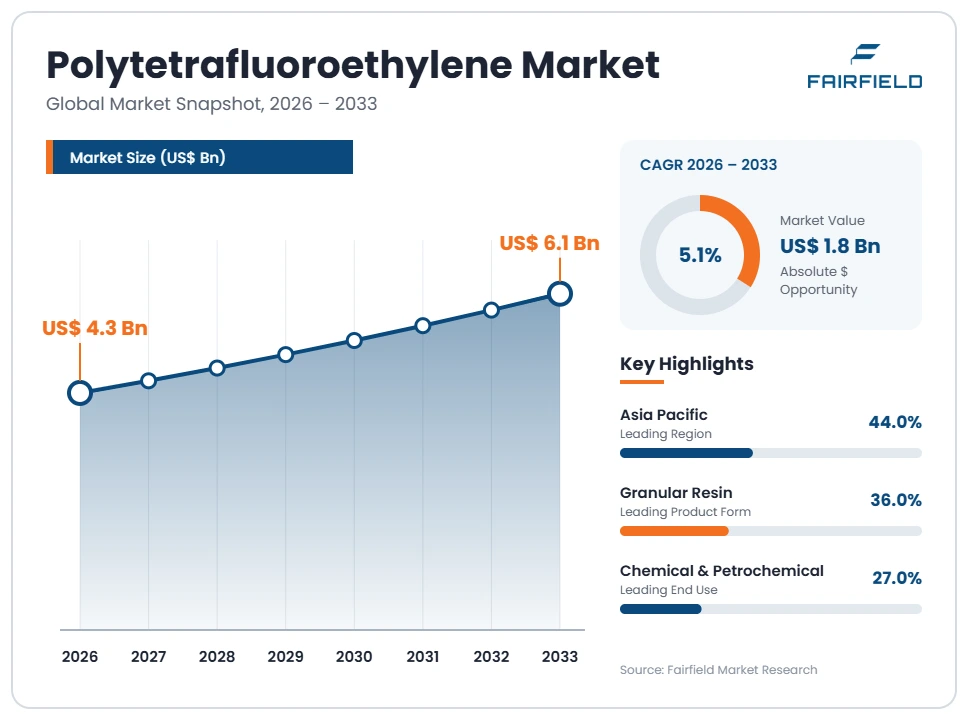
The global Polytetrafluoroethylene market size is expected to be valued at US$ 4.3 billion in 2026 and projected to reach US$ 6.1 billion by 2033, growing at a CAGR of 5.1% between 2026 and 2033.
The market grew at a 3.1% CAGR between 2020 and 2025 to reach US$ 4.1 billion, as industrial demand absorbed a steady retreat from consumer uses. Three factors carry the forecast. Wafer fabrication investment raises consumption of ultrapure linings, tubing and valve components that no other polymer matches. High-frequency electronics and electric vehicle wiring need the dielectric behaviour and thermal stability of the resin. Chemical plant maintenance replaces linings, gaskets and expansion joints on a fixed cycle regardless of the construction market. Working against those, cookware coatings and consumer textiles keep substituting away under retailer and regulatory pressure. The direction is a market splitting in two: applications that cannot replace this fluoropolymer, and applications that quietly already have.
Key Report Takeaways
- By Product Form: Granular resin held 36.0% share in 2026, while micronised powders and additives are projected to expand at a 7.1% CAGR through 2033, as lubricant, ink and coating formulators adopt fine fluoropolymer particles.
- By Application: Chemical processing equipment and linings held 22.5% share in 2026, while semiconductor and electronics is projected to grow at an 8.2% CAGR through 2033, on new wafer fabrication capacity and tighter extractables limits.
- By End Use Industry: Chemical and petrochemical held 27.0% share in 2026, while energy and power is projected to advance at a 7.6% CAGR through 2033, driven by electrolyser stacks and battery manufacturing equipment.
- By Processing Method: Compression moulding held 31.0% share in 2026, while paste extrusion is projected to expand at a 7.3% CAGR through 2033, because thin-wall tubing and high-frequency cable insulation need that route.
- By Geography: Asia Pacific held 44.0% share in 2026, while Middle East & Africa is projected to grow at a 7.4% CAGR through 2033, on petrochemical, chlor-alkali and desalination construction in the Gulf.
Global Polytetrafluoroethylene Market Trends and Insights
Drivers Impact Analysis
Two demand pools account for most of the forecast growth in this fluoropolymer.
| Driver | Impact on CAGR Forecast | Geographic Relevance | Impact Timeline |
| Absence of any qualified substitute in chemical, sealing and ultrapure duty | High | Global | Long term ≥4 years |
| Wafer fabrication capacity and high-frequency electronics build-out | High | Asia Pacific, North America | Medium term 2–4 years |
No Qualified Substitute Exists for Polytetrafluoroethylene in Aggressive Chemical Service
The single reason this market survives intense scrutiny is that nothing replaces the polymer where it matters. No other material combines near-universal chemical inertness, a service range from cryogenic temperatures to roughly 260°C, low dielectric constant and the lowest friction coefficient of any solid polymer. Chemical plant linings, glass-lined vessel seals, pump and valve components, and expansion joints therefore keep specifying it through every procurement review.
The mechanism is engineering, not loyalty. A reactor handling hot sulphuric, hydrofluoric or nitric acid has no polyolefin or engineering thermoplastic alternative at any price, and metal alternatives corrode. Sealing standards, pressure equipment requirements and plant integrity programmes write material grades into drawings, so a change means requalification, leak testing and recertification. Operators judge the alternative as unplanned downtime, which costs far more than the resin, and keep buying.
Wafer Fabrication and High-Frequency Electronics Lift Polytetrafluoroethylene Consumption
Electronics is the fastest-moving pull on fluoropolymer resin. Each new wafer fabrication plant consumes lined piping, valves, fittings, tanks, wet bench components, tubing and filter housings specified on particle shedding and extractables rather than on price. High-frequency circuit substrates, coaxial cable dielectrics, antenna feeds and aerospace wiring add a second stream that grows with data traffic and radar content.
The cause is physics at higher frequencies. As signals move above several gigahertz, dielectric loss in conventional laminates becomes the limiting factor, and the polymer’s low and stable dielectric constant keeps insertion loss manageable. Semiconductor purity and extractables requirements work the same way, because a few parts per billion of leached metal ruins wafer yield. Industrial policy support for domestic chip manufacturing in several economies underwrites the construction pipeline that converts these properties into orders.
Restraints Impact Analysis
Two constraints weigh on the outlook for this fluoropolymer over the forecast period.
| Restraint | Impact on CAGR Forecast | Geographic Relevance | Impact Timeline |
| Proposed per- and polyfluoroalkyl substance restriction and planning uncertainty | High | Europe, North America | Long term ≥4 years |
| Supply concentration, price volatility and limited end-of-life routes | Medium | Global | Medium term 2–4 years |
The Open PFAS Restriction Question Freezes Polytetrafluoroethylene Design Decisions
Planning uncertainty, rather than any enacted ban, is what currently limits the market. A proposed universal restriction on per- and polyfluoroalkyl substances is under opinion development at the European Chemicals Agency, and the scope question is unresolved. Design engineers postpone new specifications, consumer brands remove fluoropolymer claims pre-emptively, and procurement teams build alternative sourcing plans they may never use.
Two positions are on the record and neither has been settled. Industry associations argue that fluoropolymers meet the criteria for polymers of low concern, being insoluble, non-bioavailable, thermally stable and immobile once manufactured. Regulators and environmental organisations contest that framing, noting that the OECD structural definition places these polymers inside the substance class, and pointing to emissions during manufacture and uncertain end-of-life fate. The outcome will decide which applications continue under derogation.
Supply Concentration and Price Volatility Expose Polytetrafluoroethylene Buyers to Requalification Risk
Buyers face a narrowing supplier base in a material they cannot substitute. Fewer companies remain active in fluoropolymer chemistry, and withdrawals from the sector force customers into requalification programmes lasting months in industrial grades and years in semiconductor and medical grades. Resin prices are high and volatile, moving with fluorspar, hydrofluoric acid, chloroform and electricity costs rather than with downstream demand.
The cost structure explains the volatility. Production requires anhydrous hydrogen fluoride, tight-containment monomer handling and energy-intensive polymerisation and drying, so power prices pass straight through. Permitting for new fluorochemical capacity has become slow and contested in several jurisdictions. End-of-life adds a further penalty, because the polymer cannot be melt-processed by conventional equipment, mechanical recycling is limited to regrind and micronising, and high-temperature destruction outlets are scarce and costly.
Market Opportunities
Electrolyser, Battery and Hydrogen Equipment Open Fresh Polytetrafluoroethylene Revenue Pools
Clean energy equipment manufacturing is the clearest untapped revenue pool for fluoropolymer resin. Water electrolysis stacks use the polymer in gaskets, frames, membrane reinforcement and gas-liquid separation hardware under conditions that destroy conventional elastomers. Lithium battery production uses it as an electrode binder, particularly in dry-electrode processing, and as lining material for electrolyte handling, drying ovens and solvent recovery systems.
Resin producers with fine powder and dispersion grades, plus the application engineering needed to support binder development work, are best placed to capture this pool. Demand comes from cell manufacturers, electrolyser stack integrators and the specialist equipment builders who supply them, rather than from end consumers. National hydrogen strategies and battery manufacturing incentives underwrite the construction pipeline, while dry-electrode processing moves fluoropolymer from a coating additive to a structural component of the finished cell itself.
Reclaimed and Reprocessed Polytetrafluoroethylene Builds a Secondary Materials Business
Recovered material is becoming a saleable product rather than a disposal problem. Machining scrap, skiving offcuts, rejected mouldings and end-of-life components can be cleaned, irradiated and ground into micronised powders and reprocessed compounds that sell into lubricants, greases, inks, coatings and filled bearing grades. The pool is meaningful because conversion yields in ram extrusion and skiving generate substantial offcut volume.
Micronising specialists and independent compounders are best placed to capture it, selling to lubricant blenders, printing ink houses, coating formulators and bearing makers who need particle performance rather than virgin resin certification. Customer demand comes from procurement teams working under corporate circularity targets and from formulators seeking price relief from volatile virgin material. Rising disposal costs and limited high-temperature incineration capacity make recovery economically attractive well before any regulation requires it.
Segment Analysis
- By Product Form: Granular Resin Leads the Base While Micronised Powders Set the Pace
Granular resin held 36.0% of the polytetrafluoroethylene market in 2026, the largest form because suspension polymerisation feeds compression moulding and ram extrusion, the routes that make billets, sheet, rod and machined parts for sealing and chemical service. Micronised powders and additives grow fastest at a 7.1% CAGR to 2033, as lubricant blenders, printing ink formulators and coating makers adopt fine particles for friction and abrasion control. Fine powder for paste extrusion, aqueous dispersions for coating and impregnation, and filled and modified compounds complete the structure, with filled grades carrying the highest value per tonne because glass, carbon, bronze and graphite loadings solve creep and wear problems that virgin resin cannot. The commercial implication is that value increasingly sits in formulation and particle engineering rather than in base polymerisation capacity.
- By Application: Chemical Processing Linings Hold the Base While Semiconductor Use Accelerates
Chemical processing equipment and linings accounted for 22.5% of demand in 2026, the leading application because vessel and pipe linings, bellows, diaphragms and pump components consume heavy section weight and are replaced on maintenance cycles. Semiconductor and electronics is the fastest-expanding application at an 8.2% CAGR through 2033, driven by ultrapure fluid handling, wet process hardware and high-frequency circuit materials. Seals and gaskets, wire and cable insulation, automotive components, cookware and bakeware coatings, textiles and architectural membrane, medical devices and lubricant additives complete the picture. Cookware coatings remain a large outlet but face the most direct substitution pressure, since ceramic and sol-gel alternatives are adequate for a frying pan even though they would fail in a reactor. The implication is clear: growth and volume now sit in different applications.
- By End Use Industry: Chemical and Petrochemical Dominates While Energy and Power Gains Ground
Chemical and petrochemical led end use with 27.0% share in 2026, reflecting the breadth of lining, sealing and fluid handling duty across refineries, acid plants, chlor-alkali units, fertiliser complexes and pharmaceutical intermediates production. Energy and power is the fastest-growing industry at a 7.6% CAGR through 2033, pulled by electrolyser components, fuel cell hardware, battery manufacturing and transmission cable insulation. Electrical and electronics remains the second-largest consumer, while automotive and transportation, building and construction, consumer goods and healthcare make up the balance. Consumer goods is the one industry where volumes decline in several markets as brands reformulate cookware and textile finishes. The business implication is that industrial breadth cushions the market, because no single regulatory action aimed at a consumer-facing use threatens more than a modest slice of total consumption.
- By Processing Method: Compression Moulding Leads While Paste Extrusion Expands Fastest
Compression moulding held 31.0% share in 2026, the dominant route because the polymer’s extreme melt viscosity rules out conventional injection moulding, so preforming and sintering remain the standard way to make billets and near-net shapes. Paste extrusion grows fastest at a 7.3% CAGR to 2033, because thin-wall tubing, catheter liners, wire and cable insulation, and unsintered tape all depend on fine powder mixed with a lubricant and extruded below the melting point. Ram extrusion, isostatic moulding, dispersion coating and skiving complete the set, with isostatic moulding gaining in complex lined components and skiving supplying film and gasket stock. The underlying insight is that processing capability, not resin access, decides who serves which application, which is why converters defend their positions through accumulated process control.
Geography Analysis
- North America Buys Polytetrafluoroethylene for Semiconductor and Chemical Plant Duty
North America held 24.0% of polytetrafluoroethylene demand in 2026, with the United States accounting for the overwhelming majority. The regional profile is unusually high-value: new wafer fabrication plants in Texas, Arizona, Ohio and New York buy ultrapure linings, tubing and wet process hardware, while Gulf Coast chemical and refining complexes consume lining, sealing and expansion joint volume on maintenance cycles. Aerospace and defence wiring adds a steady specialty stream. The region is also where regulatory pressure is most fragmented, since individual states have enacted restrictions on intentionally added per- and polyfluoroalkyl substances in consumer products, with different scopes and exemption lists. The main change shaping the region is domestic resin supply security, as buyers weigh the consequences of a narrowing producer base.
- Europe Combines Demanding Process Industries With an Unresolved Regulatory Question
Europe accounted for 22.0% of consumption in 2026, led by Germany, Italy, France and the Netherlands. Demand is concentrated in chemical and pharmaceutical process plant, sealing for pressure equipment, semiconductor and automotive electronics, and architectural membrane. The regional situation is distinctive because the jurisdiction with the most demanding process industries is also assessing the broadest restriction proposal on this chemistry. Buyers are documenting their use cases in detail, since any derogation process places the burden on the user to show that no alternative performs. Consumer-facing demand has already fallen as retailers remove fluoropolymer finishes from cookware and apparel. The decisive variable is the restriction outcome, which will determine whether industrial sealing and lining uses continue on long-term derogation.
- Which Region Is Leading the Polytetrafluoroethylene Market?
Asia Pacific leads the polytetrafluoroethylene market with 44.0% share in 2026, a position built on both production and consumption. China holds the largest installed resin capacity and the broadest converter base, supplying granular, fine powder and dispersion grades at scale and exporting heavily. Japan and South Korea supply high-specification grades and ultrapure converted components for wafer fabrication, display manufacturing and medical devices. Taiwan adds foundry demand for lined piping and wet process hardware. Domestic chemical, chlor-alkali and fertiliser construction sustains lining and sealing volume across the region, while cable and electronics assembly consumes insulation grades. The clearest regional change is quality convergence, as local producers move from commodity granular resin into dispersion, fine powder and filled compound grades that previously came from abroad.
- Latin America Consumes Polytetrafluoroethylene Mainly Through Industrial Maintenance
Latin America represented 5.0% of fluoropolymer resin demand in 2026, concentrated in Brazil and Mexico, with Argentina, Chile and Colombia adding smaller volumes. Consumption is weighted toward maintenance rather than new construction: gaskets, packing, lined pipe spools and pump components for refining, petrochemical, pulp and paper, mining and fertiliser plants. Mexican demand includes automotive wiring, seals and appliance coatings tied to export manufacturing. Barriers are structural, including near-total dependence on imported resin, currency exposure on dollar-priced material, long replenishment lead times and a thin local compounding base. Enforcement of industrial safety and emissions requirements is uneven, which slows upgrades that would otherwise specify better materials. The clearest opportunity is in refinery and chemical plant turnarounds, where sealing and lining specifications are set well before shutdown.
- Which Geography Is Growing Fastest in the Polytetrafluoroethylene Market?
Middle East & Africa is the fastest-growing geography at a 7.4% CAGR between 2026 and 2033, expanding from a 5.0% share in 2026 held mainly by Saudi Arabia, the United Arab Emirates and Qatar, with South Africa, Egypt and Algeria adding industrial volume. Demand follows capital projects: refineries, crackers, ammonia and urea complexes, chlor-alkali plants and desalination trains all specify lined pipe, gaskets, valve seats and expansion joints for hot, chloride-rich and acidic service. High ambient temperature and aggressive brine conditions favour fluoropolymer over cheaper alternatives in these duties. Barriers include complete reliance on imported resin and converted parts, limited local fabrication and technical service, and project payment cycles that stretch orders. The clearest pull is the downstream diversification programmes underway in the Gulf, where material specifications are written at the front-end engineering stage and lock in demand for a decade.
Competitive Landscape
The polytetrafluoroethylene market is moderately concentrated and becoming less so at the commodity end while staying tight at the specialty end. A small group of integrated fluorochemical producers in North America, Europe, Japan and India supplies most high-specification resin, backed by captive hydrogen fluoride and monomer capacity. Chinese producers now hold the majority of global installed capacity and compete aggressively in granular and dispersion grades, which has compressed commodity pricing. Below the resin layer sits a large, fragmented population of compounders, machinists, lining fabricators and tape converters that captures much of the end-user value. Consolidation pressure runs in one direction only: fewer companies are choosing to stay in fluoropolymer chemistry, and the sector has seen withdrawals driven by liability exposure and permitting difficulty rather than by weak demand.
Competition is decided on consistency, documentation and technical service rather than on the polymer itself. Buyers test molecular weight distribution, particle size, thermal stability, extractables and lot-to-lot repeatability, and in regulated applications they weigh the supplier’s regulatory data package as heavily as the data sheet. Food contact clearances for coatings, semiconductor extractables qualification and pressure equipment documentation all determine whether a grade can be designed in at all. New entrants have come almost entirely from integrated producers in Asia Pacific moving from commodity resin into fine powder, dispersion and filled compound grades.
Strategic activity concentrates on securing fluorspar and hydrogen fluoride supply, on converting fluorosurfactant-free polymerisation into a documented sales argument, on moving downstream into compounds and finished components, and on building the emissions and exposure data that regulators and customers now request. Several suppliers are developing non-fluorinated options in parallel for consumer-facing uses.
Strategic direction centres on three themes: defending applications where substitution is impossible, documenting essential use for regulatory processes, and capturing margin further down the chain.
Polytetrafluoroethylene Industry Leaders
The Chemours Company
Daikin Industries
AGC Inc.
Gujarat Fluorochemicals
Shandong Dongyue Group
Recent Industry Developments
- January 2006: The United States Environmental Protection Agency launched a global stewardship programme under which participating fluoropolymer manufacturers committed to eliminate long-chain fluorosurfactant emissions and residual product content by 2015 – this began the manufacturing-side transition away from legacy polymerisation aids that now defines how the resin is made.
- May 2019: The Conference of the Parties to the Stockholm Convention listed perfluorooctanoic acid, its salts and related compounds in Annex A for elimination – it converted a voluntary industry transition into a binding international obligation and closed off any return to legacy processing aids.
- February 2023: The European Chemicals Agency published the universal restriction proposal on per- and polyfluoroalkyl substances submitted by authorities from five European countries – the subsequent opinion-development process is the single largest source of planning uncertainty for resin producers and their customers.
- October 2023: The United States Environmental Protection Agency finalised reporting and recordkeeping requirements for per- and polyfluoroalkyl substances under the Toxic Substances Control Act – it obliges manufacturers and importers to compile historical production, use and exposure data, raising compliance cost across the chain.
Companies Covered in the Report
The Chemours Company
Daikin Industries
AGC Inc.
Gujarat Fluorochemicals
Shandong Dongyue Group
Zhejiang Juhua Co.
Shanghai 3F New Materials
Yeu Ming Tai Chemical Industrial
HaloPolymer
Saint-Gobain Performance Plastics
Chukoh Chemical Industries
Zeus Company
Shamrock Technologies
Micro Powders Inc.
Polytetrafluoroethylene Market Report Scope
| Metric | Value |
| Study Period | 2020–2033 |
| Market Size 2026 | US$ 4.3 Billion |
| Market Size 2033 | US$ 6.1 Billion |
| CAGR 2026–2033 | 5.1% |
| Absolute Dollar Opportunity | US$ 1.8 Billion |
| Largest Market | Asia Pacific (44.0% share, 2026) |
| Fastest-Growing Market | Middle East & Africa (7.4% CAGR, 2026–2033) |
| Market Concentration | Medium |
| Major Players | The Chemours Company, Daikin Industries, AGC Inc., Gujarat Fluorochemicals, Shandong Dongyue Group |
Polytetrafluoroethylene Market Segmentation
- Executive Summary
- Global Polytetrafluoroethylene Market Snapshot
- Future Projections, 2026-2033
- Key Market Trends
- Regional Snapshot
- Market Overview
- Market Definition and Scope
- Historical Market Trends, 2020-2025
- Market Dynamics
- Drivers Impact Analysis
- No Qualified Substitute Exists for Polytetrafluoroethylene in Aggressive Chemical Service
- Wafer Fabrication and High-Frequency Electronics Lift Polytetrafluoroethylene Consumption
- Restraints Impact Analysis
- The Open PFAS Restriction Question Freezes Polytetrafluoroethylene Design Decisions
- Supply Concentration and Price Volatility Expose Polytetrafluoroethylene Buyers to Requalification Risk
- Market Opportunities
- Electrolyser, Battery and Hydrogen Equipment Open Fresh Polytetrafluoroethylene Revenue Pools
- Reclaimed and Reprocessed Polytetrafluoroethylene Builds a Secondary Materials Business
- Drivers Impact Analysis
- Global Polytetrafluoroethylene Market Outlook, 2020-2033
- Global Polytetrafluoroethylene Market Outlook, by Product Form, Value (US$ Billion), 2020-2033
- Granular Resin
- Fine Powder
- Aqueous Dispersions
- Micronised Powders and Additives
- Filled and Modified Compounds
- Global Polytetrafluoroethylene Market Outlook, by Application, Value (US$ Billion), 2020-2033
- Chemical Processing Equipment and Linings
- Seals and Gaskets
- Wire and Cable Insulation
- Semiconductor and Electronics
- Automotive Components
- Cookware and Bakeware Coatings
- Textiles and Architectural Membrane
- Medical Devices
- Lubricant Additives
- Global Polytetrafluoroethylene Market Outlook, by End Use Industry, Value (US$ Billion), 2020-2033
- Chemical and Petrochemical
- Electrical and Electronics
- Automotive and Transportation
- Energy and Power
- Building and Construction
- Consumer Goods
- Healthcare
- Global Polytetrafluoroethylene Market Outlook, by Processing Method, Value (US$ Billion), 2020-2033
- Compression Moulding
- Ram Extrusion
- Paste Extrusion
- Isostatic Moulding
- Dispersion Coating
- Skiving
- Global Polytetrafluoroethylene Market Outlook, by Region, Value (US$ Billion), 2020-2033
- North America
- Europe
- Asia Pacific
- Latin America
- Middle East & Africa
- Global Polytetrafluoroethylene Market Outlook, by Product Form, Value (US$ Billion), 2020-2033
- North America Polytetrafluoroethylene Market Outlook, 2020-2033
- North America Polytetrafluoroethylene Market Outlook, by Product Form, Value (US$ Billion), 2020-2033
- Granular Resin
- Fine Powder
- Aqueous Dispersions
- Micronised Powders and Additives
- Filled and Modified Compounds
- North America Polytetrafluoroethylene Market Outlook, by Application, Value (US$ Billion), 2020-2033
- Chemical Processing Equipment and Linings
- Seals and Gaskets
- Wire and Cable Insulation
- Semiconductor and Electronics
- Automotive Components
- Cookware and Bakeware Coatings
- Textiles and Architectural Membrane
- Medical Devices
- Lubricant Additives
- North America Polytetrafluoroethylene Market Outlook, by End Use Industry, Value (US$ Billion), 2020-2033
- Chemical and Petrochemical
- Electrical and Electronics
- Automotive and Transportation
- Energy and Power
- Building and Construction
- Consumer Goods
- Healthcare
- North America Polytetrafluoroethylene Market Outlook, by Processing Method, Value (US$ Billion), 2020-2033
- Compression Moulding
- Ram Extrusion
- Paste Extrusion
- Isostatic Moulding
- Dispersion Coating
- Skiving
- North America Polytetrafluoroethylene Market Outlook, by Country, Value (US$ Billion), 2020-2033
- United States Polytetrafluoroethylene Market Outlook, by Product Form, 2020-2033
- United States Polytetrafluoroethylene Market Outlook, by Application, 2020-2033
- United States Polytetrafluoroethylene Market Outlook, by End Use Industry, 2020-2033
- United States Polytetrafluoroethylene Market Outlook, by Processing Method, 2020-2033
- North America Polytetrafluoroethylene Market Outlook, by Product Form, Value (US$ Billion), 2020-2033
- Europe Polytetrafluoroethylene Market Outlook, 2020-2033
- Europe Polytetrafluoroethylene Market Outlook, by Product Form, Value (US$ Billion), 2020-2033
- Granular Resin
- Fine Powder
- Aqueous Dispersions
- Micronised Powders and Additives
- Filled and Modified Compounds
- Europe Polytetrafluoroethylene Market Outlook, by Application, Value (US$ Billion), 2020-2033
- Chemical Processing Equipment and Linings
- Seals and Gaskets
- Wire and Cable Insulation
- Semiconductor and Electronics
- Automotive Components
- Cookware and Bakeware Coatings
- Textiles and Architectural Membrane
- Medical Devices
- Lubricant Additives
- Europe Polytetrafluoroethylene Market Outlook, by End Use Industry, Value (US$ Billion), 2020-2033
- Chemical and Petrochemical
- Electrical and Electronics
- Automotive and Transportation
- Energy and Power
- Building and Construction
- Consumer Goods
- Healthcare
- Europe Polytetrafluoroethylene Market Outlook, by Processing Method, Value (US$ Billion), 2020-2033
- Compression Moulding
- Ram Extrusion
- Paste Extrusion
- Isostatic Moulding
- Dispersion Coating
- Skiving
- Europe Polytetrafluoroethylene Market Outlook, by Country, Value (US$ Billion), 2020-2033
- Germany Polytetrafluoroethylene Market Outlook, by Product Form, 2020-2033
- Germany Polytetrafluoroethylene Market Outlook, by Application, 2020-2033
- Germany Polytetrafluoroethylene Market Outlook, by End Use Industry, 2020-2033
- Germany Polytetrafluoroethylene Market Outlook, by Processing Method, 2020-2033
- Italy Polytetrafluoroethylene Market Outlook, by Product Form, 2020-2033
- Italy Polytetrafluoroethylene Market Outlook, by Application, 2020-2033
- Italy Polytetrafluoroethylene Market Outlook, by End Use Industry, 2020-2033
- Italy Polytetrafluoroethylene Market Outlook, by Processing Method, 2020-2033
- France Polytetrafluoroethylene Market Outlook, by Product Form, 2020-2033
- France Polytetrafluoroethylene Market Outlook, by Application, 2020-2033
- France Polytetrafluoroethylene Market Outlook, by End Use Industry, 2020-2033
- France Polytetrafluoroethylene Market Outlook, by Processing Method, 2020-2033
- Netherlands Polytetrafluoroethylene Market Outlook, by Product Form, 2020-2033
- Netherlands Polytetrafluoroethylene Market Outlook, by Application, 2020-2033
- Netherlands Polytetrafluoroethylene Market Outlook, by End Use Industry, 2020-2033
- Netherlands Polytetrafluoroethylene Market Outlook, by Processing Method, 2020-2033
- Europe Polytetrafluoroethylene Market Outlook, by Product Form, Value (US$ Billion), 2020-2033
- Asia Pacific Polytetrafluoroethylene Market Outlook, 2020-2033
- Asia Pacific Polytetrafluoroethylene Market Outlook, by Product Form, Value (US$ Billion), 2020-2033
- Granular Resin
- Fine Powder
- Aqueous Dispersions
- Micronised Powders and Additives
- Filled and Modified Compounds
- Asia Pacific Polytetrafluoroethylene Market Outlook, by Application, Value (US$ Billion), 2020-2033
- Chemical Processing Equipment and Linings
- Seals and Gaskets
- Wire and Cable Insulation
- Semiconductor and Electronics
- Automotive Components
- Cookware and Bakeware Coatings
- Textiles and Architectural Membrane
- Medical Devices
- Lubricant Additives
- Asia Pacific Polytetrafluoroethylene Market Outlook, by End Use Industry, Value (US$ Billion), 2020-2033
- Chemical and Petrochemical
- Electrical and Electronics
- Automotive and Transportation
- Energy and Power
- Building and Construction
- Consumer Goods
- Healthcare
- Asia Pacific Polytetrafluoroethylene Market Outlook, by Processing Method, Value (US$ Billion), 2020-2033
- Compression Moulding
- Ram Extrusion
- Paste Extrusion
- Isostatic Moulding
- Dispersion Coating
- Skiving
- Asia Pacific Polytetrafluoroethylene Market Outlook, by Country, Value (US$ Billion), 2020-2033
- China Polytetrafluoroethylene Market Outlook, by Product Form, 2020-2033
- China Polytetrafluoroethylene Market Outlook, by Application, 2020-2033
- China Polytetrafluoroethylene Market Outlook, by End Use Industry, 2020-2033
- China Polytetrafluoroethylene Market Outlook, by Processing Method, 2020-2033
- Japan Polytetrafluoroethylene Market Outlook, by Product Form, 2020-2033
- Japan Polytetrafluoroethylene Market Outlook, by Application, 2020-2033
- Japan Polytetrafluoroethylene Market Outlook, by End Use Industry, 2020-2033
- Japan Polytetrafluoroethylene Market Outlook, by Processing Method, 2020-2033
- South Korea Polytetrafluoroethylene Market Outlook, by Product Form, 2020-2033
- South Korea Polytetrafluoroethylene Market Outlook, by Application, 2020-2033
- South Korea Polytetrafluoroethylene Market Outlook, by End Use Industry, 2020-2033
- South Korea Polytetrafluoroethylene Market Outlook, by Processing Method, 2020-2033
- Taiwan Polytetrafluoroethylene Market Outlook, by Product Form, 2020-2033
- Taiwan Polytetrafluoroethylene Market Outlook, by Application, 2020-2033
- Taiwan Polytetrafluoroethylene Market Outlook, by End Use Industry, 2020-2033
- Taiwan Polytetrafluoroethylene Market Outlook, by Processing Method, 2020-2033
- Asia Pacific Polytetrafluoroethylene Market Outlook, by Product Form, Value (US$ Billion), 2020-2033
- Latin America Polytetrafluoroethylene Market Outlook, 2020-2033
- Latin America Polytetrafluoroethylene Market Outlook, by Product Form, Value (US$ Billion), 2020-2033
- Granular Resin
- Fine Powder
- Aqueous Dispersions
- Micronised Powders and Additives
- Filled and Modified Compounds
- Latin America Polytetrafluoroethylene Market Outlook, by Application, Value (US$ Billion), 2020-2033
- Chemical Processing Equipment and Linings
- Seals and Gaskets
- Wire and Cable Insulation
- Semiconductor and Electronics
- Automotive Components
- Cookware and Bakeware Coatings
- Textiles and Architectural Membrane
- Medical Devices
- Lubricant Additives
- Latin America Polytetrafluoroethylene Market Outlook, by End Use Industry, Value (US$ Billion), 2020-2033
- Chemical and Petrochemical
- Electrical and Electronics
- Automotive and Transportation
- Energy and Power
- Building and Construction
- Consumer Goods
- Healthcare
- Latin America Polytetrafluoroethylene Market Outlook, by Processing Method, Value (US$ Billion), 2020-2033
- Compression Moulding
- Ram Extrusion
- Paste Extrusion
- Isostatic Moulding
- Dispersion Coating
- Skiving
- Latin America Polytetrafluoroethylene Market Outlook, by Country, Value (US$ Billion), 2020-2033
- Brazil Polytetrafluoroethylene Market Outlook, by Product Form, 2020-2033
- Brazil Polytetrafluoroethylene Market Outlook, by Application, 2020-2033
- Brazil Polytetrafluoroethylene Market Outlook, by End Use Industry, 2020-2033
- Brazil Polytetrafluoroethylene Market Outlook, by Processing Method, 2020-2033
- Mexico Polytetrafluoroethylene Market Outlook, by Product Form, 2020-2033
- Mexico Polytetrafluoroethylene Market Outlook, by Application, 2020-2033
- Mexico Polytetrafluoroethylene Market Outlook, by End Use Industry, 2020-2033
- Mexico Polytetrafluoroethylene Market Outlook, by Processing Method, 2020-2033
- Argentina Polytetrafluoroethylene Market Outlook, by Product Form, 2020-2033
- Argentina Polytetrafluoroethylene Market Outlook, by Application, 2020-2033
- Argentina Polytetrafluoroethylene Market Outlook, by End Use Industry, 2020-2033
- Argentina Polytetrafluoroethylene Market Outlook, by Processing Method, 2020-2033
- Chile Polytetrafluoroethylene Market Outlook, by Product Form, 2020-2033
- Chile Polytetrafluoroethylene Market Outlook, by Application, 2020-2033
- Chile Polytetrafluoroethylene Market Outlook, by End Use Industry, 2020-2033
- Chile Polytetrafluoroethylene Market Outlook, by Processing Method, 2020-2033
- Colombia Polytetrafluoroethylene Market Outlook, by Product Form, 2020-2033
- Colombia Polytetrafluoroethylene Market Outlook, by Application, 2020-2033
- Colombia Polytetrafluoroethylene Market Outlook, by End Use Industry, 2020-2033
- Colombia Polytetrafluoroethylene Market Outlook, by Processing Method, 2020-2033
- Latin America Polytetrafluoroethylene Market Outlook, by Product Form, Value (US$ Billion), 2020-2033
- Middle East & Africa Polytetrafluoroethylene Market Outlook, 2020-2033
- Middle East & Africa Polytetrafluoroethylene Market Outlook, by Product Form, Value (US$ Billion), 2020-2033
- Granular Resin
- Fine Powder
- Aqueous Dispersions
- Micronised Powders and Additives
- Filled and Modified Compounds
- Middle East & Africa Polytetrafluoroethylene Market Outlook, by Application, Value (US$ Billion), 2020-2033
- Chemical Processing Equipment and Linings
- Seals and Gaskets
- Wire and Cable Insulation
- Semiconductor and Electronics
- Automotive Components
- Cookware and Bakeware Coatings
- Textiles and Architectural Membrane
- Medical Devices
- Lubricant Additives
- Middle East & Africa Polytetrafluoroethylene Market Outlook, by End Use Industry, Value (US$ Billion), 2020-2033
- Chemical and Petrochemical
- Electrical and Electronics
- Automotive and Transportation
- Energy and Power
- Building and Construction
- Consumer Goods
- Healthcare
- Middle East & Africa Polytetrafluoroethylene Market Outlook, by Processing Method, Value (US$ Billion), 2020-2033
- Compression Moulding
- Ram Extrusion
- Paste Extrusion
- Isostatic Moulding
- Dispersion Coating
- Skiving
- Middle East & Africa Polytetrafluoroethylene Market Outlook, by Country and Subregion, Value (US$ Billion), 2020-2033
- Saudi Arabia Polytetrafluoroethylene Market Outlook, by Product Form, 2020-2033
- Saudi Arabia Polytetrafluoroethylene Market Outlook, by Application, 2020-2033
- Saudi Arabia Polytetrafluoroethylene Market Outlook, by End Use Industry, 2020-2033
- Saudi Arabia Polytetrafluoroethylene Market Outlook, by Processing Method, 2020-2033
- United Arab Emirates Polytetrafluoroethylene Market Outlook, by Product Form, 2020-2033
- United Arab Emirates Polytetrafluoroethylene Market Outlook, by Application, 2020-2033
- United Arab Emirates Polytetrafluoroethylene Market Outlook, by End Use Industry, 2020-2033
- United Arab Emirates Polytetrafluoroethylene Market Outlook, by Processing Method, 2020-2033
- Qatar Polytetrafluoroethylene Market Outlook, by Product Form, 2020-2033
- Qatar Polytetrafluoroethylene Market Outlook, by Application, 2020-2033
- Qatar Polytetrafluoroethylene Market Outlook, by End Use Industry, 2020-2033
- Qatar Polytetrafluoroethylene Market Outlook, by Processing Method, 2020-2033
- South Africa Polytetrafluoroethylene Market Outlook, by Product Form, 2020-2033
- South Africa Polytetrafluoroethylene Market Outlook, by Application, 2020-2033
- South Africa Polytetrafluoroethylene Market Outlook, by End Use Industry, 2020-2033
- South Africa Polytetrafluoroethylene Market Outlook, by Processing Method, 2020-2033
- Egypt Polytetrafluoroethylene Market Outlook, by Product Form, 2020-2033
- Egypt Polytetrafluoroethylene Market Outlook, by Application, 2020-2033
- Egypt Polytetrafluoroethylene Market Outlook, by End Use Industry, 2020-2033
- Egypt Polytetrafluoroethylene Market Outlook, by Processing Method, 2020-2033
- Algeria Polytetrafluoroethylene Market Outlook, by Product Form, 2020-2033
- Algeria Polytetrafluoroethylene Market Outlook, by Application, 2020-2033
- Algeria Polytetrafluoroethylene Market Outlook, by End Use Industry, 2020-2033
- Algeria Polytetrafluoroethylene Market Outlook, by Processing Method, 2020-2033
- Gulf Polytetrafluoroethylene Market Outlook, by Product Form, 2020-2033
- Gulf Polytetrafluoroethylene Market Outlook, by Application, 2020-2033
- Gulf Polytetrafluoroethylene Market Outlook, by End Use Industry, 2020-2033
- Gulf Polytetrafluoroethylene Market Outlook, by Processing Method, 2020-2033
- Middle East & Africa Polytetrafluoroethylene Market Outlook, by Product Form, Value (US$ Billion), 2020-2033
- Competitive Landscape
- Industry Leaders
- Recent Industry Developments
- Company Profiles
- The Chemours Company
- Daikin Industries
- AGC Inc.
- Gujarat Fluorochemicals
- Shandong Dongyue Group
- Zhejiang Juhua Co.
- Shanghai 3F New Materials
- Yeu Ming Tai Chemical Industrial
- HaloPolymer
- Saint-Gobain Performance Plastics
- Chukoh Chemical Industries
- Zeus Company
- Shamrock Technologies
- Micro Powders Inc.
- Appendix
- Research Methodology
- Report Assumptions
- Acronyms and Abbreviations
Product Form
- Granular Resin
- Fine Powder
- Aqueous Dispersions
- Micronised Powders and Additives
- Filled and Modified Compounds
Application
- Chemical Processing Equipment and Linings
- Seals and Gaskets
- Wire and Cable Insulation
- Semiconductor and Electronics
- Automotive Components
- Cookware and Bakeware Coatings
- Textiles and Architectural Membrane
- Medical Devices
- Lubricant Additives
End Use Industry
- Chemical and Petrochemical
- Electrical and Electronics
- Automotive and Transportation
- Energy and Power
- Building and Construction
- Consumer Goods
- Healthcare
Processing Method
- Compression Moulding
- Ram Extrusion
- Paste Extrusion
- Isostatic Moulding
- Dispersion Coating
- Skiving
Regions
- North America
- Europe
- Asia Pacific
- Latin America
- Middle East & Africa
Our Research Methodology
Considering the volatility of business today, traditional approaches to strategizing a game plan can be unfruitful if not detrimental. True ambiguity is no way to determine a forecast. A myriad of predetermined factors must be accounted for such as the degree of risk involved, the magnitude of circumstances, as well as conditions or consequences that are not known or unpredictable. To circumvent binary views that cast uncertainty, the application of market research intelligence to strategically posture, move, and enable actionable outcomes is necessary.
View Methodology
Quality Assured
Rigorous Validation Process

Confidentiality Assured
End-to-end Data Security

Custom Research Services
Tailored To Your Objectives
FAQs
The market is valued at US$ 4.3 billion in 2026, counting resin, dispersions, micronised powders, compounds and semi-finished forms sold by resin producers.
The market is projected to reach US$ 6.1 billion by 2033, growing at a 5.1% CAGR and adding US$ 1.8 billion in absolute dollar opportunity.
Granular resin leads with 36.0% share in 2026, because suspension-polymerised material feeds compression moulding and ram extrusion for sealing and chemical service parts.
Semiconductor and electronics grows fastest at an 8.2% CAGR, driven by ultrapure fluid handling hardware and high-frequency circuit materials in new fabrication plants.
Asia Pacific leads with 44.0% share in 2026, and concentration is medium, with integrated producers holding specialty grades and fragmented converters below them.
Related Reports
Plastic Resins Market
The plastic resins market is forecast to rise from US$655.0 billion in 2026 to US$805.0 billion by 2033, growing at a 3.0% CAGR.
Detergent Chemicals Market Size, Share, Insights, Competitive Landscape, and Forecast 2026 to 2033
The detergent chemicals market is forecast to grow from US$ 72.0 billion in 2026 to US$ 99.3 billion by 2033 at a 4.7% CAGR.
Aviation Carbon Fiber Market Size, Share, Insights, Competitive Landscape, and Forecast 2026 to 2033
The aviation carbon fiber market is forecast to reach US$ 5.10 billion by 2033 from US$ 2.65 billion in 2026, growing at a 9.8% CAGR.
Transportation Composites Market Size, Share, Insights, Competitive Landscape, and Forecast 2026 to 2033
The global transportation composites market is valued at US$48.6 billion in 2026, reaching US$78.5 billion by 2033, growing at a 7.1% CAGR
Tamper Evident Packaging Market Size, Share, Insights, Competitive Landscape, and Forecast 2026 to 2033
The global tamper evident packaging market is valued at US$18.5 billion in 2026, reaching US$26.9 billion by 2033, growing at a 5.5% CAGR
Personal Care Ingredients Market Size, Share, Insights, Competitive Landscape, and Forecast 2026 to 2033
The global personal care ingredients market is valued at US$18.6 billion in 2026, reaching US$28.2 billion by 2033, growing at a 6.1% CAGR